An ISO 27001 surveillance audit has no universal price. Start with the certification body’s written scope, calculated audit time and fee schedule, then budget separately for travel, internal preparation and any follow-up work. The worksheet below helps compare proposals without treating an invented dollar or pound range as a market benchmark.
Table of Contents

Copy the annual surveillance budget record.
The comparison fields below are planning inputs, not ISO-set prices. Your actual invoice depends on the number of people within the certified scope, organisational complexity, locations, changes to the ISMS, audit delivery method, the certification body, and whether additional follow-up work is required.
The most useful budgeting approach is therefore not to ask, “What does an ISO 27001 surveillance audit cost?” in isolation. Ask instead: How many audit days will our certification body require this year, what is included in its rate, and what internal work will we need before and after the audit?
8 Essential ISO 27001 Surveillance Budget Checks
These are purchasing and budgeting checks, not additional ISO requirements. They help you evaluate a proposal without treating a generic headcount table or an unsupported market-price range as a quote.
What is an ISO 27001 surveillance audit?
ISO/IEC 27001 certification is not a one-time inspection. The current standard, ISO/IEC 27001:2022, establishes requirements for an information security management system, or ISMS, that has to be maintained and continually improved after certification.
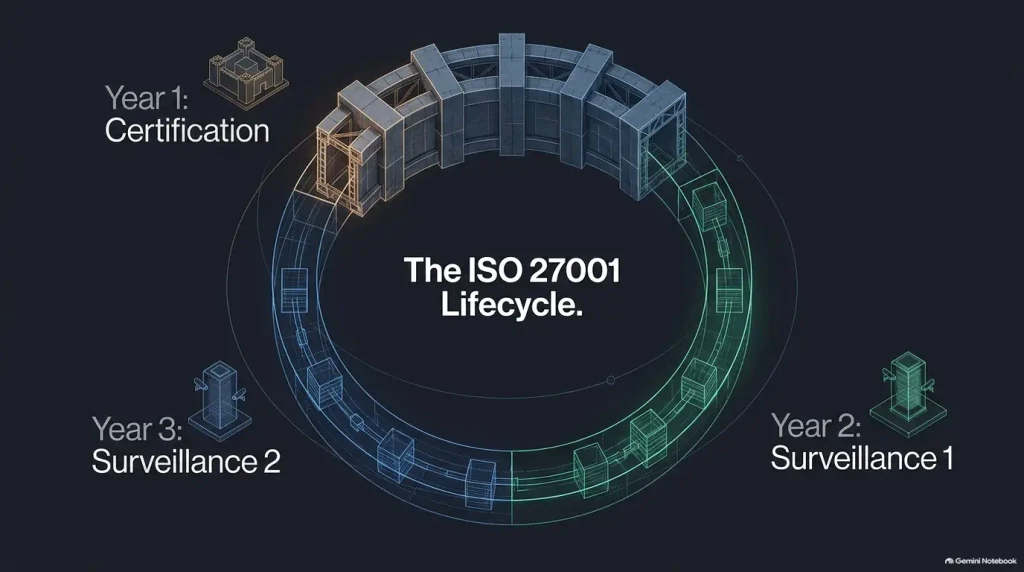
A successful initial certification audit is therefore followed by ongoing surveillance. Certification provider NQA describes certification as valid for three years and maintained through annual surveillance audits, followed by recertification on the three-year cycle.
A surveillance audit is narrower than the initial certification exercise. The auditor generally samples parts of the ISMS rather than repeating every part of Stage 1 and Stage 2 from scratch. The audit still needs enough evidence to establish that the management system remains operational, effective, and responsive to change.
Expect attention to areas such as previous nonconformities, corrective actions, internal audits, management review, information security objectives, risk management, changes to the organisation, selected controls, and evidence that the ISMS is being maintained rather than merely preserved as a collection of documents.
How much does an ISO 27001 surveillance audit cost in 2026?
No ISO document publishes a dollar or pound tariff for surveillance audits. ISO/IEC 27006-1:2024 instead establishes requirements for organisations that audit and certify ISMSs. The ISO/IEC 27006-1:2024 standard overview explains that it supplements ISO/IEC 17021-1 with requirements specific to ISO 27001 certification.
Scroll the table horizontally on small screens. Keyboard users can focus the table region and use the arrow keys.
| Quote input | Record for each provider |
|---|---|
| Scope and cycle | Certified scope, locations, personnel basis, changes since the last audit, and the surveillance visit being quoted. |
| Audit effort | Calculated auditor-days, rate, remote/on-site split, preparation/reporting included, and the rationale for adjustments. |
| External cash | Audit fee, travel basis, administrative fees, applicable tax and any separately charged follow-up. |
| Internal capacity | Evidence preparation, interviews, internal audit, management review and corrective-action work, with named owners. |
| Currency and terms | USD or GBP as quoted, tax treatment, quote expiry, payment schedule, rescheduling and cancellation conditions. |
| Uncertainty | Unpriced items, scope-change conditions, follow-up day rates and the person responsible for confirmation. |
Compare like-for-like proposals within a currency. A converted USD price is not a UK market quote; an amount excluding VAT is not the same cash total as an amount including it.
A planning worksheet should not be treated as a quote. A 20-person SaaS company with one tightly defined product scope and mature documentation can be a very different audit from a 20-person company operating several regulated platforms across multiple locations.
The same warning applies to comparisons between the US and UK. A US dollar estimate cannot simply be converted into pounds and presented as a UK market price. Certification-body rates, taxes, travel arrangements, auditor availability, and accreditation markets differ.
The real surveillance audit budget has more than one line
The auditor’s invoice is only the visible tip of the spreadsheet. A sensible surveillance budget separates at least five possible cost categories.
- Certification-body audit fee: auditor time, technical review, reporting, and whatever certification administration the quotation includes.
- Travel and expenses: potentially relevant when auditors or technical specialists attend a physical site.
- Internal staff time: evidence preparation, interviews, management review, internal audit, risk updates, and coordination.
- Corrective action: engineering, policy, process, or documentation work required before or after the audit.
- Optional outside support: consultants, outsourced internal auditors, compliance platforms, specialist security testing, or legal and privacy support where genuinely required.
This distinction matters because reducing the certification body’s fee by $1,000 does not necessarily reduce the total cost by $1,000. A disorganised audit can consume expensive engineering, security, HR, legal, and management time even when the auditor’s invoice looks modest.
Worked Budget: Separate External Cash From Internal Capacity
Fictional arithmetic example, not a market quote: assume a provider proposes two auditor-days at $1,500 per day, including its stated reporting work. The example also assumes $400 of separate administration, $300 of travel, and a $600 allowance for possible follow-up. These invented inputs demonstrate the method only; they are not US pricing evidence or a recommendation about how many days any organization needs.
| Line | Calculation | Budget treatment |
|---|---|---|
| Audit fee | 2 × $1,500 = $3,000 | External cash; do not add the same fixed fee again. |
| Administration and travel | $400 + $300 = $700 | External cash assumptions requiring quote confirmation. |
| Possible follow-up | $600 allowance | Planning allowance, not a confirmed invoice or a guaranteed cap. |
| Planned external cash | $3,000 + $700 + $600 = $4,300 | Before any applicable tax and before the separate reserve below. |
| Internal preparation capacity | 24 hours × $60 = $1,440 | Allocated internal resource cost; not automatically additional payroll cash. |
| Resource envelope | $4,300 + $1,440 = $5,740 | External budget plus allocated internal capacity, before reserve and tax. |
| Optional planning reserve | 10% × $4,300 = $430 | Separately chosen buffer; not an ISO requirement or a predicted charge. |
With that chosen reserve, the external planning envelope is $4,730 before applicable tax. Including the allocated staff capacity gives $6,170. Those totals describe this fictional model, not the likely cost of a real audit. If follow-up is unnecessary, the $600 allowance need not become a cost; if remediation is substantial, that allowance may be insufficient.
Keep the difference between committed fees, estimates, allowances, and actual invoices visible. Do not add $1,440 to the cash forecast merely because employees have been assigned to preparation. Additional paid overtime, contractors, or backfill would be separate cash items if actually expected. Conversely, paid staff time still has an opportunity cost even when the cash salary budget does not change.
For a UK proposal, rebuild the same categories from a GBP quote and its stated tax treatment. Do not convert this fictional USD example and label the result a UK market estimate. If the business needs both an invoice cash forecast and a net cost view, have finance record them distinctly using the actual quote and applicable accounting treatment.
What determines the certification body’s price?
1. People within the ISMS scope
Headcount matters because audit time has to be sufficient for the scale of the management system being sampled. The relevant population is not always identical to the total number printed on the company’s LinkedIn page or payroll report.
Employees, contractors, distributed teams, and other personnel may affect the calculation depending on how they participate in activities covered by the ISMS. Give certification bodies an accurate and consistent description when requesting competing quotations.
2. The boundaries of your certified scope
A certificate covering one SaaS service, one legal entity, and a defined set of supporting teams is not equivalent to an enterprise-wide scope containing several products, offices, infrastructure environments, and business units.
A narrower scope can reduce audit effort when that scope truthfully reflects the security assurance customers actually need. Artificially carving essential processes out simply to save audit money is another matter: the boundary still has to make operational sense and withstand auditor scrutiny.
3. Sites and organisational structure
Multiple physical locations can increase audit planning, sampling, travel, and coordination. Acquisitions, reorganisations, new offices, outsourcing arrangements, and major staffing changes can also alter the audit picture between certification and surveillance.
4. Security and operational complexity
Two companies with similar headcounts can still require materially different audit effort. Data sensitivity, technical architecture, outsourcing, customer obligations, regulatory exposure, and the complexity of business processes all influence the work required to obtain reasonable audit evidence.
New technology can quietly expand this complexity. For example, unmanaged generative-AI tools, AI meeting assistants, browser extensions, and employee accounts can create new information flows that were not considered during the original certification. The Kioptrix guide to AI shadow IT risk provides a useful companion checklist for identifying those less obvious changes before audit week.
5. Findings from previous audits
An organisation that arrives with previous findings properly closed, current evidence available, and clearly assigned responsibilities generally creates a cleaner audit process than one still reconstructing what happened six months earlier.
Additional review can also arise when corrective-action evidence has to be submitted and assessed. Ask explicitly whether follow-up review for nonconformities is included in the quoted fee or charged separately.
6. Remote versus on-site work
Remote audit activity may reduce travel and accommodation expenses where it is appropriate and accepted by the certification body. It does not automatically reduce the required professional audit effort. The auditor still needs sufficient evidence, interviews, document review, and sampling to reach a defensible conclusion.
Do not automatically use “one-third of the initial audit” as your budget
Audit-time ratios are not invoice formulas. If a certification body uses a relationship between initial-certification time and surveillance time, ask it to explain the current requirements, baseline, adjustments, and resulting auditor-days for your organization. Do not infer a universal fee percentage from an audit-time relationship.
The current ISMS certification-body standard is ISO/IEC 27006-1:2024. Your certification body should calculate the appropriate audit duration for your circumstances. Even where audit time is significantly shorter than the initial audit, your invoice will not necessarily be exactly one-third of the original invoice because travel, administration, minimum engagement structures, specialist involvement, and scope changes can affect the commercial total.
The better question is simple: “How many audit days have you calculated for this surveillance audit, and what changed that calculation from our initial certification?”
What can make surveillance more expensive than expected?
- A significant increase in people covered by the ISMS.
- A new product, legal entity, office, data centre, or geographic region entering scope.
- Major architecture or cloud-platform changes.
- Material outsourcing or new critical suppliers.
- Unclosed findings from the previous audit.
- Poorly maintained risk assessments or Statement of Applicability records.
- Missing internal-audit or management-review evidence.
- Extra auditor travel or specialist expertise.
- Adding related standards or extending the certification scope.
- Having to reconstruct evidence shortly before the audit instead of maintaining it continuously.
Customer pressure can also expose gaps indirectly. A large buyer may ask questions about incident response, testing, encryption, access control, business continuity, or suppliers long before your surveillance auditor arrives. Keeping a disciplined evidence library for a customer security questionnaire can therefore reduce duplicated work between sales assurance and ISO surveillance.
Penetration testing is a separate cost
Do not assume the ISO surveillance fee includes penetration testing, vulnerability scanning, cloud security reviews, or other technical security work. A certification auditor evaluates the management system and samples evidence; the auditor is not being hired to become your penetration-testing provider.
If penetration testing forms part of your risk treatment, customer commitment, contractual obligation, or established security programme, budget for it separately. The Kioptrix breakdown of penetration testing cost explains the main pricing variables, while the comparison of penetration testing versus vulnerability scanning helps distinguish continuous automated checking from a deeper human-led assessment.
The money-saving lesson here is not to buy every security service before surveillance. It is to know which tests your own risk assessment, Statement of Applicability, customers, contracts, and internal security programme actually require, then preserve credible evidence that those activities occurred and findings were handled.
How to reduce surveillance costs without weakening the ISMS
Keep the scope accurate before asking for quotes
Send each prospective certification body the same scope statement, personnel information, locations, and relevant organisational details. Otherwise you are comparing different audits disguised as different prices.
Maintain evidence throughout the year
Surveillance becomes expensive internally when the organisation spends two frantic weeks rediscovering twelve months of activity. Keep internal audit records, management-review outputs, risk decisions, access reviews, incident records, supplier reviews, security metrics, corrective actions, and control evidence current as part of normal operations.
Close previous findings early
Do not wait for the next auditor to remind you about the last auditor. Track each corrective action to completion, retain evidence of the correction, and check whether the underlying cause rather than only the visible symptom was addressed.
Tell the certification body about major changes before audit week
If headcount doubled, a company was acquired, the certified service moved to another cloud architecture, or the ISMS scope expanded, disclose that during audit planning. Surprises tend to be poor cost-control tools.
Ask for the entire certification-cycle cost
When choosing or renewing a certification body, request the projected structure for initial certification or recertification, subsequent surveillance audits, administrative fees, travel rules, and likely follow-up charges. A low first invoice can be less interesting once the full cycle is visible.
US and UK buyers should verify accreditation separately
ISO itself recommends evaluating several certification bodies and checking whether the body is appropriately accredited. Accreditation is distinct from ISO certification: the accreditation body evaluates the competence of the certification body, while the certification body audits the company seeking ISO 27001 certification.
In the United States, ANAB publishes information on its ISO/IEC 27001 accreditation programme and provides access to its directory of accredited management-system certification bodies.
In the United Kingdom, buyers can use the UKAS directory of accredited organisations and UKAS CertCheck to verify relevant accreditation and management-system certification claims.
This check is especially worthwhile when ISO certification is being purchased because a customer, tender, investor, insurer, or supply-chain programme specifically expects accredited certification. Do not rely solely on a provider’s logo wall or the word “international” in its marketing copy.
A Cheaper Headline Fee Can Produce a Higher Total
Second fictional example: assume two eligible proposals have been checked for the same scope, audit effort, delivery, and required outputs. The amounts below are invented, expressed in the same currency, and shown before applicable tax. They are not observed provider prices.
| Comparable item | Proposal A | Proposal B |
|---|---|---|
| Headline audit fee | $3,000 | $2,600 |
| Reporting | Included | $400 |
| Administration | Included | $300 |
| Travel assumption | $250 | $200 |
| Comparable stated total | $3,250 | $3,500 |
Proposal B has a headline fee $400 lower, yet its comparable stated total is $250 higher. That arithmetic still does not settle the purchase. Check accreditation, audit-time rationale, competence for the service, scheduling, deliverables, follow-up terms, and excluded charges. A missing follow-up price is unknown, not zero.
This comparison only works after the scope and outputs match. One auditor-day is not automatically equivalent to two, a scope extension is not the same visit as routine surveillance, and a consultant’s readiness review is not a certification-body surveillance audit. Ask the provider to resolve those differences before placing totals next to one another.
Questions to ask before accepting a surveillance audit quote
- What exact ISO/IEC 27001 scope is this quotation based on?
- What personnel count did you use for the audit-time calculation?
- How many surveillance audit days are included?
- Has the audit duration changed since initial certification, and why?
- Is the certification body accredited for ISO/IEC 27001 certification?
- Are report preparation and technical review included?
- Are certificate administration or maintenance fees separate?
- Will the audit be remote, on site, or hybrid?
- Are travel and expenses included?
- Could a technical specialist create an additional charge?
- How is review of corrective-action evidence billed?
- What happens to the fee if headcount, sites, or scope change?
- What are the cancellation and rescheduling terms?
- For UK quotes, is VAT included or additional?
- What should we budget for surveillance and recertification across the entire cycle?
Make the Unpriced Assumptions Reviewable
A budget can look precise while its largest uncertainties remain in email. Separate each uncertain item from the approved base and assign someone to resolve it. “Travel included” should identify what is included; “follow-up extra” should identify the pricing basis; “scope unchanged” should be checked against the actual organization rather than copied from last year.
Use three classifications in your working notes: confirmed quoted amount, internal estimate or allowance, and unresolved item. Do not fill a blank with zero simply to finish the spreadsheet. Record when the provider or internal owner must respond and how the answer will change the total. If the quote expires before purchasing approval, refresh it rather than assuming the same commercial terms remain available.
Review shared funding before adding security work. An already approved penetration test might support several assurance activities, but that does not make it included in the surveillance invoice or justify charging the same purchase twice to the annual cash plan. Identify the funded item, scope, evidence period, and budget owner. New testing or remediation should have its own reason and estimate.
Keep the preparation plan attached to actual records. For example, an access-review owner may need to complete an overdue review, while an ISMS coordinator needs to assemble existing management-review outputs. Those are different tasks with different capacity needs. A folder of old evidence is not a substitute for performing the work represented by it.
If the Statement of Applicability has changed, link the affected controls, risk decisions, and treatment actions before estimating remediation. The ISO 27001 SoA guide helps distinguish necessary controls from their implementation status. Budget owners should see unresolved gaps rather than a single optimistic “audit readiness” percentage.
A simple way to build your surveillance budget
Instead of placing a single “ISO audit” number in the annual budget, use this model:
Annual ISO 27001 maintenance budget = certification-body surveillance fee + travel/expenses + internal preparation time + remediation + required security testing + optional specialist support.
Keep the categories separate. That makes it much easier to explain why a year became more expensive and to identify which costs are controllable.
For example, moving an audit partly online may affect travel costs. Tightening a genuinely overbroad certification scope may affect audit effort. Better evidence management may reduce staff disruption. None of those changes eliminates the need to operate an effective ISMS.
Copy an annual surveillance budget record
Provider / accreditation verification / proposal reference:
Quote date / expiry / currency / tax basis:
Certified scope and visit / changes disclosed:
Audit days / rate / remote and on-site allocation:
Quoted audit fee (A):
Travel, administration and other external fees (B):
Separately priced testing, support and follow-up (C):
Expected external cash = A + B + C:
Internal preparation and remediation hours:
Approved allocation rate / allocated capacity cost (D):
Resource envelope = A + B + C + D:
Reserve and assumptions shown separately:
Year-two / recertification items excluded from this visit:
Items already funded elsewhere / overlap removed:
Unknown charges / confirmation owner / due date:
Leave unknown charges blank and flag them for confirmation. An allocated staff cost describes resource use; it is not automatically extra payroll cash. If a fixed quoted audit fee is provided, do not add auditor-days × rate again.
ISO 27001 Surveillance Audit Cost FAQ
Can headcount alone give us a reliable surveillance price?
No. Personnel information is one input. Scope, complexity, sites, changes, audit-time calculation, delivery, and the provider’s commercial terms also matter. Obtain a current scoped quote rather than using a headcount price table as a commitment.
Should internal staff time be added to the invoice cash budget?
Track staff capacity separately. An allocation based on existing salaried hours is not automatically new payroll spending. Add actual expected overtime, contractor, or backfill cash separately and avoid double counting.
Does a remote audit guarantee a smaller audit fee?
No. It may reduce travel where appropriate, but the certification body must still determine adequate audit effort. Confirm the accepted delivery method, auditor-days, and commercial price instead of assuming remote means fewer days.
Does paying for remediation guarantee a successful audit?
No. Budget approval and completed spending do not establish effective implementation or conformity. The organization needs appropriate operating evidence, and the certification body makes its assessment and certification decisions through its process.
Approve a Budget You Can Explain
For planning, request the provider’s calculated auditor-days and rate in a current scoped quote. The comparison fields above identify the information needed; they do not establish a market price or a headcount tariff.
But the headline price is less important than the machinery underneath it. ISO 27001 surveillance cost is driven by audit time, scope, people, complexity, sites, organisational change, and the certification body’s commercial rate. Internal preparation and remediation can add just as much budget pressure as the audit invoice itself.
Before approving a quote, verify the certification body’s accreditation, make sure competing providers are quoting the same scope, request the calculated audit days, identify every additional fee, and look at the full three-year certification cycle. That turns surveillance from an annual invoice surprise into a predictable part of running the ISMS.
Editorial review: November 16, 2026. Added fictional cash-and-capacity calculations, a like-for-like quote comparison, assumption handling, and FAQ. Removed leftover references to absent price ranges and clarified that an audit-time relationship is not an invoice formula. All new amounts are invented teaching inputs. No certification-body quote, market-price survey, or assessment was obtained for this article.
Earlier technical correction: October 13, 2026. Relabeled unsupported surveillance-price ranges as hypothetical budgeting inputs and removed unverified market and headcount claims.