PCI DSS ecommerce security software can cost anything from a few hundred dollars per year for basic compliance tooling to custom enterprise contracts for payment-page monitoring, client-side protection, and audit evidence. The catch is that products sold under the broad label of “PCI security software” often solve very different parts of the problem.
Table of Contents
Copy the comparable-quote and annual-cost record.
Published price examples checked on November 16, 2026 show that a small merchant can find basic PCI compliance services starting around $399 per year, while mainstream web application firewall plans may cost roughly $10 to $250 per month. Dedicated PCI DSS 4.0.1 payment-page security platforms, however, frequently use quote-based pricing rather than publishing a fixed monthly fee.
The most useful way to budget is therefore not to ask, “How much does PCI software cost?” but, “Which PCI controls does my ecommerce architecture still require me to operate?” A hosted checkout, a WooCommerce store, and a custom payment application can have dramatically different security scopes.
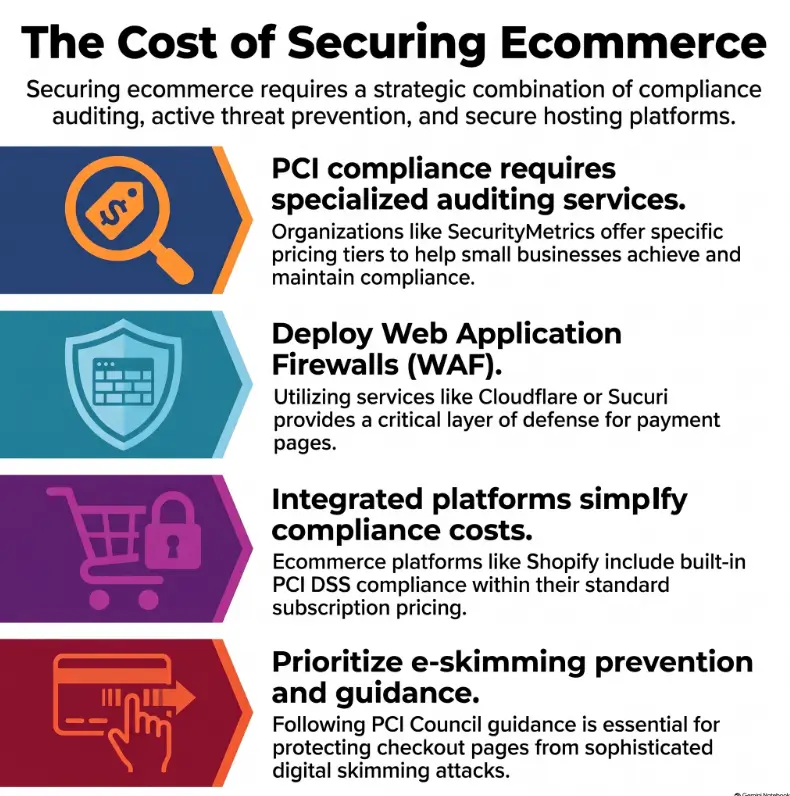
8 Essential Checks Before Pricing PCI DSS Ecommerce Software
These are purchasing prompts, not additional PCI requirements or an endorsement of the products named below. A public entry price is useful only when its scope and commercial conditions match the service you intend to buy.
PCI DSS ecommerce software pricing at a glance
| Security layer | Published pricing example | What it generally covers |
|---|---|---|
| Basic PCI compliance portal | SecurityMetrics from $399/year | SAQ workflow, external vulnerability scanning, reporting and related compliance tools |
| Website firewall | Sucuri from $9.99/month | WAF, traffic filtering, DDoS protection and website security features |
| General WAF/CDN security | Cloudflare Pro $20/month annually; Business $200/month annually | WAF, DDoS protection, managed rules and broader application security features |
| Hosted ecommerce platform | Shopify Basic $29/month annually (US USD rate) | Hosted ecommerce infrastructure with PCI-compliant payment environment |
| Dedicated payment-page script monitoring | Quote-based options; some public entry plans (see below) | Script inventory, authorization, integrity monitoring, tamper detection and PCI evidence |
These USD amounts are dated vendor list-price examples, not a market average, merchant quote or set of interchangeable packages. Annual-billing monthly equivalents require the corresponding annual commitment; taxes, payment processing, add-ons and implementation may be additional. A $9.99 firewall plan is not equivalent to a dedicated payment-page security platform, and neither automatically replaces your merchant validation obligations.
Translate Monthly Headlines Into the Actual Annual Basis
The following arithmetic uses public USD prices checked on November 16, 2026. It compares billing bases, not equivalent security coverage. Taxes, add-ons, processing, usage charges, setup, and other commercial conditions are not included unless explicitly stated.
| Published example | Annual basis | Important limitation |
|---|---|---|
| SecurityMetrics small-business PCI service | From $399/year | Entry package and its stated limits; confirm the actual merchant offer. |
| Sucuri Basic Firewall at $9.99/month | $119.88 for 12 months at that unchanged rate | Arithmetic annualization, not a separately verified annual contract price; one-site firewall service. |
| Cloudflare Pro | $240/year at $20/month billed annually; $300 over 12 months at $25/month | Different billing commitments; neither is a quote for a dedicated payment-page monitoring stack. |
| Source Defense displayed Essentials configuration | $1,176/year at the displayed $98/month annual-billing equivalent | Record solution selection, domains, payment pages, traffic and retention before treating it as your price. |
| Shopify Basic US annual-billing rate | $348/year at the displayed $29/month equivalent | Hosted ecommerce platform, not a like-for-like standalone security tool; payment and other charges can be separate. |
A monthly equivalent is not a promise that you can buy one month at that rate and cancel. Retain the actual billing term, commitment, selected configuration, renewal basis, and quote or order summary. A first-year offer also should not silently become the renewal assumption.
For current source details, see SecurityMetrics small-business pricing, Sucuri Firewall, Cloudflare plans, Source Defense pricing, and Shopify pricing. Confirm the displayed market, currency, billing term, and chosen products when requesting an offer.
Why PCI DSS 4.0.1 changed the ecommerce software budget
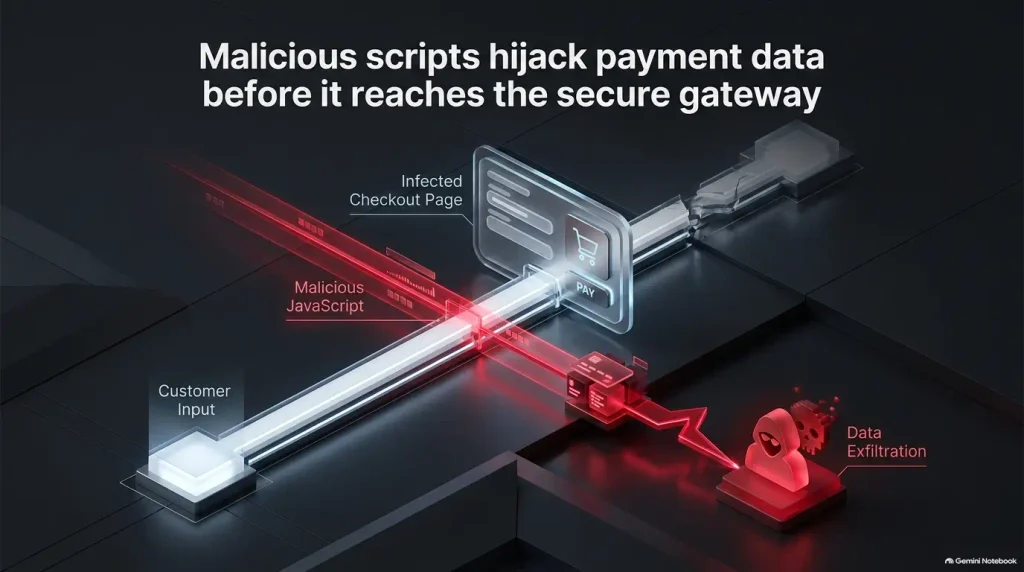
The current PCI DSS framework places particular attention on browser-side payment-page security. The PCI Security Standards Council explains that Requirements 6.4.3 and 11.6.1 address risks from scripts running in payment pages and unauthorized changes that can enable ecommerce skimming.
Requirement 6.4.3 focuses on managing payment-page scripts. Organizations may need to confirm that scripts are authorized, assure their integrity, and maintain an inventory with justification for why each script is necessary.
Requirement 11.6.1 addresses change and tamper detection for payment pages and security-impacting HTTP headers. These controls became effective on March 31, 2025, which is why many PCI-oriented security vendors now sell dedicated client-side monitoring products in addition to traditional firewalls and vulnerability scanners.
SAQ A r1 no longer reports 6.4.3 and 11.6.1 as standalone requirements; its script-attack eligibility criterion applies to embedded provider forms, with provider confirmation or suitable protective techniques as possible routes. Redirect-only and fully outsourced payment-link flows are excluded from that particular criterion. Confirm the applicable validation route before budgeting a dedicated monitor. This distinction matters when comparing prices. A conventional WAF mainly evaluates traffic reaching a web application. Modern ecommerce skimming attacks can instead occur inside the shopper’s browser through compromised or unauthorized JavaScript. That creates a second security layer that may require its own monitoring and evidence.
1. Basic PCI compliance software: about $399 per year and up
For smaller merchants, the least expensive commercial option may be a PCI compliance portal combining a Self-Assessment Questionnaire, vulnerability scanning and reporting.
On November 16, 2026, SecurityMetrics advertised its small-business PCI service starting at $399 per year. Its published package includes an online PCI SAQ, one external vulnerability scan target, compliance reporting, a compliance certificate, card-data discovery software and security awareness training.
That makes $399 a useful reference point for basic merchant validation tooling, but it should not be mistaken for the total cost of securing a complex ecommerce application.
SecurityMetrics separately offers Shopping Cart Monitor packages aimed at PCI DSS Requirements 6.4.3 and 11.6.1. Those plans use Basic, Plus and Pro tiers, but the vendor currently directs buyers to request a quote rather than publishing the subscription amounts.
2. Website firewall pricing can start below $20 per month
A web application firewall is another common part of an ecommerce security stack. It can help block malicious requests, exploit attempts and unwanted traffic before they reach the store.
On November 16, 2026, Sucuri’s page listed its Basic Firewall at $9.99 per month and its Pro Firewall at $19.98 per month for one site. Its broader security platform starts at $229 per year, with Pro at $339 per year and Business at $549 per year.
Sucuri markets its firewall as supporting PCI security requirements, but merchants should distinguish “helps address PCI controls” from “completes PCI compliance.” PCI DSS covers the wider cardholder-data environment, operational practices, access control, vulnerability management and other controls that no single firewall subscription can satisfy by itself.
If you operate WordPress or WooCommerce, infrastructure choices can also affect how much additional security tooling you need. The site’s WordPress hosting security comparison provides a useful companion framework for comparing security features already included by hosting providers.
3. Cloudflare pricing illustrates why feature names must be checked carefully
On November 16, 2026, Cloudflare’s plans page listed a Free plan, a Pro plan at $20 per month when billed annually or $25 when billed monthly, and a Business plan at $200 per month annually or $250 when billed monthly.
Those plans include various combinations of WAF, DDoS protection, managed security rules and other application-security capabilities. Cloudflare’s Business plan overview advertises PCI compliance support, and its pricing comparison lists PCI DSS 4.0 Compliance for Business and Contract. Verify the exact product scope and required configuration rather than assuming that only a custom Contract tier can support PCI obligations.
This is an important purchasing lesson: do not assume that buying a product from a PCI-compliant provider means every subscription tier supplies every control, report or contractual assurance you need for your own PCI validation.
4. Dedicated payment-page security is commonly quote-based
Dedicated payment-page tools have different pricing models. Some suppliers require a scoped quote; others publish entry tiers. Neither model establishes what your merchant will pay or which controls the selected plan includes.
Reflectiz offers a dedicated PCI Module for Requirements 6.4.3 and 11.6.1, including continuous payment-page script monitoring, iframe and fourth-party script detection, HTTP-header change detection and QSA evidence exports. Its current plans page uses “Get Quote” rather than publishing a fixed price.
Feroot’s PaymentGuard similarly focuses on script inventory, authorization, tamper detection, cardholder-data exfiltration controls and audit evidence. Feroot advertises deployments starting from one website and one payment page, but directs buyers to a demo or sales conversation instead of publishing subscription prices.
Jscrambler also markets a PCI DSS solution built around payment-page script inventory, authorization, behavior monitoring, e-skimming protection and audit-ready reporting. Its public PCI pages direct buyers toward demos and assessments rather than displaying a simple per-site PCI price.
Quote-based pricing does not automatically mean the product is expensive. It usually means the cost can depend on variables such as domains, payment pages, traffic, business units, deployment model, support level and the amount of compliance evidence or professional assistance required.
For a public-price counterexample, Source Defense displayed Essentials from $98 per month and Standard from $197 per month on annual billing on November 16, 2026. Product selections, limits, retention, protection features and bundle options affect the configuration. Ask the supplier to demonstrate the required monitoring, alert delivery and evidence export in your checkout flow rather than treating an entry price as a complete PCI budget.
What actually drives your PCI ecommerce security cost?
The checkout architecture is usually more important than the merchant’s revenue when estimating the software stack.
- Number of payment pages: A single checkout path is easier to monitor than dozens of regional storefronts.
- Third-party JavaScript: Analytics, chat tools, tag managers, personalization platforms and advertising pixels increase the script inventory that must be understood.
- Hosted versus self-hosted checkout: Redirecting customers to a payment provider can reduce the merchant-controlled attack surface compared with directly hosting payment functionality.
- Number of domains: Multi-brand or international retailers may need monitoring across many domains and subdomains.
- Compliance validation method: A small merchant completing an SAQ has a very different cost structure from an organization undergoing a QSA-led assessment.
- Existing security stack: Your CDN, hosting provider, WAF, vulnerability scanner or ecommerce platform may already cover some requirements.
Before adding another subscription, inventory the tools you already pay for. The security tool stack cost calculator can help frame that exercise and expose overlapping subscriptions.
Hosted ecommerce can change the economics completely
For smaller merchants, changing architecture may sometimes reduce PCI complexity more effectively than purchasing another standalone security product.
Shopify states that it is certified as a Level 1 PCI DSS compliant service provider and that stores powered by Shopify are PCI compliant by default. The US USD pricing page checked on November 16, 2026 lists annual-billing monthly equivalents of $29 for Basic, $79 for Grow, and $299 for Advanced. Shopify Plus starts at $2,300 per month.
That does not mean merchants have zero security responsibility. Store administrators still control accounts, applications, integrations and business processes. However, using a hosted platform can shift substantial payment infrastructure responsibility to the platform provider instead of requiring the merchant to assemble every security component independently.
A practical way to build your PCI software budget
Start with architecture rather than vendor names.
- Map the payment flow. Identify whether payment data is redirected, embedded through an iframe, tokenized or handled directly by your systems.
- Confirm your validation path. Determine the relevant SAQ or assessment requirement with your acquiring bank, payment processor or QSA.
- List existing controls. Record your WAF, ASV scanning, vulnerability management, endpoint security, logging, payment provider and client-side monitoring.
- Map the remaining PCI requirements. Do not buy a second tool merely because its landing page mentions PCI DSS.
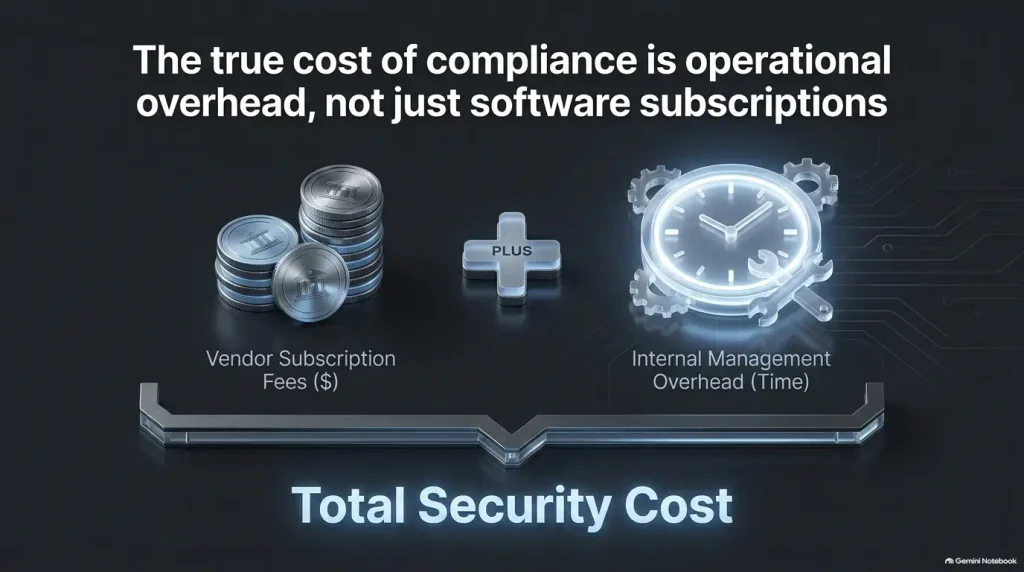
- Price the operational work. Software that costs less but generates hours of weekly manual script review may be more expensive in practice.
- Request comparable quotes. Give each vendor the same number of domains, checkout paths, monthly sessions, environments and support requirements.
Copy a comparable-quote and annual-cost record
Keep every quote in the same currency, billing period and payment-flow scope. A blank amount means unknown, not zero. Separate external cash from internal capacity so allocated staff time is not mistaken for an additional invoice.
Vendor / selected product and tier / quote reference:
Quote date / expiry / currency / tax basis:
Payment flow and validation path confirmed by:
Domains / checkout paths / traffic unit / environments:
Controls included / excluded / existing coverage:
Annual subscription cash (A):
One-time deployment and integration cash (B):
Other required external services and add-ons (C):
Expected first-year external cash = A + B + C:
Internal setup hours / recurring hours per year:
Approved allocation rate / internal capacity cost (D):
First-year resource envelope = A + B + C + D:
Reserve listed separately / assumptions:
Retention / export / alert integration / support limits:
Renewal basis / overage / cancellation terms:
Year-two recurring cash and labor assumptions:
Items unquoted / confirmation owner / due date:
Do not add the full cost of a platform already funded elsewhere without identifying the incremental charge. Avoid double-counting a service included in both a processor package and a separate proposal.
Worked Example: The Lower License Price Can Use More Resources
Fictional budget exercise: assume two proposed tools have first been checked for the same required control support, coverage, and evidence outputs. The numbers below are invented and do not describe any named vendor. They show why you should record external cash and internal capacity separately.
| First-year input | Option A | Option B |
|---|---|---|
| Subscription | $75 × 12 = $900 | $150 × 12 = $1,800 |
| External onboarding | $600 | $100 |
| Other external add-on | $200 | $200 |
| External cash before tax | $1,700 | $2,100 |
| Internal setup at assumed $60/hour | 6 hours = $360 | 2 hours = $120 |
| Recurring work at assumed $60/hour | 1 hour/month × 12 = $720 | 0.25 hour/month × 12 = $180 |
| Allocated internal capacity | $1,080 | $300 |
| First-year resource envelope | $1,700 + $1,080 = $2,780 | $2,100 + $300 = $2,400 |
Option A uses $400 less external cash, while Option B uses $380 less total resource in this fictional model. Neither is automatically the better purchase. A cash-constrained business and a team short of engineering time may value the trade-off differently. Verify real effort through an appropriate trial rather than assuming that a higher-priced tool saves time.
Allocated staff time is not automatically an additional invoice or payroll outflow. Add expected contractors, overtime, or backfill separately when they create new cash spending. Keep setup and recurring work apart: year two may remove one-time onboarding, but can introduce renewal changes, traffic growth, additional domains, or new evidence requirements.
Do not add these fictional amounts to the vendor list-price table as though they were observed implementation costs. The useful output is the model: annual subscription plus external setup and add-ons, with internal setup and recurring capacity shown separately. Reserves, unquoted charges, and tax assumptions should remain visible.
A $200 tool and a $20,000 tool may not be competing products
PCI DSS software comparisons become misleading when every product carrying the word “PCI” is placed in the same table. An ASV scanner, WAF, SAQ portal and browser-side payment-page monitor solve different problems.
A small store with an outsourced hosted checkout may need comparatively little merchant-managed software. A retailer running a customized checkout with dozens of third-party scripts may need dedicated script authorization, tamper monitoring, SIEM integration and assessor-ready reporting.
The cheapest subscription is therefore not necessarily the cheapest PCI strategy. Reducing scope, removing unnecessary scripts and consolidating overlapping controls can sometimes save more than negotiating a lower license price.
Do you also need penetration testing or cyber insurance?
PCI tooling is only one part of an ecommerce security budget. Depending on your environment and assessment requirements, penetration testing, vulnerability management, incident-response preparation and insurance may create separate costs.
If you are estimating those adjacent expenses, see the site’s guide to small-business penetration testing costs. Ecommerce operators comparing financial risk transfer can also review cyber insurance for ecommerce stores.
Evaluate Evidence and Operating Work Before Comparing Totals
Use a controlled evaluation to test the purchasing assumptions. Agree on the exact pages, environments, traffic unit, permissions, and evidence outputs with the supplier before connecting a service. Use provider-permitted synthetic activity and authorized test changes; do not introduce a real malicious script or expose customer account data to make a demonstration more convincing.
First, check coverage. Can the product observe the relevant guest and logged-in routes, embedded form, regional checkout, and other paths in your scoped requirement? A discovery result from a public landing page does not establish coverage of an authenticated payment flow. Record routes the product cannot reach and how those gaps will be handled.
Second, check the workflow. Ask the supplier to demonstrate how a script is identified, assigned a business justification and authorization decision where relevant, and how an approved change is distinguished from an unexpected one. Review alert delivery, the receiving owner, investigation information, and the evidence retained. Detecting an event and stopping an event are different capabilities; identify which one the selected tier provides.
Third, check the output. Export a representative report and confirm that the responsible compliance team or assessor can understand its scope, time period, limitations, and relationship to the control being supported. “Audit-ready” is a vendor description, not confirmation that an assessor has accepted your implementation. Record retention and export limits before depending on a low-price tier.
Finally, measure work. Track setup, tuning, false-positive review, routine approval, reporting, and response tasks during the evaluation. A trial is too short to prove annual labor savings, but it can expose assumptions that need more investigation. Preserve those limits when building the budget.
Questions to ask before buying PCI DSS ecommerce software
- Which exact PCI DSS 4.0.1 requirements does the product help address?
- Does the price include every production domain and payment page?
- Are staging environments charged separately?
- Does it discover scripts automatically?
- Can it maintain script authorization and business justification records?
- Does it detect changes to payment-page content and security-impacting HTTP headers?
- How frequently does monitoring run?
- Does the product generate evidence that your QSA or acquiring bank can use?
- Are implementation, onboarding and professional-services hours extra?
- What happens to pricing when traffic, domains or storefronts increase?
PCI DSS Ecommerce Software Pricing FAQ
Does a PCI compliance portal replace a payment-page monitor?
Not automatically. Compare the actual control functions, covered pages, evidence, and operational responsibilities. An SAQ workflow, an ASV scan, a WAF, and browser-side script monitoring are different services even when one supplier sells several of them.
Does SAQ A always require buying a dedicated script-monitoring tool?
No universal purchase requirement follows from the SAQ name. Check every eligibility condition and the actual integration. The script-related eligibility condition for embedded forms and its permitted confirmation routes must be considered separately from other applicable requirements, including ASV scanning. Confirm the validation route with the accepting entity.
Can we compare tools using only their per-month price?
No. Align the billing commitment, domains, payment pages, traffic units, environments, control functions, retention, support, setup, and recurring work. A cheaper license can produce more cash or staff work elsewhere.
Is a vendor’s PCI claim proof that our store is compliant?
No. Establish what service and controls the claim covers, what configuration is required, and which duties remain with the merchant. Product capability and provider assurance do not replace the store’s applicable validation or evidence that controls operate.
Price the Required Controls and Their Operation
For a small ecommerce business, the visible entry price for PCI-related security software can be only a few hundred dollars per year. SecurityMetrics advertises small-business PCI tooling from $399 annually, while basic website firewall products can start below $20 per month.
That is only the shallow end of the pool. PCI DSS 4.0.1 payment-page requirements have created a specialized category of client-side security tools for script authorization, integrity monitoring and tamper detection, and many leading vendors price those products by quotation.
Before requesting quotes, identify your payment architecture and compliance scope. Then compare vendors against the same set of requirements. That approach turns “PCI DSS software pricing” from a foggy vendor-shopping exercise into a defensible security budget.
- PCI Security Standards Council – Payment Page Security and Preventing E-Skimming Guidance
- SecurityMetrics – PCI Compliance Pricing for Small Businesses
- Cloudflare – Web Application Security and WAF Pricing Plans
- Sucuri – Website Firewall and Security Pricing
- Shopify – Ecommerce Platform Pricing and PCI DSS Compliance
Editorial and public-price review: November 16, 2026. Rechecked the cited public price examples and vendor sales routes; added annual-basis comparisons, a fictional total-resource calculation, an evaluation workflow, and FAQ. Prices are dated public examples, not negotiated quotes or market averages. The two-option calculation is entirely fictional. No hands-on product test, live checkout test, or compliance assessment was performed for this article.
Earlier technical correction: October 13, 2026. Updated US Shopify annual-billing prices, corrected Cloudflare Business PCI support, and clarified SAQ A script-security eligibility.