
Reviewed October 16, 2026. This is an adaptable study template, not a personal exam-success story, a validated no-burnout method or an OffSec requirement. Two hours describes the available session, not the time needed to master a machine.
Choose one learning task, preserve evidence and leave a clear restart note. A working adult may have two hours on some evenings and much less on others. The useful plan fits that reality instead of requiring a complete exploit chain every day. Total hours alone cannot establish readiness or predict a pass.
Start with the Time You Can Actually Protect
Check the coming week for work deadlines, family commitments and recovery time. Plan the sessions that fit rather than borrowing from essential rest. If a two-hour block is unrealistic, shorten it or split a task across sessions. A missed evening is a reason to update the plan, not to add an automatic catch-up marathon.
Keep the Course and Exam Rules Separate from This Template
Use the current OffSec exam guide for requirements. As checked on October 16, 2026, it provides 23 hours 45 minutes for the assessment and a separate 24-hour documentation window. It requires a report with enough steps, commands and evidence for a technically competent reader to reproduce the work. A short weekday lab is not a full rehearsal of that workflow.
The official FAQ describes an open-book exam with specific restrictions, including chatbot/LLM use during the exam and reporting phases. Review current rules before practice that is meant to simulate the exam. A tool used in a course exercise is not automatically permitted in the exam.
Prepare a Repeatable Starting Point
Keep the permitted target, working environment, notes and recovery process ready. Verify addresses and network boundaries before connecting. Retain a clean recovery copy, and record software versions when they matter. Use the platform comparison to resolve a real compatibility or workflow question; installing a different hypervisor is not a prerequisite for useful study.
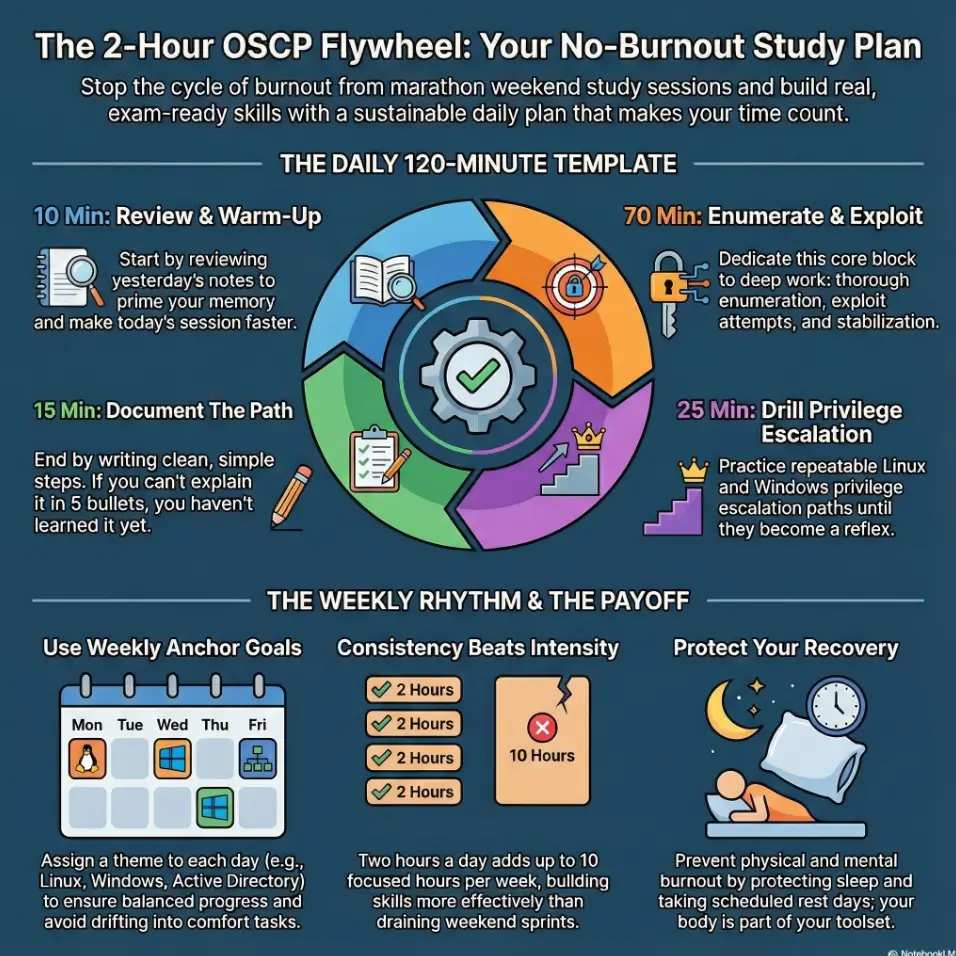
An Illustrative 120-Minute Session
| Minutes | Purpose |
|---|---|
| 0–10 | Read the previous note and define one question. |
| 10–50 | Collect evidence or practice a specific skill. |
| 50–60 | Take a break and check whether the task still fits. |
| 60–100 | Test one justified next step or reproduce the result. |
| 100–120 | Write findings, limits and the next starting action. |
The blocks total 10 + 40 + 10 + 40 + 20 = 120 minutes, including the break. They do not require exploitation or privilege escalation on demand. An evening spent validating one service or writing a reproducible finding can be a complete session. Stop a test when its scope ends, the lab becomes unstable or the evidence answers the question.
Rotate According to Gaps, Not a Fixed Weekday Formula
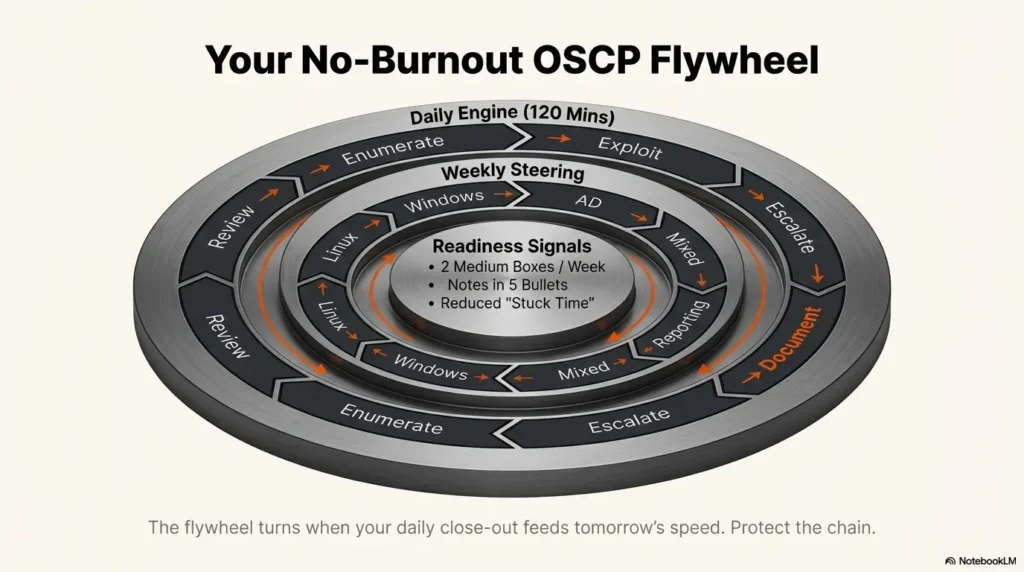
Review your practice evidence across Linux, Windows, identity/Active Directory and reporting. Assign the next task to the least understood part of that record. A possible week might alternate service enumeration, local permissions, an identity relationship and report reproduction, with a review session at the end. It is an editorial example, not the provider’s curriculum or a measured optimal rotation.
Check Whether the Plan Fits This Week
Ask whether the lab works, the task is clear, the required material is available and the schedule leaves room for other obligations. These are planning questions, not exam eligibility rules. A “no” identifies something to change; there is no evidence-based number of failed checklist items that makes a learner unsuitable.
Calculate Scheduled Hours Without Predicting a Score
Hypothetical example: four 120-minute sessions plus one 60-minute review total (4 × 120 + 60) ÷ 60 = 9 scheduled hours. If each longer session includes the 10-minute break above, those breaks account for 40 minutes of that total. Log actual focused work separately. Neither number predicts completion time, skill gain or exam points.
Allow Shorter Sessions and Recovery
A timetable cannot make study burnout-proof. When fatigue or discomfort makes focused practice unrealistic, stop or choose a shorter, manageable task. Avoid treating rest as a failure or turning every missed session into a debt. Persistent symptoms or difficulty coping deserve appropriate support rather than a more aggressive study quota.
Use Rehearsals to Expose Gaps
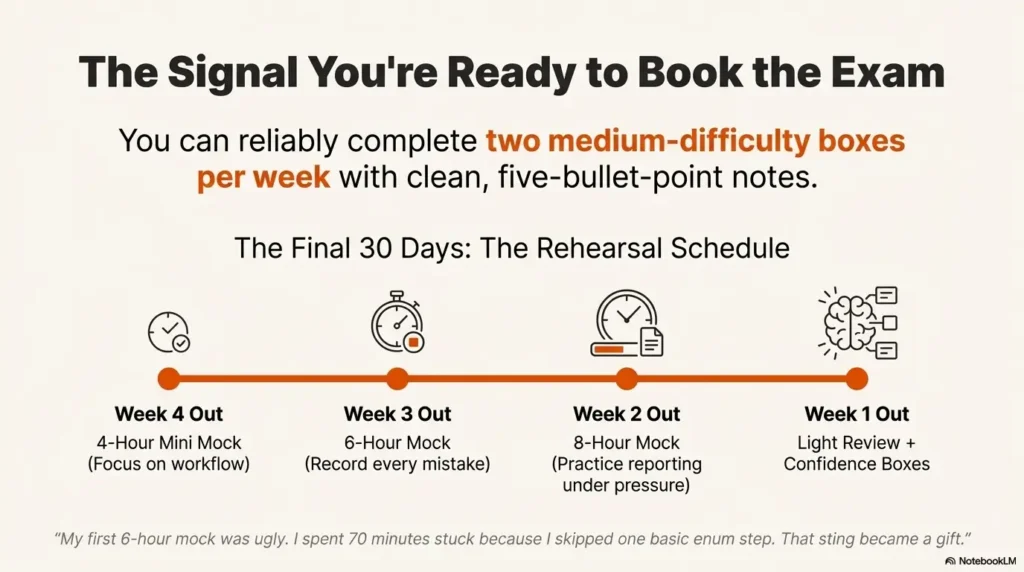
Choose rehearsals that test the workflow you need: independent decisions, evidence capture, reporting and handoff. A four-hour exercise can test part of the process but does not reproduce the full exam. Review what failed and why. Do not book solely because a certain number of weeks or boxes has passed; use demonstrated work, current provider requirements and your practical ability to complete the assessment and report.
Close Each Session with a Reproduction Note
Record scope, starting state, actions, important output, result and uncertainty. Keep original evidence and explain why the next step followed. On another day, reproduce a permitted finding from those notes. The OSCP preparation priorities connect those habits to a broader skills review.
Confirm Costs and Access Before Committing
Check current provider terms for course access, exam booking and retakes. Use your actual currency, taxes and availability rather than an unverified fee table. Include setup and reporting time in the calendar. A study schedule does not justify an expense if the access period or assessment timing does not fit.
Common Planning Questions
Is two hours a day enough?
It can be a useful available block. Required preparation varies; no daily duration guarantees readiness.
Must I study without notes?
Independent reasoning matters, but the exam FAQ permits notes within its rules. Practicing recall can be an optional drill, not an invented exam requirement.
What should I do after a difficult workday?
Choose a realistic smaller task or stop. Preserve a restart note so the next session has a clear beginning.
Plan One Week, Then Review the Evidence
These local checkboxes do not save your calendar or assess readiness. Review the actual work at the end of the week, then keep, shorten or rearrange the next week’s sessions. The purpose is a workable learning process, not a promised completion date.