
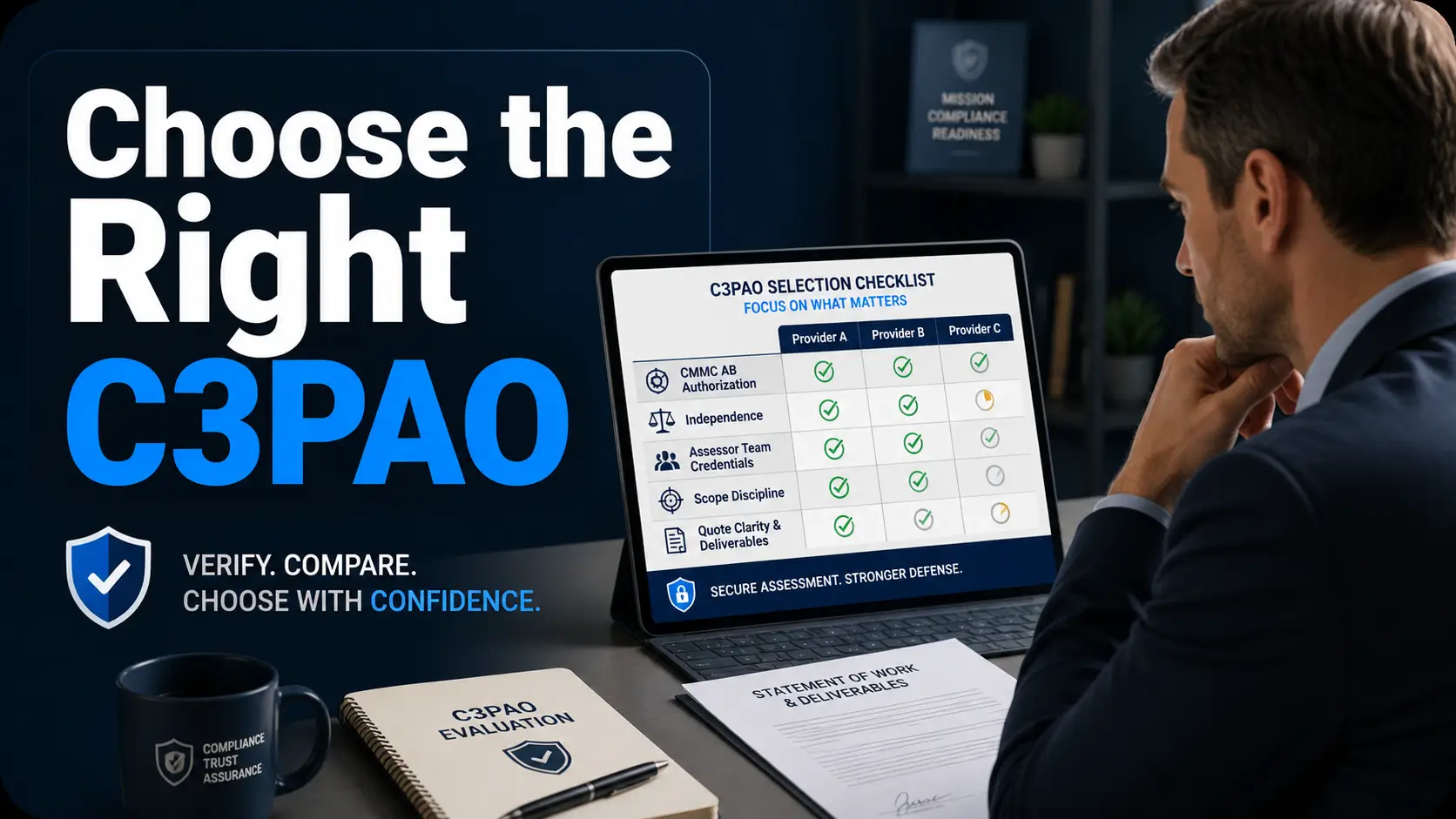
KIOPTRIX • CMMC PROVIDER SELECTION • AUGUST 2026
How to Choose a CMMC C3PAO:
Compare the Assessor Before You Compare the Price
Choosing a CMMC Third-Party Assessment Organization is not the same as hiring an ordinary cybersecurity consultant. You are selecting an independent assessment organization whose authorization, assessor team, conflict-of-interest position, scoping discipline, evidence handling, and contract terms can materially affect the engagement.
The first question in August 2026 is also unusual: do you actually need to buy a C3PAO assessment right now? The Department has suspended the planned CMMC Phase II transition, while Phase I self-assessment requirements remain in place. That makes verification of your current solicitation, contract, subcontract, or amendment the first procurement step.
If a C3PAO engagement still makes sense for your organization, do not pick the provider with the smoothest sales deck. Verify its standing, screen independence, understand who will actually assess you, normalize competing quotes, and make the statement of work describe the real assessment boundary.
Verify the requirement, then buy the assessment. Reversing that order can be an expensive little cart-before-horse problem. 🔐
Snapshot
For: defense contractors and subcontractors comparing CMMC assessment providers. Problem solved: separating legitimate C3PAO selection criteria from sales claims and opaque quotes. Next decision: determine whether you need an external assessment now, then build a defensible shortlist and statement of work.
Table of Contents
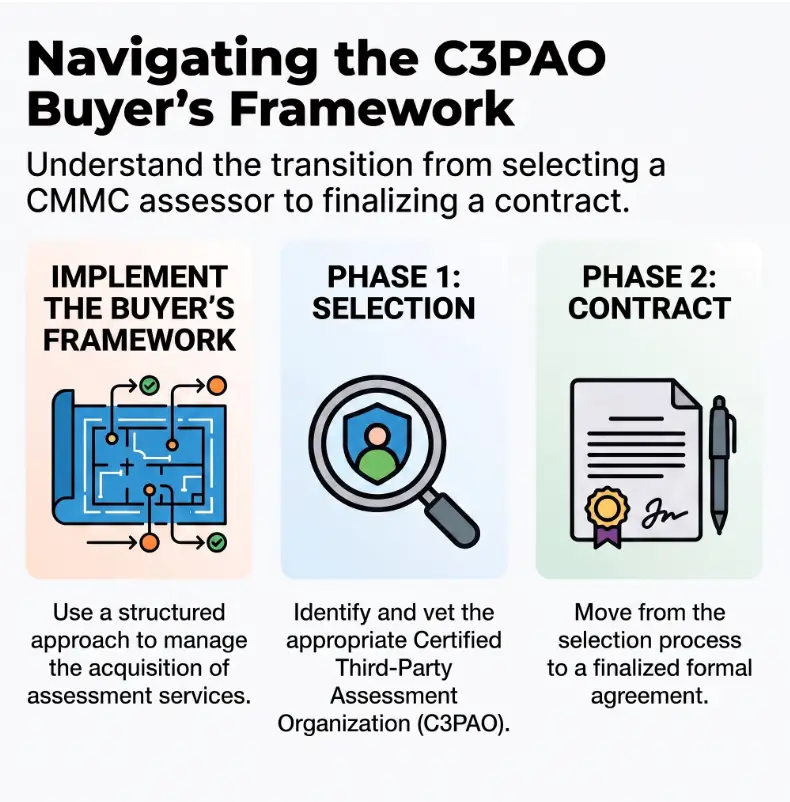
How should you choose a CMMC C3PAO?
Choose a C3PAO in two stages. First, apply non-negotiable eligibility gates. Then compare the providers that survive those gates on assessment quality, scope fit, team competence, contract clarity, evidence security, schedule, and price.
A sensible shortlist process looks like this:
- Confirm that your current contract path actually calls for a C3PAO assessment.
- Verify the organization’s current C3PAO authorization or accreditation status through the official CMMC ecosystem.
- Ask for the named Lead CCA and expected assessment team before signing.
- Disclose prior consultants and screen for conflict-of-interest problems.
- Give each bidder the same assessment-boundary assumptions.
- Require an itemized statement of work with inclusions, exclusions, travel, change-order rules, and post-assessment work.
- Score the finalists on methodology and execution before using price as the tie-breaker.
The federal CMMC rule assigns Level 2 certification assessments to authorized or accredited C3PAOs. The rule also prescribes assessment-team, quality-assurance, reporting, records, ethics, and conflict-of-interest requirements.
Decision rule: C3PAO status is the entry ticket, not the reason to choose a provider. Once authorization is confirmed, the differentiators become independence, people, scope discipline, contract structure, data handling, availability, and commercial clarity.
The answer changes when these six variables change
- Current contractual requirement: self-assessment versus external certification assessment.
- CMMC assessment scope: number and type of systems, locations, users, enclaves, external providers, and specialized assets.
- Evidence maturity: whether your SSP, diagrams, policies, records, and technical artifacts already support assessment.
- Environment complexity: cloud, manufacturing technology, remote sites, external service providers, engineering systems, and unusual data flows.
- Schedule pressure: whether you are planning calmly or trying to meet a procurement milestone.
- Prior consulting relationships: because preparation work can create independence problems for the assessment team.
Before You Act
This guide is a procurement and decision framework, not legal or contractual advice. Confirm the requirement in your actual solicitation, contract, subcontract, modification, and applicable current program guidance. CMMC rules, acquisition implementation, CUI scope, external-provider dependencies, and assessment status can change what is appropriate.
Check the 2026 CMMC status before buying an assessment
This is the most important procurement wrinkle in this article.
On July 13, 2026, the Department announced the immediate suspension of the CMMC Phase II requirements that had been scheduled for November 10, 2026. Current Department guidance states that Phase I remains in place and that the program is paused with Level 1 and Level 2 self-assessment paths operating during the suspension.
The implementation memorandum goes further: during the suspension, requiring activities are directed not to designate Level 2 C3PAO or Level 3 DIBCAC assessments in procurement requirements. It also directs action to remove such requirements from affected active solicitations and, as applicable, existing contracts through amendments or modifications. The underlying DFARS safeguarding obligations remain in force.
What that means for a C3PAO buyer
Do not assume that a C3PAO engagement is currently mandatory merely because your organization handles CUI, because an older roadmap said Phase II would begin in November 2026, or because a vendor proposal describes certification as urgent.
Start with the document that governs your procurement today. If an older solicitation still contains a Level 2 C3PAO requirement, ask the contracting officer or prime contractor whether an amendment has been issued or is pending.
If you are still considering a C3PAO engagement during the suspension, separate two questions:
- What security work remains sensible regardless of the implementation timetable?
- What external assessment spending is actually necessary now?
Scoping CUI, implementing NIST SP 800-171 requirements, maintaining an accurate SSP, correcting technical weaknesses, and improving evidence are durable activities. Paying an assessment fee purely because of a superseded calendar assumption is a different decision.
For the wider budget picture, see the Kioptrix guide to CMMC compliance cost for small defense contractors.
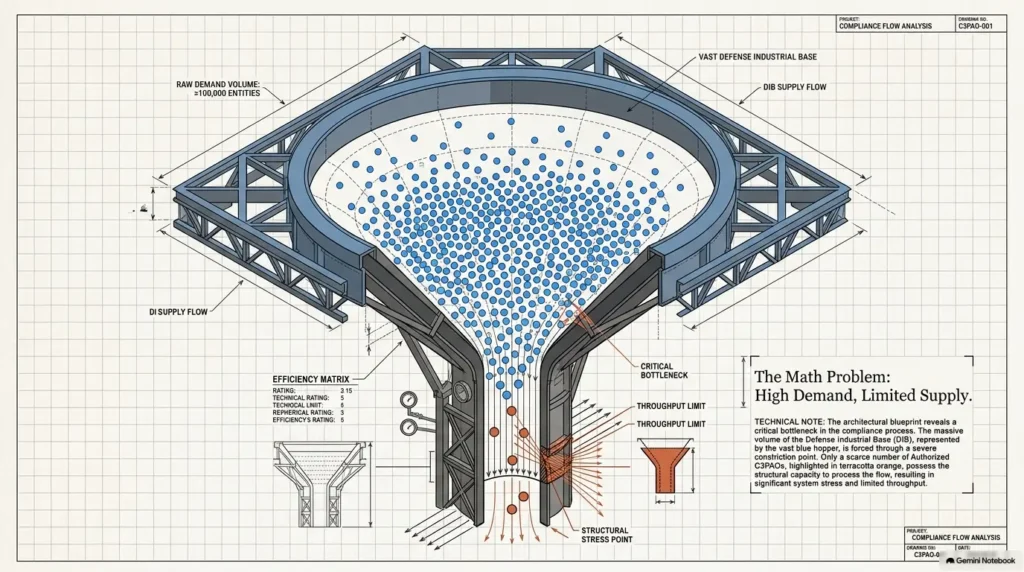
Verify the C3PAO before evaluating its sales pitch
A polished website is not proof that an organization can perform an official Level 2 certification assessment.
Under 32 CFR Part 170, a C3PAO is an organization authorized or accredited by the CMMC Accreditation Body to conduct Level 2 certification assessments. The Cyber AB maintains the CMMC ecosystem and identifies C3PAOs and qualified assessment professionals.
Gate 1: confirm the organization
Before discussing rates, ask the bidder for its exact legal organization name and current C3PAO status. Then verify that identity through the official ecosystem rather than relying on a badge copied into a proposal.
Gate 2: confirm the people
Ask who is expected to act as Lead CCA, who else is expected to serve as a CCA, whether CCPs will participate, and how the provider handles substitutions.
This matters because the rule requires a Level 2 C3PAO assessment team to include at least two people: a Lead CCA and at least one additional CCA. Additional CCAs and CCPs may participate. The C3PAO must also maintain a separate quality-assurance function, and the individual performing quality assurance for an assessment cannot be a member of that same assessment team.
Gate 3: confirm independence
Provide the bidder with a list of firms and individuals that materially helped prepare your organization for CMMC. Ask the C3PAO to confirm in writing that the proposed team has been screened for conflicts.
Do this early. Discovering an independence problem after calendars, purchase orders, travel, and internal preparation have been arranged is procurement archaeology nobody enjoys.
C3PAO Selection Flow
What is required now?
Is the C3PAO verified?
Any prior consulting conflict?
Who will assess?
What boundary is priced?
What is included?
Who owns each risk?
Use this 100-point C3PAO buyer scorecard
After the eligibility gates are passed, use the same scorecard for every finalist. Otherwise a confident salesperson, an unusually low quote, or a familiar brand can quietly change the criteria halfway through the buying process.
| Criterion | Weight | What good looks like |
|---|---|---|
| Scope methodology | 20 | Asks detailed questions about CUI flows, assets, locations, ESPs, CSPs, specialized assets, and boundaries before fixing the engagement. |
| Independence and conflict screening | 20 | Explains conflict checks clearly and is willing to document the result. |
| Assessment team | 15 | Names or profiles the expected Lead CCA and team, with a clear substitution process. |
| Quote transparency | 15 | Separates assumptions, inclusions, exclusions, travel, rescheduling, scope changes, and post-assessment work. |
| Evidence and data handling | 10 | Explains secure evidence review, retention, assessor devices, confidentiality, and approved workflows. |
| Schedule and continuity | 10 | Can explain staffing availability, contingency plans, dependencies, and realistic scheduling. |
| Communication, QA, appeals | 10 | Explains escalation, quality assurance, findings delivery, disagreement handling, and appeals without sales fog. |
How to score it
Give each category a percentage score, multiply by the weight, and total the results. A procurement team does not need mathematical theater. The point is consistency.
A cheaper provider scoring 91 may be a much better decision than a famous provider scoring 72. A provider scoring highly everywhere except scope methodology deserves more scrutiny because poor scope assumptions can later infect the quote, schedule, evidence request, and assessment plan.
High-value buyer rule: do not assign points for being authorized. Authorization is a pass/fail gate. Your score begins only after the provider is eligible to perform the engagement you are buying.
Minimum, sensible, and high-assurance selection processes
| Approach | What you do | Best fit |
|---|---|---|
| Minimum | Verify status, check conflicts, obtain two comparable quotes, review scope and exclusions. | Small, simple environment with a stable boundary and experienced internal compliance lead. |
| Sensible | Use a written scorecard, interview the Lead CCA, normalize three quotes, review evidence handling and change-order terms. | Most small and midsize defense contractors. |
| High-assurance | Add legal/procurement review, architecture walkthrough, formal conflict disclosures, staffing commitments, data-handling review, and executive approval. | Complex CUI environments, multiple sites, sensitive programs, or high commercial dependency on assessment timing. |
Compare C3PAO quotes without being fooled by the total price
A $30,000 quote and a $45,000 quote are not comparable if one includes travel, assessment planning, project management, findings reporting, and closeout support while the other treats half of those items as billable extras.
Instead of asking, “What does your assessment cost?” ask every provider to price or describe the same components.
| Quote component | Question to ask | Why it matters |
|---|---|---|
| Assessment scope | Which systems, sites, CAGE codes, users, external providers, and asset categories does this quote assume? | A scope mismatch can make the headline total meaningless. |
| Pre-assessment planning | Which planning meetings and document exchanges are included? | Some providers separate planning from active assessment effort. |
| Assessment team | How many people and which roles are included? | Staffing affects schedule, travel, coordination, and continuity. |
| On-site work | How many locations and days are assumed? | Travel can materially alter total cost. |
| Expenses | Are airfare, lodging, mileage, meals, or other expenses included, capped, or billed separately? | Prevents an inexpensive base price from becoming an expensive invoice. |
| Scope change | What triggers a change order? | Boundary changes are common commercial friction points. |
| Re-evaluation | How is allowed re-evaluation during the assessment handled commercially? | Clarifies what happens when additional evidence becomes available. |
| POA&M closeout | Is a later closeout assessment included or separately priced? | Conditional status can create another assessment event. |
| Reporting and administration | Are findings reporting, quality assurance, certificate activity, and required system submissions included? | These are part of the assessment process, not decorative paperwork. |
| Rescheduling | What happens if either party must move dates? | Scarce assessor calendars can make rescheduling costly. |
What Changes the Quote
The largest quote variables are usually more operational than glamorous: the number of locations, size and complexity of the assessment boundary, specialized assets, cloud and external-service dependencies, evidence maturity, assessor travel, internal scheduling constraints, and whether the C3PAO expects substantial pre-assessment coordination.
This is why employee count alone is a weak pricing input. A 15-person engineering firm with CUI scattered across email, CAD systems, laptops, cloud storage, backups, and remote administration can create more assessment complexity than a larger contractor using a tightly controlled enclave.
The Technical Detail That Matters
For a Level 2 certification assessment, 32 CFR §170.17 ties the assessment to NIST SP 800-171A, CMMC scoping rules, formal scoring, required reporting, and defined evidence handling. Your provider is therefore not merely reviewing a policy binder. The assessment is evaluating the systems inside the declared CMMC Assessment Scope and the evidence that demonstrates whether applicable objectives are met.
The rule also requires hashed assessment artifacts to be retained by the assessed organization for six years, and it specifies reporting and artifact-integrity requirements for Level 2 certification assessments.
Independence and conflicts can disqualify an otherwise attractive provider
This is one of the most important differences between choosing an assessor and choosing a readiness consultant.
The CMMC conflict-of-interest and professional-conduct framework requires ecosystem members to avoid actual or perceived conflicts and prohibits participation in a Level 2 certification assessment when the individual previously served as a consultant preparing that organization for a CMMC assessment within the preceding three years.
Build a consulting-history list before contacting assessors
Create a simple record covering the previous three years:
- CMMC readiness firms used.
- Individual CCPs, CCAs, or other professionals who materially supported preparation.
- Gap assessments and mock assessments.
- SSP or policy-development assistance.
- Remediation projects involving CMMC preparation.
- Managed service providers that also supplied CMMC advisory personnel.
Give the relevant information to a prospective C3PAO before contracting and ask it to perform its conflict check.
Do not buy a suspiciously convenient “prepare and certify” package
A business may legitimately offer different types of services in different circumstances, but your assessment must preserve the required independence. The commercial convenience of having one vendor “take care of everything” does not override conflict rules.
Walk-away question: “Did anyone proposed for our assessment provide CMMC preparation or consulting to our organization during the previous three years?” A vague answer to a precise independence question is information in itself.
Assess the assessment team, not just the company logo
The organization may have an excellent reputation while the people available on your dates have little exposure to environments resembling yours. Procurement should therefore evaluate both the C3PAO and the proposed team.
Questions for the Lead CCA
- What types of environments create the most scoping friction during Level 2 assessments?
- How do you approach cloud services and external service providers that affect the CUI environment?
- How do you handle specialized assets or manufacturing technology?
- What must be settled before the formal assessment period begins?
- How do you distinguish an implementation weakness from an evidence weakness?
- What causes assessment schedules to expand?
- How do you handle evidence that becomes available during the permitted re-evaluation period?
- How does your quality-assurance process interact with the assessment team?
- How are disagreements and appeals handled?
- Under what circumstances would your firm require a commercial change order?
Questions about evidence security
The assessment may expose architecture diagrams, configuration information, policies, screenshots, inventories, identity details, security practices, and other sensitive material. Ask where assessment information may be processed, how it is protected, what devices assessors use, how records are retained, and what happens after the engagement.
The federal rule imposes security and confidentiality obligations on C3PAOs and assessment personnel, including requirements around assessment records, personally identifiable information, and the technology used to handle assessment information. That makes evidence handling a legitimate procurement criterion, not an IT afterthought.
Interview for your actual environment
If you operate a cloud-heavy software business, ask about shared-responsibility evidence and external service providers. If you manufacture physical components, ask about shop-floor systems, specialized assets, remote support, engineering workflows, and physical boundaries.
You are not looking for an assessor who promises to make difficult issues disappear. You are looking for one that identifies those issues early enough to prevent avoidable surprises.
How the right C3PAO changes by contractor scenario
Real-world example: a 20-person engineering subcontractor
Imagine a small engineering firm with a relatively contained CUI environment, one office, managed laptops, a secure cloud enclave, and a mature SSP.
For this company, an enormous assessment organization with a complex enterprise delivery model may add little value. A smaller authorized C3PAO with clear pricing, a competent named Lead CCA, predictable staffing, and strong experience with compact enclaves could be entirely adequate.
The buying priority is straightforward execution. Scope clarity, independence, schedule certainty, and transparent travel or closeout costs matter more than brand prestige.
During the current Phase II suspension, however, the company should first verify whether buying the certification assessment now is commercially necessary at all.
Real-world example: an 80-person manufacturer with several sites
Now consider an 80-person manufacturer with corporate IT, engineering networks, shop-floor equipment, multiple locations, remote administration, cloud services, an MSSP, and CUI moving between engineering and production.
Here, the lowest fixed quote should not dominate the decision. The buyer needs to understand whether the proposed team can reason cleanly about specialized assets, physical scope, external providers, segmented systems, evidence collected across sites, and scheduling multiple stakeholders.
Paying somewhat more for a provider whose scope assumptions are demonstrably better can be rational. Paying more merely because the firm is larger is not.
Scenario: the company that is not assessment-ready
If the SSP is stale, the CUI boundary is disputed internally, MFA is incomplete, service-provider responsibilities are undocumented, and evidence collection is improvised, your most important purchase may not be a C3PAO assessment.
Fixing readiness first can be cheaper than purchasing an independent assessment merely to receive an expensive confirmation of gaps you already suspected.
| Your situation | Likely sensible action |
|---|---|
| No current C3PAO requirement and substantial gaps remain | Prioritize scoping, remediation, self-assessment, and evidence maturity. |
| Stable environment and future assessment expected | Build a verified shortlist and understand current commercial terms without assuming immediate purchase is necessary. |
| External assessment is confirmed as applicable | Run a formal C3PAO procurement using authorization, independence, team, scope, and quote gates. |
| Complex environment with unresolved scope | Stabilize the assessment boundary before requesting fixed assessment pricing. |
C3PAO red flags worth walking away from
Most procurement mistakes announce themselves quietly. The trick is noticing them before the purchase order.
Red flag 1: certification is “guaranteed”
An independent assessor should not promise the assessment outcome before performing the assessment. A guarantee transforms a serious assurance process into marketing confetti.
Red flag 2: nobody asks about scope before quoting
A quote produced from employee count alone should be treated as preliminary at best. The assessment boundary, locations, assets, cloud services, external providers, and complexity matter.
Red flag 3: the salesperson will not identify the likely assessment team
Exact personnel can change, but a serious provider should be able to explain who is expected to perform the work, what qualifications govern team composition, and what happens if a key assessor becomes unavailable.
Red flag 4: consulting and assessment roles are blurred
If the same people appear to be selling remediation advice and independent certification for the same organization, stop and resolve the conflict issue before proceeding.
Red flag 5: exclusions are almost invisible
Look for travel, additional sites, scope expansion, rescheduling, extended evidence review, POA&M closeout, project management, and post-assessment activity. An inexpensive proposal can become expensive through undefined edges.
Red flag 6: urgency is based on an outdated 2026 timeline
The July 2026 Phase II suspension materially changed the immediate procurement context. A provider should be able to discuss the current situation without pretending the former November transition date is still operating unchanged.
Contract red-flag checklist
Before signing, confirm the assessment scope, assumed locations, named roles, substitution rights, confidentiality, assessment-data handling, travel treatment, invoicing milestones, rescheduling terms, scope-change pricing, POA&M closeout pricing, findings delivery, appeals process, termination terms, and which obligations survive the engagement.
For the underlying C3PAO responsibilities, including authorization, assessment-team requirements, quality assurance, records, reporting, and appeals, review 32 CFR §170.9 directly.
FAQ
Do we need a C3PAO assessment in August 2026?
Do not assume so. The Department suspended CMMC Phase II requirements in July 2026 and currently limits the Phase I procurement path to Level 1 and Level 2 self-assessment designations. Check the current solicitation, contract, subcontract, amendment, or modification and confirm uncertain requirements with the relevant contracting authority or prime contractor.
Can we simply choose the cheapest authorized C3PAO?
You can, but price alone is a weak selection method. Two quotes may assume different boundaries, locations, staffing, travel, closeout work, scheduling terms, and evidence-review effort. Normalize the scope first, then compare total commercial exposure.
Should we hire our CMMC readiness consultant as the assessor?
Conflict-of-interest rules require careful separation. The CMMC professional-conduct framework prohibits ecosystem members from participating in the Level 2 certification assessment when they previously served as a consultant preparing that organization for a CMMC assessment within three years. Disclose prior preparation relationships and obtain a conflict determination before contracting.
What should we ask about the assessment team?
Ask who will serve as Lead CCA, who the second CCA is expected to be, whether CCPs will participate, how replacements are handled, how the independent quality-assurance role is staffed, and whether the team has relevant experience with environments resembling yours.
Is a POA&M closeout included in the original C3PAO price?
Do not assume that it is. Under the CMMC rule, eligible Level 2 conditional-status items must be closed through the applicable closeout process within the prescribed 180-day window. Ask bidders explicitly whether a potential closeout certification assessment is included, separately priced, or subject to a later quote.
How many C3PAO quotes should a small contractor obtain?
Three comparable proposals are often enough to expose differences in scope assumptions and commercial structure without turning procurement into a second career. Two may be sufficient when availability is constrained or the environment is unusually specialized. The useful goal is not a magic quote count; it is a comparison in which every provider prices the same problem.
Build your C3PAO shortlist in 15 minutes
Do one thing before sending another request for proposal: create a one-page C3PAO buying brief.
- Copy the exact current CMMC requirement from the governing solicitation, contract, subcontract, amendment, or modification.
- Write one sentence describing where CUI is processed, stored, and transmitted.
- List the expected assessment locations and major external service providers.
- List every CMMC consultant or preparation firm used during the previous three years.
- Write these seven scoring headings: scope, independence, team, quote, evidence security, schedule, and QA/appeals.
- Send that same brief to each provider so the responses begin from comparable assumptions.
That page will do more for the buying decision than a folder full of generic capability statements. It forces the real questions into daylight: what is required, what is being assessed, who can independently assess it, who will perform the work, and what exactly you are paying for.
The decision to make today
Confirm your current assessment requirement before spending money. If a C3PAO engagement is appropriate, verify authorization first, independence second, assessment scope third, and price only after the competing proposals describe the same job.
Last reviewed: 2026-09