KIOPTRIX • CMMC COST & READINESS GUIDE • AUGUST 2026
CMMC Compliance Cost for Small Defense Contractors:
What Should You Actually Budget?
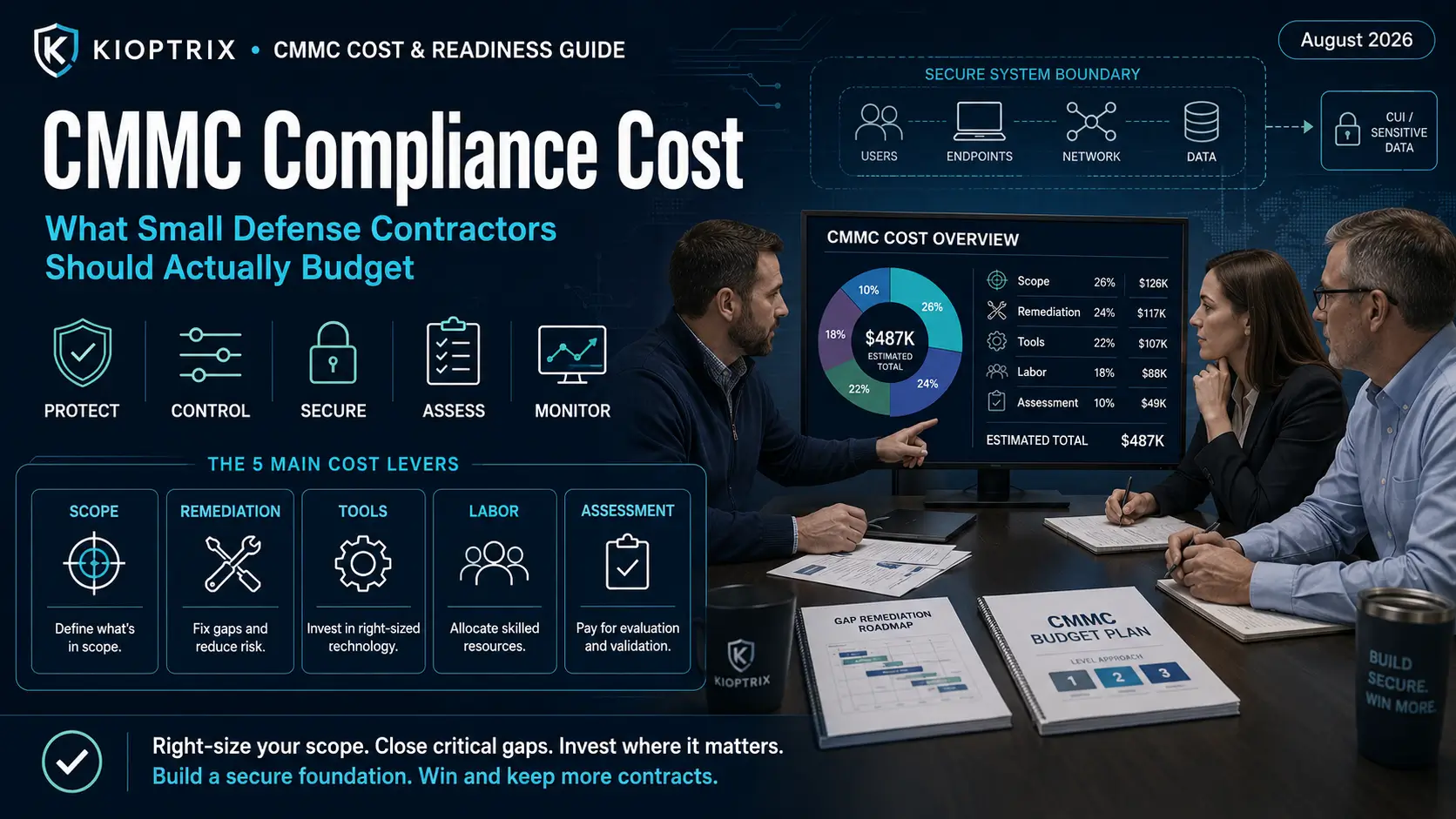
CMMC compliance cost is easy to underestimate because the assessment fee is only one slice of the bill. For a small defense contractor, the larger expense may be scoping Controlled Unclassified Information, fixing technical gaps, documenting controls, collecting evidence, changing cloud or IT services, and keeping those controls operating after the assessment is over.
There is also an unusually important 2026 wrinkle. As of August 2026, the Department has suspended the planned CMMC Phase II transition. Phase I self-assessment requirements remain in place, while Level 2 C3PAO and Level 3 assessment requirements may not be newly designated during the suspension. That changes what a small contractor should pay for right now, but it does not erase the underlying obligation to protect FCI or CUI.
The useful budgeting question, therefore, is not merely “How much is a CMMC audit?” It is: What level applies, what systems are genuinely in scope, which requirements are already implemented, and which expenses are necessary before spending money on outside assessment work?
Budget the boundary before you budget the audit. 🔐
Snapshot
For: small U.S. defense contractors and subcontractors budgeting for CMMC Level 1 or Level 2. Problem solved: separating assessment costs from implementation, remediation, tools, labor, and recurring compliance costs. Next decision: determine whether you need a self-assessment now, what your real CMMC scope is, and which spending can wait.
CMMC cost: the quick answer
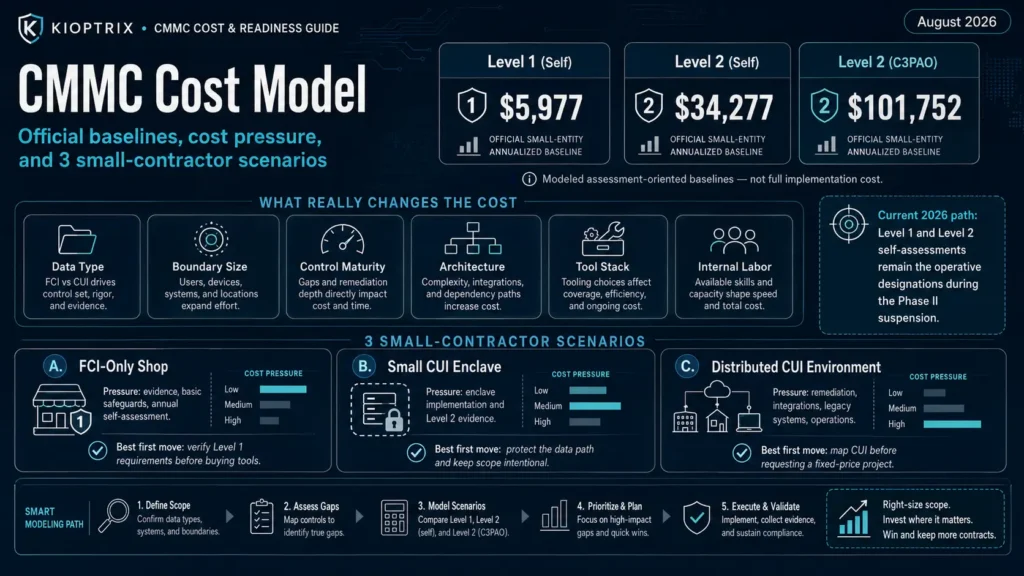
The best official starting point is the economic analysis published with the CMMC final rule. For a small entity, the government estimated approximately $5,977 for a Level 1 self-assessment and initial affirmation, $34,277 for a Level 2 self-assessment and initial affirmation, and $101,752 for a Level 2 C3PAO certification-assessment cycle and initial affirmation under the assumptions used in the rule.
Those numbers are useful, but they are frequently misunderstood. They are not universal quotes for becoming compliant. For Level 1 and Level 2, the rule’s economic analysis generally assumes the applicable underlying security requirements have already been implemented. In other words, major remediation and technology projects can sit outside the headline assessment estimate.
| CMMC path | Official small-entity modeling baseline | Frequency in the rule | What the number does not tell you |
|---|---|---|---|
| Level 1 (Self) | About $5,977 | Self-assessment annually | Cost of fixing missing basic safeguards |
| Level 2 (Self) | About $34,277 initially; $37,196 modeled over three years | Assessment every three years plus annual affirmation | Cost of implementing missing NIST SP 800-171 Rev. 2 requirements |
| Level 2 (C3PAO) | About $101,752 initially; $104,670 modeled over three years | Certification assessment every three years plus annual affirmation under the rule | Actual market quote, remediation, architecture changes, and ongoing security operations |
The same rule modeled approximately $31,234 specifically for the C3PAO engagement within its small-entity Level 2 certification estimate. The rest of the modeled total includes contractor preparation, participation, reporting, outside support, and affirmation work. That distinction matters when someone says, “The audit only costs X.” The audit is not the whole project.
Before You Act
This article is a budgeting and procurement guide, not legal or individualized regulatory advice. Confirm the requirement in your current solicitation, contract, subcontract, DFARS clauses, information flow, and system architecture. The July 2026 CMMC suspension is also under review, so major spending decisions should be checked against current official guidance before you commit funds.
Key cost rule: treat the official assessment estimate as a budgeting reference point, not as the total cost of reaching the required security state.
What changed in 2026 and why it matters to your budget
The timing question is unusually important in 2026. The CMMC acquisition rule became effective on November 10, 2025, beginning phased implementation. Then, on July 13, 2026, the Department announced an immediate suspension of the planned Phase II requirements while conducting a broader review of the program.
What remains in force during the suspension
The implementing suspension memorandum says CMMC Level 1 self-assessments and Level 2 self-assessments remain the allowed CMMC designations during the suspension. Program managers and requiring activities may not newly designate Level 2 C3PAO or Level 3 DIBCAC assessments during this period.
The memorandum also states that the cybersecurity obligations in DFARS 252.204-7012 remain in effect. For contractors handling CUI, the suspension therefore should not be read as permission to stop implementing the underlying safeguards.
What happens to solicitations that called for a C3PAO assessment?
The July implementation guidance directs program managers and requiring activities to initiate amendments removing Level 2 C3PAO or Level 3 requirements from active solicitations. For existing contracts containing those requirements, contracting or agreements officers are directed to remove them through a modification before the next option period or during the next scheduled administrative modification.
Do not assume that your contract text changed magically overnight. If your solicitation or contract still shows a third-party assessment requirement, ask the contracting officer or prime contractor for the applicable amendment or modification rather than working from headlines.
2026 spending rule: do not rush into a C3PAO engagement merely because Phase II used to be on the calendar. Verify the requirement that applies to your award today.
For current notices, implementation guidance, FAQs, and official CMMC documentation, use the Department’s own program page rather than a consultant’s countdown clock.
A realistic CMMC cost model
A more useful budget separates CMMC into distinct buckets. Otherwise, software purchases, consultant hours, internal labor, evidence work, and assessment charges melt into one large number and nobody can tell which costs are mandatory, optional, recurring, or avoidable.
A practical CMMC total-cost model
FCI/CUI flow, users, assets, providers
What is MET, NOT MET, unclear
Technology, configuration, process
SSP, policies, screenshots, records
Self-assessment or required external assessment
Monitoring, training, reviews, renewals
Total budget = scope + gap analysis + remediation + evidence + assessment + recurring operations + contingency.
One-time costs
- Mapping where FCI and CUI enter, move through, and leave the organization.
- Defining the CMMC assessment boundary.
- Initial gap assessment against applicable requirements.
- Designing or separating a CUI enclave when appropriate.
- Replacing unsupported systems or insecure workflows.
- Implementing required identity, access, logging, encryption, configuration, media, and physical safeguards.
- Writing or repairing the System Security Plan and supporting procedures.
- Preparing assessment evidence.
Recurring costs
- Security software and cloud subscriptions.
- Managed IT or security services.
- Log review, vulnerability management, patching, backups, account reviews, and incident-response maintenance.
- Security awareness and role-based training.
- Annual affirmation work.
- Periodic self-assessment or future certification assessment work.
- Updating documentation when systems, vendors, staff, or data flows change.
The hidden cost: internal labor
For a 20-person contractor, twelve hours from the owner, thirty hours from the IT lead, repeated engineering meetings, evidence collection, procurement reviews, and policy updates may never appear on a consultant invoice. They still consume real capacity.
Create a labor line in the budget even if employees are salaried. Otherwise CMMC can appear inexpensive on paper while quietly consuming the people responsible for delivery, engineering, finance, and customer work.
The six variables that change the cost most
Two companies with twenty employees can have radically different CMMC budgets. The answer changes when the following variables change.
1. Whether you handle FCI or CUI
Level 1 maps to the 15 basic safeguarding requirements associated with FAR 52.204-21. Level 2 maps to the 110 security requirements in NIST SP 800-171 Revision 2. That difference changes not only assessment effort but also the depth of identity, access control, configuration, logging, incident response, documentation, media protection, and other operational practices that must be supported.
2. How large your FCI or CUI boundary is
If CUI is routinely copied into corporate email, shared drives, personal workstations, engineering systems, backup platforms, ticketing tools, and collaboration services, the assessment boundary can become wide and expensive. Every additional in-scope system creates another place to configure, document, test, monitor, and collect evidence.
A thoughtfully designed enclave can sometimes shrink the boundary substantially, but only if business workflows genuinely keep CUI inside it. Drawing a neat rectangle in a network diagram does not make data obey the rectangle.
3. Your existing NIST SP 800-171 maturity
A company that already operates disciplined access controls, MFA, centralized endpoint management, secure backups, change control, logging, account reviews, incident procedures, and maintained documentation starts from a very different cost position than a company discovering those concepts during assessment preparation.
If MFA is still being deployed, Kioptrix’s MFA rollout guide can help separate the technical rollout from the wider compliance project.
4. Cloud and external service providers
Cloud does not automatically remove systems from scope. You need to understand which provider stores, processes, transmits, secures, backs up, authenticates, or otherwise affects protected information, and what evidence supports that use.
A low-priced SaaS tool can become expensive if replacing it later requires data migration, retraining, workflow redesign, and contract changes. Compliance budgeting should include switching cost, not just subscription cost.
5. Documentation debt
A control can exist technically and still require substantial work to demonstrate consistently. The SSP, procedures, inventories, diagrams, configuration evidence, access records, training records, incident documentation, risk artifacts, and other evidence need to tell the same story.
6. How much remediation is still open
Level 1 does not permit a POA&M. Level 2 allows conditional status only under specified conditions, and eligible POA&M items must be closed within 180 days. The framework is not designed around leaving a large security backlog unresolved indefinitely.
The answer changes when: CUI spreads into more systems, your existing control maturity falls, external providers multiply, or evidence cannot prove that controls actually operate.
Three small-contractor budget scenarios
These are hypothetical examples, not market quotes. Their purpose is to show why “small contractor” is not a cost category by itself.
Scenario A: 12-person manufacturer handling FCI but no CUI
The company uses managed laptops, business email, basic access restrictions, updated operating systems, anti-malware controls, and documented physical access. Its current procurement calls for Level 1 (Self).
Here, the official Level 1 small-entity assessment model of roughly $5,977 is a useful orientation point. If the 15 safeguards are already implemented, the incremental burden may concentrate on validating them, fixing modest gaps, recording evidence, submitting results, and maintaining annual compliance.
The expensive mistake would be buying an enterprise compliance platform before determining whether a spreadsheet, evidence folder, responsible owner, and disciplined annual review are sufficient.
Scenario B: 25-person engineering subcontractor with a small CUI enclave
The company receives CUI for a limited program. Five employees need regular access, and the contractor can keep that work inside a controlled environment rather than allowing CUI onto every laptop and SaaS platform.
Under the August 2026 suspension, a current requirement may call for Level 2 (Self), not a C3PAO assessment. The official small-entity Level 2 self-assessment model of about $34,277 becomes a more relevant assessment reference than the six-figure Level 2 certification model.
The real savings, however, comes from architecture. If only five users and a contained set of systems handle CUI, the contractor may avoid pulling the whole corporate environment into the most burdensome part of the program.
Scenario C: 60-person contractor with CUI across email, engineering, file storage, remote work, and OT
This company may still be “small,” but its CUI footprint is not. Remote access, legacy engineering applications, specialized equipment, cloud services, backup systems, shared credentials, and multiple facilities can create a much larger evidence and remediation project.
Here, the government assessment model is only one budget line. Remediation, architecture, internal labor, service-provider changes, endpoint management, logging, identity controls, documentation, and recurring operations may dominate.
If third-party assessment requirements return after the current review, this contractor would also face a more demanding future assessment project because assessors would need to understand a larger and more complicated scope.
| Scenario | Likely cost pressure | Best first budgeting move |
|---|---|---|
| Small FCI-only shop | Evidence, basic safeguards, annual self-assessment | Check all Level 1 requirements before buying tools |
| Small CUI enclave | Enclave implementation and Level 2 evidence | Protect the data path and keep scope intentional |
| Distributed CUI environment | Remediation, integrations, legacy systems, operations | Map CUI before requesting a fixed-price project |
How to reduce CMMC cost without creating false economy
The cheapest control is often the system that never needs to enter scope. That does not mean artificially excluding assets. It means redesigning workflows so fewer people, applications, devices, and providers legitimately handle sensitive contract information.
Start with data flow, not a shopping list
- Identify where FCI and CUI originate.
- List who must access each data type to perform the contract.
- Trace where the information is stored, transmitted, backed up, printed, exported, or synchronized.
- Identify systems that provide security protection to those assets.
- Remove unnecessary copies and unnecessary access.
- Only then decide what technology or outside help is needed.
This sequence prevents the classic small-business error of buying five security products and discovering later that the expensive problem was uncontrolled data movement.
Use an enclave only when the workflow supports it
An enclave can reduce the number of in-scope users and systems, but it may add operational friction. Engineers may need different devices, secure transfer procedures, restricted collaboration, new authentication workflows, and rules for printing or removable media.
The right question is not “Can an enclave lower my compliance bill?” It is “Can our people actually keep CUI inside this environment every working day?”
Do not replace functioning controls merely because a product says “CMMC”
CMMC is an assessment of security requirements across an organization and defined information-system scope. No single product purchase turns the organization compliant.
When evaluating the expense of your security stack, the Kioptrix security tool stack cost calculator can help separate per-user, per-endpoint, and recurring tooling costs from the broader compliance project.
Best place to save: unnecessary scope, duplicated technology, avoidable data copies, and redundant consulting work. Worst place to save: controls that the contract actually requires.
DIY, software, consultant, or assessor?
Small contractors often overspend because four very different jobs get bundled under the label “CMMC help.” Separate them before requesting proposals.
| Approach | Best when | What you are paying for | Main risk |
|---|---|---|---|
| DIY | Scope is small and internal IT/security capability is strong | Mostly internal labor | Missing evidence or misunderstanding scope |
| Compliance software | Many controls, owners, assets, evidence items, or recurring workflows need coordination | Workflow, evidence management, reminders, reporting | Buying automation before the process is understood |
| Consultant / readiness provider | Architecture, scoping, remediation, or assessment preparation needs specialized help | Expert analysis and project acceleration | Paying for generic templates instead of organization-specific work |
| C3PAO | A Level 2 certification assessment is actually required | Independent certification assessment | Booking or paying before confirming the current contractual requirement |
Do it free or mostly DIY when
- Your environment is genuinely small and well understood.
- You have competent staff who can interpret the applicable requirements.
- Your main gap is organization and evidence rather than technical implementation.
- Your current requirement is a self-assessment.
- You can maintain the work after the initial project ends.
Pay for software when
- Evidence lives across many teams or systems.
- Manual reminders repeatedly fail.
- You need recurring control tracking rather than a one-time checklist.
- Multiple frameworks create meaningful overlap that is expensive to manage manually.
- The software saves enough staff time to exceed its subscription and implementation cost.
Pay for professional help when
- You cannot confidently define the FCI or CUI boundary.
- Your SSP does not match the actual environment.
- You have significant technical remediation.
- You rely on unusual engineering, manufacturing, OT, or legacy systems.
- A customer or contract requires independent assessment or stronger evidence.
- You need an objective readiness check before a future certification assessment.
The current suspension makes this distinction especially valuable. Readiness consulting may still make sense. Paying for a certification assessment simply because you expected Phase II to arrive in November 2026 may not.
How to compare CMMC quotes before signing
A cheap quote with fuzzy scope can become the expensive quote later. Ask providers to make assumptions visible before comparing totals.
Your quote should answer these questions
- Which CMMC level and assessment type is the proposal built around?
- How many users, endpoints, locations, applications, cloud environments, and specialized assets are assumed?
- Is CUI-flow mapping included?
- Is the System Security Plan being created, reviewed, or merely accepted as an input?
- Does the price include technical remediation or only findings?
- Are policies and procedures customized to the actual environment?
- What evidence collection is included?
- Which meetings and internal staff hours are expected from the contractor?
- Are travel and expenses included?
- Are cloud, external service provider, and subcontractor issues in scope?
- Is POA&M closeout work included if applicable?
- What happens to fees if the assessment scope changes?
- What happens if government CMMC implementation requirements change again?
Separate readiness pricing from assessment pricing
A proposal that says “CMMC package: $60,000” tells you remarkably little. Ask how much covers scoping, readiness, remediation support, documentation, evidence preparation, actual assessment work, project management, and post-assessment work.
This makes competing quotes comparable and gives you a clean way to remove work your internal team can do competently.
Red flags worth slowing down for
- A guarantee that a consultant can “guarantee CMMC certification.”
- A fixed price issued before anyone asks where CUI resides.
- A proposal that treats employee count as the only scope variable.
- A claim that purchasing one platform makes the business compliant.
- No distinction between readiness consulting and independent assessment.
- A large non-refundable C3PAO payment without discussion of the July 2026 suspension.
- No explanation of what is excluded.
Buyer rule: the best quote is not necessarily the lowest one. It is the quote whose scope, assumptions, exclusions, responsibilities, and change conditions are easiest to understand.
You can verify the formal program structure and the government’s original small-entity cost assumptions in the official CMMC final rule.
CMMC cost mistakes that waste small-business budgets
Budgeting only for the assessor
This treats compliance as an inspection rather than an operating state. If controls are missing, the expensive part happens before assessment day.
Buying tools before mapping CUI
A security platform can improve operations and still be unnecessary for your actual scope. Start with the information flow and requirements, then buy the missing capability.
Assuming a small company automatically has a small scope
Ten employees using fifteen interconnected systems can create more compliance work than fifty employees using a tightly controlled enclave.
Treating a POA&M as an indefinite postponement
CMMC Level 2 conditional status has formal restrictions, and eligible open items must be closed within the applicable 180-day period. Budget remediation before relying on conditional status.
Paying for Phase II as though July 2026 never happened
The CMMC program is actively under review. That does not mean “stop security work.” It means distinguish durable work, such as protecting CUI, reducing scope, correcting control gaps, and producing evidence, from volatile spending tied to a particular assessment deadline.
Ignoring the underlying DFARS obligation
The July suspension guidance specifically says DFARS 252.204-7012 requirements remain in effect. A delayed external assessment does not cancel contractual safeguarding obligations.
Contractors handling covered defense information should review the current clause rather than relying on a summary written for a different contract.
FAQ
Should a small contractor still prepare for CMMC Level 2 during the Phase II suspension?
If your organization handles CUI or has contracts requiring the underlying NIST SP 800-171 safeguards, continuing readiness work can still be rational. Prioritize durable security and evidence improvements rather than spending solely to meet the former November 2026 C3PAO timetable.
Does the 2026 suspension mean CMMC is cancelled?
No. The July 2026 action suspended Phase II implementation and initiated a review. Phase I self-assessment requirements remain, and the official implementation memorandum continues Level 1 and Level 2 self-assessment designations during the suspension.
Does the suspension remove NIST SP 800-171 requirements from existing defense contracts?
No general conclusion like that should be drawn. The suspension guidance explicitly states that DFARS 252.204-7012 remains in effect and says the Department will continue enforcing baseline compliance through self-assessments and selected government-led assessments.
Can a very small subcontractor avoid CMMC because it has only a few employees?
Employee count is not the core applicability test. The CMMC regulation focuses on contractor and subcontractor systems that process, store, or transmit FCI or CUI in performance of applicable defense work, subject to the program’s rules and acquisition requirements.
Can an enclave reduce CMMC compliance cost?
Potentially. If the enclave genuinely limits where CUI can be processed, stored, or transmitted, it can reduce the number of systems and users requiring the most intensive controls and evidence. The savings disappear if staff routinely export CUI into corporate email, local drives, collaboration tools, printers, or other uncontrolled destinations.
What should I do if my solicitation still requires Level 2 C3PAO?
Confirm the current requirement with the contracting officer or, for a subcontract, the prime contractor. The July 2026 implementation guidance directs amendments to active solicitations that included Level 2 C3PAO or Level 3 requirements, but you should work from the actual solicitation amendment rather than assume a change has already been processed.
How much should I budget for a CMMC consultant?
There is no responsible universal consultant number without knowing your scope, control maturity, documentation state, architecture, provider dependencies, and desired deliverables. Ask for separate pricing for scoping, gap analysis, remediation support, documentation, evidence preparation, project management, and assessment-readiness work. That turns an opaque package price into something you can actually compare.
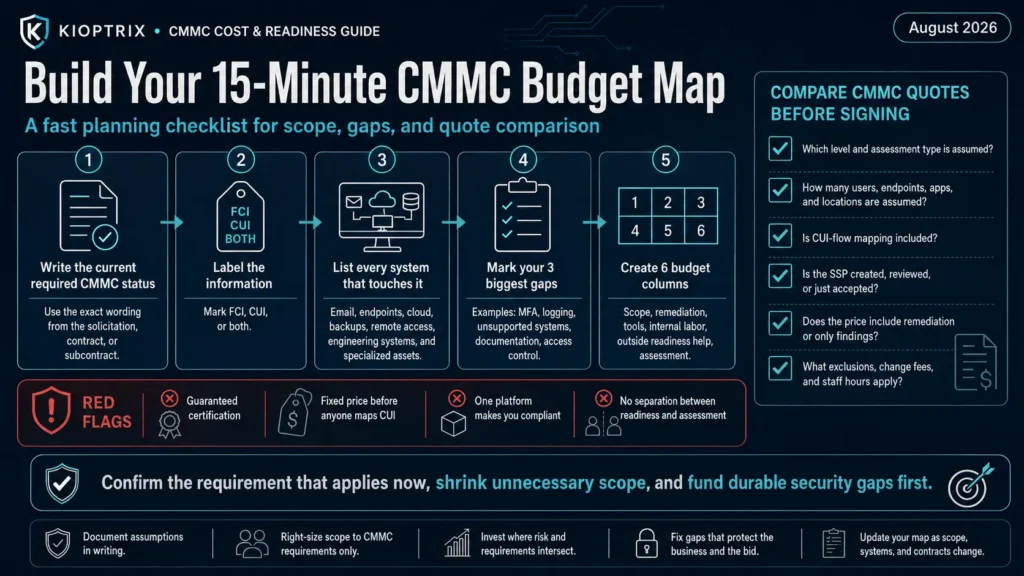
Build your 15-minute CMMC budget map
Before requesting another quote, spend fifteen minutes creating a single-page CMMC budget map. Do not start with vendors. Start with the contract and the information.
- Write the current required CMMC status exactly as it appears in the current solicitation, contract, subcontract, amendment, or modification.
- Write FCI, CUI, or both beside it.
- List every system that touches that information, including email, endpoints, file storage, cloud services, backups, engineering systems, remote access, and specialized equipment.
- Mark your three largest known gaps, such as MFA, logging, unsupported systems, documentation, access control, or an unclear CUI boundary.
- Create six budget columns: scope, remediation, tools, internal labor, outside readiness help, and assessment.
That one page will tell you more about your likely CMMC compliance cost than an assessment price advertised without context. It also gives a consultant, prime contractor, or internal IT lead something concrete to challenge and refine.
The decision to make today
Confirm the requirement that applies now, shrink unnecessary scope, and fund durable security gaps first. Assessment spending should follow those answers, not precede them.
For the latest program status before committing to a major CMMC expense, verify the current Department guidance directly.
Last reviewed: 2026-08