CMMC Cost & Procurement Guide
C3PAO Assessment Cost:
What Buyers Should Expect in 2026
A C3PAO quote is not the same thing as your total CMMC budget. The government’s own Level 2 cost model separates external assessor expense from the internal labor needed to plan, support, document, and complete the assessment.
For a small entity, the final CMMC rule modeled a Level 2 certification assessment and initial affirmation at $101,752, but only $31,234 of that model represented the external C3PAO engagement. Remediation, new security tooling, architecture changes, and much of the work required to become ready can sit outside that figure.
There is also a major 2026 timing issue: on July 13, 2026, the Department suspended the planned transition to CMMC Phase II while conducting a program review. That makes scope confirmation more important than speed. Buyers should verify what their actual solicitation, prime contractor, or contractual obligation requires before paying for an assessment.
Buyer rule: the cheapest assessment is rarely the cheapest engagement if the scope is vague, evidence is weak, or a closeout assessment becomes necessary. 🔎
Snapshot
This guide is for defense contractors, subcontractors, IT leaders, compliance managers, and founders deciding whether to procure a CMMC Level 2 C3PAO assessment. It explains the government’s cost model, what changes a real quote, which expenses may be excluded, and how to compare assessment proposals without confusing certification cost with the broader cost of becoming CMMC-ready.
Table of Contents
Before You Act
CMMC requirements can change with federal rulemaking, contract language, program decisions, your information flows, subcontract relationships, and assessment scope. This article is a procurement and budgeting guide, not legal or individualized regulatory advice. Before signing an assessment agreement, confirm the current requirement in your solicitation or contract and verify the proposed assessment scope with appropriate contracting, compliance, and technical personnel.
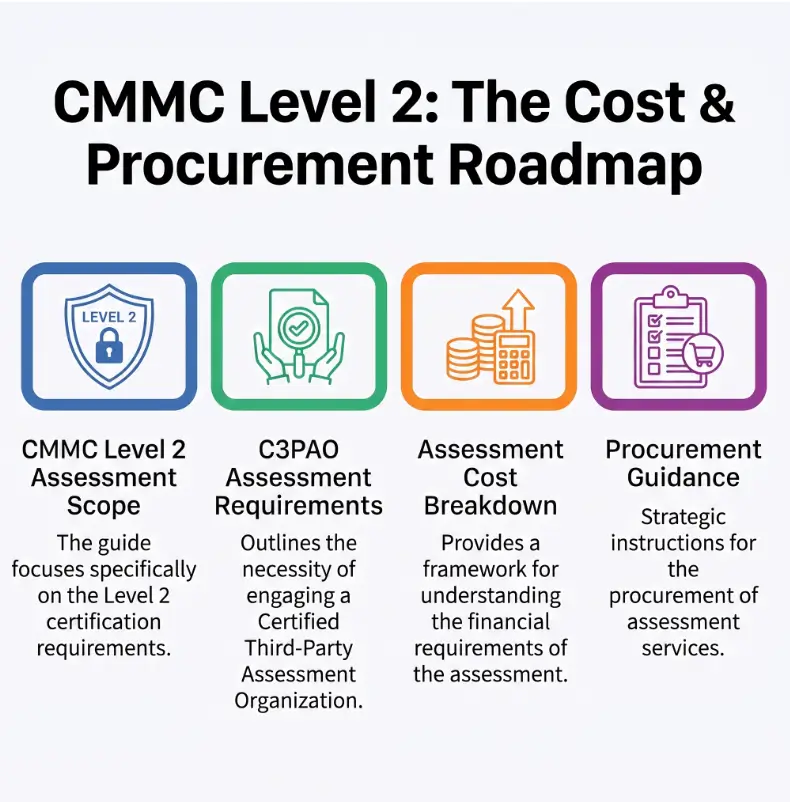
What should a C3PAO assessment cost in 2026?
The cleanest starting point is not an anonymous market average. It is the economic model published with the 2024 CMMC final rule.
For a small entity, the Department modeled a Level 2 certification assessment and initial affirmation at $101,752. The modeled three-year cost rises to $104,670 after the intervening annual affirmations are included. For an other-than-small entity, the corresponding model was $112,345 initially and $117,768 across the three-year cycle.
Those numbers are easy to misuse. They are not simply the invoice you should expect from a C3PAO.
Inside the government’s model, the external C3PAO component was approximately $31,234 for a small entity and $52,056 for an other-than-small entity. The rest includes modeled internal and external support labor associated with planning, conducting, reporting, and supporting the assessment; it is not all unpaid in-house time.
| Official cost model | Small entity | Other-than-small entity | What it means |
|---|---|---|---|
| External C3PAO component | $31,234 | $52,056 | Government-modeled external assessor cost, not a mandated price |
| Initial Level 2 certification assessment and affirmation | $101,752 | $112,345 | Includes modeled internal and external assessment-support labor |
| Three-year certification cycle | $104,670 | $117,768 | Adds intervening annual affirmation costs |
Key cost insight: if a C3PAO sends you a $40,000 assessment proposal, comparing that figure directly with the government’s $101,752 model is apples versus the whole orchard. The government total contains substantial internal labor that may never appear on the assessor’s invoice.
Do not treat the government model as a price ceiling
C3PAOs are commercial organizations. Your quote reflects the provider’s staffing model, anticipated assessment effort, travel assumptions, scheduling, complexity, and commercial pricing.
The government’s historical calculation explains the components of its regulatory economic model. It assumes the relevant security requirements are already implemented. It is not a 2026 vendor quote, an official fee schedule, a price ceiling or a complete implementation budget. Obtain current proposals for your actual scope.
The 2026 suspension changes urgency, not the need for careful budgeting
On July 13, 2026, the Department announced an immediate suspension of the planned transition to CMMC Phase II and said Phase I self-assessment requirements remain in place while the program is reviewed. The Department also said it would continue enforcing NIST SP 800-171 Revision 2 through self-assessments and selected government-led assessments during the interim period.
That means a contractor should not assume, solely from handling CUI, that it must immediately purchase a C3PAO assessment. The actual solicitation, contract, prime-contractor flowdown, and current program guidance should drive the decision.
What are you actually paying for?
A Level 2 certification assessment is an independent examination of the systems, processes, people, and evidence inside the defined CMMC assessment scope. Under 32 CFR Part 170, Level 2 uses the 110 security requirements from NIST SP 800-171 Revision 2.
The C3PAO is not being hired to build your security program during the certification engagement. Its job is to assess whether the applicable requirements are met and document the assessment result.
1. Assessment planning
The assessor must understand the legal entity, CAGE codes, assessment boundary, relevant systems, external service providers, locations, staff, and architecture that make up the assessment scope.
Poor scoping creates expensive ambiguity. A business with 70 employees but a tightly isolated CUI environment may be simpler to assess than a 25-person contractor that allows CUI to flow across email, endpoints, cloud applications, file servers, engineering systems, and multiple managed providers.
2. Evidence examination, interviews, and testing
Assessment work may involve reviewing documents and artifacts, interviewing personnel, and testing or observing technical implementations. A policy saying MFA is enabled does not prove that MFA is consistently enforced on every in-scope access path.
The cost therefore depends partly on how quickly your organization can connect each requirement to clear, current, defensible evidence.
3. Findings, scoring, and reporting
The C3PAO records assessment results and submits required information through the CMMC assessment process. Under the regulation, results are uploaded into the CMMC implementation of eMASS for transmission to SPRS, and the organization receives a CMMC Assessment Findings Report.
4. Possible POA&M closeout work
Some unmet requirements may qualify for a Plan of Action and Milestones under the CMMC rules. Where Conditional Level 2 status is allowed, qualifying items must be remediated and a C3PAO closeout assessment completed within 180 days.
This is why buyers should ask whether closeout assessment activity is included in the original fee, priced separately, or billed using a day rate.
The CMMC budget stack
Scope, SSP, evidence, gap review
Independent certification assessment
Technical and process fixes
If permitted POA&M items remain
Operations and annual affirmation
A provider quote may cover only box 2. A realistic business budget must identify who owns all five.
What changes a C3PAO quote?
Company headcount matters less than many buyers expect. The more useful question is: how complicated is the environment that actually stores, processes, or transmits CUI?
Assessment boundary size
A narrowly designed enclave usually creates fewer systems, identities, data flows, locations, and dependencies for an assessor to examine. A company-wide CUI boundary can multiply the work.
Technical diversity
One standardized cloud environment is a different assessment problem from a mixed estate containing Microsoft 365, on-premises Active Directory, engineering workstations, legacy servers, multiple clouds, remote access, manufacturing technology, and several security service providers.
Evidence quality
Good evidence lowers friction. Weak evidence forces assessors and your staff to spend more time discovering what is actually implemented.
A useful evidence package maps each requirement to the responsible owner, applicable assets, implementation statement, and supporting artifacts. It should agree with the SSP and with reality.
Locations, personnel, and service providers
Multiple facilities, geographically dispersed employees, cloud service providers, managed service providers, security providers, and specialized engineering environments can expand interview and evidence requirements.
What Changes the Quote
Think of assessment effort as a function of five variables:
Scope size × technical diversity × evidence friction × organizational complexity × assessment logistics
Employee count is only a rough proxy. Two organizations with the same headcount can produce very different assessment workloads.
For the broader cost of implementing and sustaining CMMC controls beyond the assessor engagement, see the kioptrix.com guide to CMMC compliance cost and budgeting.
How should you budget by assessment complexity?
Because C3PAO prices are market prices rather than a fixed federal tariff, a useful planning method is to classify the engagement before asking vendors for a number.
| Assessment profile | What it usually looks like | Buyer implication |
|---|---|---|
| Good: bounded and assessment-ready | Clear CUI enclave, current SSP, limited locations, standardized systems, mature evidence map | Seek a tightly defined fixed-fee assessment with explicit assumptions |
| Better: moderate complexity | Several platforms, remote users, external providers, multiple departments, some evidence cleanup required | Expect more assessor time and clarify how out-of-scope discoveries affect fees |
| Complex: broad enterprise scope | Multiple sites, cloud and on-premises systems, engineering environments, many data flows, heterogeneous controls | Request detailed staffing, schedule, travel, and scope-change terms before comparing price |
Scenario 1: the small defense subcontractor with an enclave
Imagine a 35-person manufacturer that has intentionally moved CUI into a controlled environment used by eight employees. Authentication, file storage, email, endpoint management, logging, and administrative access have been standardized inside that boundary.
This company may be easier to assess than its headcount suggests. Its buyer priority should be validating the enclave boundary and proving that CUI does not quietly escape through personal email, unmanaged devices, shared drives, printers, engineering transfers, or subcontractor workflows.
Scenario 2: the 80-person contractor with CUI everywhere
Now consider an 80-person organization where CUI appears in email, laptops, file shares, cloud collaboration, an engineering application, VPN access, backups, and two facilities.
Even with similar cybersecurity maturity, the assessment surface is much larger. More systems must be understood, more implementation evidence must agree, and more personnel may need to participate.
The useful lesson is not that larger companies always pay more. It is that uncontrolled scope behaves like compound interest. Each additional place where CUI travels creates another dependency that may require explanation and evidence.
Which costs sit outside the assessment quote?
This is where a seemingly affordable C3PAO proposal can become an expensive CMMC project.
The CMMC final rule’s Level 2 economic model assumes the underlying NIST SP 800-171 security requirements have already been implemented under existing contractual obligations. In other words, the government assessment estimate does not give you a complete budget for fixing an immature environment.
Readiness consulting
You may need help defining scope, improving the SSP, validating control implementation, organizing evidence, or conducting a gap assessment.
There is an important independence rule here. CMMC ecosystem members are prohibited from participating in a Level 2 certification assessment when they previously served as a consultant preparing that organization for a CMMC assessment within the prior three years.
Practically, do not assume the same firm can both prepare you and later serve as your certification assessor.
Technology remediation
A failed requirement can require more than rewriting a policy. Remediation may involve identity architecture, MFA, endpoint controls, network segmentation, logging, backup protection, vulnerability management, secure administration, incident-response capability, or replacing a service that cannot support the required safeguards.
Internal labor
Security, IT, compliance, engineering, HR, legal, operations, and executive staff can all become involved. Their time has a cost even when no vendor invoice appears.
Closeout and reassessment
If your result is conditional and eligible deficiencies remain, remediation and a closeout certification assessment can create another professional-services charge. Ask about this before the initial assessment starts, not after the finding arrives.
Common budgeting mistake: approving a $35,000 assessment purchase order and calling the CMMC budget “$35,000.” That figure may contain no money for scope redesign, evidence preparation, control remediation, employee time, travel, or POA&M closeout.
Price a cancellation or postponement before paying a deposit
Ask what becomes earned at each milestone, what remains refundable, how postponement differs from cancellation, and whether committed travel or rescheduling charges are additional. The percentage of the headline assessment fee paid upfront does not reveal the maximum exit cost.
Hypothetical example: a $36,000 assessment requires a 25% advance, or $9,000. If the agreed cancellation clause retains 40% of that advance, the retained amount is $3,600 and the remaining advance is $5,400 before any separately permitted charges. This is arithmetic using invented terms, not a vendor quote or a statement of legal refund rights.
Have the provider identify the contract language supporting each charge and the notice date that triggers it. Negotiate an explicit exposure limit where commercially possible; do not infer one from a sales email.
How to compare C3PAO quotes without buying the wrong scope
Do not start by asking, “What is your price?” Start by making sure every bidder is pricing the same assessment.
Put these items in every request for quote
- Legal entity and relevant CAGE codes.
- Requested CMMC level and assessment type.
- Number of in-scope employees and administrators.
- Number and type of physical locations.
- Summary of the CUI environment and boundary.
- Cloud, managed, and external service providers involved in the scope.
- Major operating systems, identity services, network platforms, and security technologies.
- Current SSP status and version.
- Whether a readiness or gap assessment has already been completed.
- Target contracting or procurement date, if there is a real contractual driver.
Ask these ten provider questions
- What assumptions did you use to calculate this quote?
- How many assessment personnel are included?
- Which activities are fixed fee and which can generate additional charges?
- Are travel and expenses included?
- What happens if the assessment boundary changes before the active assessment?
- How do you price additional locations or systems discovered during planning?
- Is POA&M closeout assessment work included or separately priced?
- What cancellation, postponement, or rescheduling fees apply?
- What information must we provide before the engagement begins?
- What would cause the final invoice to exceed the proposal?
Check authorization, not merely marketing language
Under 32 CFR Part 170, a Level 2 certification assessment is performed by an authorized or accredited C3PAO. Verify the organization through the official CMMC ecosystem directory rather than relying only on a website badge or sales deck.
Red flags worth slowing down for
- The provider will not explain the assumptions behind the price.
- The proposal does not define the assessment boundary.
- Closeout assessment costs are completely unspecified.
- The provider promises certification or a guaranteed pass.
- The same organization prepared you for the assessment and proposes to conduct the certification assessment without clearly addressing independence rules.
- The quote relies heavily on employee count but barely mentions systems, CUI flows, locations, or evidence.
- Travel, postponement, and scope-change fees are buried or open-ended.
- The sales conversation treats readiness consulting and certification assessment as if they were the same service.
Better buying rule: compare the assumptions first and the dollar totals second. A $28,000 proposal scoped for one site is not cheaper than a $42,000 proposal covering three sites, travel, planning, and closeout support. They are different products wearing the same label.
Should you hire a C3PAO now?
Under the official guidance reviewed on October 13, 2026, this is no longer a simple “book the first available assessor” decision.
The Department’s July 13 suspension paused the planned Phase II transition and pending future implementation milestones while a CMMC reform review is underway. Phase I self-assessment requirements remain in place.
The correct spending decision depends on your actual procurement situation.
| Situation | Practical response | Why |
|---|---|---|
| No near-term contract requires C3PAO status | Do the readiness work first | A premature assessment can convert known gaps into expensive assessment findings |
| Prime or solicitation appears to require a specific CMMC status | Verify the requirement before signing | Current 2026 program changes may affect timing or enforcement |
| Controls are mature but evidence is disorganized | Fix evidence before paying for assessment time | The problem may be assessability rather than technology |
| Assessment boundary is still changing | Stabilize scope | Moving scope changes effort, evidence, architecture, and possibly price |
| You have a confirmed contractual need and mature scope | Begin C3PAO procurement | Independent validation may be a legitimate award or business requirement |
Do it internally when the issue is readiness
You do not need a certification assessor merely to inventory CUI, review the SSP, collect evidence, assign requirement owners, or identify obvious control gaps. Organizations with sufficient internal CMMC and NIST SP 800-171 expertise can perform much of that work themselves.
Pay for software when evidence operations become the bottleneck
Compliance software may be useful where spreadsheets have become difficult to maintain, multiple owners need workflows, evidence must be refreshed repeatedly, or management needs a durable view of control status.
Software does not transform an unmet security requirement into a met requirement. It can organize proof and workflow, but it cannot substitute for an actual technical or operational control.
Pay a C3PAO when independent certification is the actual problem
A C3PAO becomes the right purchase when an authorized Level 2 certification assessment itself is required or strategically justified. Buying one simply because “CMMC is coming” is a weak procurement reason, especially while the 2026 program review is active.
FAQ
Is $101,752 the price a small business pays to a C3PAO?
No. It is the government’s modeled total for supporting the Level 2 certification assessment and initial affirmation for a small entity. The modeled external C3PAO component was $31,234. The remainder includes modeled internal organizational effort and external-service-provider support associated with the assessment.
Can a C3PAO charge more than the government’s modeled amount?
Yes. The regulatory cost model is not a mandatory pricing schedule. Commercial assessment pricing can change with scope, provider staffing, locations, logistics, schedule, and market conditions.
Does a C3PAO assessment include remediation?
Do not assume so. Certification assessment and remediation are different activities. The independence requirements also matter when an organization has previously provided CMMC preparation consulting.
What happens if some requirements are not met?
Some requirements may qualify for POA&M treatment under the CMMC rules, but not every deficiency can simply be deferred. When Conditional Level 2 status is achieved, qualifying deficiencies must be closed and the required C3PAO closeout assessment completed within 180 days.
How long is a Final Level 2 C3PAO status valid?
The regulatory framework uses a three-year Level 2 certification assessment cycle, with annual affirmation of continuous compliance requirements. Material changes to the environment or compliance posture can still matter during that period.
Should I book an assessment before the 2026 CMMC review is finished?
Only if you have a sound reason. Confirm the current contractual requirement, the maturity of your environment, your scope, and the business value of obtaining the assessment now. If your real problem is incomplete NIST SP 800-171 implementation, money may be better spent fixing that problem before paying for independent assessment activity.
Your 15-minute next step: build the one-page quote brief
Before contacting another C3PAO, spend 15 minutes creating a one-page assessment brief.
Write down these five things:
- Why you think you need the assessment: name the solicitation, contract, prime requirement, or business reason.
- Your CUI boundary: list the systems and locations that you currently believe are in scope.
- Your people: note the number of users, administrators, and key evidence owners involved.
- Your readiness: record whether the SSP, evidence map, and gap review are complete.
- Your exclusions: write down what you expect the assessor’s fee to include and what you expect to pay separately. Count bundled services once, keep cash and internal opportunity costs distinct, and do not add the modeled C3PAO fee to the government total again: it is already included.
Send the same brief to each C3PAO you are considering. Then compare assumptions, staffing, exclusions, closeout terms, and scope-change rules before comparing price.
That single page does something surprisingly valuable: it turns “How much does a C3PAO cost?” from a vague sales question into a procurement question that can actually be answered.
Last reviewed: 2026-09
Technical guidance updated: 2026-10-13. Removed exposed citation placeholders, clarified external support within the government cost model and prevented double counting, updated the review date, and repaired section navigation.
Editorial review: October 16, 2026. This revision clarifies purchasing assumptions, evidence or contract mechanics. Worked examples are hypothetical and do not report product tests, completed assessments or guaranteed outcomes.