PCI DSS tokenization can reduce the amount of payment-card data stored across your systems, limit the damage caused by some data exposures, and potentially reduce PCI DSS scope, but it does not automatically make a business PCI compliant or remove every system from scope. The financial case depends on what happens to the primary account number (PAN) before and after tokenization, who controls the token vault, which systems can request de-tokenization, and how much compliance work actually disappears after the architecture changes.
Table of Contents
See the hypothetical cash-versus-resource comparison before treating staff hours as cash savings.
There is no official PCI Security Standards Council price for tokenization. A business may receive tokenization as part of an existing payment-provider service, purchase a separate token vault or API, or build and operate its own solution. That means the useful question is not simply “What does tokenization cost?” It is “What will we spend to implement and operate it, and which security and PCI costs will it actually remove?”
For businesses already budgeting a wider payment-security program, this guide to PCI DSS compliance costs for small businesses explains why payment architecture and scope generally matter more than company size alone.
What PCI DSS tokenization actually does
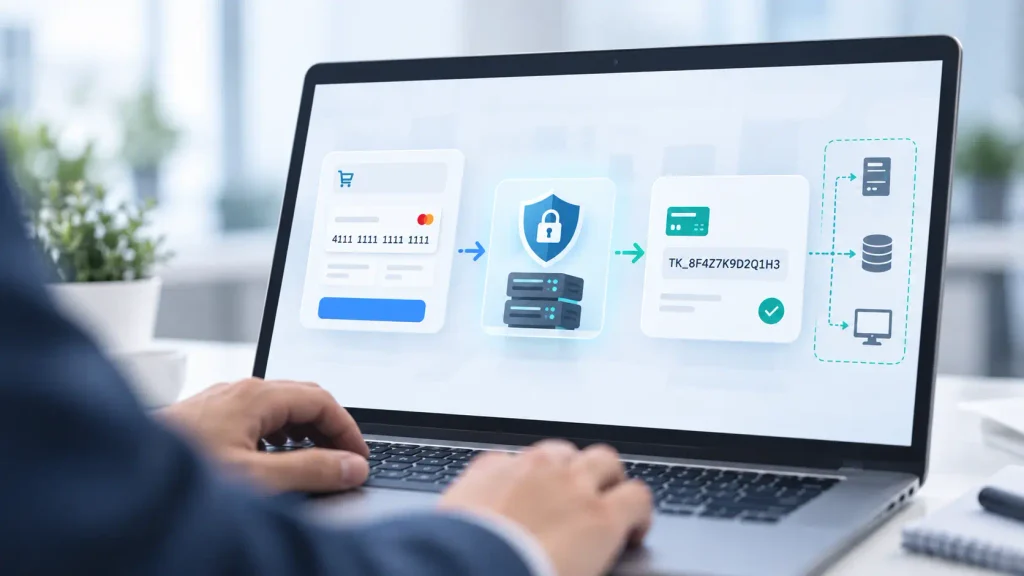
Tokenization replaces a PAN with another value, normally called a token. An application can then store or use the token for an allowed business purpose without necessarily retaining the original card number in that application.
The PCI Security Standards Council’s tokenization guidance explains the central PCI benefit: properly implemented tokenization can reduce the number of places where cardholder data exists and may therefore reduce the number of merchant systems to which PCI DSS requirements apply.
There is a large condition attached to that benefit. The tokenization system itself, PAN storage, de-tokenization functions, and systems or processes with access to those functions can remain within the cardholder data environment. Tokenization moves and concentrates sensitive work; it does not make that work evaporate.
This distinction matters financially. Replacing PAN with tokens across ten ordinary business applications may remove substantial compliance work from those applications while leaving a smaller, tightly controlled tokenization environment in scope. That can be an excellent trade. Moving PAN into a token vault while allowing almost every application to retrieve it on demand may deliver far less scope reduction.
The real cost of tokenization
Do not budget tokenization as a single software line item. A useful cost model has several layers.
| Cost area | What you may be paying for | What makes it more expensive |
|---|---|---|
| Tokenization service | Vault, API, gateway, processor, or token-service fees | Transaction volume, stored credentials, API calls, regions, support level |
| Integration | Engineering changes to checkout, billing, CRM, ERP, or other applications | Legacy code, multiple payment channels, custom integrations |
| Data migration | Converting existing stored PANs into tokens and removing old copies | Large databases, backups, archives, multiple processors |
| Security architecture | Segmentation, access controls, logging, secrets and key management | Self-hosted vaults, complicated networks, broad de-tokenization access |
| Testing and validation | Scope review, assessment work, security testing and evidence | Large CDE, segmentation reliance, custom payment applications |
| Operations | Monitoring, access reviews, incident response and vendor management | 24/7 systems, multiple teams, high availability requirements |
| Exit and migration | Moving tokens or payment credentials when providers change | Proprietary tokens, limited portability, complex vault migration |
A provider therefore offering “tokenization included” does not necessarily make the project free. The token-generation fee may be zero while engineering, data cleanup, testing, migration, and recurring governance consume most of the budget.
The reverse can also happen. Paying for a well-designed hosted tokenization service may increase the payment-provider bill while reducing the internal systems, infrastructure, staff procedures, testing, and evidence that need to remain in PCI scope. A more expensive service can create a cheaper overall compliance architecture.
Do not use a generic tokenization price range as your budget
Public tokenization pricing is difficult to turn into a defensible industry-wide range because commercial models are fundamentally different. Tokenization may be bundled with payment processing, priced as part of a payment vault, sold through an enterprise contract, charged by API or transaction usage, or implemented internally.
A $0 incremental token feature and a large enterprise tokenization project can therefore both be real without describing comparable solutions.
Build your estimate from this equation instead:
First-year tokenization cost = provider fees + implementation labor + migration and cleanup + security changes + assessment/testing + operational setup.
Ongoing cost = provider fees + security operations + recurring validation/testing + support + change management.
If tokenization is part of a broader ecommerce redesign, compare the project with your existing payment architecture rather than evaluating the token vault in isolation. The PCI DSS ecommerce cost guide covers the other expenses that can remain around hosted checkout, payment-page security, scanning, testing, remediation, and validation.
Benefit 1: Less PAN scattered around the business
The most concrete benefit is data minimization. An organization that stores PAN in a billing application, support platform, analytics database, reporting warehouse, CRM, development environment, and export files has created many places that must be secured and investigated.
Tokenization can replace PAN with tokens in systems that do not need the real number. The PAN can remain confined to a much smaller environment or to an appropriately selected service provider.
This is valuable even before discussing assessment cost. A stolen database full of properly designed tokens generally creates a different exposure from a database containing usable payment-card numbers. Tokenization is therefore partly a compliance strategy and partly a data-exposure-reduction strategy.
Benefit 2: PCI DSS scope may become smaller
Scope reduction is usually the business case that attracts the finance team, but it needs careful wording.
PCI SSC guidance states that systems adequately isolated from the tokenization system and cardholder data environment, containing only tokens and no cardholder data or sensitive authentication data, may potentially fall outside the CDE. The organization still needs to establish that PAN cannot be retrieved from those supposedly out-of-scope components.
Imagine that an order-management application needs to associate purchases with a saved payment method but never needs to display the complete PAN. Storing a suitable token instead of PAN may allow the application to perform that function without becoming another repository of card numbers.
Now multiply that design decision across reporting, subscriptions, customer service, refunds, loyalty systems, and data warehouses. The benefit can become substantial because every removed system may mean fewer PCI-specific configurations, access reviews, inventories, evidence requests, remediation tasks, and assessment questions.
But scope is determined by the actual architecture, connectivity, access and functions, not by whether a database column happens to be named token.
Benefit 3: Developers can work with payment references instead of card numbers
Tokenization can simplify application design by separating a business identifier for a payment method from the underlying payment credential.
A subscription system may need to know that Customer 1842 has Payment Method ABC123. It generally does not need every internal microservice to know the corresponding PAN.
That separation can reduce accidental card-data leakage through application logs, debugging tools, database replicas, test environments, data exports, internal dashboards, and analytics pipelines. It does not replace secure-development practices, but it gives developers fewer opportunities to accidentally copy PAN into places it should never have reached.
Benefit 4: A smaller CDE can reduce recurring compliance labor
The recurring savings can matter more than the first-year implementation cost.
PCI DSS is an operating program, not merely an annual questionnaire. Depending on the environment and validation route, organizations may have recurring work involving inventories, access, vulnerability management, monitoring, testing, policies, service providers, evidence and security reviews.
If tokenization genuinely removes systems from PCI scope, the organization may be able to maintain that PCI-specific work across a smaller estate. Where penetration or segmentation testing remains applicable, reducing the environment can also affect the amount of testing work required. For broader budgeting context, see this guide to small-business penetration testing costs.
Tokenization does not mean every token is automatically out of scope
This is one of the most important procurement questions to settle before signing a contract.
A token is useful for scope reduction only within the context of its implementation. Ask whether the system holding the token can also obtain the PAN, whether it can call a de-tokenization API, whether it shares unrestricted connectivity with the token vault, and whether other cardholder data is present in the same environment.
The PCI SSC’s guidance on truncated PANs and systems using tokenization or encryption similarly emphasizes that reversibility, access to related security mechanisms, and environmental separation can affect scope determinations.
In other words, the useful unit is not “the token.” It is the complete system around the token.
Tokenization and encryption are not interchangeable
Encryption transforms data using cryptography and allows authorized recovery of the original value with the necessary cryptographic material. Tokenization replaces the PAN with a surrogate value whose relationship to the PAN is managed through the tokenization system or another controlled mechanism.
Both can be useful security technologies, but they have different implications. PCI SSC has specifically clarified that encryption alone is not sufficient to make encrypted cardholder data automatically fall outside PCI DSS scope.
Tokenization should not be purchased merely because a salesperson describes it as “better encryption.” The design questions are different: where is PAN first captured, where is the token generated, where is the PAN-token relationship maintained, who can reverse or redeem the token, and what connects to those systems?
Merchant tokens and EMV payment tokens are also different
The payment industry uses the word token for several related but distinct technologies.
Acquirer or merchant tokenization commonly replaces PAN after a merchant or its service provider receives payment credentials. These tokens are often used for stored payment methods, recurring billing and internal data-protection purposes.
EMV payment tokens are part of a different standardized payment-tokenization ecosystem. PCI SSC explains in its guidance on PCI DSS and EMVCo Payment Tokens that qualifying EMV payment tokens outside the Token Service Provider’s token data environment are not considered PCI Account Data, although PCI DSS still applies wherever actual Account Data is stored, processed or transmitted.
EMVCo maintains the EMV Payment Tokenisation framework; its Payment Tokenisation Specification – Technical Framework reached version 2.4 in July 2026. Do not assume that a processor’s proprietary card-on-file token, a network payment token and an internally generated database token have identical PCI treatment simply because all three are called tokens.
Hosted tokenization versus running your own vault
| Approach | Potential advantage | Main cost or risk |
|---|---|---|
| Payment provider tokenization | Can keep PAN away from more merchant infrastructure | Provider dependency and migration constraints |
| Independent token vault/service | Can provide a token layer across several processors or applications | Additional integration, service and governance complexity |
| Self-hosted tokenization | Maximum architectural control | Merchant owns more security, availability and PCI responsibilities |
Building a token vault internally can appear attractive when a team already has strong infrastructure skills. However, the comparison should include availability, access control, monitoring, key or secret management where applicable, secure development, backup and recovery, incident response, assessment effort and the continuing cost of maintaining a high-value security service.
A tokenization product should also be evaluated as a security system rather than merely an API. The PCI SSC’s Tokenization Product Security Guidelines discusses security considerations for products that replace PAN with acquiring tokens, including the wider implementation surrounding token generation and use.
The hidden cost: migration and token portability
One of the least glamorous tokenization costs appears when you want to leave.
If tokens are proprietary to a payment provider, moving a subscription business to another provider may require a controlled payment-credential migration rather than simply exporting the token strings and importing them somewhere else.
Before selecting a provider, ask how an eventual migration works. Find out whether the provider supports secure vault-to-vault transfers, which parties must authorize the transfer, whether fees apply, what formats are supported, how long the process typically requires under the contract, and what happens to legacy tokens after migration.
Vendor lock-in is not automatically bad. A managed service may remove enough operational burden to justify it. The mistake is discovering the exit architecture only after the commercial relationship deteriorates.
A simple tokenization ROI calculation
You can estimate the business case without pretending there is one universal market price.
Start with:
Annual benefit = compliance labor avoided + security tooling avoided + testing or assessment work avoided + operational savings + expected risk reduction that your organization is prepared to quantify.
Then compare that with first-year and recurring tokenization costs.
Here is a purely hypothetical example, not an industry price benchmark. Suppose a company expects 80 hours of engineering integration at an internal loaded cost of $100 per hour, $500 per month in service costs, and $2,000 of externally invoiced migration and validation work.
Its illustrative first-year project cost would be:
80 × $100 = $8,000 implementation labor
$500 × 12 = $6,000 annual service cost
$2,000 migration and validation
Total illustrative first-year resource cost = $16,000 ($8,000 external cash plus $8,000 allocated internal labor)
Now suppose the new architecture demonstrably removes enough systems from PCI scope to save 100 hours of recurring compliance and engineering work per year at $80 per hour plus $4,000 of testing, tooling or assessment expense.
100 × $80 = $8,000 labor savings
$4,000 other recurring savings
Total illustrative annual resource benefit = $12,000 ($4,000 external expense avoided plus $8,000 internal capacity released)
This hypothetical example is a resource comparison, not a cash-return forecast or industry benchmark. Assuming all benefits begin in year one, resource benefit of $12,000 less resource cost of $16,000 gives a first-year net resource effect of −$4,000 and a simple resource ROI of −25%. The 100 hours released are capacity, not automatically a payroll reduction. Prorate benefits if implementation takes part of the year, and add any recurring operating costs omitted from the illustration.

Scroll the table horizontally on small screens. Keyboard users can focus the table region and use the arrow keys.
| Same hypothetical example | External cash | Internal capacity / resource view |
|---|---|---|
| First-year additions | $6,000 service + $2,000 external migration = $8,000 | $8,000 allocated setup labor; total resource cost $16,000 |
| Full-year avoided work and expense | $4,000 assumed external expense avoided | 100 hours × $80 = $8,000 capacity released; total resource benefit $12,000 |
| First-year net effect | $4,000 avoided − $8,000 new cash = −$4,000 | $12,000 benefit − $16,000 cost = −$4,000 |
| Later full-year net effect | $4,000 avoided − $6,000 service = −$2,000 | $12,000 benefit − $6,000 service = +$6,000 before other recurring resource costs |
The later-year resource result is positive while cash cost still rises in this example. That can be a deliberate capacity investment, but it should be described that way. Confirm that the $4,000 external expense will actually stop, identify how released hours will be used, and do not count either benefit twice.
When tokenization is most likely to be worth the cost
The business case tends to become stronger when PAN currently reaches many systems or when several applications need a persistent payment reference without needing the card number itself.
- You currently store PAN in one or more merchant-controlled databases.
- Multiple internal applications receive or copy card numbers.
- You operate recurring or card-on-file billing.
- Developers, analysts or support systems need payment references but not PAN.
- Your current CDE includes substantial infrastructure solely because card data passes through it.
- You repeatedly spend staff or assessor time proving controls for systems that could function with tokens instead.
- You are redesigning payment architecture anyway and can remove card data rather than merely protecting more copies of it.
When tokenization may not save much money
Tokenization is not automatically an optimization project.
If a small merchant already uses a strongly outsourced payment model and does not store PAN, another tokenization layer may add complexity without materially reducing merchant scope. Similarly, an organization that installs a token vault but retains old PAN databases, unrestricted de-tokenization, flat network connectivity and card numbers in logs may pay for tokenization while preserving most of the original compliance burden.
A tiny environment should therefore compare tokenization against the simpler option of avoiding card-data storage altogether. Sometimes the most economical token vault is the one your existing payment provider already operates.
What to ask a tokenization provider before buying
- Where is PAN first captured? Determine whether it touches your website, application, server, network or employees before tokenization.
- Who operates the vault? Identify the entity storing the PAN-token relationship and its role in your PCI architecture.
- Who can de-tokenize? Document applications, users, service accounts and workflows that can recover or otherwise access PAN.
- What PCI evidence is available? Ask for appropriate current compliance documentation and understand which services and locations it actually covers.
- What remains our responsibility? A provider’s PCI compliance does not transfer all PCI obligations to its customers.
- How are tokens scoped? Ask how the provider expects merchant systems storing only its tokens to be evaluated and confirm important assumptions with your assessor or compliance-accepting entity.
- How does migration work? Get the exit procedure before creating thousands or millions of stored payment references.
- What happens during an outage? Understand availability, recovery, redundancy and how payment operations behave when token services fail.
- How are logs and support tools protected? A pristine vault does not help if PAN is copied into debugging logs before reaching it.
- What exactly does the quote include? Separate tokenization, payment processing, vault storage, API usage, support, migration and professional services.
Common tokenization mistakes that destroy the expected savings
Keeping the original PAN “just in case.” If the old card database remains active, the organization may preserve the very exposure and compliance burden the project was supposed to remove.
Allowing broad de-tokenization. When numerous applications and employees can exchange tokens for PAN, the scope-reduction story becomes much harder to defend.
Ignoring backups and archives. Deleting PAN from the production database does not necessarily remove historical copies from backups, exports, data lakes, old test systems or disaster-recovery environments.
Confusing tokenization with complete PCI outsourcing. PCI DSS is broader than stored PAN. Systems can remain relevant because they process or transmit account data or can affect the security of the CDE.
Buying before mapping the data flow. A tokenization quote without a payment-data diagram is a little like pricing a bridge before deciding which river it crosses.
Frequently asked questions
Does tokenization make a business PCI DSS compliant?
No. PCI SSC explicitly treats tokenization as a technology that may help reduce cardholder-data exposure and PCI DSS scope. It does not replace the applicable PCI DSS requirements or the need to validate compliance through the route required for your organization.
Can tokenization completely remove a system from PCI scope?
Potentially, but not merely because the system stores tokens. The system’s connectivity, ability to retrieve PAN, relationship with the CDE, presence of other account data, segmentation and actual implementation all matter. Scope decisions should be confirmed for the specific environment rather than assumed from a product description.
Does tokenization eliminate the need for encryption?
No. Tokenization and encryption solve different problems, and a tokenization environment still needs appropriate protection for PAN, communications, credentials, secrets and other sensitive information wherever applicable. Tokenization should be part of the security architecture, not a substitute for it.
Is network tokenization the same as a merchant’s payment-vault token?
No. EMV payment tokens operate within the EMV payment-tokenization framework, while acquirer or merchant tokens may be proprietary values used for card-on-file, recurring payments or internal data protection. Their functions and PCI implications should not be treated as identical.
Is tokenization worth it for a small business?
It can be, particularly when the business would otherwise store PAN or distribute card data across several applications. For a very small merchant already using a fully outsourced payment flow, adding another tokenization product may provide little additional scope reduction. Start with the payment architecture, not the product catalogue.
Calculate the benefit from the systems you can actually remove from scope
The strongest financial argument for PCI DSS tokenization is not that tokens are fashionable security plumbing. It is that fewer systems handling real card numbers can mean fewer places to protect, fewer places to leak PAN, and potentially fewer systems requiring PCI-specific controls and evidence.
Before requesting tokenization quotes, draw the current payment-data flow. Mark every location where PAN is captured, transmitted, stored, logged, backed up or recoverable. Then draw the proposed tokenized architecture beside it.
For each system, ask one blunt question: after tokenization, does this system genuinely stop storing, processing, transmitting or having relevant access to cardholder data and the tokenization environment?
That before-and-after map is the foundation for the cost calculation. If the map gets dramatically smaller, tokenization may pay for itself through reduced exposure and recurring compliance work. If almost everything remains connected to PAN and de-tokenization, you may have purchased an elegant new token layer while leaving the PCI workload largely intact.
Technical guidance updated: 2026-10-13. Made the tokenization example’s negative first-year ROI and net recurring benefit explicit.
Worked example reviewed: 2026-10-23. Separated externally invoiced costs, avoided cash expense and allocated internal capacity in the hypothetical ROI example. The figures are illustrative assumptions, not vendor prices or observed savings.