A vendor’s PCI DSS Attestation of Compliance (AOC) summarizes the provider’s assessment scope and result. Match it to the service and deployment you use.
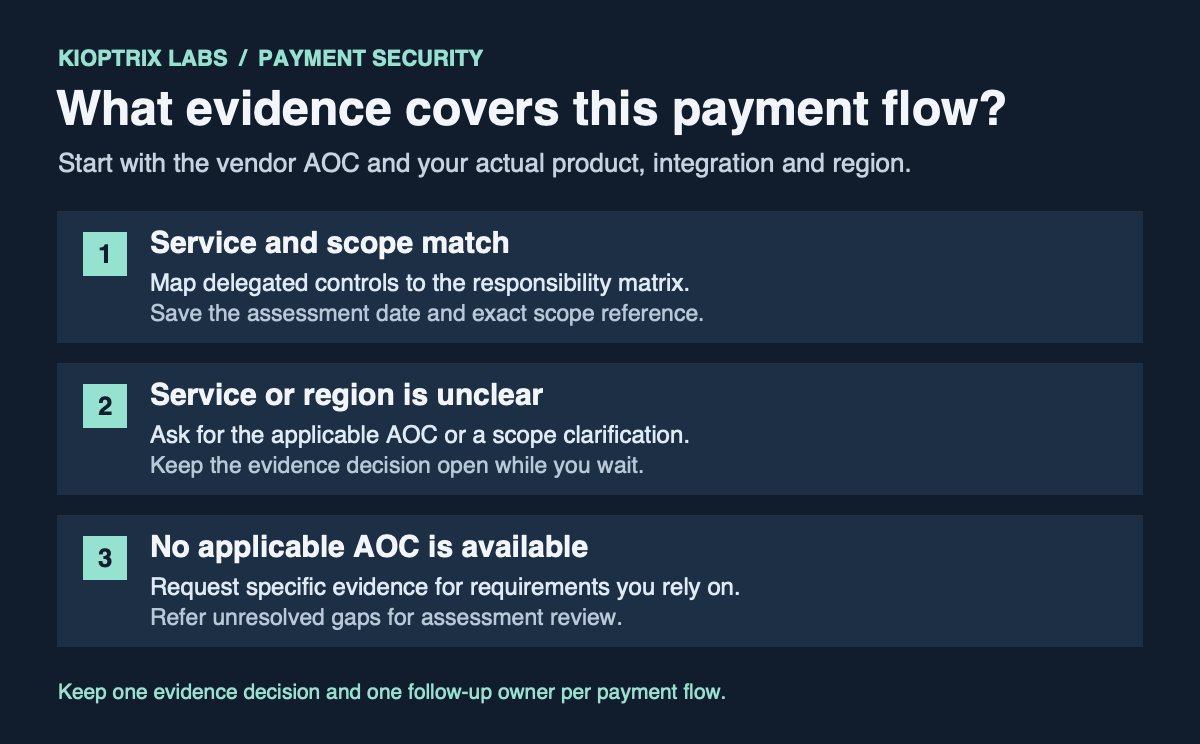
Scope matches: Record the match and verify delegated controls.
Scope unclear: Request a written clarification tied to the assessment.
Evidence missing: Request evidence for the controls you rely on and assign a reviewer.
Table of contents

Start with three records. Open the provider’s AOC, your signed order form and your live payment-flow inventory. Put them side by side. If the service or region differs, record the exact mismatch and send the request template below.
How to Review a PCI DSS Attestation of Compliance
For each payment flow, record one evidence decision and one next action. Start with the legal entity, the product and the live deployment, then map the controls you depend on. A PCI DSS Attestation of Compliance can cover one payment flow while leaving another open for follow-up.
- Scope matches. Save the section that names the service and map the delegated controls to your responsibility matrix.
- Scope is unclear. Request a written clarification that identifies the assessed product, integration or region.
- Applicable evidence is missing. Ask for control-specific evidence and record who will review it.
Read the Official Service Provider AOC
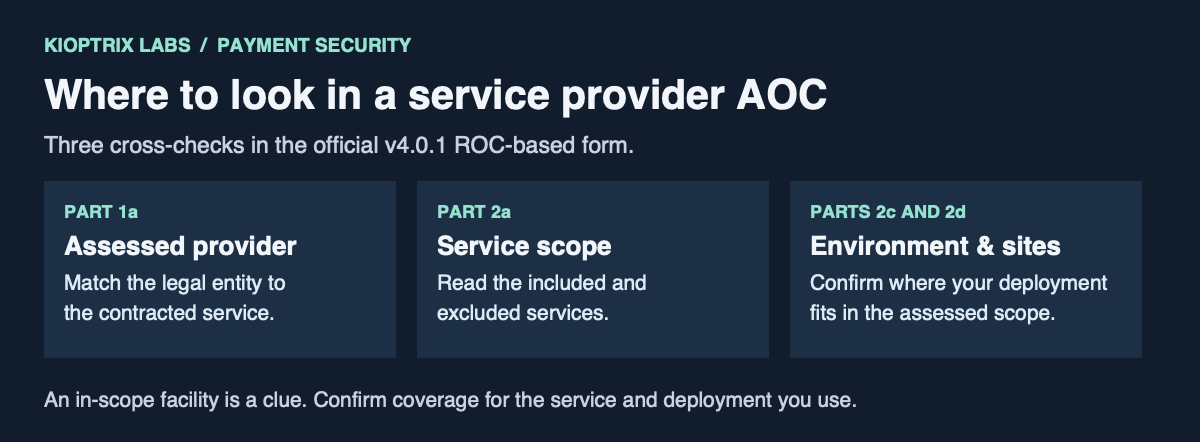
Use the PCI SSC v4.0.1 ROC AOC for Service Providers (PDF) alongside your order form and payment-flow inventory. The section numbers below apply to the August 2024 ROC-based service-provider form. If your provider was assessed using SAQ D for Service Providers, start with the corresponding AOC and follow the section labels in that form.
| Form section | What to capture in your review |
|---|---|
| Part 1a · Assessed entity | Record the service provider named on the AOC. Match it to the contracted service and document how any reseller, affiliate or trade name relates to that entity. |
| Part 2a · Scope verification | Read both the included and excluded services. Capture the exact service name and note how your integration matches it. A familiar product name is a starting point for the comparison. |
| Part 2c and 2d · Environment and facilities | Read the environment description in the PCI DSS Attestation of Compliance alongside the locations list. A listed facility is one piece of evidence about where the assessed environment operates. Confirm separately whether the checkout deployment you use was in scope. |
| Part 3 · Validation | Record the assessment date and the result for the assessed services. Keep the date you reviewed the document and any sign-off dates in their own fields so each date has a clear meaning. |
If a provider sends a marketing badge or stand-alone certificate in place of a PCI DSS Attestation of Compliance, ask for the applicable official reporting form. If its PCI DSS Attestation of Compliance names a broad service family, identify exactly what still needs confirmation before accepting it for your payment flow. PCI SSC FAQ 1220.
1. Match the assessed legal entity
Start with the legal entity named in the PCI DSS Attestation of Compliance and compare it with your agreement, order form and vendor inventory. A different legal name can be legitimate when a reseller invoices you, a subsidiary delivers the service or the provider operates under a trade name. Ask for a written mapping that identifies the entity delivering the service and the assessed entity covering it.
Record both names in your review. If the supplier can only point to a parent company’s logo, leave the scope question open until the coverage relationship is documented.
2. Match the product and deployment you use
Write down the exact product, integration mode and region for each live payment flow before reading the scope description in the PCI DSS Attestation of Compliance. Use your order form and deployment inventory. Where the document describes broad service families, ask the provider to identify the specific product and any limitations.
For example, a vendor may sell both a hosted payment page and an API integration under the same brand. Track them separately if your business uses both. A regional product launch, new integration or migration can change the evidence you need even when the contract name stays the same.
3. Check the assessment basis and date
Check the stated PCI DSS version, assessment completion date, assessment basis and attestation details. File the complete applicable version of the AOC in your restricted evidence repository and record the date you reviewed it. Ask for the next assessment timeline when the current evidence is approaching your review window.
Keep the vendor’s assessment date, your review date and your next follow-up in separate fields. PCI SSC distinguishes evidence deemed valid when reviewed during an assessment from the ongoing process of updating evidence. For acceptance questions, check with the organization managing your compliance program. PCI SSC FAQ 1601.
4. Read the scope exclusions and assessment results
Look for services, locations or components that the PCI DSS Attestation of Compliance describes as outside scope. Where the attestation alone leaves a control or scope question unresolved, request the applicable excerpts from the Report on Compliance (ROC) or SAQ D for Service Providers, using the provider’s secure sharing process. Seek evidence tied to the part of the service you actually use.
A redaction that obscures your service coverage creates a specific follow-up. Ask for a written confirmation tied to the assessment scope, or arrange a controlled review of the necessary detail. Record the open question before marking a control as supported. PCI SSC FAQ 1576.
5. Tie delegated controls to the responsibility matrix
Identify which applicable PCI DSS requirements you rely on the provider to perform and compare them with the provider’s responsibility matrix or equivalent documentation. For shared controls, write down each party’s actions and the evidence each side supplies. In a managed service, for example, the provider might operate a monitoring tool while your team owns escalation contacts and follow-up.
Keep the AOC, written acknowledgment and responsibility mapping available as separate records in the vendor file. The PCI DSS responsibility matrix guide shows how to document shared controls and assign follow-up owners.
Use one row per service and applicable requirement. A row for managed monitoring could name the vendor as the alert operator and your team as the owner of the response procedure. Write down who provides a control description and who can answer follow-up questions. Store the scope reference alongside the row so reviewers can trace the decision back to the correct deployment.
Which Vendor Document Answers Which Question?
Choose the evidence to match the question blocking your review. Ask for the smallest useful extract through the provider’s evidence portal. A short scope clarification can settle an entity-name mismatch. A question about an outsourced control calls for its ownership mapping and the applicable assessment evidence.
- Attestation of Compliance. Use the PCI DSS Attestation of Compliance to identify the assessed entity, the relevant service and the assessment outcome. Keep a reference to the section on which you rely.
- ROC or SAQ D for Service Providers excerpt. Ask for the portion that clarifies the assessment scope or the result for the specific requirements your team relies on.
- Responsibility matrix. Use it to assign control activities and identify which party should supply evidence when you prepare your own assessment.
- Signed agreement or acknowledgment. Use it to document the commercial relationship and the provider’s acknowledgment. Map any reseller or affiliate name to the assessed provider in your vendor records.
6. Escalate missing or mismatched evidence
If the vendor lacks an applicable PCI DSS Attestation of Compliance, ask what evidence it can provide for the requirements you rely on. PCI SSC describes a path where the vendor supplies specific evidence for customer or assessor review. A merchant SAQ A or its AOC is insufficient evidence of PCI DSS compliance for a provider’s merchant customers. PCI SSC FAQ 1065.
Requirement 12.8 covers how you oversee vendors and monitor their compliance status. When a provider performs a PCI DSS requirement on your behalf, evidence for that requirement also matters to your own assessment. If enough evidence is unavailable, document the gap and discuss the assessment impact with your assessor or compliance program contact. PCI SSC FAQ 1312.
7. Record the decision and set the next review
Give each payment flow a review status such as evidence matched, clarification requested or referred for assessment review. Save the reason, the supporting document reference and the owner of the next action. This lets the next reviewer reproduce the decision without rebuilding the payment inventory.
Monitor provider compliance status at least once every 12 months under Requirement 12.8.4. As an operating practice, reopen your coverage review when your payment flow changes, a provider moves the service to a different region or you add a managed feature that affects a relevant control. See the payment provider switch checklist for the evidence to collect during a migration.
Worked example: One provider, three evidence decisions
An illustrative online retailer runs hosted checkout in the US and EU. It also buys managed monitoring for its payment page. The provider’s PCI DSS Attestation of Compliance specifically identifies US Hosted Checkout. Here is what the retailer records before deciding which evidence can support each flow.
| Service in use | What the AOC shows | Review action |
|---|---|---|
| Hosted Checkout, US | Matches the named service and region | Record the scope match and verify the controls you plan to rely on. |
| Hosted Checkout, EU | US coverage only | Ask for evidence covering the EU deployment or written clarification tied to the assessment scope. |
| Managed payment page monitoring | Separate add-on with no scope mapping | Identify who runs the control and request evidence for the add-on if your assessment relies on it. |
Completed Vendor Review Record
Illustrative record. Provider, dates and evidence are fictional. The part numbers refer to the official ROC AOC above. In this example the merchant has a valid record for its US redirect flow and is reviewing its separate EU redirect deployment.
| Review field | Completed example |
|---|---|
| Assessed provider and payment flow | Example Payments LLC · Hosted Checkout · EU deployment · browser redirect. Order form reference: EX-017, line 2. |
| Assessment and review dates | ROC assessment completed 2026-08-26. Merchant reviewed the evidence on 2026-11-20. |
| Exact evidence reference | Provider PCI DSS Attestation of Compliance v4.0.1, Part 2a identifies Hosted Checkout US. Part 2c describes the US checkout environment. The material supplied leaves EU deployment coverage unconfirmed. |
| Delegated control evidence | The merchant relies on checkout operation and the associated access controls. The supplied responsibility matrix maps responsibilities for US Hosted Checkout. EU control coverage remains open. |
| Decision and reason | Scope confirmation pending. The AOC names a service used by the merchant, but the evidence available for the review covers only the US deployment. |
| Owner, next action and follow-up | Payments Operations · Request an applicable EU AOC or a written scope clarification tied to the assessment, plus the EU control mapping · Follow up on 2026-11-27. |
| Closure criteria | A reviewer records the applicable scope reference and separately resolves the controls the merchant relies on. If the provider cannot supply enough evidence before the review deadline, refer the unresolved item to the assessor or compliance program contact. |
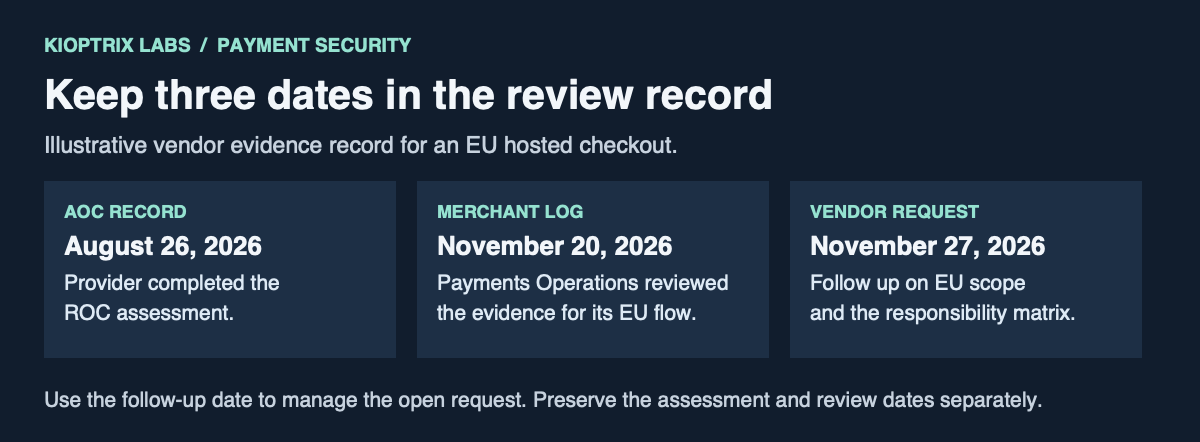
This row records an evidence decision for a single payment flow. Keep the ordering document, the assessment evidence and the responsibility matrix together by reference so a reviewer can trace why each field was filled in. Retain a separate row for the US deployment and update the EU row only when you receive evidence relevant to that deployment.
What to Keep in the Vendor Review Record
Close a clarification only after the evidence owner records what changed and who reviewed it. For instance, after the provider confirms which regional service it assessed, update the deployment row and record the basis for the decision. Leave any unresolved control evidence attached to the requirement and identify the next reviewer.
Set a Follow-Up Date for Open Evidence Requests
For an open request, log the service, the exact question, the vendor contact and your internal decision owner. Set the follow-up date far enough ahead of your assessment deadline to allow for another exchange. Evidence becomes hard to trace if answers live in one person’s inbox, so attach the response to the matching service row.
At the next annual review, compare the new assessment scope against the previous record and your live payment-flow inventory. If your business moved from a redirect to an embedded integration, mark the new flow explicitly and ask whether the latest PCI DSS Attestation of Compliance covers it. Let the previous evidence remain linked to the earlier deployment so the next reviewer can see why the decision changed.
Copy this vendor request
Subject · PCI DSS evidence for [product and deployment]
Hello [team], we use [product and integration mode] in [region] under an agreement with [contracting entity]. Could you share the service provider PCI DSS Attestation of Compliance applicable to this deployment and point us to the scope statement that covers it?
Please also share the PCI DSS responsibility matrix or equivalent mapping for the services we use. If any component is excluded or delivered by another entity, please identify which component, who provides it and what evidence is available. A secure portal or controlled evidence review works for us.
Two More Ways Vendor Evidence Can Miss Your Payment Flow
The invoice and the assessment name different companies
Imagine an online store buys its checkout through a reseller. The invoice lists one company, the checkout documentation lists an operating subsidiary, and the PCI DSS Attestation of Compliance names a third entity. Procurement can confirm who signed the agreement, while the payment owner can confirm which service handles the live transactions. Ask the party that supplies the assessment evidence to explain the legal entity and delivery relationship in writing.
A usable answer identifies the assessed entity that covers the contracted checkout and explains which entity operates it. Record the mapped names and the scope section in the vendor file. If the reseller also has a role in managing the integration, record that role separately so its activities are visible when controls and evidence owners are assigned.
Suggested follow-up wording: “Our order form identifies [reseller], but our integration documentation names [operator]. Which entity operates the service covered by the assessment, and which scope section includes the checkout listed on our order form?”
A second payment integration goes live after the initial review
Suppose a subscription business validated its hosted checkout evidence and later adds a payment API for another workflow. The original review covered the redirect checkout. Open a second row for the API and record what the application sends, which service receives it and who operates each part of the flow. Attach an architecture reference so the evidence owner can identify the exact integration.
Send the provider the names of both integrations. Ask which one the assessment scope covers and whether the responsibility mapping differs between them. Keep the first decision tied to the redirect. For the API, leave the review open until the provider or assessor can connect the new flow to adequate evidence.
Suggested follow-up wording: “We already reviewed Hosted Checkout for [region]. We are now adding [API capability] to [workflow]. Please confirm which evidence covers this integration and identify any responsibilities that our team must take on.”
Prepare the Unresolved Items for Assessment Review
Keep the assessment handoff short enough for a reviewer to act on. Include the product, region and integration, followed by the exact question that remains open. Attach the evidence you already received and describe where it falls short. If the provider gave you a partial document under a confidentiality process, record how the appropriate reviewer can access the relevant portion.
Before handing over the record, open each link using the reviewer’s access level where practical. An evidence reference should point to the right file and scope section. For secure portal links that expire, record the provider contact and the access procedure alongside the link so the reviewer can request a fresh copy.
Common questions
Does a public provider listing settle the scope question?
Use the listing as an initial check. Retain the listing as a reference and use the evidence for your deployment to make the scope decision.
Does a vendor PCI DSS Attestation of Compliance cover our own assessment?
Use it as evidence for the relevant provider services. Your assessment still needs evidence for the applicable controls your organization manages, including your part of any shared responsibilities.
What if the vendor says its next assessment is underway?
Request the existing applicable evidence and the expected completion date. Log the follow-up owner and date. If the assessment deadline comes first, ask your compliance program contact which evidence it can accept.
Sources and Editorial Review Scope
Source check, November 20, 2026. Kioptrix Labs checked the review steps against the August 2024 service-provider ROC AOC form for PCI DSS v4.0.1 and PCI SSC guidance on third-party provider evidence, assessment dates and customer responsibilities. The decision examples are illustrative. The review covers identifying applicable evidence and documenting gaps.
The annual monitoring cadence, the assessment completion date and the deadline for your own validation serve different purposes. Start with PCI SSC FAQ 1312 for vendor oversight and PCI SSC FAQ 1601 for evidence that is nearly a year old at the time of review. The organization that accepts your compliance evidence can answer questions about what it will accept for your assessment.
Official references
- PCI SSC Document Library for PCI DSS standards and reporting templates
- PCI SSC FAQ 1576 on evidence from third-party service providers
- PCI SSC FAQ 1312 on customer responsibilities when using service providers
- PCI SSC FAQ 1601 on assessment completion dates and evidence review