A PCI DSS responsibility matrix records who manages each applicable requirement when you use a third-party service provider. Give each row an exact service, a requirement or control, an owner, and evidence that covers that service. If a task is shared, write down what each party must do and who verifies the handoff. That last detail is what makes the matrix useful when a provider changes or an assessor asks for proof.
Contents

See a completed example · Copy a blank row · Request provider evidence
A completed PCI DSS responsibility matrix example
This PCI DSS responsibility matrix example follows a fictional retailer that uses a hosted checkout, an in-scope payment administration portal, and a separately contracted managed-support add-on. Scroll across the table on narrow screens to see the decision for each row. These are internal evidence decisions for the services and sample records shown. Determine requirement applicability and your validation method for your own environment. PCI DSS v4.0.1 in the PCI SSC Document Library
| Requirement and service | Merchant action | Provider action | Evidence reviewed | Decision and next step |
|---|---|---|---|---|
| 8.2.5 In-scope payment admin portal · terminated-user access | Record the effective termination time, trigger the removal, and verify that the portal account no longer has access. | The managed service disables the role immediately at termination under the agreed offboarding workflow. | Effective time and provider audit event both recorded at 09:00 UTC, plus the offboarding ticket and post-change access export. Check physical factors where applicable. | Verified for this sample. The event and export match the user, portal, and effective time. Retain the evidence with the ticket. |
| 12.8.2 Hosted checkout · written acknowledgment | Check that the signed agreement includes the provider’s written acknowledgment for the hosted service and retain the relevant section. | Provide the written acknowledgment covering its responsibilities for account-data security or its ability to affect the customer’s cardholder data environment, as applicable. | Executed agreement, service schedule, and dated review note pointing to the exact clause. | Verified for hosted checkout. Keep the link to the signed clause. Review the support add-on separately. |
| 12.8.4 Hosted checkout · provider status monitoring | Review the provider’s status at least annually. Match the assessed entity, service, and relevant coverage to the signed scope. | Supply the applicable Attestation of Compliance (AOC) and clarify which service and deployment it covers. | AOC scope pages, signed order form, assessment completion date, dated merchant review, and next review date. | Review complete for hosted checkout. The AOC covers that service. The review does not extend to the managed-support add-on. |
| 12.8.4 and 12.8.5 Managed-support add-on · scope and responsibility gap | Keep the add-on as a separate service. Ask who administers payment settings, which tasks remain with the merchant, and how the provider’s work is evidenced. | Confirm the service boundary and provide the responsibility split and applicable assessment or control evidence. | The order form lists the add-on. The AOC received covers only hosted checkout. No add-on responsibility statement or applicable control evidence has been reviewed. | Open. The vendor owner requests the missing documents before activation. Close only after reviewing the allocation and supporting evidence, or after documenting and validating a different control arrangement. |
Start with the open row. The provider sent an AOC, but its scope stopped at hosted checkout. For the add-on, the merchant still needed a responsibility split and evidence for the applicable controls. See how the vendor owner followed up.
Requirement | Exact service and environment | Merchant action | Provider action | Evidence reference and date | Decision and reason | Follow-up owner and due date | Next review
1. Scope services for the PCI DSS responsibility matrix
Start your PCI DSS responsibility matrix from the payment journey. Follow a shopper from the storefront to checkout and back to the order confirmation. Then follow the staff workflow for refunds, account access, and support. Record the services that handle account data or can affect the security of the cardholder data environment. The functional name in your process notes should map to a specific contracted service.
Write down the provider’s legal entity, the commercial product name, the purchased tier or add-on, and the relevant environment or region. A reseller, platform operator, and managed support team can have different roles. In a small business they may share a single invoice. Keep distinct entries if their responsibilities or evidence differ.
When your integration has more than one payment path, identify each path. A hosted checkout for web orders and a separately administered virtual terminal for phone orders should have distinct notes. Evidence for one path may have no bearing on the other. The payment provider switching checklist shows additional things to record during a migration.
The PCI Security Standards Council (PCI SSC) also distinguishes a vendor that sells a product from one that provides ongoing support or has access to the cardholder data environment. Review the service it delivers as well as the product it sells. PCI SSC FAQ 1427 on suppliers and ongoing services
2. Map applicable requirements in the PCI DSS responsibility matrix
PCI DSS v4.0.1 Requirement 12.8.5 calls for maintaining information that identifies which requirements each third-party service provider manages, which the customer manages, and which they share. A PCI DSS responsibility matrix is one way to document that information. Requirement 12.9.2 addresses the provider’s support for customer requests about status and responsibilities. Use the standard for applicability and the Council’s guidance for the supporting evidence. PCI SSC Document Library · PCI SSC FAQ 1576 on provider evidence
Use the most specific requirement reference you can support. If a provider marks an entire requirement family “shared,” ask which task it performs on which service. Record the answer at account, console, or service level so the next reviewer can trace it to the right evidence.
Use Merchant, Provider, and Shared as responsibility values. Keep a separate evidence status such as Verified, Open, or Under Review. An unknown owner belongs in the follow-up queue. For a requirement you believe does not apply, record the reason in a separate applicability decision and confirm it through your validation process. The PCI DSS SAQ guide explains where those decisions fit into the assessment record.
If purchasing and security have separate workbooks, give the agreement, evidence package, and responsibility row a common service identifier. Reviewers can find the signed scope from a row without searching every order form. Keep the provider’s full document in a controlled folder and point the matrix to the relevant section instead of copying confidential assessment details into shared notes.
3. Split shared responsibilities into separate actions
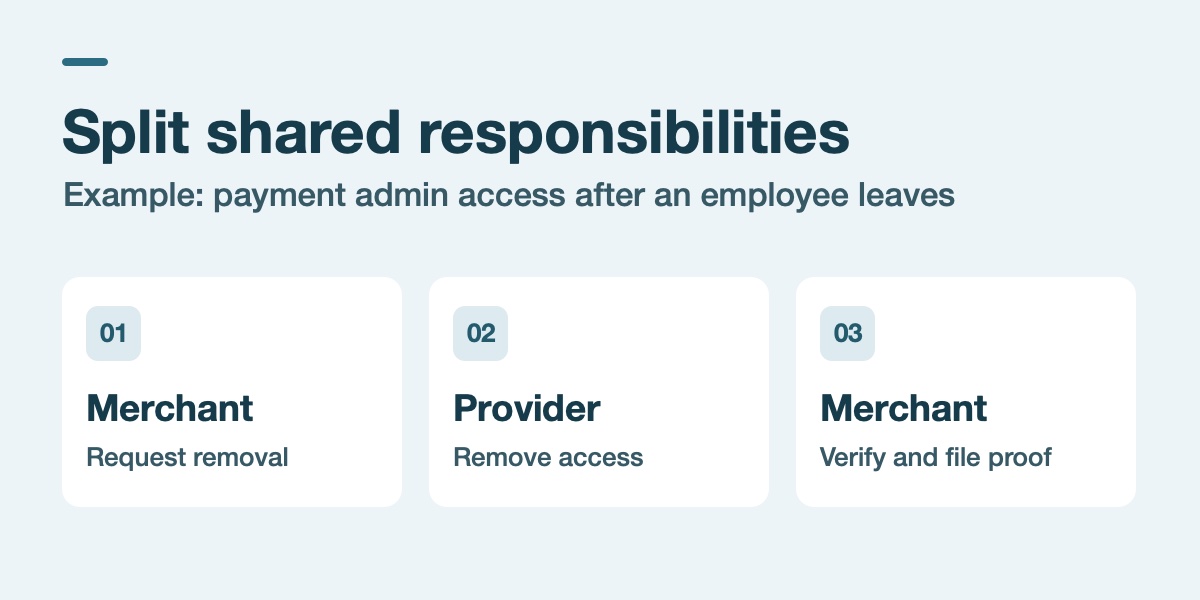
Each shared row in the PCI DSS responsibility matrix needs an input, an action, and a check. In the example above, the merchant sends the user identity, the affected service, and the applicable departure time through the agreed route. The provider removes the managed role and acknowledges completion. A named merchant role checks the outcome and records the link to the ticket. Write each action in its own sentence.
Review how the handoff works when the normal contact is absent. An agreed fallback contact and a method to confirm that a request was received can matter more than a generic response-time promise. Ask whether a request can be tracked to completion and who receives the result. An unanswered confirmation should have an owner and a next review date.
The PCI DSS responsibility matrix can include more than two parties. If the identity team removes the internal account, the merchant asks a managed service to remove a separate portal role, and the payment provider administers a different set of accounts, write one row per boundary. Evidence of action in one directory or portal should support the record for that system only.
4. Match the AOC and other evidence to the service
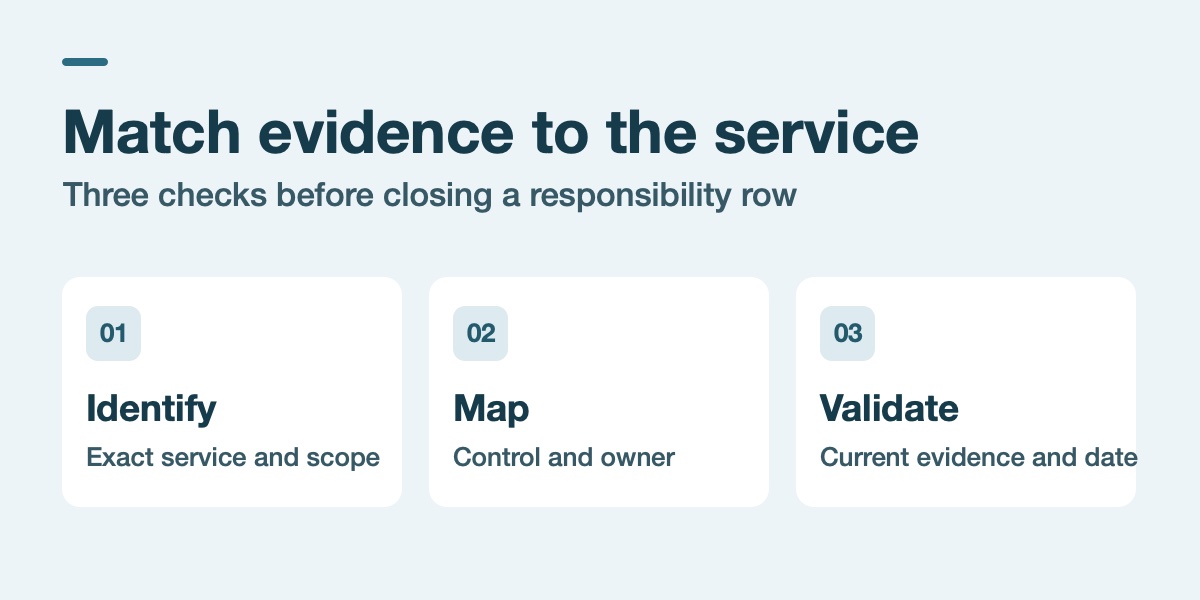
Review the provider AOC against the service in the PCI DSS responsibility matrix. Match the assessed entity and service description to your contract, then check whether the relevant requirements were covered. Look for limitations and exclusions that affect your configuration. Record the assessment completion date and the date your team reviewed the evidence as separate fields.
If an order form uses a different product name from the AOC, request a written mapping that identifies the assessed service and any explicit exclusions. Record the source and its effective date. If the provider confirms an exclusion, ask for the relevant requirement-specific evidence or revisit the control arrangement.
PCI SSC FAQ 1576 explains what to request if an applicable AOC is unavailable. Ask for evidence tied to the specific requirements the provider performs for you. Coordinate the acceptable evidence with the assessor or compliance-accepting entity where appropriate. The material you receive may need a restricted storage location or a secure review arrangement. PCI SSC guidance on an applicable AOC and other evidence
If the assessment date is approaching a year, ask about the provider’s next assessment and document the response. PCI SSC addresses that timing in a dedicated FAQ. Use it to frame the discussion with your assessor, provider, or compliance-accepting entity rather than assigning a universal expiration date in your workbook. PCI SSC FAQ 1601 on assessment timing
How a scope mismatch looks in the review record
At intake, the hosted-checkout AOC was usable for the hosted-checkout row. The separately ordered managed-support tier stayed open. The vendor owner sent the provider the exact order-form description and asked which service can change payment settings and which evidence covers those actions.
In this fictional follow-up, the provider confirmed the add-on was outside its AOC. It then supplied a signed scope and duties statement for the add-on and offered controlled review of a sampled authorization record, change log, and completion acknowledgment. The merchant reviewer compared the sample with the agreed duties, recorded the limitations and confirmed with the assessor how the applicable controls would be evaluated. The reviewer closed the responsibility assignment under 12.8.5 after both sides confirmed the split. The separate provider-status review under 12.8.4 used the documented outcome and its next review date. The hosted-checkout AOC remained attached to the hosted-checkout row.
In your PCI DSS responsibility matrix, record the decision date, reviewer role, document references, and reason for the change. If the provider supplied only a statement assigning duties, you could resolve ownership while leaving evidence of control operation open. That distinction prevents a closed ownership question from being mistaken for a completed assessment.
5. Locate the written acknowledgment in the agreement
Alongside your PCI DSS responsibility matrix, keep the written agreement and locate the relevant acknowledgment of security responsibilities under 12.8.2. The PCI SSC explains these merchant and provider obligations in its outsourcing guidance. Keep the effective date and the applicable service appendix with the agreement, so you can show what was in effect when the provider began work. PCI SSC FAQ on outsourced payment processing
Use the agreement to identify the commitment, the AOC or scoped evidence to support the assessment status, and the matrix to assign operational work. If the documents differ, ask the relevant parties to confirm the difference in writing and record how it was resolved.
Before contract renewal, open the PCI DSS responsibility matrix and check how your team can obtain the current evidence, which contact receives urgent requests, and how the provider announces material changes. Link the current terms to the relevant rows. If an addendum supersedes part of the agreement, record its effective date and which services the addendum covers. A reviewer should be able to trace the row back to the terms in force on the relevant date.
6. Give gaps an owner and a next decision
Open an issue whenever the PCI DSS responsibility matrix contains an unknown owner, unverifiable coverage, or an unresolved dependency. Capture who will collect the missing information, when a decision is needed, and what the decision can affect. A missing link is a different issue from evidence that expressly excludes a service. Use a precise note so the next person can act on it.
| Finding | Next action | What would close it |
|---|---|---|
| No written answer on role removal | Merchant IAM owner asks the managed service who removes and verifies portal roles. | Written assignment and a sample completion record. |
| AOC only lists the core hosted checkout | Vendor owner asks for evidence that covers the support add-on or confirmation of its exclusion. | Applicable evidence reviewed. If excluded, the responsible team documents the alternative and confirms treatment. |
| Customer and provider each mark the other as owner | Compliance lead brings both owners together and records the disagreement. | Agreed assignment, an evidence owner and the first review date. |
For an open row tied to a launch or validation submission, make the dependency visible. Tell the person deciding whether to proceed which service is affected and what remains unresolved. If you are relying on a provider for an applicable requirement, PCI SSC notes that the provider’s work affects the customer’s compliance assessment. PCI SSC guidance on third-party service providers
7. Keep the PCI DSS responsibility matrix current
Requirement 12.8.4 calls for monitoring provider PCI DSS compliance status at least annually. Treat each review as a compare-and-record exercise. Start with the prior PCI DSS responsibility matrix, confirm the services still in use, and note what changed in the agreement, provider status, or duties. Keep the evidence date and reviewer initials so the next owner can see what actually happened.
Review the affected rows when you add or remove a checkout path, change provider plans, bring in a managed support team, or alter who can administer payments. If both old and new providers are active during migration, keep both entries and note the handover date. Inspect retained access, remaining services, and any outstanding evidence before archiving the old row.
Keep a dated change history. A useful entry identifies the affected row, what changed in service or ownership, which new evidence was reviewed, and when the new arrangement took effect. The PCI DSS v4.0.1 ecommerce checklist can help place that review in your broader evidence calendar.
Copy this provider evidence request
Before closing an open item in your PCI DSS responsibility matrix, send the provider’s compliance contact the contract or order-form reference. Give the provider enough detail to identify the service without sending payment account data. Ask for a secure route for any evidence it restricts.
Subject PCI DSS responsibility and evidence request for [service]
We use [exact service, tier, environment and region] under [agreement reference]. Please confirm which applicable PCI DSS requirements your team manages, which we manage, and which are shared. For each shared control, please describe your action, the input you need from us, and the evidence we can use to verify that it was completed.
Please provide the applicable AOC or tell us what requirement-specific evidence is available. Flag services, add-ons or deployment regions outside the evidence scope. Please also identify the written responsibility acknowledgment relevant to our contract and the contact for future changes.
Frequently asked questions
Can I use the provider’s matrix as mine?
Use it as an input. Add your exact deployment, customer actions, evidence locations, and owners for follow-up. Where providers overlap, confirm which team carries out each task.
Does a hosted checkout remove the need to track responsibilities?
Outsourcing can change which requirements apply directly to the merchant’s environment. You still need to understand the provider responsibilities and your own validation obligations. Confirm the applicable validation path with your acquirer or other compliance-accepting entity.
What if the provider gives only a marketing page?
Request an applicable AOC or evidence of the requirements it performs for your service. Record the request and keep the evidence status open until you can make and document a scoped decision.
What is the quickest way to find a weak shared row?
Ask who initiates the task, who performs it and who checks the outcome. If any answer is missing, name an owner to resolve it before counting the row as verified.
Start with the most important service in your checkout path. Put one completed row in front of the team that works with the provider and ask it to show the artifact for each action. Then use the provider evidence request for the items that remain open.