An ISO 27001 audit does not have one universal price. The certification-body fee is driven first by the number of auditor-days required for your ISMS scope, then by complexity, locations, technology, outsourcing, travel, administration, and any extra work created by findings or scope changes.
The useful budgeting formula is therefore not “ISO 27001 costs $X.” It is:
Required audit time × certification body’s commercial audit rate + certification/admin fees + travel + additional audit work = external audit cost.
For an accredited certification audit in 2026, the important rulebook behind audit duration is ISO/IEC 27006-1:2024. It provides the framework certification bodies use to determine ISO/IEC 27001 audit time. Your fastest first action is to ask every prospective certification body for the number of auditor-days used in its quote and the assumptions behind that calculation. That turns an opaque price into something you can actually compare.
Table of Contents
What You Are Actually Paying for in an ISO 27001 Audit
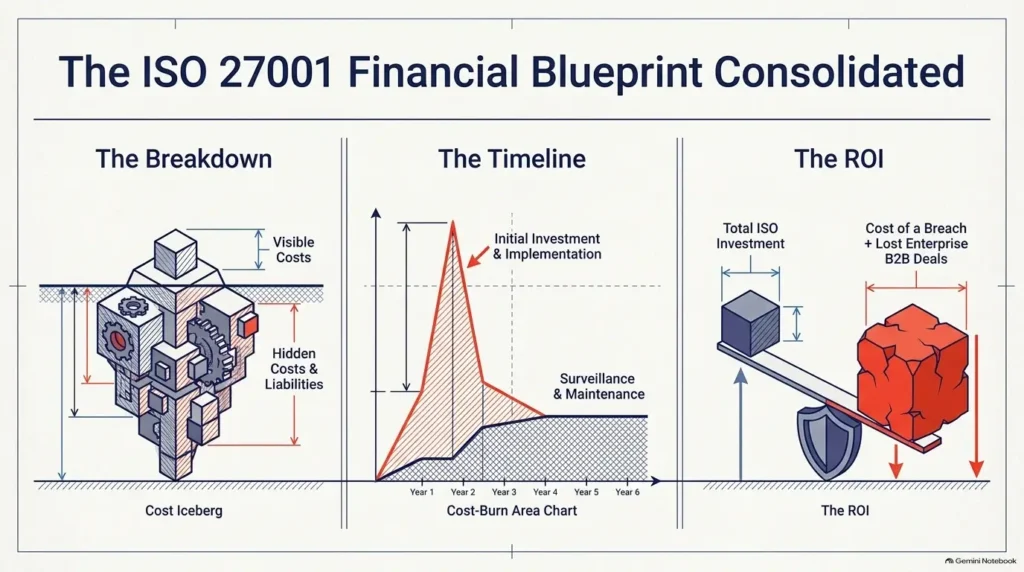
The certification audit fee is only one part of an ISO 27001 budget. Confusing audit cost with the entire certification project is why apparently contradictory price estimates circulate online.
| Cost Component | What It Covers | Usually Paid To |
|---|---|---|
| Stage 1 audit | Readiness, scope, documentation and planning review | Certification body |
| Stage 2 audit | Evaluation of implementation and effectiveness | Certification body |
| Certification and administration | Programme management, certificate processing or related fees where charged | Certification body |
| Travel and expenses | Auditor transport, accommodation or subsistence where applicable | Certification body or reimbursed expenses |
| Remediation | Fixing control, documentation or process gaps | Your organization or specialist provider |
| Consulting | Optional implementation or readiness assistance | Consultant |
| Compliance software | Evidence collection, workflow, monitoring or documentation automation | Software vendor |
| Surveillance audits | Ongoing certification-cycle audits | Certification body |
| Recertification | Renewal assessment before the certification cycle expires | Certification body |
This distinction matters. A company with a mature ISMS may spend relatively little outside the certification audit. Another company with the same audit scope may face substantial internal engineering, policy, evidence, remediation and consulting costs before it is ready for Stage 2.
ISO itself does not certify organizations. Certification is performed by independent certification bodies. ISO explains that distinction in its official certification guidance.
How ISO 27001 Audit Days Are Calculated in 2026
The biggest pricing clue is not company revenue. It is the number of people doing work under the organization’s control within the certification scope, followed by adjustments for the actual complexity of the ISMS.
ISO/IEC 27006-1:2024 includes an audit-time framework for the combined Stage 1 and Stage 2 initial certification audit. Selected baseline points are shown below to illustrate how quickly scope affects the engagement.
| People Within the Relevant Scope | Initial Stage 1 + Stage 2 Baseline |
|---|---|
| 1–10 | 5 auditor-days |
| 11–15 | 6 auditor-days |
| 16–25 | 7 auditor-days |
| 26–45 | 8.5 auditor-days |
| 46–65 | 10 auditor-days |
| 66–85 | 11 auditor-days |
| 86–125 | 12 auditor-days |
| 126–175 | 13 auditor-days |
| 176–275 | 14 auditor-days |
| 276–425 | 15 auditor-days |
These are audit-time baselines, not price quotes. The certification body still has to evaluate the circumstances of the specific ISMS. ISO/IEC 27006-1 explicitly requires the audit-time table to be considered together with adjustment factors rather than used as a standalone calculator.
The standard also limits downward adjustment of the chart-derived audit time. A cheap quote therefore deserves more scrutiny when its auditor-day allocation seems implausibly small. Ask how the calculation was reached instead of comparing only the invoice total.
The Six Variables That Change ISO 27001 Audit Cost Most
Two organizations with similar headcounts can legitimately receive different audit-time calculations. These are the variables most likely to explain the difference.
1. People inside the ISMS scope
The relevant number is not automatically every employee appearing on payroll. The certification scope matters. Contractors and other people working under the organization’s control may also matter when their activities fall inside that scope.
A tightly defined but defensible ISMS boundary can therefore be much cheaper to audit than a sprawling organization-wide scope. The key word is defensible. Cutting a system, team or location from scope merely to lower the quote can make the resulting certificate far less useful to customers.
2. Technology diversity
A small SaaS company running a relatively homogeneous cloud environment presents a different audit problem from an organization operating several cloud providers, legacy infrastructure, segmented networks, development environments, data centres and specialized platforms.
More technical diversity can mean more evidence paths, more interviews and more controls to verify.
3. Outsourcing and third parties
Outsourcing does not automatically remove something from audit consideration. The auditor may need to understand how third-party services are governed, how supplier risks are assessed, what contractual controls exist and what evidence demonstrates continuing oversight.
A heavily outsourced company can therefore have few employees yet still have a non-trivial ISMS.
4. Number of sites and disaster-recovery locations
Additional locations can affect audit planning, sampling, travel and the evidence that must be evaluated. Distributed operations deserve particular attention when comparing quotes because one certification body may have interpreted the proposed scope differently from another.
5. Information-system development
An organization building and operating its own software may expose the audit to development, change management, access control, security testing, deployment and related evidence that would not exist in the same form for a simpler business environment.
6. ISMS maturity and previous performance
A stable, well-demonstrated management system can affect audit planning differently from one undergoing substantial change. For surveillance and recertification, changes to the organization and ISMS also matter.
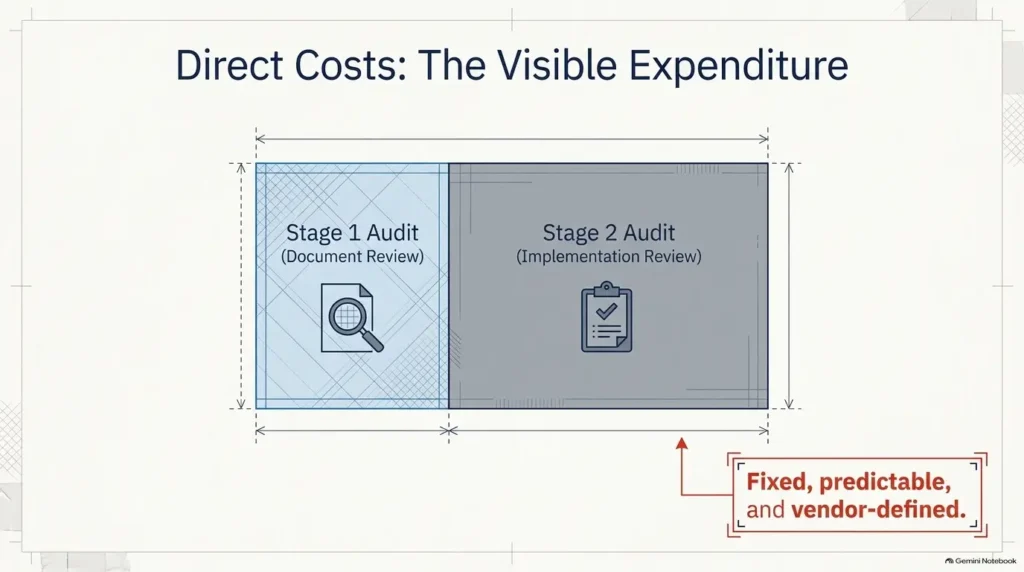
Stage 1 and Stage 2 Are Different Purchases Inside the Initial Audit
Initial certification is a two-stage process. Treating Stage 1 as a ceremonial document check is a budgeting mistake.
Stage 1
Stage 1 helps the certification body understand the ISMS, certification scope, readiness and planning needs for Stage 2. If the organization is plainly not ready, problems discovered here can prevent an expensive Stage 2 surprise.
Stage 2
Stage 2 examines whether the ISMS has actually been implemented and is operating effectively against the certification requirements. Evidence, interviews, records and operational practices matter here, not simply the existence of polished policy files.
The current certification standard is ISO/IEC 27001:2022, with the 2024 climate-action amendment also applying. That amendment should not be treated as a mysterious new bundle of security controls or an automatic audit surcharge.
Budget for the Certification Cycle, Not Just the First Audit
The first-year quotation is not the lifetime cost of ISO 27001 certification. Management-system certification operates as a continuing cycle.
| Audit Event | Audit-Time Planning Rule | Budget Implication |
|---|---|---|
| Initial certification | Stage 1 + Stage 2 calculation | Largest starting audit engagement |
| First surveillance | Normally about one-third of initial audit time | Recurring cost after certification |
| Second surveillance | Normally about one-third of initial audit time, subject to changes | Another recurring cost |
| Recertification | At least two-thirds of the audit time an equivalent initial audit would require at that time | Material renewal cost before the next cycle |
The wording around recertification is important. It is not simply two-thirds of whatever you paid years ago. If your workforce, technology, sites or certification scope have grown, the calculation can grow with them.
That is why procurement should request a three-year fee schedule rather than approving a provider from the attractive first-year number alone.
The Costs an ISO 27001 Audit Quote May Exclude
An inexpensive certification proposal can remain inexpensive, or it can sprout extra invoices like an enthusiastic hydra. The contract tells you which one you are buying.
- Auditor travel and accommodation: especially important for multi-site or international scopes.
- Application or programme fees: ask whether administrative charges sit outside the quoted auditor-days.
- Certificate or annual fees: confirm whether they are bundled.
- Additional work for nonconformities: verification or additional audit activity can create extra cost depending on the findings and contract.
- Scope extensions: adding a business unit, location, service or material activity can require additional audit time.
- Interpreter or specialist requirements: unusual language or technical circumstances can affect delivery.
- Internal employee time: evidence collection, interviews, internal audit, management review and remediation consume real labour even though they never appear on the certification-body invoice.
Security tooling is another separate budget. If certification work exposes a wider question about monitoring, endpoint, cloud or other controls, use a security budget model rather than silently attributing every new tool to the audit. KIOPTRIX.COM’s security tool stack cost calculator can help separate operational-security spending from certification fees.
A Better ISO 27001 Cost Calculator
You do not need an invented “average ISO price” to create a working budget. Ask for the variables and calculate from the quote.
Initial audit budget = (adjusted Stage 1 auditor-days + adjusted Stage 2 auditor-days) × quoted auditor-day rate + fixed certification fees + travel + expected additional audit charges.
Then build the lifecycle budget:
First-cycle budget = initial audit + the two surveillance audits + expected travel/admin + internal maintenance + remediation contingency. Show recertification separately as the renewal cost at the cycle boundary, or explicitly label a budget that includes it as initial certification through renewal. Count bundled administration and travel only once.
Suppose, purely as a calculation example, the certification body determines that your initial engagement requires six auditor-days after its documented scope analysis. If its quoted audit rate is R, the audit-labour component is 6 × R. Add the actual fixed fees and expenses quoted by that provider. Do not substitute a random internet day rate and call the result a market price.
This method is less glamorous than a giant dollar range. It is also much harder to fool.
Your 15-Minute ISO 27001 Scope Check
Before requesting quotes, write down the following information. A certification body will need some version of it, and different answers can materially change audit time.
- The exact products, services and business activities intended to appear within the ISMS scope.
- The legal entities included.
- The people doing work within that scope, including relevant contractors.
- Physical offices, operational sites and disaster-recovery locations.
- Major cloud platforms, networks and technology environments.
- Whether the organization develops software.
- Material outsourced services and third-party operations.
- Existing certifications or integrated management systems.
- Major organizational or infrastructure changes expected during the certification cycle.
Send the same scope description to each certification body. Otherwise, you may think you are comparing prices when you are really comparing three different interpretations of the company.
How to Compare Two ISO 27001 Quotes Fairly
The best quotation is not necessarily the lowest number. Compare the machinery behind the number.
| Question to Ask | Why It Matters | Warning Sign |
|---|---|---|
| How many auditor-days are allocated to Stage 1 and Stage 2? | Reveals the core cost calculation | Provider will not disclose audit time |
| What headcount or effective population did you use? | Confirms scope assumptions | The figure does not match your supplied scope |
| What complexity adjustments did you make? | Explains differences between providers | No explanation for an unusually low duration |
| What is excluded from this price? | Exposes travel, certificate and follow-up charges | “All inclusive” without defined inclusions |
| What are the surveillance and recertification costs? | Shows the real certification-cycle commitment | Only year-one pricing is supplied |
| How are scope changes priced? | Protects growing organizations | No mechanism for adding sites or activities |
| How are additional audit activities billed? | Clarifies finding-related exposure | Undefined charges after nonconformities |
| What accreditation covers this ISO 27001 certification? | Helps validate procurement credibility | Accreditation status is vague or unverifiable |
As of 2026, the international accreditation system is operating through Global Accreditation Cooperation Incorporated, which succeeded the former international accreditation organizations. You can review the current framework through Global ACI. ISO also recommends checking accreditation when evaluating certification providers.
How to Reduce ISO 27001 Audit Cost Without Cutting Corners
The safest savings usually come from reducing ambiguity and waste, not from bargaining the auditor into doing less than a credible certification requires.
- Define the certification scope before asking for quotes. Do not pay to audit systems that have no legitimate reason to sit inside the certificate boundary.
- Use one consistent scope statement across bids. Comparable inputs produce comparable quotes.
- Clean up evidence before Stage 1. Missing ownership, stale policies and inconsistent records consume attention that should have been spent demonstrating the ISMS.
- Resolve obvious readiness gaps before Stage 2. Certification is expensive terrain on which to discover that your internal audit or management processes never actually happened.
- Ask where remote techniques are appropriate. Remote auditing does not automatically reduce required auditor-days, but it may reduce travel-related cost where the certification body considers remote methods suitable.
- Plan scope growth before signing. If another product or site will be added six months later, ask how that extension will be handled now.
Consulting Software and the Certification Audit Solve Different Problems
A certification body answers: Does the ISMS conform sufficiently for certification? A consultant answers a different question: How do we build or repair this system? Compliance software answers yet another: How can we organize, collect or monitor the work more efficiently?
You may need all three, one, or only the certification body.
| Approach | Reasonable When | Poor Value When |
|---|---|---|
| Mostly internal preparation | You already have capable security/compliance staff and a functioning ISMS | The team does not understand the standard or cannot produce reliable evidence |
| Compliance software | Evidence collection and repeatable workflows are becoming operational bottlenecks | You are buying dashboards instead of fixing weak controls |
| Consultant or readiness specialist | You lack implementation expertise, time or an objective pre-certification review | The internal team could close the gaps from the standard and existing evidence without substantial outside work |
| Accredited certification body | Independent certification is required | You only need an internal gap assessment and no certificate |
If your ISO 27001 project began because enterprise customers keep sending security questionnaires, certification may be only one part of the operational problem. The separate guide to security questionnaire automation explains when automation starts saving real staff time.
When the Cheapest ISO 27001 Quote Is a Bad Deal
A low quote is not automatically suspicious. Different travel models, staffing arrangements and legitimate audit-time adjustments can produce different prices. The warning sign is a price that cannot be reconciled with the scope.
- The provider cannot explain its auditor-day calculation.
- The quotation appears to use an older audit-time methodology without explanation.
- Major locations or activities you supplied are absent from the scope.
- Surveillance pricing is missing.
- Travel or follow-up fees are undefined.
- Accreditation claims cannot be independently verified.
- The sales conversation promises certification rather than describing an impartial audit process.
ISO/IEC 27006-1:2024 became the relevant current framework for ISMS certification-body audit-time determination, and the international transition period for accredited certification bodies ended in 2026. A new quote should therefore not quietly rely on an obsolete methodology.
ISO 27001 Audit Cost vs SOC 2 Cost
If the real business question is “Which assurance programme will satisfy customers most efficiently?”, do not compare ISO 27001 certification and SOC 2 using audit fees alone. They are different forms of assurance with different reporting, market and customer-use characteristics.
For SaaS buyers weighing both paths, see the separate SOC 2 cost for SaaS startups analysis. The cheaper audit can still be the more expensive business decision if your target customers continually request the other assurance format.
Frequently Asked Questions
Does ISO set the price of an ISO 27001 certification audit?
No. ISO publishes standards but does not perform certification or set a universal commercial audit price. Independent certification bodies establish their fees while accredited certification bodies must follow applicable certification and audit-time requirements.
Can a small company have an expensive ISO 27001 audit?
Yes. Headcount is an important starting variable, but technology diversity, software development, third-party arrangements, sites, risk and ISMS complexity can also affect audit effort. A small organization is not automatically a simple organization.
Does a remote ISO 27001 audit cost less?
Not necessarily. Remote techniques may reduce travel expenses, but they do not automatically erase required audit time. The certification body has to select audit methods that still allow an effective audit of the scope.
Will compliance software reduce the certification body’s audit fee?
Not automatically. Software can make evidence collection, ownership and recurring compliance work more efficient, but the certification body’s audit-time determination follows the certification rules and your actual scope. Buying a platform does not buy fewer mandatory audit days.
What happens to the budget if the ISO 27001 scope grows later?
A scope extension can trigger additional audit work. ISO/IEC 27006-1:2024 specifically considers factors such as the type of extension, added locations, relevant risks, controls, people and integration with the existing ISMS. Ask for the provider’s scope-extension charging method before signing the original contract if growth is foreseeable.
What to Ask Before Requesting ISO 27001 Quotes
Spend ten minutes creating one scope sheet containing your people, sites, business activities, technology environment, software-development activity and important outsourced services. Send that exact sheet to each certification body.
Then ask for five numbers: Stage 1 days, Stage 2 days, surveillance days, recertification assumptions, and every fee that sits outside the auditor-day charge.
If two quotes differ substantially, do not immediately negotiate the higher one downward. Ask both providers to explain the audit-time calculation. The difference may reveal a useful scope problem, an omitted location, different headcount assumptions, or an expense that has merely been moved to another line of the contract.
That is the cleanest way to budget ISO 27001: compare scope first, auditor-days second, commercial rates third, and the full certification cycle before signing anything.
Last reviewed: 2026-10
Technical guidance updated: 2026-10-13. Clarified multiplication of the combined Stage 1 and Stage 2 days, separated first-cycle spending from recertification renewal, and prevented duplicate bundled fees.