Open the practical working record to connect this guide to your scope, evidence and next decision.
Founder’s First-Year Budget Guide
SOC 2 Cost for SaaS Startups: What You’ll Really Pay
The first SOC 2 quote often looks reassuringly tidy. Then the quieter costs arrive: a penetration test, endpoint controls, policy work, evidence collection, engineering interruptions, and the small matter of keeping everything operational after the report is issued.
For an early-stage SaaS company, the useful question is not simply, “How much does a SOC 2 audit cost?” It is, “What will our first year of independent assurance cost once we include the work required to make the audit possible?” Those are different numbers, occasionally separated by several zeroes and one exhausted CTO.
This guide breaks the project into scoping, readiness, software, remediation, examination fees, and internal labor. It will help you compare Type 1 and Type 2 options, normalize auditor proposals, and decide whether SOC 2 is attached to real revenue or merely wearing a fashionable trust badge.
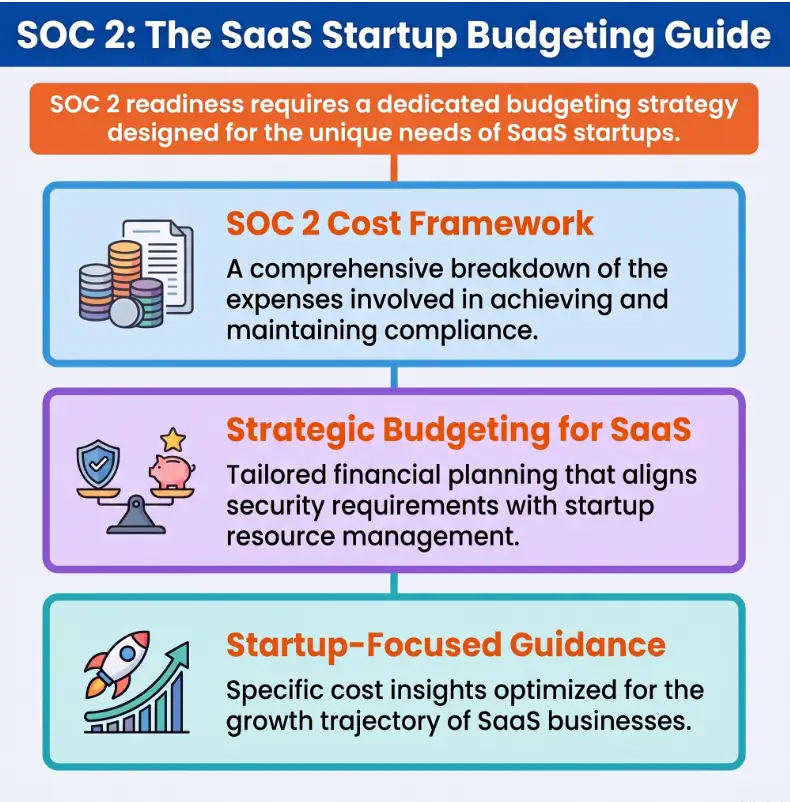
Budget clearly
Separate the auditor’s fee from the full first-year cost.
Scope carefully
Keep unnecessary systems and criteria outside the examination.
Buy deliberately
Compare software, consultants, tests, and CPA firms without paying twice.
The goal is not the cheapest report. It is the smallest defensible project that your customers will actually accept. 🧭
Snapshot
Who it is for: seed-to-Series A SaaS founders, CTOs, security leads, and operations teams preparing for enterprise procurement. What it solves: confusion between a quoted audit fee and the total cost of becoming and remaining audit-ready. What you can do next: create a one-page scope, estimate five cost buckets, and request comparable proposals.
Before You Act
This article offers general budgeting and purchasing guidance, not accounting, legal, cybersecurity, or attestation advice for a specific company. SOC 2 scope, testing, report language, and fees vary by system, control maturity, customer expectations, and CPA firm. Confirm material decisions with qualified security, legal, finance, and licensed CPA professionals before signing contracts or representing your assurance status to customers.
Table of Contents
Who Needs SOC 2 Now, and Who Can Wait?
A strong fit for SaaS companies selling upmarket
SOC 2 becomes easier to justify when it is connected to a visible commercial obstacle. Perhaps three prospects have requested a report, a strategic customer has placed the deal behind a security review, or the sales team keeps receiving questionnaires that ask for independent assurance.
These are not abstract signals. They are evidence that trust requirements are affecting sales velocity, contract value, or access to a target market.
- Enterprise buyers repeatedly request a current SOC 2 report.
- Contracts require independent testing of security controls.
- The company stores sensitive customer, employee, financial, or business data.
- Security questionnaires are consuming significant engineering or executive time.
- Procurement reviews are delaying otherwise qualified opportunities.
- The startup is entering healthcare, financial services, insurance, or another security-conscious market.
When waiting may be the more disciplined choice
A pre-revenue startup does not automatically need SOC 2. If the product architecture changes every few weeks, access processes exist mostly in people’s heads, and there is no enterprise sales motion, an examination may freeze attention around controls that will soon be redesigned.
Waiting does not mean ignoring security. It means building sound practices before paying to have them independently tested. A startup can document access, logging, backups, incident response, vendor review, and change management without immediately commissioning a report.
A useful starting point is a practical policy set that matches how the company actually operates. The internal guide on SOC 2 policies for startups can help teams avoid collecting polished documents that bear little resemblance to daily work.
The revenue-trigger test
Before approving the project, ask one uncomfortable but clarifying question: Which specific revenue event changes if we obtain this report?
- Name the customer, opportunity, market, or contract requirement.
- Estimate the revenue currently delayed or at risk.
- Confirm whether the buyer requires Type 1, Type 2, or another form of assurance.
- Ask whether an interim package, such as policies, test results, or a readiness statement, would help while the examination is underway.
- Compare the likely report date with the customer’s procurement schedule.
Key Takeaway
SOC 2 is easiest to defend when it unlocks a known sales channel, satisfies a documented customer requirement, or reduces a repeatable procurement delay. A vague wish to “look more mature” is a fragile foundation for a five-figure project.
Why the Examination Fee Is Not the Whole Project
The audit fee is only one line item
A CPA firm may quote a fixed fee for the SOC 2 examination. That fee matters, but it usually covers the independent testing and reporting engagement, not every task required to reach the starting line.
A company with mature controls, clean documentation, a narrow system boundary, and organized evidence may stay close to the quoted amount. A company discovering missing logs, informal access reviews, incomplete vendor records, and inconsistent offboarding will not.
The five invoices hiding inside one project
The complete first-year budget generally includes five categories:
- Readiness: identifying control gaps and preparing documentation.
- Remediation: fixing missing or unreliable security and operational controls.
- Software: collecting evidence, mapping controls, tracking owners, and managing questionnaires.
- Independent examination: the licensed CPA firm’s testing and report.
- Internal labor: time from engineering, IT, HR, legal, finance, security, and leadership.
Visible cost versus quiet cost
Vendor invoices are visible because they arrive with due dates. Internal work is quieter. A two-hour evidence meeting involving a founder, CTO, engineer, and operations lead may never appear in the compliance budget, yet it still consumes paid time and interrupts other priorities.
The same is true of delayed product work. A logging change that takes one engineer three days is not free merely because no consultant sent an invoice.
| Cost type | Easy to see? | Common examples | Budget treatment |
|---|---|---|---|
| Auditor fee | Yes | Testing, interviews, report preparation | Use the signed proposal |
| Software fee | Yes | Platform subscription, onboarding, framework add-ons | Include first-year and renewal pricing |
| Remediation | Partly | Logging, endpoint protection, backup testing, access cleanup | Estimate project and recurring costs |
| Internal labor | Usually not | Evidence, policies, reviews, meetings, control ownership | Estimate hours by department |
| Opportunity cost | Rarely | Delayed roadmap work, founder attention, sales delays | Document separately for decision-making |
Illustrative example: the reassuringly small quote
A 22-person SaaS company receives an attractive examination quote. The founders initially treat that number as the SOC 2 budget.
During readiness, the team discovers that contractor access is not reviewed consistently, security training is informal, laptop controls vary, and several critical vendors lack completed reviews. The company also needs a penetration test and improved cloud logging.
The auditor’s fee did not change dramatically. The project did. Software, testing, endpoint controls, consulting, and hundreds of internal hours turned a neat line item into a much larger first-year commitment.
The lesson is not that the original quote was misleading. It is that the founders asked for the price of the examination when they really needed the price of the entire journey.
Type 1 or Type 2: The Cheaper Path Can Cost More Later
Type 1 examines a specified date
A Type 1 report addresses whether relevant controls are suitably designed and implemented as of a specified date. It can be useful when the control environment is new, a buyer accepts point-in-time assurance, or the company needs an earlier milestone.
Because it does not test operation across a longer observation period, a Type 1 engagement may require less evidence and may carry a lower examination fee. That does not automatically make it the lower-cost business decision.
Type 2 tests operating effectiveness over time
A Type 2 report evaluates whether controls operated effectively during an observation period. The company must therefore show repeated execution, not merely a well-designed process on one chosen day.
That means more samples, recurring evidence, follow-up questions, and greater exposure to missed reviews or inconsistent control performance. It is more demanding because it answers the question many enterprise customers care about: “Did the company actually do what its policies say?”
When Type 1 is a useful bridge
- A named customer has confirmed in writing that Type 1 is acceptable.
- The startup recently implemented controls and lacks a meaningful operating history.
- An earlier report may unblock procurement while Type 2 work continues.
- The company wants an independent checkpoint before committing to a longer observation period.
When going directly to Type 2 may save money
If target customers ultimately require Type 2, completing Type 1 first may create two proposals, two testing cycles, two report processes, and additional management time. Some work may carry forward, but not every cost disappears.
| Decision factor | Type 1 may fit | Direct Type 2 may fit |
|---|---|---|
| Customer requirement | Buyer explicitly accepts Type 1 | Buyer requires Type 2 |
| Control maturity | Controls are newly implemented | Controls already operate consistently |
| Timing pressure | A point-in-time report helps sooner | There is enough runway for observation |
| Budget concern | Near-term cash is tightly constrained | Avoiding two engagements matters more |
| Evidence readiness | Historical samples are limited | Recurring evidence is already available |
Key Takeaway
Do not choose Type 1 merely because the quote is lower. Confirm what customers will accept, estimate the cost of a second engagement, and compare both paths against the timing of real revenue.
Scope Is the First and Strongest Price Lever
Security alone, or additional Trust Services Criteria?
Security is the common criterion in a SOC 2 examination. Availability, processing integrity, confidentiality, and privacy may also be relevant when they reflect customer commitments, contractual obligations, data handling, or system risks.
Adding a criterion can introduce new controls, documentation, evidence, and testing. It should therefore be treated as a scoping decision, not a decorative upgrade.
Count systems, not only employees
Headcount can influence cost, but system complexity is often more revealing. A ten-person company with two products, several cloud accounts, production workloads across regions, sensitive data, many vendors, and inconsistent access patterns may require more work than a forty-person company with one well-managed application.
- Products and customer-facing services
- Cloud accounts, regions, networks, and production environments
- Databases, object stores, queues, and data pipelines
- Identity providers and privileged access paths
- Code repositories, deployment systems, and ticketing platforms
- Employee devices and endpoint management
- Critical vendors and subservice organizations
- Legal entities, offices, and remote-work arrangements
One broad sentence can quietly expand the examination
The system description explains the services, infrastructure, people, processes, data, and boundaries relevant to the report. Overly broad language can pull experimental tools, unrelated products, corporate systems, or supporting processes into evidence collection.
The answer is not to hide relevant components. It is to define the system accurately and narrowly enough that the report covers what customers depend on without swallowing the whole company.
The smallest defensible scope checklist
- Which product or service is customers’ procurement team evaluating?
- Which data supports that service?
- Which production infrastructure processes or stores that data?
- Which employees and contractors can affect the system?
- Which vendors perform relevant functions?
- Which commitments have been made in contracts, policies, and service descriptions?
- Which additional criteria are truly connected to those commitments?
Teams using AWS should also compare their intended control language with actual evidence. The AWS CloudTrail logging checklist offers a useful example of translating a broad logging promise into verifiable operational details.
The SOC 2 Scope Funnel
1. Sales trigger
Identify the buyer, contract, or repeated objection.
2. Customer promise
List the services, commitments, and data involved.
3. System boundary
Map infrastructure, people, processes, and vendors.
4. Criteria choice
Include only criteria supported by risk and commitments.
Result: a report boundary customers can understand and the company can operate without theatrical paperwork.
Build the Budget From Five Cost Buckets
1. CPA firm examination fee
The independent examination fee is the cleanest number in the budget, but only when proposals use the same assumptions. Report type, criteria, system boundary, observation period, locations, support level, and expected readiness can all affect the quote.
Ask for a fixed-fee proposal when practical, then request a plain-English list of events that may trigger additional charges.
2. Readiness and gap assessment
Readiness work answers a blunt question: “If testing began today, where would we struggle?” It may be performed internally, through a consultant, through a compliance platform’s service team, or with support separate from the CPA examination.
- Control mapping and ownership
- Policy review and customization
- Evidence walkthroughs
- System-description preparation
- Risk assessment support
- Identification of missing or unreliable controls
3. Software, security controls, and remediation
A compliance platform may organize evidence, integrations, control status, and policy workflows. It does not remove the need for security controls to exist and operate.
Remediation may include endpoint management, vulnerability scanning, penetration testing, centralized logging, backups, alerting, access reviews, employee training, background checks, vendor management, secure development practices, and incident response preparation.
For a broader estimate of the surrounding security stack, use the security tool stack cost calculator as a companion budgeting exercise. Keep SOC 2-specific spending separate from controls you would need for responsible operations anyway.
4. Internal labor and opportunity cost
Internal labor often determines whether a low vendor quote remains low. Estimate the people, hours, and recurring frequency for each control rather than assigning the whole project to “security.”
Engineering may own change management and vulnerability remediation. HR may own onboarding, offboarding, training, and background checks. Finance or legal may support vendor agreements. Executives may approve risk decisions and policies.
5. Recurring maintenance and renewal
SOC 2 is not a one-time construction project followed by a ribbon-cutting ceremony. Controls must continue to operate, evidence must remain available, and subsequent examinations must be planned.
| Budget bucket | First-year questions | Recurring questions |
|---|---|---|
| CPA examination | Type 1, Type 2, scope, observation period? | What is the renewal estimate? |
| Readiness | How many controls need redesign? | Will advisory support continue? |
| Compliance software | Onboarding, integrations, frameworks? | Renewal increase, added entities, support tier? |
| Security controls | What must be purchased or fixed? | Licenses, testing, monitoring, training? |
| Internal labor | Who owns implementation? | Who collects evidence and performs reviews? |
Key Takeaway
Build the budget in layers. Start with the examination, then add readiness, remediation, software, internal labor, and annual maintenance. A single “SOC 2” line in the finance plan is too blunt to guide a real buying decision.
Three Planning Budgets for an Early-Stage SaaS Company
Build each scenario from current written proposals and your own staff estimate. The environments below are scope comparisons, not market price ranges or minimum first-year budgets.
Lean environment: a narrow, mature service
A lean scenario has one primary product, a well-managed cloud environment, a justified Security scope, stable access controls, organized documentation and staff available for preparation. Ask providers to price those exact assumptions.
- Few products and production environments
- Limited remediation
- Simple identity and endpoint setup
- Existing security policies that match operations
- Internal staff available to manage evidence
- A straightforward examination with limited added support
Growing environment: more owners and evidence
A growing scenario may add departments, integrations, technical testing, evidence software, remediation and a Type 2 examination. Price each component and assign its owner rather than inferring the budget from the funding round.
The company may still be technically simple, but coordination begins to matter. More control owners create more interviews, more training records, more access reviews, and more opportunities for evidence to become scattered.
Complex environment: multiple services or entities
A complex scenario may combine multiple products or entities, additional criteria, several frameworks, outside advice, numerous vendors and inherited technical debt. Request separate scope and effort assumptions for each source of work.
Complexity can also come from organizational history. Acquired tools, inconsistent identity systems, undocumented processes, and regional variations can make a moderate headcount expensive to test.
Good, Better, Best planning model
| Approach | Best for | Typical support model | Main trade-off |
|---|---|---|---|
| Good: founder-led and narrow | Small, technically mature team | Internal readiness, focused tools, independent CPA firm | Lower cash cost, higher internal workload |
| Better: supported execution | Growing startup with limited compliance experience | Automation platform, readiness support, penetration test, CPA firm | Higher vendor spend, less operational guesswork |
| Best: coordinated multi-framework program | Complex or regulated sales motion | Dedicated owner, advisory support, integrated testing, broader assurance roadmap | Highest cost and greater program management needs |
The “best” option is not automatically the most expensive. It is the approach that gives your specific team enough support to execute controls reliably without purchasing services you cannot use.
Show me the nerdy details
A stronger budget model separates one-time implementation costs from recurring control costs. For each control, estimate setup hours, recurring frequency, evidence time, reviewer time, software expense, and likely remediation.
For example, a quarterly access review may require system exports, manager review, ticket creation, follow-up with application owners, removal verification, and evidence retention. Multiplying only the final meeting time will understate the work.
A useful formula is: first-year cost = external fees + one-time remediation + recurring tool costs + internal implementation labor + internal operating labor + contingency. Count any bundled testing or advisory service only once. Include recurring controls paid for during year one, but budget the next annual examination separately rather than adding a second full-year renewal to the first-year total. Keep opportunity cost visible as a separate decision metric rather than adding the same employee time twice.
A worked first-year budget without counting bundled services twice
Hypothetical purchased work: CPA examination $12,000, readiness support $6,000, evidence software $8,000 and separately needed security work $4,000. External first-year cash cost is $30,000. Sixty internal hours valued at $100 add $6,000 of staff capacity, for a $36,000 economic total. None of these invented fees is an AICPA price or a market average.
If the software contract already includes the same readiness work, count that work once and document the included deliverables. Keep pre-existing security subscriptions out of incremental project cost unless the project creates additional spend; show the full operating budget separately when it is useful.
Build year two from the expected examination, renewal, recurring security work and staff activity. Do not carry one-time onboarding forward automatically, or assume it is free because it disappeared from the renewal invoice. Confirm the independent CPA firm and its responsibilities using the AICPA SOC resources.
Your Largest Hidden Cost May Already Be on Payroll
Control owners need recurring calendar time
Controls do not operate because a policy exists. Someone must perform the review, approve the exception, retain the record, follow up on failures, and confirm remediation.
- Monthly vulnerability review
- Quarterly user-access certification
- Annual risk assessment
- Employee security training
- Vendor review and contract tracking
- Backup restoration testing
- Incident-response exercises
- Policy review and approval
Engineering work arrives as small interruptions
Compliance work rarely arrives as one dramatic engineering project. It appears as a stream of access questions, log exports, ticket updates, screenshots, sample explanations, and minor fixes.
Each request may take twenty minutes. The switching cost is larger. Product work is pushed aside, restarted, and pushed aside again. A realistic plan batches evidence tasks and gives the project a named technical owner instead of broadcasting requests across the engineering channel.
Evidence carries a weekly tax
Automation can collect some system evidence, but many controls still depend on human judgment. A screenshot may prove that a setting existed. It may not explain whether the setting was reviewed, whether an exception was approved, or whether a failed check was resolved.
The most affordable controls are often those that produce evidence naturally through normal work. For example, an approved ticket is usually more reliable than a quarterly scramble to reconstruct who authorized a production change.
Calculate the founder-time premium
In small companies, the founder often becomes project manager, policy writer, system-description editor, control owner, and escalation point. This can be workable for a narrow project, but it should be intentional.
| Role | Likely SOC 2 work | Cost-control tactic |
|---|---|---|
| Founder or COO | Scope, policy approval, risk decisions, vendor coordination | Appoint one project owner and set decision deadlines |
| CTO or engineering | Architecture, logging, changes, access, remediation | Batch evidence requests and automate repeatable exports |
| HR or operations | Onboarding, training, offboarding, background checks | Use one documented workflow with retained records |
| Legal or finance | Contracts, insurance, vendor terms, entity questions | Review only material exceptions and commitments |
| Security lead | Control mapping, risk, testing, evidence quality | Maintain a control calendar and evidence index |
Key Takeaway
Employee time is not free, and founder attention is not infinitely renewable. Give recurring controls named owners, calendar time, and evidence paths before the observation period begins.
Do Not Buy Compliance Software Before Defining the Job
Automation does not issue the SOC 2 report
A compliance platform may collect evidence, map controls, track policy approvals, coordinate personnel tasks, and display readiness status. The independent SOC 2 examination and report remain the work of a licensed CPA firm.
This distinction matters because bundled marketing can make several separate services feel like one purchase. Ask who is responsible for readiness, remediation guidance, penetration testing, examination work, and report issuance.
Ask what the subscription price actually includes
- Platform access and number of users
- Frameworks, criteria, entities, and workspaces
- Implementation and onboarding support
- Policy templates and customization help
- Readiness review or advisory hours
- Auditor access or marketplace introduction
- Penetration testing or vulnerability scanning
- Security questionnaire and trust-center features
- Renewal pricing and contract term
Test integrations before signing annually
An impressive integration catalog is not enough. Confirm that the platform can collect useful evidence from your actual cloud accounts, identity provider, code repository, ticketing system, HR platform, endpoint tools, and production stack.
Ask to see the exact check, evidence artifact, and remediation workflow. A green dashboard tile is not valuable when the underlying check does not match your architecture.
Avoid paying twice for the same guidance
| Provider | Possible role | Question to prevent overlap |
|---|---|---|
| Compliance platform | Evidence collection, control tracking, templates | Does the price include human readiness support? |
| Readiness consultant | Gap review, control design, project guidance | Which platform tasks will you repeat manually? |
| Penetration-testing firm | Independent technical testing | Is retesting included after remediation? |
| CPA firm | Independent examination and reporting | What readiness assistance is allowed and included? |
| Security provider | Managed controls, monitoring, incident support | Which evidence will the service produce? |
A free spreadsheet can be enough for a very small, mature team with a narrow scope and disciplined control owners. Paid software becomes more attractive when integrations reduce manual evidence work, several people need assignments, multiple frameworks are planned, or questionnaires and trust-center requests are consuming sales time.
SOC 2 Cost Mistakes That Drain Startup Runway
Mistakes made before signing a contract
- Calling SOC 2 a certification: SOC 2 is an attestation report, not a permanent certificate that ends the work.
- Starting without customer-backed scope: imagined future requirements can pull unnecessary systems and controls into the project.
- Choosing every criterion: broader coverage can increase documentation and testing without helping current buyers.
- Comparing headline prices: two quotes may cover different report types, systems, periods, and support levels.
- Buying software first: the platform may shape the project before the company has defined what customers need.
Mistakes made during readiness
- Entering the observation period too early: unstable controls create missed evidence and avoidable exceptions.
- Copying generic policies: documents that do not match reality create awkward interviews and brittle operations.
- Assigning controls to departments: “Engineering” is not an owner. A named person is.
- Ignoring vendor evidence: critical service providers can become late-stage research projects.
- Waiting to test backups or incident plans: a policy cannot substitute for an actual exercise.
Mistakes made after the first report
The most expensive post-report mistake is treating SOC 2 as finished. Access reviews slip, policies age, evidence disappears, and control owners return fully to product work. Months later, the renewal project begins with a digital archaeological dig.
Maintain a control calendar, retain evidence continuously, review exceptions, and estimate renewal costs while the first engagement is still fresh.
Security questionnaires also continue after the report. A useful next step is to align the report, policies, and customer responses using a repeatable vendor security questionnaire workflow.
Cost Leak Warning
A cheap control that fails every quarter is expensive. A slightly more automated control that produces reliable evidence during normal work may reduce both audit friction and operational risk.
The Auditor Quote Scorecard Most Founders Skip
Normalize scope in plain English
Send each provider the same written description of the product, infrastructure, report type, criteria, observation period, entities, locations, and expected timeline. Then ask the firm to state its assumptions.
Without normalization, a lower quote may simply cover less work.
Ask what happens when evidence is incomplete
- Are additional meetings billed separately?
- Are remediation reviews included?
- Does delayed evidence change the project schedule or fee?
- How many retests or sample replacements are included?
- What happens if the scope changes during fieldwork?
- How are exceptions communicated before the draft report?
Confirm who performs the examination
Distinguish the licensed CPA firm’s examination from software support, readiness consulting, security testing, and policy assistance. The providers may collaborate, but their responsibilities, independence requirements, contracts, and fees are not interchangeable.
Compare first-year help and renewal cost
| Scorecard item | What to request | Red flag |
|---|---|---|
| Scope | Products, systems, entities, locations, criteria | “Standard scope” without detail |
| Report type | Type 1 or Type 2 and exact period | Unclear assumptions about timing |
| Support | System-description help, samples, meetings, draft review | Support described only as “included” |
| Extra fees | Retesting, delays, scope changes, additional meetings | Open-ended hourly charges |
| Team | Engagement lead, testing team, relevant SaaS experience | No access to the actual examination team |
| Renewal | Estimated second-year fee and likely changes | No discussion of ongoing cost |
Before selecting a firm, review what the final deliverable will look like and how customers may interpret it. The guide on how to read a penetration test report applies a similar discipline to technical testing: understand the scope, method, limitations, and useful output before buying the service.
SOC 2 Cost FAQ for SaaS Founders
How much does a SOC 2 audit cost for a small SaaS startup?
There is no universal first-year minimum in this guide. Obtain scope-matched examination, readiness, software and security-work proposals, then add internal effort separately. The scenarios describe complexity rather than asserting market prices.
Is SOC 2 Type 1 cheaper than Type 2?
Type 1 often requires less operating evidence and may carry a lower examination fee. However, completing Type 1 and then Type 2 can cost more than moving directly into a Type 2 observation period. Confirm the customer requirement before choosing.
Can a startup complete SOC 2 without compliance software?
Yes. A small company can manage controls and evidence using tickets, shared documents, spreadsheets, cloud exports, and disciplined ownership. Software may become worthwhile when manual evidence consumes too much time, integrations are valuable, several people own controls, or the company plans multiple frameworks.
Does a SOC 2 software subscription include the audit?
Not necessarily. Some packages coordinate access to a CPA firm or include separate examination pricing, while others provide only software and support. Ask for a written breakdown of platform, readiness, testing, and independent examination fees.
How much should a startup budget for a penetration test?
Pricing depends on application size, APIs, cloud exposure, authentication paths, testing depth, retesting, and report quality. Obtain a written scope and compare methodology, tester experience, retest terms, limitations, and deliverables rather than buying by price alone.
How long should a Type 2 observation period be?
The appropriate period depends on customer expectations, control maturity, auditor planning, and commercial timing. Discuss the intended period with the CPA firm and confirm that control frequencies will produce enough evidence during that window.
Who is allowed to perform a SOC 2 examination?
A SOC 2 examination is performed by an independent licensed CPA firm qualified to conduct the engagement. Software vendors, readiness consultants, and security firms may support preparation but do not replace the independent CPA examination.
How often does a SaaS company need a new SOC 2 report?
Customers commonly expect reports to be refreshed regularly, often through an annual cycle, but contract requirements vary. Confirm customer expectations and plan recurring testing, evidence, software, and staff time rather than budgeting only for the first report.
Can customers accept a readiness letter instead of a completed report?
Some customers may accept interim information, while others will not. Ask the customer exactly what documentation is acceptable, who must issue it, what it needs to state, and how long the temporary arrangement will last. Do not imply that readiness work is equivalent to a completed SOC 2 report.
Is SOC 2 worth the cost before Series A funding?
Funding stage alone does not decide the answer. SOC 2 may be worthwhile before Series A when it unlocks enterprise revenue, supports a security-sensitive market, or resolves repeatable procurement objections. It may be premature when the product, infrastructure, and sales motion are still changing rapidly.
Your 15-Minute SOC 2 Cost Brief
The fastest useful next step is not booking a demo. It is writing one page that forces the company to define the project before vendors define it on your behalf.
Minutes 1 to 3: write the sales trigger
Name the customer, contract requirement, target market, or repeated questionnaire issue creating the need. Add the revenue affected and the date by which assurance would be useful.
Minutes 4 to 8: draft the smallest defensible scope
- Product or service
- Production cloud environment
- Customer data and supporting systems
- Relevant people and locations
- Critical vendors
- Security and any additional criteria
- Preferred Type 1 or Type 2 path
Minutes 9 to 12: estimate the five cost buckets
- CPA examination
- Readiness and gap support
- Compliance software
- Security testing and remediation
- Internal labor and recurring maintenance
Minutes 13 to 15: choose a go-or-wait rule
Write your organization’s own approval condition. For example, compare confirmed customer requirements, project scope, available staff capacity and an approved budget. Any suggested revenue threshold is an internal decision rule, not a validated estimate of expected return.
Then send the same brief to three providers and request separate prices for readiness, software, penetration testing, Type 1 work, Type 2 work, added support, and renewal. The internal SOC 2 budget calculator can help turn those responses into a comparable model.
The decision in one line
Approve SOC 2 when the report is attached to real customer demand, the scope is narrow enough to operate honestly, and the full first-year cost is proportionate to the revenue or market access it protects.
A good SOC 2 budget does more than predict invoices. It protects the company from buying a report customers will not accept, controls the team cannot maintain, or software that merely turns uncertainty into a colorful dashboard.
Start with the one-page brief. Fifteen focused minutes can save weeks of vendor conversations and keep the project tied to the reason it exists: earning trust without burning the runway meant to build the product.
Last reviewed: 2026-10-13
Technical guidance updated: 2026-10-13. Clarified illustrative budget assumptions, aligned the FAQ ranges, prevented bundled-service and renewal double counting, and repaired section navigation.
Editorial review: October 16, 2026. Updated the decision guidance and removed misleading illustrations where identified. Worked examples are hypothetical; they do not describe testing performed by Kioptrix, actual quotes, claim decisions or guaranteed outcomes.
SaaS SOC 2 budget responsibility map
Use this when: you are a startup planning a scoped examination and the work needed to support it. Copy these fields into your notes and replace each prompt with a dated response. Keep assumptions and unresolved questions visible.
| Field | What to record | Your evidence / owner / next check |
|---|---|---|
| Buyer requirement | Record the requested report type, criteria, service and timing. | To complete |
| External purchases | Separate examination, software, readiness and specialist work. | To complete |
| Internal operation | Assign implementation, evidence review and recurring control ownership. | To complete |
| Cost horizon | Separate first-year cash, allocated staff time and future recurring costs. | To complete |
Next action: Identify the largest unowned internal task before treating a quote as the full budget. Mark the relevant row confirmed, provisional or unresolved. Keep the supporting record, responsible person and next check beside it so another reader can continue the work without treating an assumption as a result.
This is an editorial working aid. Complete it with your own scope, source records and accountable reviewers. Filling the table does not by itself establish coverage, compliance or acceptance.
Worksheet change record — October 20, 2026
Added this saas soc 2 budget responsibility map with four article-specific fields and an evidence-based next action. Existing source notes retain their own review dates. This addition is not a fresh verification of every statement or a newly executed test.