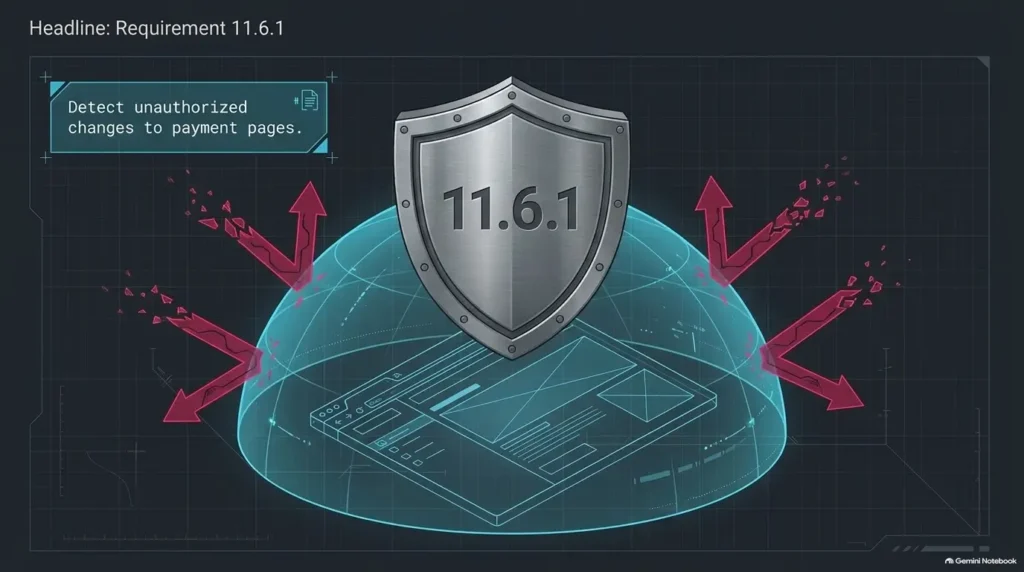
PCI DSS Requirement 11.6.1 requires applicable e-commerce environments to use a change- and tamper-detection mechanism that can identify unauthorized modifications to payment pages and security-impacting HTTP headers as they are received by the customer’s browser. For merchants, the practical objective is to detect e-skimming and similar browser-side attacks before silently altered checkout content continues collecting payment information.
Table of Contents

This is different from simply checking whether files on your web server have changed. A checkout page can depend on third-party JavaScript, tag managers, content delivery networks, analytics tools, payment-provider components, and other browser-loaded resources. An attacker may tamper with one of those paths without changing the merchant’s primary application files.
The current standard is PCI DSS v4.0.1. Requirements 6.4.3 and 11.6.1 became effective on March 31, 2025. Merchants implementing these controls should use the PCI Security Standards Council as the primary source for the standard, official guidance, FAQs, and validation documentation.
Define monitoring coverage · Copy a drill record · Review official sources
What PCI DSS Requirement 11.6.1 actually requires
Requirement 11.6.1 focuses on unauthorized modifications to the HTTP headers and contents of payment pages as received by the consumer browser. The change-detection mechanism is intended to identify indicators such as unexpected changes, additions, or deletions and alert appropriate personnel when suspicious modification is found.
The PCI SSC’s official e-commerce guidance explains the requirement together with Requirement 6.4.3 because the two controls address different parts of the same browser-side attack problem. Merchants can review the Council’s Payment Page Security and Preventing E-Skimming guidance for implementation context covering both requirements.
The mechanism should not merely record that something changed. A merchant needs a way to determine whether a modification was expected, authorized, or potentially malicious. That typically requires connecting payment-page monitoring with release management, incident response, and ownership of third-party scripts.
Why server-side file monitoring alone is not enough
Traditional file integrity monitoring is useful, but it observes only part of the path between the merchant’s infrastructure and the customer’s browser.
Imagine that a merchant’s checkout application files remain untouched, but an attacker gains control of a third-party tag-management account. The attacker adds a JavaScript resource that loads only on the checkout page and captures information entered by customers.
A server-side file monitor might report no modification because the merchant’s application files did not change. From the customer’s perspective, however, the payment page now contains unauthorized code.
Requirement 11.6.1 addresses this gap by focusing on what reaches the browser. Merchants evaluating broader browser protections such as Content Security Policy can also review this site’s guide to WAF vs RASP vs CSP, which explains how CSP can restrict where browser-side resources are allowed to load. CSP can complement a payment-page security strategy, but it should not be assumed to replace Requirement 11.6.1 by itself.
What should merchants monitor?
The exact scope depends on the merchant’s payment architecture, but monitoring should be designed around the parts of the payment experience that can affect the security of account data.
- Payment-page HTML and browser-delivered content.
- JavaScript loaded or executed in connection with the payment page.
- Unexpected scripts or browser resources added to checkout.
- Expected payment-page elements that unexpectedly disappear.
- Security-impacting HTTP response headers.
- Third-party resources capable of changing the browser-side payment experience.
- Changes introduced through tag managers, CDN resources, plugins, or externally hosted libraries.
A good monitoring process therefore starts with knowing what the expected payment page looks like. If the organization cannot identify its approved scripts and normal browser-facing configuration, distinguishing a legitimate deployment from malicious tampering becomes much harder.
Build a payment-page coverage matrix
A checkout URL is a starting point, not a complete description of what the browser receives. A guest, a signed-in customer and a customer with different consent choices may load different resources. Build an editorial coverage matrix around the states your store actually supports, then agree the applicable monitoring coverage with the people responsible for validation.
| State to identify | Why the content may differ | Record before calling it covered |
|---|---|---|
| Guest and signed-in checkout | Account features, saved preferences or fraud components can change | How the monitor reaches each state and which content it observes |
| Consent choices | Tags may load only after a particular consent action | The tested choice and any resource paths that remain unobserved |
| Regional or language variants | Different integrations or deployments may serve different customers | Relevant variant, delivery path and responsible owner |
| Mobile or alternate checkout route | A separate template or checkout entry point may be used | The actual route and rendered payment experience examined |
| Embedded provider component | Merchant content and provider content have different owners | Which layer each party monitors and the supporting responsibility record |
Do not claim a cross-origin iframe is inspected merely because the parent page was loaded. Ask the provider to explain the observation boundary, restrictions and responsibility for the embedded component. Keep a clear distinction between watching the merchant page around the form and evaluating the provider-controlled payment content.
Treat a failed navigation as a coverage issue. If a synthetic check reaches a login screen, a consent overlay or an error page, a successful HTTP response does not prove that it inspected the intended checkout. Retain the failure, assign an owner and verify recovery. For browser telemetry, ask which sessions contribute observations and what happens when collection is interrupted.
After a checkout redesign, compare the matrix with the new flow before accepting a new baseline. Remove obsolete routes through the normal review process and add replacement routes explicitly. Automatically approving every newly observed script because a release occurred can conceal a change that was never part of the approved release.
Requirement 11.6.1 vs Requirement 6.4.3
Requirements 6.4.3 and 11.6.1 are closely related, but merchants should not treat them as duplicates.
| Requirement | Primary purpose | Merchant question |
|---|---|---|
| 6.4.3 | Manage payment-page scripts, including authorization, integrity, inventory, and justification. | Which scripts are supposed to be here, and why? |
| 11.6.1 | Detect unauthorized changes to payment-page content and relevant HTTP headers. | Did the customer’s browser receive something different from what was authorized? |
Requirement 6.4.3 gives the merchant visibility into the expected script population. Requirement 11.6.1 helps identify deviations from that expected state.
PCI SSC developed its dedicated e-commerce supplement specifically around these two controls. Merchants should consult the official PCI SSC e-skimming supplement rather than relying solely on a vendor’s interpretation of what PCI DSS requires.
A practical e-skimming example
Consider a merchant whose checkout normally loads a payment-provider script, a fraud-detection library, the site’s application code, and several approved supporting resources.
An attacker compromises a third-party service used by the checkout page and causes an additional JavaScript file to load. The script watches payment fields or intercepts customer input and forwards data to an attacker-controlled endpoint.
The merchant’s application repository may still contain exactly the same code as the day before. The malicious difference exists in what the consumer’s browser receives.
A correctly designed 11.6.1 control is intended to make that difference detectable rather than allowing the altered checkout experience to remain invisible.
How often does Requirement 11.6.1 monitoring need to run?
PCI DSS specifies that the applicable change- and tamper-detection functions are performed at least once every seven days, or at a periodic frequency defined according to an applicable targeted risk analysis where the standard permits that approach.
The seven-day figure should not be interpreted as a recommendation to wait a week before investigating potentially dangerous checkout changes. It establishes a compliance frequency condition. A merchant with high payment volume, extensive third-party JavaScript, frequent releases, or elevated browser-side risk may choose substantially more frequent or continuous monitoring.
The PCI SSC’s published material describing Requirement 11.6.1 can be found through its official document library, which should be used when checking the current wording of PCI DSS rather than relying on an old checklist or secondary summary.
Does PCI DSS require real-time monitoring?
PCI DSS does not state that every merchant must use continuous real-time monitoring for Requirement 11.6.1. The applicable frequency in the standard must be met, while organizations may implement more frequent monitoring where appropriate.
This distinction matters when evaluating commercial PCI DSS products. A vendor may offer real-time JavaScript monitoring, client-side telemetry, synthetic browser checks, or continuous page-integrity analysis. Those features may improve detection speed, but merchants should separate useful product capabilities from claims that a specific commercial architecture is universally mandated by PCI DSS.
What about payment pages hosted in an iframe?
Outsourcing payment processing to a compliant provider can reduce the merchant’s PCI DSS scope, but it does not necessarily mean the merchant’s surrounding e-commerce page becomes irrelevant.
For example, a merchant might embed a payment processor’s form inside an iframe while its own webpage loads marketing scripts, analytics libraries, consent tools, chat widgets, and tag-management code around that iframe.
The PCI SSC has specifically addressed this situation. Its SAQ A e-commerce eligibility FAQ explains that a merchant can demonstrate that its webpage is protected against script attacks by using techniques such as those described in Requirements 6.4.3 and 11.6.1, or by obtaining appropriate confirmation from a compliant payment processor or third-party service provider when the provider’s solution includes the required protections and is implemented according to its instructions.
Merchants should therefore map responsibility rather than assume that the presence of an iframe transfers every browser-side security obligation to the payment processor.
The SAQ A change that causes confusion
SAQ A treatment changed in 2025, and this is an important source of confusion around Requirement 11.6.1.
PCI SSC removed Requirements 6.4.3 and 11.6.1 as directly reported requirements from the revised SAQ A and introduced an eligibility criterion requiring applicable merchants to confirm that their site is not susceptible to attacks from scripts that could affect the merchant’s e-commerce systems.
However, PCI SSC explicitly explained that the SAQ A reporting change did not remove or diminish the underlying PCI DSS requirements. The Council’s announcement can be reviewed in Important Updates Announced for Merchants Validating to Self-Assessment Questionnaire A.
FAQ 1588 limits this particular script-attack eligibility criterion to pages embedding a provider payment form; redirect-only checkout and fully outsourced payment links are excluded from that criterion. Those exclusions do not remove other applicable SAQ A obligations, including the ASV scanning discussed below. This distinction matters because SAQ eligibility and the underlying PCI DSS standard are related but not identical concepts. A merchant should not conclude that 11.6.1 became irrelevant simply because it no longer appears as an individually answered SAQ A requirement.
SAQ A merchants still need to consider their public-facing site
Outsourcing payment processing does not make the merchant’s e-commerce site immune to compromise. An attacker who controls the merchant’s page may be able to redirect users, interfere with the payment flow, modify content, or introduce malicious scripts.
PCI SSC reinforced this broader principle in a 2026 FAQ covering external vulnerability scanning. The Council explains that applicable SAQ A merchants can still have responsibilities for public-facing e-commerce webpages even where transactions are redirected to a third-party service provider or an embedded iframe is used. Merchants can read the official PCI SSC FAQ on SAQ A and ASV scans for the current guidance.
A practical implementation workflow for merchants
PCI DSS does not require every merchant to purchase the same monitoring product. The implementation should fit the merchant’s architecture while satisfying the control’s objective and testing procedures.
- Map the payment flow. Identify checkout URLs, redirects, iframe components, tag managers, payment-provider scripts, CDNs, and third-party services that can affect the payment page.
- Identify expected browser content. Establish what scripts, important page components, and relevant HTTP headers are authorized.
- Connect script inventory to Requirement 6.4.3. Document why each applicable payment-page script is necessary and how its authorization and integrity are managed.
- Deploy browser-facing change detection. Monitor what is actually delivered to the consumer browser rather than relying entirely on source-code or filesystem monitoring.
- Set the required frequency. Configure monitoring to satisfy PCI DSS frequency requirements and document any applicable targeted risk analysis.
- Route alerts to an owner. An alert must reach personnel capable of distinguishing legitimate releases from suspicious modification.
- Define containment and escalation. Establish what happens when an unauthorized change could affect payment information.
- Retain evidence. Keep the records necessary to demonstrate operation of the control during the applicable PCI DSS validation process.
Merchants designing a wider assurance program may also find it useful to place payment-page monitoring within a broader security testing strategy. PCI DSS controls should still be evaluated against the official standard, but coordinating automated monitoring, vulnerability testing, manual investigation, and response processes can prevent each activity from becoming an isolated checkbox.
What evidence should you prepare?
Buying a monitoring service is not the same as demonstrating that Requirement 11.6.1 operates effectively. Depending on the merchant’s validation method, assessor, architecture, and scope, useful evidence may include:
- A list or map of applicable payment pages.
- Documentation showing what content and headers are monitored.
- The configured monitoring frequency.
- Payment-page script inventories associated with Requirement 6.4.3.
- Alert-routing and escalation procedures.
- Examples showing detection of relevant changes.
- Records showing how authorized changes are distinguished from unauthorized ones.
- Investigation records for unexpected changes.
- Third-party responsibility documentation where monitoring or payment functionality is outsourced.
If a third-party provider supplies the monitoring technology, determine exactly what that provider observes. Some tools may watch scripts but not HTTP headers. Others may monitor only specific URLs, browser sessions, or deployment environments. A compliance label on a product does not remove the need to understand its coverage.
Test whether the monitoring actually works
One useful verification method is to make an authorized test modification in a controlled environment and confirm that the monitoring mechanism detects the change and produces the expected alert.
The test should answer several operational questions:
- Was the change detected?
- How quickly was it detected?
- Did the alert identify enough information for an investigation?
- Did the alert reach the correct person or system?
- Could the team determine whether the change had been authorized?
- Was there a documented escalation path if the modification was suspicious?
Testing should be performed only on systems for which the organization has authorization, with safeguards that avoid exposing real payment information or disrupting live transactions.
Copy a payment-page monitoring drill record
Use an approved, controlled test environment with nonpayment test data. Record the planned change and actual observation separately. This blank editorial record does not demonstrate that a control operates; complete it only from authorized work and retain the evidence in your approved repository.
Test authorization / change owner / date:
Checkout page and browser states covered:
Relevant page content and HTTP headers in scope:
Approved baseline / deployment reference:
Monitoring method, coverage and configured frequency:
Planned test modification and expected signal:
Actual modification time and time zone:
Detection time / alert delivery time / acknowledgement time:
Recipient and investigation evidence:
Authorized versus unexpected change decision:
Restore or follow-up action / verification evidence:
Untested states, limitations and unresolved questions:
Next check / responsible reviewer:
A detected test change supports a conclusion about that test and its conditions. Record other pages, headers, browser states and delivery paths that remain untested rather than declaring complete coverage from one result.
Interpret a payment-monitoring drill result
Fictional example: Harbor Outfitters approves a harmless content change in its isolated checkout test environment using nonpayment test data. The change is made at 10:00 UTC. The monitor records it at 10:04, delivers a notification at 10:07, and the assigned responder acknowledges it at 10:19. These invented times illustrate separate measurements; they are not observed vendor performance or PCI DSS response deadlines.
| Observation | Supported conclusion | What remains unproven |
|---|---|---|
| Test change detected after four minutes | The mechanism detected that change under those test conditions | Detection across other pages, headers, states or attack methods |
| Notification arrived three minutes later | The tested delivery path worked for that recipient | Backup routing or delivery during an integration outage |
| Acknowledgement followed twelve minutes later | A responder saw and acknowledged the test | Completed investigation, containment or recovery |
| No blocking was configured or tested | The drill measured detection and notification | Prevention of data collection or automatic blocking |
During review, the team compares the observed change with the approved test reference and records the disposition. It then restores the environment and verifies the expected state. A real unexpected change should follow the organization’s incident process; the presence of a nearby deployment is a lead to investigate, not automatic proof that the change is authorized.
If detection succeeds but the notification never arrives, preserve both facts. The sensor result does not repair the routing failure. Assign the integration issue, check an appropriate alternative escalation path and repeat the affected delivery test after remediation. Likewise, a notified team that cannot identify an owner has an operational gap even if the product dashboard is green.
This limited drill supports a conclusion about the tested setup. It is not a PCI DSS assessment, and testing only a pre-production environment cannot establish that production controls satisfy all applicable requirements. Use the exercise to expose questions for production coverage and validation, with any further work approved and planned for the actual environment.
Common Requirement 11.6.1 mistakes
- Monitoring only application files. Browser-side changes can originate outside the primary web server.
- Ignoring HTTP headers. Requirement 11.6.1 is not limited to JavaScript files.
- Failing to establish an approved baseline. Detection is difficult if the merchant cannot identify normal payment-page behavior.
- Ignoring third-party scripts. Analytics, tag-management, advertising, consent, and customer-support tools can materially change browser behavior.
- Generating alerts nobody reviews. Detection without ownership produces a security-shaped inbox rather than an effective control.
- Assuming an iframe removes all responsibility. The surrounding merchant webpage can still matter.
- Confusing 6.4.3 with 11.6.1. Script governance and tamper detection are complementary controls.
- Assuming SAQ A removed the underlying requirement. PCI SSC explicitly says the reporting change does not diminish PCI DSS 6.4.3 or 11.6.1.
Browser protection is broader than one PCI DSS control
Requirement 11.6.1 provides detection. Other controls can reduce the likelihood or potential impact of unauthorized browser-side behavior.
For example, Content Security Policy can restrict permitted sources for scripts and other resources when configured correctly. Subresource Integrity can help verify certain externally loaded resources. Strong tag-management controls, change approval, multi-factor authentication, third-party governance, and rapid incident response can further reduce exposure.
If you are deciding how browser protections fit together, see the internal guide to WAF, RASP, and CSP. The important PCI DSS point is that complementary controls do not automatically substitute for the specific testing objective of Requirement 11.6.1.
Consider the wider business impact of payment-page compromise
Payment-page compromise is not only a PCI DSS issue. A serious e-skimming incident can create incident-response costs, forensic investigation work, business interruption, customer notification issues, contractual exposure, and potential insurance claims.
Merchants reviewing that wider risk can also read the site’s guide to cyber insurance for e-commerce stores. Insurance and PCI DSS solve different problems: insurance may transfer defined financial risks under a policy, while PCI DSS establishes security requirements intended to protect payment account data. One does not replace the other.
PCI DSS Requirement 11.6.1: merchant FAQ
Does a clean ASV scan prove payment-page monitoring works?
No. External vulnerability scanning and browser-facing change detection address different questions. Keep the applicable scanning evidence separate from the evidence showing payment-page monitoring coverage, operation and alert handling.
Should every change alert become an incident?
Review it against the approved change and relevant evidence. An expected release can explain a change, but it does not justify dismissing an unrelated addition. Record the decision and escalate unexplained or suspicious changes through the incident process.
Does one successful drill prove complete coverage?
No. It supports the result observed for that test. Record untested routes, browser states, headers and delivery paths. A useful report identifies its limits instead of turning a narrow success into a claim about every customer session.
Is automatic blocking required by 11.6.1?
The control concerns detection and alerting. Blocking can be a separate protective capability, with its own configuration and testing. Do not describe a detection-only drill as proof that an attack was prevented.
Official PCI DSS sources merchants should bookmark
- PCI Security Standards Council — official PCI SSC home page.
- PCI SSC Document Library — current standards, SAQs, guidance, and supporting documents.
- Payment Page Security and Preventing E-Skimming — PCI SSC guidance for Requirements 6.4.3 and 11.6.1.
- PCI SSC SAQ A Update — explanation of the 2025 SAQ A reporting changes.
- PCI SSC FAQ 1588 — guidance on SAQ A eligibility and protection from script attacks.
- PCI SSC FAQ 1604 — current guidance on SAQ A merchants and external vulnerability scanning.
Put the monitoring record into operation
PCI DSS Requirement 11.6.1 is essentially a browser-facing tamper-detection requirement for payment pages. Its purpose is to help merchants identify unauthorized modifications to the payment-page content and relevant HTTP headers that customers actually receive.
The clearest implementation model is to combine 11.6.1 with Requirement 6.4.3: know what scripts are authorized, understand why they are necessary, protect their integrity, establish the expected browser-facing state, and detect unexpected deviations from that state.
Merchants using embedded payment forms, redirects, hosted checkout, or third-party monitoring should document responsibility rather than infer it. The final validation approach should be confirmed against the current PCI DSS documentation and, where necessary, with the merchant’s acquirer, payment brand, Qualified Security Assessor, or other compliance-accepting entity.
Reviewed November 16, 2026. Checked the linked PCI SSC eligibility and scanning FAQs, expanded the checkout-state coverage matrix and added a fictional drill interpretation. These editorial examples do not report a live payment-page test or establish compliance.