PCI DSS Requirement 6.4.3 addresses the scripts that run in a customer’s browser on a payment page. Where 6.4.3 applies to your assessment, you need to authorize those scripts, protect their integrity, and maintain an inventory explaining why each is necessary. A familiar vendor name or a working checkout does not establish that a script is safe.
Table of Contents
Before choosing controls, identify your payment integration and compliance validation route. A store that builds its own payment page has different responsibilities from one using a provider’s embedded form or redirecting customers to a hosted checkout. The SAQ A script-security eligibility criterion makes that distinction especially important.
This guide explains the browser-security principles for US and UK online stores. Your checkout architecture and the organization accepting your compliance submission determine how those principles apply to your assessment.
Check the SAQ A distinction · Copy a script review record
Why payment-page scripts need their own controls
A checkout page can load code from your application, payment provider, tag manager, analytics services, and other integrations. Some scripts load additional scripts after the page opens. The browser therefore executes more than the code stored in your website’s main repository.
E-skimming targets that browser environment to steal payment information. A store can have an encrypted connection and still deliver malicious code to customers. HTTPS protects the connection; it does not decide whether a script should be running on the page.
PCI SSC’s explanation of its payment-page security guidance connects Requirements 6.4.3 and 11.6.1 to script authorization, integrity, tamper monitoring, and security-impacting HTTP headers. These controls address what reaches the customer’s browser, not just the condition of your server.
Translate 6.4.3 into three management questions
The following is a plain-English summary. Use the full requirement and its testing procedures in the PCI SSC Document Library when preparing your assessment.
1. Has this script been authorized?
There should be a method for confirming that each script is authorized. In practice, make it possible to connect a script observed in the browser to an approval decision. Record who approved it, where it is allowed to run, and which change introduced it.
A tag manager deserves particular attention. Approving the container does not, by itself, explain every script that people can publish through it. Restrict publishing access and include checkout-related tag changes in your approval process.
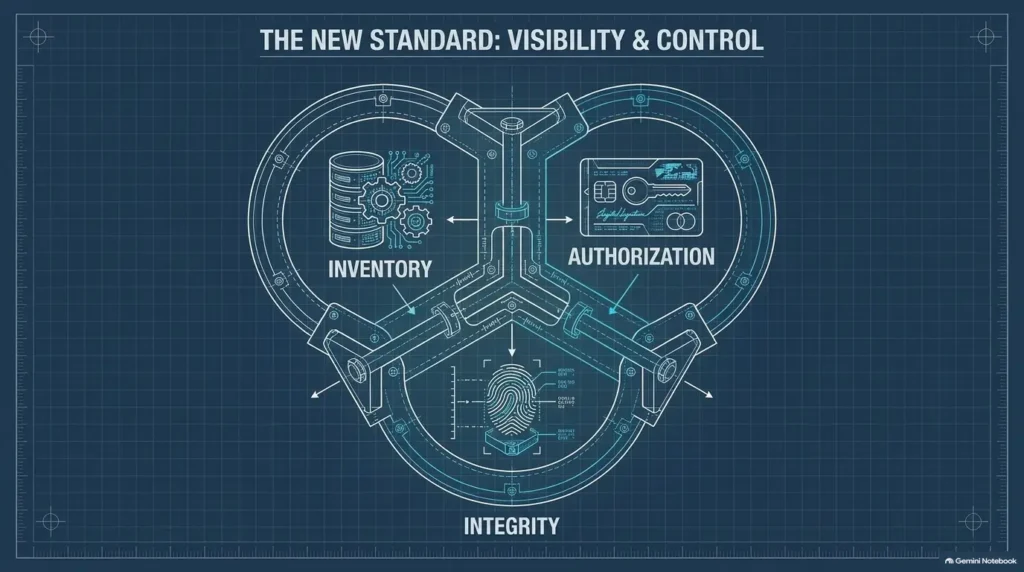
2. How is its integrity protected?
Authorization and integrity answer different questions. Authorization concerns permission to run. Integrity concerns whether the script remains as intended rather than being altered without authorization.
Your technical approach must fit the scripts and integration you actually use. A static file controlled by your developers and a frequently changing provider script may require different treatment. Document what each control protects and where it has limitations.
3. Why is it necessary on the payment page?
The inventory should identify the scripts and include a written business or technical justification for each. A list of domains alone provides little explanation of what is executing or why it belongs on checkout.
For example, “creates the payment token for the selected payment method” is a useful explanation. “Marketing requested it” needs more detail. Ask whether the same business purpose could be served on a page that does not handle payment entry.
Embedded forms and redirects are different SAQ A situations
PCI SSC’s SAQ A script-eligibility FAQ explains that the relevant criterion applies when the merchant’s webpage embeds a payment provider’s page or form, such as an iframe.
The FAQ describes two routes: implement protective techniques, potentially including those in 6.4.3 and 11.6.1, or obtain confirmation from the compliant payment provider that its embedded solution protects the merchant’s payment page against script attacks when implemented as instructed.
SAQ A r1 removed the standalone 6.4.3 and 11.6.1 assessment requirements and replaced them with this eligibility confirmation. That change does not remove those requirements from the full PCI DSS standard or other applicable assessment routes. Redirects and fully outsourced payment-link arrangements are excluded from this particular criterion. Other SAQ eligibility conditions still apply. Confirm the appropriate questionnaire with the organization accepting your compliance submission, typically your acquirer or payment brand.
If you rely on provider confirmation, retain the confirmation for your actual integration and the instructions it depends on. A general statement that a provider is PCI DSS compliant does not explain whether your implementation meets this particular condition.
Build an inventory from the checkout customers actually use
Start with a developer-assisted walkthrough of your authorized checkout environment. Inspect scripts loaded during the payment journey and compare them with your approved integrations. Use test transactions and avoid retaining real payment information in screenshots or browser exports.
As a practical coverage check, include guest and signed-in checkout, relevant consent choices, different payment methods, and alternate checkout routes. Scripts that appear only after an interaction can be missed by inspecting the initial page source.
The following hypothetical inventory illustrates useful management fields. It is not a prescribed PCI SSC template.
| Script or integration | Reason for presence | Evidence to maintain |
|---|---|---|
| Payment integration | Supports the chosen payment flow | Approval, provider instructions, applicable integrity controls |
| Address validation | Checks delivery information | Owner, justification, approved source and change record |
| Analytics tag | Measures a defined checkout event | Reason it must run here, approval and control coverage |
| Unused promotion widget | No current purpose | Removal decision and confirmation it no longer loads |
Copy a script review record
Use one record per script or clearly identified integration. Replace the prompts with dated evidence in your approved repository; leave unverified fields unresolved. This is an editorial working aid, not a PCI SSC form or a completed assessment.
Checkout flow / page / environment:
Validation route and responsible owner:
Script identity, source and relevant revision:
Loader or tag-manager dependency:
Observed browser state / observation date / evidence reference:
Authorization decision / approver / date:
Business or technical necessity:
Integrity method and supporting evidence:
Applicable provider instructions or confirmation:
Exception / responsible owner / resolution date:
Related change-monitoring record, where applicable:
Next review trigger / reviewer / unresolved question:
Record what was actually observed and reviewed. Keep real payment data, session tokens and other secrets out of shared examples and screenshots.
Removing unnecessary scripts reduces the number of components you must understand and maintain. Test the complete checkout after removal; a component that looks cosmetic may have an unexpected dependency.
Example: turn a script list into an approval decision
Fictional store example: Cedar Basket discovers four integrations on its checkout: a payment component, address validation, analytics and an old campaign widget. The team initially has a list of domains and a note saying “approved vendors.” That is insufficient to explain each script’s purpose, authorization or integrity treatment. The following decisions are illustrative; they are not findings about a real merchant or a prescribed control selection.
| Observed integration | Question that changes the decision | Example record to retain |
|---|---|---|
| Payment component | Does this exact integration match the provider’s instructions and the assessed payment flow? | Integration owner, approval reference, applicable instructions and integrity approach |
| Address validation | Must it run at payment entry, and what other scripts does it load? | Technical justification, dependency review and controlled update procedure |
| Analytics tag | What defined event is needed, and can that purpose be met outside payment entry? | Business decision, approved location and limits on what is collected |
| Old campaign widget | Is there a current justified purpose or only historical approval? | Removal decision, deployment reference and verification that it no longer executes |
The reviewer records an explicit result for each item: approved with supporting evidence, unresolved pending an owner’s answer, or scheduled for removal. These are suggested internal labels, not official PCI DSS assessment results. An unresolved entry should identify the missing fact and accountable owner; it should not silently become approved when a deadline arrives.
For the old widget, deleting one tag is only the start. The developer checks the applicable checkout routes and interactions to confirm another loader does not reintroduce it. For the retained address service, the record identifies the approved integration and what happens when its resource changes. The result connects an observed browser component to a decision a later reviewer can understand.
If an integration loads several separately identifiable scripts, do not let a broad vendor label conceal them. Record enough detail to reconcile what actually executes with the authorization, integrity method and necessity of the relevant scripts. A source URL is useful, but dynamic URLs, loaders and changing revisions need a documented identification approach.
CSP and integrity checks are tools, not automatic compliance
Content Security Policy (CSP) gives browsers rules about which resources may load or execute. It can support a controlled script environment, but allowing a trusted domain does not prove that every script delivered by that domain is unchanged or appropriate.
Do not confuse testing a policy with enforcing it. As Mozilla’s CSP documentation explains, a report-only policy generates reports without enforcing that policy. Report-only deployment can help identify checkout breakage before enforcement; it is not itself a blocking control.
Subresource Integrity (SRI) lets the browser compare a supported resource against an expected cryptographic hash. It can be useful for suitable external scripts, but changing the file changes its hash. Coordinate legitimate updates and follow the payment provider’s integration requirements rather than adding controls blindly.
Our comparison of WAF, RASP, and CSP provides background on where these controls operate. For this requirement, the practical question is whether your chosen combination addresses payment-page scripts and produces evidence you can explain.
Maintain script controls through releases
An inventory becomes stale if the release process can introduce scripts without updating it. Use the existing change process to ask what is being added, removed or modified, which checkout states are affected, who authorizes it, and how the relevant integrity protection continues to work. These are operating suggestions for maintaining evidence, not a new PCI SSC release checklist.
- Before deployment: identify the relevant scripts and dependencies, review the purpose and authorization, and document the proposed technical protection.
- During the approved change: deploy through the controlled process with a named owner and a recovery plan appropriate to the checkout.
- After deployment: compare the observed scripts with the approved change, verify the intended checkout behavior and update the controlled evidence.
- When something differs: investigate the discrepancy rather than automatically adding the unexpected script to the approved list.
For a suitable static external script, MDN’s Subresource Integrity documentation explains hash matching and the cross-origin access conditions needed for verification. A legitimate resource update can require a corresponding integrity update. Plan and test that change with the provider’s supported integration; do not remove a failing integrity check simply to clear a checkout error.
A frequently changing provider resource needs a supported protection approach that accounts for its behavior. “The file changes too often” explains a design constraint; it does not establish that no integrity treatment is needed where 6.4.3 applies. Document the method, its limits and the evidence supporting its use, and resolve uncertainty with the appropriate technical and validation participants.
Keep operational recovery separate from automatic approval. If a new control breaks a payment method, preserve the observation and follow the approved recovery process. After service is restored, investigate the incompatibility and validate the revised protection. A successful purchase proves that a flow completed under those conditions; it does not prove that every script is authorized or protected.
Connect this review to the PCI DSS 11.6.1 payment-page change-detection guide. The script record explains the approved state; the monitoring record helps the team investigate deviations. Keeping a shared change reference makes the two records easier to reconcile without treating them as interchangeable controls.
Understand the separate role of Requirement 11.6.1
Requirement 6.4.3 concerns script management. Requirement 11.6.1 addresses detecting unauthorized changes to payment pages and relevant HTTP headers as received by the browser. An approval record cannot tell you that a page was later altered; a change alert cannot supply the missing business justification for a script.
Keep those responsibilities distinct when evaluating a service. Ask what it observes, which checkout states it covers, what triggers an alert, who receives it, and how investigations are recorded. Confirm the applicable monitoring frequency against the full requirement and your assessment approach rather than assuming an annual review is sufficient.
Handle 3-D Secure scripts carefully
PCI SSC provides a specific clarification for 3-D Secure (3DS). Its FAQ on 3DS scripts and 6.4.3 states that validation against 6.4.3 is not required for scripts performing 3DS functionality because of the established trust relationship with the 3DS provider. Scripts running for other purposes remain subject to 6.4.3.
Do not extend that clarification to every script supplied by a payment company. Identify the function of the particular script before deciding how the clarification applies.
PCI DSS Requirement 6.4.3 FAQ
Is a domain allowlist a complete script inventory?
No. It does not by itself identify and justify every script that executes. Reconcile the observed scripts and dependencies with the authorization, integrity treatment and business or technical purpose recorded for them.
Does a report-only CSP block suspicious scripts?
No. Report-only policy is useful for observing potential violations without enforcing that policy. Keep its behavior distinct from an enforced policy and from other script protections. A report-only deployment should not be described as proof of blocking.
Can we approve everything a trusted payment vendor supplies?
Identify the actual function and integration first. The specific clarification for 3DS functionality does not apply to every script bearing a payment vendor’s name. General vendor trust does not replace the requirement-specific analysis.
Does removing unnecessary scripts finish the job?
No. Verify removal, keep the retained scripts under appropriate management, and update evidence when the checkout changes. Reducing unnecessary components can simplify the work, but the remaining scripts still need the applicable authorization, integrity and inventory controls.
Make the next decision about ownership
PCI SSC identified March 31, 2025 as the effective date for these previously future-dated requirements in its e-commerce security announcement. Treat implementation as an ongoing responsibility, with your current validation route determining what you must demonstrate.
Bring your developer and payment provider a description of the checkout flow, the scripts you have observed, and the questionnaire your acquirer expects. Establish who authorizes changes, who operates integrity controls, and who investigates alerts.
If the payment integration or responsibility boundary remains unclear, that is a concrete reason to involve a Qualified Security Assessor before signing a compliance declaration. The useful outcome is a checkout whose scripts have an explainable purpose, an accountable approval decision, and appropriate technical protection—with evidence that remains accurate when the checkout changes.
Reviewed November 16, 2026. Expanded the fictional script-decision example, release workflow and FAQ. Checked the linked PCI SSC eligibility and 3DS clarifications and MDN technical references. Examples are editorial aids; no checkout implementation was assessed for this revision.