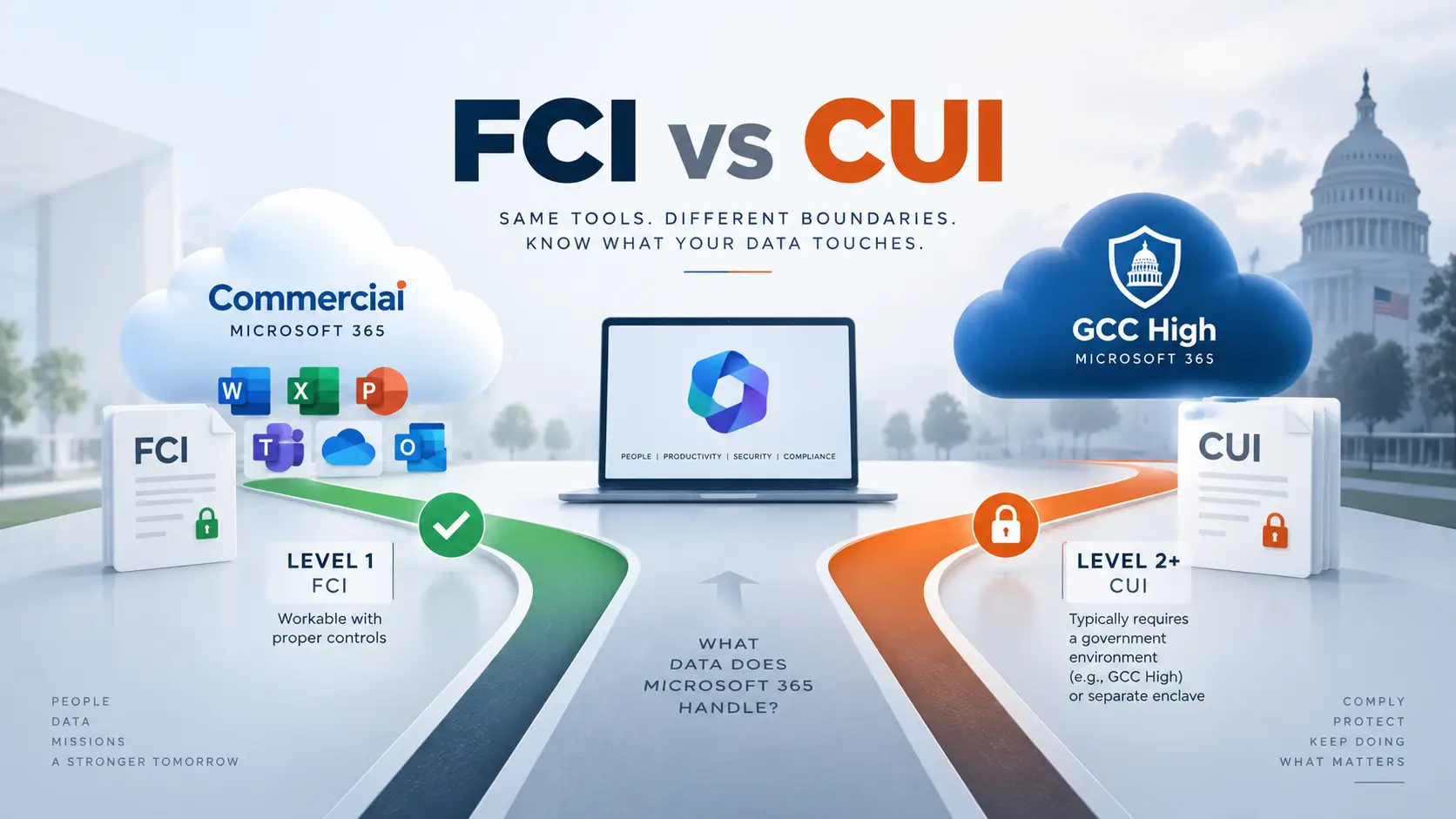
If your organization uses Microsoft 365 Commercial and CMMC suddenly appears in a DoD contract or prime-contractor flowdown, the first question is not “Do we need GCC High?” It is “Will Federal Contract Information or Controlled Unclassified Information enter Microsoft 365?”
That distinction changes almost everything. Microsoft positions Microsoft 365 Commercial as capable of supporting CMMC Level 1 for Federal Contract Information (FCI), subject to your own configuration and operating controls. Once Microsoft 365 will store, process, or transmit Controlled Unclassified Information (CUI), however, ordinary Commercial becomes a poor fit: Microsoft does not position its Commercial productivity services for CUI or DFARS 252.204-7012 cloud requirements. Microsoft recommends its government environments, particularly GCC High when CUI, export controls, or broader defense requirements are involved.
Your useful first action is therefore a data-flow check, not a license purchase. Determine whether contract email, Teams messages, SharePoint files, OneDrive documents, attachments, or synchronized endpoint data contain FCI or CUI before deciding whether Commercial can remain, needs to be isolated, or must be replaced inside the CMMC boundary.
Table of Contents
The Decision Hinge Is FCI Versus CUI
CMMC does not certify a Microsoft 365 subscription. It assesses how a contractor protects information within the systems used for contract performance. The relevant Microsoft environment depends largely on what information reaches it.
| Situation | What Microsoft 365 Commercial Means | Likely Next Step |
|---|---|---|
| Only ordinary corporate data | CMMC may not bring that workload into scope | Keep it separated from systems handling contract information |
| FCI enters Microsoft 365 | Commercial can potentially support a Level 1 architecture | Verify the 15 Level 1 safeguards, tenant configuration, endpoints, and operating evidence |
| CUI never enters Commercial because a separate enclave handles it | Commercial may remain outside the CUI boundary | Prove the separation and prevent CUI spillage |
| CUI is stored, emailed, synchronized, or discussed in Commercial | Commercial becomes a major compliance problem | Re-architect the data flow or move the CUI workload to an appropriate government environment |
| CUI includes ITAR, EAR, or other tightly controlled CUI | Commercial is not the appropriate destination | Evaluate GCC High and related sovereign-cloud requirements |
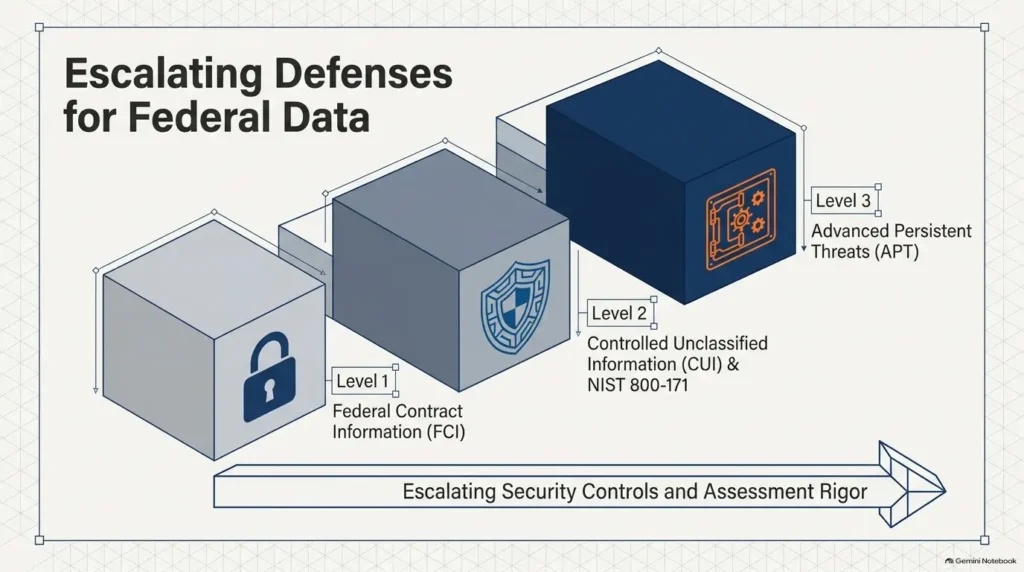
Level 1 focuses on safeguarding FCI and uses the 15 basic safeguarding requirements in FAR 52.204-21. Level 2 protects CUI and evaluates 110 requirements derived from NIST SP 800-171 Revision 2 under the current CMMC program structure. The DoD’s current CMMC program page is worth checking before acting because implementation timing is presently changing.
The July 2026 CMMC Phase II Suspension Does Not Remove CUI Duties
There is an important timing wrinkle. In July 2026, the Department announced that the CMMC Phase II requirements scheduled to begin on November 10, 2026 were suspended while the program undergoes review. Phase I self-assessment requirements remain in place.
That suspension should not be interpreted as permission to put CUI wherever convenient. Existing contract clauses still matter, and DFARS 252.204-7012 continues to impose safeguarding and incident-reporting obligations where the clause applies. In particular, if an external cloud service provider stores, processes, or transmits covered defense information, the clause requires the contractor to ensure that the provider meets security requirements equivalent to the FedRAMP Moderate baseline and satisfies specified cyber-incident obligations. You can verify the operative language in DFARS 252.204-7012.
So the practical rule in September 2026 is simple: do not postpone correct CUI handling merely because one CMMC rollout milestone has been suspended. Certification timing and contractual data-protection duties are related, but they are not the same thing.
What Microsoft Says About Microsoft 365 Commercial
Microsoft’s current CMMC guidance draws a fairly sharp product boundary. It describes Microsoft 365 for Enterprise as supporting organizations working toward CMMC Level 1, while positioning Microsoft 365 GCC High for organizations working toward Levels 2 and 3 when configured appropriately.
The distinction becomes even clearer in Microsoft’s current CMMC guidance: compliance still depends on the customer’s configuration, implementation, operations, scope, and assessment. Buying a particular Microsoft SKU does not produce CMMC compliance by itself.
Microsoft’s more detailed May 2026 cloud compliance comparison goes further. Microsoft states that its Microsoft 365 Commercial productivity services are not intended for management of CUI and are not offered as meeting the relevant FedRAMP commitment for that workload.
This distinction applies specifically to Microsoft 365 Commercial productivity services. Do not casually generalize it to every service called “Commercial” inside the Microsoft ecosystem. Azure Commercial has its own authorization boundaries and service-specific compliance status. A system architect must evaluate the actual cloud service offering in use, not merely the word “Microsoft.”
Why an E3-to-E5 Upgrade Does Not Solve the Problem
A common procurement mistake is treating CMMC as a feature gap. An organization sees missing controls, upgrades from Microsoft 365 E3 to E5, enables more Defender or Purview capabilities, and assumes the compliance problem has disappeared.
Additional security capabilities can absolutely help implement controls. They do not change the underlying cloud environment from Commercial to GCC or GCC High.
- Adding stronger identity controls does not change where Microsoft operates the service.
- Adding data-loss prevention does not create a government-cloud authorization boundary.
- Adding retention or auditing does not make Microsoft 365 Commercial a DFARS-supported CUI productivity environment.
- Buying E5 does not document your system boundary, procedures, training, incident response, or assessor evidence.
The license question comes after the architecture question. Otherwise you can spend more money while leaving the decisive compliance gap untouched.
What Actually Changes When CUI Enters Microsoft 365
CUI changes more than the mailbox in which a file arrives. Once Microsoft 365 participates in CUI handling, the compliance boundary can reach identity, endpoints, collaboration, logging, support arrangements, integrations, and the administrators capable of accessing the environment.
Email becomes part of the CUI path
A company may carefully build a protected SharePoint repository and then allow employees to email the same drawing through an ordinary Commercial mailbox. The secure repository no longer tells the whole story. Exchange, Outlook clients, mobile devices, cached attachments, mail protection systems, and potentially connected services can become relevant to scope.
Teams and OneDrive can quietly expand scope
Teams conversations can contain CUI even when nobody attaches a document. OneDrive synchronization can place CUI on laptops that were never intended to be inside the assessed environment. A compliance boundary drawn only around “the CUI folder” can therefore become fiction remarkably quickly.
Identity becomes a security component
Authentication, privileged access, account lifecycle, remote access, and administrative roles affect the security of the CUI environment. Microsoft can provide technical capabilities, but your organization still owns decisions such as who receives privileged access, how accounts are reviewed, how exceptions are approved, and how evidence is retained.
Endpoints matter because cloud data rarely stays in the cloud
A compliant cloud architecture can be undone by unmanaged laptops, local downloads, browser caches, personal devices, USB media, or unsanctioned synchronization. If CUI can reach an endpoint, that endpoint and the controls protecting it deserve explicit scoping analysis.
Commercial, GCC, or GCC High?
The useful comparison is not “cheap cloud versus expensive cloud.” It is which environment provides the commitments your specific information and contracts require.
| Environment | Best-Fit CMMC Use | Main Limitation to Check |
|---|---|---|
| Microsoft 365 Commercial | FCI and potential Level 1 architectures | Microsoft does not position the productivity environment for CUI or DFARS 7012 |
| Microsoft 365 GCC | Government workloads, FCI, and some CUI scenarios | Not every CUI category or sovereignty requirement is covered; export-controlled data needs particular scrutiny |
| Microsoft 365 GCC High | CUI-focused defense contractor environments and CMMC Levels 2-3 | Eligibility, migration effort, feature differences, integration compatibility, and higher operating complexity |
Microsoft currently states that GCC provides FedRAMP High and DFARS commitments, while GCC High adds the government-cloud architecture and commitments designed for more demanding defense workloads, including ITAR-related use cases. Microsoft’s Government cloud eligibility and purchasing guidance is the appropriate place to verify current eligibility and service commitments before procurement.
GCC High is therefore not a universal CMMC tax. If you handle only FCI, purchasing it solely because somebody uttered “CMMC” may be unnecessary. If CUI flows through Microsoft 365, however, keeping ordinary Commercial usually requires a far more difficult argument than redesigning the workload around a suitable government environment.
A CUI Enclave Can Let Commercial Stay Outside the Boundary
Moving the entire company to GCC High is not the only architecture available. Organizations with a limited population handling CUI sometimes build a separate CUI enclave while leaving ordinary corporate operations in Microsoft 365 Commercial.
The economic appeal is obvious: fewer users and workloads enter the expensive compliance boundary. The catch is equally obvious once you draw the arrows. The separation must survive real human behavior.
- CUI must not be forwarded into Commercial mailboxes.
- Users must not copy CUI into ordinary Teams chats or Commercial SharePoint sites.
- Endpoints need controls that prevent uncontrolled synchronization and downloads.
- Third-party applications must not silently transfer enclave data into Commercial SaaS services.
- Administrative paths and identity dependencies must be included in the system boundary analysis.
- Procedures must explain how users recognize CUI and what they do when accidental spillage occurs.
An enclave works when it creates a smaller, defensible boundary. It fails when it creates a small protected island connected to a dozen unexamined bridges.
The Evidence Changes Along With the Technology
CMMC is assessed through evidence, not architectural intent. “We use Microsoft” is not evidence that a requirement is met, and “Microsoft has the feature” is not evidence that you enabled, governed, reviewed, and maintained it correctly.
For a Microsoft 365 environment in scope, expect to map responsibilities across at least four layers:
- Microsoft responsibility: controls implemented by the cloud provider within the applicable service boundary.
- Customer configuration: tenant, identity, endpoint, security, logging, retention, and access settings you must configure.
- Customer operations: account reviews, incident handling, vulnerability management, training, change control, media handling, and other recurring processes.
- Evidence: policies, procedures, configuration exports, screenshots where appropriate, logs, tickets, review records, system diagrams, and the System Security Plan that explain how the requirement is satisfied.
This is why a tenant migration and a CMMC implementation are separate projects. One moves workloads. The other establishes and proves a security program.
Third-Party Apps Can Reopen the Boundary You Just Closed
Teams, SharePoint, Outlook, and Entra environments rarely operate alone. Backup platforms, e-signature services, ticketing systems, CRM connectors, archiving products, mobile applications, AI assistants, security tools, and workflow automation may receive Microsoft 365 data through APIs or user actions.
If CUI crosses that connection, the compliance question follows the data. A government-cloud tenant does not confer its assurances on an unrelated SaaS provider.
Before approving an integration, ask three questions: Can this product receive CUI? Where does it process or store that data? What contractual and security evidence supports its use? If nobody can answer all three, the integration should not quietly enter the CUI workflow.
What a Migration Quote Should Actually Include
If the answer points toward GCC or GCC High, do not compare quotes by license cost alone. Much of the work sits outside the license.
| Cost Driver | Why It Matters | Question to Ask |
|---|---|---|
| Tenant migration | Email, SharePoint, Teams, OneDrive, permissions, and metadata may need migration | Exactly which workloads and historical data are included? |
| Identity design | Separate tenants or enclaves can complicate authentication and administration | What happens to identities, domains, guests, and privileged accounts? |
| Endpoint management | CUI access may require a more tightly controlled device population | Which devices enter scope and how will they be managed? |
| Security configuration | Licenses do not arrive configured to your SSP | Which controls will the provider configure and document? |
| Application compatibility | Commercial integrations may not have equivalent government-cloud support | Which applications stop working or need replacement? |
| Evidence development | Assessment readiness requires documentation beyond deployment | Are SSP updates, diagrams, control evidence, and procedures included? |
| Ongoing operations | CMMC controls must continue after the migration project ends | Who owns recurring reviews, alerts, evidence, and changes? |
If budgeting becomes the next problem, the larger cost model is covered in KIOPTRIX’s CMMC compliance cost guide. The expensive surprise is often not the government-cloud license itself. It is reducing scope, migrating data, replacing integrations, fixing endpoints, documenting controls, and operating the environment afterward.
Your 15-Minute Microsoft 365 CMMC Scope Check
Before calling Microsoft, a consultant, or a C3PAO, answer these questions internally. They will make the next conversation considerably more useful.
- Read the contract and flowdowns. Identify FAR 52.204-21, DFARS 252.204-7012, CMMC clauses, and any specific data-handling language.
- Identify the information. Separate ordinary business data, FCI, CUI Basic, CUI Specified, and export-controlled information instead of calling everything “government data.”
- Trace Microsoft 365. Check Exchange, Teams, SharePoint, OneDrive, Forms, Power Platform, mobile devices, backups, and connected applications.
- Find the first CUI touchpoint. Ask where CUI is first received or created and every location to which it can move afterward.
- Mark what Commercial must do. Decide whether Commercial will handle only ordinary corporate information, FCI, or CUI.
- Choose the boundary before the SKU. Compare remaining on Commercial for Level 1, creating a CUI enclave, using GCC where appropriate, or moving relevant workloads to GCC High.
- Record unresolved assumptions. Anything depending on the contract, CUI category, export controls, cloud authorization, or assessor interpretation should become a named question rather than an architectural guess.
If step three produces a spiderweb rather than a diagram, that is useful information. Your first project may be scope reduction, not migration.
When Professional Help Is Worth Paying For
You do not need a consultant merely to discover that Commercial holds no CUI. A small organization with clear contracts, a simple FCI-only environment, and capable internal administrators may be able to perform much of its Level 1 preparation internally.
Professional help becomes easier to justify when CUI already exists across Commercial mailboxes and file stores, when export-controlled information is involved, when multiple tenants or subsidiaries complicate scope, or when nobody can confidently explain the cloud-provider requirements inherited from DFARS.
Before paying, ask the provider to show what is included: current-state discovery, CUI data-flow mapping, tenant architecture, migration, security configuration, SSP updates, evidence mapping, endpoint work, integration review, remediation support, and assessment preparation. A quote labeled “GCC High migration” may cover only a fraction of that list.
If certification is required, remember another boundary: an implementation consultant can help you prepare, but preparation is not the same as the independent assessment required when your solicitation calls for a C3PAO assessment.
Frequently Asked Questions
Can we keep Microsoft 365 Commercial if we need CMMC Level 1?
Potentially, yes. Microsoft currently states that organizations may support CMMC Level 1 and FCI protection in Microsoft 365 Commercial. Your organization still must implement, operate, and prove the applicable safeguards. Microsoft also cautions that Commercial is not purpose-built for U.S. government requirements, so future contractual needs should be considered before treating it as a permanent architecture.
Does CMMC Level 2 automatically require GCC High?
CMMC itself does not contain a rule saying every Level 2 contractor must purchase GCC High. The real requirements come from the data, contract, cloud-service obligations, CUI category, and architecture. Microsoft recommends GCC High for CUI and Levels 2-3 because it is purpose-built around the relevant defense and sovereignty requirements. GCC may support some CUI scenarios, but it requires closer examination of the data category and contractual commitments.
Can we keep Commercial for normal employees and use GCC High only for CUI users?
Yes, a separated enclave architecture can be viable. The difficult part is proving that CUI cannot casually leak into Commercial through email, Teams, downloads, identities, integrations, endpoints, backups, or user error. The cost advantage of a smaller enclave should be weighed against the operational complexity of maintaining that separation.
Does using GCC High make us CMMC compliant?
No. GCC High can provide cloud capabilities and inherited controls useful to a CMMC program, but your organization still owns customer-side configuration, endpoints, identities, policies, procedures, training, incident response, documentation, evidence, and other requirements within its assessment scope.
Should we delay a Microsoft 365 decision because CMMC Phase II was suspended?
Not if your existing contract already requires protection of CUI or contains applicable DFARS clauses. The 2026 Phase II suspension changes rollout timing, not the underlying fact that covered defense information must be safeguarded under applicable contracts. Delay a migration only when your current architecture legitimately satisfies the requirements or when the governing requirement itself remains unresolved.
What to Check Before Changing Your Microsoft Tenant
Open one recent defense contract or prime-contractor flowdown and one simple diagram of your Microsoft 365 environment. Circle every place FCI or CUI can enter Exchange, Teams, SharePoint, OneDrive, an endpoint, or a connected SaaS application.
Then write one sentence: “Microsoft 365 Commercial will handle _____, but will not handle _____.”
If the second blank contains CUI and your current tenant is Commercial, you have a clean architectural objective: either keep CUI out of Commercial through a defensible enclave or move the relevant workload to a cloud environment that supports the contractual requirements. If only FCI enters Commercial, the next job is not migration. It is proving that the Level 1 safeguards are actually implemented.
That one boundary decision can prevent two expensive mistakes: migrating an entire company when CUI never needed to touch it, or keeping CUI in a convenient Commercial tenant that was never designed to carry the compliance burden.
Last reviewed: 2026-10