If you failed a CMMC Level 2 assessment, the remediation cost is not a single consulting fee. Your real budget may include internal engineering time, control changes, evidence and System Security Plan updates, new security tooling, remediation support, and either a POA&M closeout assessment or an entirely new CMMC assessment.
The distinction that matters most is whether you received Conditional Level 2 status or received No CMMC Status. A conditional result can allow eligible deficiencies to be corrected through a limited POA&M process. A result below the permitted threshold, or a failure involving certain requirements that cannot be placed on a POA&M, can push you into a new assessment cycle after remediation.
Your first action should therefore be surprisingly unglamorous: do not start buying tools. Obtain the final findings, identify every NOT MET requirement, confirm which findings are eligible for a POA&M, and determine whether the C3PAO expects a closeout assessment or a new certification assessment.
This guide addresses remediation after an assessment; it does not establish whether your contract currently requires a C3PAO assessment. Verify the solicitation, contract or flowdown and the current CMMC implementation guidance before commissioning one. Where incorporated, DFARS 252.204-7021 governs the required status and continuing affirmation.
Table of Contents
First Determine Whether You Actually Failed CMMC
Teams often use “failed CMMC assessment” to describe several very different outcomes. Those outcomes do not create the same remediation bill.
| Assessment outcome | What it means | Likely cost consequence |
|---|---|---|
| Final Level 2 | Required security requirements were satisfied and any applicable closeout work is complete. | No failed-assessment remediation cycle. |
| Conditional Level 2 | Eligible NOT MET requirements remain on an approved POA&M. | Remediation plus evidence work and a POA&M closeout assessment. |
| No CMMC Status | The assessment did not qualify for conditional or final status. | Remediation may be followed by a new assessment rather than a limited closeout. |
| Conditional status expires | The POA&M was not successfully closed within the permitted period. | Prior remediation spending may still have value, but another assessment cycle may be required. |
For Level 2, the CMMC rule permits conditional status only when the score reaches the required threshold and the remaining findings satisfy the POA&M rules. The threshold is at least 80% under the rule’s Level 2 calculation, effectively 88 on the 110-point Level 2 scale, but score alone is not enough. Certain deficiencies cannot remain open for purposes of obtaining conditional status.
This distinction is the hinge of the entire cost estimate. Paying for a narrow closeout assessment is a different financial problem from paying to prepare for another complete assessment.
What CMMC Remediation Actually Costs
There is no official flat “CMMC remediation fee.” Remediation is work performed to eliminate the specific deficiencies identified by the assessment, and two organizations with the same assessment score can face radically different workloads.
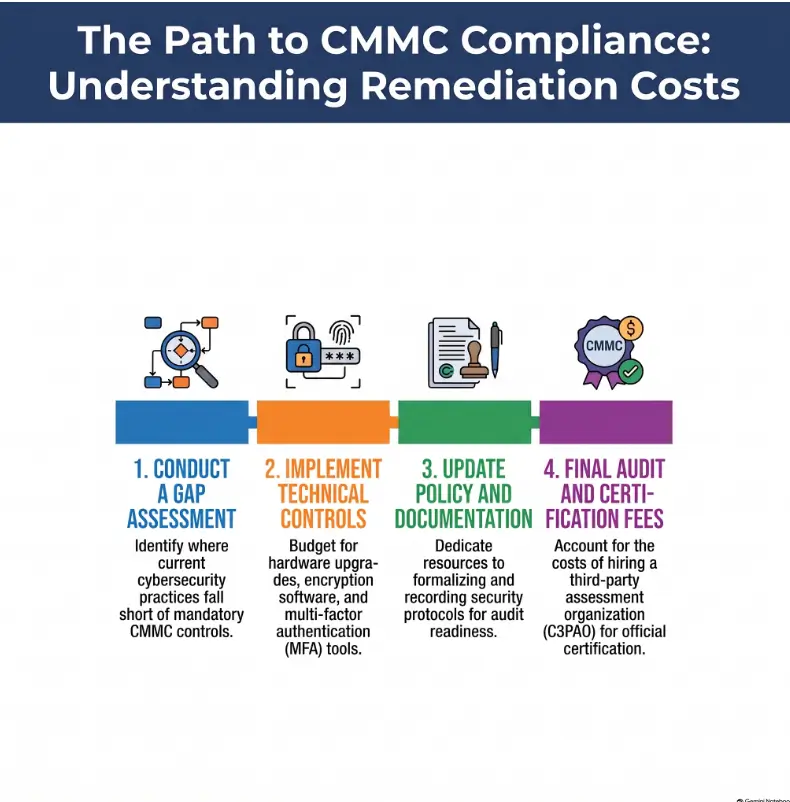
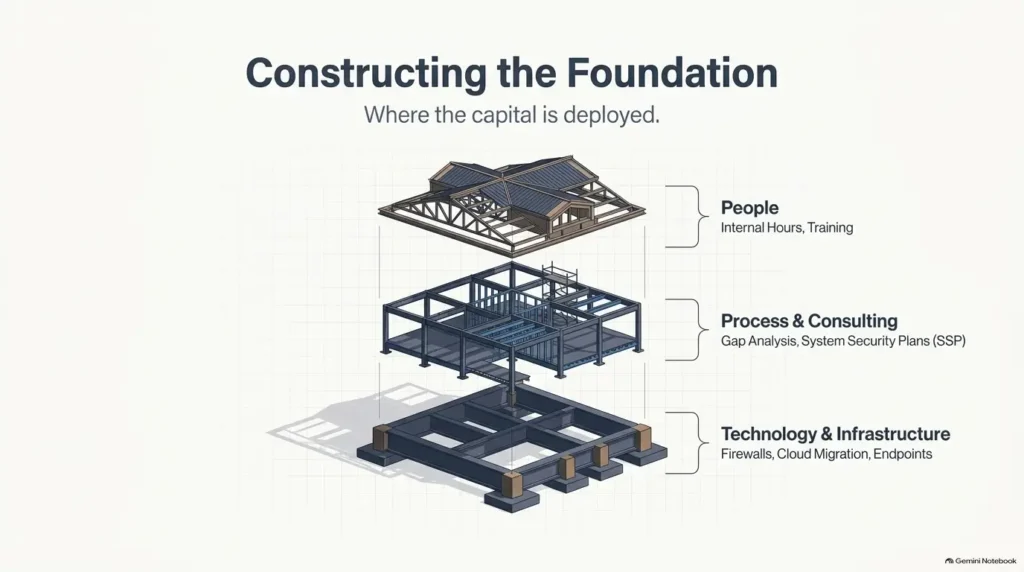
Realistic remediation budget = internal labor + technical changes + documentation and evidence + outside remediation help + assessment or closeout costs + operational disruption + contingency.
That formula is more useful than a generic market price because it forces each failed requirement to acquire an owner, an implementation task, an evidence requirement, and a cost.
| Cost bucket | What you may actually be paying for | What controls the cost |
|---|---|---|
| Internal labor | Security, IT, compliance, legal, HR, facilities, management, and evidence collection | Number of findings and amount of cross-team work |
| Technical remediation | Configuration changes, identity controls, encryption, logging, segmentation, endpoint protection, backups, or infrastructure work | Whether the control is missing or merely misconfigured |
| Documentation | SSP corrections, procedures, diagrams, inventories, policies, and evidence mapping | Quality of existing documentation |
| Software and services | Licenses, managed services, compliant hosting, monitoring, or other technical capabilities | Whether a real capability gap exists |
| Professional remediation | Specialist implementation, architecture, compliance support, or evidence preparation | Internal expertise and deadline pressure |
| Assessment work | POA&M closeout or another certification assessment | Your assessment outcome and C3PAO agreement |
| Business impact | Maintenance windows, migration, staff training, system redesign, or process changes | How deeply the failed control touches production operations |
Do not ask a consultant only, “How much will CMMC remediation cost?” Ask for the cost broken down by failed requirement, implementation task, evidence deliverable, dependency, and assessment consequence. A single bundled number makes it difficult to distinguish necessary remediation from optional modernization.
The Cost Drivers That Move the Budget Most
The number of failed requirements matters, but the type of failure usually matters more. Five variables tend to change the financial picture fastest.
1. Configuration Gap or Missing Capability
A requirement that is substantially implemented but lacks a defensible configuration, procedure, or evidence trail may be inexpensive to correct. A requirement that depends on infrastructure you do not possess can trigger licensing, migration, integration, and recurring operating costs.
Separate each finding into fix existing and build or buy missing capability. Mixing those categories is one of the fastest ways to inflate a remediation project.
2. CMMC Scope Size
A control affecting five carefully bounded CUI assets is a different implementation problem from the same control applied across a broad environment containing hundreds of endpoints, multiple sites, cloud services, administrative systems, and external service providers.
Before expanding technology everywhere, verify the CMMC assessment scope. Correct scoping is not a loophole. It is a way to avoid paying to redesign systems that do not need to participate in the assessed CUI environment.
3. Evidence Debt
A working security control is not necessarily an assessable control. If the organization cannot produce adequate evidence showing that the requirement is implemented and operating as required, remediation can become a documentation and governance project even when little technology changes.
This is why a failed assessment can create work for system administrators, compliance personnel, management, HR, physical-security staff, and asset owners at the same time.
4. Dependencies Between Findings
Ten findings are not necessarily ten separate projects. A single identity architecture correction might resolve several weaknesses. Conversely, one seemingly small requirement may depend on directory services, endpoint configuration, logging, policies, and training.
Budget by remediation workstream rather than simply multiplying the number of findings by a consulting rate.
5. Closeout Versus Full Reassessment
This can be the largest external-cost difference. If you hold Conditional Level 2 status and successfully remediate eligible POA&M items, the next assessment activity may be a focused POA&M closeout. If you did not obtain conditional status, or the conditional process fails, a new assessment can become necessary.
Which Failed Requirements Can Go on a CMMC POA&M?
A CMMC POA&M is not permission to postpone any control you choose. Level 2 conditional status is available only within the restrictions of 32 CFR Part 170.
Under the Level 2 rules, remaining POA&M items generally cannot include requirements valued above one point under the CMMC scoring methodology. There is a specific exception for SC.L2-3.13.11 concerning CUI encryption when encryption is employed but is not FIPS-validated.
The rule also identifies six Level 2 requirements that cannot be placed on a POA&M for achieving conditional status:
- AC.L2-3.1.20 — External Connections involving CUI
- AC.L2-3.1.22 — Control Public Information involving CUI
- CA.L2-3.12.4 — System Security Plan
- PE.L2-3.10.3 — Escort Visitors
- PE.L2-3.10.4 — Physical Access Logs
- PE.L2-3.10.5 — Manage Physical Access
The Department of Defense’s current CMMC FAQ also explains an especially expensive failure mode: if a Level 2 assessment does not meet the conditional-status threshold, or includes a prohibited POA&M requirement, the organization can receive No CMMC Status rather than conditional status.
That means remediation budgeting should begin with classification, not purchasing. Determine which findings are eligible for the conditional pathway before deciding how aggressively to compress the project.
The 180-Day Deadline Can Turn a Cheap Fix Into an Expensive One
Eligible Level 2 POA&Ms must be closed within 180 days of the conditional CMMC status date. The deadline is not simply an internal project target.
For a Level 2 certification assessment, the POA&M closeout assessment is conducted by a C3PAO. The DoD Level 2 Assessment Guide describes the distinction between Conditional Level 2 and Final Level 2 status and the role of the closeout assessment.
Confirm the formal closeout procedure and evidence requirements with the C3PAO before scheduling. Under 32 CFR § 170.17, the C3PAO must complete the closeout and post the compliance results within 180 days of the Conditional Level 2 status date. If it is not successfully closed in that period, conditional status expires and a new assessment is required. Do not budget on an assumed extension.
So the cheapest strategy is not “schedule the closeout as quickly as possible.” It is schedule the closeout only after every POA&M item has been independently verified against the applicable assessment objectives and evidence.
Build the Remediation Budget From Findings, Not From Products
A useful remediation budget starts as a findings register. One row per assessment finding is enough. The register should then expose where money will actually be consumed.
| Field | Question to answer |
|---|---|
| Requirement | Which CMMC Level 2 requirement was NOT MET? |
| Assessment objectives | Which specific objectives caused the finding? |
| Root cause | Is the problem technology, process, documentation, evidence, scope, or ownership? |
| POA&M eligibility | Can the finding legally remain open for conditional status? |
| Implementation task | What must actually change? |
| Owner | Who can make that change? |
| Evidence | What will demonstrate the requirement is MET? |
| Dependency | What other remediation must happen first? |
| Internal effort | How many staff hours are expected? |
| External spend | What software, service, or professional work is genuinely required? |
| Recurring cost | Does the fix create an annual operating expense? |
| Verification | Who will test the remediation before the formal closeout? |
Once these fields are completed, the budget becomes arithmetic instead of speculation.
Total remediation budget = Σ internal remediation hours × loaded internal rate + implementation purchases + outside professional services + assessment-related fees + expected recurring cost + contingency.
The formula deliberately contains no universal dollar amount. There is no responsible way to estimate a failed CMMC remediation project without knowing what failed, how the environment is scoped, what capabilities already exist, and whether the organization is facing a closeout or a new assessment.
Separate Security Remediation From Assessment Remediation
This separation prevents a subtle but expensive mistake.
Security remediation changes the actual environment: access rules, encryption, identity controls, logging, physical controls, configuration, monitoring, segmentation, or operational processes.
Assessment remediation makes the implementation demonstrable: SSP updates, policies, procedures, diagrams, inventories, screenshots, configuration records, interview preparation, and other evidence needed to substantiate that the requirement is satisfied.
Some failed requirements need both. Others need only one. If a vendor proposes new software for a finding that is actually an evidence or procedure problem, ask exactly which assessment objective the software changes.
If the answer remains foggy, the purchase may be solving a sales problem rather than your assessment problem.
When DIY, Software, or Professional Help Makes Sense
A failed assessment does not automatically justify a large consulting engagement. The right delivery model depends on the unresolved problem.
| Approach | Usually sensible when | Watch for |
|---|---|---|
| Internal remediation | Your team understands the requirement, owns the systems, and can produce defensible evidence. | Teams fixing configuration while forgetting procedures, SSP updates, or assessment evidence. |
| Security or compliance software | A genuine repeatable capability is missing, such as centralized management, evidence collection, or monitoring. | Buying a platform that documents gaps without implementing the underlying control. |
| Specialist consultant | The issue requires architecture, CUI scoping, specialized configuration, evidence mapping, or knowledge the internal team lacks. | Open-ended hourly work without requirement-level deliverables. |
| Managed provider | The control requires ongoing operational capability your team cannot sustain internally. | Recurring cost, data handling, scope, responsibility boundaries, and CMMC implications of external service providers. |
| C3PAO | Independent CMMC Level 2 certification assessment or applicable POA&M closeout is required. | Confusing assessment work with remediation consulting. |
Remember the independence boundary. The organization performing your certification assessment is not simply your implementation consultant wearing a different hat. CMMC ecosystem roles and conflicts of interest matter. Use the appropriate remediation resource while preserving the independence required for certification assessment work.
What to Ask Your C3PAO Before Spending More Money
Before signing a remediation contract or buying another security platform, obtain clarity on the assessment path. These questions can prevent expensive assumptions:
- Did our result produce Conditional Level 2 status or No CMMC Status?
- Which exact requirements and assessment objectives were NOT MET?
- Which findings are on the accepted POA&M?
- Are any findings ineligible for a POA&M?
- What is the conditional-status date from which the 180-day period runs?
- What evidence will be needed during the closeout assessment?
- What is included in the contracted assessment price for POA&M closeout?
- What fees, travel, scheduling, or administrative expenses are excluded?
- If we do not qualify for closeout, what portion of a new assessment must be repeated?
- What must be submitted or updated in SPRS or CMMC eMASS after successful remediation?
The current DFARS clause at 252.204-7021 requires contractors subject to the clause to maintain the applicable current CMMC status and addresses conditional status, final status, affirmations, and POA&M closeout. Use the contract clause, rather than a vendor’s marketing summary, when determining contractual consequences.
Five Remediation Spending Traps to Avoid
The most expensive failed assessment is not necessarily the one with the most findings. It is often the one where money is spent before the findings are translated into exact work.
- Buying a GRC platform before fixing the control. Better evidence organization cannot make an unimplemented security requirement MET.
- Replacing a security product that was merely misconfigured. Determine whether the failed assessment objective requires new capability or correct use of existing capability.
- Implementing controls outside the real scope by default. Broad enterprise modernization may be useful, but do not disguise it as mandatory CMMC remediation.
- Waiting until the closeout assessment to test evidence. A formal closeout should confirm remediation, not become the first serious test of it.
- Ignoring recurring cost. A fix that introduces a managed service, cloud platform, compliance tool, or new operational role may create a much larger three-year ownership cost than its initial implementation invoice suggests.
Use a Two-Pass Verification Before the Formal Closeout
Before telling the C3PAO that a POA&M item is ready, perform two separate checks.
Pass 1: Implementation Verification
- Confirm the technical or procedural change exists.
- Test the control under realistic operating conditions.
- Confirm responsible staff understand the changed process.
- Verify the change applies throughout the intended assessment scope.
Pass 2: Assessment Verification
- Map the remediation back to every applicable assessment objective.
- Confirm evidence is current and consistent with the production environment.
- Update the SSP and related documentation where necessary.
- Check that interviews, configuration evidence, policies, and observed behavior tell the same story.
This is cheaper than discovering during the formal closeout that the control works but the evidence does not prove it, or that one dependent assessment objective was overlooked.
Frequently Asked Questions
Can every failed Level 2 requirement be placed on a POA&M?
No. CMMC restricts which Level 2 findings can remain on a POA&M for conditional status. Certain higher-value requirements are excluded, six identified requirements are specifically prohibited, and only a narrow encryption exception applies to SC.L2-3.13.11 under the stated conditions.
What happens if we miss the 180-day CMMC POA&M deadline?
Conditional status expires if the required POA&M closeout is not successfully completed within the permitted 180-day period. That can create both contract-eligibility consequences and the cost of another assessment cycle, depending on the circumstances.
Can our internal IT team perform the remediation?
Yes, when the team has the capability to implement the required controls and produce appropriate evidence. Remediation itself does not automatically require a consultant. For a Level 2 certification assessment, however, the applicable independent C3PAO assessment or closeout requirements still apply.
Will buying a CMMC compliance platform fix a failed assessment?
Not by itself. Software can help with evidence, workflow, configuration, monitoring, reporting, or control operation, depending on the product. It cannot convert an unmet requirement into a met requirement unless it actually provides or supports the missing capability and that implementation satisfies the applicable assessment objectives.
Should we ask the C3PAO for a remediation quote?
First clarify the independence boundaries and the services the organization is permitted to provide. For remediation, compare providers based on requirement-level scope, deliverables, evidence, assumptions, recurring cost, and responsibility for implementation. Do not select a remediation provider merely because it promises to make the next assessment easier.
Your Next 15 Minutes
Open the final assessment findings and create five columns: requirement, NOT MET objective, POA&M eligibility, remediation owner, and verification evidence.
Then mark the assessment outcome at the top of the document: Conditional Level 2 or No CMMC Status. If conditional, record the exact conditional-status date and calculate the 180-day closeout window. If there is no status, ask the C3PAO what assessment work must be repeated after remediation.
Only after those questions are answered should you request software, consulting, or managed-service quotes. Require every proposed expense to point back to a failed requirement, a concrete implementation task, or a necessary assessment activity.
That small discipline turns “How much will this failed CMMC assessment cost us?” from an anxious blank check into a controlled remediation budget.
Last reviewed: 2026-10
If your remediation budget includes another certification review, compare the likely scope with our guide to CMMC Level 2 assessment cost before approving the next C3PAO engagement.
Remediation is only one part of the total program expense. Our breakdown of CMMC compliance cost can help separate assessment fees, implementation work, security tooling, and ongoing compliance expenses.
When multiple technical findings compete for limited engineering time, a documented vulnerability remediation SLA can help define ownership, deadlines, escalation rules, and verification expectations.
Identity and access-control weaknesses can create remediation work across several systems. Use this Active Directory security audit guide to review common directory-security gaps before paying for unnecessary replacement technology.
If new security products are being proposed as part of the remediation plan, estimate the broader ownership impact with the security tool stack cost calculator before adding another recurring license.