
KIOPTRIX • CMMC ASSESSMENT BUDGET GUIDE • AUGUST 2026
CMMC Level 2 Assessment Cost:
What Contractors Should Actually Budget
A CMMC Level 2 assessment is not a flat-fee inspection with a universal price tag. The number changes with your CUI boundary, assessment team, facilities, external service providers, evidence quality, and the amount of organizational effort required to support the C3PAO.
There is also a major 2026 wrinkle: the Department suspended the planned Phase II CMMC transition in July. That means contractors should separate two questions that used to look like one: What would a Level 2 C3PAO assessment cost? and Do we actually need to purchase one now?
This guide focuses narrowly on the formal assessment engagement: the government’s cost benchmark, what C3PAO quotes should contain, what expands the bill, what may sit outside the quote, and when paying for an assessment is rational.
Price anchor
Separate the C3PAO fee from the full assessment-support burden.
Quote control
Know which scope assumptions can turn a cheap quote expensive.
2026 timing
Avoid buying an assessment against a deadline that has been suspended.
Budget the assessment boundary before you budget the assessor. 🔐
Snapshot: This guide is for U.S. defense contractors, subcontractors, compliance leaders, IT managers, and owners trying to price a formal CMMC Level 2 C3PAO assessment. It will help you distinguish the assessor’s fee from internal assessment support, identify quote-expanding scope, and decide whether paying for certification work makes sense during the current Phase II suspension.
Table of Contents
CMMC Level 2 assessment cost: the quick answer
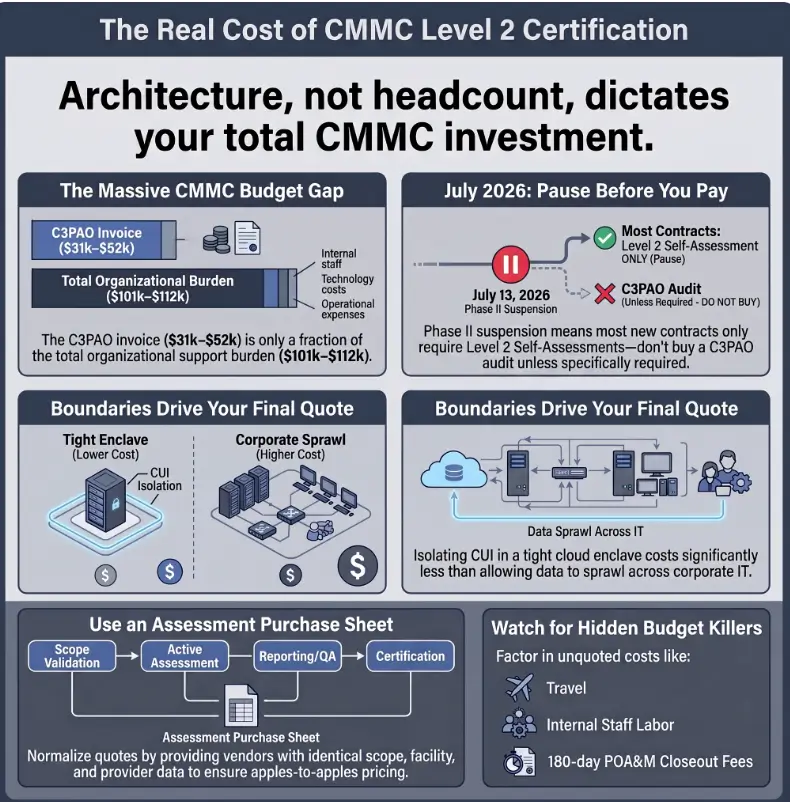
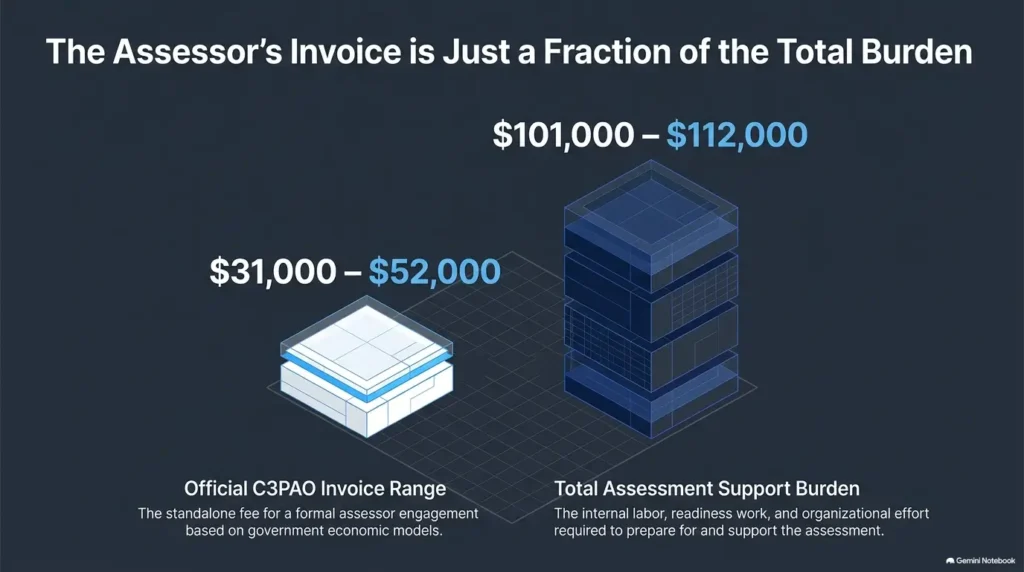
For planning purposes, the strongest official cost anchor remains the economic analysis published with the CMMC final rule. The government modeled the C3PAO engagement itself at approximately $31,234 for a small entity, assuming a three-person assessment team and 120 hours, and $52,056 for an other-than-small entity, assuming a five-person team and 200 hours. Those figures are regulatory modeling assumptions, not mandatory prices or guaranteed 2026 market quotes.
The more important number is larger. The same government analysis estimated the total cost of supporting a Level 2 certification assessment and initial affirmation at approximately $101,752 for a small entity and $112,345 for an other-than-small entity. Those totals incorporate organizational preparation, participation, reporting work, outside support assumptions, the C3PAO engagement, and affirmation rather than merely the assessor invoice.
| Budget item | Official small-entity model | Other-than-small model | How to use it |
|---|---|---|---|
| C3PAO engagement | About $31,234 | About $52,056 | Useful benchmark for the formal assessor portion, not a universal quote |
| Total assessment support + initial affirmation | About $101,752 | About $112,345 | Better planning reference for organizational burden surrounding the assessment |
| Major remediation | Not reliably captured by the headline assessment figure | Not reliably captured by the headline assessment figure | Budget separately if controls, architecture, documentation, or providers still need material work |
In plain English, a contractor planning for a future formal Level 2 certification should think of the assessor as a five-figure professional-services engagement, while recognizing that the total organizational cost around the assessment can move into six figures under the government’s own assumptions.
If you need the broader cost of becoming ready, including remediation, technology, consulting, internal labor, and recurring security operations, use the separate Kioptrix guide to CMMC compliance cost for small defense contractors. This page intentionally stays focused on the formal assessment purchase and quote.
Before You Act
This is a budgeting and procurement guide, not individualized legal or regulatory advice. Confirm your current solicitation, contract, subcontract, amendments, data flows, CMMC status requirement, and system architecture before committing money. CMMC implementation is under active federal review in August 2026, so timing can materially change the correct purchasing decision.
Decision rule: Do not treat $31,234 or $52,056 as a price list. Treat them as evidence that a properly staffed Level 2 certification assessment is substantial professional work, then compare actual C3PAO proposals against your real scope.
What changed in July 2026
This is the part that can save a contractor from writing the wrong check.
On July 13, 2026, the Department announced the immediate suspension of the planned CMMC Phase II transition, which had been scheduled for November 10, 2026. Phase I self-assessment requirements remain in place while the program undergoes review.
New procurements are not supposed to designate Level 2 C3PAO during the suspension
The implementation guidance is unusually direct: during the suspension, program managers and requiring activities may designate CMMC Level 1 (Self) or Level 2 (Self), but may not designate Level 2 (C3PAO) or Level 3 (DIBCAC) assessments. Active solicitations containing those higher assessment requirements are to be amended, and existing contracts containing them are to be modified according to the guidance.
That means a contractor looking at an August 2026 procurement should not automatically allocate $30,000, $50,000, or $100,000 to an immediate mandatory C3PAO assessment. First verify the current amended requirement.
The assessment process itself has not vanished
The Cyber AB stated after the suspension that C3PAO Level 2 certification assessments remain operational and available. A company may therefore encounter voluntary, strategic, customer-driven, or future-readiness reasons to understand assessment pricing even while the government’s Phase II procurement transition is paused.
The underlying CUI safeguarding obligation did not disappear
The suspension guidance expressly keeps DFARS 252.204-7012 obligations in place and says the Department will enforce NIST SP 800-171 Revision 2 compliance through self-assessments and selected government-led assessments during the interim period.
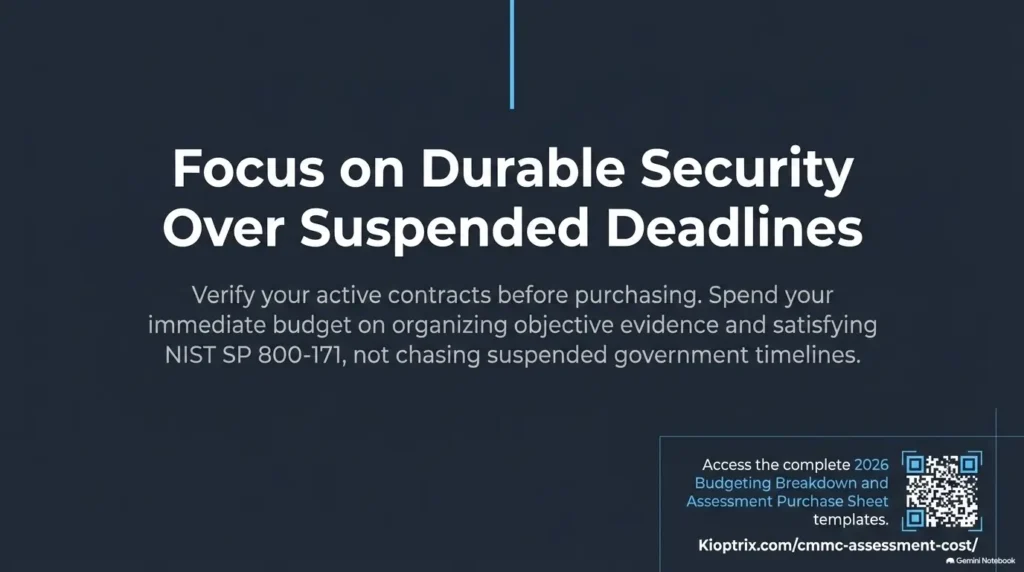
2026 spending rule: keep funding durable security and evidence work. Delay an assessor purchase whose only justification is the former November 2026 Phase II deadline until the actual contractual requirement is confirmed.
What a C3PAO quote is actually buying
A C3PAO does more than arrive, inspect a few screenshots, and hand over a certificate before lunch. The formal CMMC Assessment Process includes preliminary contracting and scoping work, pre-assessment activity, active assessment, reporting and quality assurance, certification activity, and POA&M closeout when applicable. The Cyber AB’s assessment process also requires a written contractual agreement between the C3PAO and the organization seeking certification.
1. Pre-assessment and scope validation
The assessment team reviews the System Security Plan, validates the Level 2 assessment scope, identifies relevant assets and service-provider relationships, confirms evidence availability, and decides whether the organization is ready to proceed.
This is why a quote issued without meaningful questions about your SSP, CUI environment, CAGE codes, facilities, cloud providers, security-protection assets, and specialized assets deserves scrutiny. Scope is not decorative paperwork. Scope determines how much environment the assessors must understand and test.
2. The active assessment
The C3PAO evaluates implementation of the applicable NIST SP 800-171 Revision 2 requirements using the prescribed assessment methodology and CMMC scoring rules. Evidence needs to show that applicable objectives are satisfied, not merely that a policy claims the organization intends to satisfy them.
3. Reporting, quality assurance, and certification work
Findings must be documented, results undergo C3PAO quality assurance, required information is submitted through the CMMC process, and a qualifying final or conditional status can lead to issuance of the Level 2 Certificate of CMMC Status. The process also provides formal appeal procedures.
4. POA&M closeout may become a second engagement
If an organization receives Conditional Level 2 status, only eligible deficiencies can remain on a POA&M, and the required closeout must occur within 180 days. The Cyber AB process allows the organization to retain the original C3PAO or another eligible C3PAO for closeout. That makes one contract question essential: Is POA&M closeout included, priced separately, or billed later?
The C3PAO cost stack
SSP, assets, CUI boundary, providers
Interviews, examination, testing, evidence
Findings, scoring, QA, submissions
Certificate and, if needed, POA&M closeout
A proposal that prices only “assessment days” without explaining these responsibilities can make comparison difficult.
What changes the quote
Employee count is a weak shortcut. Two 30-person defense contractors can create radically different assessment projects.
The final CMMC rule defines Level 2 scope around assets that process, store, or transmit CUI plus assets providing security protection to those systems. Contractor Risk Managed Assets, Specialized Assets, cloud services, and external service providers can also create documentation or assessment work depending on their role.
| Cost driver | Lower assessment effort | Higher assessment effort | Question to answer before requesting quotes |
|---|---|---|---|
| CUI boundary | Small, intentional enclave | CUI spread across corporate IT | Exactly which systems process, store, transmit, or protect CUI? |
| Facilities | One location | Multiple sites or complex physical access | Which facilities are inside the assessment scope? |
| Users | Few personnel with CUI access | Broad workforce access | How many people actually interact with the scoped environment? |
| Cloud and ESPs | Simple provider relationships | Many interconnected providers | Which external services handle CUI or security protection data? |
| Specialized assets | Standard managed IT | OT, test equipment, GFE, IoT, legacy engineering systems | Which specialized assets exist and how are they documented? |
| Evidence readiness | Final, organized, consistent artifacts | Drafts, missing records, contradictory documents | Can every claimed control be demonstrated with current evidence? |
| Assessment logistics | Remote-friendly, centralized | Travel, multiple facilities, complex scheduling | What onsite work, travel, or extended interviewing is expected? |
The answer changes most when the CUI boundary changes
A small employee roster does not rescue a sprawling technical scope. If CUI appears in corporate email, engineering workstations, file servers, backups, collaboration platforms, remote-access systems, printers, cloud services, and multiple facilities, the assessor has a much larger story to verify.
External providers can enlarge the evidence problem
A managed service provider, security service, cloud environment, identity platform, logging service, or other external provider may affect the assessed environment. The contractor still needs documentation showing who performs which security responsibility.
Evidence disorder converts easily into billable time
Policies scattered across folders, stale diagrams, an SSP that describes last year’s network, unidentified asset owners, or screenshots with no clear control mapping slow down everyone. The assessor is not being paid to admire the archaeology.
What Changes the Quote
The biggest variables are usually scope size, asset complexity, facilities, external providers, evidence readiness, and assessment logistics. Reduce ambiguity in those six areas and competing quotes become much easier to compare.
Three assessment-budget scenarios
These examples are hypothetical. They do not predict actual vendor quotes. Their job is to show which official cost benchmark is more useful and when the assessment invoice may cease to be the main budget problem.
Scenario A: 18-person engineering subcontractor with a tight enclave
Five employees access CUI through a deliberately constrained environment. The organization has one facility, a maintained SSP, a clean inventory, stable providers, and evidence mapped to each requirement.
If a future C3PAO assessment becomes required, the government’s small-entity C3PAO assumption of roughly $31,234 is the more relevant starting reference than a six-figure assumption about the assessor alone. The important phrase is starting reference: actual C3PAO proposals still depend on scope and commercial terms.
Scenario B: 45-person contractor with CUI across normal corporate IT
CUI reaches laptops, Microsoft 365 workloads, engineering storage, backups, remote access, endpoint security, logging, and several outsourced IT services. Documentation exists, but responsibilities between the contractor and providers are unevenly recorded.
This company should expect more assessment coordination than Scenario A even if both entities meet the same 110 Level 2 security requirements. The broader official modeling assumptions and total assessment-support burden become more informative because the assessment team has more systems, relationships, personnel, and evidence paths to understand.
Scenario C: manufacturer with OT and specialized equipment
The organization has plant-floor systems, test equipment, government-furnished equipment, standard IT, remote engineering access, and multiple buildings. CUI handling differs by production workflow.
The core challenge is no longer simply “find a cheap C3PAO.” The contractor first needs a defensible asset categorization and assessment boundary. Otherwise a quote can be technically inexpensive while being based on assumptions that collapse during pre-assessment.
| Scenario | Main assessment pressure | Best first move |
|---|---|---|
| Small enclave | Evidence quality and assessor team time | Prepare a concise scope packet and request comparable fixed assumptions |
| Distributed corporate CUI | Asset count, providers, users, evidence relationships | Map CUI and security-protection systems before obtaining final quotes |
| Manufacturing / OT | Specialized assets, physical scope, complex architecture | Resolve asset categorization and site scope before pricing the assessment |
Hidden assessment costs contractors miss
The assessor’s proposal can be perfectly reasonable and your total project can still blow past the number approved by finance. The missing money usually lives outside the headline fee.
Internal staff time
Executives, IT staff, engineers, HR, physical-security personnel, compliance owners, and outside providers may need to participate in interviews, evidence retrieval, scheduling, clarification, and follow-up. The government’s own assessment-cost model explicitly assigns substantial organizational labor to planning and active assessment support, which is one reason its total burden estimate is far higher than its modeled C3PAO fee.
Travel and multiple-site work
Never assume travel is included. Ask whether transportation, lodging, per diem, onsite days, or additional site visits are included in the fixed price, billed at cost, or charged separately.
Scope changes
A quote built around one facility, 40 endpoints, two cloud providers, and a contained enclave is not economically equivalent to an environment that later reveals additional systems, users, providers, or CUI flows.
Ask for the change-order mechanism before signing. A short paragraph describing how scope changes are priced is worth more than a vague promise that the provider will “work with you.”
POA&M closeout
Conditional Level 2 status is not a blank cheque for unfinished security work. The rule limits which requirements may remain on a POA&M and imposes the 180-day closeout window. A later closeout assessment can therefore create another professional-services bill and another internal scheduling burden.
Common budgeting mistake: “C3PAO quote” and “cost of completing the certification cycle” are not necessarily the same number. Travel, change orders, internal labor, remediation, provider participation, and POA&M closeout can sit outside the advertised assessment fee.
How to compare C3PAO quotes without being fooled by the total
Three quotes for $32,000, $42,000, and $55,000 tell you almost nothing until the assumptions are normalized.
A better comparison starts by forcing each provider to price the same assessment story.
Give every C3PAO the same quote-prep packet
- Legal entity name and relevant CAGE code or codes.
- Current required CMMC status and contractual context.
- Short description of the CUI environment.
- Number of in-scope users and facilities.
- Asset counts by meaningful category rather than one giant device number.
- List of cloud and external service providers relevant to the assessment.
- List of specialized assets such as OT, IoT, test equipment, GFE, or restricted systems.
- Current SSP status.
- Expected onsite versus remote assessment needs.
- Desired assessment timeframe.
Ask these questions before comparing price
- Which assessment phases and activities are included in the fee?
- How many assessors are assumed?
- How many onsite days are assumed?
- Are assessor travel and expenses included?
- Which facilities are included?
- Which external providers are assumed to participate?
- What happens if the validated assessment scope differs from the quote assumptions?
- Are project-management meetings included?
- How are additional assessment days priced?
- Is POA&M closeout included or separate?
- What is the cancellation or rescheduling policy?
- How are disputes and assessment appeals handled?
- Which fees are refundable if federal implementation requirements change before the assessment?
Compare exclusions before comparing discounts
| Proposal item | Why it matters | Red flag |
|---|---|---|
| Assessment scope | Determines the work being priced | “Entire company” or “standard Level 2” with no technical detail |
| Team structure | Affects assessor capacity and scheduling | No explanation of who will perform the assessment |
| Travel | Can create meaningful extra cost | Silent or undefined |
| Change orders | Controls cost if scope expands | Open-ended hourly billing with no trigger definition |
| POA&M closeout | May create a second assessment event | Not mentioned |
| Cancellation | Especially important during the 2026 review | Large non-refundable payment with no regulatory-change language |
| Certification promises | The assessment result must remain independent | “Guaranteed certification” language |
The Cyber AB’s assessment process expressly prohibits C3PAOs from offering guarantees or promises concerning the outcome of a Level 2 certification assessment. Treat a certification guarantee as a procurement warning, not a premium feature.
How to reduce assessment cost without weakening readiness
The best savings rarely come from haggling an assessor’s hourly rate down by a few percent. They come from removing avoidable complexity before the assessment scope is locked.
Shrink unnecessary CUI exposure
If employees and systems do not need CUI to perform their work, do not casually distribute it to them. A legitimate, operationally enforced CUI boundary can reduce the number of systems, users, providers, and workflows that require the most intensive assessment attention.
This is not creative scoping. An asset that meets an in-scope category cannot simply be declared out of scope because the assessment would be cheaper. The final rule defines the asset categories and treatment requirements.
Do not use the C3PAO as your readiness consultant
The certification engagement is the wrong moment to discover that your SSP is incomplete, your network diagram omits a cloud service, or nobody can produce access-review evidence.
Use internal staff or separate readiness expertise to resolve uncertainty before the formal assessment. The economic benefit is simple: expensive assessment time is spent evaluating evidence rather than untangling your environment.
Organize evidence around the assessment objectives
Create a controlled evidence index that points the assessment team to approved policies, system configurations, logs, records, screenshots, tickets, inventories, diagrams, and responsible personnel. Do not manufacture evidence for assessment week. Build a trail from normal operations.
Resolve provider responsibilities before assessment week
For every important cloud or external provider, know which security responsibilities belong to the provider and which remain yours. A customer responsibility matrix or equivalent service-responsibility documentation can prevent the grim little meeting where three organizations stare at each other and nobody owns the control.
Best place to save
Unnecessary CUI copies, unclear scope, stale documentation, redundant systems, evidence hunting, and preventable rescheduling.
Worst place to save: skipping required control implementation and hoping the assessor will accept a convincing explanation.
When paying for a CMMC Level 2 assessment makes sense
The 2026 suspension makes the distinction between readiness and certification unusually important.
| Approach | Use it when | What you are buying | 2026 caution |
|---|---|---|---|
| DIY / internal readiness | Staff understand NIST SP 800-171 and scope is manageable | Internal control validation, evidence organization, self-assessment preparation | Often appropriate while Level 2 Self remains the current procurement designation |
| Compliance software | Evidence, owners, recurring tasks, and multiple systems are difficult to coordinate manually | Workflow, evidence organization, reminders, reporting | Software does not create certification or substitute for controls |
| Readiness professional | Scope, architecture, evidence, or technical implementation is uncertain | Gap identification and preparation | Keep readiness work distinct from independent certification assessment |
| C3PAO assessment | A formal Level 2 certification is actually justified | Independent certification assessment | Verify why you need it during the Phase II suspension before signing |
Pay now when there is a concrete reason
- You have verified a legitimate present need for formal certification despite the federal implementation pause.
- A strategically important customer or supply-chain opportunity makes voluntary certification economically rational.
- You have already completed expensive readiness work and consciously choose to preserve momentum.
- You understand the program-change risk and have negotiated sensible scheduling, cancellation, and refund terms.
Wait before signing when the only reason is an old deadline
- Your project plan still says “C3PAO required by November 10, 2026” and nobody has revisited it since July.
- Your active solicitation is being amended.
- You cannot identify the exact contract or business reason requiring certification.
- Your CUI scope is still changing materially.
- Large technical gaps remain open.
- The proposed engagement requires a large non-refundable payment despite the active federal review.
The Department’s current CMMC page states that implementation is paused in Phase 1 and that Level 1 and Level 2 self-assessments are the assessment paths that may currently be required during the suspension.
FAQ
Is $31,234 the official price of a small-business CMMC Level 2 assessment?
No. It is a government economic-model assumption for the C3PAO portion of a small-entity certification assessment, based on 120 hours for a modeled three-person team. C3PAOs are commercial organizations, and actual proposals can differ based on scope, logistics, team composition, exclusions, and contract terms.
Why does the government estimate more than $100,000 if the modeled assessor fee is around $31,000?
Because supporting an assessment consumes organizational effort. The government’s small-entity model includes preparation, assessment participation, reporting, outside-support assumptions, the C3PAO engagement, and initial affirmation. It is therefore a burden estimate, not simply an audit invoice.
Should I budget for a C3PAO assessment in 2026?
Budget for the possibility if Level 2 certification matters strategically, but do not assume an immediate mandatory purchase. As of August 2026, the Phase II transition is suspended and current federal guidance limits procurement designations during the suspension to Level 1 (Self) and Level 2 (Self). Confirm the latest official guidance and your actual amended contractual documents before paying.
Can I keep using an existing C3PAO quote after changing my CUI enclave?
Ask the C3PAO to confirm the quote assumptions again. If the assessment boundary, facilities, providers, users, or specialized assets have changed, the original price may no longer represent the work required.
Does a cheaper assessment mean the C3PAO is less credible?
Not necessarily. A lower quote may reflect a smaller scope, more efficient delivery, fewer travel requirements, or different commercial terms. Compare authorization status, scope assumptions, assessor staffing, exclusions, change-order terms, schedule, and POA&M closeout pricing before drawing conclusions from price alone.
Can a C3PAO guarantee that we will pass?
No responsible proposal should promise the assessment outcome. The Cyber AB assessment process prohibits C3PAOs from offering guarantees or promises concerning the result of the Level 2 certification assessment.
What happens if we receive Conditional Level 2 status?
Only qualifying deficiencies can remain on a POA&M. Those items must be remediated and the required closeout completed within the 180-day period established by the rule. Ask your C3PAO in advance how closeout work would be scheduled and priced.
Build your 15-minute assessment budget before requesting another quote
Do one thing before contacting another C3PAO: create a one-page Assessment Purchase Sheet.
- Write the exact CMMC requirement currently shown in your solicitation, contract, subcontract, amendment, or modification.
- Write down whether a formal C3PAO assessment is actually required now, voluntarily desired, or merely being planned for a future requirement.
- List the facilities, users, CUI assets, Security Protection Assets, specialized assets, cloud providers, and external service providers you currently expect to be in scope.
- Mark your SSP as current, needs revision, or incomplete.
- Create four budget lines: C3PAO fee, internal assessment labor, excluded expenses, possible closeout/change-order costs.
- Put the government’s roughly $31,234 small-entity and $52,056 other-than-small C3PAO modeling assumptions beside the assessor line as reference points, not targets.
- Send the same sheet to every provider you ask to quote.
That small exercise turns “How much does CMMC Level 2 cost?” into a question vendors can answer much more honestly. It also makes a $35,000 proposal and a $50,000 proposal comparable instead of merely different numbers on polished PDFs.
The decision to make today
Confirm whether you need a C3PAO assessment now. If you do, price the validated scope and the full engagement rather than chasing the lowest advertised audit number. If you do not, keep funding durable NIST SP 800-171 security work and preserve the assessor budget until the federal review produces a clearer requirement.
Last reviewed: 2026-09