
Mastering the Fog: A Beginner’s Guide to Kioptrix
Walkthroughs can make Kioptrix feel like everyone else is solving in straight lines while you are still untangling the headphones. That is the quiet trap for beginners: you compare your live confusion to somebody else’s polished ending.
If you are learning Kioptrix as a beginner, the problem is not just the box. It is the pressure to move fast, recognize every clue instantly, and turn every scan result into a breakthrough before you have even built a clean picture of the target.
Keep guessing under that pressure, and you lose the real lesson: how to observe, document, test, recover, and think clearly when the path is still foggy.
This guide helps you use Kioptrix as a structured practice lab instead of a confidence shredder. You will learn how to handle walkthrough comparison, improve enumeration, read service and version clues more calmly, and measure progress before you ever get a shell.
The method here is simple: fewer frantic branches, better notes, smaller hints, and a scoreboard based on thinking quality rather than speed.
Table of Contents

Start Here: Why Kioptrix Feels Harder When You Read Too Many Walkthroughs
How hindsight turns someone else’s messy process into a clean little legend
A walkthrough is almost always a cleaned kitchen after dinner. You do not see the burnt pan, the wrong spice, the moment someone stared into the fridge like it had betrayed them personally. You see the plated meal. That creates a psychological distortion for beginners. It suggests that competent people move in straight lines, when most lab work is actually a sequence of noticing, testing, doubting, revising, and circling back.
I have seen beginners open a write-up after twenty minutes and immediately assume they are behind. But behind whom, exactly? Behind a version of the story that has already been edited for clarity. That is not a fair race. It is a stage performance compared against a rehearsal room.
Why “they saw it instantly” is usually a storytelling illusion
Write-ups are compressed for readability. That compression matters. A person may have spent an hour on enumeration, another hour wandering down a false lead, and only then found the clue they now describe in two crisp sentences. On the page, it looks like intuition. In real life, it was probably persistence wearing muddy boots.
This matters because your emotions are not reacting to the box alone. They are reacting to narrative. When the narrative lies, even politely, your confidence pays the bill.
What beginners are actually supposed to learn from Kioptrix first
Beginners are not supposed to become instant exploit poets. They are supposed to learn how to look. How to describe the target. How to separate facts from vibes. How to notice one odd version string, one weird web page behavior, one tiny inconsistency in headers or paths, and then ask, “What does this actually suggest?” That is a real skill. It is also much closer to how cybersecurity work is framed by the NICE Framework, which centers concrete tasks, knowledge, and skills rather than vague hacker mystique. If you need a calmer starting frame, a beginner-friendly Kioptrix for beginners approach can keep the first lesson grounded in observation rather than performance.
- Polished write-ups are edited stories, not live thought streams
- Fast-looking progress often hides slow real-world trial and error
- Your job is to learn observation before speed
Apply in 60 seconds: Before opening any lab, write one sentence: “My goal today is to notice and record, not impress myself.”
The Real Win: What Success Looks Like Before You Ever Get a Shell
Why enumeration quality matters more than dramatic breakthroughs
There is a particular beginner sadness that arrives when no shell appears. It feels like nothing happened. But good enumeration is not nothing. It is the scaffolding that makes every later move less random. If you discovered services, versions, page behavior, directory clues, response patterns, or suspicious age in the stack, you did real work.
One of the most misleading habits in beginner labs is measuring progress only by whether something “popped.” That is like judging a detective novel by whether the suspect confessed in chapter two. No one would read that book, and no one should learn that way either.
How to measure progress in clues, not only outcomes
A better scoreboard is simple:
- What did I confirm?
- What surprised me?
- What became less likely?
- What is the most specific next question?
If you can answer those four questions after a session, the session had value. In fact, it often had more value than a copied exploit path you barely understood.
Let’s be honest… most beginners are not failing, just narrating their learning too harshly
I have watched beginners say, “I got nowhere,” right after explaining that they found three services, identified an outdated web component, noticed a strange response code, and ruled out two dead-end assumptions. That is not nowhere. That is a map getting sharper. The problem is not the work. The problem is the narration.
Cybersecurity career resources keep leaning on pathways and skill clusters for a reason. The field is broad, the work is varied, and progress is often built through repeated, role-shaped practice rather than one cinematic victory. CyberSeek’s pathway materials and labor snapshots reflect that structure, including entry-level feeder routes and a still-large national market for cyber-related roles.
“Did I get root?”
Fast, dramatic, and emotionally brutal.
“What did I learn, confirm, and narrow?”
Slower, steadier, and actually reusable.
Neutral next step: Choose the scoreboard you want before the session starts.
Comparison Trap First: The Quiet Habit That Makes Labs Feel Worse Than They Are
How walkthrough-binging changes your expectations before you even start
If you read five write-ups before touching the box, you quietly train your brain to expect recognizability instead of uncertainty. Then, when your own session feels murky, you mistake normal ambiguity for incompetence. The lab has not become harder. Your baseline expectation has become less honest.
This is the trap. The write-up becomes a kind of emotional benchmark, not just a technical reference. And benchmarks can bruise when they are secretly fictional.
Why borrowed confidence collapses the moment your screen looks different
Borrowed confidence is fragile because it depends on the environment matching the script. The moment the page loads differently, the service banners are odd, or your enumeration returns something slightly unexpected, the whole illusion cracks. Suddenly, the confidence was not yours. It was rented.
I learned this the awkward way years ago on a different beginner box. I had read just enough outside material to feel “basically oriented,” which is a polite phrase for “dangerously overconfident.” Ten minutes later, my screen looked different from the guide I half-remembered, and my certainty dissolved like cheap sugar in tea.
The difference between learning from a write-up and hiding inside one
A write-up can be a flashlight, or it can become a hiding place. The difference is timing and intent. If you use it after forming your own hypothesis, it can sharpen your thinking. If you use it before forming one, it can replace your thinking. That replacement feels comforting in the moment and expensive later. This is why a slower Kioptrix methodology matters: it gives you a process before the solution tries to steal the steering wheel.
Show me the nerdy details
In practical terms, preloading your brain with someone else’s exploit chain narrows your search behavior. You begin overweighting signals that confirm the known path and underweighting clues that point elsewhere. That bias can make enumeration worse, not better.
Who This Is For, and Who It Is Not For
Best for beginners doing Kioptrix after work, before work, or in short sessions
This guide is for the learner who does not have the luxury of sprawling six-hour Saturdays every week. Maybe you open the VM before breakfast. Maybe you squeeze in thirty minutes after work when your brain still smells faintly of spreadsheets and unfinished tickets. That is normal. Short sessions are not second-class learning.
Good fit for learners coming from help desk, IT support, or self-taught basics
If your background includes troubleshooting, ticket triage, basic networking, Linux fundamentals, or that scrappy self-taught instinct of “let me poke this and see what it tells me,” you already have useful instincts. Kioptrix is often less about brilliance than about disciplined curiosity. For that audience, Kioptrix for help desk workers can feel less like a leap into darkness and more like a structured extension of problems you already know how to diagnose.
Not ideal for people who only want the fastest path to the flag
If your only goal is the fastest path to “done,” this article may feel slower than you want. That is intentional. Speed without understanding has a glitter problem. It shines briefly and then leaves very little behind.
Not for treating walkthroughs as a substitute for note-taking and observation
If you do not want to take notes, pause, or explain your own reasoning in plain English, Kioptrix will probably feel harsher than it needs to. Beginners often want one perfect tool list. What they need is a way to stay oriented while uncertainty does its little weather act.
- Yes or No: Can you describe what enumeration is before you start exploiting?
- Yes or No: Can you work in 20 to 40 minute sessions without panicking about speed?
- Yes or No: Are you willing to write down facts before guesses?
- Yes or No: Can you tolerate not finishing the box in one sitting?
If you answered “No” to two or more, start with note discipline first and treat the box as practice, not proof.
Neutral next step: Pick one session length and one note format before you begin.
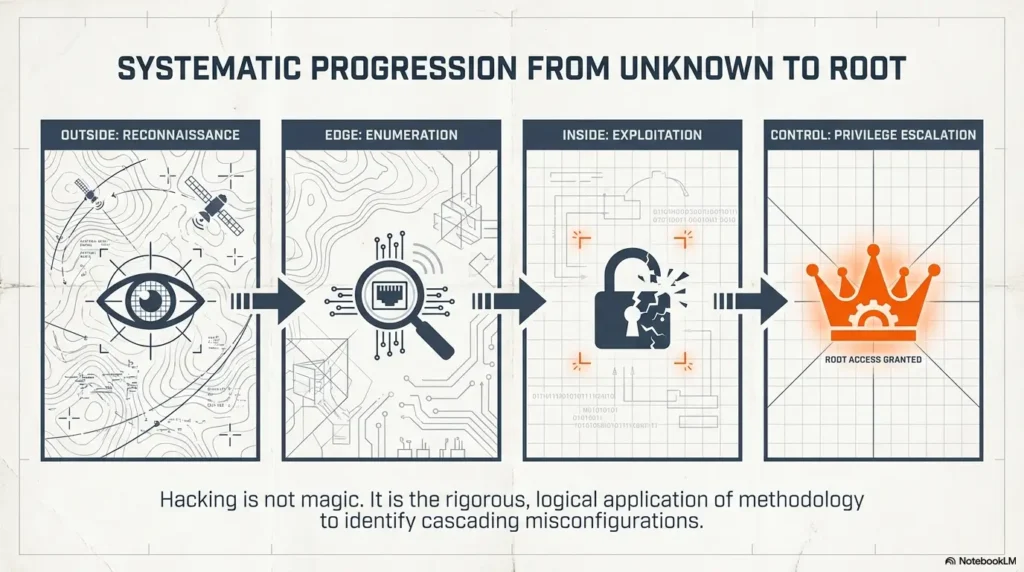
First Moves Matter: What to Do in the Opening 20 Minutes Instead of Spiraling
How to begin with asset discovery, service clues, and version awareness
The opening 20 minutes should feel almost boring. That is good. Boring is where beginner judgment grows bones. Start with identifying the target clearly, collecting exposed services, and noting any version clues or technology hints. You are not trying to be impressive. You are trying to avoid inventing a fantasy box that does not exist.
Why one calm scan often beats five frantic tools
Beginners often treat tooling like a buffet plate built by an anxious cousin: a little of everything, too much of nothing, and somehow three sauces that do not belong together. In practice, one calm scan interpreted carefully is often more useful than a stack of noisy outputs you barely read. If scan output is where your anxiety spikes, a practical comparison like Nmap vs. Rustscan for Kioptrix can help you choose one lane instead of turning the session into tool confetti.
CISA’s cyber hygiene materials are meant for organizations, not lab learners, but the underlying principle is still relevant: consistent, structured checking beats vague confidence. Exposure gets reduced by seeing clearly, not by looking busy.
A simple beginner rule: collect facts before inventing theories
Try this opening sequence:
- Confirm target reachability.
- Identify exposed services.
- Record versions or stack hints where visible.
- Visit the web interface manually.
- Write three plain-English observations before testing a single exploit path.
That order sounds humble. Good. Humility is underrated in labs and in life.
- Verify the target before theorizing
- Read your scan results slowly
- Write observations in plain English, not only command history
Apply in 60 seconds: Open a blank note and add these headings now: Services, Versions, Web Clues, Oddities, Next Question.
Don’t Do This: Beginner Mistakes That Make Kioptrix Feel “Impossible”
Jumping to exploitation before you can describe the target clearly
If you cannot describe the target in a few sentences, you are not ready to exploit responsibly. I do not mean morally. I mean cognitively. Your brain has nothing sturdy to hang the next step on. So every exploit attempt becomes a coin toss wearing a trench coat.
Treating every strange response like a hidden breakthrough
Not every odd response is a secret door. Sometimes a weird page is just a weird page. Beginners often get hypnotized by novelty. The page behaved strangely, so it must matter. Maybe. Maybe not. The important question is whether the oddity changes your hypothesis space in a concrete way.
Copying commands without knowing what result would count as useful
This one is common, and it is brutal. A beginner runs a command because it looked relevant in a guide or a video, but has no prior idea what a meaningful result would look like. Then the output arrives as a wall of text, and panic politely puts on glasses. You cannot interpret what you never framed.
Here’s what no one tells you… panic-clicking can look productive while teaching almost nothing
Panic-clicking feels energetic. It gives you the emotional illusion of effort. But frantic action often blocks the very noticing that beginner labs are designed to cultivate. A slow note that says “this service version seems old enough to matter” is often more educational than ten copied commands you cannot explain afterward. When copied commands start replacing reasoning, a guide on why Kioptrix copy-paste commands fail can be a useful reset.
- Target IP or hostname
- Confirmed open services
- Visible versions or likely software families
- One manually observed web behavior
- One hypothesis you can explain without jargon
Neutral next step: Gather these five items before you even think about outside hints.
Walkthrough Timing: When a Hint Helps and When It Steals the Lesson
How long to struggle before checking outside help
There is no holy number, but many beginners do well with a simple boundary: one focused session on enumeration and one focused session on testing your best explanation of the box. After that, a tiny hint can be reasonable. The key word is tiny.
What you want is friction, not paralysis. Enough resistance to force your thinking to mature. Not so much that you turn into a resentful statue with browser tabs.
The difference between a nudge, a spoiler, and a full handoff of thinking
A nudge says, “Look more carefully at the web app versioning clues.” A spoiler says, “The bug is in this component.” A full handoff says, “Run this exact chain.” Those are not morally identical. They teach different things. Beginners benefit most from nudges because nudges preserve ownership of the reasoning.
Why “just one peek” often changes the entire lab experience
“Just one peek” is the lab equivalent of eating one potato chip directly from the bag while standing in the kitchen. We all know how this movie ends. The moment you see the actual path, your search behavior mutates. You stop asking, “What could this be?” and start asking, “How do I recreate what I just saw?” Those are related, but they are not the same skill.
Show me the nerdy details
Hints are most educational when they preserve uncertainty at the level of mechanism. In other words, they point you toward an area, signal class, or conceptual mistake without naming the specific vulnerability or exact sequence. That keeps your hypothesis engine alive.
Read the Box Better: How to Turn Tiny Clues Into a Real Direction
Why old web apps, odd headers, and rough edges matter more than flashy guesses
Beginner boxes often reward plain noticing over exotic creativity. A dated component, an awkward login flow, a verbose error message, or a rough-edged page can matter more than your most theatrical hypothesis. The box is usually telling you something. The art is in not talking over it.
When I was newer, I used to chase “cleverness” because it felt advanced. Then, embarrassingly often, the useful clue turned out to be something humble sitting in the open like a house key under a plant pot. Not literally under a plant pot. Labs are less charming than that. But you get the idea.
How to separate signal from noise when everything looks equally important
Use three filters:
- Does this clue change what I think the target is?
- Does this clue narrow the likely attack surface?
- Does this clue suggest a specific next check I can describe?
If the answer is no to all three, the clue may be noise for now. Archive it and move on. Beginners suffer when every breadcrumb gets crowned king.
What a beginner should write down after each small discovery
Write one line for the fact, one line for why it might matter, and one line for the next thing to verify. That tiny structure keeps your notes from becoming either empty poetry or a command landfill. A reusable Kioptrix recon log template can make that habit less dependent on mood, memory, or whatever storm system your browser tabs are currently hosting.
- Facts matter more than vibes
- Specific next checks beat dramatic guesses
- Notes should link observation to action
Apply in 60 seconds: Pick one clue from your last lab and write, “This matters because…” followed by one concrete check.
Reachability, services, versions, web behavior.
Ask what each clue changes.
Run one hypothesis, not six random ones.
Three facts, two guesses, one next action.
Use: Repeat this loop in 20 to 40 minute blocks instead of marathon guessing.
No, Really: Slow Is Not the Problem
Why careful learners often build stronger instincts than fast imitators
Fast learners are real. So are fast narrators. The trouble is that beginners cannot always tell which one they are looking at. Careful learners often develop sturdier instincts because they are forced to build explanations, not just outcomes. They know what the clue meant, not merely where the clue led.
How short, repeatable sessions beat one exhausted marathon
A tired brain does a strange thing in labs. It starts confusing motion with progress. Tabs multiply. Notes get thinner. Curiosity degrades into flailing. A 25-minute session with clear boundaries often beats a 3-hour slog powered by caffeine and self-reproach. That is not laziness. That is workflow design. A healthier model for Kioptrix practice sessions without burnout can help keep the lab from becoming an endurance contest wearing a terminal prompt.
Structured, repeatable learning is also more consistent with how workforce development resources describe cyber growth. The emphasis is on pathways, competencies, and repeated exposure, not heroic one-night transformations into terminal-window thunder gods.
Why frustration is data, not a verdict on your ability
Frustration usually points to one of three things: missing context, overloaded attention, or a mismatch between your expectations and the actual stage of learning. None of those is a permanent identity statement. They are conditions. Conditions can be changed.
Short Story: A beginner I once helped was convinced Kioptrix “wasn’t for people like me.” He had spent a week reading write-ups and felt dumb every time his notes looked smaller than someone else’s post. So we changed only one thing. No write-ups for two sessions. Just enumeration, plain-English notes, and one hypothesis at a time. The first session felt slow. The second felt calmer.
By the third, he had not rooted the box yet, but he could explain what he had seen, why two ideas were weak, and what one version clue suggested next. His face changed before his results did. That mattered. The shell came later. The real shift happened when the lab stopped being a referendum on his intelligence and became a place to practice seeing clearly.
Common Mistakes Beginners Make When Comparing Themselves to Walkthroughs
Mistaking polished write-ups for real-time thinking
This is the grand illusion. You compare your raw footage to someone else’s final edit and then decide your learning must be defective. It is an unfair comparison and, frankly, a slightly rude one to your own brain.
Assuming your detours mean you are uniquely bad at labs
Detours are normal. Detours are often where pattern recognition grows. The trick is to make them visible in your notes so they become part of the lesson instead of a foggy shame puddle.
Confusing tool usage with understanding
Beginners often overcredit the tool and undercredit the interpretation. A tool can reveal. It cannot decide what matters for you. That part is still your job. Which is inconvenient, yes, but also where the actual learning lives.
Measuring yourself against experts instead of your previous session
The only comparison that reliably helps is temporal and personal. Are your notes clearer than last week? Are your first checks less random? Do you form better hypotheses than before? That is the growth line that matters. A periodic Kioptrix self-assessment can turn that question into evidence instead of another fog machine for doubt.
- Tier 1: Reachability and service discovery only
- Tier 2: Service plus version/context notes
- Tier 3: Manual web review and clue ranking
- Tier 4: One hypothesis tested carefully
- Tier 5: Hint review or exploit validation only after your own theory exists
Neutral next step: Pick one tier before you start so the session has edges.
Build a Better Scoreboard: What to Track So You Stop Grading Yourself by Speed
Three facts you confirmed
These should be boring and specific. Open service. Probable software family. Notable page behavior. Boring facts are excellent because they do not wobble when your mood does.
Two guesses you still need to test
A guess is not a confession of ignorance. It is a disciplined maybe. Write guesses clearly enough that future-you can evaluate them without having to reconstruct the whole emotional weather system of the previous session.
One next action for the next session
The session should end with one obvious reentry point. Not five. One. A single next action protects you from that awful feeling of reopening the lab and having to rediscover your own thought process from scratch.
Why this simple record keeps doubt from rewriting the whole day
Doubt is a talented editor. It trims your wins, exaggerates your confusion, and leaves you with a misleading memory of “I did nothing.” A small written scoreboard fights back. It lets reality keep a receipt.
- Three confirmed facts anchor the session
- Two testable guesses keep you curious
- One next action makes reentry painless
Apply in 60 seconds: Copy this template into your notes app now: 3 Facts / 2 Guesses / 1 Next Action.
Estimate your session overload by entering how many tools, tabs, and hypothesis branches you used.
Result: This is a rough reflection tool, not a scientific metric.
Neutral next step: Reduce one input next session and see whether your notes improve.
FAQ
Is Kioptrix too hard for complete beginners?
Not necessarily. It can feel harsh if you treat it like a speed test or compare yourself to polished write-ups, but it is often useful precisely because it teaches disciplined observation. The difficulty is not only technical. It is emotional and procedural.
How long should a beginner spend before looking at a walkthrough?
Try at least one session focused on enumeration and one session focused on your best hypothesis before looking outside. If you do need help, use the smallest hint that keeps your own reasoning alive.
Am I doing it wrong if I only found services and nothing exploitable yet?
No. Services, versions, web behavior, and eliminated paths are all progress. The box does not owe you a dramatic reveal in the first sitting.
Should I restart the box if I feel lost?
Sometimes, yes, but restart the notes first. A clean note page with a cleaner question often matters more than a fresh VM. If your session drifted into chaos, reset your method before you reset the machine. When the whole process feels tangled, a Kioptrix level restart guide can help you restart with intention instead of shame.
Is it normal to understand a write-up only after reading it twice?
Completely normal. A write-up often lands better after you have your own half-built mental scaffolding. The second read feels clearer because your brain finally has hooks to hang it on.
Can I still learn if I use hints?
Yes, especially if the hint points toward an area or clue class rather than handing you the exact exploit path. Hints can preserve agency. Full solutions often replace it.
Why do other people seem to solve it so much faster?
Because you are often comparing your unedited live process to their finished account, and because some of them are simply further along than you are. Neither fact means you are failing.
What should I write in my notes during a Kioptrix session?
Write confirmed facts, what each clue might mean, what you ruled out, and one next action. Notes should not just archive commands. They should preserve reasoning.
How many tools should a beginner use at first?
Fewer than you think. Start with enough to identify the surface and inspect it calmly. Tool sprawl often becomes stress with extra windows.
What counts as real progress if I do not get root?
Better observations, cleaner note structure, fewer random branches, and stronger next-step questions all count as real progress. Often they count more.
Next Step: One Small Session You Can Do Today
Open Kioptrix and spend 30 minutes on enumeration only
That is the entire mission. No heroics. No “maybe I’ll just quickly try three exploit paths.” Just enumeration. Just listening to what the box is willing to say before you start arguing with it. If you want a wider weekly rhythm around that, a simple Kioptrix practice routine can turn small sessions into something durable.
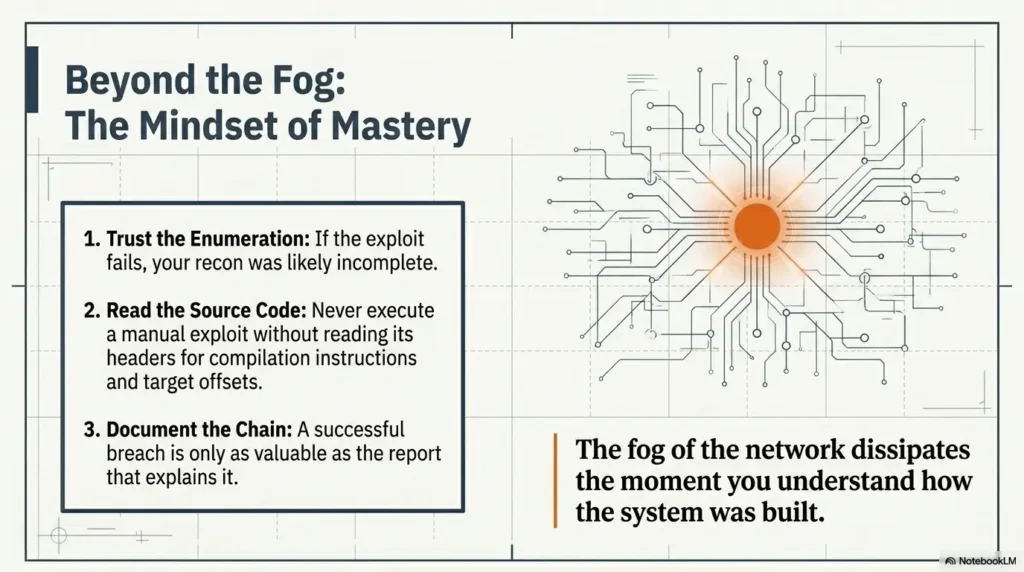
Write down three confirmed facts before you test a single exploit path
Force the facts to exist on paper. Or in a notes app. Or on the back of an envelope that previously held takeout receipts and your dignity. The medium matters less than the discipline.
End the session with one plain-English question you want tomorrow-you to answer
This is how you make the next session merciful. A good question might be, “Does this version clue make the web app the most likely starting surface?” or “What explains this odd response behavior better than my first assumption?”
The point of this article was never to convince you that Kioptrix is secretly easy. It was to show that comparison makes it feel harder than it has to. There is a difference, and it matters.
Conclusion
The curiosity loop at the beginning of this article was simple: why does Kioptrix feel so much harder after reading walkthroughs? Now you know the answer. Because walkthroughs often arrive as polished endings, while your own work is still wet paint. They flatten uncertainty, compress time, and make real learning look cleaner than it is. That distortion does not mean you are weak. It means you are human.
So here is the honest next move for the next 15 minutes: open the box, spend one bounded session on enumeration only, record three facts, two guesses, and one next action, then stop. Do not grade yourself by speed. Grade yourself by clarity. That is how beginners quietly become dangerous in the best sense of the word: not flashy, not frantic, just steadily harder to fool.
- Use bounded sessions
- Prioritize enumeration quality
- Track progress with facts, guesses, and next actions
Apply in 60 seconds: Schedule one 30-minute Kioptrix session and label it “enumeration only.”
Last reviewed: 2026-04.