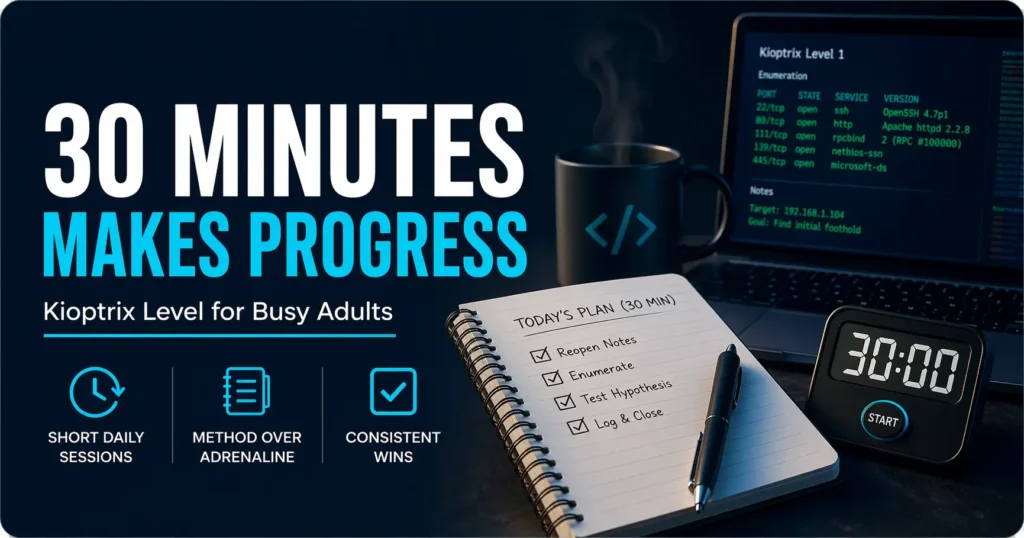
Method Beats Adrenaline
Thirty minutes is enough to make Kioptrix Level useful, but only if you stop treating practice like a weekend endurance stunt and start treating it like a repeatable lab ritual.
For busy adults, the real breakthrough is rarely a dramatic exploit. It is building a method that still works when your energy is low, your calendar is full, and your brain feels lightly oven-roasted by 9:30 p.m.
“Random cramming creates noise. Poor notes erase continuity. By the time you sit down again, you are not learning. You are re-entering the wreckage.”
This guide shows how to use short daily sessions to build sharper enumeration, cleaner note-taking, stronger hypothesis testing, and better interview-ready reasoning without burning out.
- ✔ Clean endings make better restarts.
- ✔ Small, repeatable wins outlive heroic Saturdays.
- ✔ Build a practice rhythm that survives ordinary adult life.
Table of Contents
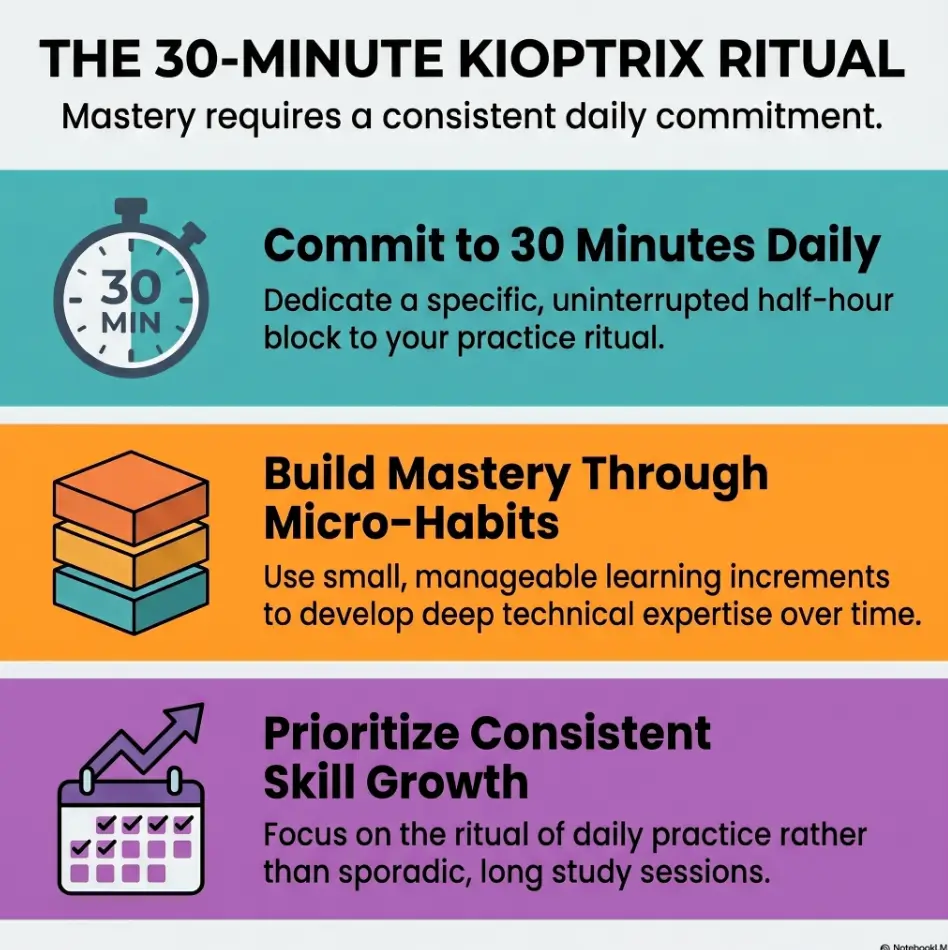
Why 30 Minutes Works Better Than Random Weekend Cramming
Short sessions build recall faster than irregular binge practice
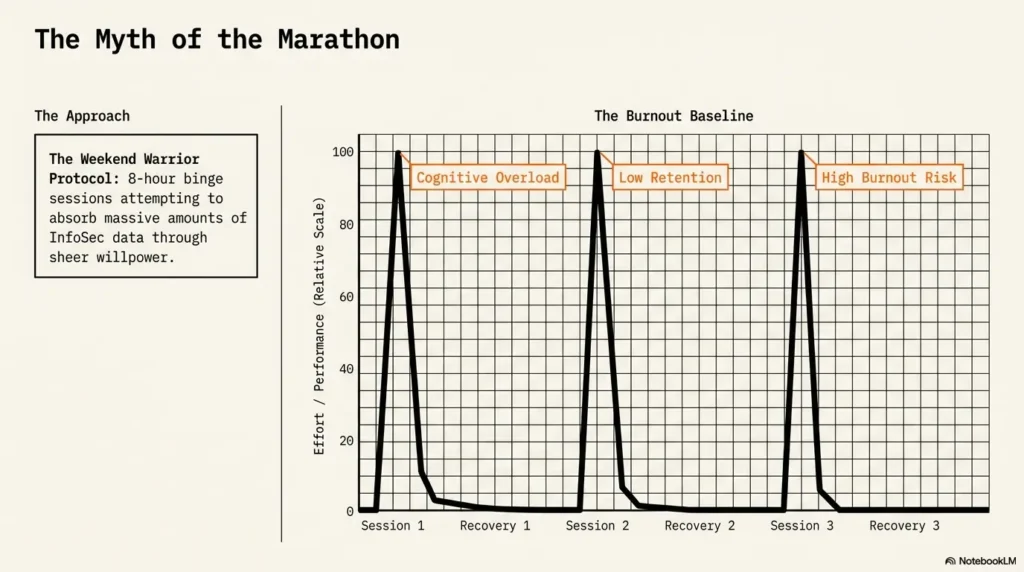
Weekend cramming feels productive because it is dramatic. There are scans everywhere, tabs breeding like fruit flies, and that sweet illusion that effort alone will turn confusion into skill. The trouble is that cybersecurity practice is less like stuffing a suitcase and more like tuning an ear. Frequency matters. You improve by returning to patterns often enough that they start looking familiar rather than theatrical.
Thirty minutes a day gives you something binge sessions rarely do: continuity. Yesterday’s failed idea is still warm. The service list is still in your head. The question you wrote at the end of the last session is waiting like a bookmark instead of a cliff. That small continuity gap matters more than people admit. Many adults do not lack intelligence or grit. They lack re-entry speed.
I have seen this in almost every serious learner who also has a normal life. A parent gets 25 minutes after dinner. A help desk worker gets half an hour before bed. A career-switcher gets one quiet pocket before the house wakes up. The ones who improve are rarely the loudest. They are the people who keep coming back before the trail goes cold.
And there is a second advantage: short sessions make you less likely to practice sloppily. When time is tight, you become choosier. You ask better questions. You stop launching random commands just to feel busy. Suddenly, the session has shape. That is also why many learners do better with a structured Kioptrix practice routine than with irregular bursts of enthusiasm.
- Frequent return reduces re-learning time
- Smaller windows force sharper priorities
- Less fatigue usually means better judgment
Apply in 60 seconds: Pick one fixed daily time block, even if it is only 25 to 30 minutes.
Decision Card: Daily 30 Minutes vs Weekend Cramming
| Pattern | Best for | Trade-off |
|---|---|---|
| Daily 30 minutes | Retention, rhythm, note continuity | Slower visible breakthroughs |
| Weekend cramming | Longer uninterrupted runs | Higher fatigue, weaker recall, harder restart |
Neutral next step: Choose the model that makes you most likely to practice again tomorrow.
Start With the Right Goal: Method, Not Speed
Kioptrix Level is a process lab, not a race track
One of the most expensive beginner mistakes is measuring progress by how quickly you “pop” a box. That metric flatters adrenaline and punishes thought. Kioptrix Level becomes much more useful when you treat it as a process lab. You are not merely trying to reach a flag. You are learning how to notice, narrow, test, document, and recover when your first guess is wrong.
The real milestone is cleaner thinking under time pressure
In real security work, people rarely clap because you remembered a flashy command at 11:47 p.m. They care whether you can explain why you ran something, what it told you, what changed your mind, and what you would do next. That is why the old-lab question, “Is Kioptrix too old to matter?” misses the point. As a technology snapshot, yes, it reflects an earlier era. As a training surface for workflow discipline, it still has teeth.
NIST’s NICE Framework has long emphasized shared language around cybersecurity tasks, knowledge, and skills. That matters here because good lab practice trains more than exploitation mechanics. It trains observation, analysis, documentation, and communication. Those habits travel well, even when the specific target does not. If you want the broader picture, it helps to see where this article fits inside a larger Kioptrix learning path.
Let’s be honest: most people do not need more time, they need a better loop
I once watched a learner spend nearly 90 minutes rerunning scans, not because the box demanded it, but because uncertainty made repetition feel safer than thinking. It looked busy. It felt serious. It accomplished almost nothing. The next day, when they wrote one sharper question before touching the keyboard, the whole session changed. Same toolset. Same box. Different loop.
That is why speed is a noisy metric for busy adults. Method scales better than mood. If you build a process that tells you where to start, how to stop, and what to carry forward, 30 minutes becomes surprisingly muscular. That is also the heart of a method-first Kioptrix methodology: the loop matters more than the theatrics.
Show me the nerdy details
Method-first labs improve transfer because they force a learner to connect observation to action. A service banner, open port, version string, or odd response is not useful by itself. The value comes from turning it into a specific hypothesis, then testing that hypothesis without losing the chain of reasoning. That chain is what employers, teammates, and future-you can actually reuse.
Who This Is For, and Who It Is Not For
This is for adults balancing work, family, and limited focus
If your study life happens in crumbs rather than banquet halls, you are exactly the audience. Maybe you work in support and want to move toward security. Maybe you are learning after the kids are asleep. Maybe your energy is decent at 7:00 a.m. and positively haunted by 9:30 p.m. Either way, this approach assumes you are smart, busy, and not interested in pretending otherwise.
This is for learners who want structure more than adrenaline
Kioptrix can tempt people into treating every session like a dramatic hack montage. That works beautifully in movies and terribly in real life. This article is for learners who would rather build a repeatable habit than collect random moments of panic-driven triumph. If you want a calm, reusable framework, you are in the right room.
This is not for people chasing instant “pwned in 15 minutes” results
If your main goal is to speedrun old boxes for social proof, this rhythm may feel too deliberate. That is fine. Different goals, different playbooks. But if your current routine leaves you forgetting what you learned two days later, then speed probably is not your friend. It is the glitter jacket your confusion borrowed for the evening.
This is not for learners who skip documentation and call it instinct
There is a kind of romantic myth in technical learning that notes are for the timid and “real” operators just remember everything. Charming story. Terrible system. The National Vulnerability Database exists for a reason: in security, naming, tracking, and describing what you found is part of the work, not a clerical afterthought. Your notes do not slow you down. They keep you from becoming your own missing documentation.
Eligibility Checklist
- Yes: You can protect one 30-minute block on at least 4 days a week.
- Yes: You are willing to keep notes in one consistent place.
- Yes: You can tolerate slow, methodical progress without melodrama.
- No: You expect every session to end with a breakthrough.
- No: You plan to “wing it” and reconstruct your thinking later.
Neutral next step: If you got at least three yeses, this approach is likely a better fit than sporadic binge practice.
Your First 30 Minutes: What to Do Before You Touch Anything Fancy
Spend the first block setting up notes, scope, and a repeatable workflow
Your first session should be almost boring. That is not a bug. It is the foundation. Set up your note template. Decide how you will store screenshots, commands, outputs, and hypotheses. Pick where the machine lives. Pick where your notes live. Decide what “done for today” looks like. This is the administrative part many learners skip because it lacks cinematic sparkle. They regret it by day three.
A good starter template can be plain:
- Objective for today
- Known services or clues
- Hypotheses to test
- Commands run
- What changed
- What to do first tomorrow
Choose one machine, one notebook format, and one stopping point
There is a quiet power in reducing choice. Busy adults often waste more time deciding how to practice than practicing. Choose one Kioptrix machine. Choose one format for notes, whether that is Markdown, Obsidian, Notion, a text file, or a gloriously plain notebook. Then choose a stopping ritual. Mine is simple: I never end without writing one sentence that begins, “Tomorrow I will start by…”
That line is worth more than it looks. It turns tomorrow’s startup friction into a doorway rather than a swamp. Instead of reopening the lab and wondering what past-you was doing, you have a breadcrumb. Past-you becomes mildly useful. A rare and lovely event. If you need help choosing a notes system, a dedicated guide to the best Kioptrix note-taking tool can save a lot of early friction.
Here’s what no one tells you: bad session endings ruin the next day’s session too
People usually think only about how to start. They should think harder about how to stop. A sloppy ending creates fog. A clean ending creates momentum. If your last five minutes are frantic, vague, or undocumented, the next session begins with archaeology. If your last five minutes produce one clear next move, the next session begins with traction.
A beginner-friendly setup is not glamorous, but it is merciful. Mercy, in adult learning, goes a long way.
- Use one note template only
- Define a stopping ritual before you start
- Write tomorrow’s first move before you close
Apply in 60 seconds: Create a note with six headings and save it as your permanent Kioptrix session template.
The Daily Loop: What 30 Minutes Should Actually Look Like
Minutes 1 to 5: reopen notes and define one narrow target
Do not begin by touching the terminal like it insulted your family. Reopen your notes first. Read the last five to ten lines. Then define one narrow target for the session. Not “make progress.” Not “get root.” Something like: “Verify what service on port X is actually doing,” or “Check whether the version string suggests a known issue,” or “Test whether the web app leaks useful paths.”
Minutes 6 to 15: enumerate with purpose, not with panic
This is where discipline beats appetite. Enumeration is not a ceremonial prelude you rush through before the “real” fun. It is the real work. What is exposed? What looks default? What looks old? What changes when you touch it from a browser, a scanner, or a manual request? A short time window helps because it discourages vanity scanning. You do not need a parade. You need a clue. Learners who want a sharper opening sequence often benefit from a dedicated Kioptrix recon routine built for repeatability.
Minutes 16 to 25: test one hypothesis and capture what changed
One hypothesis. Not three. Not a buffet. Pick the most plausible thread and tug carefully. If the test fails, write why you think it failed. If it partly succeeds, note what changed. A good session sometimes ends with a refined question rather than a solved problem. That still counts. In fact, some of the best sessions do exactly that.
Minutes 26 to 30: log findings, name blockers, and set tomorrow’s first move
These last minutes are sacred. Write the blocker in one sentence. Write the strongest remaining lead in one sentence. Write tomorrow’s first command or question in one sentence. Three sentences, and your next session suddenly has a spine.
Here is a surprisingly strong 30-minute pattern for many learners:
- 5 minutes to orient
- 10 minutes to inspect
- 10 minutes to test
- 5 minutes to close cleanly
It is not flashy. It is sturdy. And sturdy usually wins. If you are still wondering whether this window is enough, compare it with a fuller breakdown on how session length changes Kioptrix practice.
Mini Calculator: What 30 Minutes Actually Becomes
If you practice 30 minutes a day for 5 days, that is 150 minutes a week, or 2.5 hours.
If you sustain that for 4 weeks, you get 10 focused hours with far less restart friction than one-off weekend sprints.
Neutral next step: Write your weekly target as sessions completed, not hours imagined.
Enumeration First, Exploitation Later: Do Not Invert the Order
Rushing to exploits too early creates fake progress
Nothing burns beginner confidence faster than forcing exploitation before the target has introduced itself properly. It creates the feeling of action without the substance of direction. You end up pasting payloads into the void and calling the silence “being stuck.” Often, you are not stuck. You are under-informed.
Good enumeration makes small time blocks surprisingly powerful
Enumeration has a compounding effect. A single service banner can narrow a search space. A small discrepancy in a page response can tell you the app is doing more than it appears. A version hint can suggest a family of problems, even before you test anything. NVD exists because security work depends on structured vulnerability information, not vague hunches dressed as courage.
This is where Kioptrix still shines for learners. It lets you practice the basic covenant of technical investigation: observe before you conclude. You do not need a glitter cannon of tools to do that. You need a disciplined eye and a notebook that does not lie about what you actually saw. When people skip this stage, they usually recreate the same Kioptrix enumeration mistakes in slightly different costumes.
One overlooked service can waste an entire week of “practice”
I once ignored a service for two sessions because it looked secondary, almost decorative. It was the technical equivalent of skipping the side door because the front entrance seemed more cinematic. By the time I circled back, the solution path was obvious enough to feel insulting. That was a useful lesson. Sometimes the box is not hiding from you. Sometimes it is waiting for you to stop grandstanding and read the room.
Enumeration is not delay. It is investment. When time is limited, investment matters even more. If you want a companion piece, a fuller guide to Kioptrix enumeration fits naturally beside this mindset.
Show me the nerdy details
A strong enumeration pass usually answers three questions: what is reachable, what looks identifiable, and what changed when you interacted with it manually. The first question helps scope. The second helps prioritize. The third helps you separate generic noise from target-specific behavior. Even when the eventual path is simple, the discipline of collecting these answers is what makes later labs easier to approach.
The Plateau Problem: Why Day 4 Often Feels Worse Than Day 1
Early momentum fades when the box stops giving easy clues
Day 1 is often energized by novelty. You set things up. You get your first scan. You recognize a service. The lab feels generous. Then day 4 arrives with the emotional weather of a damp sock. The obvious clues are gone. Your notes look thinner than you hoped. Suddenly you wonder whether you were ever learning at all.
This is normal. Not glamorous normal. Not inspiring-poster normal. Real normal. Early progress often comes from surface-level visibility. Later progress requires inference. That shift feels slower because it is slower. And because it asks more of your judgment than your keyboard.
Frustration is often a note-taking problem wearing a technical costume
Many plateaus are not true skill ceilings. They are documentation failures. You lose the thread. You forget what you already ruled out. You repeat the same scan with slightly different emotional seasoning and call it persistence. Meanwhile, the real blocker is that your notes do not let you see the shape of the investigation.
Try this instead: when you feel stuck, read only your hypotheses and blockers from the last three sessions. Ignore the commands for a moment. Ask what question has stayed unanswered the longest. That question is often the real bottleneck.
The learners who improve are usually the ones who slow down here
The plateau tempts people to lunge. Better learners narrow. They reduce the session goal. They revisit assumptions. They compare yesterday’s interpretation with today’s evidence. It is not thrilling. It is grown-up work. Which, admittedly, is less marketable than “10 hacks that changed my life,” but far more useful.
When the lab feels stingy, shrink the target. Smaller targets are not a concession. They are precision. This is also why patience in Kioptrix Level is not a soft skill side quest. It is part of the method.
- Review unanswered questions, not just old commands
- Shrink the target for the next session
- Use blockers as clues, not as verdicts
Apply in 60 seconds: Write one sentence: “The thing I still do not understand is…” and make tomorrow’s session answer only that.
Short Story: One Tuesday night, after a long workday, I opened a Kioptrix lab and felt that special kind of stupidity that only arrives after dinner. I reran a familiar check, stared at the same output, and felt my confidence dribble quietly onto the floor. Then I noticed something embarrassingly plain: my notes contained commands, but almost no questions. I had recorded activity, not thinking.
So I stopped the session and wrote three lines: what I believed, what evidence supported it, and what might disprove it. The next evening, I came back with those three lines instead of vague determination. The box had not changed. My tools had not changed. My IQ had not staged a comeback concert. But the session was suddenly legible. That night did not end with fireworks. It ended with a clearer lead. Oddly enough, that was the moment practice started feeling real.
Common Mistakes Busy Adults Make With Kioptrix Level
Treating every session like it must end with a breakthrough
This is the first trap and the most emotionally expensive. When every session is judged by visible progress, invisible progress stops counting. But invisible progress is often the actual engine: understanding a service better, ruling out one bad theory, noticing one weird behavior, documenting one dependency. These things do not always sparkle. They still matter.
Re-running the same scans without a sharper question
Repetition is not automatically refinement. If you run the same check three times without changing the question, you are probably rehearsing uncertainty, not reducing it. The fix is simple and slightly humbling: before rerunning anything, write what new information you hope it will reveal. If you cannot answer that, do not rerun it yet.
Confusing tool activity with analytical progress
Cybersecurity learning can become a strange costume party where everyone hopes the tools will make them look more advanced than they feel. There is nothing wrong with learning tools. There is something wrong with mistaking motion for traction. Busy adults are especially vulnerable here because limited time creates pressure to “do something.” But the right something is not always the loudest thing.
Studying tired and calling the confusion “lack of talent”
Some evenings are just bad cognitive weather. That does not mean you are unsuited to the work. It may mean your brain has already been rented out to the day. On nights like that, reduce the goal. Review notes. Label screenshots. Organize evidence. Write questions for tomorrow. A lighter session is still a valid session. Adults need more permission for that, not less. People who keep stumbling over the same loops often recognize themselves quickly in these common Kioptrix recon mistakes.
Quote-Prep List: What to Gather Before Comparing Approaches
- Your last three blockers
- Your top two recurring mistakes
- How many sessions you actually complete per week
- Whether your fatigue is technical, emotional, or scheduling-related
Neutral next step: Use these four inputs before changing your entire study system out of frustration.
Do Not Build the Habit Around Motivation
Motivation is unreliable at 9:30 p.m. after a long workday
Motivation is a fine houseguest and a terrible landlord. If your study plan depends on feeling inspired after the dishes, inbox, commute, and ordinary ache of being alive, your plan is built on weather. Busy adults do better with cues than with feelings.
Ritual beats excitement when life gets crowded
A fixed start cue is often stronger than a fixed amount of enthusiasm. Same chair. Same beverage. Same note template. Same opening move. Your brain starts recognizing the ritual and wastes less energy negotiating with itself. That matters more than people think. Many sessions are lost not to hard technical problems, but to the small civil war between intention and inertia.
A fixed start cue matters more than a perfect mood
My favorite cue is almost laughably simple: open the notes before opening the terminal. That tiny order change prevents the session from dissolving into random clicking. Another learner I know keeps one pair of cheap wired earbuds for lab time only. The moment they go in, the brain understands the assignment. It is not magic. It is choreography.
If you want a habit that survives family schedules, travel, deadlines, and the occasional existential potato state, make the routine easy to enter. You are not trying to become endlessly motivated. You are trying to become easy to restart. A surprisingly useful companion to this idea is thinking in terms of a weekly Kioptrix habit rather than isolated heroic sessions.
What to Track So You Can See Real Progress
Track hypotheses, not just commands
Most beginner notes are command graveyards. They tell you what was typed, but not why it was typed. Weeks later, the notes read like archaeological debris from a civilization that loved terminals and hated explanation. That does not help you learn, and it certainly does not help you tell your story in interviews.
Better notes connect action to thought. A good entry looks like this: “I suspect this service may be relevant because of X. I am testing Y to confirm or reject that assumption.” That single sentence changes the value of everything beneath it. Suddenly the command has a job.
Track dead ends so you stop romanticizing repetition
Dead ends are not embarrassing. Unnamed dead ends are expensive. When you record what failed and why you think it failed, you save future-you from revisiting the same corridor with fresh optimism and old ignorance. Busy adults need this especially badly because long gaps between sessions make false novelty feel real.
Track what changed your mind, because that becomes interview gold
Some of the best interview stories do not come from dramatic wins. They come from course corrections. What evidence made you abandon one path and try another? What clue mattered more than expected? What assumption turned out to be weak? NIST’s NICE material is helpful here because it frames cybersecurity work in ways that include analysis, communication, and task clarity, not just technical heroics. Employers often listen for judgment long before they admire cleverness.
Track these four things and you will see progress more honestly:
- Hypothesis
- Evidence
- Action taken
- What changed your mind
- Record the question behind each action
- Preserve dead ends to avoid fake novelty
- Write what changed your mind after each test
Apply in 60 seconds: Add one new line to your notes template: “Why am I doing this now?”
Show me the nerdy details
If your notes are interview-bound, the highest-value entries are not full command dumps. They are concise chains of reasoning: clue, interpretation, next test, result, revised interpretation. This turns a practice lab into evidence of analytical maturity. It also makes it much easier to resume work after a multi-day gap. For readers building that habit intentionally, a technical journal for Kioptrix work can make your note trail far more useful later.
When You Only Have 30 Minutes, Pick Smaller Wins on Purpose
A clean service map is a win
There is a peculiar cruelty in modern productivity culture: it teaches adults to underrate small wins and overrate dramatic endings. In a 30-minute lab, a clean service map is not a consolation prize. It is a real output. It narrows uncertainty. It gives tomorrow a proper starting point. That matters.
A better theory about one vector is a win
Maybe today you do not exploit anything. Maybe you only learn that one path is more plausible than another. Good. That is not failure. That is technical sorting. Security work is full of sorting. The calm elimination of weaker options is often what makes strong options visible.
A documented failure with reasoning is still a win
This point deserves to be tattooed on the inside of many learners’ foreheads, though perhaps with gentler typography. A failed test plus a written reason is not wasted time. It is structured evidence. The danger is not failure. The danger is unexamined failure, repeated with new hope and old blindness.
Tiny wins keep the door open for tomorrow
Busy adults do not need every session to be triumphant. They need every session to preserve momentum. A tiny win does that. It keeps the practice relationship alive. It lowers dread. It gives the next day somewhere to stand. Over a month, that matters much more than one glorious Saturday that leaves you exhausted and absent for nine days.
Coverage Tier Map: What Counts as a Good Session?
| Tier | What you finished | Why it still matters |
|---|---|---|
| Tier 1 | Reopened notes and clarified target | You reduced startup friction |
| Tier 2 | Improved service map or clue list | You narrowed uncertainty |
| Tier 3 | Tested one hypothesis cleanly | You advanced the investigation |
| Tier 4 | Found a viable path or strong pivot | You created visible momentum |
Neutral next step: Count sessions at Tier 2 and above as successful enough to repeat.
Next Step: Build Your First Five-Day Loop
Pick one Kioptrix Level machine and commit to five consecutive 30-minute sessions
If you want this article to become more than a pleasant nod from across the room, make it concrete today. Choose one Kioptrix machine. Block five consecutive sessions, ideally Monday through Friday or any five-day stretch that fits your life. Consecutive matters because it protects continuity. It lets the lab stay alive in your head instead of turning into a forgotten errand.
Use the same note template each day
Consistency compounds. You are trying to make learning friction smaller, not decorate it. Same headings. Same closure ritual. Same opening review. This sameness is not boring in the bad sense. It is boring in the useful sense, like a key always living in the same bowl by the door.
End every session by writing tomorrow’s first command or question
This is the hinge that closes the hook from the beginning of the article. The reason 30-minute practice can work for busy adults is not that 30 minutes is magically sufficient. It is that a well-ended 30-minute session sends help forward in time. Tomorrow arrives to find the trail still lit.
CISA’s workforce training guidance and training resources exist because cybersecurity skill-building is not just about raw exposure. It is about structured development. That idea matters here. A five-day loop is small enough to begin, long enough to teach you something, and honest enough to survive adult life.
You do not need a perfect setup. You need a living one. In the next 15 minutes, you can create it. For readers who like a concrete checkpoint, it can help to run a quick Kioptrix self-assessment before starting the loop and again after week one.
- Choose one machine only
- Repeat the same note structure daily
- End with tomorrow’s first move every time
Apply in 60 seconds: Put five 30-minute blocks on your calendar and name them “Kioptrix: reopen notes first.”
FAQ
Can I really learn from Kioptrix Level with only 30 minutes a day?
Yes, if you redefine success correctly. Thirty minutes is enough to review notes, enumerate one area, test one hypothesis, and leave a clean starting point for tomorrow. It is usually not enough for dramatic wandering. That is why structure matters so much. Short sessions reward focus and punish chaos.
Is Kioptrix Level too old to still be useful for adults learning now?
As a snapshot of current enterprise reality, it is old. As a workflow trainer for enumeration, hypothesis testing, note discipline, and investigative thinking, it can still be valuable. The lab is not useful because it mirrors every modern stack. It is useful because it gives you a contained place to practice method. Treat it as a training surface, not a prophecy.
Should I finish one box completely before moving to another lab?
Usually yes, at least when you are building a stable habit. Finishing one contained target teaches continuity and closure. Hopping too quickly can make every new lab feel exciting and every old one feel vaguely unresolved. That is fun for an evening and bad for skill formation. If you do switch, do it deliberately, not because frustration bullied you.
What should I do if I spend several days stuck on the same point?
First, reduce the session goal. Stop trying to solve the entire problem and focus on one unanswered question. Second, review your notes for repeated assumptions and repeated dead ends. Third, decide whether you need a hint, a walkthrough check, or a better enumeration pass. Being stuck for several days does not automatically mean you are failing. It may mean your question is still too large.
Do I need to learn lots of tools before starting Kioptrix Level?
No. In fact, starting with too many tools can make early learning noisier. What you need first is a repeatable process. A small, familiar toolkit plus good notes is better than a crowded toolkit with no clear reasoning. The point is not to cosplay as a Swiss Army knife. The point is to learn what each observation suggests you should do next.
Is weekend-only practice worse than daily short sessions?
Not always, but daily short sessions are often better for retention and restart speed. Weekend-only practice can still work if it is the only realistic option. In that case, preserve continuity aggressively. End with a clear next move, summarize blockers, and keep your notes extremely clean so the one-week gap does not erase your momentum.
How should I take notes if I want to use this in interviews later?
Center your notes on reasoning, not just commands. Record what clue you noticed, what you thought it might mean, what you tested, what happened, and what changed your mind. That structure helps you speak like someone who can investigate rather than someone who merely copied steps from memory. If your end goal is telling stronger hiring stories, it also helps to study how those details become Kioptrix interview stories.
What if I forget what I learned between sessions?
That is exactly why closure rituals matter. Before ending, write tomorrow’s first move and summarize the current state in three lines: strongest clue, current blocker, next test. Forgetfulness is normal. A good process assumes it and builds around it rather than shaming it.
Closing Thoughts
The curiosity loop from the beginning was simple: can 30 minutes really be enough for a busy adult to make Kioptrix Level stick? The honest answer is yes, but only if you stop asking those 30 minutes to perform like three free hours. Small windows become powerful when they inherit momentum from yesterday and hand momentum to tomorrow.
That is the whole trick. Not hype. Not punishment. Not pretending your life is emptier than it is. Just one stable ritual, one narrow target, one honest note trail, and one clean ending repeated often enough to become a shape.
So here is your next move for the next 15 minutes: choose one Kioptrix machine, create one note template, schedule five 30-minute sessions, and write the first line now: “Tomorrow I will start by…” That sentence is smaller than motivation and stronger than it looks. If you are still choosing where to begin, a simple first Kioptrix lab guide is a sensible doorway.
Last reviewed: 2026-04.