Kioptrix Level for Beginners Who Need a More Structured Thinking Workflow

kioptrix for beginners

The Kioptrix Mirror: Mastering Sequence Over Tools

Kioptrix Level has a talent for exposing a beginner’s weakest habit in under 30 minutes: not lack of tools, but lack of sequence. The lab looks small, almost harmless, until your tabs multiply, your notes blur, and your terminal starts sounding smarter than your thinking.

That is the real friction. Many beginners do not fail because Kioptrix is too advanced. They stall because enumeration, hypothesis testing, and note-taking collapse into one messy blur. Keep practicing that way, and you do not just lose time, you build brittle habits that crack the moment a lab stops being familiar.

“This post shows a better use for Kioptrix: a structured thinking workflow that helps you observe cleanly, test smaller, review dead ends, and make decisions you can actually explain later. Not louder progress. Better progress.”

The method here is grounded in a repeatable loop of observation, hypothesis, test, and review that turns one legacy lab into real beginner training. Because this is where it changes: a small box can become a serious mirror.

Keep reading. The workflow is simpler than most beginners expect and far more valuable than a fast win.

Fast Answer: Kioptrix Level is useful for beginners who need a more structured thinking workflow because it rewards observation, note-taking, and step-by-step decision-making more than flashy speed. The best beginner approach is not to chase a fast exploit, but to build a repeatable workflow for enumeration, hypothesis testing, dead-end review, and reflection. In this lab, structure is not a luxury. It is the skill.

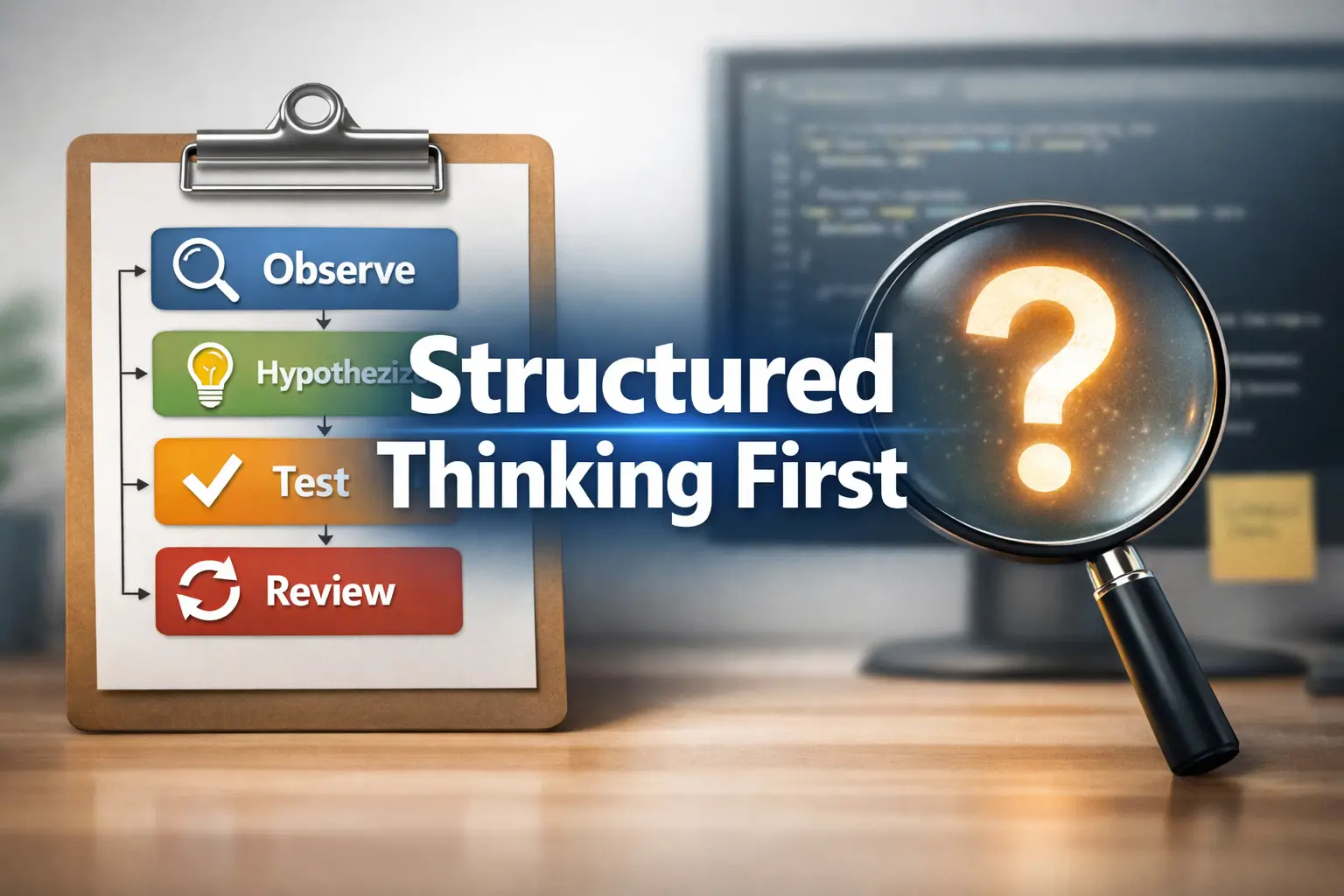
Infographic: The beginner workflow Kioptrix quietly teaches

1. Observe

What services, versions, behavior, and patterns can you actually confirm?

2. Hypothesize

What might this evidence mean, and what is still missing?

3. Test

What is the smallest safe next action that could clarify the picture?

4. Review

What changed, what failed, and what does that suggest now?

The point: You do not need a louder toolkit. You need a steadier loop.

kioptrix for beginners

Structured Thinking First, Terminal Second

Why Kioptrix can teach judgment before it teaches speed

Beginners often imagine cybersecurity labs as a sequence of dramatic breakthroughs. Screen glows. Ports appear. Something pops. The truth is quieter. A small legacy lab like Kioptrix is often more valuable because it strips away the fireworks and leaves you alone with your own decisions. That is useful. You get to see whether you can notice patterns, set priorities, and avoid flailing.

The first time I returned to an old lab after spending too much time reading tool-heavy walkthroughs, I realized something mildly embarrassing. I had more commands in my notes than thoughts in my head. The terminal looked busy. My reasoning did not. That is exactly why a structured workflow matters. It makes you prove that each action had a reason.

For beginners, that is gold. Fast exploitation can feel satisfying for 90 seconds. Structured thinking keeps paying rent long after the session ends.

The real beginner trap is not lack of tools, but lack of sequence

Most beginner frustration does not come from not knowing enough commands. It comes from not knowing when to use anything and why one step should come before another. Without sequence, even simple output becomes fog. A scan result is not guidance by itself. It is only a clue. You still have to decide what to ignore, what to test, and what to postpone.

That is where Kioptrix becomes surprisingly honest. It does not merely ask, “Can you run a tool?” It asks, “Can you build a sequence that survives uncertainty?” Those are very different questions. One is about motion. The other is about judgment.

A small lab can reveal big thinking gaps surprisingly fast

There is a reason small labs can feel sharper than sprawling environments. They leave fewer places to hide. If your notes are messy, you feel it. If your assumptions are sloppy, you feel it. If you confuse “I tried many things” with “I learned something,” the lab will hand that confusion back to you like a library book you forgot to return.

That is not failure. It is feedback. And for a beginner, feedback with clear edges is far more useful than false confidence.

Takeaway: Kioptrix is most useful when you treat it as a reasoning lab before you treat it as a target.
  • Sequence matters more than command count
  • Judgment grows through restraint, not speed
  • Small labs expose thinking gaps quickly

Apply in 60 seconds: Write one sentence before starting: “Today I am practicing workflow, not showing off.”

Who This Is For, and Who Will Hate It

Best for beginners who need a repeatable workflow, not adrenaline

This approach fits beginners who want a dependable system more than a thrill. If you are the kind of learner who likes checklists, annotated notes, and slow confidence, Kioptrix can be excellent. It gives you room to test ideas without the cognitive tax of a giant modern lab stack. You are not wrestling ten dashboards and three half-broken plugins. You are mostly wrestling your own thought process. That is cleaner training.

A strong fit for career changers, help desk learners, and note-heavy self-studiers

Career changers often bring one hidden advantage: they already know what it means to work methodically under imperfect information. Help desk learners, for example, may already be good at observing symptoms, narrowing causes, and documenting what changed. Kioptrix rewards exactly that temperament. So do hiring managers later, though they rarely say it that neatly.

I have seen learners with modest technical range make better progress than more “advanced” beginners simply because they respected sequence. They checked assumptions. They wrote better notes. They did not panic when the first idea failed. That matters more than people think. If that sounds familiar, Kioptrix for help desk workers exploring security and this guide for career changers using Kioptrix as a bridge into security extend that same logic in a more specific direction.

Not for people chasing instant wins, shortcut lists, or copy-paste confidence

If your goal is to collect screenshots fast and move on, you may dislike this style. If you want a lab that flatters impatience, this is not it. Kioptrix can absolutely be solved, but it is not at its best when treated like a vending machine for confidence. Put in a tool. Receive triumph.

Copy-paste confidence is especially dangerous. It feels sturdy until someone asks the simplest follow-up question: “Why did that step make sense?” That is where many otherwise enthusiastic beginners discover they have been building a cardboard cathedral. If that pattern feels uncomfortably familiar, the breakdown in why copy-paste commands fail in Kioptrix is worth reading.

Eligibility checklist

  • Yes: You like note-taking and want a repeatable learning loop.
  • Yes: You can tolerate being stuck for 10 to 20 minutes without spiraling.
  • Yes: You care about explaining decisions, not just finding answers.
  • No: You mainly want shortcut lists and instant validation.
  • No: You get bored the moment a lab asks for patience.

Next step: If three or more “Yes” lines fit, this workflow-first approach is probably worth your time.

Before You Touch the Box, Build the Workflow Spine

What a beginner-friendly thinking workflow actually includes

A beginner-friendly workflow does not need to be ornate. In fact, ornate is usually where trouble begins. You need four simple parts: observation, hypothesis, test, review. That is the spine. Everything else is muscle and weather.

Observation is what you can verify. Hypothesis is what you think the evidence might suggest. Test is the smallest reasonable next move. Review is what changed after the move. With those four steps, the lab stops feeling like a maze and starts feeling like a series of deliberate questions.

Observation, hypothesis, test, review: the four-part loop that keeps you honest

This loop matters because it prevents one of the oldest beginner errors in cybersecurity practice: acting as though a guess is already a fact. A noisy scan result can tempt you into a leap. A version string can seduce you into tunnel vision. A tutorial memory can whisper, “I think I’ve seen this before,” which is not the same as knowing anything.

The loop slows you just enough to stay honest. It asks: what do you know, what do you suspect, what are you trying to learn next, and what actually changed? That rhythm is small, but it keeps ego from driving the car.

Why writing down “what changed” matters more than writing down every command

Many beginners keep logs that read like a rain gutter full of commands. Useful now and then, but not exactly elegant. What you need more is a record of state change. What did you learn? What became less likely? What opened up? What got ruled out?

I once reviewed a set of old practice notes where I had captured almost every command but almost none of the reasoning. Reading them later felt like opening a cookbook written by a sleepwalker. The steps were there. The logic was not. Since then, I have preferred lighter command notes and stronger decision notes. Future-you will thank present-you for that kindness. A dedicated Kioptrix technical journal workflow or a more general guide to note-taking systems for pentesting can help if your notes currently feel like a pile of disconnected shell history.

Show me the nerdy details

A useful workflow note often has five tiny fields: observation, confidence level, working hypothesis, next test, and result. Even a 1 to 5 confidence score can help you see when you are acting on solid evidence versus acting on vibes in a trench coat.

Workflow step What it asks What beginners often do instead
Observe What can I confirm right now? Guess from one clue and sprint ahead
Hypothesize What might this mean? Assume the first idea is correct
Test What is the smallest useful next action? Throw five tools at the wall
Review What changed and what did that rule in or out? Forget and move on too fast
kioptrix for beginners

Enumeration Is Where Structure Either Appears or Collapses

Start narrow, then widen: how to keep early scans from becoming noise

Enumeration is often where the beginner session either becomes disciplined or dissolves into static. The temptation is understandable. You run a scan, see multiple services, and suddenly every possibility feels urgent. It is a buffet of clues, and beginners sometimes respond by putting the entire buffet on one plate. The result is not nourishment. It is confusion with breadcrumbs.

A better approach is to start narrow. Capture what is visible. Group the evidence by service or exposure type. Ask what is immediately unusual and what is merely present. Then widen with intention. Old labs are especially helpful here because they let you feel the cost of chaos without burying you under scale. If you want a companion piece for that phase, this guide to Kioptrix enumeration with a cleaner process fits naturally here.

How to separate signal from clutter when the first results look messy

Clutter becomes dangerous when you cannot tell whether a service is central, incidental, or simply a scenic object on the side of the road. The beginner move is often to treat every open port like a flashing emergency light. It rarely is. Sometimes a service matters. Sometimes it is background furniture. Structure helps you test which is which.

One simple method is to rank findings by three questions: Does this look reachable? Does it look informative? Does it connect to a plausible next step? If the answer is weak across all three, let the clue sit for a while. Not every door deserves your shoulder. And if you keep misreading the first batch of findings, the write-up on common Kioptrix recon mistakes makes a good corrective mirror.

Let’s be honest… most beginners do not fail because the lab is hard, but because they stop organizing what they see

This is the part many learners do not enjoy hearing. The lab can feel hard because the thinking around it becomes unstructured long before the target becomes truly difficult. Tabs multiply. Notes scatter. Half-formed ideas start breeding in the margins. Then frustration arrives dressed as urgency. That costume fools a lot of people.

When I notice my own enumeration getting messy, it is usually not because the box suddenly became brilliant. It is because I stopped maintaining the map. The cure is rarely “work faster.” It is “restore the structure.”

Takeaway: Enumeration becomes manageable when you organize clues before you chase them.
  • Start narrow, then widen with a reason
  • Rank clues instead of treating all output equally
  • Restore note structure the moment tabs begin multiplying

Apply in 60 seconds: Add three labels to your notes now: “High signal,” “Maybe,” and “Background.”

Don’t Sprint to Exploitation Before the Story Makes Sense

Why premature exploitation creates fragile learning

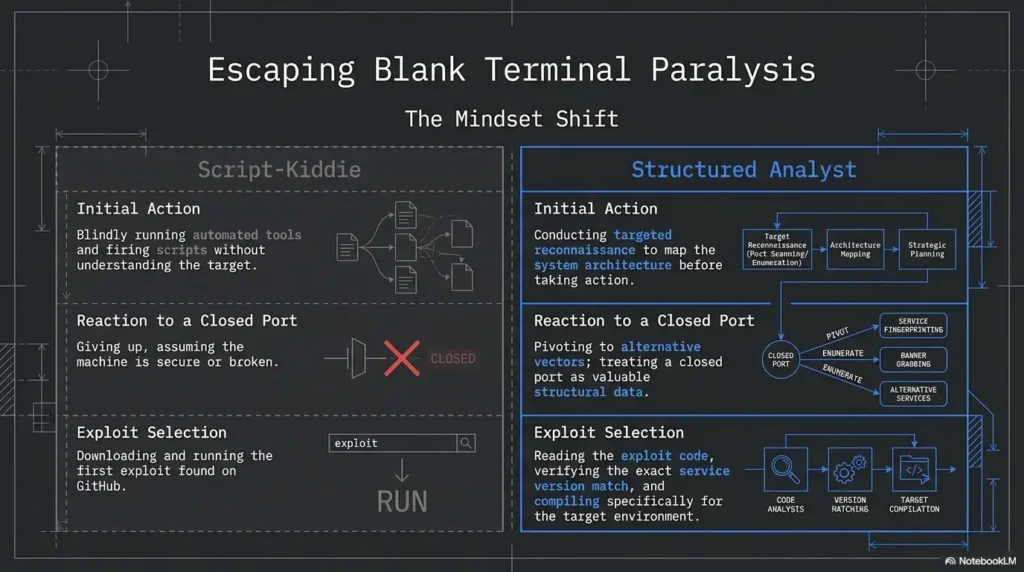
There is a particular beginner rush that appears the moment a plausible exploit path shows up. It feels like relief. Finally, a concrete thing to do. But if the broader story of the system does not make sense yet, exploitation becomes fragile learning. You may reach a result without understanding the path. That creates a false sense of fluency, the kind that vanishes on the next slightly different lab.

Ethical practice is stronger when you can explain not only what worked, but why it was reasonable to try. Otherwise you are not really building judgment. You are collecting lucky weather.

What to ask before you try anything aggressive or irreversible

Before moving from observation into more assertive testing, pause and ask three questions. What evidence supports this step? What safer or smaller check could clarify the same idea? What would success or failure actually tell me? Those questions keep the session grounded. They also mirror the kind of thinking that matters in real professional environments, where restraint is not optional.

In beginner labs, the answer to the second question is often the most useful. There is usually a smaller, cleaner probe available before the larger move. Choosing it does not make you timid. It makes you thoughtful.

The better beginner question: “What evidence would make this next step reasonable?”

This single question can save a session. It turns your thinking from appetite to evidence. Instead of asking, “Can I try this?” you ask, “What would make trying this sensible?” That subtle shift protects you from guess-hunger, which is one of the more expensive beginner habits.

Sometimes the honest answer is, “Not enough yet.” Good. That means your judgment is alive. Learners deciding whether to lean on automation early may also benefit from reading Metasploit vs. manual practice in Kioptrix, especially when the real question is not speed but learning quality.

Decision card: When to move forward vs when to pause

Move forward when the evidence chain is visible, the next step is proportionate, and you know what result would mean.

Pause and gather more when the idea mostly comes from memory, excitement, or one weak clue.

Neutral action: If you cannot explain the reason for the next step in one sentence, gather one more fact first.

Common Mistakes That Make Kioptrix Feel Harder Than It Is

Mistaking tool output for understanding

Tool output can feel authoritative, especially when it arrives with version numbers, banners, and neat formatting. Beginners sometimes treat that as comprehension. It is not. Output is raw material. Understanding begins when you compare, rank, and interpret what that material means. Until then, you are just holding puzzle pieces and admiring the cardboard.

Treating every open service like an emergency instead of a clue

Old labs can invite overeagerness because the environment seems smaller, and smaller feels like it should be easier. So the moment multiple services appear, beginners start reacting to all of them at once. The better habit is to treat open services as clues, not alarms. A clue asks for context. An alarm asks for panic. Choose the first one.

Skipping note structure and trusting memory to carry the session

Memory is charming until it is not. During a 30 to 45 minute practice session, it will absolutely betray you at least once. You will forget why you ruled something out. You will lose the order of a test. You will remember the emotional tone of the moment more clearly than the evidence itself. That is a dreadful archivist.

I learned this the annoying way. I once revisited a lab after a few days, confident I would remember the reasoning path. What I actually remembered was the soundtrack I had on, the tea I was drinking, and approximately none of the important logic. Charming, yes. Useful, no.

Confusing motion with progress when scans, tabs, and guesses multiply

Motion can create the illusion of progress. More commands. More browser tabs. More note fragments. More “maybe this?” moments. But progress is narrower than that. Progress means the search space became smaller, the next step became clearer, or the model of the target became more accurate. Everything else is just activity wearing a fake mustache. That distinction becomes even clearer in this breakdown of Kioptrix enumeration mistakes, where busy work and useful work part ways.

Takeaway: Kioptrix feels harder when your process gets louder than your reasoning.
  • Tool output is not the same as understanding
  • Open services are clues, not emergencies
  • Progress means sharper decisions, not busier screens

Apply in 60 seconds: Delete or close one distracting tab that is not tied to your current hypothesis.

Here’s the Quiet Advantage: Dead Ends Can Become Your Best Training Data

Why failed guesses are useful when they are recorded clearly

A dead end is only wasted if you learn nothing from it. In practice, failed guesses can be some of the richest training data you produce, especially as a beginner. They show where your assumptions were too broad, where your evidence chain was weak, or where you moved before the story of the box made sense.

That is why a clean record matters. When you log a failed path clearly, you are not just preserving disappointment. You are preserving a decision trail. That trail teaches you more than a lucky success often does.

How to review a dead end without turning it into self-criticism

This part matters more than many technical guides admit. Beginners often treat dead ends like verdicts on intelligence. They are not. A dead end is a data point about a decision under uncertainty. That is all. The useful review questions are: What evidence was I relying on? What assumption turned out weak? What smaller test could have come first? What signal did I ignore?

When you review a dead end that way, your tone changes. The session stops feeling like a trial and starts feeling like training. That emotional shift is not decorative. It protects consistency.

What dead ends reveal about your assumptions, pacing, and bias

Dead ends are especially good at revealing bias. Maybe you anchored too hard on one service. Maybe you favored the first idea because it felt familiar. Maybe you were tired and chose the exciting route over the careful one. None of this is rare. In fact, it is ordinary. That is why it is worth studying.

Short Story: A beginner once described a Kioptrix session to me as “thirty minutes of being wrong in increasingly organized ways.” I liked that immediately because it was both funny and accurate. They had started with confidence, latched onto one clue too early, and spent ten minutes tugging on a thread that led nowhere. In a previous season of learning, that would have ruined the mood for the rest of the night.

This time they stopped, wrote down why the guess had seemed attractive, marked what evidence was actually missing, and went back to the last confirmed fact. The final breakthrough was not dramatic. It came from a calmer second pass through the target. What stayed with them most was not the solution. It was the realization that their notes had turned failure into usable signal. That is beginner progress in a form worth keeping.

Show me the nerdy details

If you want better training data from dead ends, add two tiny fields to your notes: “Why this seemed plausible” and “What would have falsified it sooner.” Those fields turn hindsight into method instead of regret.

Don’t Build a Workflow That Breaks the Moment You Feel Stuck

Why beginners need fallback questions, not just primary steps

A fragile workflow works beautifully until the first stall. Then it falls apart like a folding chair on a polished floor. That is why beginners need fallback questions, not just a list of primary steps. Primary steps tell you what to do when the path looks promising. Fallback questions tell you what to do when the path goes quiet.

Useful fallback questions include: What is the last thing I truly confirmed? Which clue am I overweighting? What have I not explained yet? Which assumption would hurt most if it is wrong? These questions are small anchors. They keep you from drifting into random action just because the room got silent.

What to do when nothing obvious works and frustration starts steering

The first thing is not technical. It is procedural. Slow down. Re-state the known facts in plain language. Check whether your notes still reflect the present session or whether they have become a museum of abandoned guesses. Then reduce the problem. Choose one clue and ask what single question would sharpen it.

Frustration loves scale. It whispers that the whole lab is opaque. Usually it is not. Usually one part is unclear, and the mind has inflated that into a weather system. A smaller question often punctures that balloon.

The value of returning to known facts before widening the attack surface

There is quiet wisdom in returning to known facts before widening the search. It feels less glamorous, but it prevents sprawl. The wider you go under frustration, the more likely you are to confuse breadth with intelligence. Returning to confirmed facts is not going backward. It is regaining traction. When learners need a more visual pattern for that moment, a Kioptrix decision tree for next-step choices can be surprisingly grounding.

Quote-prep list for a stuck session

  • Last confirmed finding
  • Current hypothesis in one sentence
  • Weakest assumption in that hypothesis
  • One small clarifying test
  • One thing to ignore for now

Neutral action: Fill these five lines before you widen the scope of the session.

A Better Session Rhythm for Beginners Who Overstudy

Why long sessions often erode patience, precision, and recall

Long study sessions can feel virtuous. They look serious. They sound committed. But in beginner lab work, long sessions often degrade the very qualities you most need. Patience thins out. Precision softens. Recall gets theatrical. You remember the shape of what happened, not the logic. After a point, more time does not equal more learning. It just means the chair is becoming philosophical.

I have had sessions where the first 25 minutes were excellent, the next 20 were decent, and the final 40 were an elaborate performance of declining judgment. Beginners rarely benefit from that arc. A shorter, bounded rhythm is often better.

Short, bounded lab blocks can produce cleaner thinking than marathon practice

A 30 to 45 minute lab block is often enough for a beginner to observe, test a few ideas, and write a meaningful review. That smaller window creates urgency without chaos. It also encourages better note structure because you know the session needs a beginning, middle, and end.

When the block ends, stop. Write the next question you would pursue tomorrow. That single line acts like a bridge across time. It helps you restart without spending 15 minutes wondering what your earlier self was trying to do. If you want a tighter recommendation on pacing, the article on ideal Kioptrix session length for learning without burnout pairs neatly with this section.

Here’s what no one tells you… stopping at the right time is sometimes more skillful than pushing through

There is a kind of maturity in ending a session while your reasoning is still clean. It can feel unsatisfying at first, especially if you grew up equating endurance with worth. But in technical learning, stopping at the right moment preserves signal. Pushing too far can smear it. Knowing when to stop is not weakness. It is pacing.

Takeaway: Shorter, cleaner sessions often teach more than heroic marathons.
  • Use 30 to 45 minute practice blocks
  • End with one written next question
  • Protect reasoning quality before fatigue takes over

Apply in 60 seconds: Set a timer for your next lab block and decide the stop point before you start.

Your Notes Should Explain Decisions, Not Just Preserve Commands

What a useful beginner note template looks like in real practice

A practical beginner note template does not need fancy software. A simple document or notebook page works. The useful fields are: clue, interpretation, test, result, next move. If you want one extra field, add confidence. That helps you distinguish hard facts from hunches. The page begins to function less like a transcript and more like a thinking map.

How to document clues, assumptions, tests, outcomes, and next moves

For each clue, write what you actually observed. Then write what you think it might mean. Then record the smallest test you ran and what happened. Then write the next move. This sounds modest because it is. That modesty is the point. It reduces the chance that your notes become a scrapbook of technical confetti.

One of the nicest side effects of this structure is that it prepares you for future storytelling. If you ever need to explain your learning in an interview, you already have the raw shape of a real narrative: situation, clue, decision, outcome, reflection. That is one reason a well-structured Kioptrix lab report or stronger Kioptrix interview stories built from real sessions can matter more than one flashy screenshot.

Why future-you needs reasoning breadcrumbs more than terminal transcripts

Future-you rarely needs a perfect transcript of every keystroke. Future-you needs to know why the path turned left instead of right. That is the breadcrumb trail worth preserving. Without it, returning to a paused lab can feel like walking into a room where somebody moved all the furniture and then left you a receipt.

Mini calculator: Is your note system too heavy?

Use 3 inputs: minutes spent writing, number of useful decisions captured, number of commands copied.

If you are spending more time copying commands than capturing decisions, your note system is likely too heavy for beginner learning.

Neutral action: Trim one repeated command log and replace it with one sentence explaining why the step mattered.

Show me the nerdy details

Some learners keep two note layers: a fast session sheet for thinking, and a cleaner archive after the session ends. That split can work well because it protects real-time flow while still preserving a polished record later.

What Progress Actually Looks Like in This Lab

Early progress: cleaner observation and fewer random guesses

At the beginning, progress does not always look impressive from the outside. You may not be dramatically faster. You may not have bigger wins. Instead, you notice cleaner observations, fewer random guesses, and a smaller urge to try everything at once. That is real progress. It is foundational progress, which is often less photogenic and much more useful.

Mid-stage progress: better narrowing, better testing, better restraint

As your workflow matures, your testing becomes narrower and more meaningful. You stop treating each clue as a separate universe. You begin to connect evidence. You get better at asking what would actually falsify a belief. You become more comfortable leaving low-value ideas alone. That restraint is a strong sign. Mature beginners often look “slower” because they are wasting less motion.

Mature progress: being able to explain why a step made sense before you took it

The clearest sign of growth is simple: you can explain why a step made sense before you took it. Not after success. Before the step. That means the reasoning was present in advance. It means you were not merely narrating luck. You were building a decision.

This is where Kioptrix becomes more than a solved lab. It becomes a mirror. It shows whether your learning is moving from imitation toward judgment.

Takeaway: Progress in Kioptrix is measured by sharper reasoning, not louder wins.
  • Early growth looks quiet and procedural
  • Mid-stage growth shows up as restraint
  • Mature growth means explaining the “why” before acting

Apply in 60 seconds: After your next step, write whether you could have justified it beforehand in one sentence.

Next Step: Run One Lab Session With a Four-Column Thinking Sheet

Column 1: What I observed

This is where you record facts. Keep it narrow. Services seen, behavior noticed, responses confirmed. Avoid interpretation in this column. Facts first. Clean facts are precious in technical work because they stay useful even when your earlier theory collapses.

Column 2: What I think it might mean

This column holds your working interpretation. Keep the language humble. Use phrases like “might suggest,” “possibly,” or “worth checking.” That wording is not timid. It is disciplined. It reminds you that interpretation is provisional.

Column 3: What I tested

Write the smallest meaningful action you took. Not every command. The meaningful action. What question was the test supposed to answer? That one sentence matters more than the syntax parade.

Column 4: What changed, and what I will do next

This final column is where the learning becomes portable. What changed? What got ruled in or ruled out? What is the next smallest reasonable step? If you keep this column well, you can pause the session and return later without the usual fog.

In practical terms, this four-column sheet is a beginner’s bridge between curiosity and discipline. It is light enough to use immediately and strong enough to teach better habits over time. In a world full of elaborate templates and heroic lab mythology, that simplicity is refreshing. If you want a reusable structure instead of a blank page, start with a Kioptrix recon log template and adapt it to your own style.

Decision card: Four-column sheet vs freeform notes

Choose the four-column sheet if you get scattered, forget your logic, or restart sessions confused.

Choose freeform notes only if you already have strong structure and can reliably capture reasoning without prompts.

Neutral action: Try the four-column sheet for one full session before deciding it is “too simple.”

kioptrix for beginners

FAQ

Is Kioptrix too old to be useful for beginners today?

No. Its age is part of the point. For beginners, an older lab can reduce noise and make the learning signal clearer. The value is not that it mirrors every modern environment perfectly. The value is that it gives you a manageable space for practicing observation, sequencing, and disciplined note-taking.

Do I need to know a lot of tools before starting Kioptrix?

No. You need a small set of familiar tools and a stronger commitment to reasoning than to tool collecting. Many beginners delay practice because they think they need a giant toolkit first. Usually they need a steadier workflow more than a bigger toolbox.

How long should one beginner practice session be?

For many beginners, 30 to 45 minutes is a strong range. That window is long enough to observe, test, and review without letting fatigue quietly take over. More time is not automatically better.

What should I write in my notes during the lab?

Write the clue, what you think it might mean, what you tested, what happened, and what you will do next. Focus on reasoning breadcrumbs more than command transcripts. The commands matter, but the decisions matter longer.

Is it normal to get stuck during enumeration?

Yes. It is normal and expected. Enumeration is often where the session reveals whether your structure is strong enough. Being stuck is not the problem. Losing your process while stuck is the problem.

How do I know whether I am learning or just following steps?

Ask whether you could explain why each step made sense before you took it. If you can, you are likely learning. If you can only explain after seeing a successful result, you may still be leaning too heavily on imitation.

Should beginners focus on exploitation or on workflow first?

Workflow first. Exploitation without a reasoning spine creates brittle learning. A modest win supported by good judgment is worth more than a flashy result that you cannot explain clearly later.

Can Kioptrix help me build interview stories later?

Yes. A well-documented Kioptrix session can become a strong interview story because it shows how you observed, prioritized, tested, and learned from dead ends. Interviewers usually remember judgment more than a list of tool names.

What competitors usually do How this article avoids it
Treat Kioptrix as a simple beginner hacking walkthrough Frames Kioptrix as a structured thinking system, not just a box to solve
Focus heavily on commands and exploit steps Centers judgment, observation, pacing, and note flow
Use generic sections like benefits and conclusion Uses differentiated sections around mistakes, dead ends, and workflow design
Promise speed and ease without nuance Shows how structure reduces friction without pretending the lab is effortless
Ignore who the method is not for Includes a clear fit and non-fit section
Treat dead ends as failure Repositions dead ends as training data
Give vague advice on notes Provides a four-column thinking sheet and decision-focused note logic
End with generic encouragement Ends with a specific 15-minute next step the reader can use immediately

Conclusion: Structure Is the Beginner Skill That Quietly Changes Everything

At the start, we opened with a small but important claim: Kioptrix is most useful when it teaches you how to think, not just how to chase a result. That loop closes here. The reason this lab still matters for beginners is not nostalgia. It is clarity. It gives you a space where observation, sequence, dead-end review, and careful note-taking can become visible habits instead of vague good intentions.

If you do one thing in the next 15 minutes, make it this: open a blank document, draw four columns, and label them What I observed, What I think it might mean, What I tested, and What changed. Then run one short, bounded session. Not a heroic one. Not a cinematic one. A clean one. That is how beginners stop feeling lost and start building a workflow sturdy enough to carry them into harder labs later. From there, a broader Kioptrix learning path can help you turn one thoughtful session into a longer arc of deliberate practice.

Last reviewed: 2026-04.