
Open the practical working record to connect this guide to your scope, evidence and next decision.
Separate insurance types and contractual obligations
Professional liability and cyber coverage can address different losses, and policy titles alone do not establish coverage. Check exclusions, limits, consent requirements and any client-required wording. A certificate or checklist is not a substitute for the bound policy and appropriate advice on your circumstances. Reference and scope.

Independent Professional Risk Guide
Cyber Insurance for Freelancers
Handling Client Data
Map the actual professional services, client contracts and incident costs to proposed policy wording.
Cyber insurance can help pay certain response and liability costs, but the policy title is only the wrapper. The useful protection lives deeper inside the definitions, sublimits, exclusions, security conditions, reporting rules, retroactive date, and endorsements. A polished certificate of insurance may look reassuring while revealing almost none of those details.
This guide helps freelancers compare coverage without drowning in insurance vocabulary. You will learn how to connect a client contract to the right insurance limit, distinguish cyber liability from technology errors and omissions, prepare an accurate application, and spot the small-print traps most likely to create an uninsured bill.
Compare Clearly
Separate first-party costs, client claims, cybercrime, and professional liability.
Avoid Gaps
Test exclusions, sublimits, waiting periods, and contract assumptions before buying.
Request Better Quotes
Build one risk brief so every broker prices the same version of your business.
The goal is not to buy the thickest policy. It is to know which invoice should be covered when the screen goes dark. 🔐
Snapshot
Who this is for: U.S. freelancers, independent consultants, designers, developers, marketers, bookkeepers, and virtual professionals who access or retain client information. What it solves: confusion about cyber liability, technology E&O, policy limits, exclusions, and security applications. What you can do next: create a one-page coverage brief and request quotes that can be compared line by line.
Table of Contents
Before You Act
This article provides general educational information, not legal, cybersecurity, insurance, or risk-management advice. Policy wording, state breach-notification rules, contractual duties, and available endorsements vary. Review the full policy, application, client agreements, and retroactive date with qualified professionals before relying on coverage or responding to an incident.
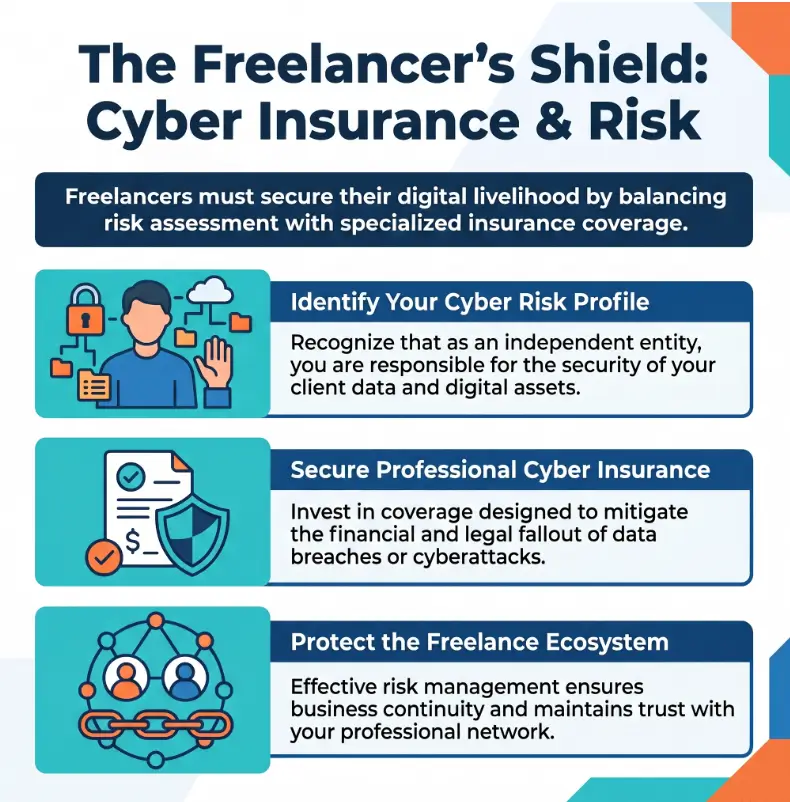
Who Cyber Insurance Fits, and Who May Not Need It Yet
Cyber insurance becomes easier to evaluate when you stop asking, “Am I big enough to be hacked?” and ask a more useful question: “What would happen if I could no longer control the client data or accounts I touch?”
A solo business can have a modest revenue line and still occupy a sensitive position inside a larger company’s systems. The risk may come from access, not size.
Strong candidates sitting inside a client’s digital perimeter
Coverage deserves serious consideration when you access customer databases, employee records, payment details, medical information, login credentials, confidential files, source code, production environments, or administrative dashboards.
A bookkeeper who can initiate payments, a developer with deployment credentials, and a virtual assistant managing executive email face different incidents, but each could create a costly path into a client’s operations.
- You download client records to your own device.
- You retain client files after a project ends.
- You can reset passwords, change permissions, publish content, or move money.
- You use assistants, subcontractors, or offshore collaborators.
- Your client agreement includes privacy, security, or indemnification duties.
- A client requires proof of cyber liability or technology E&O insurance.
Contract-driven buyers may need coverage before system access
Larger clients often screen independent professionals as vendors. Their onboarding package may request a certificate of insurance, a specified cyber liability limit, technology errors and omissions coverage, or evidence that insurance will remain active after the engagement ends.
In that setting, insurance is partly a sales requirement. The policy does not merely defend the business after a loss. It may unlock the contract before the first invoice is sent.
Lower-risk freelancers may have simpler options
A freelancer who handles no sensitive data, stores nothing locally, works only inside tightly controlled client systems, has no privileged access, and faces no contractual insurance requirement may decide that stronger security controls and an emergency reserve are sufficient for now.
That is not the same as having zero cyber risk. Email compromise, accidental disclosure, lost devices, and fraudulent payment instructions can affect nearly any online business. The question is whether insurance is the best tool for the likely loss.
“I only use cloud apps” is not an exemption
Cloud services reduce some infrastructure work, but they do not remove account takeover, weak sharing permissions, compromised credentials, unauthorized downloads, or configuration mistakes. A freelancer can expose client information without owning a server.
Key takeaway
The strongest signal is not business size. It is the combination of sensitive data, privileged access, client contracts, and your ability to absorb specialist response costs without insurance.
One Stolen Laptop, Five Bills: Where a Cyber Loss Spreads
The laptop is often the least expensive item in the story. The larger bill may come from determining whether anyone accessed the device, what information was stored, whether the data was encrypted, which clients must be contacted, and what contractual deadlines have started ticking.
Device replacement is usually the smallest question
A suspected compromise can create several categories of expense at once:
- Digital forensic investigation and system containment
- Legal review of privacy, contractual, and notification duties
- Data restoration and secure account recovery
- Client communication, notification, and credit-monitoring expenses
- Business interruption while systems or accounts remain unavailable
- Defense against client claims or regulatory inquiries
- Public-relations assistance when reputational damage is likely
First-party losses hit the freelancer directly
First-party coverage concerns your own response costs and operational losses. Depending on the policy, this may include approved forensics, legal consultation, data restoration, extortion response, crisis management, and income lost during a covered interruption.
For a one-person business, interruption can be especially sharp. There is no second department waiting in the wings. When your email, cloud drive, or website is unavailable, production and billing may stop together.
Third-party claims arrive from outside
Third-party liability may respond when a client, customer, or other party alleges that your security or privacy failure caused harm. Common allegations include exposing confidential data, enabling unauthorized system access, violating privacy duties, or failing to follow contractual security requirements.
Small incidents still consume expert hours
An ambiguous incident can be expensive precisely because nobody knows what happened. A strange login, missing folder, or forwarded email may require technical and legal investigation before anyone can determine whether notification, recovery, or client remediation is necessary.
Illustrative example: the altered payment request
A freelance bookkeeper receives what appears to be a routine email from a client executive. The message asks for a supplier’s bank details to be updated before the afternoon payment run.
The email address looks correct at a glance, and the request matches the executive’s usual writing style. The freelancer changes the payment instructions. Hours later, the real executive asks why the supplier has not been paid.
The resulting problem is not one tidy “cyber claim.” It may involve email compromise, social engineering, a voluntary transfer exclusion, disputed client responsibility, contractual indemnification, and questions about whether the freelancer followed a verification procedure.
The practical lesson is simple: coverage and controls must meet in the same room. A social-engineering endorsement may matter, but so does a written rule requiring payment changes to be confirmed through a second channel.
First-Party vs Third-Party Coverage: The Split That Changes Everything
A useful cyber insurance comparison begins by separating what happens to your business from what others claim your business did to them. Many confusing quotes become clearer once every feature is placed on one side of that line.
Incident response and digital forensics
Check whether the policy pays for approved investigators to contain an incident, preserve evidence, review logs, identify malware, and determine what information may have been accessed. Also check whether you must use the insurer’s panel vendors.
A policy may provide access to a breach hotline and specialist network. That can be more valuable than reimbursement alone because the first hours of an incident are rarely a good time to search the web for a forensic firm.
Privacy liability and regulatory response
Review coverage for defense costs, settlements, regulatory proceedings, privacy investigations, and civil penalties where legally insurable. Definitions matter. “Personal information,” “confidential corporate information,” and “privacy event” may not mean what ordinary language suggests.
Business interruption for a one-person business
Compare the waiting period, restoration period, income calculation, dependent-system coverage, and proof requirements. Some policies focus on interruption caused by a failure of your own network, while others may extend to specified cloud or technology providers.
Ask how lost income is calculated when revenue varies by project. A freelancer with uneven monthly billing may need clearer documentation than a business with predictable recurring revenue.
Cyber insurance and technology E&O solve different problems
Cyber insurance generally addresses security, privacy, data, network, and certain cybercrime events. Technology errors and omissions coverage may address financial loss caused by defective professional services, failed software, missed specifications, implementation errors, or system performance.
The same project can trigger both. A developer might accidentally expose customer records while deploying code that also causes the client’s checkout system to fail. One allegation concerns security and privacy. The other concerns professional performance.
| Loss or allegation | Coverage commonly examined | What to verify |
|---|---|---|
| Malware investigation and containment | First-party cyber response | Approved vendors, consent requirements, response hotline |
| Client alleges confidential data was exposed | Third-party privacy or network liability | Definitions, defense costs, contractual liability |
| Email fraud causes money to be transferred | Social engineering or cybercrime endorsement | Sublimit, verification conditions, voluntary transfer wording |
| Cloud platform outage stops work | Dependent business interruption | Named providers, waiting period, outage trigger |
| Software or professional work fails | Technology E&O or professional liability | Covered services, exclusions, retroactive date |
Key takeaway
Do not ask only whether a quote includes “cyber.” Ask which parts pay your own response costs, which parts defend client claims, and which professional-service failures require separate E&O protection.
The Client Contract Clause That Quietly Sets Your Insurance Limit
A freelancer may begin shopping for insurance by estimating the cost of replacing a laptop or recovering files. The larger exposure may already be sitting in the client agreement.
Liability caps may disappear for data breaches
Many service agreements cap ordinary damages at the fees paid under the contract. Confidentiality, data protection, security, intellectual property, and indemnification obligations may be excluded from that cap.
A modest project fee can therefore sit beside a much larger potential obligation. Before choosing an insurance limit, locate every clause that survives, bypasses, or expands the ordinary liability cap.
Insurance requirements can exceed the project’s value
An enterprise client may require a substantial cyber or technology E&O limit even for a relatively small engagement. The requirement often reflects the systems and information involved, not the amount you will invoice.
Confirm whether the contract requires a particular limit, policy type, notice of cancellation, continuing coverage, additional insured status, or waiver. Some requests fit awkwardly with cyber insurance, so the wording should be discussed with a broker rather than copied blindly into a quote request.
Indemnification can reach beyond negligence
Broad indemnification may require you to defend or reimburse the client for events involving subcontractors, credentials, third-party software, alleged privacy violations, or failure to meet promised security standards.
The policy’s contractual liability exclusion may then become crucial. Some coverage may apply to liability you would have faced even without the contract, while additional duties assumed only by agreement may be treated differently.
The client may care before you do
Insurance can function as a vendor-qualification credential. For freelancers moving toward larger clients, regulated industries, or higher-value system access, the right policy may reduce onboarding friction.
That does not mean accepting every contract term. Insurance is not a magical eraser for uncapped indemnification. It is one layer of protection alongside contract negotiation, security controls, data minimization, and careful work design.
For related preparation, use a structured vendor security questionnaire guide to anticipate the controls larger clients may ask you to document.
Limits, Retentions, and Sublimits: Read the Smaller Numbers First
The headline limit is the number most likely to appear on a proposal. It is not necessarily the number available for the incident you are most likely to experience.
The headline limit may not govern every claim
Ransomware, fraudulent transfer, social engineering, reputational harm, notification, data restoration, and dependent interruption may each have a smaller sublimit. A policy can therefore advertise a large overall limit while offering much less for a common email-fraud event.
| Number to compare | Why it matters | Question to ask |
|---|---|---|
| Overall policy limit | Maximum available across covered categories, subject to terms | Is this per claim, aggregate, or both? |
| Social-engineering sublimit | May be far smaller than the main limit | What verification procedure is required? |
| Business-interruption sublimit | Controls how much lost income may be recoverable | Which systems and outages qualify? |
| Retention | Amount you fund before coverage responds | Does a separate retention apply to each coverage part? |
| Waiting period | Delays the start of interruption coverage | Is it measured in hours, business hours, or days? |
| Annual aggregate | One claim can reduce what remains for later incidents | Do defense expenses reduce the aggregate? |
Deductible versus retention
Both terms describe money the insured may need to pay, but the mechanics can differ. The practical question is how much cash you must provide, when it is due, and whether the insurer begins managing the claim before or after that amount is satisfied.
Choose a retention you can fund during an emergency. A low premium paired with an unaffordable retention can turn coverage into a locked cabinet whose key costs too much.
Defense costs inside or outside the limit
If legal fees reduce the policy limit, an extended dispute may leave less money for settlement. Ask whether defense costs are inside the limit, outside it, or subject to a separate arrangement.
Good, better, best ways to structure the buying process
| Approach | What it includes | Best suited to | Main limitation |
|---|---|---|---|
| Good | Basic cyber quote matched to current contract minimums | Low-data freelancers with simple operations | May miss technology E&O, cloud interruption, or cybercrime gaps |
| Better | Cyber plus professional-liability review, sublimit comparison, and control checklist | Consultants with recurring client access | Requires more application preparation |
| Best | Contract review, cyber and E&O coordination, incident-response planning, and annual security-control verification | Freelancers serving enterprise or regulated clients | Higher advisory and coverage cost |
Show me the nerdy details
Many cyber and professional-liability policies are written on a claims-made basis. Coverage may depend on when the claim is first made, when it is reported, and whether the underlying act occurred after the retroactive date.
A retroactive date is not decorative. Work performed before that date may fall outside coverage even when the client complains during the current policy period. Continuous coverage and timely reporting can therefore matter more than freelancers expect.
Also examine consent-to-settle wording, panel counsel, vendor approval, related-claims language, extended reporting options, and whether several allegations are treated as one claim. These provisions can influence both control and available limits.
A $1 million headline can still leave a small fraud limit
Hypothetical wording exercise, not a claim estimate: assume a $40,000 loss that otherwise qualifies for a social-engineering coverage part, a $25,000 sublimit and a $2,500 retention. If the invented wording applies the retention to the loss and then caps payment, the calculation is min($40,000 − $2,500, $25,000) = $25,000. The insured funds $15,000 in this simplified case.
Different wording could apply the retention within the sublimit: min($40,000, $25,000) − $2,500 = $22,500, leaving $17,500 to the insured. These are two assumed mechanisms, not rules about how insurers must calculate claims. Exclusions, consent, defense expenses, other claims and aggregates can change the result.
Ask a licensed broker to identify the controlling clause and show the calculation for the same scenario in each proposal. The FTC cyber-insurance buying guidance is a starting point for coverage questions, not a substitute for the issued policy. A certificate showing $1 million does not establish which calculation applies.
Do Not Buy the Cheapest Policy Until You Test These Exclusions
Premium matters, but price is meaningful only after two quotes are placed on the same foundation. A cheaper policy may simply move an important risk outside the contract.
Contractual liability exclusions
Check how the policy treats responsibilities assumed in a client agreement. Pay close attention to indemnification, security warranties, notification deadlines, service levels, and promises to comply with a client’s internal standards.
Unencrypted devices and minimum-security conditions
Applications and policies may ask about multifactor authentication, encryption, endpoint protection, patching, backups, administrative access, and supported software. Do not assume these questions are harmless underwriting trivia.
If your answer says every laptop is encrypted but an older spare device is not, that discrepancy may become important after a claim involving the spare device.
Social engineering and voluntary transfer traps
Fraud involving altered invoices, impersonated executives, stolen credentials, or fake payment instructions may require a specific endorsement. Even then, coverage may depend on a call-back procedure or second-channel verification.
Subcontractors, prior events, and widespread incidents
Confirm whether assistants, agencies, subcontractors, managed-service providers, and other collaborators are included. Review prior-knowledge wording for suspicious activity, known vulnerabilities, or unresolved incidents discovered before the policy began.
Also inspect exclusions involving war, state-backed attacks, utilities, internet infrastructure, major cloud failures, and systemic cyber events. These provisions can be broad, technical, and carrier-specific.
Key takeaway
Compare exclusions against your actual workflow. A policy that excludes the way you receive payments, collaborate with subcontractors, or access client systems may be inexpensive for a reason.
Security Controls Before Applying: Five-Minute Questions With Expensive Answers
Security controls affect more than the chance of an incident. They may influence eligibility, premium, available limits, policy conditions, and claim review.
Multifactor authentication across critical accounts
Enable strong multifactor authentication on email, cloud storage, password managers, financial services, hosting panels, project-management platforms, and privileged client accounts. Email deserves special attention because it often controls password resets for everything else.
Encryption, tested backups, and patching
Confirm that laptops, phones, portable media, and relevant backups are encrypted. Do not rely on the vague comfort of “it is probably on.” Open the settings and verify.
A backup is useful only if it can be restored without depending on the compromised system. Test a small restoration, document the result, and keep at least one protected copy separated from ordinary account access.
Patch operating systems, browsers, plugins, website software, remote-access tools, and endpoint protection. Unsupported devices and abandoned plugins are the digital equivalent of keeping a basement window open because nobody uses that room.
Data minimization and deletion schedules
Retain only what the project, contract, law, and business records genuinely require. Remove unnecessary copies from inboxes, download folders, test environments, old phones, shared links, and completed-project archives.
Less retained data can mean a smaller incident, a simpler investigation, and fewer uncomfortable explanations.
A lightweight incident-response plan
- Record the insurer or broker’s reporting number outside your email account.
- Know how to disconnect a device without wiping evidence.
- List the clients whose systems or data could be affected.
- Document your cloud providers, devices, administrators, and subcontractors.
- Prepare a separate communication channel in case email is compromised.
- State who can authorize payments, notifications, or outside vendors.
The Freelancer Cyber Readiness Loop
1. Map
List client data, devices, accounts, and collaborators.
2. Verify
Check MFA, encryption, backups, patches, and deletion.
3. Read
Find insurance, indemnity, privacy, and notice clauses.
4. Compare
Match limits, sublimits, exclusions, and E&O needs.
5. Prepare
Store reporting contacts and first-response steps offline.
Freelancers building a practical control budget can also compare priorities with this security tool stack cost calculator.
The Application Can Become Evidence: Answer Carefully
An insurance application is not a wish list of controls you hope to install next quarter. It is a factual description of the business at the time you apply.
Inventory before you estimate
Before requesting quotes, gather the information that underwriters commonly need:
- Annual revenue and the services you provide
- Types and approximate volume of client records handled
- Devices, cloud platforms, hosting services, and payment systems
- Subcontractors or assistants who can access client information
- Current MFA, encryption, backup, patching, and endpoint controls
- Prior incidents, claims, suspicious activity, or known vulnerabilities
- Client industries and any regulated or unusually sensitive information
Avoid aspirational answers
Do not answer “yes” to universal statements unless they are genuinely universal. “All privileged accounts use multifactor authentication” is different from “most accounts use multifactor authentication.”
When an answer needs explanation, ask whether the application permits comments or a supplemental statement. A precise qualification is safer than a cheerful guess.
Define “records” the insurer’s way
Email addresses, credentials, employee documents, payment information, customer files, and confidential business records may be counted or classified differently. Ask what the application means rather than applying your own informal definition.
Save the submitted application
Keep the final application, supplements, emails, security attestations, quotes, policy, endorsements, and client insurance requirements together. Review the answers at renewal rather than automatically repeating last year’s statements.
Application rule of thumb
Describe controls as they exist today. Then keep a dated note showing how you verified each answer. Memory is a poor audit trail, especially after an incident.
Common Mistakes That Leave a Clean-Looking Policy Full of Holes
Assuming an existing business policy already covers cyber loss
General liability and commercial property coverage should not be assumed to pay for data restoration, privacy claims, cyber-related interruption, notification, or network incidents. Read the actual endorsements and exclusions.
Buying cyber coverage without checking technology E&O
A privacy event and a professional-services failure can emerge from the same project. Confirm whether your work is covered as a professional service and where the cyber policy stops.
Ignoring the retroactive date or allowing a lapse
Claims may surface months after the work was performed. Treating a claims-made policy as temporary equipment insurance can create a gap exactly when an old project returns with a new allegation.
Investigating alone before reporting
Do not hire unapproved vendors, admit liability, delete evidence, pay a demand, or notify affected parties without checking policy instructions and obtaining appropriate guidance. Immediate containment may be necessary, but improvisation can complicate both the incident and the claim. Coordinate reporting and notifications promptly with counsel; waiting for an insurer’s approval must not cause you to miss a legal or contractual deadline.
| Common mistake | Safer alternative |
|---|---|
| Comparing quotes by premium alone | Compare the same limits, sublimits, retentions, exclusions, and endorsements |
| Using the certificate as proof of complete protection | Read the policy, definitions, conditions, and endorsements |
| Choosing limits without reading contracts | Map insurance requirements and uncapped duties first |
| Assuming cloud storage transfers all responsibility | Review account compromise, permissions, and dependent-system coverage |
| Answering security questions from memory | Verify controls and save dated evidence |
| Keeping every client file forever | Use a documented retention and deletion schedule |
Readers comparing broader business protection can use this related guide to cyber insurance for small businesses as a companion to the freelancer-specific questions in this article.
When to Seek Professional Help Before the Problem Gets Larger
A capable freelancer can complete much of the preparation alone. Some moments, however, deserve a broker, lawyer, forensic specialist, or incident-response provider.
Contact the insurer or broker when an incident is suspected
Follow the reporting instructions as soon as practicable. Ask which vendors are approved, what immediate containment steps are expected, and whether the policy requires consent before costs are incurred.
Bring in privacy counsel when client data may be exposed
Legal counsel can help assess contractual duties, privilege, notification requirements, regulatory issues, and client communications. This becomes particularly important when sensitive personal information, financial credentials, medical data, children’s information, government data, or large datasets may be involved.
Use forensic help when the scope is unclear
Qualified technical assistance may be appropriate when accounts are compromised, logs are missing, malware is suspected, information may have been downloaded, or unauthorized access may still be active.
Request contract review before accepting broad indemnification
Professional review may be worth the cost when a contract includes uncapped liability, defense obligations, short breach-notification deadlines, audit rights, extensive security warranties, responsibility for subcontractors, or insurance requirements that do not match the work.
| Situation | DIY may be enough | Paid help may be worth considering |
|---|---|---|
| Preparing a basic risk inventory | You have simple systems and no sensitive regulated data | Multiple platforms, subcontractors, or complex data flows are involved |
| Comparing straightforward quotes | Coverage forms and limits closely match | Exclusions, endorsements, or E&O coordination differ materially |
| Reviewing a client contract | Terms are balanced and liability is clearly capped | Indemnity is broad, uncapped, or tied to strict security promises |
| Responding to suspicious login activity | No client data or privileged account appears affected | Scope is unclear, logs are missing, or access may remain active |
Freelancers who want response support arranged before a crisis can review the tradeoffs in this guide to an incident-response retainer.
Cyber Insurance FAQ for Independent Professionals
Do freelancers legally have to carry cyber insurance?
There is no single universal federal rule requiring every freelancer to buy cyber insurance. Client contracts, regulated work, platform terms, licensing obligations, or industry-specific requirements may make coverage practically necessary. Confirm the rules and contractual obligations that apply to your work.
Is cyber insurance worth it for a one-person business?
It may be worth considering when you handle sensitive information, have privileged system access, face client insurance requirements, rely heavily on cloud accounts, or cannot comfortably absorb legal, forensic, restoration, and interruption costs. Lower-risk freelancers may reasonably prioritize stronger controls and an emergency reserve first.
Does general liability insurance cover a client data breach?
Do not assume it does. General liability policies often do not provide the specialized response, restoration, privacy, network, notification, and cyber interruption coverage found in dedicated cyber forms. Review the actual policy and endorsements.
What is the difference between cyber liability and professional liability?
Cyber liability commonly addresses security, privacy, data, network, and certain cybercrime events. Professional liability or technology E&O commonly addresses allegations that your professional work, advice, software, or services caused financial loss. Some projects can produce both types of claim.
Does cyber insurance cover a hacked email account?
Coverage depends on the resulting loss, applicable definitions, security controls, endorsements, exclusions, reporting compliance, and whether money was transferred. A hacked mailbox may trigger response coverage, liability coverage, social-engineering coverage, or no covered loss, depending on the facts and policy.
Will a policy cover data stored in Google Drive, Dropbox, or Microsoft 365?
It may, but confirm coverage for third-party platforms, account compromise, configuration errors, dependent systems, and events occurring outside your own network. The platform storing the data and the account controlling access are not always treated the same way.
Does cyber insurance cover subcontractors?
Review the definitions of insured persons, employees, vendors, and independent contractors. Also check vicarious liability, incidents occurring inside subcontractor systems, contractual requirements, and whether the subcontractor must maintain separate insurance.
How much cyber insurance should a freelancer buy?
Start with client contract minimums, then compare the largest plausible response expense, data sensitivity, interruption exposure, defense costs, potential client claims, and relevant sublimits. The correct limit is not automatically the largest option or the cheapest compliant option.
What affects cyber insurance cost for freelancers?
Pricing can be influenced by revenue, services, data types, record volume, client industries, limits, retentions, prior incidents, subcontractor access, security controls, and requested endorsements. Use identical information and limits when comparing quotes, or the premium comparison will be little more than decorative arithmetic.
Build Your One-Page Coverage Brief in 15 Minutes
You do not need to master every insurance term before speaking with a broker. You do need a stable description of the risk so each quote is built around the same business.
Open a blank document and add these five headings:
- Client data: List what you access, store, transmit, download, or delete.
- Contract duties: Record the largest client’s insurance, indemnification, privacy, security, and notification requirements.
- Systems and people: List devices, cloud platforms, privileged accounts, assistants, and subcontractors touching the data.
- Security controls: Confirm MFA, encryption, backups, patching, endpoint protection, access reviews, and deletion procedures.
- Coverage priorities: Note the first-party response, third-party liability, cybercrime, interruption, and technology E&O protections you need compared.
Attach the relevant client insurance clause and use the same brief for every quote request. Ask each broker to identify where the proposal differs from your requested protection rather than simply sending a premium and a certificate sample.
Your next move
Spend 15 minutes documenting the data you touch and the client contract that worries you most. That single page will make security improvements clearer, broker conversations faster, and quote comparisons far less foggy.
Cyber insurance works best when it is treated as part of a small operating system: careful contracts, verified controls, limited data retention, accurate applications, and a response plan you can reach when your inbox cannot be trusted.
Last reviewed: 2026-10-13
Technical guidance updated: 2026-10-13. Clarified that insurer coordination does not suspend legal or contractual notification deadlines, labeled the payment-fraud scenario as illustrative, and repaired section navigation.
Editorial review: October 16, 2026. Updated the decision guidance and removed misleading illustrations where identified. Worked examples are hypothetical; they do not describe testing performed by Kioptrix, actual quotes, claim decisions or guaranteed outcomes.
Freelancer cyber coverage scenario
Use this when: you are an independent professional reviewing a proposed policy against actual client work. Copy these fields into your notes and replace each prompt with a dated response. Keep assumptions and unresolved questions visible.
| Field | What to record | Your evidence / owner / next check |
|---|---|---|
| Professional activity | Describe the service, client data and contractual insurance obligation. | To complete |
| Loss scenario | Separate your response costs from a third party claim. | To complete |
| Policy mapping | Record the relevant wording, exclusions, limits and retention. | To complete |
| Claim process | Clarify notice, consent and approved response-provider requirements. | To complete |
Next action: Ask a qualified broker to explain the first scenario that does not map clearly to the wording. Mark the relevant row confirmed, provisional or unresolved. Keep the supporting record, responsible person and next check beside it so another reader can continue the work without treating an assumption as a result.
This is an editorial working aid. Complete it with your own scope, source records and accountable reviewers. Filling the table does not by itself establish coverage, compliance or acceptance.
Worksheet change record — October 20, 2026
Added this freelancer cyber coverage scenario with four article-specific fields and an evidence-based next action. Existing source notes retain their own review dates. This addition is not a fresh verification of every statement or a newly executed test.