
KIOPTRIX BUYER GUIDE · REVIEWED AUGUST 2026
CMMC Compliance Software Pricing Guide:
What You Should Actually Budget For
CMMC software can cost anything from free self-assessment tools to five-figure annual compliance platforms. The sticker price, however, is rarely the number that decides whether the purchase is sensible.
The important questions are what information your organization handles, which CMMC level applies, how many systems and enclaves sit inside scope, how much evidence must be maintained, and whether you are buying software, advisory help, security controls, or some mixture of all three.
There is also an unusual 2026 wrinkle. CMMC Phase II has been suspended while Phase I self-assessment requirements remain in effect, so buyers should be especially careful about paying today for assessment-related capabilities they may not need yet.
Best starting rule: buy the least expensive system that can reliably manage your actual CMMC evidence and workflow, not the biggest compliance dashboard a salesperson can fit on a slide. 🔐
Snapshot
This guide is for defense contractors, subcontractors, IT managers, founders, and compliance leads deciding whether CMMC software is worth paying for. You will leave with a realistic pricing model, a way to compare quotes, and a clear threshold for choosing DIY, software, or professional support.
Table of Contents
How much does CMMC compliance software cost?
There is no defensible single “average CMMC software price.” Current public pricing shows why.
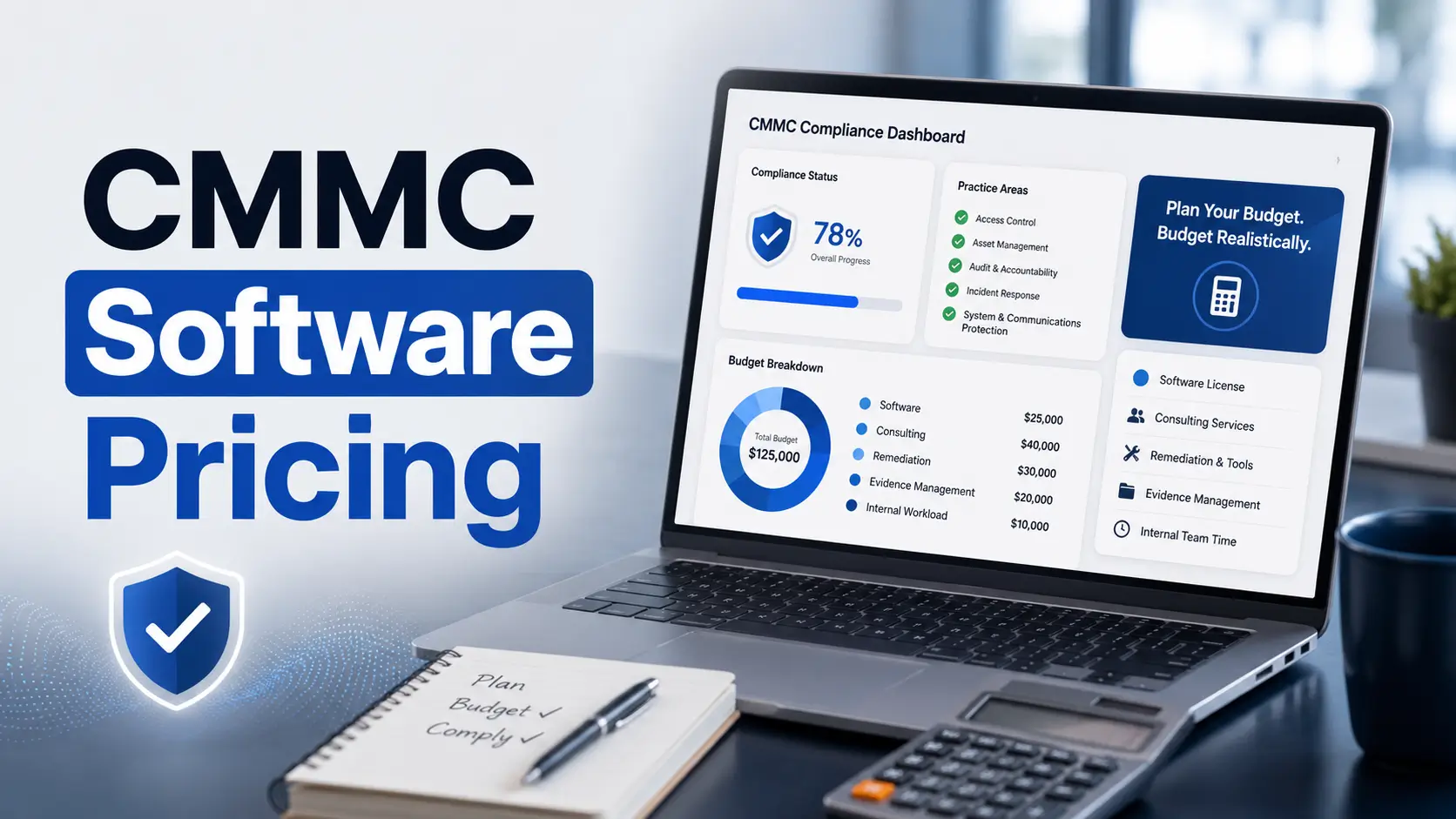
As of August 2026, FutureFeed publicly lists its core platform at $1,196 per year for organizations with 25 or fewer FTEs and $4,796 per year for organizations with 26 to 999 FTEs, with CMMC Level 2 listed as an additional $1,008 per year. Paramify publicly lists its CMMC Level 2 compliance package at $8,000 to $25,000 per year. These are individual vendor prices, not market averages, but they illustrate how widely packaging can vary.
In other words, publicly listed CMMC workflow software can begin in the low-thousands of dollars per year and extend well into five figures before you add security remediation, managed IT, consulting, or assessment costs.
Cost rule: never compare a $3,000 software subscription with a $30,000 managed compliance proposal as though they are competing licenses. One may be a workflow tool; the other may include people, implementation, remediation planning, documentation, and ongoing management.
The 2026 status changes what you should buy
On July 13, 2026, the department administering CMMC announced the immediate suspension of Phase II requirements that had been scheduled for November 10, 2026. Phase I self-assessment requirements remain in force, and the official CMMC site currently describes the program as paused in Phase I.
For procurement, that matters. Paying a large premium purely for near-term C3PAO assessment workflow is harder to justify if your actual contract requires only a Level 1 or Level 2 self-assessment today.
That does not mean CUI safeguarding requirements disappeared. The official program guidance states that Level 1 uses 15 FAR 52.204-21 requirements, while Level 2 self-assessment continues to use the 110 NIST SP 800-171 Revision 2 requirements.
Before You Act
This guide is a purchasing framework, not legal or contractual advice. Confirm the CMMC requirement in the solicitation, prime-subcontractor flow-down, contract clause, and current official CMMC guidance before committing to software or professional services. Your data flows, system architecture, existing DFARS obligations, and contract language can materially change the answer.
If you are estimating the entire compliance program rather than only the software layer, use the broader CMMC compliance cost guide. Software is only one slice of that budget.
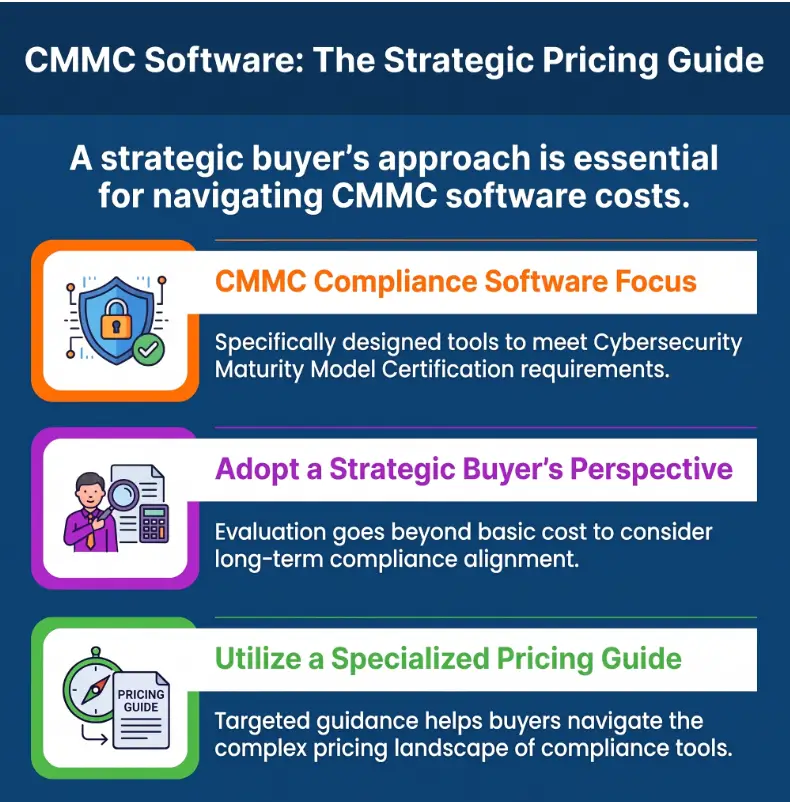
What are you actually paying for?
CMMC compliance software is usually governance and workflow software. It can organize evidence, map requirements, manage policies, calculate readiness or SPRS-related scores, track remediation, and maintain an SSP or POA&M.
It does not magically implement MFA, protect endpoints, configure firewalls, secure Microsoft 365, segment a CUI enclave, retain logs, or train employees. The dashboard can tell you the roof leaks. It is not necessarily the roofer.
A useful five-part cost model
The CMMC budget stack
License, modules, users, workspaces
Onboarding, imports, integrations
Evidence, policies, ownership, reviews
Security controls and architecture
Readiness or independent assessment when required
Realistic total budget = license + setup + internal labor + remediation + external help + contingency.
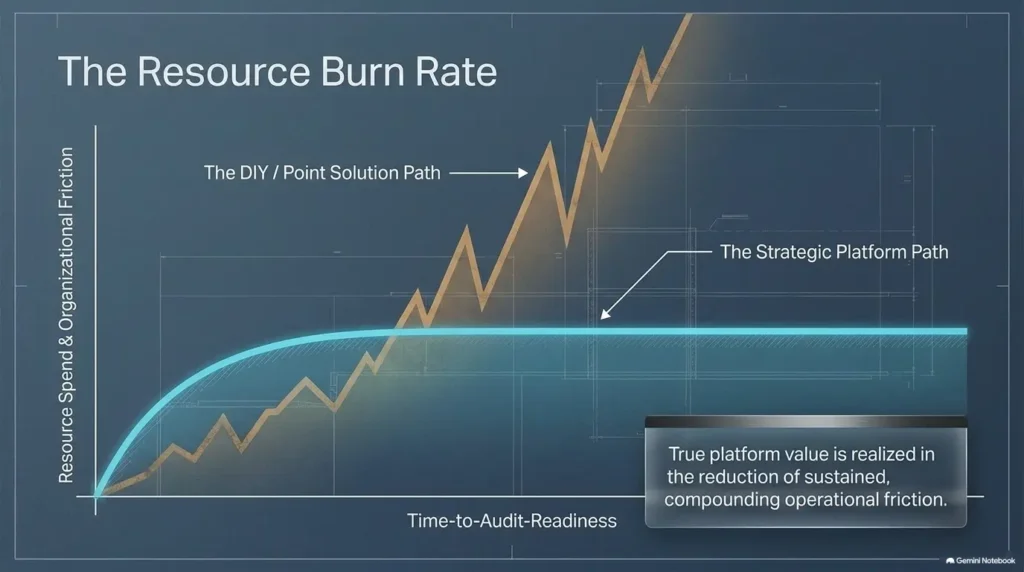
Software should remove work, not merely relocate it
A platform becomes economically useful when it removes repeated work: collecting evidence, assigning controls, updating documentation, tracking exceptions, showing what changed, and producing usable exports.
If your team still maintains the authoritative SSP in Word, the evidence index in a spreadsheet, remediation in Jira, policy approvals in email, and the software dashboard separately, you may have purchased one more system to maintain rather than one less.
How CMMC software pricing models work
The headline annual price tells you less than the unit behind it. CMMC platforms commonly price by company size, framework, workspace, enclave, organization, service tier, or some combination of those dimensions.
| Pricing model | What it means | Buyer risk |
|---|---|---|
| Company-size tier | Price increases with employees or FTEs | Growth can move you abruptly into a higher plan |
| Per user | You pay for named platform users | Cross-functional evidence owners can make seat count balloon |
| Per workspace or enclave | Each environment or entity may require another subscription | Multi-enclave organizations can become expensive quickly |
| Framework add-on | Core platform plus CMMC or other compliance modules | The attractive base price may exclude the framework you actually need |
| Flat annual license | One subscription includes a defined capability set | Check limits on entities, integrations, evidence storage, and support |
| Software plus advisory | Platform bundled with human compliance support | Compare service hours and deliverables, not only the monthly price |
| Enterprise/custom | Negotiated around size, integrations, support, or supplier governance | Renewal increases and implementation fees may matter more than year-one discounting |
Public list prices are useful, but only as anchors
For one current example, FutureFeed publishes its CMMC pricing structure rather than requiring every buyer to request a quote. That transparency makes it useful as a reference point, but it still does not tell you what another platform with different services, integrations, or data architecture should cost.
Use public prices to establish the rough order of magnitude. Use your own scope to determine value.
What changes a CMMC software quote?
The answer changes most when six variables change.
1. Your required CMMC level
A Level 1 organization managing FCI has a much smaller requirement set than a Level 2 organization protecting CUI. Paying for an elaborate Level 2 evidence program when your contractual requirement is Level 1 can be wasteful.
2. Number of environments in scope
A 60-person company with one tightly bounded CUI enclave may have a simpler software problem than a 25-person company with several subsidiaries, facilities, disconnected systems, and external service providers.
3. Existing security maturity
If identity, endpoint security, logging, backups, asset inventory, access reviews, and documentation already exist, the software may primarily organize evidence. If those foundations are missing, a GRC subscription will expose a remediation budget rather than eliminate one.
4. Automation and integrations
Integrations matter when they replace manual evidence gathering. An integration that continuously confirms a relevant configuration can save real labor. A connector that merely paints another green tile on a dashboard is harder to price generously.
5. Human services included
Some subscriptions are software-only. Others bundle compliance officers, consultants, documentation review, implementation help, office hours, or managed services. Separate the people component before comparing quotes.
6. Whether the platform will hold sensitive evidence
Ask what will actually be uploaded. Screenshots, network diagrams, asset inventories, policies, security architecture, and configuration evidence may themselves reveal sensitive operational information. Your security team should review hosting, access controls, encryption, administrative access, retention, deletion, backups, and data-export arrangements before treating the platform as an evidence vault.
The answer changes when: your required level, CUI boundary, number of enclaves, evidence volume, integration needs, or need for human support changes. Employee count alone is a poor proxy for CMMC complexity.
DIY vs software vs professional help: where is the threshold?
| Approach | When it can be enough | Main limitation |
|---|---|---|
| Free / DIY | Small scope, Level 1, mature internal team, limited evidence volume, stable environment | Manual tracking becomes fragile as scope and evidence grow |
| Dedicated software | Repeated evidence collection, multiple owners, Level 2 workflow, SSP/POA&M maintenance, reporting needs | Software cannot implement missing technical controls for you |
| Software + professional support | Weak internal expertise, complex CUI boundary, compressed procurement timeline, substantial remediation backlog | Can become expensive if responsibilities and deliverables are vague |
| Independent assessment or validation | Required by contract, future program rules, customer assurance, or risk decision | Independent assessment should not be confused with implementation consulting |
Do it free when the workflow is still small
For a small organization with a simple Level 1 environment, spreadsheets, document templates, official guidance, and free government-supported resources may be sufficient.
The defense department’s Project Spectrum program provides free training and readiness resources for small and medium-sized businesses. Official small-business guidance specifically points contractors toward free CMMC Level 1 and Level 2 readiness tools.
Pay for software when repetition becomes the problem
The software purchase starts to make sense when compliance work is recurring: evidence expires, systems change, owners rotate, policies need review, POA&Ms must be tracked, and leadership needs a reliable picture without rebuilding the answer every quarter.
Pay for professional help when judgment is the bottleneck
Professional support is more defensible when you cannot confidently determine scope, interpret responsibilities between your organization and service providers, design a CUI enclave, close technical gaps, or prepare evidence without outside expertise.
The distinction matters: software solves coordination. Experts solve judgment. Security tools solve technical controls. Sometimes you need all three, but buying one should not be mistaken for buying the others.
The costs that sit outside the software license
The most expensive CMMC surprise is often discovering that the compliance platform is the inexpensive part.
Security remediation
You may need identity changes, MFA, endpoint protection, logging, vulnerability management, secure backups, email security, asset management, configuration management, network segmentation, encrypted collaboration, or a redesigned CUI environment.
If you are building that budget separately, the security tool stack cost calculator is the more relevant next step than buying a larger GRC plan.
Internal labor
Price the hours consumed by interviews, evidence collection, policy ownership, technical remediation, reviews, approvals, vendor coordination, and ongoing maintenance.
A useful calculation is:
Annual internal compliance cost = monthly compliance hours × loaded hourly labor cost × 12
Then compare that figure with the labor a platform can credibly remove. This is much more useful than asking whether $500 per month “sounds expensive.”
Onboarding and integration
Ask whether initial configuration, data migration, framework setup, policy imports, SSO, APIs, cloud integrations, training, and implementation support are included.
Renewals and exit costs
Compliance data has a long memory. Before signing, confirm how you export policies, evidence indexes, SSP material, POA&Ms, audit history, control mappings, and attachments if you leave.
Hidden-cost warning: a cheap first-year license can become expensive if onboarding, additional enclaves, mandatory advisory services, integrations, evidence storage, or data export are separately priced.
What CMMC software capabilities are worth paying for?
Ignore the feature count. Price features by the work or risk they remove.
| Capability | Buyer consequence | Worth paying more when… |
|---|---|---|
| Requirement mapping | Keeps evidence connected to the right requirement | Your team is currently maintaining mappings manually |
| Evidence repository | Reduces scattered screenshots and document hunting | Access, retention, and export controls meet your needs |
| SSP management | Keeps system descriptions aligned with current scope | Your SSP changes frequently or has many contributors |
| POA&M workflow | Assigns gaps, owners, evidence, and deadlines | You have a meaningful remediation backlog |
| Automated evidence | Reduces repeated collection | The integration validates something materially relevant |
| Change history | Shows who changed what and when | Multiple people administer compliance evidence |
| Multi-enclave support | Separates environments and evidence sets | You genuinely operate more than one assessment scope |
| Supplier governance | Coordinates downstream organizations | You are a prime or manage significant flow-down obligations |
| Export / assessor package | Reduces reformatting and handoff work | You need portable, structured evidence packages |
Where the cost comes from
The expensive tier of a CMMC platform should normally earn its price by solving one or more expensive operational problems: multi-entity governance, multi-enclave management, large evidence volumes, automated control checks, complex integrations, supplier oversight, enterprise identity, or substantial human advisory support.
If the premium tier mostly adds prettier dashboards, AI-written policy text, and executive charts, ask whether those outputs actually shorten your readiness work.
AI-generated compliance text deserves particular caution. Drafting can be useful, but an eloquent SSP describing controls you have not implemented is not an asset. It is well-formatted fiction.
Three realistic CMMC software buying scenarios
Scenario 1: 18-person manufacturer, FCI only
Assume the company currently needs Level 1, has one office, a small IT environment, and an experienced administrator who can maintain evidence.
Likely decision: start with official guidance, Project Spectrum, and a disciplined manual evidence process. A dedicated paid platform can wait until repeated annual work or internal coordination becomes painful.
The mistake here is buying Level 2 automation because the organization “might need CMMC later.” Future possibility is not the same thing as current contractual scope.
Scenario 2: 45-person subcontractor handling CUI
Assume one CUI enclave, multiple evidence owners, an existing NIST SP 800-171 effort, and recurring documentation updates.
Likely decision: a dedicated Level 2 workflow platform becomes easier to justify. Evidence management, SSP maintenance, remediation tracking, ownership, and structured exports can save more labor than a spreadsheet-centric process.
Here, compare low-thousands and higher-priced annual platforms based on actual workflow removed. Do not automatically select the cheapest or the plan with the longest feature page.
Scenario 3: 220-person multi-site defense supplier
Assume several facilities, separate business units, many evidence contributors, outside service providers, complex identity systems, and supplier governance responsibilities.
Likely decision: enterprise pricing can be justified if it delivers multi-enclave separation, SSO, role-based access, integrations, supplier oversight, audit history, API access, and practical implementation support.
The procurement team should demand a detailed three-year total cost of ownership rather than negotiating only the year-one subscription.
How to compare CMMC software quotes without getting fooled by packaging
Normalize every proposal into the same cost sheet before choosing a vendor.
- Write down the CMMC level and assessment type your current contract actually requires.
- List organizations, enclaves, locations, and systems the platform must support.
- Record the annual base license.
- Add framework modules and mandatory add-ons.
- Add onboarding and implementation charges.
- Add required advisory or support packages.
- Add integration charges.
- Add extra workspace, entity, enclave, user, or storage costs.
- Estimate internal hours that remain after implementation.
- Record renewal pricing, minimum term, and cancellation conditions.
- Confirm how all compliance data can be exported at termination.
- Keep technical remediation outside this subtotal so you can see what the software itself costs.
Questions to put in the procurement email
- What exactly is included in the quoted annual price?
- What causes the price to increase?
- How many entities, enclaves, users, and workspaces are included?
- Which CMMC capabilities are separate modules?
- Are onboarding and training included?
- Which integrations require extra fees?
- Is advisory support included, and how much?
- Can we export all evidence, mappings, SSP data, POA&Ms, and audit history?
- Where is customer evidence hosted, and who can administratively access it?
- What are the retention and deletion procedures after termination?
- What is the renewal price or price-increase mechanism?
- Which advertised features depend on services that are not included in this quote?
Walk-away signal: if a vendor cannot explain what creates a price increase, what happens to your evidence when you leave, or which services are excluded from the proposal, the quote is not ready for approval.
Small businesses that have not yet established a baseline can also use the government’s Project Spectrum resources before purchasing commercial software. That gives you a clearer picture of the problem you are paying someone to solve.
FAQ
Does buying CMMC software make a company compliant?
No. Software can organize controls, evidence, documentation, remediation, and assessments, but compliance depends on what the organization has actually implemented and what its contract requires.
Do we still need CMMC software now that Phase II is suspended?
Possibly, but the justification should come from your current workload rather than the suspended milestone. Phase I self-assessment requirements remain in effect, and underlying safeguarding obligations have not vanished. Organizations with substantial Level 2 evidence-management work may still benefit from software.
CMMC references NIST SP 800-171 Revision 2, but hasn’t NIST published Revision 3?
Yes. NIST has superseded Revision 2 with Revision 3 in its own publication series, but the current CMMC Phase I program guidance continues to specify the 110 requirements from NIST SP 800-171 Revision 2 for Level 2 self-assessment. Confirm the applicable contractual requirement rather than assuming the newest NIST publication automatically changes CMMC.
You can review the NIST SP 800-171 Revision 2 publication page directly.
Should a small contractor buy the cheapest CMMC platform?
Not automatically. A cheaper product is adequate when it handles your actual level, evidence volume, documentation, and exports without creating substantial manual work. The cheapest subscription becomes false economy when key modules, integrations, or service support must be purchased separately.
Should C3PAO assessment fees be included in software pricing?
No. Keep independent assessment costs separate from the software license. Combining them obscures whether you are paying for a technology platform, preparation services, or an independent assessment.
What if a vendor promises its platform will guarantee CMMC success?
Treat that claim cautiously. A software vendor does not control your implemented security measures, personnel behavior, contractual scope, government decisions, or independent assessment results. Buy capabilities and defined services, not guarantees.
Your 15-minute next step: price the problem before the product
Before booking another CMMC software demo, open a blank document and write down just four things:
- Your current contractual CMMC level and assessment type.
- The number of organizations or enclaves that must be managed.
- The three compliance tasks consuming the most internal time today.
- The security gaps that require actual technical remediation rather than documentation.
That small exercise changes the buying conversation. Instead of asking, “How much is CMMC software?” you can ask, “What will this product remove from our workload, what remains outside the license, and what will the same scope cost us over three years?”
That is the number worth comparing.
Last reviewed: 2026-09