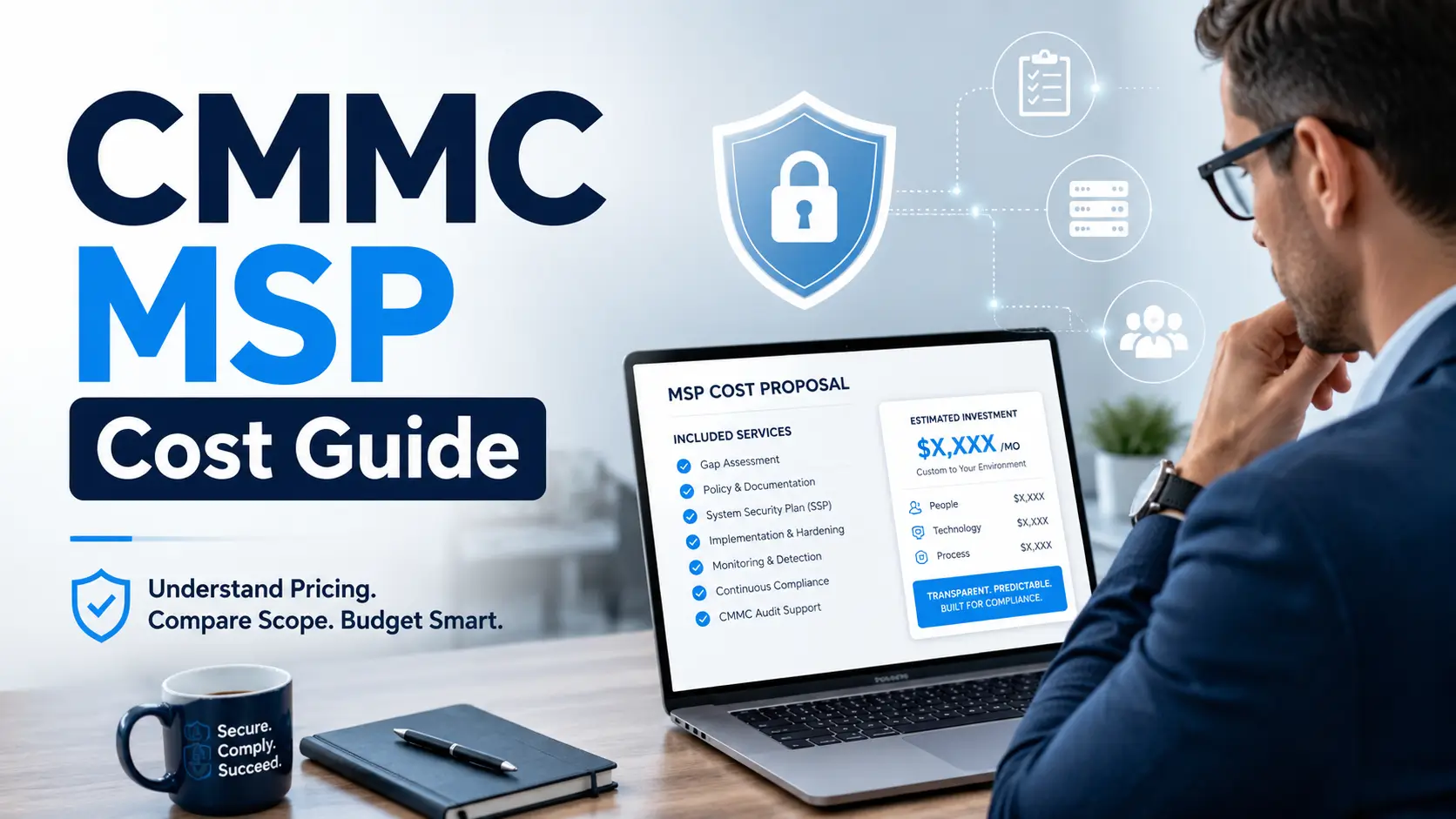

CMMC cost planning for defense contractors
CMMC Managed Service Provider Cost in 2026:
What an MSP Quote Should Actually Buy
A CMMC managed service provider can cost anything from a relatively small monthly fee for a tightly contained CUI environment to five figures per month for outsourced IT, security monitoring, evidence collection, documentation, and compliance operations. Those offers may all be legitimate because they are selling very different scopes.
There is an important 2026 wrinkle. As of October 13, 2026, the Department has suspended CMMC Phase II implementation, which had been scheduled for November 10, 2026. Phase I self-assessment requirements remain in place, and the Department says the pause does not remove existing protection obligations tied to DFARS 252.204-7012.
That makes quote discipline more important, not less. The useful question is not simply, “What does a CMMC MSP cost?” It is, “Which parts of our CUI environment, security operations, evidence workload, and remediation are we asking the provider to own?”
Budget rule: compare MSP proposals by responsibility and assessment scope before comparing the monthly number. 💰
This guide is for small and mid-sized defense contractors comparing CMMC-focused MSP, MSSP, enclave, or managed-compliance quotes. It will help you build a realistic recurring budget, identify costs commonly left outside the headline price, and decide whether you need advisory support, co-managed security, or a fully managed environment.
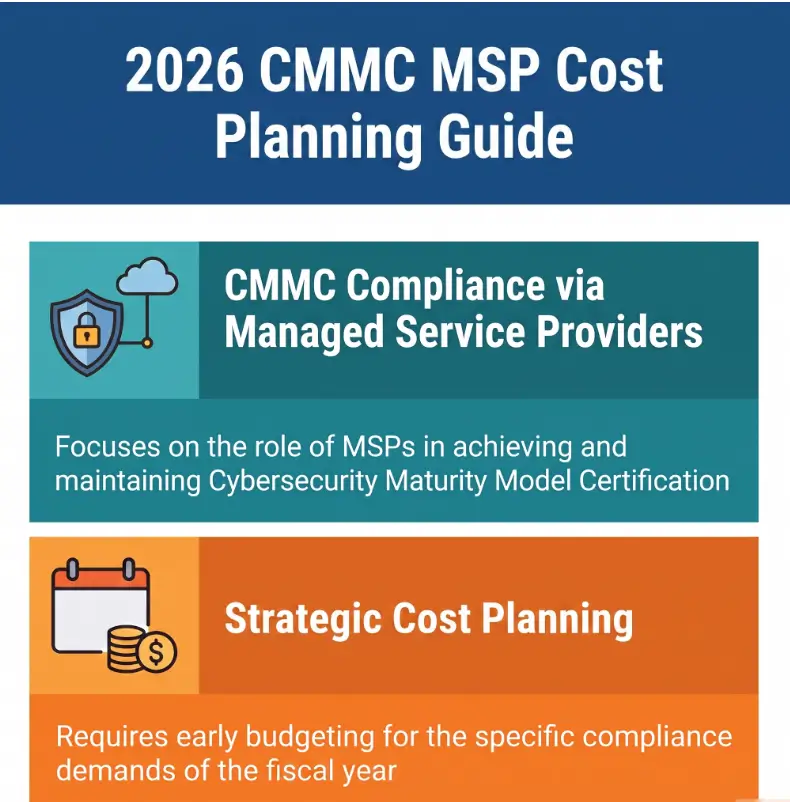
How much does a CMMC managed service provider cost?
There is no official CMMC MSP price because CMMC does not prescribe an MSP package or monthly service fee. The figures below are hypothetical budgeting examples, not verified current provider quotes or measured market rates. Obtain a dated proposal for your actual scope.
A secure collaboration subscription, a single-workstation enclave and a fully managed IT service cover different responsibilities. Use the CUI enclave pricing comparison to identify what a narrow package includes, then ask the MSP which additional administration, security operations and evidence work your organization still needs.
For broader managed services, request separate prices for base IT, security operations, compliance evidence, licenses and project work. Do not assume an advertised per-user fee covers every device, site, log source, incident or remediation task.
A useful comparison puts a recurring deliverable beside every recurring fee. If a supplier will not identify the task, owner, frequency, evidence and exclusion, the monthly price is not yet a reliable budget.
A practical 2026 planning model
| Service model | What to price explicitly |
|---|---|
| Narrow enclave | Included users, devices, storage, support and customer-retained work. |
| Compliance advisory | Named deliverables, review cadence, advisory hours and excluded administration. |
| Co-managed service | A responsibility matrix for internal IT, MSP and security provider; escalation coverage and evidence. |
| Fully managed service | Users, endpoints, sites, software, monitoring, support, recurring evidence and limits on remediation. |
Do not turn those references into a procurement rule. A 12-person machine shop with three CUI users and one segregated workstation should not automatically pay as though all 12 employees, every server, and the entire corporate network were inside the assessment boundary.
Conversely, an 80-person contractor with multiple sites, remote administrators, on-premises servers, security tooling, cloud workloads, and broad CUI access should be suspicious of a proposal priced like a three-user secure-file-sharing package.
What the 2026 CMMC pause changes
The current program status matters when you budget. On July 13, 2026, the Department suspended implementation of CMMC Phase II. Its current CMMC guidance says Phase I remains in force, with Level 1 annual self-assessment and affirmation requirements and Level 2 self-assessment requirements tied to NIST SP 800-171 Revision 2.
That means a provider should not sell you an expensive managed program solely by claiming every contractor imminently needs the same C3PAO certification event. Check the actual solicitation, contract clauses, current Department guidance, and your CUI handling before approving an assessment-related budget.
What has not disappeared
- The need to identify whether you receive or generate FCI or CUI.
- Existing DFARS safeguarding obligations where applicable.
- NIST SP 800-171 implementation work for affected CUI environments.
- Documented system boundaries, asset treatment, policies, procedures, and evidence.
- The need for accurate self-assessment and affirmation where required.
- Operational security work such as identity control, logging, patching, configuration management, incident response, and access management.
CMMC rules, implementation phases, solicitation requirements, and assessment expectations can change. This article is a budgeting and procurement guide, not legal or contract advice. Before signing a long-term MSP agreement, confirm your required level, applicable clauses, assessment type, CUI boundary, and current program status.
For the current source material, use the Department’s official CMMC resources and documentation. The site currently carries the Phase II suspension notice as well as the Level 1 and Level 2 guidance.
Build the CMMC MSP cost from five separate layers
The cleanest budgeting method is to stop treating the proposal as one monthly number. Break it into five layers.
CUI users, endpoints, sites, servers, cloud and vendors
Licenses, identity, EDR, SIEM, backup, secure collaboration
Help desk, monitoring, patching, evidence and administration
Projects required to close security and documentation gaps
Readiness checks and any applicable independent assessment
1. Base managed IT and security
This is the work you would need even without the CMMC label: endpoint administration, help desk, patching, account management, backups, endpoint protection, network administration, vulnerability management, and security monitoring.
If the quote begins with ordinary managed IT and then adds a “CMMC package,” ask what capabilities are already present in the base service. Paying twice for endpoint security or monitoring is an impressively dull way to burn budget.
2. Compliance-specific operations
This can include SSP maintenance support, control ownership mapping, recurring evidence collection, asset inventories, network diagrams, account reviews, access-review records, training records, POA&M tracking, policy updates, and preparation for interviews or assessments.
3. Licensing and infrastructure
Ask whether government-cloud subscriptions, secure file sharing, endpoint detection, mobile-device management, SIEM, backup, vulnerability scanning, DNS filtering, privileged-access tools, ticketing, and compliance platforms are included or simply passed through as separate charges.
If you need a wider security-stack budget beyond the MSP fee itself, the Kioptrix security tool stack cost calculator can help separate software licensing from provider labor.
4. Implementation and remediation
The recurring monthly fee often does not cover the ugly first-year work: identity redesign, network segmentation, cloud migration, domain consolidation, privileged-access cleanup, endpoint replacement, firewall upgrades, backup redesign, log onboarding, physical-security improvements, or remediation of inherited technical debt.
5. Independent validation
Keep provider preparation work conceptually separate from independent assessment. The Cyber AB states that assessors who participated in preparing an organization cannot then participate on the assessment team for that organization.
Given the current Phase II suspension, do not automatically add a large certification-assessment fee merely because an MSP uses the word “CMMC.” Confirm what your solicitation and current program rules actually require first.
The answer changes when these six variables change
Employee count matters, but it is rarely the best predictor of cost by itself. These six variables usually move the quote more.
| Cost driver | Why it changes the quote | Question to answer before requesting proposals |
|---|---|---|
| CUI user count | Changes licensing, administration, evidence, and support workload | How many people truly need to handle CUI? |
| Assessment boundary | A broader boundary pulls more systems and controls into operational scope | Can CUI be restricted to a smaller enclave? |
| Current control maturity | Weak identity, logging, configuration, or documentation creates remediation work | Which NIST SP 800-171 requirements are actually implemented today? |
| Infrastructure complexity | Servers, multiple sites, OT, remote access, cloud and legacy systems increase labor | What assets support the CUI environment? |
| Internal IT capacity | A strong internal team can retain daily administration and reduce outsourced labor | Which controls can employees operate reliably? |
| Provider access to CUI or security data | Can affect how the MSP or other external service providers fit into assessment scope | Does provider infrastructure store CUI, logs, configurations, or credentials? |
The scope question can be worth more than the discount
For Level 2, the Department’s scoping guidance distinguishes CUI assets, security protection assets, contractor risk-managed assets, specialized assets, and out-of-scope assets. Assets that process, store, or transmit CUI are in scope, while genuinely separated assets that cannot handle CUI and do not protect CUI assets may be out of scope.
This is why spending money on boundary design before buying 80 seats of compliance tooling can sometimes be the better economic move.
A provider supporting three CUI users in a contained enclave is pricing a different operational system from a provider taking responsibility for 60 endpoints, two offices, Microsoft administration, SIEM, vulnerability management, backup, help desk, policy upkeep, and recurring evidence. Comparing their monthly totals without normalizing scope is procurement fog.
What should a CMMC MSP actually include?
A higher MSP fee is justified only when it removes real workload or risk. Translate every service name into an operational consequence.
Technical operations
- Managed endpoints and defined patching responsibilities.
- Identity administration and multifactor-authentication support.
- Configuration baselines and secure-change procedures.
- Endpoint detection or other agreed security monitoring.
- Vulnerability scanning and remediation tracking.
- Backup administration and recovery testing where in scope.
- Logging, alert handling, and escalation responsibilities.
- Privileged-account administration.
If MFA deployment remains unfinished, use the Kioptrix MFA rollout guide to identify whether the provider is quoting an implementation project or merely the ongoing management layer.
Compliance operations
- Defined responsibility for the SSP and supporting documentation.
- Asset inventory and network-diagram maintenance.
- Evidence collection mapped to control owners.
- Review cadence for policies and procedures.
- POA&M administration where permitted and applicable.
- Assessment-readiness support.
- Customer responsibility matrix for shared controls and outsourced services.
- Recurring review of users, privileges, configuration, incidents, vulnerabilities, and other evidence.
External service provider responsibilities matter
The Level 2 Scoping Guide treats some MSP functions as External Service Provider activity. It specifically lists managed service provider personnel performing system maintenance as examples of security protection assets and explains that an ESP may fall within the organization’s CMMC scope when CUI or security protection data resides on provider assets.
The guidance also distinguishes an MSP from a cloud service provider. A non-cloud ESP that stores, processes, or transmits CUI requires assessment, while a non-cloud ESP that does not handle CUI does not require its own CMMC assessment, although the services it provides can remain within the customer’s assessment scope. Staff augmentation using only the customer’s processes, technology, and facilities is treated differently again.
That distinction belongs in your quote review because it affects architecture, evidence access, contracts, provider responsibilities, and potentially the provider’s own assessment burden.
Make the first service month an acceptance check
Agree on observable deliverables before approving recurring work. The checklist below is a proposed purchasing test, not a claim that KIOPTRIX tested an MSP. Use sanitized sample records during demonstrations and an approved channel for operational evidence.
| Check | What to record |
|---|---|
| Inventory and ownership | Reconcile the agreed assets and licenses with the invoice. Identify an owner for every responsibility retained by the customer. |
| Response and recovery | Walk through a sample alert, named escalation contacts and an approved restore exercise. Distinguish a notification SLA from investigation or recovery time. |
| Monthly evidence | Ask for an example of the delivered access review, patch exceptions, alert review and updated documentation. Record missing inputs and who resolves them. |
| Exit continuity | Confirm customer access to tenant administration, configurations and agreed evidence exports. Specify transition assistance and fees; do not wait until termination to discover dependencies. |
Hidden costs that make the cheap quote expensive
The monthly service fee is only useful when the exclusions are equally clear.
| Potential exclusion | Why it matters | What to request |
|---|---|---|
| Onboarding | Discovery, tenant migration and endpoint deployment can become a large project | Fixed onboarding scope and change-order rates |
| Government-cloud licensing | Licenses can materially change per-user economics | Exact SKU, quantity and renewal assumptions |
| Log storage | Retention and ingestion volume can create variable bills | Included volume, retention and overage price |
| Remediation | The MSP may identify gaps without fixing them under the base fee | Rate card and examples of project vs recurring work |
| After-hours response | “24/7 monitoring” does not necessarily mean 24/7 remediation | Escalation and response SLA |
| Incident response | Major incidents may trigger a separate retainer or hourly rate | Included hours and emergency rate |
| Documentation | Templates are not the same as maintaining organization-specific evidence | Named documentation deliverables and cadence |
| Assessment support | Preparation, attendance, POA&M closeout and independent assessment may differ | Exact assessment-related services included |
| Exit assistance | Switching providers can expose data and documentation dependencies | Export format, credential handoff and transition fee |
Ask who owns the evidence
Your company should be able to retrieve the documentation and evidence needed to understand its own security implementation. Avoid arrangements where screenshots, logs, configuration records, asset inventories, incident records, or customer-specific documentation effectively disappear when the contract ends.
Buying an inexpensive compliance portal while assuming it includes remediation, security operations, help desk, recurring evidence and assessment preparation. Software can organize work. It does not silently perform all of it.
DIY, software, co-managed, or fully managed?
The most expensive option is not automatically the safest choice. Buy the operating model that matches your missing capability.
| Approach | Good fit when | Main advantage | Main risk |
|---|---|---|---|
| DIY | Experienced internal IT/security team, small scope, sufficient time | Lowest external service spend | Internal labor and evidence burden are underestimated |
| Software-assisted | Controls largely exist but documentation and workflow are messy | Better organization and repeatability | Tooling does not fix technical deficiencies |
| Advisory + existing IT | Existing MSP or internal IT can implement recommendations | Avoids replacing a functioning IT operation | Responsibility can become fragmented |
| Co-managed MSP/MSSP | Internal IT exists but security monitoring or compliance operations are weak | Specialized capability without outsourcing everything | Shared responsibilities must be explicit |
| Fully managed environment | Small internal team, broad operational needs, high dependence on provider | Single operational owner for much of the workload | Higher recurring cost and switching friction |
Do it internally when the capability already exists
If your IT team can administer identity, endpoints, patching, logging, vulnerability remediation, backups and evidence reliably, paying a second organization to duplicate that work may be unnecessary. Targeted advisory help or workflow software may be enough.
Pay for software when repeatability is the bottleneck
A compliance platform can be useful when owners, evidence, review dates, policies and control mappings are scattered across tickets and spreadsheets. Its value comes from workflow and evidence management, not magical compliance dust.
Pay for managed service when operations are the bottleneck
If nobody internally can reliably run the underlying controls month after month, a managed service becomes easier to justify. That threshold is particularly clear when security monitoring, privileged administration, patching, log review, vulnerability management or documented evidence collection would otherwise be neglected.
How to compare CMMC MSP quotes
Do not ask three providers for “CMMC pricing” and then compare the totals. Give them the same scope sheet.
Send these facts to every provider
- Required CMMC level or current contract requirement.
- Number of employees and number of actual CUI users.
- Number of endpoints, servers and locations potentially in scope.
- Cloud platforms and major SaaS services involved.
- Whether CUI can be restricted to an enclave.
- Existing MSP, internal IT and security staffing.
- Current security tools.
- Known documentation or NIST SP 800-171 gaps.
- Target date driven by a real procurement event, not a generic marketing deadline.
Then normalize every proposal into the same table
| Proposal item | Provider A | Provider B | Provider C |
|---|---|---|---|
| One-time onboarding | Confirm | Confirm | Confirm |
| Monthly managed IT | Confirm | Confirm | Confirm |
| Security tooling | Confirm | Confirm | Confirm |
| Compliance tooling | Confirm | Confirm | Confirm |
| Recurring evidence collection | Confirm | Confirm | Confirm |
| SSP/document maintenance | Confirm | Confirm | Confirm |
| Vulnerability remediation | Confirm | Confirm | Confirm |
| Incident response | Confirm | Confirm | Confirm |
| Assessment-readiness support | Confirm | Confirm | Confirm |
| Major remediation projects | Confirm | Confirm | Confirm |
| Contract minimum | Confirm | Confirm | Confirm |
| Exit/data handoff | Confirm | Confirm | Confirm |
For a wider view of implementation, readiness, tooling and assessment expenses beyond the MSP relationship, see the Kioptrix CMMC compliance cost guide.
Choose the proposal with the clearest responsibility model, not automatically the lowest monthly fee. Ambiguous responsibility tends to reappear later as project fees, unclosed gaps or frantic pre-assessment work.
Provider and contract red flags
A credible provider should be willing to explain what it does, what your company still owns, and how the service fits your assessment scope.
Walk carefully when you hear these claims
- “Our software makes you CMMC compliant.” A tool may support requirements, but implementation remains organization-specific.
- “Everything is included.” Ask for the exclusions schedule anyway.
- “Every employee must move into the expensive environment.” Maybe, but demand the scoping logic.
- “You need a C3PAO assessment immediately.” Verify that against current program status and your solicitation.
- “We handle the whole assessment for you.” Ask which activities are preparation and which are independent assessment.
- “24/7 SOC included.” Confirm whether humans respond, what they respond to, and what remediation is actually included.
- “Unlimited remediation.” Define whether migrations, hardware replacement and architecture projects count.
Contract questions worth asking before signing
- Which people, devices, systems and locations does the quoted price assume?
- Which CMMC or NIST SP 800-171 responsibilities are ours and which are yours?
- Will your systems store or process CUI or security protection data?
- Which cloud services are involved, and who is responsible for validating their suitability?
- Which tools are included in the fee?
- Which remediation work is excluded?
- Who maintains our asset inventory, network diagram and SSP?
- What evidence will you produce every month or quarter?
- How quickly can we export evidence and configuration records?
- What happens to our documentation if we terminate?
- What is the minimum term and annual price-increase mechanism?
- What event triggers additional project charges?
If independent CMMC assessment services later become relevant to your procurement, verify provider and assessor status through The Cyber AB, the organization that operates the official CMMC ecosystem.
Three realistic budgeting scenarios
Scenario 1: Seven-person engineering firm, two CUI users
The firm already has competent outsourced IT, but only two engineers need to receive controlled technical files. Most administrative work never touches CUI.
A narrowly designed CUI enclave plus targeted compliance guidance may be more economical than migrating every employee into a premium managed environment. Ask vendors to price the same two-user boundary, devices, support hours, evidence duties and exit obligations. A low software subscription and a fully managed service are different purchases.
Decision: price scope containment first. Paying for full managed CMMC operations across the whole company may be unnecessary if the architecture legitimately keeps most systems outside the CUI boundary.
Scenario 2: 25-person subcontractor with internal IT
The internal administrator handles endpoints, accounts and Microsoft administration, but the company lacks mature documentation, recurring evidence collection and security-operations depth.
A co-managed model may fit better than replacing the internal administrator. For a hypothetical calculation, a $2,250 monthly compliance layer plus $75 per user in tooling would equal $4,125 per month for 25 users before the underlying managed IT cost. That is not a market quote, but it demonstrates why buyers must separate compliance labor, licensing and base IT.
Decision: retain internal administration where it works; outsource evidence, security operations or compliance tasks that have no reliable internal owner.
Scenario 3: 50-person manufacturer with broad CUI access
The manufacturer has multiple servers, remote employees, engineering workstations and a small internal IT team. CUI cannot easily be confined to two or three users.
For illustration, assume $250 to $350 per user per month for a 40-to-50-employee managed Level 2-oriented environment. At 50 users, that particular pricing model translates to roughly $12,500 to $17,500 per month before separately scoped major projects. Treat it as a hypothetical budget, not an industry tariff.
Decision: a five-figure monthly managed service may be economically rational when it genuinely replaces several operational functions. The buyer should still isolate migration, hardware, remediation and assessment costs before approving the total first-year budget.
FAQ
Does an MSP need to be CMMC certified to support us?
Not automatically. The answer depends on what the provider does and whether CUI or security protection data resides on provider assets. Department scoping guidance distinguishes between MSPs, CSPs, staff augmentation and other External Service Provider arrangements. A provider that merely supplies staff using your processes, technology and facilities can be treated differently from an MSP whose systems store CUI or security-relevant data. Review the actual service architecture rather than relying on the provider’s marketing label.
Should the C3PAO assessment be included in an MSP contract?
Keep the cost and role separate unless there is a very clear reason not to. Preparation and independent assessment serve different purposes, and current Cyber AB rules restrict assessment-team participation by people who helped prepare the same organization. In addition, Phase II implementation is suspended as of October 13, 2026, so confirm whether and when an independent assessment is actually required for your situation.
Can a small contractor reduce CMMC MSP cost with an enclave?
Potentially. When CUI can be legitimately confined to a small number of users and systems, an enclave can reduce licenses, managed endpoints, evidence volume and assessment complexity. It is not a loophole. The boundary still has to reflect how CUI is actually processed, stored and transmitted.
Why do two CMMC MSP quotes differ by $5,000 or more per month?
They may contain completely different services. One proposal might provide documentation and tooling while your staff still runs the controls. Another may include help desk, endpoint management, SOC monitoring, SIEM, vulnerability management, backup, government-cloud administration and recurring compliance evidence. Normalize both quotes before concluding one is expensive.
Should we delay all CMMC spending because Phase II was suspended?
Do not use the pause as a blanket spending signal. The Department states that Phase I requirements remain in place and that the suspension does not remove existing obligations to protect information under applicable DFARS requirements. A better response is to avoid unnecessary certification-driven spending while continuing work that your current contracts and security responsibilities actually require.
Your 15-minute next step: create a one-page quote scope
Before requesting another CMMC MSP quote, spend 15 minutes writing down five numbers: total employees, CUI users, in-scope endpoints, in-scope servers, and locations that handle CUI.
Then add three short lines: who manages IT today, which major security tools already exist, and which work you actually want the MSP to own.
Send that same page to every provider. Ask each one to return separate prices for onboarding, recurring operations, software licensing, remediation projects and any assessment-related assistance.
Do not optimize for the lowest MSP invoice. Optimize for the smallest defensible scope plus a service model your organization can operate consistently. That is the combination most likely to keep cost, evidence burden and operational confusion under control.
Last reviewed: 2026-09
Technical guidance updated: 2026-10-13. Clarified that unverified price figures are hypothetical budgeting assumptions, refreshed current program context, and repaired the table-of-contents links. Count bundled services once and separate one-time costs from recurring annual costs.
Editorial review: October 16, 2026. This revision clarifies purchasing assumptions, evidence or contract mechanics. Worked examples are hypothetical and do not report product tests, completed assessments or guaranteed outcomes.