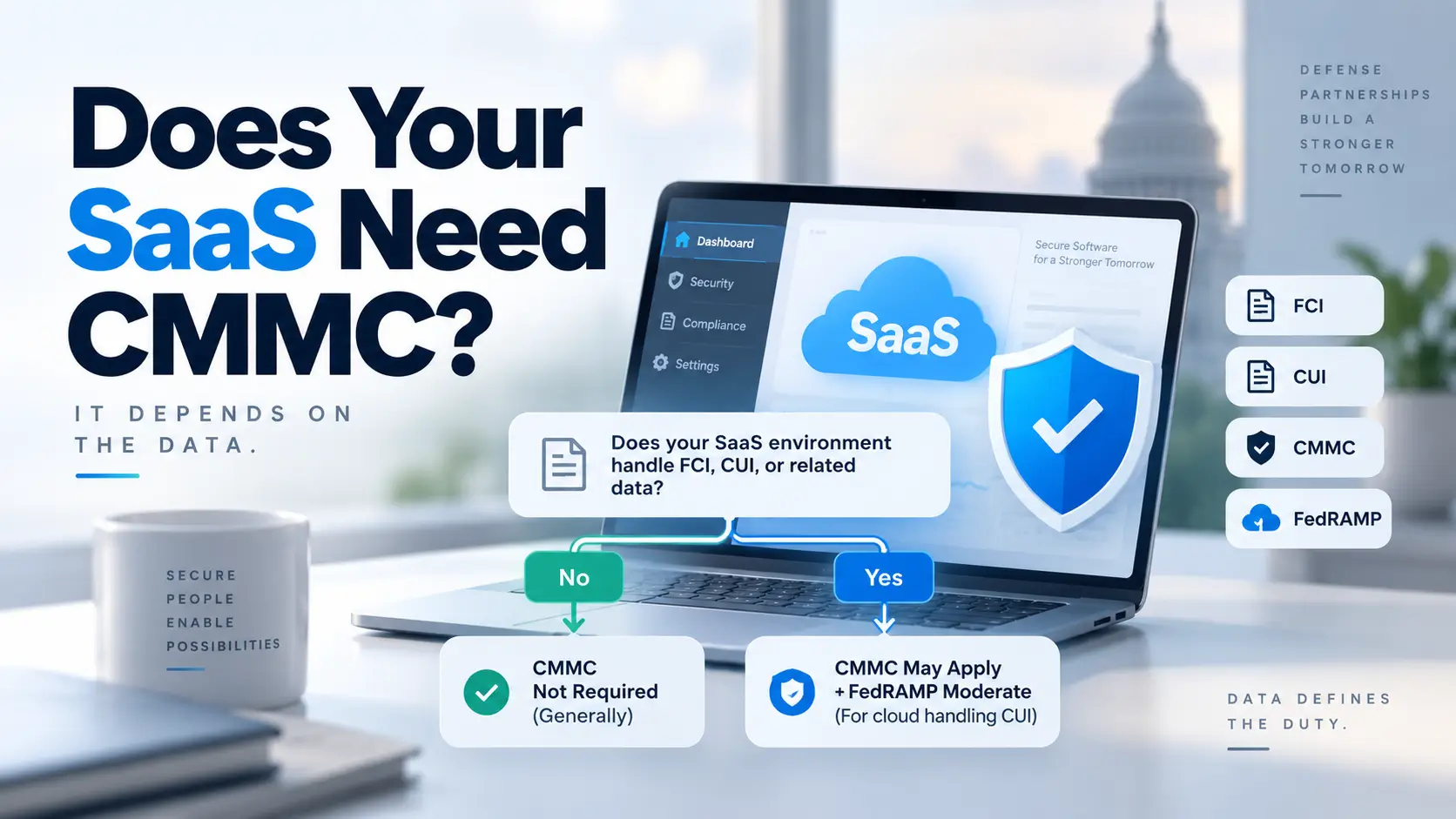
Short answer: a SaaS vendor does not need CMMC simply because it sells software to a defense contractor. The requirement turns on what information the SaaS environment will process, store, or transmit, how the vendor participates in the DoD contract, and what CMMC level the contract or subcontract requires.
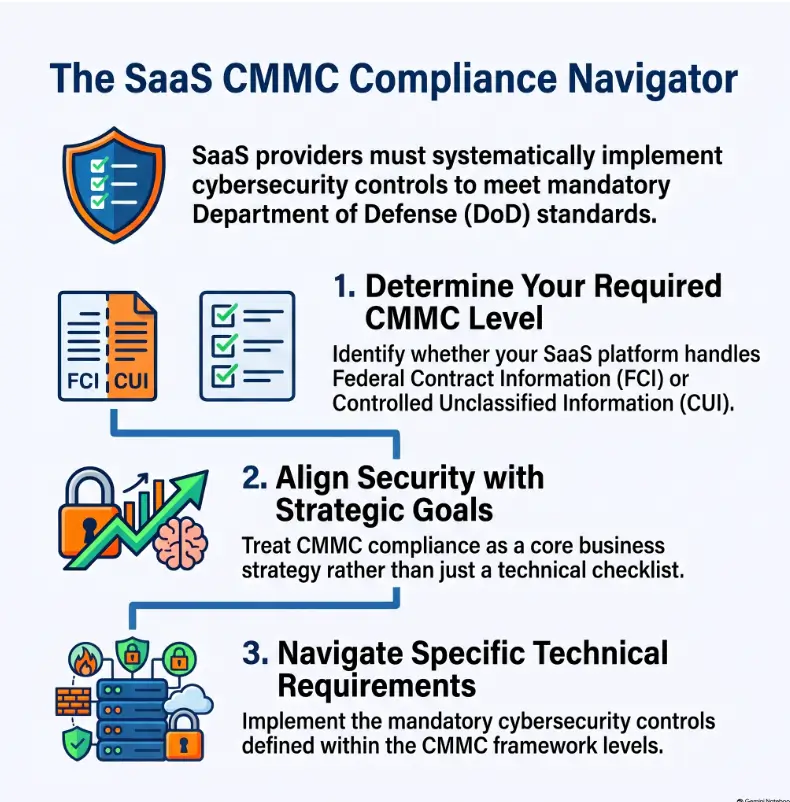
If your SaaS handles only ordinary public or commercial data, CMMC may never enter the picture. If it handles Federal Contract Information (FCI), Level 1 may apply. If it handles Controlled Unclassified Information (CUI), Level 2 requirements become the central issue. For a cloud service that stores, processes, or transmits CUI, there is another gate that SaaS teams often miss: DFARS 252.204-7012 requires the cloud service provider to meet FedRAMP Moderate-equivalent security requirements.
Your first action should therefore be architectural, not administrative: identify whether FCI, CUI, or security-protection data ever enters the SaaS product, support systems, logs, backups, analytics tools, or administrative workflows. That data-flow boundary determines most of what follows.
Table of Contents
The CMMC Decision Hinge for a SaaS Vendor
The most important distinction is whether you are a contractor or subcontractor with CMMC obligations of your own, or a cloud or external service provider supporting another company’s CMMC environment. Those situations can overlap, but they are not the same.
| Situation | What Usually Matters | What to Verify |
|---|---|---|
| SaaS vendor directly performs a DoD contract | The CMMC level specified for systems handling FCI or CUI | Solicitation, contract, CMMC clause, data type |
| SaaS vendor is a subcontractor | CMMC requirements flowed down by the prime or higher-tier contractor | Subcontract language and information being flowed down |
| SaaS platform is used as a CSP to hold CUI | FedRAMP Moderate or DoD-approved equivalency requirements | Cloud service offering, shared-responsibility model, CUI location |
| External service stores security logs or configuration data but not CUI | It may still fall inside the customer’s CMMC assessment scope as a Security Protection Asset | What security-protection data resides with the service |
| SaaS never receives FCI, CUI, or relevant security-protection data | CMMC may not apply to that service relationship | Actual data flow rather than customer industry alone |
This distinction prevents two expensive errors. The first is buying a full CMMC compliance program for a product that can be kept outside the regulated data boundary. The second is assuming that being “just a SaaS provider” keeps your platform outside scope when CUI is quietly arriving through uploads, support tickets, telemetry, backups, or integrations.
What Changed in 2026: CMMC Phase II Was Suspended
There is an important 2026 update. The Department announced on July 13, 2026 that implementation of CMMC Phase II, originally scheduled to begin November 10, 2026, was suspended while the program undergoes review. Phase I requirements remain in effect.
As of September 2026, the Department’s current CMMC program guidance says implementation is paused in Phase I and focuses on Level 1 and Level 2 self-assessments. The Department also makes clear that the pause does not remove existing duties to protect CUI under DFARS 252.204-7012.
That makes one piece of older CMMC advice particularly dangerous: do not build your schedule around the assumption that Phase II automatically begins November 10, 2026. That was the previous implementation date. The current Department position supersedes that rollout assumption.
At the same time, the underlying CMMC framework and DFARS contract clauses still matter. If a solicitation, contract, or subcontract contains a cybersecurity requirement, read the actual instrument rather than treating a program-wide implementation announcement as permission to ignore contract language.
Which CMMC Level Applies to SaaS Vendors?
CMMC currently organizes requirements around the sensitivity of information the contractor system must protect. For most SaaS companies, the practical divide is FCI versus CUI.
| Level | Protected Information | Security Baseline | Current Assessment Position |
|---|---|---|---|
| Level 1 | FCI | 15 safeguarding requirements associated with FAR 52.204-21 | Annual self-assessment and annual affirmation |
| Level 2 | CUI | 110 requirements from NIST SP 800-171 Rev. 2 | During the current Phase I pause, Level 2 self-assessment remains the operative broad rollout model |
| Level 3 | CUI requiring enhanced protection | Level 2 requirements plus selected NIST SP 800-172 requirements | Part of the CMMC program framework, but broader rollout has not progressed beyond the current Phase I pause |
One subtle point matters for engineering teams: CMMC is still assessing Level 2 against NIST SP 800-171 Revision 2. NIST SP 800-171 Revision 3 exists, but implementing Rev. 3 does not automatically prove that every Rev. 2 assessment objective required by the current CMMC program has been met. Use the current DoD assessment materials available through the CMMC resources and documentation page when building the evidence map.
Commercial SaaS Is Not Automatically Exempt
A common procurement shortcut sounds roughly like this: “We’re a commercial SaaS product, so CMMC does not apply.” That conclusion is too broad.
The current DFARS rules can apply to commercial products and commercial services. There is a specific exclusion for solicitations and contracts solely involving commercially available off-the-shelf items, but a SaaS provider should not casually treat a commercial cloud service as though the COTS exclusion automatically settles the question.
The safer test is functional: will a contractor information system used in contract performance process, store, or transmit FCI or CUI, and does the relevant solicitation or contractual instrument impose a CMMC level? The current DFARS 252.204-7021 clause ties the CMMC obligation directly to those systems and requires applicable requirements to flow down to subcontractors and other contractual instruments.
If Your SaaS Stores CUI, FedRAMP Becomes a Separate Gate
For SaaS vendors, this is often the most consequential requirement in the entire analysis.
DFARS 252.204-7012 says that when a contractor uses an external cloud service provider to store, process, or transmit covered defense information, the contractor must require and ensure that the cloud provider meets security requirements equivalent to the Government’s FedRAMP Moderate baseline. The clause also brings cyber-incident reporting, malicious-code submission, media preservation, forensic-access, and damage-assessment obligations into the cloud relationship.
You can verify the controlling cloud language directly in DFARS 252.204-7012.
FedRAMP authorization and CMMC are not interchangeable badges. A FedRAMP Moderate-authorized or equivalent cloud offering can help satisfy the cloud-service requirement for CUI, but it does not magically make every customer configuration, endpoint, identity system, administrator, integration, or business process CMMC compliant.
The reverse is also true. A SaaS company should not assume that a CMMC-ready corporate environment makes a nonqualifying cloud service acceptable for storing CUI. The cloud requirement has to be evaluated on its own terms.
How External Service Providers Enter CMMC Scope
A SaaS company may enter another contractor’s CMMC boundary even when the SaaS company is not the prime contractor. The question is what data resides on the provider’s assets and what security function the provider performs.
The Department’s Level 2 scoping guidance treats an External Service Provider as potentially in scope when CUI or Security Protection Data resides on provider assets. The CMMC Level 2 Scoping Guide also emphasizes documenting the service relationship, shared responsibilities, and the provider’s customer responsibility matrix.
| What Resides at the Provider? | Cloud SaaS Provider | Non-Cloud External Provider |
|---|---|---|
| CUI | FedRAMP Moderate or equivalent cloud requirements become central | Provider services may be assessed as part of the customer’s CMMC scope |
| Security Protection Data only | Relevant service may be assessed as a Security Protection Asset | Relevant service may be assessed as a Security Protection Asset |
| Neither CUI nor Security Protection Data | May remain outside the customer’s CMMC assessment scope | May remain outside the customer’s CMMC assessment scope |
This is why “we do not store CUI” is necessary but sometimes insufficient. A SIEM, managed security platform, cloud logging tool, configuration-management service, or security administration platform may hold data used to protect the CUI environment. That can pull the service into the assessment conversation even when the original CUI itself never lands there.
The SaaS CMMC Scope Check That Saves the Most Money
The cheapest compliant architecture is usually not the architecture with the cheapest tools. It is the architecture with the smallest defensible CMMC boundary.
Before buying a compliance platform, MSP package, enclave, or consulting project, trace six paths:
- Production data: Can FCI or CUI enter the application database, object storage, queues, caches, or search indexes?
- Backups: Where are snapshots, replicas, archives, and disaster-recovery copies stored?
- Logs: Can application logs, traces, crash reports, or security logs contain CUI or sensitive metadata?
- Support: Can customers paste CUI into tickets, chat sessions, screen-sharing tools, or diagnostic uploads?
- Administration: Which laptops, privileged accounts, CI/CD systems, bastions, and consoles can access the regulated environment?
- Integrations: Can observability, AI, analytics, CRM, email, file-transfer, or ticketing platforms receive regulated data downstream?
A single overlooked support attachment can punch a hole through an otherwise elegant enclave design. CMMC scoping is often less about drawing a box around production and more about finding every little door through which the data can escape that box.
What Evidence a SaaS Vendor Should Be Ready to Produce
Implementing a control and proving that it is implemented are different jobs. CMMC assessment readiness therefore needs an evidence model, not just a security-tool inventory.
| Area | Useful Evidence | Likely Owner |
|---|---|---|
| Scope | Network diagrams, data-flow diagrams, asset inventory, CUI boundary | Security / infrastructure |
| Identity | Account inventory, MFA configuration, privileged-access records, access reviews | IT / security |
| Configuration | Baselines, cloud policies, hardened images, configuration records | Cloud / DevOps |
| Logging | Log configuration, retention settings, alerting evidence, review procedures | Security operations |
| Vulnerability management | Scan results, remediation tickets, exceptions, closure evidence | Security / engineering |
| Incident response | Plan, contact paths, exercises, incident records, reporting procedures | Security / legal / leadership |
| External services | Contracts, service descriptions, responsibility matrices, FedRAMP evidence where applicable | Security / procurement |
| Governance | System Security Plan, policies, assessment results, affirmations | Compliance / executive owner |
If AWS logging is part of the boundary, a repeatable CloudTrail logging checklist can help turn an assumed control into verifiable evidence. Likewise, if MFA implementation is incomplete rather than merely undocumented, the MFA rollout guide is the more useful next task than buying another compliance dashboard.
What CMMC Software Can and Cannot Do for a SaaS Team
Compliance software becomes useful when evidence collection, ownership, recurring reviews, and control mapping are becoming difficult to manage manually. It does not replace control implementation or independent assessment requirements.
DIY may be enough when the environment is deliberately small, the CUI boundary is clean, security ownership is clear, and the team can maintain the SSP, evidence, policies, and assessment records without losing track of them.
Compliance software starts earning its cost when evidence is scattered across several cloud accounts, repositories, identity providers, ticketing systems, security tools, and business owners. Automation can reduce evidence-chasing, but each integration also needs maintenance and someone still has to decide whether the evidence proves the requirement.
Professional help becomes more defensible when the boundary itself is uncertain, CUI is already spread across production and corporate systems, FedRAMP equivalency needs validation, a contract contains unfamiliar flowdowns, or a formal assessment is approaching. A consultant cannot make an inappropriate architecture compliant by producing prettier documents.
Five Expensive CMMC Mistakes SaaS Vendors Can Avoid
- Buying before scoping. A compliance platform cannot tell you whether CUI should have been prevented from entering half the tools you connected to it.
- Treating SOC 2 as a substitute. SOC 2 evidence may support security maturity, but it does not replace the CMMC assessment model, NIST SP 800-171 requirements, contractual flowdowns, or FedRAMP cloud obligations.
- Ignoring customer support systems. Production may be tightly controlled while ticket attachments quietly send CUI to an ordinary commercial help desk.
- Assuming encryption removes cloud requirements. Encryption does not automatically convert a nonqualifying CSP into an acceptable CUI storage service under DFARS 252.204-7012.
- Preparing for the wrong CMMC calendar. Phase II’s previously planned November 10, 2026 start was suspended in July 2026. Current contract language and current Department guidance matter more than a stale rollout chart.
What CMMC Compliance Is Likely to Cost a SaaS Vendor
There is no responsible universal SaaS price tag because the largest cost driver is the architecture you choose to place inside scope.
A useful budget model is:
Boundary reduction and architecture work + control implementation + documentation and evidence + external-service changes + remediation + assessment work + recurring operations = realistic CMMC budget
A company that can isolate one CUI workload behind a narrow set of identities, endpoints, cloud services, and administrative paths may face a very different project from a SaaS company that has allowed CUI to spread through its primary production stack, developer laptops, observability tools, ticketing platform, CI/CD environment, backups, and corporate SaaS estate.
Before asking a consultant for a number, define the boundary. Then compare the quote against the cost drivers in the CMMC compliance cost guide. Otherwise, you are effectively asking someone to price a building before deciding how many floors it has.
What to Ask a CMMC Consultant or SaaS Compliance Provider
The best buying questions force a provider to explain scope, evidence, and exclusions rather than merely displaying badges and partner logos.
- Will you help determine whether our SaaS platform is a contractor system, CSP, ESP, or some combination of these roles?
- How will you document our CUI boundary and data flows before recommending tools?
- Which work is control implementation, which is evidence preparation, and which is assessment preparation?
- How do you evaluate FedRAMP Moderate or equivalency requirements for cloud services that will hold CUI?
- What responsibility remains with us after your implementation work is complete?
- Which deliverables do we keep if we terminate the engagement?
- Are remediation, retesting, POA&M support, and assessment support included or separately billed?
- Will the resulting SSP and evidence repository remain usable without your software?
- What assumptions in your quote would materially increase the price if they prove false?
A particularly useful red flag is a provider that quotes a “CMMC package” before asking where CUI lives. That is selling paperwork before diagnosing the patient.
Frequently Asked Questions
Does SOC 2 make a SaaS vendor CMMC compliant?
No. SOC 2 can provide useful evidence of security controls and operational maturity, but it is not a substitute for the CMMC requirements tied to a DoD contract, the applicable NIST SP 800-171 assessment objectives, CMMC affirmations, or cloud requirements under DFARS.
Does a FedRAMP Moderate SaaS product automatically satisfy CMMC?
No. FedRAMP Moderate or an accepted equivalent can address an important requirement for a cloud service that stores, processes, or transmits CUI. The customer’s identities, endpoints, configurations, integrations, policies, administrative processes, and other assets can still remain inside the CMMC assessment scope.
Does encrypted CUI make an ordinary commercial SaaS platform acceptable?
Do not assume so. The DFARS cloud requirement applies when an external CSP stores, processes, or transmits covered defense information. Encryption is an important security control, but it is not a blanket exemption from the cloud-service requirements.
Can a SaaS vendor stay outside CMMC scope by preventing CUI from entering the platform?
Potentially, and this is often a powerful architectural strategy. It must be real rather than contractual theater. Controls should prevent CUI and relevant security-protection data from entering production, logs, backups, integrations, support systems, and other SaaS services that are meant to remain outside the boundary.
Should a SaaS company wait because CMMC Phase II was suspended?
Not if it already handles CUI or has an active contractual cybersecurity obligation. The 2026 suspension changes the rollout schedule, but it does not erase DFARS 252.204-7012 protection requirements or Phase I self-assessment obligations. Use the current solicitation or contract and current Department guidance to determine the immediate requirement.
Your Next 15 Minutes: Map One Regulated Data Flow
Do not start by creating 110 spreadsheet rows. Pick one real defense-related workflow and follow the information from arrival to deletion.
- Write down whether the workflow contains public data, FCI, CUI, or security-protection data.
- List every system that receives a copy, including logs, backups, ticketing, analytics, and support tools.
- Mark each system as internal infrastructure, CSP, or other external service.
- Identify which contract or subcontract authorizes the information to reach your company and whether it specifies a CMMC level.
- For every cloud service holding CUI, verify the FedRAMP Moderate or equivalency position before expanding the architecture further.
If those five answers are clear, you have the beginnings of a defensible CMMC scope. If they are not, that uncertainty is the problem to solve before purchasing more compliance software or scheduling an assessment.
Last reviewed: 2026-10