
A CMMC documentation package can cost anywhere from a few hundred dollars for editable templates to five figures for customized Level 2 documentation and advisory work. There is no government-set price, and the document count is a poor way to judge value. The real cost driver is how much work is required to turn your actual CUI environment, security controls, responsibilities, and evidence into defensible documentation.
For a Level 2 buyer, the first question should be whether the quote covers only templates, customized documents, or full readiness work. Those are very different purchases. Before requesting proposals, define your CMMC assessment scope and inventory the documentation you already have. That one exercise can remove thousands of dollars of unnecessary rewriting.
There is also a timing wrinkle in 2026. As of August 2026, the Department’s current CMMC guidance says Phase II requirements were suspended on July 13, 2026, while Phase I self-assessment requirements remain in place. That pause does not erase existing contractual obligations to protect CUI or make accurate documentation unnecessary. Check the current CMMC implementation status before buying a package based on an old certification deadline.
Table of Contents
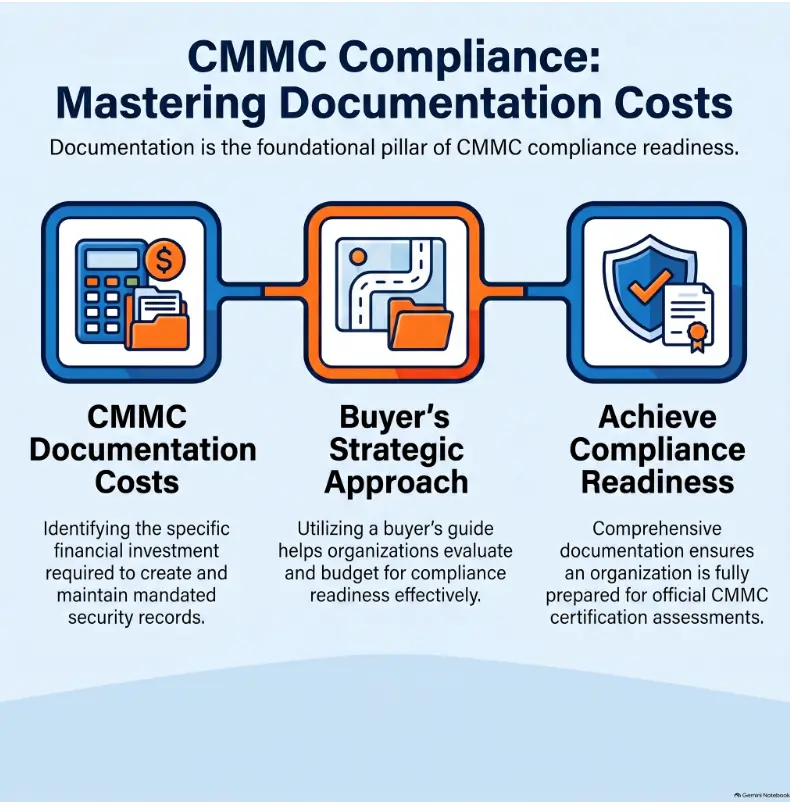
How Much Does a CMMC Documentation Package Cost?
There is no official CMMC documentation fee schedule. Publicly advertised 2026 offerings span several very different categories, from inexpensive downloadable templates to software subscriptions and customized consulting engagements costing tens of thousands of dollars.
| Approach | Typical Price Structure | What You Are Usually Buying | Main Risk |
|---|---|---|---|
| Template kit | Hundreds to low thousands of dollars | Editable SSP, policy, procedure, POA&M, or evidence templates | Your team must make every document accurately reflect the environment |
| Software-assisted documentation | Subscription or annual license, often several thousand dollars | Control mapping, evidence tracking, document generation, workflows | Automation can organize weak information just as efficiently as good information |
| Customized documentation service | Often five figures for substantial Level 2 work | Discovery, SSP drafting, policies, procedures, mapping, diagrams, reviews | The quote may exclude remediation, evidence collection, or assessment support |
| Full readiness engagement | Higher and heavily scope-dependent | Documentation plus gap analysis, remediation coordination, evidence preparation, readiness support | Documentation cost becomes difficult to separate from implementation cost |
These categories are better budgeting tools than a single market-average number. A $500 package and a $25,000 engagement may both be called a “CMMC documentation package,” while solving completely different problems.
The broader cost of reaching CMMC readiness is a separate question. If you need to budget the security controls, assessment work, remediation, tooling, and internal labor around the paperwork, see the CMMC compliance cost breakdown. Do not add a documentation quote and a compliance estimate together until you know whether they contain overlapping services.
The Biggest Cost Distinction Is Templates vs. Truth
The expensive part of CMMC documentation is rarely typing policy language. It is discovering what your organization actually does, deciding what belongs in scope, tracing how CUI moves, identifying who owns each process, reconciling contradictory practices, and connecting statements in the SSP to evidence that can support them.
A template can provide structure. It cannot safely decide whether your Microsoft 365 tenant, managed service provider, engineering workstation, VPN, backup system, security tool, employee laptop, or cloud workload belongs inside your CMMC assessment scope.
This creates a useful buying rule: pay for discovery and validation when you need them; do not pay consultant rates merely to receive prettier boilerplate.
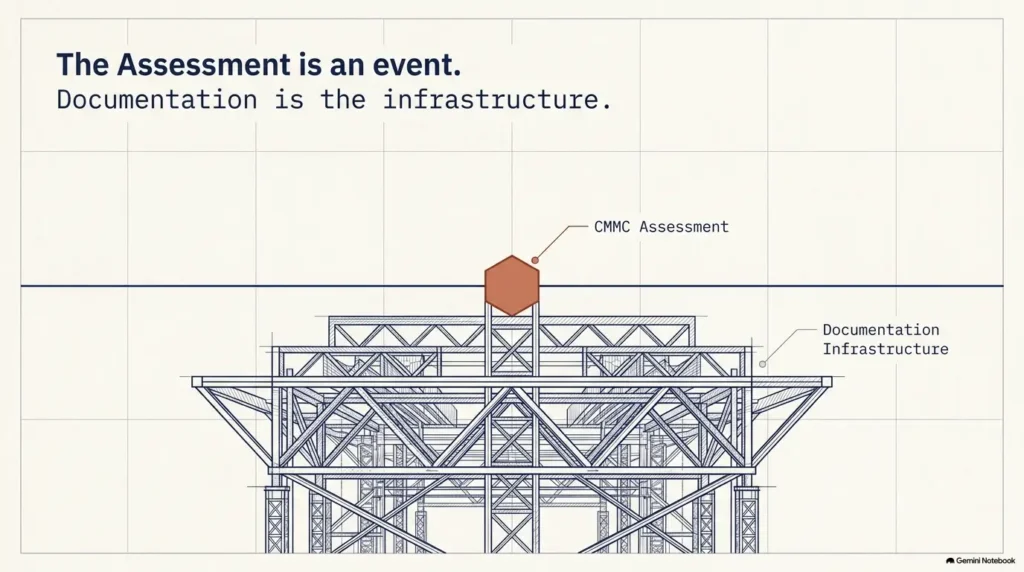
What a Level 2 Documentation Package Should Actually Contain
For CMMC Level 2, documentation should form a connected evidence system rather than a folder full of impressive filenames. The Department’s CMMC resources and assessment guidance should be the reference point for scoping and assessment preparation.
| Deliverable | Why It Matters | What to Verify Before Paying |
|---|---|---|
| System Security Plan | Explains the system boundary, environment, implementation of requirements, and system relationships | It describes your environment rather than a generic reference architecture |
| CMMC scope description | Defines what the documentation and assessment apply to | CUI assets, supporting security assets, and other relevant asset categories are handled consistently |
| Asset inventory | Connects the declared boundary to actual systems and devices | Ownership, role, category, and treatment are clear |
| Network and data-flow documentation | Shows important connections and where protected information travels | Diagrams agree with the SSP and real configuration |
| Policies and procedures | Documents governance and repeatable operational behavior | Owners, frequencies, responsibilities, and actual processes are identified |
| Requirement mapping | Connects NIST SP 800-171 requirements to implementation statements and supporting material | The mapping points to evidence rather than merely declaring “compliant” |
| Evidence index | Makes supporting artifacts easier to locate and maintain | Evidence has an owner, source, date, and relationship to the relevant requirement |
| POA&M support where permitted | Tracks unresolved deficiencies that qualify for treatment through a POA&M | The provider does not use a POA&M as a parking lot for requirements that cannot legally be deferred |
| Review and revision cycle | Reconciles documentation after technical discovery | The contract states how many review rounds are included |
A provider may combine several of these artifacts. That is not inherently a weakness. The official Level 2 assessment guidance specifically recognizes that an SSP can reference other policies, procedures, architecture records, and implementation documents instead of duplicating every technical detail inside one giant file.
CMMC Does Not Require a Magic Number of Policies
One of the easiest ways to overpay is to treat document count as a compliance metric. A provider may advertise 14 policies, 20 policies, 30 procedures, or a 100-document binder. Those counts describe the provider’s packaging method, not a government requirement for an exact number of separate files.
CMMC Level 2 currently incorporates the 110 security requirements of NIST SP 800-171 Revision 2. Assessment activities may examine policies, procedures, system records, configurations, interviews, and tests depending on the requirement. The objective is to demonstrate implementation, not to win a paperwork weightlifting contest.
As of August 2026, CMMC Level 2 continues to use Revision 2 through the CMMC program even though NIST has separately superseded that publication with Revision 3. Before remapping an entire documentation library, verify the standard actually incorporated by the CMMC program rather than assuming the newest NIST publication automatically became the CMMC assessment baseline. NIST keeps the SP 800-171 Revision 2 publication record available for reference.
The SSP Is Not an Optional Extra
If a Level 2 documentation quote treats the System Security Plan as an optional premium add-on, ask why. The SSP occupies a different position from ordinary supporting paperwork.
The CMMC Level 2 Assessment Guide says an organization must have an up-to-date SSP describing each information system within the assessment scope. It also identifies items such as the scope, environment of operation, implementation methods, system relationships, and update frequency.
There is another budget-relevant detail: under the CMMC POA&M rules, the Level 2 system security plan requirement is among the requirements that cannot be placed on a POA&M to obtain Conditional Level 2 status. In practical terms, “we will write the SSP after the assessment” is not a sound readiness plan.
What Actually Changes the Documentation Price?
The number of employees matters less than many buyers expect. A 25-person manufacturer with multiple facilities, legacy equipment, an MSP, shared corporate services, and loosely controlled CUI can require more documentation work than a larger company using a tightly segmented enclave.
| Cost Driver | Why It Raises the Workload | How to Control the Cost |
|---|---|---|
| Unclear CUI boundary | Consultants must discover which systems, users, services, and flows belong in scope | Map CUI before drafting documents |
| Large assessment scope | More assets and connections require more implementation narratives and evidence | Evaluate whether legitimate architectural segmentation can reduce scope |
| Little existing documentation | Policies, procedures, inventories, diagrams, and ownership records must be created | Collect usable current material before the engagement begins |
| Documentation conflicts with reality | The provider must reconcile policy language with technical configuration | Validate key controls before finalizing narratives |
| Multiple cloud and external service providers | Shared responsibility and dependencies take more analysis | Create a service inventory with data handled and security role |
| Complex physical or operational technology | Asset treatment may not fit a simple office-IT template | Identify specialized assets early |
| Weak ownership | Drafts stall because nobody can confirm how a process operates | Assign a technical and business owner to each control family or process |
| Assessment preparation included | Evidence review, interviews, mock assessment work, and revisions add substantial labor | Ask for documentation and readiness support as separate line items |
The most powerful cost lever is therefore not negotiating the hourly rate. It is reducing uncertainty before expensive outside labor begins.
Documentation Cost Is Not CMMC Compliance Cost
A documentation package describes and organizes your security program. It does not automatically create the technical state described in those documents.
If the SSP says privileged access requires multifactor authentication but administrators can still log in without it, better prose has not solved the security requirement. The same problem appears with logging, vulnerability remediation, configuration management, encryption, incident response, backups, access reviews, and many other controls.
Separate these budget buckets:
- Scoping: identifying systems, assets, services, CUI flows, and boundaries.
- Documentation: creating or correcting the SSP, policies, procedures, diagrams, mappings, and related records.
- Implementation: changing technology and operational processes to meet applicable requirements.
- Evidence preparation: collecting artifacts that support implementation claims.
- Assessment activity: performing the required self-assessment or other applicable assessment.
- Ongoing maintenance: keeping documentation and evidence aligned with changes to the environment.
The distinction also matters when reading official cost estimates. The 2024 CMMC final-rule economic analysis estimated that supporting a Level 2 self-assessment and initial affirmation for a small entity would cost $34,277, with a three-year estimate of $37,196. Those figures are not an official price for a documentation package. The analysis expressly assumed that the organization had already implemented the applicable NIST SP 800-171 Revision 2 requirements and allocated costs to preparation, assessment activity, reporting, and affirmation.
You can review the assumptions in the CMMC program final rule and economic analysis. Treat those government estimates as regulatory modeling, not as a quote you should expect from a consultant.
Use a Cost Model Instead of Chasing One Average Price
A defensible documentation budget can be built from five components:
Documentation budget = discovery and scoping + drafting + technical validation + evidence mapping + revision and maintenance
Ask each provider to expose those components. A fixed price is perfectly reasonable, but you should still understand what workload the fixed price contains.
A hypothetical calculation
Suppose a provider estimates 100 hours of customized work at an assumed $225 per hour. That produces $22,500 of outside labor. If your staff will contribute another 50 hours and your internal loaded labor cost is assumed to be $80 per hour, add $4,000 of internal labor.
The working budget would therefore be $26,500 before any software license, technical remediation, assessor fee, travel, managed service, or ongoing maintenance. These numbers are deliberately hypothetical, not market benchmarks. Replace the hours and rates with the figures in your proposals.
This simple calculation exposes something a flat “$20,000 documentation package” cannot: whether your team is expected to supply 90 percent of the answers, or whether the provider is performing the discovery and validation work.
DIY, Software, or a Consultant?
The least expensive option that produces accurate, maintainable documentation is usually the right one. The cheapest purchase price is not necessarily the cheapest path.
DIY or templates
DIY can work when the CUI environment is small, the scope is already understood, internal staff know NIST SP 800-171 well, and existing security processes are mature enough to describe accurately.
The danger is not ugly formatting. It is filling a template with statements nobody has verified. A polished policy claiming quarterly access reviews becomes a liability if nobody performs or records those reviews.
Compliance software
Software becomes more useful when evidence must be repeatedly collected, control ownership is distributed, documentation changes frequently, or the organization needs a durable compliance workflow rather than a one-time binder.
Before subscribing, ask what happens to your documents and evidence if you cancel. Exportability matters. A tool that reduces drafting labor but makes your compliance record difficult to retrieve later carries a switching cost that belongs in the budget.
Professional documentation help
Outside help is easier to justify when the CUI boundary is uncertain, several providers participate in the environment, the existing SSP is unreliable, internal expertise is thin, or conflicting control implementations need to be reconciled.
Paying more can also make sense when the engagement includes technical interviews, architecture validation, evidence mapping, and meaningful review. Paying more merely because the provider promises a larger pile of policies is harder to defend.
Your CMMC Documentation Quote Comparison Checklist
Before comparing total prices, normalize the scope. Send every provider the same questions and require the answers to appear in the proposal or statement of work.
- Is this template access, customized drafting, or a complete readiness engagement?
- Is CMMC scoping included?
- Who identifies and validates CUI flows?
- Is a customized SSP included?
- Are asset inventory and network or data-flow documentation included?
- How are existing policies and procedures reused rather than rewritten?
- How are NIST SP 800-171 requirements mapped to implementation statements?
- Does the engagement build an evidence index or evidence repository?
- Who validates that written statements match actual configurations and processes?
- How many review and revision cycles are included?
- Does the price include a gap assessment?
- Does it include technical remediation?
- Does it include SPRS self-assessment preparation or submission support?
- Does it include assessment interview preparation?
- Are post-assessment revisions included?
- What recurring maintenance fee applies after delivery?
- Can all documents and evidence be exported in usable formats?
- Who owns the finished documents?
- Where will your security documentation and evidence be stored?
- Will subcontractors or offshore personnel have access to the material?
A proposal that answers these questions clearly is much easier to compare than one promising “complete CMMC compliance documentation” with no defined boundary.
Red Flags That Make a Cheap Package Expensive
The wrong documentation package creates rework precisely when your team has the least appetite for it. Watch for these patterns.
- “Guaranteed CMMC compliance.” Documents alone cannot prove implementation of the security requirements.
- A fixed number of policies presented as a government mandate. Ask which requirement establishes that exact document count.
- No discovery process. Customized documentation cannot be produced responsibly without learning how the environment works.
- No assessment-scope deliverable. An SSP built on an uncertain boundary can spread errors through the entire package.
- No technical validation. Documentation should not simply memorialize whatever somebody said during a kickoff call.
- POA&M used for everything unfinished. CMMC restricts what may be placed on an assessment POA&M.
- Assessment fees hidden inside “certification support.” Ask which organization performs each service and which fees are separate.
- No maintenance model. A document that becomes inaccurate after the first infrastructure change is a short-lived asset.
- No data-handling explanation. The vendor may receive architecture diagrams, control evidence, account information, and other sensitive material.
Why the 2026 CMMC Pause Changes How You Should Buy
On July 13, 2026, the Department announced the immediate suspension of CMMC Phase II requirements that had been scheduled for November 10, 2026. Current Department guidance says implementation remains paused in Phase I, with Level 1 and Level 2 self-assessment requirements continuing while the program is reviewed.
That makes deadline-driven sales language especially worth checking. A proposal written around the assumption that every Level 2 contractor must immediately purchase a third-party certification package may no longer reflect the current implementation posture.
It does not mean contractors handling covered defense information can discard NIST SP 800-171 work. DFARS 252.204-7012 continues to impose safeguarding requirements where the clause applies. Contractors should verify their own solicitation and contract language against the current DFARS safeguarding clause rather than treating a program-wide announcement as a substitute for contract review.
The sensible purchasing response is therefore neither panic nor paralysis. Build documentation that accurately supports the obligations you have now, keep it maintainable, and avoid paying a premium solely for an assessment event whose timing or form may change.
Frequently Asked Questions
Can I buy a CMMC template package and complete the documentation myself?
Yes. A template can be economical when you already understand your scope, controls, systems, and evidence. The work does not become compliant merely because the template contains the right headings, however. Every material statement must match your real environment.
Should a CMMC documentation package include remediation?
Not necessarily. Documentation and remediation are distinct services. Keeping them as separate proposal line items can actually make the budget easier to control. What matters is that the provider clearly identifies implementation gaps instead of quietly documenting a control as complete when it is not.
Is a POA&M always part of a Level 2 package?
A provider may include a POA&M structure or help document applicable deficiencies, but a CMMC assessment POA&M is subject to specific restrictions. Not every unmet requirement can be deferred, and the SSP requirement itself is among the Level 2 requirements that cannot be placed on a POA&M for Conditional status.
How often should CMMC documentation be updated?
Update documentation whenever material changes make it inaccurate. CMMC guidance also treats periodic intervals as no longer than one year, and the Level 2 assessment guidance calls for an SSP update frequency of at least annually. A yearly review should therefore be viewed as a floor, not permission to leave a known change undocumented for months.
Does an expensive documentation package make a CMMC assessment more likely to succeed?
Price by itself proves very little. A higher fee can be justified by complex scoping, technical discovery, validation, evidence mapping, and skilled review. It is poor value when the additional spend mainly buys more boilerplate, prettier formatting, or documents that cannot be traced back to actual controls and evidence.
Your Next 15 Minutes
Before requesting another CMMC documentation quote, open a blank page and write five headings: CUI scope, existing SSP, existing policies, existing diagrams and inventory, existing evidence.
Under each heading, mark what is current, outdated, missing, or uncertain. Then send that inventory to prospective providers and ask them to price only the gaps, with remediation and assessment support shown separately.
That small exercise changes the buying conversation. Instead of asking, “How much is your CMMC package?” you can ask the much sharper question: “What work is still required to turn our current environment and existing documentation into an accurate, maintainable Level 2 evidence set?”
That is the quote worth comparing.
Last reviewed: 2026-10