
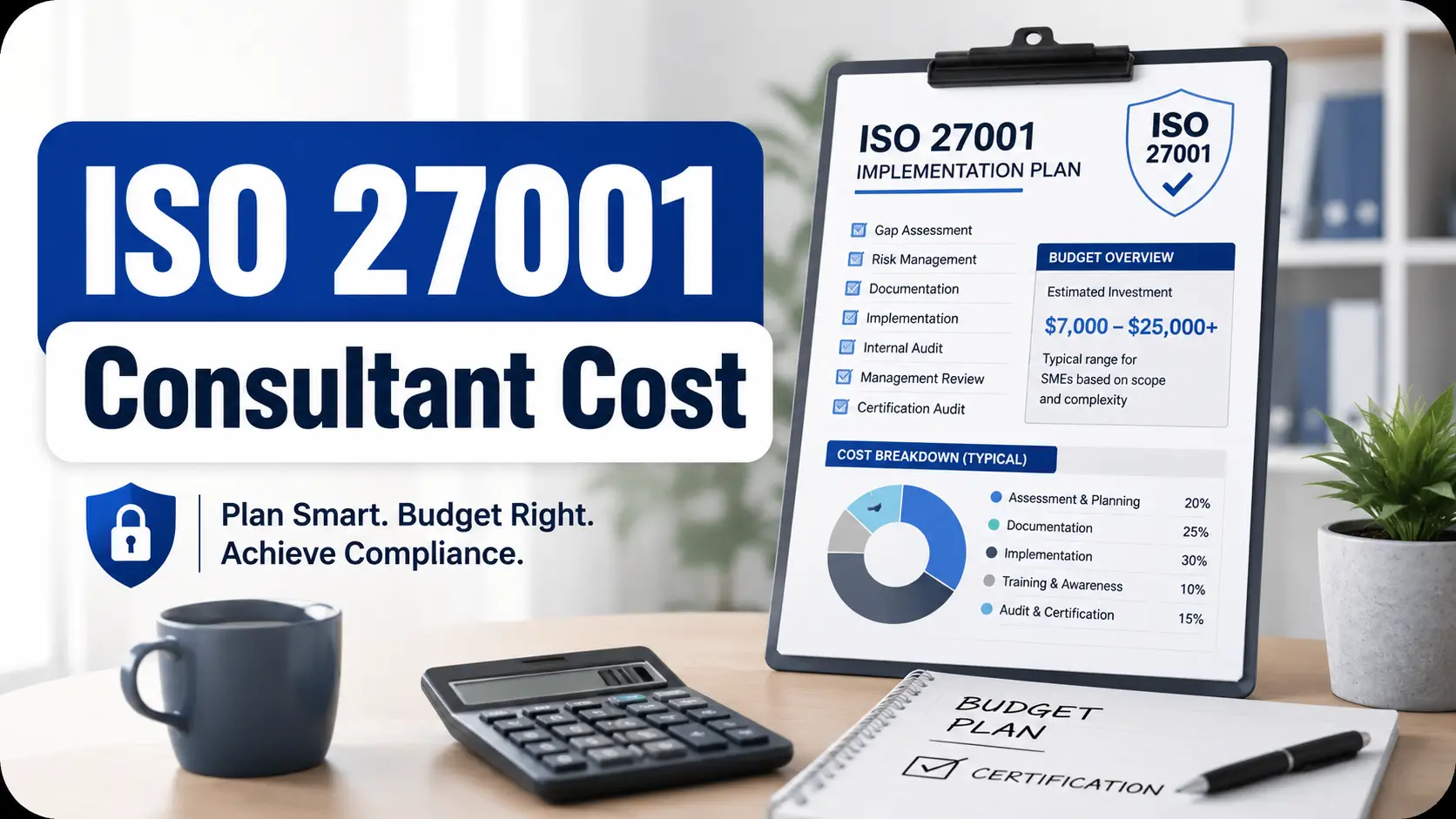
For a small or mid-sized organization, ISO 27001 consultant fees commonly move from the low five figures into $50,000 or more when the consultant is doing substantial implementation work. A narrow gap assessment or advisory engagement can cost much less, while multi-site, regulated, or poorly documented environments can move well beyond that range.
The number that matters is not the consultant’s headline fee. Your realistic Year 1 budget may also include internal staff time, remediation, security tooling, internal audit work, and a separate certification-body audit. ISO does not set consultant prices.
The biggest pricing variable is usually how much of the ISMS already exists and how much work you expect the consultant to perform. Before requesting quotes, define the intended certification scope and ask every provider to separate consulting, internal audit, certification support, software, remediation, and external audit costs.
Table of Contents
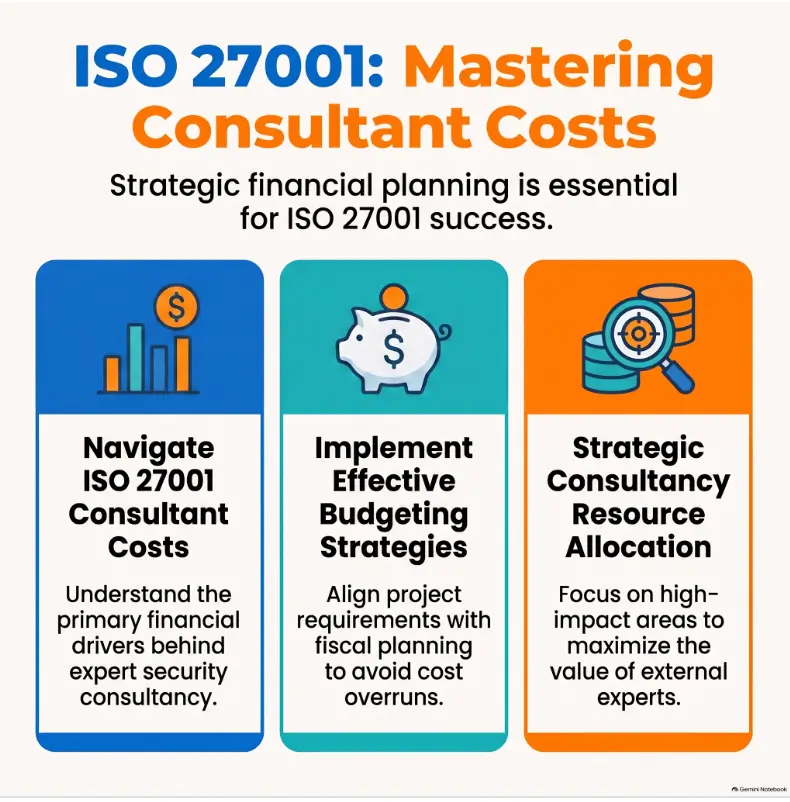
A Practical ISO 27001 Consultant Cost Range
There is no official ISO consulting tariff. Published market pricing varies sharply, so the following bands are best used for early budgeting rather than as a promise of what your organization will pay.
| Engagement | Rough Consultant Budget | Typical Fit | Usually Not Included |
|---|---|---|---|
| Gap assessment or limited advisory | $3,000–$10,000 / £2,500–£8,000 | Existing security program with an experienced internal owner | Full implementation, remediation, certification audit |
| Guided implementation | $10,000–$25,000 / £8,000–£20,000 | Small organization able to perform much of the work internally | Major technical remediation and certification-body fees |
| Hands-on implementation | $25,000–$50,000+ / £20,000–£40,000+ | Organizations needing substantial policy, risk, evidence, and project support | Usually certification audit, major security projects, and ongoing operations |
| Complex or multi-site program | $50,000–$100,000+ / £40,000–£80,000+ | Large scopes, multiple entities, regulated operations, or weak starting maturity | Depends heavily on contract |
These are planning bands, not ISO-prescribed rates or guaranteed market averages. A 25-person cloud company with mature access control, logging, vendor management, incident response, and existing documentation can require less consulting than a smaller company starting with scattered policies and no formal risk process.
What You Are Actually Paying the Consultant to Do
A useful quote should describe deliverables rather than simply promising to “get you ISO certified.” The consultant prepares and improves the management system. An independent certification body makes the certification decision.
| Workstream | Useful Deliverable | What Expands the Work |
|---|---|---|
| Scope definition | Clear ISMS boundary, locations, systems, services, and interfaces | Multiple products, legal entities, offices, and shared infrastructure |
| Gap assessment | Requirement-by-requirement findings and remediation priorities | Little documentation or uncertain control ownership |
| Risk management | Risk methodology, assessment, treatment plan, and ownership | Large asset estate or many business processes |
| Statement of Applicability | Documented treatment of applicable Annex A controls | Weak risk rationale or unclear existing controls |
| Policies and procedures | Organization-specific documentation with assigned owners | Starting from templates with little existing governance |
| Evidence preparation | Organized evidence demonstrating that processes operate | Manual systems and fragmented evidence repositories |
| Readiness support | Issues identified before certification | Late remediation or incomplete management-system activities |
| Audit support | Stage 1 and Stage 2 preparation and finding-management support | Short deadlines and significant nonconformities |
The current certifiable standard is ISO/IEC 27001:2022. ISO describes it as the requirements standard for establishing, implementing, maintaining, and continually improving an information security management system. The 2013 edition has been withdrawn.
One useful pricing test follows from that distinction: if the quote mostly buys generic policy templates, you are not necessarily buying the difficult part. The expensive work is often deciding what applies, assigning ownership, changing processes, producing evidence, and resolving weaknesses that the documents reveal.
Consulting Cost and Certification Cost Are Different
This distinction can prevent a surprisingly large budgeting error.
- Consultant: helps design, implement, document, test, or prepare the ISMS.
- Certification body: independently audits the ISMS and makes the certification decision.
- Accreditation body: assesses the competence and impartiality of certification bodies within the accreditation system.
ISO explains that organizations may implement ISO/IEC 27001 without pursuing certification at all. Where certification is required by customers or procurement, using an appropriately accredited certification body can provide an additional layer of confidence.
The rules governing bodies that audit and certify ISO/IEC 27001 systems are addressed by ISO/IEC 27006-1:2024, which supplements the broader management-system certification requirements with ISMS-specific requirements for competence, consistency, and impartiality.
In practice, initial management-system certification normally includes Stage 1 and Stage 2 audits, followed by surveillance activity during the certification cycle and later recertification. That means your first certification invoice is not the last external-assurance cost you should budget for.
The Real Year 1 Cost Model
A consultant quote becomes much easier to judge when you put it inside the complete cost equation:
Consulting + certification audit + internal labor + remediation + security tooling + training + contingency = realistic Year 1 budget
The equation matters because a $15,000 consultant can expose $40,000 of overdue remediation, while a $35,000 consultant working with a mature security team may require little new technology. The consulting price alone tells you almost nothing about the final economic impact.
Internal labor is easy to underestimate
Someone inside the organization still has to make decisions. A consultant cannot permanently own your risk acceptance, employee responsibilities, supplier relationships, management review, or day-to-day operation of controls.
Estimate internal cost using the people who will actually participate:
Hours spent by security + IT + engineering + HR + legal/procurement + leadership × loaded internal labor cost
You do not need elaborate finance software for this calculation. A rough estimate is enough to expose a proposal that appears inexpensive only because most of the work has quietly been pushed back onto your employees.
Remediation can cost more than consulting
The consultant may discover that access reviews are informal, backups are not adequately tested, supplier security responsibilities are unclear, logging is incomplete, or important security processes exist only in people’s heads.
ISO/IEC 27001 does not automatically require you to purchase a new product for every weakness. Remediation might be a process change, configuration change, better ownership, additional evidence, new tooling, or acceptance of a documented risk where appropriate.
If a consulting proposal assumes an expensive collection of security products, map those costs separately using a security tool stack cost calculation. Buying software and building an effective ISMS are related activities, but they are not the same purchase.
What Changes an ISO 27001 Consultant Quote Most
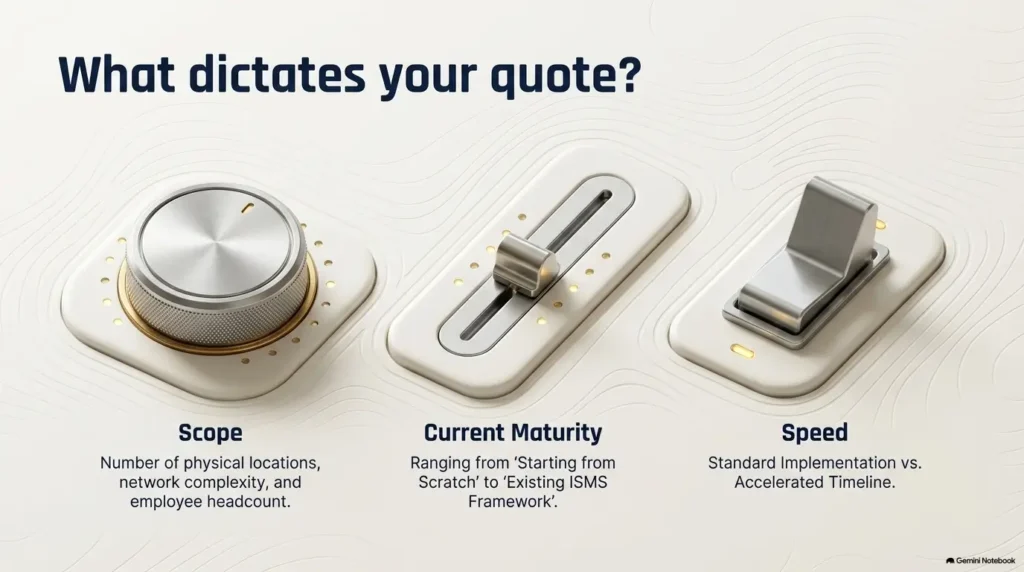
1. Your certification scope
Scope is the strongest pricing lever you can control without pretending inconvenient systems do not exist.
A single SaaS product operated by one team from a concentrated cloud environment is different from an ISMS spanning several business units, offices, products, acquired companies, and legacy platforms.
Narrowing the scope can reduce complexity, but the boundary has to remain credible. Systems, employees, suppliers, and shared services that materially affect the scoped information cannot simply vanish from the analysis because they are expensive to govern.
2. How much security governance already exists
Existing evidence can be worth more than a library of fresh templates.
A company that already operates structured risk reviews, access reviews, incident handling, change management, supplier assessments, security training, logging, backup testing, and management reporting may need alignment and documentation rather than wholesale invention.
3. Advisory versus hands-on implementation
Two consultants can quote the same project and mean radically different things.
- An adviser may tell your team what to build and review the result.
- A guided implementation provider may facilitate workshops, adapt documents, and manage the readiness plan.
- A hands-on provider may perform much of the drafting, evidence organization, project management, and audit preparation.
The third model should cost more because you are purchasing labor as well as expertise.
4. Your deadline
A customer renewal, enterprise deal, tender, or board commitment can turn a normal implementation into a compressed project. Short schedules create additional coordination, review, remediation, and project-management pressure.
Before paying a rush premium, verify whether the customer truly requires an issued certificate by the deadline or would accept a defined certification plan, audit booking, or other security evidence temporarily.
5. How fragmented the organization is
Employee count is useful but crude. Consultants also care about locations, legal entities, products, infrastructure models, suppliers, regulated data, cloud environments, control owners, and how differently teams operate.
Fifty employees working on one platform can be simpler than fifteen employees maintaining three products across several providers and jurisdictions.
Do Not Pay a Consultant to “Implement All 93 Controls”
ISO/IEC 27001:2022 contains 93 reference controls in Annex A, but ISO 27001 implementation is risk-based. The job is not to purchase or blindly implement every control because it appears in the annex.
Your organization determines necessary controls through its information-security risk treatment process and other applicable requirements, then records control applicability in the Statement of Applicability. A good consultant should be able to explain the logic connecting risks, requirements, controls, and evidence.
This is also where template-driven projects tend to wobble. A beautifully formatted Statement of Applicability with weak reasoning behind it is paperwork wearing a security costume.
A 2026 Detail Your Consultant Should Not Miss
ISO/IEC 27001:2022 now has a published 2024 climate-action amendment. The amendment affects consideration of organizational context and interested parties. It does not create a new bundle of cybersecurity products that every organization suddenly needs to buy.
A consultant using an older checklist should therefore be able to explain how the amendment is handled in the current ISMS. Conversely, be cautious if a provider treats the amendment as an excuse to sell a large new technical-control program without first establishing relevance.
There is another 2026 change on the assurance side. On January 1, 2026, Global Accreditation Cooperation Incorporated assumed the international roles previously performed by IAF and ILAC and later adopted the operating name Global ACI. Organizations checking international accreditation recognition should therefore use the current Global ACI structure rather than assuming older terminology tells the whole story.
How to Reduce Consultant Cost Without Hollowing Out the ISMS
The cheapest legitimate savings come from reducing uncertainty and duplicate labor, not from deleting controls because they are inconvenient.
- Define the scope before implementation workshops begin. Scope debates conducted on expensive consulting time are an avoidable leak.
- Name one internal ISMS owner. Consultants become expensive message routers when nobody inside can make decisions.
- Inventory existing evidence first. Policies, tickets, access reviews, contracts, risk registers, incident records, training records, architecture diagrams, and prior audits may already solve part of the evidence problem.
- Reuse mature controls across frameworks. Existing SOC 2, customer-assurance, privacy, cloud-security, or risk-management work may support the ISO project, even though the frameworks are not interchangeable.
- Separate documentation gaps from security gaps. A missing policy and an unprotected production environment are not equally difficult problems.
- Do not buy compliance software automatically. Software is useful when repeated evidence collection, integrations, ownership, and monitoring are genuine bottlenecks.
- Resolve technical remediation early. Waiting until audit preparation to fix material weaknesses converts ordinary engineering work into deadline work.
Quote Comparison Checklist
Send the same questions to each consultant. Otherwise you may end up comparing a lightweight advisory package with a full implementation engagement and conclude that one provider is inexplicably three times more expensive.
| Ask the Provider | What You Want to Learn | Red Flag |
|---|---|---|
| What exactly is included in the scope? | Products, offices, systems, entities, and teams covered | “Company-wide” with no defined boundary |
| What deliverables will we own? | Risk artifacts, SoA, policies, plans, findings, and documentation | Deliverables described only as “certification support” |
| What must our team produce? | True internal workload | Very low fee paired with undefined customer responsibilities |
| Is the internal audit included? | Who performs it and how objectivity is handled | Internal audit appears only after contract signing |
| Are certification-body fees included? | Whether external audit cost is separate | “All-inclusive certification” without identifying the certification arrangement |
| What happens after Stage 1 findings? | Remediation and rework boundaries | Finding support billed with no rate or limit |
| What software is required? | Subscription commitments and integration work | Proprietary platform required without export or transition details |
| What happens after certification? | Recurring consulting and maintenance obligations | Year 2 cost cannot be explained |
What Evidence to Request Before Paying
A polished sales deck tells you very little about whether the provider can run a disciplined ISO 27001 project.
Before signing, reasonably request:
- a sample project plan or anonymized deliverable structure;
- a written statement of scope and exclusions;
- the implementation methodology;
- the experience of the people who will actually perform the engagement;
- a clear responsibility matrix for consultant versus customer work;
- how internal-audit objectivity will be handled;
- how information and evidence supplied to the consultant will be protected;
- the approach to Stage 1 and Stage 2 findings;
- all recurring software or retainer requirements;
- the termination and document-export arrangements.
You do not need a consultant willing to guarantee that an independent auditor will certify you. You need one who can describe the work, the evidence, the dependencies, and what happens if the ISMS is not ready.
DIY, Compliance Software, or Consultant?
| Approach | Best Fit | Main Tradeoff |
|---|---|---|
| DIY | Experienced internal security or GRC owner, limited scope, flexible schedule | Lowest external spend, highest internal workload |
| Compliance software | Controls largely exist but evidence collection and recurring monitoring are painful | Automation helps workflow but does not make risk and governance decisions |
| Consultant | Limited internal expertise, complex scope, customer deadline, or substantial implementation work | Higher cash cost but can reduce research, coordination, and rework |
| Consultant plus software | Scaling organization needing both expertise and repeatable evidence operations | Can become expensive if roles overlap |
A common false economy is buying a compliance platform when the real bottleneck is governance. Another is hiring a senior consultant to spend weeks manually collecting evidence that your team could organize before the engagement starts.
What the Cheapest ISO 27001 Quote May Leave Out
A low quote can be perfectly sensible when you already have capable internal staff. It becomes dangerous when its low price depends on exclusions you discover midway through the project.
Check specifically for:
- formal scope definition;
- risk assessment and risk treatment support;
- Statement of Applicability development;
- customization of policies and procedures;
- evidence review;
- internal-audit support or execution;
- management-review preparation;
- technical remediation advice;
- Stage 1 preparation;
- Stage 2 preparation;
- nonconformity response support;
- travel or onsite expenses;
- compliance-platform subscriptions;
- post-certification maintenance.
The correct question is therefore not “Which consultant is cheapest?” It is “Which quote leaves us with the lowest reasonable total cost for a functioning, auditable ISMS?”

Frequently Asked Questions
Do I need an ISO 27001 consultant to become certified?
No. ISO/IEC 27001 does not require you to hire an implementation consultant. Organizations with sufficient internal knowledge and time can build and operate the ISMS themselves, then engage an independent certification body if certification is desired or required.
Does an ISO 27001 consultant fee normally include the certification audit?
Do not assume it does. Consulting and independent certification are different services. Ask for the certification-body fee to be shown separately even when a consultant helps coordinate introductions or scheduling.
Is compliance software cheaper than hiring a consultant?
Sometimes, but only when the missing capability is automation. Software can make evidence collection, task ownership, integrations, and recurring control monitoring easier. It cannot decide your risk appetite, establish credible scope, make management decisions, or repair weak security processes by itself.
Can ISO 27001 certification eliminate customer security questionnaires?
Not necessarily. Certification can provide valuable independent assurance, but customers may still request information about architecture, data handling, incident response, privacy, contractual controls, or risks outside the certified scope. If enterprise due diligence triggered the ISO project, a structured customer security questionnaire process can help manage the immediate evidence workload while certification proceeds.
What to Ask Before Signing the Contract
Spend ten minutes turning the proposal into six numbers or answers before approving it:
- What is the exact ISMS scope?
- What does the consultant deliver versus what must our staff deliver?
- What is excluded from the quoted fee?
- What separate certification-body cost should we budget?
- What remediation, software, or recurring costs could appear later?
- What evidence will we own and be able to maintain after the consultant leaves?
If two proposals answer those six questions clearly, their prices become much easier to compare. If a proposal cannot answer them, the number on its front page is still only a fraction of the quote.
Last reviewed: 2026-10