
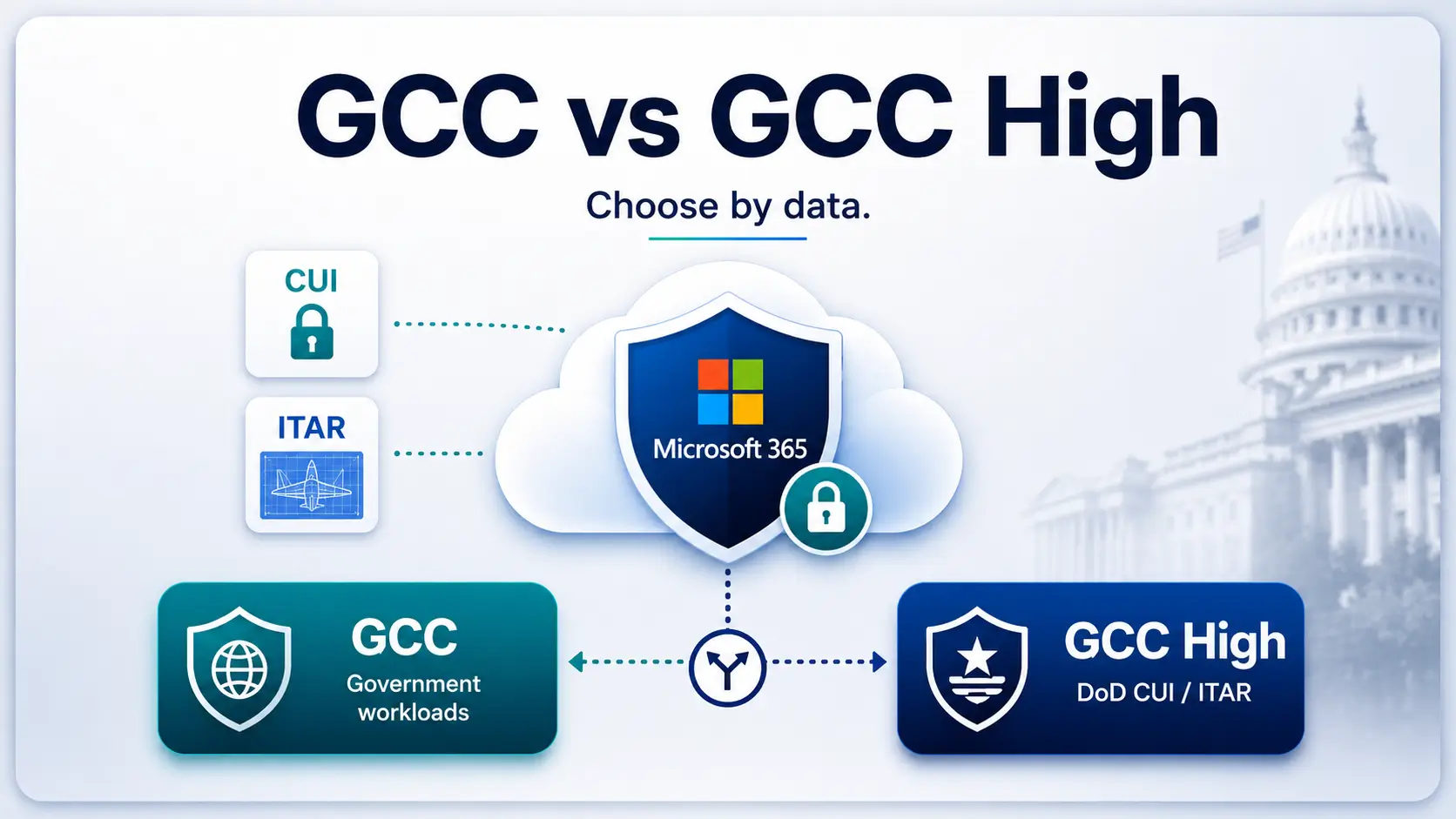

For most defense contractors, the choice between Microsoft 365 GCC and GCC High should be driven by the data entering the tenant, not by company size or a desire to “be CMMC compliant.” If your organization handles DoD Controlled Unclassified Information (CUI), ITAR-controlled technical data, or contract requirements tied to DoD sovereignty and Impact Level 4 controls, GCC High is usually the safer Microsoft 365 architecture to evaluate. If you handle government information but not those defense-specific data types, GCC may be sufficient.
The important exception is that CMMC does not require “GCC High” by product name. Under DFARS 252.204-7012, an external cloud service that stores, processes, or transmits covered defense information must meet FedRAMP Moderate-equivalent security requirements and associated incident-response obligations. Your first action should therefore be to identify whether CUI, export-controlled data, or only Federal Contract Information (FCI) will actually enter Microsoft 365.
Table of Contents

GCC vs GCC High at a Glance
GCC and GCC High are both Microsoft government cloud offerings, but they solve different assurance problems. GCC High adds stronger isolation and defense-specific commitments at the cost of a more constrained ecosystem and a potentially harder migration.
| Decision Point | Microsoft 365 GCC | Microsoft 365 GCC High |
|---|---|---|
| Typical use | Government agencies and eligible contractors with government-regulated workloads | Defense Industrial Base organizations and contractors with higher-sovereignty workloads |
| DoD CUI | Do not assume GCC is sufficient solely from the tenant label; verify the exact service, contractual commitments, and data requirements | Microsoft specifically positions GCC High for contractors handling DoD CUI |
| ITAR | Not the Microsoft 365 environment for which Microsoft agrees to ITAR contract language | Microsoft states that it agrees to ITAR contract language for GCC High |
| DoD SRG alignment | Not the normal choice for IL4 workloads | Designed around DoD SRG IL4 controls |
| Cloud isolation | Government environment with U.S. data residency and government commitments | More isolated government environment with services tied to Azure Government |
| Third-party integrations | Generally broader compatibility | More restrictions and more frequent compatibility gaps |
| CMMC | Does not create CMMC compliance by itself | Does not create CMMC compliance by itself |
| Best default | Government workload without defense-specific CUI, ITAR, or IL4 requirements | DoD CUI, export-controlled defense data, or contract-driven sovereignty requirements |
Microsoft’s own current comparison of U.S. government cloud environments describes GCC High as the more isolated option for U.S. defense organizations and contractors handling CUI. That positioning matters more to a defense contractor than the word “High” in the product name.
The Decision Hinge Is Your Data, Not Your CMMC Level
A common procurement mistake is to start with, “We need CMMC Level 2, so do we need GCC High?” The better question is, “What regulated information will Microsoft 365 store, process, or transmit, and what clauses govern that information?”
CMMC measures whether the contractor has implemented the applicable safeguarding requirements. It does not certify Microsoft tenants and does not prescribe a Microsoft product. Buying GCC High can provide useful inherited controls and contractual assurances, but the tenant is only one component of the system being assessed.
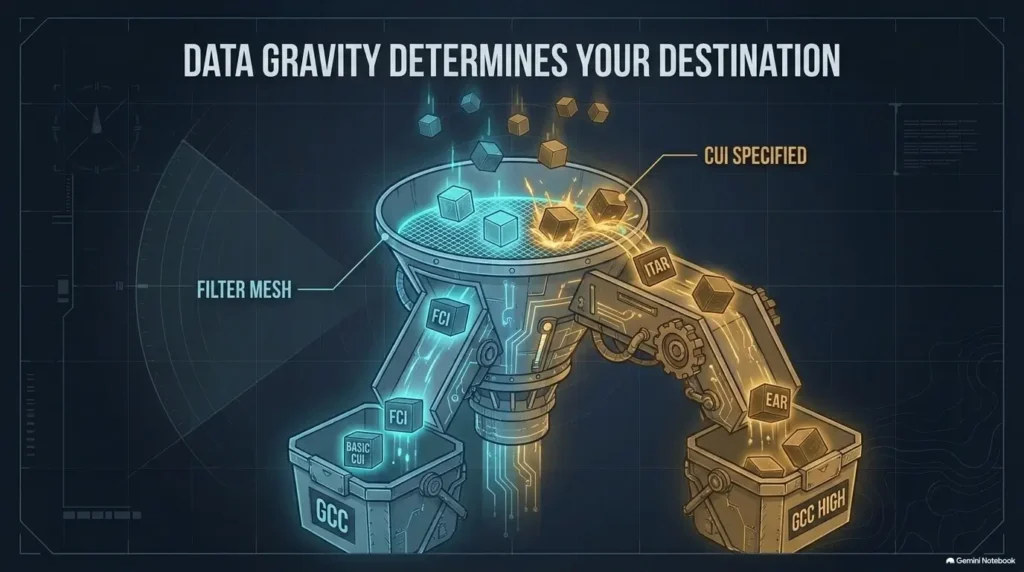
- FCI only: GCC High may be unnecessary unless the solicitation, prime contractor, customer, or other data requirement imposes additional restrictions.
- CUI: determine whether Microsoft 365 will actually process, store, or transmit the CUI and whether DFARS 252.204-7012 applies.
- ITAR or export-controlled technical data: GCC High becomes materially more important because personnel access, data location, and contractual commitments matter.
- IL4-related requirement: GCC High is the relevant Microsoft 365 environment to investigate rather than ordinary GCC.
This distinction can prevent an expensive mistake in either direction. Some contractors buy GCC High before determining whether CUI will ever enter Microsoft 365. Others stay in a cheaper or more familiar environment even after engineering drawings, technical specifications, contract attachments, or CUI-bearing email begin flowing through it.
What DFARS Actually Requires for CUI in the Cloud
DFARS 252.204-7012 is more specific than the shorthand often used in sales conversations. When an external cloud service provider stores, processes, or transmits covered defense information for contract performance, the contractor must require and ensure that the cloud provider meets security requirements equivalent to the FedRAMP Moderate baseline and complies with specified cyber-incident, evidence-preservation, forensic-access, and related obligations.
You can verify the operative language directly in DFARS 252.204-7012.
That creates two important consequences.
- FedRAMP Moderate is a floor for the relevant external cloud offering, not a blanket instruction to purchase GCC High.
- The security authorization alone is not the entire requirement. Contractual obligations surrounding incident reporting, malicious software, media preservation, and forensic cooperation also matter.
This is why a screenshot showing a FedRAMP status is weak procurement evidence. You need to know whether the specific cloud service offering you intend to use is inside the relevant authorization boundary and whether the provider’s terms support your DFARS obligations.
Why GCC High Is Still the Default Conversation for DoD CUI
Although DFARS does not name Microsoft GCC High, Microsoft explicitly designed and positions GCC High for defense workloads requiring greater sovereignty and isolation. Its GCC High service documentation describes the environment as supporting organizations that hold or process DoD CUI and organizations subject to ITAR.
GCC High also sits differently in Microsoft’s cloud architecture. Microsoft 365 GCC High integrates with Microsoft Entra ID and government services in Azure Government rather than relying on the same commercial-cloud relationships used by ordinary GCC in several product areas. That additional separation matters when a requirement concerns sovereignty rather than merely control implementation.
So the practical rule is not “CUI always mathematically equals GCC High.” It is this:
If DoD CUI will live in Microsoft 365, treat GCC High as the baseline architecture to evaluate. Depart from it only after you can document why the alternative cloud offering, contract terms, data flows, and service boundaries satisfy the actual requirement.
That is a considerably stronger position than choosing ordinary GCC because a reseller says it is “FedRAMP compliant.”
ITAR Is Where the GCC vs GCC High Choice Gets Much Clearer
If the Microsoft 365 environment will contain ITAR-controlled technical data, the case for GCC High becomes much stronger. Microsoft states that although government-cloud eligibility is broadly shared across its government offerings, it agrees to ITAR contract language only for GCC High.
That means an engineering contractor should not reduce the decision to whether a document happens to carry a CUI marking. CAD files, design drawings, manufacturing instructions, source material, technical specifications, or collaboration records can create export-control questions independently of the CMMC label attached to the system.
Ask the export-control owner or counsel to classify the information before choosing the tenant. A cloud migration is an expensive place to discover that the information category was misunderstood.
GCC High Does Not Make a Contractor CMMC Compliant
This is the most expensive misconception in the comparison. GCC High can provide inherited capabilities and a suitable cloud boundary, but the contractor remains responsible for its own implementation.
An assessor or internal self-assessment may still need evidence covering areas such as:
- identity and account management;
- multifactor authentication configuration;
- privileged administration;
- endpoint configuration and device management;
- CUI access restrictions;
- audit logging and log review;
- incident-response procedures;
- security awareness;
- configuration management;
- media handling;
- system boundaries and data-flow documentation;
- external service providers;
- policies, procedures, and operating evidence.
A perfectly licensed GCC High tenant with unmanaged endpoints, shared administrator accounts, uncontrolled SaaS integrations, or undocumented CUI flows can still produce a very uncomfortable assessment.
If the larger budgeting question is still unresolved, the CMMC compliance cost guide separates assessment expense from implementation, remediation, tooling, and internal labor.
A Current CMMC Timing Note for 2026
As of August 2026, the CMMC rollout itself is moving differently from the original schedule. DoD CIO announced in July 2026 that Phase II requirements originally scheduled for November 10, 2026 were suspended while Phase I self-assessment requirements remained in place.
The current CMMC program resources should therefore be checked before relying on an older implementation timeline.
That timing change does not erase underlying contract obligations such as DFARS 252.204-7012 or the need to safeguard CUI. A delayed certification milestone is not permission to put regulated data into an unsuitable cloud service.
The Hidden Cost of Choosing GCC High
The licensing quote is only one line of the GCC High budget. For an existing Microsoft 365 customer, the more consequential cost can be architectural friction.
| Cost Driver | Why It Matters | What to Check Before Buying |
|---|---|---|
| Tenant migration | Mail, SharePoint, Teams, OneDrive, identities, groups, and permissions may need coordinated migration | Ask for a workload-by-workload migration plan rather than a seat-price comparison |
| Identity | Government-cloud identity boundaries can affect federation, apps, authentication, and administration | Inventory every identity-dependent application |
| Endpoint management | Government Intune architecture differs from ordinary commercial service relationships | Confirm device enrollment and management migration steps |
| Third-party SaaS | Some commercial integrations do not support GCC High | Obtain written confirmation for each critical integration |
| Security tools | Backup, SIEM, email security, DLP, PAM, and monitoring products may have government-cloud limitations | Verify the exact connector and tenant type |
| Collaboration | External sharing, federation, telephony, or cross-cloud collaboration may behave differently | Test real partner workflows before cutover |
| Operations | Government environments may receive features later or have different administrative behavior | Compare required features, not generic Microsoft 365 feature lists |
A cheap license quote attached to an unscoped migration is a paper umbrella. The implementation work arrives later, usually when the project has less room to maneuver.
When GCC Is Probably Enough
GCC can be the more sensible choice when the organization qualifies for Microsoft Government Cloud but Microsoft 365 will not hold DoD CUI, ITAR-controlled information, or workloads requiring GCC High’s defense-specific isolation.
Examples can include a contractor whose Microsoft tenant contains ordinary business information while CUI is isolated in a separate authorized enclave, or an organization supporting government customers without defense-controlled information entering collaboration systems.
The word isolated matters. If employees routinely copy contract attachments from the CUI enclave into Outlook, Teams, OneDrive, or SharePoint, the architecture described on paper is no longer the architecture operating on Tuesday afternoon.
When GCC High Is Worth the Extra Friction
GCC High becomes easier to justify when the cost of maintaining a separate CUI boundary begins to exceed the cost of placing the relevant workforce in a government environment designed for that information.
- CUI regularly moves through Exchange, Teams, SharePoint, or OneDrive.
- Engineering or program teams collaborate on ITAR-controlled technical data.
- A DoD contract, prime contractor, or program office imposes stronger cloud requirements.
- Your architecture needs DoD IL4-aligned controls.
- Maintaining a separate enclave creates constant user workarounds and data-spillage risk.
- You need Microsoft contractual commitments that ordinary GCC does not provide for the data involved.
Paying more can be rational when it removes an awkward boundary employees are likely to violate. Paying more is poor value when the organization cannot explain which information or contractual requirement requires the stronger environment.
A Better Architecture Than Moving Everyone to GCC High
Some defense contractors can reduce cost by scoping the regulated environment instead of treating every employee as a CUI user. This should be an engineering decision, not a licensing trick.
Minimum approach: map the CUI boundary
Identify which people, devices, mailboxes, SharePoint sites, applications, suppliers, and workflows actually touch CUI. Do not purchase anything until this map exists.
Sensible approach: create a controlled enclave
If only part of the business handles CUI, a deliberately scoped enclave may reduce licensing, migration, and assessment scope. The design only works if users can perform their jobs without repeatedly moving regulated data back into commercial systems.
Mature approach: manage the boundary as evidence
Maintain a current system diagram, CUI data-flow map, inventory of authorized integrations, service-provider evidence, administrative ownership, and documented rules for entering or leaving the enclave. That turns architecture into something an assessor can actually evaluate.
Your 15-Minute GCC Decision Check
Before requesting GCC High quotes, answer these six questions on one page.
- What information will enter Microsoft 365? Separate ordinary business data, FCI, CUI, and export-controlled technical data.
- Which contract clauses apply? Search the prime contract and relevant subcontracts for DFARS cybersecurity and cloud requirements rather than relying on a verbal summary.
- Where will CUI actually move? Include email attachments, Teams messages, meeting recordings, SharePoint libraries, OneDrive sync, mobile devices, backups, and security logs.
- Does ITAR or another export-control restriction apply? Escalate this question to the person responsible for export controls rather than guessing from a CUI marking.
- Which integrations would break in GCC High? Inventory identity, backup, email security, SIEM, help desk, e-signature, telephony, file transfer, and supplier collaboration.
- What evidence supports the selected environment? Record the Microsoft service documentation, authorization boundary, contractual commitments, system scope, and responsible owner.
If question one is still unanswered, a licensing decision is premature. If question one clearly identifies DoD CUI or ITAR data flowing through Microsoft 365, the investigation should move toward GCC High and a validated migration design.
What to Ask a GCC High Provider Before Signing
A reseller or managed provider should be able to explain the implementation boundary, not merely repeat Microsoft compliance labels.
- Which Microsoft 365 services are included in the proposed GCC High tenant?
- Which current workloads require tenant-to-tenant migration?
- Which third-party products have you confirmed support our exact GCC High environment?
- What is excluded from the migration statement of work?
- Who is responsible for identity, endpoint enrollment, DNS, mail flow, and security-tool cutover?
- How will our current CUI data be transferred into the new environment?
- How will failed or partially migrated content be identified?
- What documentation will we receive for the final architecture and CUI boundary?
- What responsibilities remain ours after migration?
- Which claims in the proposal come from Microsoft contractual commitments, and which are your own interpretation?
If you are comparing an MSP, migration partner, or other external security provider, a structured vendor security questionnaire can help turn vague assurances into evidence you can retain.
Common GCC vs GCC High Failure Modes
Most costly mistakes occur at the boundary between compliance terminology and actual system behavior.
| Failure Mode | Why It Fails | Better Check |
|---|---|---|
| “We need CMMC Level 2, therefore GCC High.” | CMMC does not prescribe Microsoft products. | Map CUI and applicable contract clauses first. |
| “GCC is FedRAMP, so all CUI is fine.” | Authorization level alone does not resolve service boundary, contractual, ITAR, or DoD-specific requirements. | Verify the exact cloud service offering and obligations. |
| “GCC High makes us compliant.” | The contractor still owns configurations, endpoints, procedures, evidence, and many CMMC requirements. | Separate inherited controls from customer responsibilities. |
| “Only email needs migration.” | Identity, files, Teams, endpoints, applications, logging, and security tools may also depend on the tenant. | Build a dependency inventory before pricing. |
| “Our CUI enclave is separate.” | Employees may still move CUI through ordinary collaboration tools. | Trace real user workflows, not just network diagrams. |

Frequently Asked Questions
Can a defense contractor use Microsoft 365 GCC instead of GCC High?
Potentially, depending on the actual information, contractual requirements, and Microsoft services involved. However, Microsoft specifically positions GCC High for DoD CUI and defense workloads. Do not select ordinary GCC for a CUI workload solely because an umbrella compliance page lists a suitable FedRAMP level.
Does CMMC Level 2 require GCC High?
No. CMMC does not require a Microsoft product by name. If a cloud service stores, processes, or transmits CUI, the cloud offering must satisfy the applicable cloud requirements, including FedRAMP Moderate authorization or DoD-defined equivalency where required. GCC High may make that architecture easier for Microsoft-based defense workloads, but it is not itself a CMMC certificate.
Is GCC High required for ITAR data?
For organizations choosing Microsoft 365 government environments for ITAR-controlled workloads, GCC High is the relevant offering to evaluate. Microsoft states that it agrees to ITAR contract language for GCC High rather than ordinary GCC. The organization must still confirm its own export-control obligations and data flows.
Can we keep commercial Microsoft 365 for employees who never touch CUI?
A segmented architecture may be possible and can reduce cost, but only if the CUI boundary is technically and operationally enforceable. Shared identities, forwarding, unmanaged devices, cross-tenant collaboration, backup systems, and everyday file sharing can quietly expand that boundary.
What to Check Before You Buy GCC High
Open one current contract or subcontract and one simple system diagram. Mark every location where FCI, CUI, engineering data, and export-controlled information can enter email, Teams, SharePoint, OneDrive, endpoints, backups, or third-party services.
If Microsoft 365 never touches defense CUI or ITAR data, document that boundary before paying for GCC High. If it does, take the same diagram to your compliance owner, Microsoft government-cloud provider, and, where export controls are involved, qualified counsel. Ask them to confirm the exact Microsoft services and contractual commitments supporting the workload.
That fifteen-minute data-flow exercise is more valuable than beginning with a license comparison. The right cloud becomes much easier to identify once you know exactly what you are asking it to protect.
Last reviewed: 2026-10