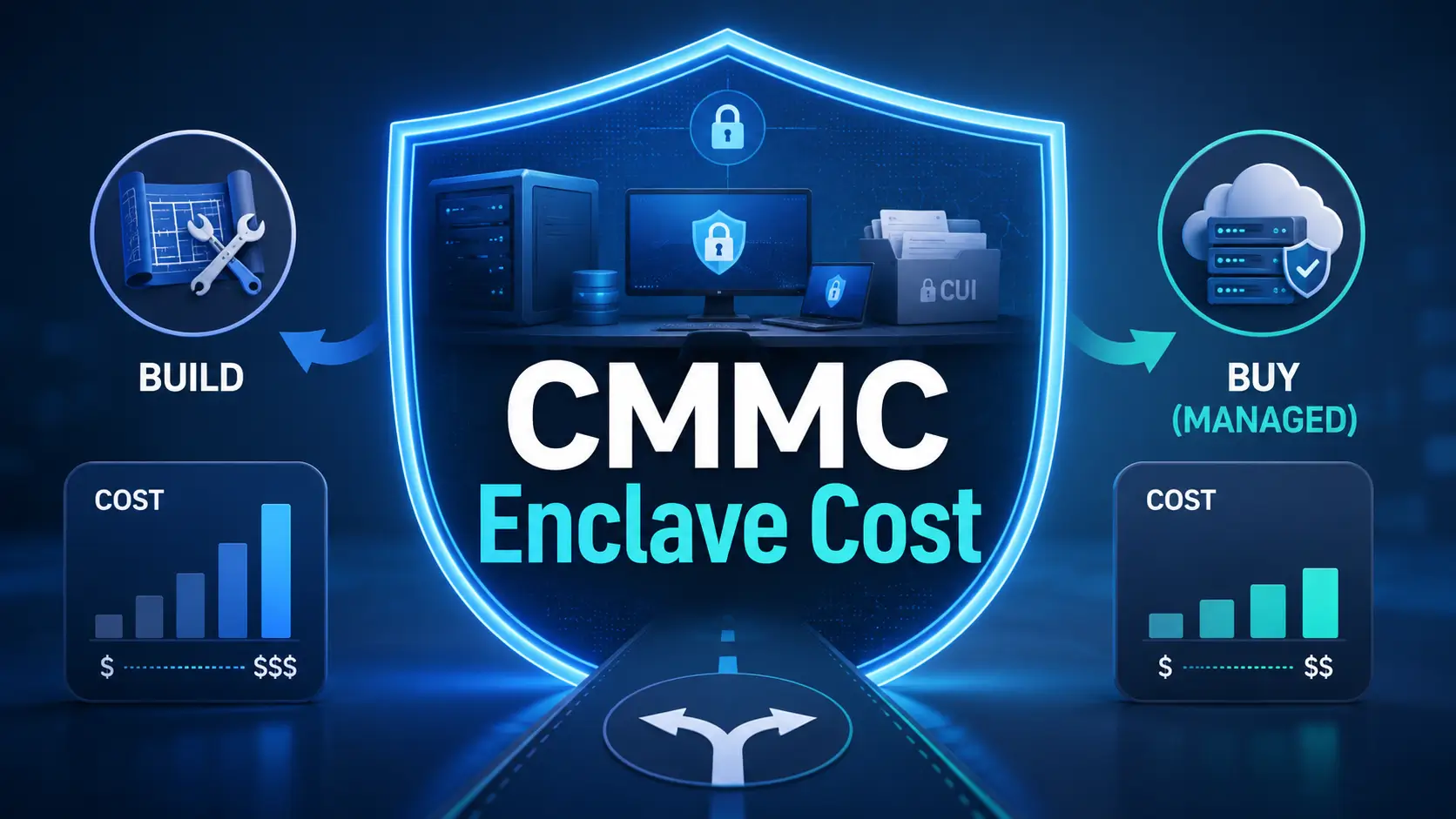
A CMMC enclave can reduce the number of systems that must be treated as part of your CUI environment, but it does not automatically make CMMC cheap. The real build-vs-buy decision is whether you want to pay your own team to design, operate, document, monitor, and defend the boundary, or pay a provider to assume some of those responsibilities while you retain the rest.
Open the practical working record to document this decision with evidence and an accountable owner.
For most small defense contractors with a limited number of CUI users and little dedicated security engineering capacity, a managed enclave is usually easier to budget and operate. Building becomes more attractive as user count, workload complexity, integration requirements, and internal technical capability increase.
The first action is not requesting quotes. Map where CUI actually enters, moves, is stored, and exits your organization. That boundary determines whether an enclave saves money or merely adds another expensive environment to maintain.
Table of Contents
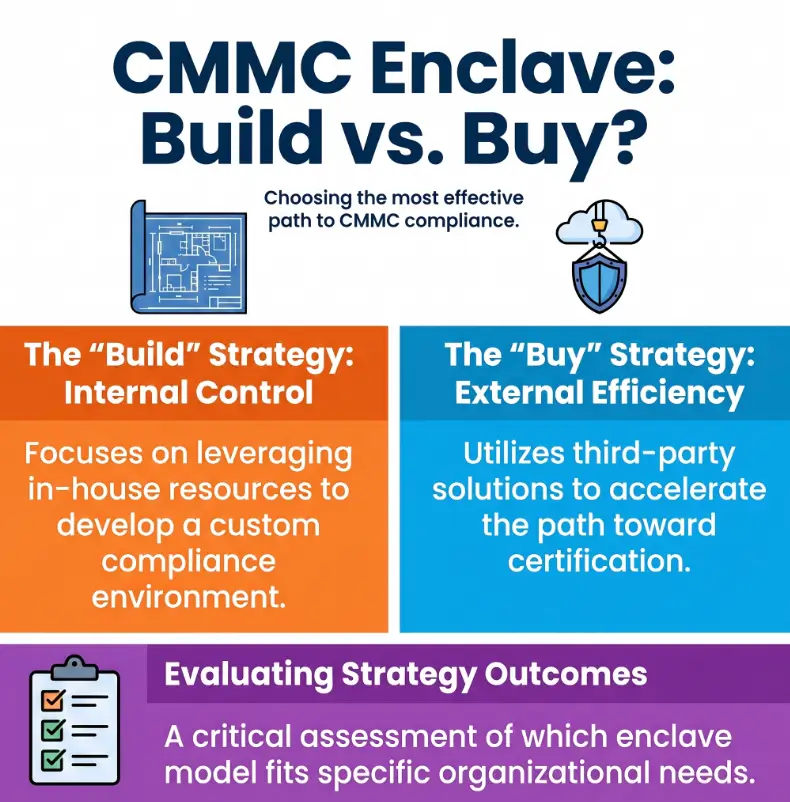
What CMMC Enclave Cost Means in 2026
There is an important timing change to understand before budgeting. On July 13, 2026, the Department of War suspended the planned advancement to CMMC Phase II. The program is currently paused in Phase I, with Level 1 and Level 2 self-assessments continuing while the Department reviews the program. The implementing guidance states that requiring activities may not designate Level 2 C3PAO or Level 3 DIBCAC assessments during the suspension.
You can verify the current implementation status on the Department’s current CMMC program page and the Phase II suspension memorandum.
That pause does not erase the underlying requirement to protect covered defense information. DFARS 252.204-7012 remains in effect, including its information-security and cyber-incident-reporting obligations. The current CMMC guidance likewise continues to align Level 2 self-assessment with the 110 requirements of NIST SP 800-171 Revision 2.
This changes the buying conversation. A vendor pitch based primarily on “you must purchase an enclave before the November 2026 C3PAO deadline” is now stale. A better question is whether the enclave economically improves your ability to protect CUI, document your environment, perform the required self-assessment, and remain ready for whatever assessment model follows the review.
If you need the broader cost picture beyond the enclave itself, including assessment and organizational readiness expenses, see the CMMC compliance cost guide.
The Decision Hinge: Does the Enclave Actually Reduce Scope?
An enclave is financially useful when it creates a defensible boundary around CUI. If CUI continues to leak into ordinary laptops, email accounts, file shares, backups, engineering applications, ticketing systems, collaboration tools, or unmanaged printers, you can end up paying for an enclave while still carrying a large assessment scope.
Under the Level 2 scoping rules, assets that process, store, or transmit CUI are CUI Assets. Security Protection Assets that provide security functions to the environment are also within scope for the requirements relevant to the protection they provide. Contractor Risk Managed Assets and Specialized Assets have their own treatment and documentation rules. Simply labeling a corporate system “outside the enclave” does not make it out of scope.
The official Level 2 Scoping Guide specifically describes physical and logical separation as ways to limit the CMMC assessment scope. Effective separation can therefore create real economic value, but only when the architecture and operating procedures preserve that separation.
The cheapest enclave is not the one with the lowest subscription price. It is the one that removes the most unnecessary complexity without creating an equally expensive integration problem.
Build vs Buy: Which Model Usually Fits?
| Situation | Build Your Own | Buy a Managed Enclave |
|---|---|---|
| Small number of CUI users | Often excessive operational overhead | Usually easier to justify |
| Large, stable CUI workforce | Economics may improve at scale | Per-user or service charges may accumulate |
| Strong internal cloud/security team | Major advantage | Provider may duplicate existing capability |
| Little compliance engineering experience | Higher implementation risk | Managed model may reduce setup burden |
| Many custom applications | Greater architectural flexibility | Integration limits need careful review |
| Need rapid deployment | Engineering schedule becomes a major cost | Usually faster if the use case fits the platform |
| Need complete administrative control | Strong fit | Provider operating model may constrain you |
Buying an enclave does not mean buying compliance. You are purchasing an architecture, operating service, or collection of technical capabilities. Your organization still owns obligations such as determining what information is CUI, controlling who may use the environment, following procedures, maintaining evidence, managing users, addressing customer responsibilities, and ensuring that business processes do not bypass the enclave.
What Changes CMMC Enclave Cost the Most
Five variables usually matter more than the brand printed on the proposal.
1. Number of CUI users
A managed platform may translate each additional user into licenses, virtual desktops, identity services, endpoint protection, support demand, storage, and administrative work. A self-built environment has its own user-driven costs, but fixed infrastructure and engineering expense can be spread over more people.
2. How many workflows must touch CUI
An enclave supporting secure email and document storage is a different project from one supporting CAD, source code, ERP workflows, manufacturing data, large engineering files, external suppliers, specialized test equipment, and automated cloud workloads.
Every additional workflow creates another question: Does CUI leave the enclave? Does another system become a CUI Asset? Does a security product become a Security Protection Asset? Does a service provider enter the responsibility chain?
3. Existing Microsoft, cloud, and security investments
A company starting from ordinary commercial SaaS may face a very different migration project from one that already operates suitable identity, endpoint-management, logging, secure configuration, backup, and administrative controls.
Do not compare a managed enclave’s monthly charge against zero. Compare it against the incremental cost of making your existing environment capable of supporting the required controls and evidence.
4. Internal labor
Internal labor is where many DIY budgets quietly fracture. Someone must own configuration, access reviews, vulnerability management, log review, endpoint administration, evidence, policy alignment, incident response, account lifecycle, backups, change management, and the SSP.
If those responsibilities are spread among a founder, an IT generalist, and a part-time consultant, the infrastructure invoice may look inexpensive while the operating model remains costly and fragile.
5. Boundary complexity
Scope reduction works best when CUI has few entrances and exits. Each connection to corporate email, engineering software, local printers, mobile devices, external suppliers, shared identity infrastructure, backup platforms, or security monitoring can complicate the boundary.
This is why a 12-user engineering company can sometimes have a harder enclave than a 50-user organization with a clean, document-centric workflow.
Use Three-Year TCO Instead of Comparing Monthly Prices
Compare both alternatives over the same explicit operating horizon; 36 months is the planning convention used below, not a mandatory enclave-contract term. Include equivalent services, retained administration, growth, renewals and exit costs. A lower modeled economic cost is not automatically a cash saving.
Use this model:
Build TCO = architecture and implementation + licenses and infrastructure + internal administration + security operations + documentation and evidence + remediation + assessment/readiness support + change costs
Buy TCO = onboarding and migration + recurring provider charges + customer-owned licenses + retained internal labor + integrations + documentation and evidence + remediation + assessment/readiness support + exit or migration costs
The break-even point is not simply the month when provider subscription fees exceed cloud licensing. It is the point at which the extra cost of outsourcing becomes greater than the engineering, operational, documentation, and risk cost your organization avoids by outsourcing.
If you are also trying to quantify endpoint, logging, identity, vulnerability-management, and other security tooling outside the enclave quote, the security tool stack cost calculator can help separate infrastructure spending from compliance-service spending.
A worked build-versus-buy comparison with retained labor
The following is a hypothetical comparison for one unchanged workload over 36 months. Neither option has been priced by a provider. Both are assumed to meet the same documented boundary and operational requirements; a cheaper design that cannot run the workload is not a valid alternative. Staff time is an economic cost, shown separately from external cash.
| Check | How to use it |
|---|---|
| Build assumptions | $18,000 setup + $900 monthly infrastructure/licenses × 36 = $50,400 external cash. Administration: 12 hours/month × $80/hour × 36 = $34,560. Total economic cost: $84,960. |
| Buy assumptions | $5,000 onboarding + $1,800 monthly service × 36 + $3,000 exit allowance = $72,800 external cash. Retained administration: 3 hours/month × $80/hour × 36 = $8,640. Total: $81,440. |
| What changes the decision | Buying costs $22,400 more in external cash but saves $25,920 of modeled staff effort, producing a $3,520 economic difference. The labor break-even is about 7.78 additional build hours per month ($22,400 ÷ 36 ÷ $80). |
| Before relying on the result | Substitute real quotes, test the retained-hour estimate, and add growth, renewal increases, remediation and assessments consistently. Do not count included licenses twice or treat staff capacity saved as guaranteed cash savings. |
Do Not Mistake the Government’s CMMC Cost Estimate for an Enclave Price
One number that appears frequently in CMMC discussions deserves careful handling. In the 2024 CMMC final rule’s regulatory analysis, the government estimated approximately $101,752 for a small entity’s Level 2 C3PAO certification-assessment and initial-affirmation activities under its stated assumptions. That was not an estimate of what a CMMC enclave costs to build.
The analysis explicitly excluded Level 2 implementation and maintenance engineering costs because the government treated NIST SP 800-171 implementation as an existing contractual obligation. The C3PAO component was only one part of the estimate. The final rule also stated that actual C3PAO pricing would be determined by market supply and demand.
That distinction matters even more after the 2026 Phase II suspension. Regulatory assessment-cost estimates, consultant readiness fees, enclave implementation costs, recurring managed-service charges, and remediation budgets are separate categories. Combining them into a single “CMMC costs six figures” headline is not useful budgeting.
When Building Your Own Enclave Makes Sense
Building is usually strongest when the organization already possesses the people and systems needed to run the environment after the consultant leaves.
- You have experienced cloud, identity, endpoint, and security administrators.
- CUI workflows are technically complex or highly customized.
- You expect the enclave to exist for many years.
- You have enough users or workloads to spread engineering expense across a meaningful base.
- You need direct control over architecture, automation, integrations, and change schedules.
- Your team can maintain the SSP, asset inventory, network diagrams, evidence, policies, and operational procedures.
- You can provide monitoring, incident response, configuration management, vulnerability management, and administrative coverage without depending on one irreplaceable employee.
The most dangerous DIY design is not the technically imperfect one. It is the environment that was configured correctly during a consulting project but has no sustainable owner six months later.
When Buying a Managed CMMC Enclave Makes Sense
A managed enclave becomes attractive when the organization wants to minimize the amount of infrastructure and security administration it must perform itself.
- You have a relatively small group of CUI users.
- Your workflows fit the provider’s architecture without extensive customization.
- You need predictable operations more than maximum technical flexibility.
- You lack dedicated security engineering staff.
- You need help maintaining configurations, logs, evidence, or operational procedures.
- Time to a defensible environment matters more than optimizing every component cost.
- Your leadership prefers recurring operating expense to a substantial internal implementation project.
The strongest buying case is not “the provider is CMMC compliant.” That phrase is too imprecise. The stronger case is that the provider can clearly show which technical and operational responsibilities it performs, which responsibilities remain yours, what evidence it supplies, and how its service fits your assessment scope.
What a Managed Enclave Quote Must Include
The official scoping guidance requires organizations using relevant external service providers to document the provider relationship and understand the customer responsibility matrix. A provider can remove work from your hands without removing accountability for understanding who performs it.
| Ask the Provider | Why It Matters |
|---|---|
| Exactly which CMMC requirements or assessment objectives does your service support? | Prevents broad “CMMC ready” language from replacing control-level responsibility. |
| Can I review the customer responsibility matrix before signing? | Shows which tasks remain with your organization. |
| Which licenses are included and which must I purchase separately? | Prevents an incomplete recurring-cost comparison. |
| Which endpoints, identities, logs, backups, and security tools remain in my scope? | Tests whether the enclave truly narrows the boundary. |
| What evidence do you provide for assessments and self-assessments? | Determines whether evidence collection is actually being reduced. |
| How are incidents handled and who performs each reporting step? | Exposes operational gaps that architecture diagrams do not show. |
| What happens when we add a user, site, application, supplier, or integration? | Reveals the real marginal cost of growth. |
| What is excluded from onboarding? | Finds migration, remediation, endpoint, documentation, and consulting costs early. |
| How do we export data, evidence, configuration records, and logs if we leave? | Measures switching cost and vendor lock-in. |
Hidden Costs That Can Break Either Model
The largest surprise costs often sit outside the platform itself.
- CUI discovery: finding old copies in email, shared drives, local devices, archives, and supplier workflows.
- Migration: moving files and business processes without creating uncontrolled duplicates.
- Application compatibility: engineering or manufacturing software may not fit a standard hosted desktop model.
- Identity integration: shared corporate identity services can complicate scope and administration.
- Printing and removable media: physical workflows can puncture an otherwise neat digital boundary.
- Backup and recovery: CUI does not stop being CUI because it moved into a backup system.
- Security Protection Assets: logging, monitoring, VPN, identity, and other protective systems may have assessment implications.
- Documentation debt: a functioning system without an accurate SSP, inventory, procedures, and evidence remains difficult to assess.
- Remediation: neither a provider nor a new enclave automatically fixes organizational practices outside the purchased service.
- Change: acquisitions, new offices, major architecture changes, and new data flows can damage a carefully constructed scope boundary.
Your 15-Minute CMMC Enclave Scope Check
Before asking a provider for pricing or approving a DIY architecture, write down answers to these questions. If several answers are unknown, the unknowns are part of your project cost.
- How many people actually need CUI access?
- What specific applications must they use while handling CUI?
- Where does CUI arrive today?
- Where is it stored?
- How does it leave the organization?
- Can users download or copy it to ordinary endpoints?
- Do corporate email, identity, backup, logging, or security systems touch the CUI environment?
- Which external service providers receive CUI or security-protection data?
- Which printers, removable media, manufacturing devices, or specialized systems interact with CUI?
- Who will maintain the asset inventory, network diagram, SSP, evidence, and annual affirmation work?
Now classify the architecture into one of three rough shapes: a small isolated knowledge-work enclave, an enclave with several corporate integrations, or an operational environment containing engineering, manufacturing, laboratory, or specialized systems. The third category deserves far more skepticism toward simple per-user price comparisons.
Frequently Asked Questions
Does buying a CMMC enclave make a company CMMC compliant?
No. A provider can supply technical controls and operational services, but compliance depends on the assessed environment and the organization’s implementation of the applicable requirements. Responsibilities retained by the customer still have to be performed and evidenced.
Does putting CUI in a cloud enclave make employee laptops out of scope?
Not automatically. If the endpoint processes, stores, or transmits CUI, it can become a CUI Asset. The Level 2 scoping guidance does provide an important exception for an endpoint running a properly configured VDI client that does not allow CUI processing, storage, or transmission beyond keyboard, video, and mouse interaction. Such an endpoint may be treated as out of scope under the stated conditions.
Should companies stop enclave projects because CMMC Phase II is suspended?
Not merely because Phase II is suspended. The 2026 suspension changes assessment timing, but the Department explicitly states that DFARS 252.204-7012 requirements remain in force and Level 2 self-assessment continues during Phase I. A project whose only business case was beating the former November 2026 C3PAO deadline deserves reconsideration; a project needed to protect CUI or satisfy existing contractual obligations does not disappear with the pause.
The current text of DFARS 252.204-7012 should be checked alongside the specific clauses in your own contract before changing a security program.
Is a managed enclave always cheaper for a small contractor?
No. A managed service can become poor value when many users require access, custom applications require expensive integration, the company already employs capable security engineers, or provider charges duplicate licenses and services the organization already owns. The correct comparison is three-year total cost and retained responsibility, not monthly subscription price.
What to Do Before You Sign the Contract
Take one real CUI workflow, such as receiving an engineering drawing from a prime contractor, and trace it from arrival to deletion. Mark every person, endpoint, identity system, application, storage location, security service, backup, external provider, and output device it touches.
Then hand that diagram to both the managed-enclave vendor and the person proposing the internal build. Ask each side to mark what remains in scope, who owns every security responsibility, what is excluded from its price, and what changes when you add a new workflow.
If the managed provider produces a smaller, defensible boundary with materially less operational work, paying more for the platform can still be the cheaper decision. If your existing staff and infrastructure can produce the same boundary without outsourcing layers you already know how to operate, building may win.
Do not purchase an enclave because the product carries the right vocabulary. Purchase or build one because the architecture gives CUI a clear home, the responsibility model is understandable, and your organization can keep the environment operating the same way after the implementation project ends.
Last reviewed: 2026-09
Technical guidance updated: 2026-10-13. Clarified the three-year cost comparison after checking current program and scoping guidance. For three-year comparisons, multiply recurring charges by the same period, count bundled services once, and show retained internal labor separately from cash spending.
Editorial review: October 16, 2026. This update clarifies the cost assumptions and purchasing checks above. Illustrative calculations use stated assumptions and are not provider quotes or evidence of product testing.
CMMC enclave build-or-buy decision
Use this when: you are a contractor comparing internal and managed delivery of the same enclave scope. Copy the table into your working notes and replace the prompts with a dated response. Keep unresolved items visible rather than filling them with a default assumption.
| Decision field | What to record | Your evidence / owner / next check |
|---|---|---|
| Equivalent boundary | Keep users, applications, devices and supported workflows constant. | To complete |
| Build workload | Price internal engineering, operation, evidence and specialist help. | To complete |
| Buy workload | Identify provider deliverables and responsibilities retained internally. | To complete |
| Lifecycle comparison | Compare onboarding, recurring costs, growth and exit across one horizon. | To complete |
How to use the result: Find the largest unpriced operational responsibility before choosing the delivery model. Mark each row confirmed, provisional or unresolved, and link the source that supports the status. Keep a reviewer and review date beside decisions that affect spending, deployment or external claims.
This is an editorial working aid. Complete it with your own scope, source documents and responsible reviewers; the completed table alone does not establish compliance or acceptance.
Worksheet change record — October 20, 2026
Added this cmmc enclave build-or-buy decision with four article-specific working fields, evidence ownership and a next action. The article’s existing source notes retain their own review dates. This addition does not represent a new verification of every statement or a newly executed lab test.