
A practical insurance budget for growing software companies
Cyber Insurance Cost for SaaS Startups: What You’ll Actually Pay
The first cyber insurance quote often arrives at an awkward moment. An enterprise prospect wants a certificate of insurance, the fundraising model is already crowded, and someone has just discovered that “cyber coverage” and “Technology E&O” are not interchangeable phrases.
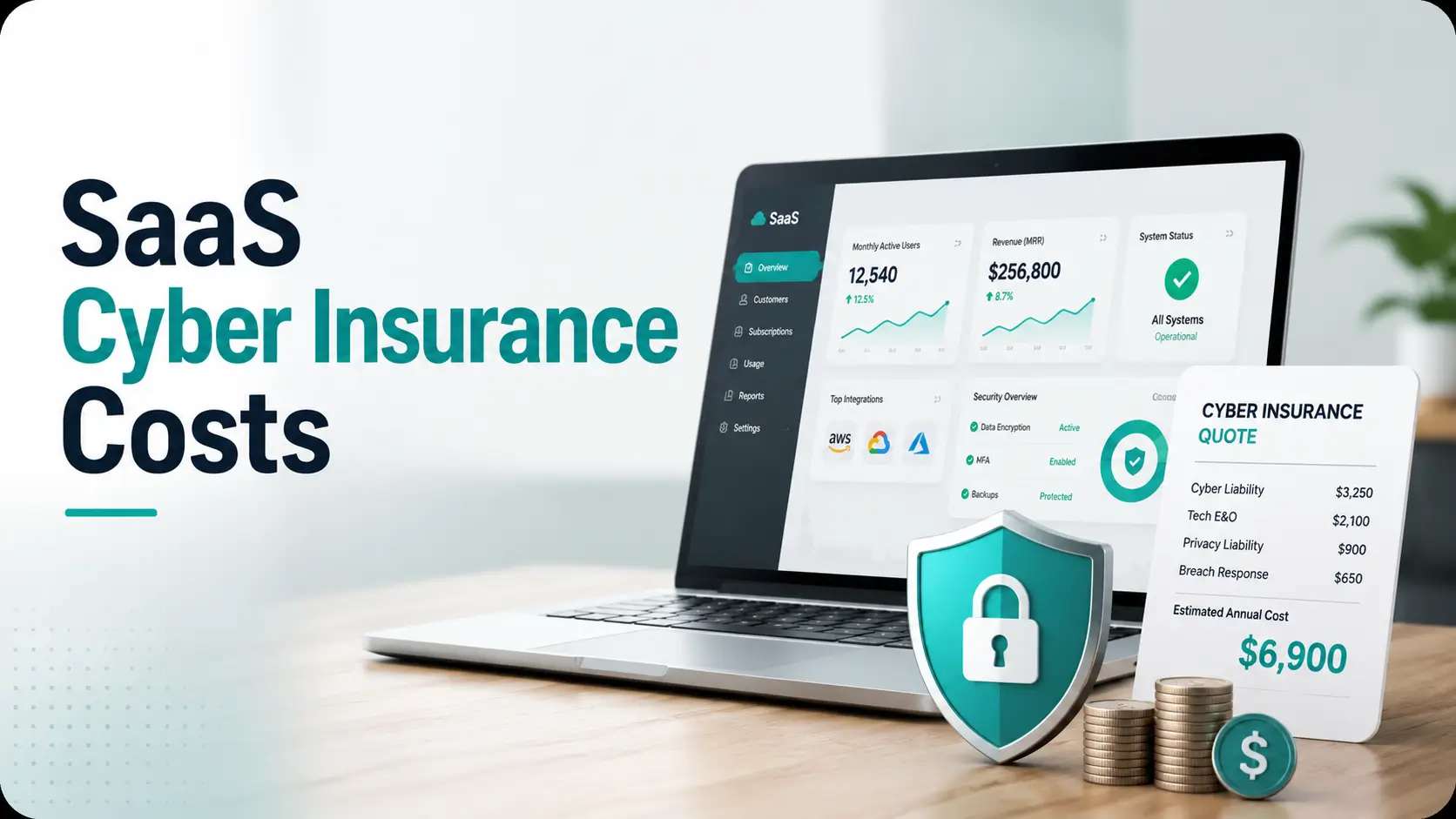
A small SaaS startup may see basic cyber premiums around $1,000 to $3,000 per year. Combined cyber and Technology E&O coverage can begin closer to $2,500 to $6,000 annually for some companies below $1 million in revenue. Those figures are planning ranges, not promises. Data sensitivity, contract size, security controls, claims history, AI functionality, and policy wording can move the number considerably.
This guide shows you how to estimate a credible budget, understand why quotes differ, spot policies that are cheap for the wrong reasons, and prepare an application your engineering and finance teams can defend later.
PRICE
Build a realistic annual budget by startup stage and exposure.
COVERAGE
Compare cyber-only quotes with combined Technology E&O protection.
PREPARATION
Create a clean quote brief before a customer deadline starts ticking.
The goal is not the cheapest premium. It is a policy that still looks sensible on the morning something goes wrong. 🔐
Snapshot
This guide is for US SaaS founders, finance leaders, and security teams pricing coverage before fundraising, enterprise contracting, or renewal. You will learn how to compare cost tiers, size limits from credible loss scenarios, identify policy gaps, and prepare a one-page brief for insurers or brokers.
Table of Contents
Before You Act
This article offers general educational information, not insurance, legal, financial, tax, or cybersecurity advice. Actual coverage depends on the policy, endorsements, exclusions, sublimits, application statements, applicable law, and facts of a claim. Compare quotations with a licensed insurance professional and involve qualified legal or security advisers when your contracts, data, or operations create unusual exposure.
Start With the Range, Then Price the Risk
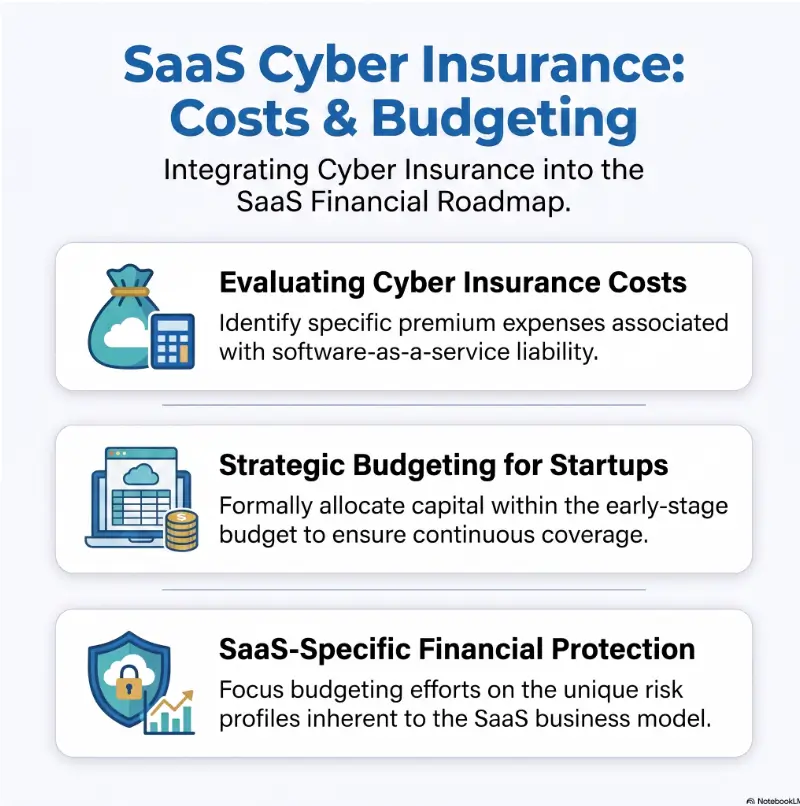
A planning number is useful, provided it is treated as the opening note rather than the whole song. For a small SaaS company, basic cyber liability coverage may fall near $1,000 to $3,000 per year. A package combining cyber liability with Technology Errors and Omissions, commonly shortened to Tech E&O, may begin around $2,500 to $6,000 annually for some businesses below $1 million in revenue.
The range can widen quickly. A pre-revenue scheduling tool with little production data is not underwritten like a healthcare workflow platform, an AI decision tool, or software that can interrupt a customer’s financial operations.
A planning budget by startup stage
| Startup profile | Possible annual planning range | Main pricing concerns | Coverage conversation |
|---|---|---|---|
| Pre-revenue product with limited live data | $1,000 to $3,000+ | Founders’ access, cloud configuration, early security controls | Basic cyber, contractual minimums, early Tech E&O needs |
| Bootstrapped SaaS below $1 million revenue | $2,500 to $6,000+ | Customer data, uptime promises, contractor access, payment systems | Combined cyber and Tech E&O often deserves comparison |
| Seed-stage company entering enterprise sales | $4,000 to $12,000+ | Larger contracts, indemnities, SSO, integrations, customer security reviews | Higher limits, contractual liability, dependent interruption |
| Series A or rapidly scaling platform | $8,000 to $25,000+ | Revenue growth, international users, privileged access, vendor concentration | Broader program review and possibly multiple policies |
| Regulated or mission-critical SaaS | Highly variable | Health, financial, biometric, children’s, government, or critical operational data | Specialist underwriting, counsel review, tailored endorsements |
These figures are not rate cards. They are budgeting bands that help a founder avoid putting $1,500 into the forecast when the actual insurance program may require five figures.
Who needs more than a benchmark?
A benchmark may be enough for an early budgeting exercise. It becomes less reliable when the company processes regulated information, serves large enterprises, holds privileged access to customer systems, offers contractual uptime commitments, or could cause a customer meaningful financial loss through a product failure.
- Bootstrapped founder: Start with a sensible range, then confirm whether customer contracts require both cyber and Tech E&O.
- Seed-stage finance lead: Budget for limits, deductibles, broker fees if applicable, and possible midterm adjustments as revenue grows.
- Security leader: Treat the quote process as an audit of control claims, not merely a procurement task.
- Regulated platform: Ask for specialist review before assuming an ordinary SaaS benchmark applies.
Key takeaway
Use a cost range to reserve cash, not to select a policy. A credible budget must also account for customer contracts, data types, product failure exposure, and the limits actually available inside the policy.
Why Two Similar SaaS Startups Get Different Quotes
Two startups can report the same revenue and employee count yet receive strikingly different quotes. Insurers are not pricing only the size of the company. They are estimating the size and probability of a loss, including how quickly one compromised account or failed service could spread across customers.
Customer data can matter more than customer count
A platform with 20 business customers may hold more sensitive information than a lightweight tool serving 20,000 consumers. Underwriters may ask what information is collected, why it is retained, how long it is stored, where it travels, and who can access it.
Names and work email addresses create one type of exposure. Health information, payment data, biometrics, precise location data, credentials, source code, or confidential customer records can create a more expensive problem.
Privileged access changes the blast radius
A SaaS product that merely displays customer-provided information presents a different exposure from one that can execute payments, modify infrastructure, send messages, manage identities, deploy code, or connect to production databases.
The question beneath many underwriting questions is simple: if one administrative account were compromised, how many systems, customers, or transactions could be affected before someone noticed?
One enterprise contract can reshape the quote
An enterprise agreement may require a $1 million, $2 million, or larger insurance limit. The same agreement may include indemnity obligations, service credits, confidentiality duties, security commitments, and reporting deadlines.
A certificate of insurance confirms that a policy exists. It does not prove that every contractual obligation is covered. Before signing, compare the insurance clause with the actual policy, and review unusually broad indemnity language with qualified counsel.
How insurers see your exposure
1. SIZE
Revenue, headcount, growth
2. DATA
Type, volume, retention
3. ACCESS
Privileges and integrations
4. CONTRACTS
Limits, duties, indemnities
5. CONTROLS
Prevention and recovery
Premium tends to rise when several columns point toward a larger or harder-to-contain loss.
Cyber-Only vs. Cyber Plus Technology E&O
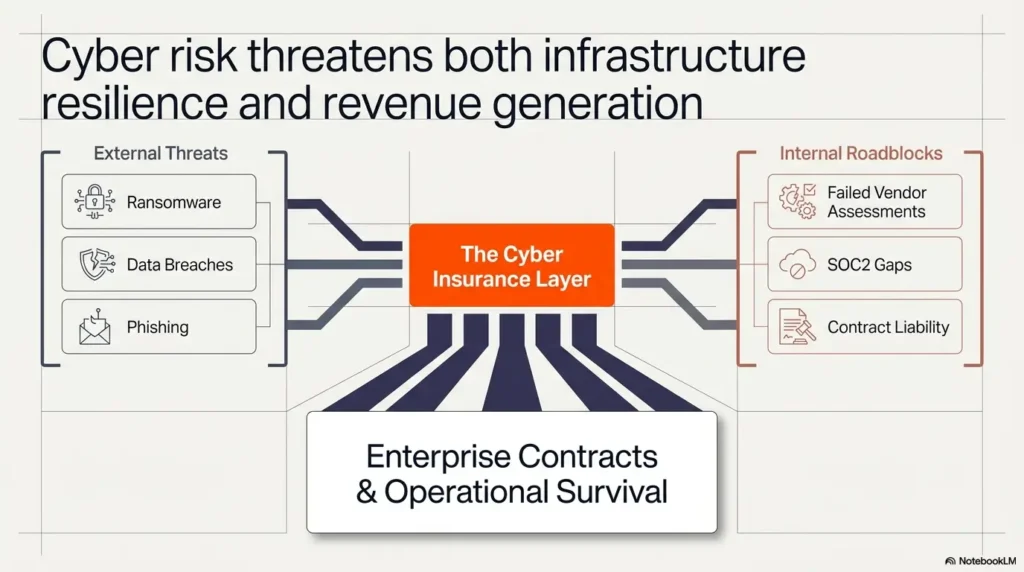
The cheapest quote can be incomplete rather than efficient. Cyber liability and Technology E&O address related risks, but they are not the same coverage.
What cyber liability generally addresses
Cyber coverage may respond to expenses and liabilities arising from security failures, privacy events, data breaches, ransomware, incident response, notification, restoration, certain regulatory matters, and business interruption. The exact list depends on policy wording and endorsements.
Some policies also include social-engineering fraud, cybercrime, reputational support, or dependent business interruption. These protections may carry separate limits, deductibles, waiting periods, or approval conditions.
What Technology E&O generally addresses
Technology E&O is designed around allegations that a technology product or professional service failed to perform as promised and caused a client financial harm. Examples may include faulty software, missed deliverables, implementation errors, corrupted output, or failure to meet contractual specifications.
A broken product is not automatically a cyber event. If an algorithm produces defective results without any breach, the dispute may sit closer to Tech E&O than cyber liability.
Where the policies meet and separate
| Scenario | Cyber liability may be relevant | Tech E&O may be relevant | What to verify |
|---|---|---|---|
| Attacker steals customer records | Yes | Possibly, if a customer alleges service failure | Privacy, security failure, defense, notification |
| Software bug causes customer billing errors | Not necessarily | Potentially | Technology services definition and financial loss wording |
| Ransomware shuts down the platform | Potentially | Potentially, if clients bring performance claims | Business interruption, extortion, overlapping claims |
| Cloud provider outage stops service | Possibly through dependent interruption | Possibly through client claims | Named providers, sublimits, waiting periods |
| AI output causes a customer loss | Only if tied to a covered cyber or privacy event | Potentially | AI exclusions, professional services, product performance |
Bundled coverage can reduce seams between policies, but it can also make quotations harder to compare. Ask every insurer to quote the same limit, deductible, retroactive date, revenue basis, and major endorsements.
Key takeaway
When a customer contract requires “cyber insurance,” check whether it separately requires Technology E&O, professional liability, media liability, crime, or another coverage. One certificate may not satisfy the whole clause.
Seven Variables Quietly Moving Your Premium
Premium calculation is not a neat multiplication problem. Still, seven variables explain much of the movement from an attractive starter quote to a more serious insurance budget.
The seven-factor underwriting checklist
- Annual revenue and expected growth: Revenue can serve as a proxy for operational scale, contractual exposure, and possible third-party claims.
- Coverage limit and deductible: Higher limits generally cost more, while a larger deductible may reduce premium but leaves the company funding more of each covered event.
- Type and volume of information: Sensitive or regulated data can increase response costs, legal duties, and potential liability.
- Largest contracts and customer concentration: One major client may create a larger claim than dozens of small customers.
- Employees, contractors, and privileged users: More identities and devices create more opportunities for credential theft, configuration errors, and unauthorized access.
- Prior incidents and known circumstances: Previous events, demands, outages, or unresolved vulnerabilities may affect pricing, exclusions, or eligibility.
- Geographic and regulatory reach: International users, regulated industries, and varied privacy obligations can increase complexity.
A quick pre-quote risk scorecard
| Question | Lower-pressure answer | Higher-pressure answer |
|---|---|---|
| What data do you hold? | Limited business contact information | Health, payment, biometric, credential, or sensitive personal data |
| What can administrators do? | View or configure the application | Move money, change infrastructure, deploy code, or access customer systems |
| How concentrated is revenue? | Many smaller customers | One or two customers drive a large share of revenue |
| What happens during downtime? | Minor inconvenience | Customers lose revenue or stop critical operations |
| How mature are security controls? | Documented, tested, monitored | Partly deployed, inconsistently documented, rarely tested |
The scorecard is not an underwriting calculator. It helps you predict where questions will become sharper and where a specialist broker may need more evidence.
Do not hide the largest contract in the average
Average contract value is tidy but can conceal the exposure that matters. Record the value of your largest customer agreement, the broadest indemnity, the strictest service-level commitment, and the most demanding insurance clause.
For founders tracking operational risk alongside revenue, a concise set of security metrics for founders can also make renewal conversations more concrete.
Security Controls That Can Change the Quote
Security controls influence more than premium. They can affect whether an insurer offers terms, how broad those terms are, and how confidently the company can answer the application.
Controls that frequently receive close attention
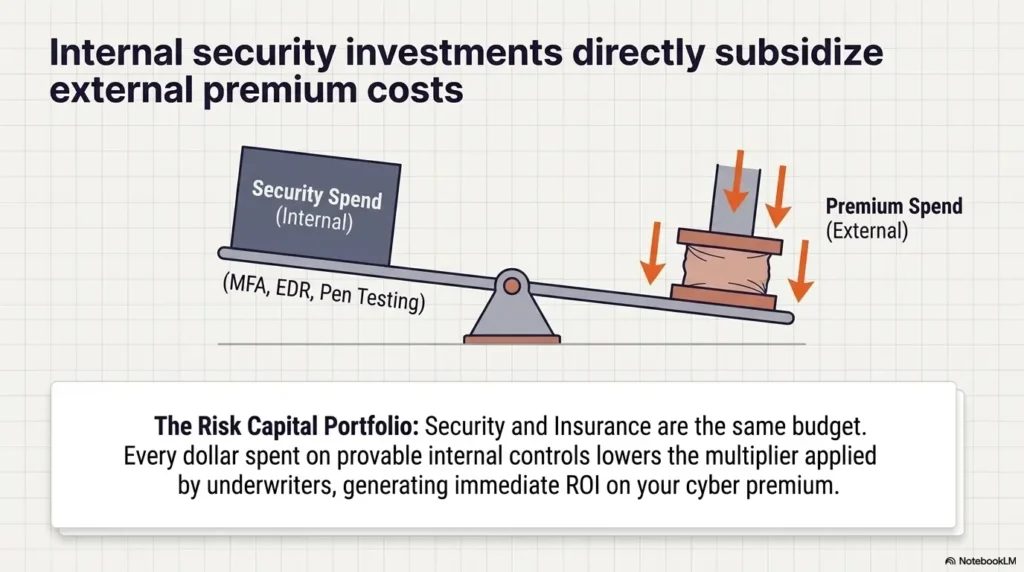
- Multifactor authentication for email, remote access, cloud consoles, code repositories, and administrative accounts
- Endpoint detection or comparable monitoring across employee and contractor devices
- Regular patching with documented remediation targets for critical vulnerabilities
- Backups that are separated from production access and tested through actual restoration
- Centralized logging and practical alert review
- Security awareness training and phishing-resistant payment-change procedures
- An incident-response plan with named decision-makers and outside contacts
- Vendor review for providers that store data or support essential operations
The exact list varies. The useful principle is consistency. A control described as “fully implemented” should work across the systems included in that statement, not only the easiest portion of the environment.
A startup preparing for enterprise security reviews may benefit from aligning its insurance answers with its vendor security questionnaire responses. Contradictory documents can create confusion before a quote and uncomfortable questions after an incident.
Can SOC 2 lower the premium?
A SOC 2 report may help demonstrate that controls are documented and examined, but it does not automatically produce a discount. Insurers may still ask about the report period, exceptions, scope, remediation, control ownership, and whether the systems relevant to the application were included.
Budgeting for assurance work should remain separate from budgeting for insurance. A SOC 2 budget estimate can help founders see how compliance costs and insurance costs fit into the same security plan without pretending they are substitutes.
The backup question is really a restoration question
“We have backups” is an incomplete answer. Useful evidence includes backup frequency, retention, encryption, access separation, immutability where appropriate, restoration test dates, recovery time, and the identity of the person responsible for confirming success.
Key takeaway
Do not install a control solely to produce a prettier quote. Install controls that reduce real exposure, assign an owner, test them, and preserve evidence that they continued to operate.
AI, APIs, and Cloud Vendors Create New Cost Multipliers
Modern SaaS products are rarely self-contained. They rely on cloud infrastructure, identity providers, model vendors, payment processors, support platforms, data tools, and a thicket of APIs. Insurance pricing and coverage become more complicated when one upstream failure can affect many customers at once.
AI errors and cyber events are not the same claim
An attacker stealing prompts or training data may create a cyber or privacy issue. An AI system producing an inaccurate recommendation may instead create a product-performance or professional-services dispute. Some incidents may involve both.
When AI is customer-facing, describe what the feature does, whether humans review high-impact output, what data enters the system, how output is logged, and whether contracts disclaim or expand responsibility for results. Ask specifically about AI exclusions or restrictions rather than assuming ordinary technology wording covers every use.
APIs multiply access paths
An API can turn one integration credential into a doorway across many records or actions. Insurers may care about authorization controls, token storage, rate limiting, logging, key rotation, customer isolation, and how quickly compromised credentials can be revoked.
Teams reviewing these controls can use an API authentication and authorization checklist to identify gaps before translating the environment into insurance application language.
Cloud resilience does not transfer every loss
Using a major cloud provider can strengthen resilience, but it does not automatically make outages, configuration mistakes, or vendor failures someone else’s insured problem. Your customers still experience your service as one product.
- Check whether dependent business interruption is included.
- Identify whether covered providers must be named or scheduled.
- Review the waiting period before loss calculation begins.
- Check the sublimit for vendor-caused interruption.
- Confirm whether non-malicious outages are included or excluded.
- Review how lost income and extra expense are calculated.
Real-world example: the inexpensive policy with a tiny cloud limit
A growing SaaS company compares two quotations. The first costs $1,800 less and carries a $1 million headline limit. The second appears expensive and includes the same headline limit.
During review, the team notices that the cheaper policy restricts dependent business interruption to $100,000 and imposes a 12-hour waiting period. The platform’s largest plausible outage could burn through that amount through lost subscription revenue, emergency engineering work, customer credits, and contract disputes.
The second quote contains a larger dependent-interruption sublimit and a shorter waiting period. It is not automatically the winner, but the price difference now has an explanation. The comparison has moved from “Which premium is lower?” to “Which balance sheet problem are we transferring?”
Show me the nerdy details
Vendor concentration creates correlated exposure. A single identity, cloud, model, or payment provider can affect many insured companies at the same time. This can lead insurers to narrow definitions, impose sublimits, require named providers, or distinguish malicious outages from ordinary service failures.
Ask how the policy defines a dependent business, dependent system failure, system outage, security failure, and waiting period. Small differences in these definitions can change whether an interruption enters the coverage calculation at all.
Choose Coverage Limits From Loss Scenarios
Copying the $1 million limit in a customer contract is convenient. It is not limit analysis. A better approach starts with plausible losses and then compares the result with contractual minimums, available capital, and quote pricing.
Model three losses before asking for limits
- Manageable incident: A contained credential compromise requires investigation, legal review, customer communication, and limited restoration.
- Serious interruption: Ransomware or a major system failure disrupts service for several days and creates lost income, emergency expenses, and customer demands.
- Severe combined event: Sensitive data is exposed, operations stop, several major customers allege breach of contract, and a regulator or claimant becomes involved.
The goal is not to predict the next incident with theatrical precision. It is to prevent the limit from being chosen by habit.
A simple SaaS loss model
| Loss component | Question to estimate | Evidence to use |
|---|---|---|
| Incident response | What would forensic, legal, restoration, and communication work cost? | Retainer quotes, prior testing, vendor estimates |
| Lost income | What revenue is at risk per day of material outage? | Recurring revenue, transaction volume, churn assumptions |
| Extra expense | What would emergency infrastructure, contractors, or customer support cost? | Cloud budgets, staffing rates, continuity plan |
| Contractual exposure | What could major customers demand under contracts? | MSAs, SLAs, indemnities, service-credit clauses |
| Privacy response | How many people or records might require investigation or notification? | Data inventory, retention map, customer geography |
| Third-party claims | Could customers allege financial loss caused by the product? | Product use cases, largest customer workflows |
For response-cost planning, compare the policy’s included services with the cost and scope of an independent incident-response retainer. The two can complement each other, but approval and vendor-selection conditions should be understood before an emergency.
Good, better, and best limit selection
| Approach | How the limit is chosen | Best suited to | Main weakness |
|---|---|---|---|
| Good | Meet the immediate customer minimum | Low-complexity early startup with limited exposure | May ignore actual interruption and response costs |
| Better | Customer minimum plus three internal loss scenarios | Seed-stage SaaS entering enterprise sales | Depends on realistic assumptions and current data |
| Best | Loss scenarios, contract review, balance-sheet tolerance, and matched policy analysis | Regulated, mission-critical, or rapidly scaling platforms | Requires more internal work and possibly paid advice |
Key takeaway
Choose the limit by testing events that could actually hurt the company. Then confirm that ransomware, fraud, cloud interruption, restoration, and contractual claims do not disappear into much smaller sublimits.
Where Affordable Policies Quietly Shrink
The premium occupies one line in the budget. The friction lives in definitions, sublimits, waiting periods, exclusions, consent requirements, and panel-vendor rules.
The headline limit is not always the usable limit
A $1 million policy may contain smaller amounts for social-engineering fraud, dependent business interruption, restoration, reputational costs, cybercrime, or regulatory matters. Some amounts may sit inside the main limit, reducing what remains for later expenses.
Ask whether defense costs erode the limit and whether separate claims share one aggregate. A limit can look generous before legal fees begin consuming it.
Deductibles and waiting periods solve different problems
A deductible is the amount the insured must absorb before covered amounts are paid, subject to policy terms. A business-interruption waiting period is often a span of time that must pass before covered interruption loss begins to count.
A SaaS company with high revenue per hour may care deeply about a waiting period. A startup with limited cash may be more sensitive to the deductible. Compare both rather than trading one for a small premium reduction without modeling the consequence.
The policy-friction checklist
- Are defense costs inside or outside the limit?
- Do cyber and Tech E&O claims share one aggregate?
- What is the business-interruption waiting period?
- Which coverages have separate sublimits?
- Are cloud, model, identity, or payment providers covered?
- Does ransomware response require advance insurer consent?
- Must legal counsel, forensic firms, or negotiators come from a panel?
- Are voluntary shutdowns covered when reasonably necessary?
- How is lost income calculated for a fast-growing company?
- Are contractual liabilities excluded beyond liabilities that would exist without the contract?
- What retroactive date applies to Tech E&O claims?
- Does the policy contain exclusions that overlap with the company’s core product?
None of these provisions automatically makes a policy poor. Restrictions can be reasonable and may lower price. The problem is discovering them for the first time during a live incident.
Treat the Insurance Application as Evidence
A cyber insurance application is not a casual survey. It records representations about security controls, incidents, revenue, data, access, and operations. Inaccurate or overly broad answers can create disputes, delay a claim, or affect coverage depending on the policy, facts, and applicable law.
Verify these answers before submission
- Confirm where multifactor authentication is active and where it is not.
- Verify that contractor devices are included in endpoint-control statements when claimed.
- Reconcile employee counts, revenue, projected revenue, and geographic reach.
- Document backup frequency, access separation, retention, and restoration testing.
- Review the definition of an incident, claim, demand, loss, and known circumstance.
- Disclose prior events and unresolved circumstances according to the application question.
- Confirm whether subsidiaries, new entities, and acquired operations are included.
- Identify the technical owner who approved each security answer.
Make your documents tell the same story
Compare the insurance application with customer security questionnaires, SOC 2 materials, penetration-test reports, privacy notices, incident logs, and internal policies. Perfectly identical wording is not required, but material contradictions deserve investigation.
For example, one document may say all sensitive administrative access requires phishing-resistant MFA while another says MFA is being rolled out. That gap should be resolved before anyone checks “yes” on a broad insurance question.
Save a dated evidence package
- Save the final signed application and every supplement.
- Preserve the quote, policy, endorsements, bind request, and relevant email explanations.
- Save dated screenshots or reports supporting material control statements.
- Record who approved financial, legal, and technical answers.
- Document any answer that required interpretation and the reason used.
- Update the broker or insurer when a requested correction is needed.
Security does not freeze on the binding date. Controls drift, administrators change, vendors are added, and a hurried exception becomes permanent. Add insurance-critical controls to a quarterly review rather than waiting for renewal.
Key takeaway
The safest application answer is not the most flattering one. It is the most accurate answer your company can explain, document, and keep true.
When Specialist Help Is Worth Paying For
Some startups can compare straightforward quotations with a careful internal team. Others face enough contractual, technical, or regulatory complexity that paid advice may prevent a false economy.
DIY comparison vs. specialist assistance
| Situation | DIY may be enough | Specialist help may be worth considering |
|---|---|---|
| Company profile | Small, low-complexity product with limited sensitive data | Regulated data, critical workflows, high growth, or international operations |
| Contract requirements | Standard $1 million requirement with modest indemnity | Large limits, broad indemnity, unusual warranties, strict SLAs |
| Policy structure | Simple combined policy with clear terms | Several policies may respond to one event |
| Security application | Controls are well documented and answers are straightforward | Controls are partial, outsourced, changing, or difficult to describe |
| Prior events | No known incidents, demands, or unresolved circumstances | Previous breach, outage, claim, demand, or active investigation |
Broker, coverage counsel, and security adviser roles
- Specialist broker: Helps collect quotations, explain market options, negotiate terms, and create comparable policy summaries.
- Coverage counsel: Reviews exclusions, definitions, endorsements, contractual requirements, and unusual wording.
- Security leader or adviser: Verifies control answers, identifies gaps, and preserves technical evidence.
- Finance leader: Tests deductibles and uninsured losses against cash reserves.
- Commercial counsel: Compares customer indemnity and insurance clauses with the coverage being purchased.
Questions to ask before choosing a broker or provider
- How much of your work involves SaaS, software, or technology companies?
- Will you compare cyber-only and combined cyber plus Tech E&O options?
- How will you normalize limits, deductibles, waiting periods, and endorsements?
- Can you explain material differences in plain language?
- Who assists during a claim or incident?
- How are fees or commissions handled?
- Will you flag application answers that need technical verification?
- Can you review an enterprise insurance clause before binding?
- How do you approach dependent business interruption and AI-related exposure?
A professional who merely forwards PDFs has added little. The useful adviser makes unlike quotations comparable, asks uncomfortable questions early, and helps the company understand what remains uninsured.
FAQ About Cyber Insurance Cost for SaaS Startups
How much does cyber insurance cost for a small SaaS startup?
A small SaaS startup may see basic cyber coverage around $1,000 to $3,000 per year, while combined cyber and Technology E&O coverage may begin around $2,500 to $6,000 annually for some companies below $1 million in revenue. Data sensitivity, controls, claims history, contract size, limits, deductibles, AI features, and regulatory exposure can move the price higher.
Is Technology E&O included in cyber insurance?
Sometimes it is bundled, and sometimes it is separate. Cyber liability generally focuses on security, privacy, and incident-related losses. Technology E&O generally addresses allegations that software or technology services failed and caused a client financial harm. Confirm the actual coverage sections rather than relying on the policy’s marketing name.
How much coverage does an enterprise customer usually require?
Many enterprise agreements request limits such as $1 million or $2 million, but requirements vary widely by customer, industry, contract value, data, and service criticality. Treat the requested amount as a contractual minimum, then test whether it is sensible for your own loss exposure.
Can SOC 2 certification lower a SaaS company’s premium?
It may help demonstrate control maturity, but it does not guarantee a discount. Insurers can still examine scope, exceptions, remediation, control operation, MFA, backups, endpoint monitoring, incidents, and other factors outside the report.
Does using AWS, Azure, or Google Cloud reduce insurance costs?
Using a mature cloud platform may support resilience, but it does not automatically reduce the premium or transfer your customer obligations. Your configurations, identities, data architecture, backup design, monitoring, and dependency on the provider still matter.
Will a previous incident prevent a startup from obtaining coverage?
Not necessarily. An insurer may ask what happened, what was affected, how the event was resolved, what controls changed, and whether any demands or circumstances remain open. The result could include higher pricing, a larger deductible, restricted terms, or an exclusion. Accurate disclosure is essential.
Are ransomware and business interruption automatically covered?
No. Coverage may be subject to definitions, exclusions, consent requirements, waiting periods, sublimits, security conditions, sanctions considerations, and approved-vendor procedures. Review the policy before an event and include response contacts in the incident plan.
Can a SaaS startup deduct cyber insurance premiums?
Business insurance premiums may often be treated as ordinary business expenses, but tax treatment depends on the company, policy, jurisdiction, and current tax rules. Confirm the treatment with a qualified tax professional rather than relying on a general insurance guide.
Build Your One-Page Quote Brief in 15 Minutes
The fastest useful next step is not requesting six random quotes. It is giving every insurer or broker the same clean description of the company and asking for matched terms.
Copy this one-page briefing structure
SaaS Cyber Insurance Quote Brief
COMPANY
Revenue, projected revenue, headcount, locations, subsidiaries
PRODUCT
Core service, customer types, critical workflows, AI features
DATA
Data categories, approximate volume, retention, geography
ACCESS
Administrative powers, integrations, customer-system access
CONTRACTS
Largest contract, required limits, SLAs, indemnities
CONTROLS
MFA, endpoints, backups, patches, logging, response plan
DEPENDENCIES
Cloud, identity, model, payment, and essential service vendors
QUOTE REQUEST
Matched limits, deductibles, waiting periods, and endorsements
Your 15-minute action
- Write down current revenue, projected revenue, headcount, and largest customer contract.
- List the sensitive data the product stores or can access.
- Name the three vendors whose failure would hurt operations most.
- Choose three loss scenarios and estimate the order of magnitude for each.
- Record the limits required by current and near-term customer contracts.
- Ask for cyber-only and combined cyber plus Tech E&O options where appropriate.
- Require every quotation to show the same limit, deductible, waiting period, and major sublimits.
Once those seven lines are complete, you are no longer shopping from a fog bank. You have a compact risk story that finance, security, legal, and insurance professionals can examine together.
The premium still matters. Cash is real, especially in a young company. But the best cyber insurance budget is not built by shaving the final few hundred dollars from a quote. It is built by understanding what the policy is being asked to protect, where it stops, and which controls make both the company and the application sturdier.
Last reviewed: 2026-08