CMMC Software Buying Guide · Reviewed October 2026
Best CMMC Compliance Software for Small Contractors:
What Is Actually Worth Paying For?
For a small defense contractor, the best CMMC platform is rarely the one with the longest feature sheet. It is the one that helps you define scope, assign requirements, maintain evidence, keep the SSP and POA&M aligned with reality, and hand a defensible record to whoever needs to review it.
For small contractors prioritizing CMMC-specific workflows and transparent pricing, FutureFeed is a sensible first comparison. This is an editorial fit judgment, not a measured performance ranking. Secureframe Defense is more compelling when you want broader automation and possibly a managed CUI environment. Drata becomes more attractive when CMMC is only one of several frameworks you must manage.
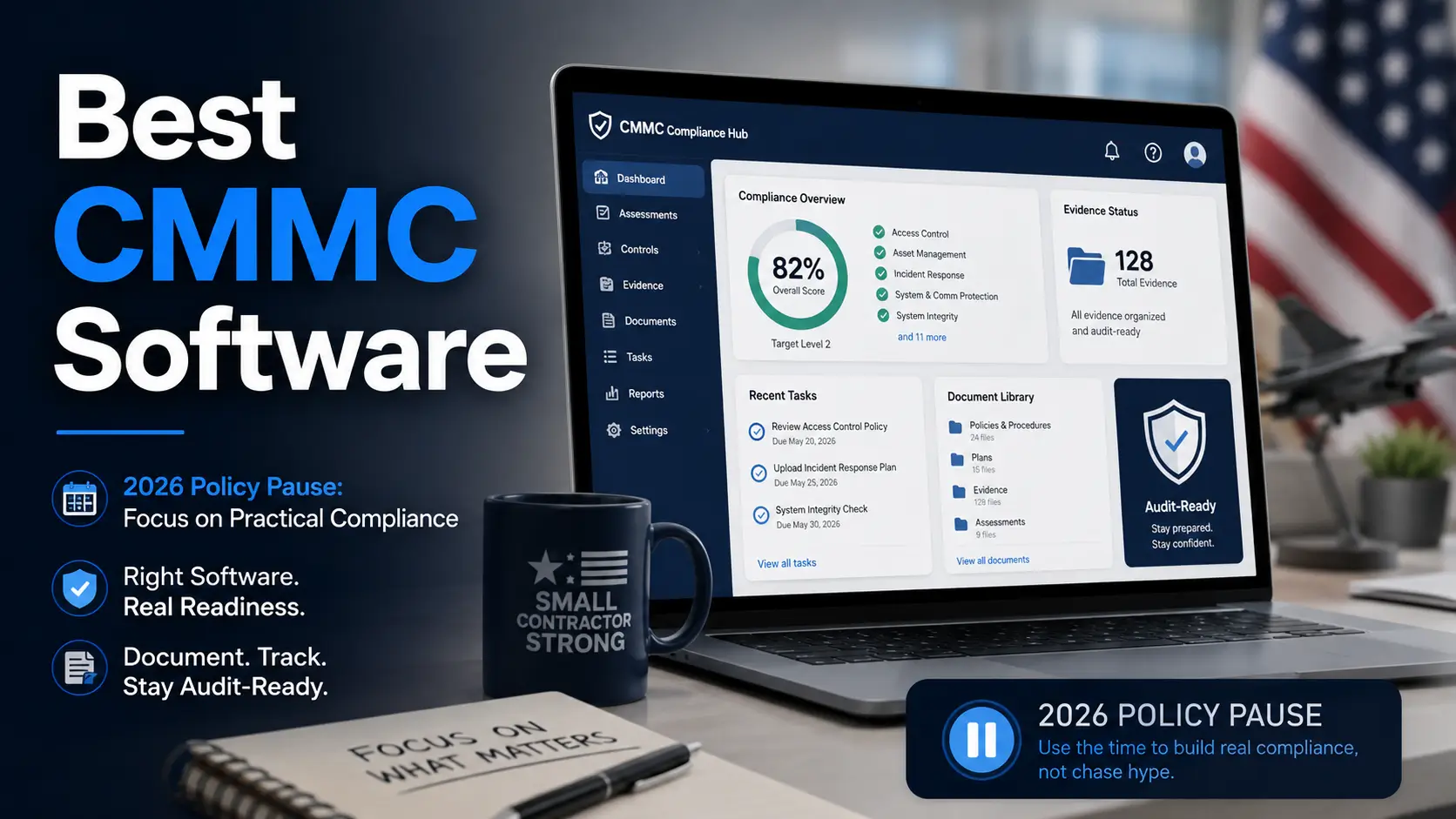
There is also a major 2026 wrinkle: CMMC Phase II was suspended in July 2026, while Phase I self-assessment requirements remain in force. That makes buying software for an imagined future audit deadline a poor strategy. Buy for the compliance work you actually have to perform now, while preserving a clean path to stronger assessment readiness later.
🛡️ The goal is not to buy “CMMC in a box.” It is to make your real security program easier to prove.
This guide is for small U.S. defense contractors and subcontractors comparing CMMC compliance software. You will be able to identify the right software tier, compare five realistic options, understand public pricing where available, avoid scope-related purchasing mistakes, and build a shortlist without assuming that software itself creates compliance.
Table of Contents
CMMC applicability depends on your contracts, flow-down requirements, information types, system architecture, assessment scope, service providers, and current government policy. This guide is a software-buying resource, not legal, contractual, regulatory, or certification advice. Confirm material scope and contract decisions with the appropriate contracting, cybersecurity, compliance, or qualified assessment professionals.
How to use this software shortlist
This is a documentation-based editorial comparison reviewed on October 16, 2026. It is not a hands-on product test, an assessor endorsement or a measured ranking of time saved. Vendor descriptions show advertised capabilities; they do not establish how well a feature works for your environment. A suitable product may exist outside this five-vendor shortlist.
Use the same synthetic requirement, asset inventory and sample evidence with each finalist. Confirm the current package and request the following demonstration before treating a feature claim as a purchasing reason. Do not upload real CUI, credentials or sensitive operational evidence for an informal sales demo.
| Check | How to use it |
|---|---|
| Accuracy | Map a requirement to its actual implementation and evidence. Show how an owner marks a failed check without an unrelated automated pass hiding the gap. |
| Daily operation | Change an asset or owner, replace stale evidence and show the history and overdue task. Record the staff steps that remain. |
| Portability | Export the SSP material, evidence index, attachments and change history in usable formats. Check whether export requires an extra tier or continuing subscription. |
| Decision | Reject a product that fails a must-have workflow or approved data-handling requirement before scoring convenience or price. Compare total cost only among products that pass. |
Quick verdict: the best CMMC software by contractor type
If you are a 10-person or 30-person subcontractor, “best” should mean best fit for the work you actually have, not most features per sales demo.
These are the five platforms worth putting on a practical shortlist:
| Software | Best fit | Why it stands out | Main caution |
|---|---|---|---|
| FutureFeed | Budget-conscious small DIB contractors | CMMC/NIST-focused workflow and unusually transparent public pricing | Less attractive if you need a broad enterprise GRC ecosystem |
| Secureframe Defense | Contractors wanting an integrated CMMC stack | SSP, POA&M, SPRS tracking, evidence automation, CUI-related services | Defense package pricing requires a quote |
| Drata | Growing technology contractors managing several frameworks | Strong automation, integrations, control ownership, evidence reuse | Can be more platform than a tiny single-framework contractor needs |
| Hyperproof | Compliance teams with multiple owners and programs | Structured GRC, evidence, control monitoring, audit trails and reporting | Pricing is not publicly simple and implementation can be heavier |
| RegScale | Federal-heavy or technically mature organizations | OSCAL-native workflows, continuous control monitoring and federal GRC depth | May be excessive for a small shop that primarily needs CMMC Level 1 or a simple Level 2 program |
If CMMC is your main compliance problem and budget matters, start with FutureFeed. If you also need automation across a modern SaaS/security stack, compare Secureframe and Drata. Move toward Hyperproof or RegScale when compliance has become an operating system for multiple teams rather than one contractor requirement.
When no paid platform may be the best answer
A very small Level 1 contractor with a stable environment, clear ownership, and competent internal security staff may be able to manage the required work with official requirements, an asset list, documented procedures, evidence folders, and disciplined spreadsheets.
Software becomes easier to justify when evidence changes frequently, multiple people own controls, CUI enters the picture, you have several cloud services, you need repeatable reporting, or compliance work is stealing hours from the same two people who also keep the company running.
What the 2026 CMMC pause changes for software buyers
This is the part many older CMMC buying guides now get wrong.
On July 13, 2026, the Department of War suspended the transition to CMMC Phase II and other pending implementation milestones while launching a program review. The official CMMC program page currently says the program is paused in Phase 1 and may require self-assessments at Level 1 and Level 2. Phase I itself remains in force.
That does not mean small defense contractors should stop protecting FCI or CUI. The Department explicitly says contractors remain obligated to safeguard covered defense information, including obligations associated with DFARS 252.204-7012.
What is required in the current Phase 1 posture?
The official CMMC program page currently describes:
- Level 1: annual self-assessment and annual affirmation against 15 security requirements associated with basic safeguarding of FCI.
- Level 2 Self: self-assessment every three years, annual affirmation, and 110 NIST SP 800-171 Revision 2 security requirements for CUI.
- Limited POA&M use: permitted for Level 2 under the conditions in 32 CFR Part 170, with closeout requirements and deadlines.
The current government summary confirms these Level 1 and Level 2 self-assessment requirements and notes that a Level 2 conditional status can involve POA&M closeout within 180 days.
What should you buy during a policy pause?
Favor software that remains useful even if implementation dates or assessment mechanics change. Durable value includes asset and scope management, requirement ownership, evidence collection, policy management, SSP maintenance, remediation tracking, audit trails, and exportable records.
Be more cautious about paying a large premium solely for a feature whose value depends on one anticipated future assessment milestone.
Your software decision changes materially based on five things:
- whether you handle FCI only or CUI;
- whether your environment is tightly isolated or spread across normal business IT;
- how many employees, endpoints, cloud services and control owners are involved;
- whether CMMC is your only framework or one of several;
- whether you need software only, or also architecture, remediation, managed security and assessment assistance.
The CMMC software features that actually matter
The software should reduce compliance work without becoming another compliance problem. Seven capabilities deserve more attention than a giant feature checklist.
1. Scope and asset accountability
You should be able to identify systems, assets, owners, services and relevant boundaries without maintaining three conflicting spreadsheets.
This matters because CMMC Level 2 distinguishes categories such as CUI Assets, Security Protection Assets, Contractor Risk Managed Assets, Specialized Assets and Out-of-Scope Assets. A compliance platform that cannot accommodate your real architecture can create tidy dashboards while leaving the important question unanswered: what exactly are we assessing?
2. Evidence tied to specific requirements
A folder containing screenshots is not an evidence strategy.
Good software lets you attach evidence to requirements, record who owns it, show when it was collected, identify whether it is still valid, and preserve a trail of changes. Automated collection is valuable when it replaces repetitive work, not merely when a dashboard displays more green circles.
3. SSP and POA&M management
The System Security Plan needs to describe your real system and how requirements are implemented. A POA&M needs to represent genuine remediation work rather than becoming a digital attic where unfinished controls disappear.
For a small contractor, native SSP and POA&M workflows can be more valuable than dozens of integrations you never intend to use.
4. Exportability and assessor handoff
Ask the vendor to demonstrate exports before you sign. You should know whether you can retrieve your SSP, POA&M data, control status, evidence index, ownership data and supporting records without preserving a subscription forever.
Know the systems, assets, users and services involved.
Assign requirements and responsible owners.
Connect adequate, current evidence to implementation.
Track gaps and permitted remediation clearly.
Keep evidence and documentation alive after the assessment.
The technical detail that matters: your compliance tool can affect scope
Before uploading CUI, logs, configuration data or credentials into any platform, understand what the service actually processes.
Under the CMMC scoping rules, an external provider that processes CUI or Security Protection Data can have assessment implications. Services handling Security Protection Data may be treated as Security Protection Assets, while cloud services processing CUI have additional requirements. A provider that processes neither CUI nor Security Protection Data is treated differently.
Ask every vendor: “Will your platform process CUI or Security Protection Data in our intended configuration, and how should we document your service in our CMMC scope and SSP?” A vague answer is not a small detail.
CMMC compliance software comparison
| Platform | CMMC focus | Evidence / control workflow | SSP / POA&M | Pricing visibility | Best buyer |
|---|---|---|---|---|---|
| FutureFeed | Very high | Yes | CMMC-focused program workflow | High | Small DIB contractor prioritizing cost and CMMC |
| Secureframe Defense | High | Strong automation | Native SSP and POA&M capabilities | Partial | Small or midsize contractor wanting a broader integrated solution |
| Drata | High within broader platform | Automated evidence and continuous monitoring | Framework and evidence workflows | Quote-based | Technology contractor with multiple frameworks |
| Hyperproof | High within GRC platform | Evidence, monitoring and audit trails | Structured compliance program management | Quote-based | Team with several compliance owners or programs |
| RegScale | High federal/GRC depth | Continuous controls monitoring | SSP and POA&M plus OSCAL-oriented artifacts | Enterprise quote; Community Edition exists | Federal-heavy, technically mature organization |
This is a fit comparison, not a benchmark test. There is no responsible way to claim that one product produces better CMMC outcomes merely from vendor feature pages. The right question is whether the product removes work from your specific environment without hiding important scope or evidence decisions.
A simple five-factor evaluation model
- Scope fit: Can the tool represent your actual CUI boundary and asset categories?
- Evidence fit: Can it collect, organize, age, review and export evidence?
- Documentation fit: Does it keep requirements, implementation statements, SSP and remediation synchronized?
- Operating fit: Will your IT staff actually keep using it after the initial project?
- Economic fit: Does the time saved justify software, onboarding and migration costs?
If a product fails either scope fit or evidence fit, a beautiful dashboard should not rescue it from your shortlist.
Which platform fits which small contractor?
FutureFeed: best budget-focused CMMC-native option
FutureFeed is unusually focused on the defense contractor problem. Its platform is built around NIST SP 800-171 and CMMC program management rather than treating CMMC as one item in a library of hundreds of frameworks.
The vendor publishes a plan calculator, but public pages do not always agree. Checked October 16, 2026: FutureFeed’s live pricing calculator shows Innovator for 25 or fewer global FTEs at approximately $1,196 annually and Standard for 26–999 FTEs at approximately $4,796 annually; the selected Standard plan summary displayed $4,796.04 due upfront. CMMC Level 2 is a separate framework option. The calculator’s rounded monthly labels should not be multiplied to infer the exact invoice. Its older support pricing page uses different FTE tiers and amounts, so obtain a dated quote confirming global FTEs, frameworks, term and renewal total.
Choose it when: you are a small subcontractor, CMMC is the main compliance problem, you want structured ownership and evidence without buying a full enterprise GRC suite, and transparent pricing matters.
Look elsewhere when: your security team needs deep enterprise risk management, extensive multi-framework orchestration, sophisticated cross-business workflows or a single broad GRC platform for several business units.
Secureframe Defense: best integrated CMMC package
Secureframe combines general compliance automation with a specific Defense offering. Its current pricing page lists SSP, POA&M, an SPRS score tracker, automated SSP implementation statuses, managed CUI enclave capabilities, managed virtual desktops and CUI-vendor management within the Defense package.
Secureframe’s entry-level Fundamentals package currently starts at $7,500 per year, but that figure should not be treated as the price of the Defense package. Defense pricing is quote-based.
Choose it when: the compliance platform and your CUI architecture are part of the same buying conversation, or you want more automated evidence and broader security/compliance workflows than a CMMC-specialist tool provides.
Watch the quote carefully: separate software, implementation, enclave or virtual-desktop services, professional support, assessment-related services and security tooling. Otherwise a seemingly simple annual software comparison becomes apples, oranges and a small rack of servers.
Drata: best when CMMC is one of several frameworks
Drata supports CMMC alongside a broader compliance automation and GRC platform. Its CMMC materials emphasize evidence organization, ownership, repeat assessments, automated evidence collection and continuous monitoring across frameworks.
Drata currently uses personalized pricing. A CMMC buyer should obtain a current written quote identifying the required package, CMMC framework, integrations, and add-ons; older plan names and entry tiers may have changed.
Choose it when: you are a software, engineering or services contractor that also needs SOC 2, ISO 27001, vendor risk, access reviews or other recurring compliance work.
Skip the extra machinery when: your organization has one small network, one primary framework and no one available to operate a broad compliance platform.
- CMMC Compliance Cost: What Small Contractors Should Budget For
- Security Tool Stack Cost Calculator for Small Businesses
- Vendor Security Questionnaire: What to Ask Before Choosing a Provider
- MFA Rollout Guide: How to Implement Multi-Factor Authentication
- SOC 2 Compliance Checklist for Startups
Hyperproof: best for structured multi-owner compliance
Hyperproof positions its CMMC product around gap assessments, control ownership, automated evidence collection, continuous monitoring, SSP reporting and audit trails. It also supports broader GRC work, making it more relevant as organizational complexity increases.
Choose it when: compliance work is distributed among IT, security, HR, operations, management and outside advisors, and you want a structured system of record rather than a small-team CMMC checklist.
Main tradeoff: the value rises with organizational complexity. A six-person subcontractor that needs a controlled folder and a disciplined self-assessment process could end up paying for organizational sophistication it does not yet possess.
RegScale: best for federal-heavy and OSCAL-oriented programs
RegScale is the most federal-GRC-oriented option in this group. Its government contractor offering emphasizes continuous control monitoring, federal frameworks and OSCAL-native artifacts including SSP, SAP, SAR and POA&M outputs.
RegScale also continues to maintain a Community Edition license, which makes evaluation possible without immediately treating the platform as an enterprise procurement project.
Choose it when: your organization expects CMMC to sit beside FedRAMP, RMF, authorization work, structured federal documentation or compliance-as-code initiatives.
Probably overkill when: the immediate need is to organize one small Level 1 or Level 2 self-assessment program.
Illustrative example: the 18-person machine shop
Imagine an 18-person manufacturer with one DoD prime customer, a small Microsoft environment, an outsourced IT provider and a limited number of people who interact with contract data.
The owner initially wants a large automation platform because “we cannot afford to fail CMMC.” But the expensive platform does not shrink the actual CUI boundary, configure endpoints, correct identity practices, fix logging or write truthful implementation statements.
A CMMC-focused lower-cost platform may be enough if the company can keep the boundary small and its IT provider can implement the technical requirements. The saved budget can then go toward the security gaps that software only records.
Change the scenario to an 80-person engineering contractor managing CMMC, SOC 2, ISO 27001, multiple clouds and dozens of control owners, and the economics flip. Automation and cross-framework reuse become much more valuable.
What CMMC software really costs
The subscription is only the cleanest line on the invoice.
A realistic CMMC technology budget looks more like this:
Real CMMC budget
Compliance software subscription
+ onboarding and migration
+ security tooling or configuration changes
+ CUI boundary or enclave costs where needed
+ documentation and advisory help
+ internal employee time
+ remediation work
+ independent assessment services when applicable
+ recurring maintenance
= the number management should actually plan around
The hidden cost most buyers underestimate: remediation
A compliance platform can tell you that MFA, logging, configuration management, access review, incident response procedures or evidence are inadequate. It does not automatically redesign your network, replace an unsupported system, negotiate a new managed-service agreement or turn a weak identity architecture into a strong one.
For many small contractors, fixing the environment costs more than organizing the evidence.
Public software pricing is useful, but incomplete
FutureFeed currently provides the clearest publicly visible CMMC-specific pricing among the products compared here. Secureframe publishes a starting price for its general Fundamentals package but quotes its Defense offering. Drata, Hyperproof and enterprise RegScale purchases require more quote-level evaluation.
Do not compare a base subscription with a higher-priced managed proposal until you know whether each includes the required framework, implementation, advisory support, architecture, integrations, evidence setup and managed services.
| Quote component | Ask this question |
|---|---|
| Software | Which CMMC framework, modules and users are included? |
| Onboarding | Who imports assets, controls, policies and existing evidence? |
| Integrations | Which integrations cost extra? |
| Documentation | Does the price include SSP or POA&M assistance, or only software fields? |
| CUI environment | Is an enclave, VDI or secure cloud environment included or separately priced? |
| Advisory | How many consulting hours are included? |
| Assessment | Is any independent assessment service included, and is it actually required under our current contract? |
| Renewal | What changes after year one? |
| Exit | What can we export if we cancel? |
DIY vs software vs professional help
CMMC software is useful, but it is not mandatory. The right spending threshold depends on complexity and expertise, not anxiety.
| Approach | Good fit | What you gain | Main risk |
|---|---|---|---|
| DIY / free | Small, stable Level 1 environment with capable internal staff | Lowest direct cost | Manual evidence drift and weak ownership discipline |
| Paid software | Level 2, several control owners, recurring evidence, multiple systems | Repeatability, visibility and less administrative work | Buying automation before fixing scope or architecture |
| Software + professional | Limited internal CMMC expertise, difficult scoping, major remediation or high contract exposure | Specialist guidance plus sustainable operations | Paying consultants to operate a system nobody internally owns |
Do it free or DIY when
- your environment is genuinely small and stable;
- you understand your contract and information types;
- technical staff can evaluate the requirements competently;
- evidence collection is manageable manually;
- there are only a few responsible owners;
- you can maintain documentation throughout the year.
Pay for software when
- you are repeating the same evidence work every quarter or year;
- multiple systems and people contribute to compliance;
- you need stronger change tracking;
- screenshots and spreadsheets are already diverging;
- you need several frameworks;
- management needs a reliable view of gaps and ownership.
Pay for a professional when
- you cannot confidently determine FCI/CUI scope;
- your environment contains legacy, industrial or specialized systems;
- your MSP or cloud architecture creates difficult shared-responsibility questions;
- your SSP does not match how the environment actually works;
- you need significant remediation rather than project management;
- independent assessment or contractual credibility becomes necessary.
CMMC software buyer checklist and red flags
A 45-minute demo can make every platform look serene. Procurement becomes more revealing when you ask the vendor to perform specific tasks.
Ask the vendor to show these, live
- Map one CMMC requirement to its implementation statement and evidence.
- Show how old evidence is identified.
- Show how a requirement owner is changed.
- Show the SSP output rather than a marketing screenshot.
- Show POA&M creation and closeout workflow.
- Show how an assessor or external advisor receives access.
- Show the audit trail after evidence is replaced.
- Show exactly what can be exported.
- Explain whether the platform processes CUI or Security Protection Data.
- Explain how the platform itself should be described in the SSP.
- Show how one control can support more than one framework if multi-framework reuse is part of the pitch.
- Show the renewal price structure and add-on boundaries.
Red flags worth walking away from
- “Our software makes you CMMC compliant.” A tool can support compliance work. It cannot replace implementation, truthful documentation or required assessment activity.
- The salesperson cannot explain CUI handling. This is not the place for “our cloud is very secure” as an answer.
- No clean export story. Your compliance history should not become hostage data.
- The proposal bundles unrelated services into one number. You cannot compare what you cannot separate.
- The product demo skips the SSP. Fancy dashboards are easier to demonstrate than accurate implementation statements.
- The tool assumes every control is an automated technical check. CMMC also involves policies, procedures, people, physical practices and operational evidence.
- A future deadline is used to manufacture urgency. Current CMMC implementation policy changed materially in July 2026. Verify official status before signing under deadline pressure.
Give every vendor the same three sample tasks and the same architecture description. A controlled demo reveals more than five separate presentations in which every salesperson chooses their favorite workflow.
If you later need an authorized C3PAO, verify the organization through The Cyber AB Marketplace. The Cyber AB states that only authorized C3PAOs can conduct CMMC certification assessments.
A practical implementation sequence
Do not begin by importing 110 requirements into software and celebrating because the progress meter exists.
Use this order instead.
- Confirm the contractual requirement. Identify the relevant clauses, prime-contractor flow-downs and current CMMC requirement.
- Identify FCI and CUI. Know what information triggers the security burden.
- Draw the boundary. List users, endpoints, cloud services, networks, external providers and specialized assets involved.
- Choose the software. Now you know what the tool must represent.
- Import existing evidence and documentation. Do not rewrite everything merely because the tool offers templates.
- Map ownership. Every requirement needs a real person responsible for implementation or evidence.
- Run the gap assessment. Separate documentation gaps from actual technical or operational deficiencies.
- Prioritize remediation. Fix control implementation before polishing prose about control implementation.
- Reconcile the SSP. Make sure the document reflects the environment that now exists.
- Conduct the applicable self-assessment and maintain the evidence cycle.
A 30-day software rollout is not a 30-day compliance promise
You can often stand up the management workflow quickly. That does not mean the underlying security requirements can be implemented quickly.
A useful first month is therefore measured by whether you have reliable scope, ownership, evidence structure, a credible gap list and a remediation plan. A green dashboard built on bad assumptions is simply a spreadsheet wearing a tuxedo.
FAQ
Is CMMC compliance software required?
No. CMMC requirements do not require you to purchase a specific compliance management platform. Software is an operational tool for organizing and maintaining the work. Smaller organizations may be able to manage simple environments manually.
What is the best CMMC software for a very small contractor?
If CMMC is your primary framework and price sensitivity is high, FutureFeed deserves the first comparison because it is CMMC-focused and publishes relatively clear pricing. A very small Level 1 contractor should still compare that cost with a disciplined DIY process before buying anything.
What is the best CMMC platform for a SaaS or technology contractor?
Secureframe or Drata may make more sense if you already operate a modern cloud stack and expect to manage CMMC alongside frameworks such as SOC 2 or ISO 27001. The economic case improves when integrations and evidence can be reused rather than recreated.
Should I delay buying software because CMMC Phase II is suspended?
Not automatically. Delay purchases driven solely by a suspended milestone, but do not delay real contractual cybersecurity obligations. If you already need to conduct Phase I self-assessments, maintain NIST SP 800-171 evidence, manage CUI or repair a weak compliance process, useful software can still have immediate value.
Can I put CUI inside my CMMC compliance platform?
Do not assume so. Ask the vendor precisely what information its service is designed and authorized to process, then evaluate the resulting CMMC scoping and cloud-service implications. A compliance tool that stores CUI or Security Protection Data can have a different role in your assessment architecture than one used only for governance records.
Do I still need an SSP if my software tracks every control?
Yes when the applicable requirements call for one. A control dashboard and a System Security Plan are not interchangeable. The SSP describes the system, its environment, relevant components, connections and how security requirements are implemented.
Should I use the same company for CMMC software, consulting and assessment?
Do not assume that one-vendor convenience is automatically appropriate. Ask how readiness services, software support and independent assessment responsibilities are separated, and verify any assessment provider through the authorized CMMC ecosystem before contracting.
What happens if the CMMC rules change again?
That is another reason to prioritize durable capabilities. Asset inventories, evidence histories, control ownership, SSP maintenance, remediation tracking and security implementation retain value even when program milestones change. Review volatile features, pricing and government requirements before each major procurement or assessment decision.
Build your shortlist in 15 minutes
Do one thing before booking any demos: write down your required CMMC level, whether you handle CUI, and the approximate number of people and systems inside the likely boundary.
Then use this filter:
- FCI only + tiny stable environment: test whether DIY is sufficient before paying.
- Small CMMC-focused Level 2 program: start with FutureFeed.
- CMMC + broader automation or CUI-environment needs: compare Secureframe Defense.
- CMMC + several commercial compliance frameworks: compare Drata.
- Several teams and mature GRC processes: add Hyperproof.
- Federal GRC, RMF or OSCAL-heavy future: add RegScale.
That gives you a two- or three-product shortlist instead of a seven-demo calendar marathon. Ask each finalist to demonstrate the same requirement, the same evidence workflow and the same export. The best platform will usually reveal itself not by how much it can do, but by how much unnecessary work it removes without distorting your real CMMC scope.
Last reviewed: 2026-09
Technical guidance updated: 2026-10-13. Updated Secureframe Fundamentals pricing, removed obsolete Drata tier assumptions, clarified the comparison methodology and hypothetical scenario, and repaired table-of-contents links. Use synthetic or sanitized records for vendor demonstrations unless sharing real evidence has been approved.
Editorial review: October 16, 2026. This update clarifies the cost assumptions and purchasing checks above. Illustrative calculations use stated assumptions and are not provider quotes or evidence of product testing.