

Lab-safe cybersecurity learning guide
Kioptrix Level for Building a More Careful Verification Habit
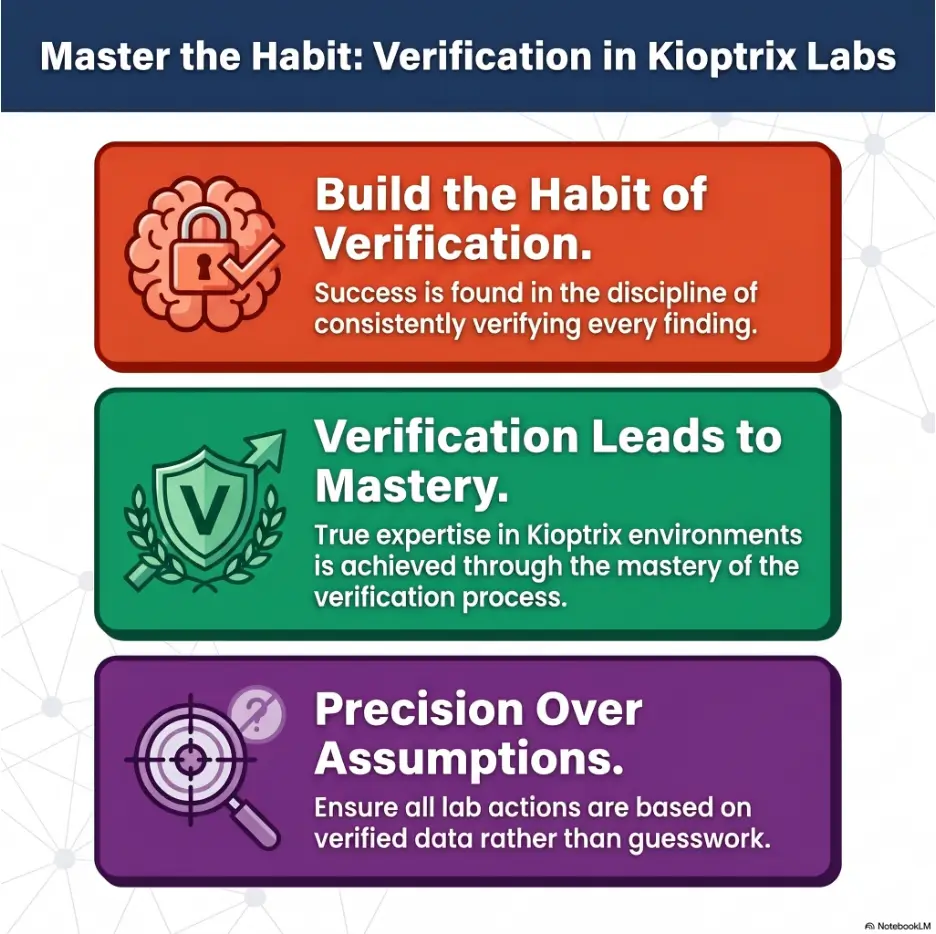
Slow Down, Prove More, Guess Less
Kioptrix has a funny way of making beginners honest. A scan result appears, a version number winks, a forum post promises glory, and suddenly the learner’s hand starts drifting toward the keyboard like a moth toward a very questionable porch light. That moment is the lesson. Not the exploit. Not the root shell. The pause.
This guide treats Kioptrix Level as a training ground for verification: confirming scope, checking evidence, separating facts from assumptions, documenting dead ends, and learning when a result is merely interesting rather than proven. It is written for ethical learners using authorized lab machines, not for anyone trying to poke at systems they do not own.
The practical reward is bigger than one retired virtual machine. A careful verification habit helps with OSCP prep, help desk troubleshooting, security reporting, vulnerability scanning, incident review, and plain old technical sanity. In security work, confidence without evidence is just a cape made of tissue paper.
Verify before acting
Turn scan output into tested evidence, not instant belief.
Document the path
Capture notes, screenshots, assumptions, and failed trails.
Stay inside scope
Keep every test inside your own authorized lab boundary.
Best first move: run one Kioptrix session where the only goal is a clean evidence log, not root. 🧭
Snapshot
This article is for cybersecurity beginners, IT students, homelab builders, and ethical hacking trainees who want Kioptrix practice to build better habits instead of noisier shortcuts. You will learn how to verify findings, avoid common lab mistakes, compare free and paid support tools, write safer notes, and finish one session with evidence you can trust.
Table of Contents
Before You Act: Keep Kioptrix Inside the Lab
Kioptrix is valuable because it gives learners a controlled place to practice. That boundary is not a polite suggestion. It is the fence around the garden.
Use Kioptrix only on systems you own, systems your instructor has assigned, or training environments where permission is explicit. Do not test school networks, employer assets, public websites, cloud hosts, neighbor Wi-Fi, or random IP addresses because a technique worked in a lab.
What this guide can and cannot do
This article can help you build safer habits: scope control, evidence review, note-taking, lab discipline, and beginner-friendly security reasoning. It is not a step-by-step attack recipe, professional legal advice, or permission to test anything outside your authorized environment.
If a decision involves a real organization, real customer data, a production system, paid testing, compliance, or employment risk, confirm your plan with a qualified instructor, security lead, attorney, or authorized professional before acting.
Key takeaway
A vulnerable VM is a sandbox. The internet is not. If the boundary is unclear, stop before you scan.
Treat every command as evidence-producing
In a careful Kioptrix session, commands are not magic words. They are questions you ask the lab. The answer may be useful, misleading, incomplete, noisy, or shaped by your own setup mistake.
Before running a command, ask: “What am I trying to confirm?” After it runs, ask: “What did this prove, and what did it merely suggest?” That tiny pause is where better security thinking begins.
Use authoritative guidance for ethics and defense
For general defensive thinking, it helps to read official security guidance alongside lab practice. CISA’s cybersecurity resources and NIST’s Cybersecurity Framework are useful reference points for learners who want their lab notes to connect with real defensive language.
Why Kioptrix Still Teaches a Modern Security Habit
Kioptrix is older than many of today’s polished cyber training platforms. That age can look like a flaw until you notice what it removes: gamified noise, shiny badges, and endless hint systems whispering in your ear.
The machine gives you something simpler and more demanding: a target, a network, services to inspect, and enough ambiguity to make your thinking visible.
The old-school lab with a current lesson
Many real security failures are not cinematic. They are old services, forgotten configurations, weak assumptions, stale software, unclear ownership, and logs no one checked until Tuesday became expensive.
Kioptrix helps beginners see those themes in miniature. The lab may feel vintage, but the thinking pattern is still useful: identify what exists, confirm what it does, test carefully, and explain the risk without overclaiming.
Verification beats speed
Speed feels good in a lab. Verification transfers better to real work.
A learner who gets root quickly but cannot explain the path has collected a souvenir. A learner who documents why three ideas failed, why one clue mattered, and what evidence supported the final path has built a portable skill.
The real win is not root
Root access is the dramatic ending. It is the cymbal crash. But the quieter win is the habit you rehearse before that moment: checking scope, confirming connectivity, comparing outputs, saving notes, and admitting when a claim is still only a guess.
That habit helps whether you are studying for a certification, working help desk tickets, writing your first pentest report, or trying to understand why a vulnerability scanner produced a result that smells faintly of old cheese.
Key takeaway
Use Kioptrix as a reasoning gym. The target matters, but the habit you carry away matters more.
The Verification Habit Kioptrix Is Really Testing
The best Kioptrix learners are not the ones who never get stuck. They are the ones who can tell the difference between evidence, assumption, guess, and wishful thinking wearing a hoodie.
Scan results are clues, not conclusions
A scan can suggest open ports, service names, version banners, operating system hints, and possible scripts to investigate. It cannot think for you.
For example, “Port 80 is open” is an observation. “The web app is exploitable” is a hypothesis. “This specific weakness is present” requires confirmation. Put each idea in the right drawer, or your notes become a junk cabinet with blinking lights.
One finding needs more than one confirmation
Whenever possible, confirm an important finding in at least two ways. A banner might say one thing. A web response, configuration clue, error message, or manual check may tell you whether that banner is useful, stale, or misleading.
This does not mean running ten tools until one agrees with your hope. It means choosing confirmation methods that answer the actual question.
Write down what changed
Beginner labs often get confusing because the learner changes the environment and then forgets what changed. A VM is rebooted. A network adapter flips modes. A scan is rerun against the wrong IP. A terminal history scrolls into fog.
Keep before-and-after notes. They are not bureaucracy. They are guardrails for the part of your brain that becomes wildly confident at 1:17 a.m.
| Claim type | Example | What to do before trusting it |
|---|---|---|
| Fact | A port appears open in your scan | Confirm the target IP and rerun or manually check if needed |
| Observation | A web page returns a server banner | Compare with another response or page behavior |
| Hypothesis | This service may be vulnerable | Check service details, configuration, and lab relevance |
| Conclusion | This finding matters because of a specific risk | Document the evidence chain and avoid overstating impact |
Show me the nerdy details
A careful verification chain usually has four links: source, method, observation, and confidence.
- Source: Where did the information come from?
- Method: How did you obtain it?
- Observation: What did you actually see?
- Confidence: What would make you more certain or less certain?
First Pass: Don’t Touch Anything Yet
The first pass of a Kioptrix lab should feel almost boring. That is a compliment. Boring is where the clean evidence starts.
Before you chase a service, exploit path, or walkthrough hint, record the environment. Many beginner “security problems” are actually lab setup problems wearing a fake mustache.
Observe the target like a careful mechanic
A mechanic does not begin by throwing parts at the engine. A careful learner should not begin by throwing tools at the VM.
Write down the target machine, attacker machine, virtualization platform, network mode, expected IP range, and how you know the target is reachable. If you cannot explain your lab map, your later conclusions are built on wet cardboard.
Confirm the environment before blaming the box
If the target does not respond, do not instantly assume the VM is broken. Check adapter mode, host-only settings, NAT behavior, firewall settings, DHCP assumptions, and whether both machines are on the intended network.
This is where a guide such as a Kioptrix lab setup checklist can support the workflow without replacing your own verification.
Here’s what no one tells you
A messy lab setup can teach bad habits faster than a vulnerable machine teaches good ones. If your notes begin with uncertainty, every later result inherits that uncertainty.
First-pass setup checklist
- Record the VM name and level.
- Record the attacker machine and operating system.
- Record the virtualization tool and network mode.
- Confirm the target IP before scanning deeply.
- Save the first clean connectivity check.
- Start a note file before running your main enumeration.
Enumeration Without the Confetti Cannon
Enumeration is where many beginners either become careful or become fireworks. The fireworks version is loud, colorful, and hard to learn from afterward.
The careful version starts broad, narrows with purpose, and preserves raw output before summarizing. It is less glamorous. It also works better.
Start broad, then narrow
The beginner mistake is jumping from one interesting service directly into exploitation. A better approach is to map the visible surface first.
Identify reachable services, note the major protocols, record what each service appears to expose, then decide which one deserves deeper attention. This keeps your session from becoming a squirrel parade.
Separate visible facts from interpretation
Visible facts are things you observed. Interpretation is what those facts might mean. Mixing them too early creates false confidence.
A clean note might say: “Port 80 responds with an Apache-looking page. Need to confirm application paths and server behavior.” A messy note says: “Apache vulnerable?” The first note gives you a next step. The second gives you a fog machine.
Save raw outputs before summarizing them
Summaries are useful only if you can return to the raw evidence. Save terminal output, screenshots, timestamps, and short explanations of what you were testing.
If you use Obsidian, plain Markdown, a spreadsheet, or a folder of text files, the tool matters less than consistency. A note-taking system for pentesting should reduce confusion, not become a second lab you must debug.
Kioptrix verification workflow
1. Scope
Confirm the target is authorized.
2. Observe
Record setup and reachability.
3. Enumerate
Map services before choosing a path.
4. Confirm
Check claims with evidence.
5. Report
Explain what happened and why it matters.
The “Looks Vulnerable” Trap
“Looks vulnerable” is one of the most dangerous phrases in beginner security practice. It sounds technical. It often means “I saw something old and got excited.”
That excitement is normal. The discipline is learning not to let it drive the car.
A version number is not proof
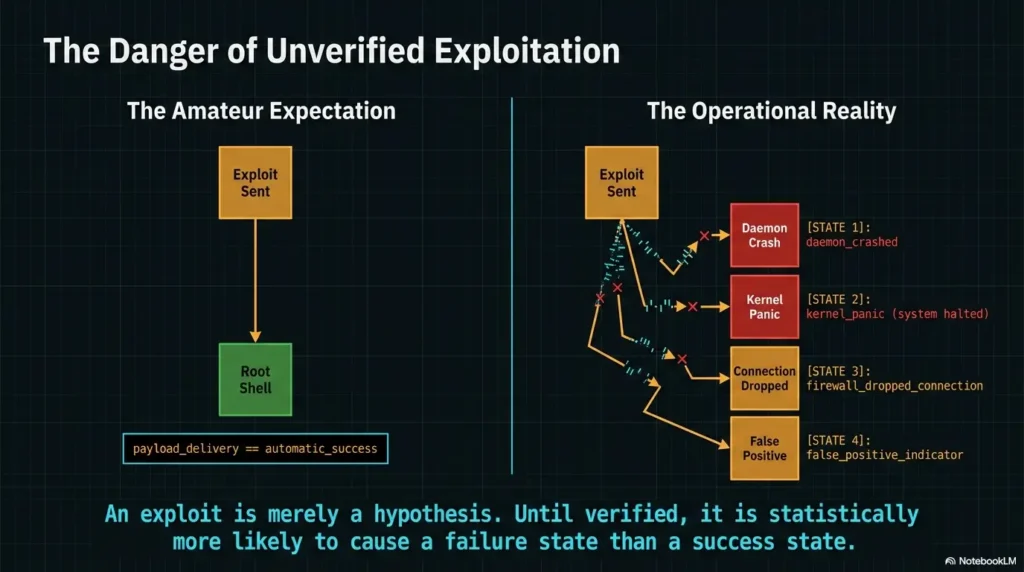
Old software may be vulnerable, patched, backported, misidentified, customized, or irrelevant to the path you are testing. A version match is a lead, not a verdict.
Your next question should be: “What other evidence supports this?” That might include application behavior, configuration clues, official advisories, lab notes, or controlled testing inside scope.
Exploit matching can create false confidence
Search results can tempt beginners into copy-paste mode. The safer habit is to compare the exploit’s assumptions with the actual lab evidence: service, version, operating system family, configuration, authentication state, and expected behavior.
If the match is vague, record it as a hypothesis. Do not promote it to truth just because a page title seems encouraging.
Don’t do this: trust the first result
The first result often feels like a door. Sometimes it is a painted door on a brick wall.
Pause and compare. In a lab, the cost is a few minutes. In real work, the cost of false confidence can be a bad report, wasted remediation time, or a very awkward meeting with people who brought notebooks.
| Beginner shortcut | Why it breaks learning | Safer alternative |
|---|---|---|
| Running the first matching exploit | It skips evidence review | Compare assumptions against observed service behavior |
| Believing every banner | Banners can be misleading or stale | Confirm with multiple observations |
| Ignoring failed paths | Dead ends teach what is not true | Document why each path failed |
| Jumping to root | It hides the reasoning chain | Explain each step before moving on |
Free vs Paid Tools for a Careful Kioptrix Workflow
You do not need an expensive setup to learn Kioptrix well. A modest computer, virtualization software, Kali or another testing VM, careful notes, and patience can take you far.
Paid tools, courses, note apps, cloud labs, and certification prep platforms can help in the right context. They should solve a real bottleneck, not decorate confusion with invoices.
When free is enough
Free is usually enough when you are still learning basic networking, lab setup, enumeration, Linux navigation, web inspection, and note-taking. At this stage, the best investment is time spent building repeatable habits.
Free official documentation can also strengthen your defensive understanding. OWASP’s testing resources are especially useful when you want web security concepts explained in a structured way.
When paid help may be worth comparing
Paid help may be useful when you need a structured path, mentor feedback, graded labs, certification preparation, or a reporting template that mirrors professional expectations.
Before paying, ask what problem the purchase solves. “I feel stuck” may call for better notes first. “I need weekly instructor feedback and accountability” may justify a course or cohort.
Good, better, best setup for beginners
| Setup tier | Best for | What to compare before spending |
|---|---|---|
| Good: free local lab | Beginners learning scope, scanning, notes, and basic Linux | Computer resources, virtualization support, storage, and time |
| Better: organized notes plus curated practice plan | Busy adults, students, and career changers who need structure | Template quality, weekly routine, progress tracking, and review habits |
| Best: guided course or mentor feedback | Learners preparing for interviews, reports, or certifications | Instructor credibility, lab safety rules, feedback depth, refund policy, and realistic workload |
A careful buyer does not ask, “What is the best cybersecurity course?” in the abstract. Better questions are: “What skill am I missing?” “Will this help me verify better?” “Does it include feedback?” “Can I afford the time as well as the price?”
Key takeaway
Spend money only after you can name the bottleneck. Tools do not fix a missing method.
Build a Repeatable Verification Checklist
A checklist is not a cage. It is a railing on a stairwell. You can still move freely, but you are less likely to tumble into preventable nonsense.
Confirm scope
Write down exactly what machine you are allowed to test. In a home lab, this may feel obvious. Write it anyway. The habit scales.
For professional work, scope determines what is legal, ethical, billable, and reportable. Kioptrix is a safe place to rehearse that seriousness without real-world blast radius.
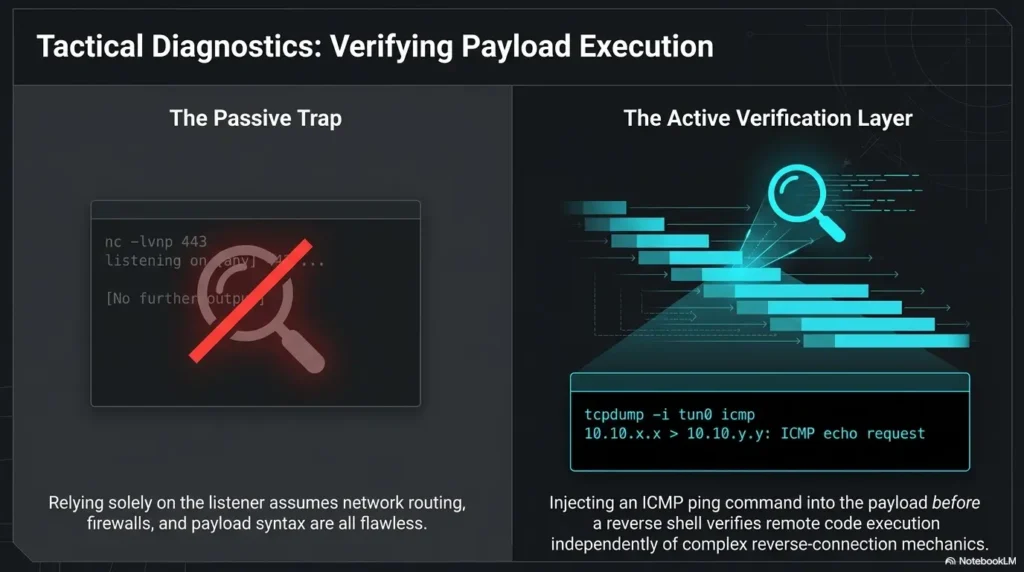
Confirm connectivity
Before deeper testing, confirm that the target IP is correct and reachable from your attacker machine. Save the result with a timestamp or clear note.
If something fails, troubleshoot the lab before assuming the target has a clever defense. Vulnerable machines are often less mysterious than your network adapter settings.
Confirm services and assumptions
Record open ports, service names, visible application behavior, and what each clue might mean. Then mark assumptions clearly.
One simple note format works well: “Observation,” “Possible meaning,” “Evidence needed,” and “Next test.” This keeps your brain from crowning guesses as royalty.
Confirm impact without overclaiming
In a learning lab, impact is educational. In a real report, impact must be explained carefully. Avoid turning every old service into an apocalypse.
Ask what the finding would mean in a real environment: exposed service, weak configuration, missing patch, poor segmentation, credential risk, or lack of monitoring. Then explain the limit of your evidence.
Verification checklist template
- Scope confirmed: target, lab, permission, boundary.
- Connectivity confirmed: IP, route, network mode, reachability.
- Services recorded: ports, protocols, banners, visible behavior.
- Assumptions marked: what you think may be true but have not proven.
- Evidence saved: raw output, screenshot, timestamp, short explanation.
- Impact framed: what the finding could mean and what you cannot claim.
How to Write a Kioptrix Learning Report Without Sounding Reckless
A Kioptrix write-up can either show maturity or broadcast chaos in a tiny party hat. The difference is not whether you found the path. It is how you explain your reasoning.
Lead with scope and ethics
Start by stating that the work happened inside a controlled lab environment. Name the target only in the context of authorized training. Make the boundary visible.
This is especially important if you plan to publish a portfolio post or discuss the lab in an interview. A hiring manager wants curiosity, not a legal thundercloud.
Explain evidence, not just actions
A thin write-up says, “I ran a scan, found a thing, used a thing, got root.” A useful report explains why each step made sense and what evidence supported the next decision.
Use phrases such as “This suggested,” “I confirmed by,” “This did not prove,” and “The next reasonable test was.” Those phrases show judgment. They also make your work easier to review later.
Avoid turning the report into a weaponized recipe
You can write a strong learning report without giving careless copy-paste instructions. Focus on method, verification, defensive lessons, and the reasoning chain.
When in doubt, ask whether the detail teaches judgment or merely lowers friction for misuse. Keep the former. Trim the latter.
Report section starter
Scope: This session was performed only inside my authorized local lab.
Goal: The goal was to practice enumeration, verification, documentation, and defensive reasoning.
Evidence standard: I separated observed facts from assumptions and recorded the evidence used to support each decision.
Real-world example: the report that earned trust
A beginner once showed a mentor two Kioptrix write-ups. The first was a victory lap: commands, screenshots, root, done. It had energy, but no spine. The mentor could not tell what the learner understood.
The second write-up was slower. It listed the lab boundary, the first scan, three wrong assumptions, one service that deserved deeper review, and the reason the final path made sense. It included a small table of “observed” versus “assumed.”
The second report looked less dramatic. It also looked employable.
The lesson was not that reports must be long. The lesson was that trust comes from visible reasoning. In security work, a clean chain of evidence is quieter than bravado, but it carries farther.
What Defenders Can Learn From Kioptrix
Kioptrix is often treated as attacker practice, but defenders can learn a great deal from it. The same careful eye that finds a path in a lab can help a team understand its own exposure.
Old services age into risk
Legacy systems are not automatically doomed, but they do require visibility and care. Forgotten services, unclear ownership, unsupported software, and weak configurations can become business risk long before anyone writes a dramatic incident headline.
For small businesses and startups, this is where security basics matter: inventory, patch review, segmentation, backup planning, access control, and clear ownership.
Visibility matters before remediation
You cannot fix what you cannot see. A defender reading a Kioptrix-style report should notice how much depends on service discovery, version review, application behavior, and configuration clues.
NIST’s Cybersecurity Framework can help learners connect these observations with broader defensive categories such as identifying assets, protecting systems, detecting activity, responding to events, and recovering after problems.
Verification helps both sides
The habit is portable. A penetration tester verifies a path before reporting it. A defender verifies an alert before escalating it. A system administrator verifies a patch before declaring the issue closed.
Kioptrix gives you a small, safe place to practice the same mental rhythm: observe, test, record, compare, explain.
| Kioptrix lesson | Defensive translation | Practical business question |
|---|---|---|
| Service discovery matters | Asset inventory must be current | Do we know what is exposed? |
| Old software can create risk | Patch and support status need review | Who owns this system? |
| Tool output needs confirmation | Scanner findings need validation | Is this a true issue or noise? |
| Reports need evidence | Remediation needs clear proof | How do we know it is fixed? |
Key takeaway
The same verification habit that improves lab testing also improves patch review, asset inventory, and incident analysis.
FAQ
Is Kioptrix still useful for cybersecurity beginners?
Yes. Kioptrix is useful for learning careful enumeration, evidence checking, lab discipline, and basic vulnerability reasoning. Its older style can actually help beginners focus on fundamentals instead of chasing shiny platform features.
Is Kioptrix legal to use?
Kioptrix is appropriate when used in your own lab or another clearly authorized training environment. It is not permission to test real systems, public websites, employer assets, school networks, or unknown IP addresses.
Should I follow a walkthrough the first time?
Try a structured attempt first, then use a walkthrough to compare your reasoning. The richest lesson often lives in the gap between your notes and the guide.
What skill does Kioptrix teach best?
It teaches verification: checking whether a service, version, assumption, or potential path is actually supported by evidence. That skill transfers to lab work, reports, troubleshooting, and defensive security.
Do I need advanced Linux skills before trying Kioptrix?
No, but basic Linux comfort helps. You should understand terminal navigation, file paths, simple networking concepts, and how to save notes. If those feel shaky, spend extra time on setup and documentation before trying to move quickly.
What should I document during a Kioptrix lab?
Document the target details, lab setup, scan results, service observations, hypotheses, tests performed, failed paths, successful findings, and defensive lessons. Save raw evidence before writing summaries.
Is getting root the main goal?
Not really. Getting root is a visible milestone, but the deeper goal is learning how to reason safely, ethically, and carefully. A clean evidence chain is more valuable than a rushed finish.
Can Kioptrix help with real-world security work?
Yes, indirectly. It builds habits used in real security work: scope control, evidence review, service identification, documentation, and risk explanation. It should be paired with modern defensive reading, current tools, and professional ethics.
Your Next 15 Minutes: Run an Evidence-Only Session
The best next step is deliberately small. Open your Kioptrix lab and run one evidence-only session. Do not chase root. Do not try to finish the box. Do not perform a victory drum solo on your keyboard.
Your only goal is to produce a clean notebook page. Record the target setup, reachable services, visible clues, assumptions, and what evidence confirms or weakens each assumption.
Use the first 15 minutes to answer four questions: What am I allowed to test? What do I know for sure? What do I only suspect? What evidence should I collect next?
15-minute evidence-only action plan
- Write the lab scope in one sentence.
- Confirm and record the target IP.
- List visible services without interpreting them yet.
- Choose one service and write what you need to verify.
- End by writing one assumption you are not yet allowed to trust.
That single page is the hinge. It swings the larger door from “I ran tools” to “I can explain what I know.” Kioptrix is only the room. Verification is the habit you carry out of it.
Last reviewed: 2026-07
Technical guidance updated: 2026-10-13. Repaired table-of-contents links to the corresponding section headings.