
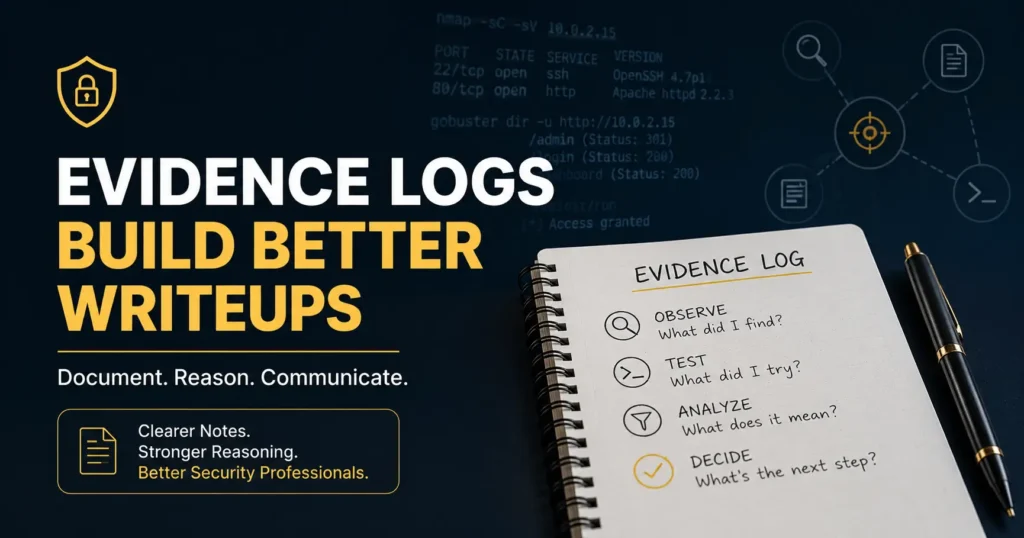
Technical writing for cybersecurity learners
How Kioptrix Level Helps You Build Better Technical Writing
One Evidence Log at a Time
Kioptrix Level is often treated as a beginner hacking lab, but its quieter gift is writing discipline. It teaches you to move from “I ran a scan” to “I observed this, tested that, ruled out the other thing, and here is why the next step made sense.” That shift is the difference between a noisy diary and a useful technical document.
For beginner cybersecurity learners, IT students, junior technical writers, and self-taught homelab builders, the lab becomes a small workshop for clarity. Each port, error message, screenshot, command, false lead, and final finding asks the same question: can another reader follow your reasoning without standing inside your head with a flashlight?
This guide focuses on safe, legal lab practice only. The goal is not to turn a walkthrough into a spellbook. The goal is to turn messy technical practice into clean explanation, ethical documentation, stronger portfolio samples, and a writing habit that survives beyond one vulnerable VM.
Better evidence
Learn what to capture before you explain what it means.
Cleaner reasoning
Turn commands, errors, and decisions into a readable thread.
Portfolio value
Build samples that show judgment, restraint, and communication.
Best next move: write one page of evidence before writing one full walkthrough. The prose gets smarter when the notes stop wobbling. 🛠️
Snapshot
This article is for cybersecurity beginners, IT students, junior technical writers, and homelab learners who want their Kioptrix Level practice to produce clearer notes, stronger walkthroughs, and safer portfolio samples. You will learn how to document evidence, explain commands, handle screenshots, describe failed attempts, and turn one lab session into a repeatable writing system.
Table of Contents
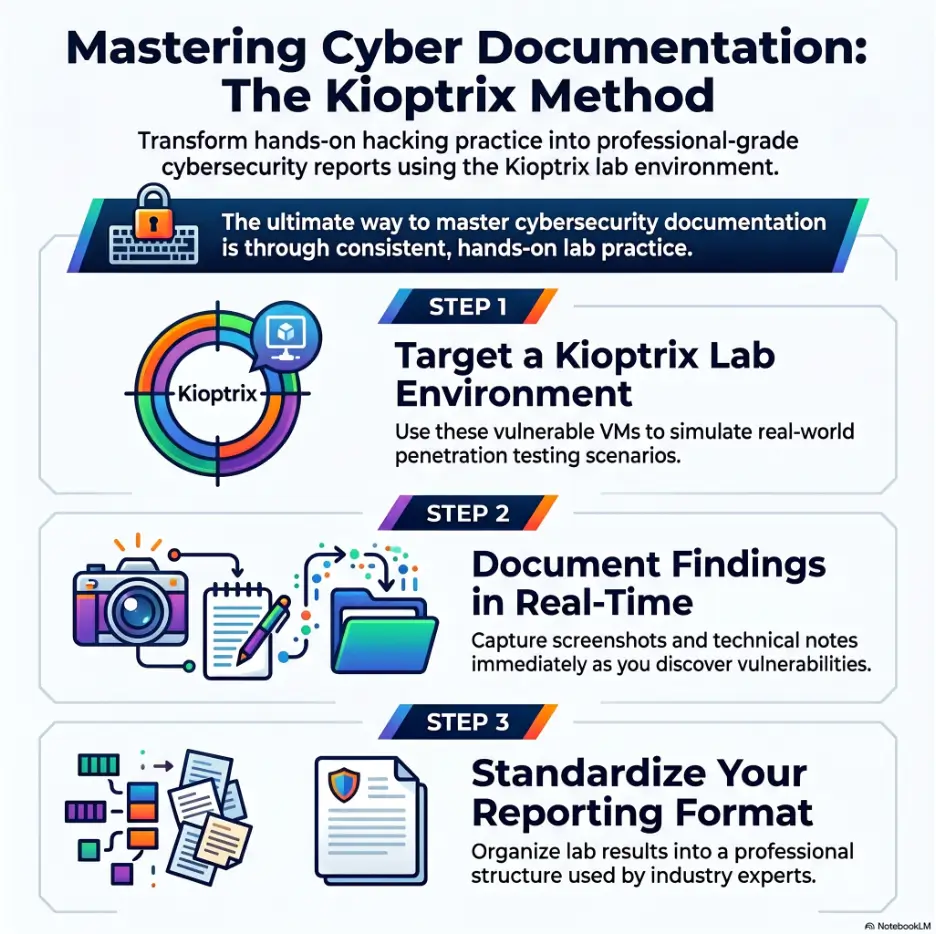
Before You Write: Keep the Lab Legal and Contained
Kioptrix Level can be a useful practice environment, but the writing lesson only matters when the practice is legal, isolated, and clearly framed. Keep every scan, test, command, and note inside systems you own or have explicit permission to use.
That ethical boundary is not a decorative ribbon tied around the article at the end. It belongs near the beginning because it shapes how you write. A good technical writeup teaches judgment, not just steps.
Before you act
This article is educational and focuses on authorized lab environments only. It does not provide permission to test public systems, private networks, cloud assets, business websites, school systems, or live IP addresses.
If you are writing for a class, employer, client, or public portfolio, confirm the rules before publishing technical details. When in doubt, reduce sensitive steps, focus on reasoning, and document the learning outcome rather than presenting instructions for real-world misuse.
Write for learning, not unauthorized replication
A responsible Kioptrix article explains what happened in a controlled lab. It does not encourage readers to aim the same workflow at random targets. This distinction may sound obvious, but beginner writeups often blur it by using vague language like “find a target” or “attack the machine” without context.
Better wording keeps the reader inside the safe box: “In my local lab,” “on the intentionally vulnerable VM,” “within an isolated practice network,” and “for documentation practice.” These phrases make the boundary visible without turning the article into a legal lecture.
Avoid live IPs, brands, and real systems
If your screenshots or notes include addresses, hostnames, usernames, file paths, or tool output that could point to a real environment, redact them. A portfolio sample should show communication skill, not loose handling of identifiers.
For a beginner, this is also a writing upgrade. Redaction forces you to separate what matters from what merely appears on the screen. The reader usually needs the finding, the decision, and the lesson. They rarely need every noisy fragment.
Why Kioptrix Turns Writing Into Evidence, Not Diary Notes
Many beginners start a Kioptrix Level writeup as a diary: “I scanned. I found ports. I tried a thing. It worked.” That is honest, but it is thin. The reader can see movement, yet they cannot see judgment.
Technical writing improves when you stop recording only what you did and begin recording what each step proved. Kioptrix is useful because it gives you a compact, messy environment where evidence appears in small pieces. Your job is to arrange those pieces so another person can understand the path.
The hidden writing lesson inside every vulnerable VM
A vulnerable VM is not just a puzzle. It is a sequence of observations. Every open port, banner, directory, service response, permission error, and failed login attempt is a little note from the system saying, “Describe me accurately.”
That is where writing skill grows. You learn to resist dramatic leaps. Instead of saying, “This service is vulnerable,” you write, “This service version appears outdated in the lab output, so I checked whether known issues matched the environment.” The second sentence is heavier with care. It has bones.
Why screenshots alone do not make a walkthrough useful
Screenshots can prove that something appeared on your screen. They do not automatically explain why it mattered. A folder full of screenshots is a shoebox of receipts. Useful, yes, but not yet a report.
The writing job is to connect each visual to a takeaway. What should the reader notice? What did you rule in? What did you rule out? What changed because of that output?
Key takeaway
A strong Kioptrix writeup does not say, “Look, I did it.” It says, “Here is the evidence, here is what I inferred, and here is how that changed my next step.”
From “I got root” to “here is how the reasoning unfolded”
“I got root” is an ending, not a lesson. It may feel satisfying, but it does not teach much by itself. The richer article explains the path: initial discovery, prioritization, tests, dead ends, corrected assumptions, evidence, result, and reflection.
This is where technical writing becomes more than a transcript. It becomes a guided tour through uncertainty. That skill transfers to help desk notes, bug reports, incident summaries, pentest reports, internal documentation, and security blog posts.
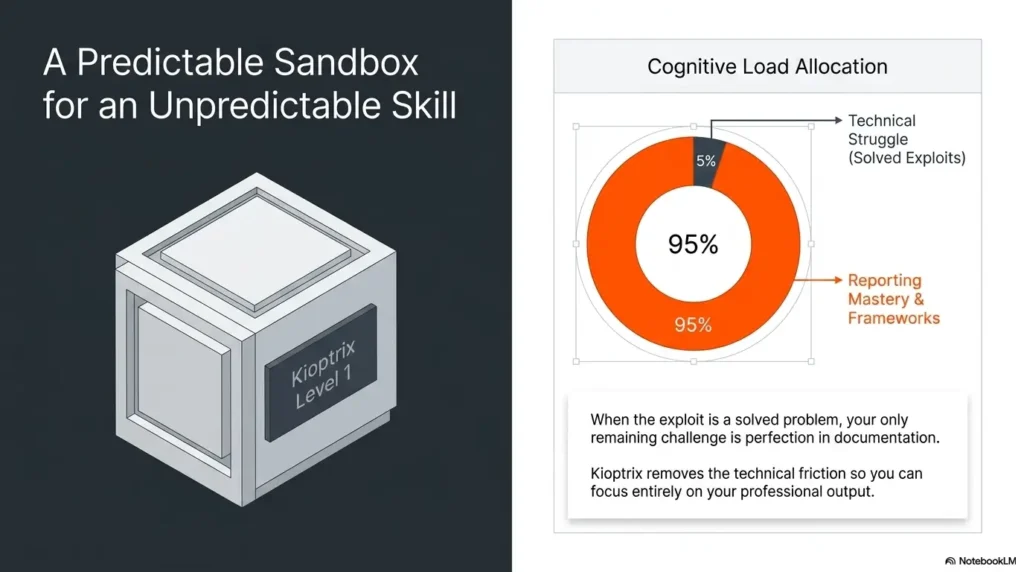
Who Gets the Most Writing Value From Kioptrix Level
Kioptrix is not only for people chasing certifications. It can help anyone who needs to explain technical work under pressure. That includes cybersecurity beginners, IT students, junior technical writers, help desk staff, career changers, and homelab learners who want stronger evidence habits.
Beginner cybersecurity learners
Beginners often know more than their notes reveal. They may understand why a port mattered during the session, but a week later the note says only “checked web stuff.” The memory has already evaporated, leaving a tiny puddle.
Kioptrix forces better capture. You learn to write findings while they are still fresh: service, evidence, assumption, test, result, and next action. That structure makes review easier and reduces the temptation to copy someone else’s walkthrough when you get stuck.
Junior technical writers and security content creators
For writers, Kioptrix offers a useful constraint: explain a real technical sequence without drowning the reader in tool output. That is the same challenge found in documentation work. You need enough detail to be credible and enough restraint to be readable.
A good security article is not a heap of commands with captions. It is a decision tree written in human language.
Help desk, IT, and career changers
If you are moving from general IT into security, Kioptrix can help you practice a new kind of explanation. Help desk notes often focus on symptom, fix, and user impact. Security notes add evidence, scope, uncertainty, and risk.
That added layer matters in interviews and portfolios. A reader can see not only that you used tools, but that you understood what the tools did and what they did not prove.
| Reader type | Main writing problem | Kioptrix writing habit that helps |
|---|---|---|
| Beginner learner | Notes are too vague to review later | Capture evidence before conclusions |
| IT student | Reports read like command transcripts | Add reasoning between tool outputs |
| Junior writer | Too much screenshot clutter | Caption visuals with takeaways |
| Career changer | Portfolio lacks proof of thinking | Turn lab work into a professional case study |
| Homelab user | Practice feels scattered | Use a repeatable session summary template |
The Scan-To-Story Gap Most Beginners Miss
The hardest part of a Kioptrix writeup is not always the lab. Often, it is the blank space between raw enumeration and readable explanation. Beginners collect tool output, then struggle to make it feel like a story with logic instead of a laundry pile with terminal dust on it.
The fix is not to become poetic. The fix is to build transitions. A transition tells the reader why one step led to the next.
How raw enumeration becomes readable structure
Raw enumeration says, “Here are the ports.” Readable structure says, “The scan showed several possible paths, but the web service gave the most immediate clues, so I started there.” That one sentence saves the reader from wondering why you ignored everything else.
A simple structure works well: discovery, prioritization, test, result, decision. You can reuse it in every major section of your writeup.
Kioptrix writing flow
1. Observe
Record what the lab actually showed.
2. Label
Name the finding without exaggeration.
3. Test
Explain what the next command checks.
4. Explain
Connect the output to your decision.
5. Review
Summarize the lesson for future use.
Why order matters more than drama
Some writeups try to create suspense by hiding the obvious clue until later. That can be fun in a story, but it is tiring in a technical article. Readers usually want a clean path, not a fog machine.
Order your writeup around decisions. Start with the evidence that narrowed your focus. Then show what you tested. Then explain what changed. This keeps the reader oriented even when the lab itself was messy.
Tiny transition sentences that make a writeup feel professional
Transitions are small, but they carry the whole article across the river. Here are examples you can adapt:
- “This result did not prove exploitation was possible, but it gave me a service to investigate.”
- “Because the first path produced no useful response, I returned to the initial scan and checked the web service.”
- “At this point, I had evidence of a possible misconfiguration, but not enough to call it a finding.”
- “The error message changed my assumption, so I adjusted the next test.”
- “Rather than continue guessing, I documented the dead end and moved back to enumeration.”
Write Commands Like Decisions, Not Magic Spells
A command without context feels like a magic spell: paste this, press enter, something happens. That kind of writing may help someone copy a step, but it does not help them learn. It also ages badly because tools, flags, and environments change.
Better writing explains the purpose of the command before the output. You are not just showing what you typed. You are explaining what question you asked the lab.
Explain what the command is trying to prove
Before showing a command, write one plain-English sentence: “I used this scan to identify exposed services inside my local lab network.” Or, “I checked the web server because the initial scan suggested it might reveal more application clues.”
This helps beginners understand intent. It also shows future employers or editors that you are not collecting commands like trading cards. You are asking controlled questions.
Show inputs, assumptions, and expected output
A useful command explanation often includes three parts: what you entered, what you expected, and what you actually observed. You do not need to include every line of output. The reader needs the meaningful part.
| Weak command writing | Stronger command writing |
|---|---|
| “I ran Nmap.” | “I used a service scan to identify exposed services on the lab VM and decide which path to investigate first.” |
| “Gobuster found stuff.” | “Directory enumeration showed a few web paths worth checking, so I reviewed the responses instead of assuming every result was important.” |
| “The exploit failed.” | “The attempt failed with a different response than expected, which suggested my assumption about the service or target state was incomplete.” |
| “Then I got a shell.” | “After confirming the lab condition matched my test case, I received an interactive shell inside the controlled VM environment.” |
When to include flags, and when to trim noise
Include command flags when the flag changes the meaning of the step. Trim repeated output, banners, progress bars, and irrelevant warnings unless they affect the decision. Think of the reader’s attention as a battery. Do not drain it with terminal confetti.
A good rule: if the output changed your next action, include it. If it only proves that the tool ran, summarize it.
Key takeaway
Commands are not the story. Decisions are the story. Commands are evidence supporting those decisions.
Screenshots Should Teach, Not Decorate
Screenshots can make a Kioptrix Level walkthrough feel tangible. They also create bloat fast. A long scroll of unlabeled terminal images is like a concert program with no music notes, only ticket stubs.
The best screenshots do one job: they help the reader verify a meaningful moment. Everything else belongs in text, tables, or a short summary.
Caption every important screenshot with a takeaway
A caption should not say, “Scan results.” That merely names the obvious. A useful caption says, “The scan narrowed the first investigation path to web and SMB services in the local lab.” Now the reader knows why the screenshot exists.
If you cannot write a takeaway for a screenshot, consider removing it. The article may be stronger without the visual clutter.
Build an evidence hierarchy before adding images
Not every piece of evidence deserves equal space. Some details belong in the main article. Others belong in a collapsible note, table, or appendix-style section. The reader should never have to dig through five screenshots to find one decision.
| Evidence type | Best format | Why it works |
|---|---|---|
| Key scan summary | Short table | Easy to compare services and priorities |
| Important error message | Quoted text or cropped screenshot | Keeps the decision point visible |
| Proof of lab result | Screenshot with caption | Shows verification without overexplaining |
| Long tool output | Trimmed excerpt plus summary | Prevents the writeup from becoming a log dump |
| Failed branch | Brief paragraph or checklist row | Shows reasoning without derailing the article |
Organize screenshots before you write
Name screenshots by sequence and purpose, not by whatever your operating system felt like mumbling at midnight. A simple naming pattern can save surprising amounts of time: 01-initial-scan, 02-web-enumeration, 03-error-message, 04-proof-summary.
If you want a deeper workflow for screenshot naming and lab evidence, connect this article with your own system using a guide like a screenshot naming pattern for security practice or a Kioptrix evidence tracking routine.
Failed Attempts Make Your Writeup More Useful
Many beginners hide failed attempts because they fear sounding confused. This is understandable. Nobody wants their article to look like a raccoon got into the terminal history.
But polished technical writing does not pretend the path was perfect. It explains mistakes with discipline. A failed attempt becomes useful when it shows what you learned, what you ruled out, and how you adjusted.
Document failed attempts without bloating the article
You do not need a full chapter for every dead end. Use a compact pattern: attempted path, evidence, result, decision. This keeps the failed step useful and brief.
- Attempted path: What did you try inside the legal lab?
- Reason: What evidence made the path worth testing?
- Result: What happened?
- Decision: What did you do next?
Turn errors into decision points
An error message is not automatically a failure. Sometimes it is a signpost wearing a bad hat. Write what the error changed. Did it suggest a version mismatch, a permission issue, a wrong assumption, a blocked path, or a need to return to enumeration?
This style helps your article feel professional because it shows calm under uncertainty. That is valuable in security work, technical support, QA, documentation, and incident review.
Real-world example: when the wrong path becomes the best paragraph
Imagine a learner who spends 25 minutes following a web path that produces no meaningful result. In a weak writeup, that time vanishes. The final article jumps from the scan to the successful path, leaving readers with the false impression that the correct choice was obvious.
In a stronger writeup, the learner writes one short paragraph: “I first investigated the web service because it returned the most visible application clues. After checking the available paths, I did not find evidence that moved the lab forward. I documented the responses, returned to the initial scan, and compared the remaining services.”
That paragraph teaches a better lesson than the successful step alone. It shows prioritization, restraint, and recovery. Those are the quiet muscles of technical writing.
Key takeaway
Do not hide every wrong turn. Trim them, label them, and use them to show how your reasoning improved.
Tools, Templates, and Budget Options for Better Lab Writing
You do not need expensive software to write better Kioptrix notes. A plain text editor, markdown app, local folder system, or notes database can work. The best setup is the one you will actually use when the lab gets awkward.
That said, different learners need different levels of structure. A casual beginner may need only a repeatable template. A portfolio builder may want cleaner exports. A junior writer may care about screenshots, headings, and reusable snippets.
Good, Better, Best note system for Kioptrix writeups
| Setup | Best for | What to include | Budget note |
|---|---|---|---|
| Good | Beginners who want simple review notes | Plain text file, dated folder, screenshot folder, short summary | Free or already available |
| Better | Students and homelab users building habits | Markdown notes, evidence table, failed-attempt log, reusable section headings | Free to low cost |
| Best | Portfolio writers and junior documentation pros | Structured template, edited screenshots, versioned drafts, final case study format | May justify paid tools if exports, search, or collaboration matter |
Free vs paid tools: what is actually worth paying for?
Paying for a note-taking app will not fix vague thinking. Before spending money, check whether your current problem is capture, organization, editing, export, or consistency. Each problem has a different fix.
- Capture problem: Use a simpler template with fewer fields.
- Organization problem: Create one folder per VM and one screenshot naming pattern.
- Editing problem: Separate raw notes from the final article draft.
- Export problem: Choose a tool that exports clean HTML, markdown, or PDF.
- Consistency problem: Schedule shorter sessions and write a five-sentence summary after each one.
Paid tools may be worth considering when you need strong search, cross-device access, clean publishing exports, collaboration, or long-term portfolio organization. For a beginner, however, a free setup is enough if the template is clear.
Buyer checklist
Before paying for a writing, note-taking, screenshot, or documentation tool, ask whether it helps you do at least one of these things faster:
- Find old lab notes quickly
- Separate raw evidence from final writing
- Export clean articles or reports
- Organize screenshots without manual chaos
- Reuse templates across multiple Kioptrix levels
The template that keeps your writeup from wandering
A good template prevents the article from becoming a wandering hallway. You can adapt this structure for a Kioptrix Level walkthrough, a technical journal, or a portfolio case study:
- Lab scope: What system did you test, and under what permission?
- Goal: What did the session aim to learn?
- Initial discovery: What did you observe first?
- Priority decision: Which path did you choose, and why?
- Evidence log: What output mattered?
- Failed attempts: What did you rule out?
- Final result: What did you confirm in the lab?
- Writing lesson: What would you explain better next time?
Show me the nerdy details
A mature Kioptrix writeup separates four layers: raw evidence, interpreted finding, reader explanation, and future lesson. Mixing those layers creates confusion.
- Raw evidence: The exact thing observed in the lab.
- Interpreted finding: What the evidence suggests, stated cautiously.
- Reader explanation: Why the finding mattered to the next step.
- Future lesson: What you would repeat, change, or verify next time.
This layering is why better notes become better articles. You stop asking, “What did I do?” and start asking, “What did I know at that moment, and why was the next choice reasonable?”
Turn Kioptrix Practice Into a Portfolio Sample
A Kioptrix writeup can become a portfolio sample, but only if it shows more than tool usage. Hiring managers, editors, instructors, and technical leads are not only looking for a successful lab result. They are looking for communication habits.
The strongest samples show scope, method, evidence, reasoning, ethical restraint, and reflection. They help a reader trust how you think.
What a reader can learn from your writeup
A clear writeup can show that you know how to gather evidence, avoid unsupported claims, explain technical decisions, and communicate uncertainty. Those skills matter even when the reader never repeats the lab.
If your article reads like a professional case study, it can support a broader cybersecurity portfolio. For related portfolio planning, connect it with guides such as building a Kioptrix cybersecurity portfolio, turning Level 1 into a portfolio piece, or writing a Kioptrix pentest-style report.
Walkthrough vs professional case study
| Format | What it emphasizes | Best use | Risk to avoid |
|---|---|---|---|
| Walkthrough | Step-by-step learning path | Helping beginners understand lab flow | Becoming a command dump |
| Technical journal | Personal learning and troubleshooting | Tracking progress over time | Sounding too private or unedited |
| Portfolio case study | Evidence, reasoning, scope, lessons | Showing communication and judgment | Oversharing sensitive tactics |
| Report-style sample | Findings, impact, remediation thinking | Practicing professional security writing | Making unsupported claims |
How to show clarity without oversharing
Public portfolio writing should be careful. You can explain lab reasoning without turning the article into an unrestricted recipe. Focus on the decision process, evidence handling, and learning outcome. Reduce step-by-step replication where it adds more risk than value.
For professional-style samples, you can also include remediation thinking. Even in a lab, ask: what would reduce this risk in a real environment? Strong writers do not stop at “access achieved.” They ask what the finding means and how someone would respond responsibly.
Key takeaway
A portfolio-worthy Kioptrix article does not brag. It demonstrates careful thinking under technical uncertainty.
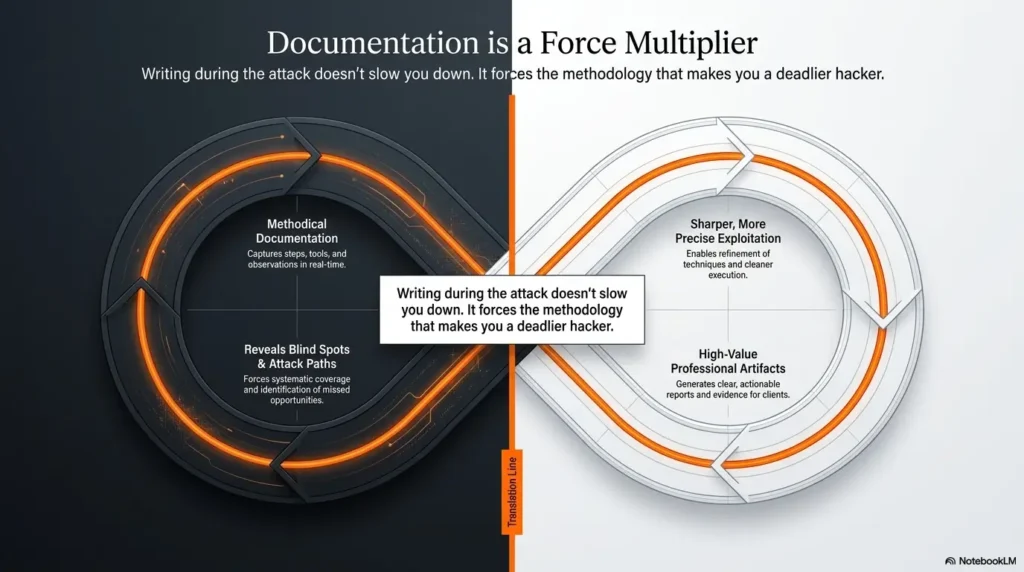
FAQ
Is Kioptrix good for beginner technical writers?
Yes, when used in a legal lab environment. Kioptrix gives beginner technical writers a compact technical process to explain: discovery, evidence, testing, failed attempts, and final lessons. It is especially useful for learning how to turn raw output into readable documentation.
Can Kioptrix writeups help build a cybersecurity portfolio?
They can, if the writeup shows more than copied commands. A strong portfolio piece explains scope, permission, evidence, reasoning, ethical limits, and what the learner would improve next time. The goal is to show judgment, not just completion.
How detailed should a Kioptrix walkthrough be?
Detailed enough for a reader to understand your decisions, but not so detailed that every output line becomes clutter. Include the evidence that changed your next step. Summarize routine or repetitive output.
Should I include every command I ran?
No. Include commands that support the learning path, prove a decision, or explain a meaningful result. If a command did not affect the outcome or teach a useful lesson, summarize it or leave it out.
Are failed attempts worth documenting?
Yes, selectively. Failed attempts are valuable when they show what you ruled out and how your thinking changed. Keep them brief, structured, and connected to the next decision.
How do I make a Kioptrix writeup easier to read?
Use short sections, clear transitions, evidence tables, captioned screenshots, and plain-English explanations before commands. Write for a tired reader who wants to know why each step mattered.
Is it safe to publish Kioptrix walkthroughs online?
It can be appropriate when the article stays inside authorized lab practice and avoids encouraging use against real systems. Redact unnecessary identifiers, frame the work ethically, and focus on learning outcomes.
What makes a Kioptrix article different from a normal CTF writeup?
A CTF writeup often focuses on solving the challenge. A strong Kioptrix article can go further by teaching documentation habits, evidence handling, troubleshooting language, and professional-style reporting.
Your 15-Minute Next Step: Write the Evidence Page
The easiest way to build better technical writing with Kioptrix Level is not to start with a full article. Start with one page. Fifteen minutes. No perfection ceremony. No grand opening paragraph. Just evidence, decisions, and a small lamp of clarity.
Use this one-page template
Open a blank note and answer these prompts after your next lab session:
- What was the lab scope, and how did I keep it authorized?
- What did I observe first?
- Which finding seemed most important, and why?
- What test did I run next?
- What output changed my decision?
- What failed attempt taught me something?
- What would I explain more clearly if I wrote the full walkthrough?
Write one confusing step like a repair note
Pick the messiest moment from your session and write it as a repair note: symptom, evidence, attempted fix, result, next action. This format removes drama and leaves structure. It is humble, practical, and surprisingly strong.
Over three to five Kioptrix writeups, this habit changes the texture of your work. Your intros get sharper. Your screenshots earn their place. Your commands stop floating. Your conclusions teach instead of celebrating loudly in the hallway.
Final practical move
Before writing your next Kioptrix walkthrough, create a file named evidence-page. Add seven lines: scope, first observation, strongest clue, first test, meaningful output, failed attempt, lesson learned. That tiny page is the hinge. The full article can swing open later.
Last reviewed: 2026-07
Technical guidance updated: 2026-10-13. Removed a duplicate callout label and repaired table-of-contents links.