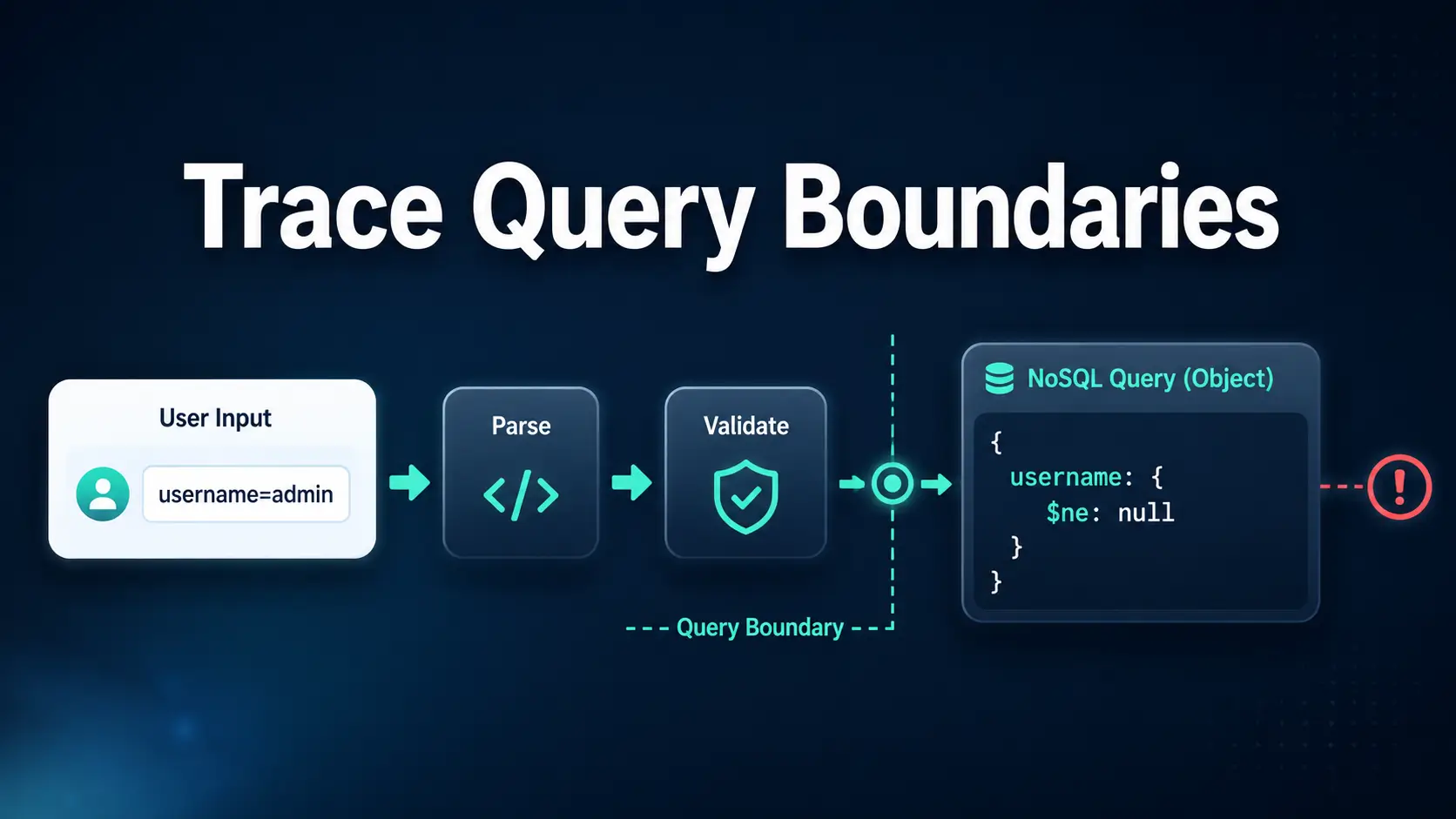
Open the practical working record to connect this guide to your scope, evidence and next decision.
Check the driver, parser and expected data type
NoSQL injection behavior depends on the application, database interface and query construction. Validate expected input types and avoid evaluating untrusted query structures. A blocked operator or one failed test does not prove the application secure. Document the controlled lab case and the observed effect without generalizing it to every database. Reference and scope.
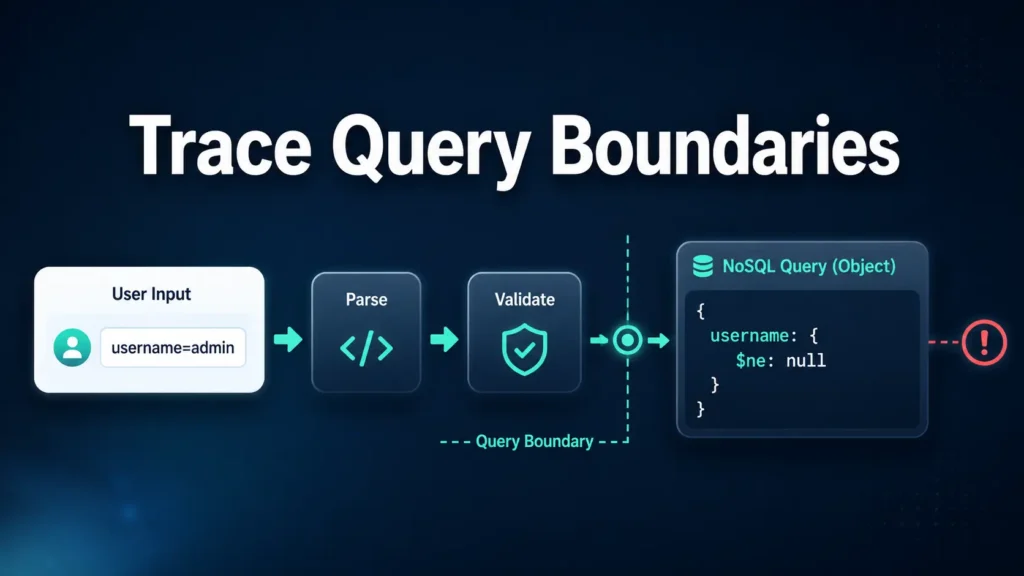
Defensive lab guide · authorized systems only
NoSQL Injection Patterns in Training Labs:How Vulnerable Queries Fail
Investigate how untrusted input reaches a specific database query rather than assuming one universal payload.
That small type change can widen a filter, confuse authentication, expose powerful expression features, or create a misleading response that looks like a successful test. The useful lesson is not a memorized payload. It is the ability to trace one value from the browser to the final query and explain exactly where its meaning changed.
This guide gives students, junior penetration testers, developers, and instructors a lab-safe method for observing those failures, confirming evidence, comparing training tools, and repairing the request-to-query boundary without turning practice into a collection of risky shortcuts.
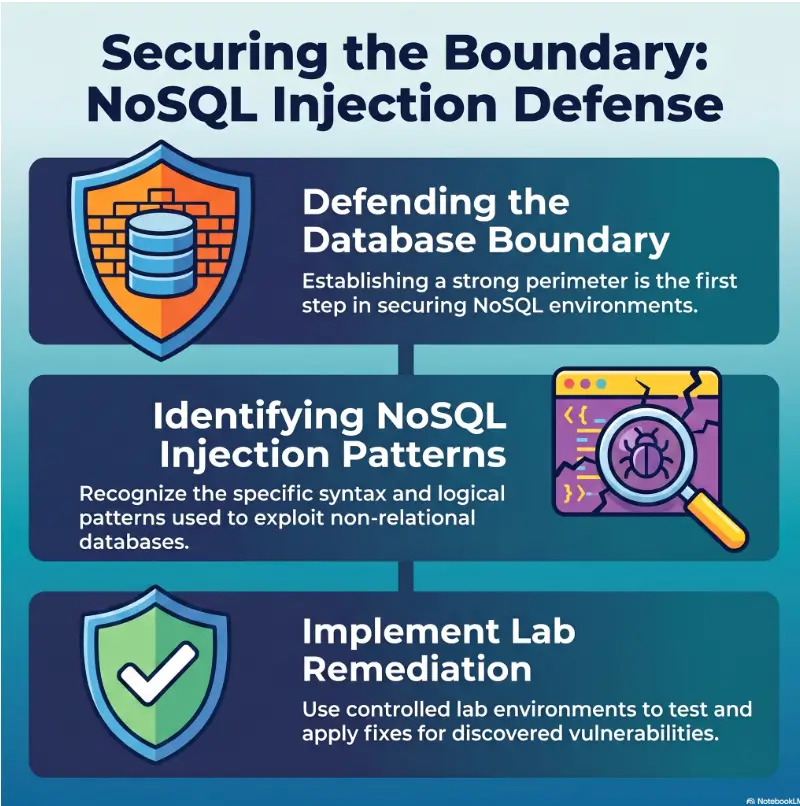
See the boundary
Follow input through parsing, validation, application code, and the database driver.
Prove the cause
Use controls, logs, and query traces instead of trusting a surprising status code.
Patch the pattern
Force expected types, construct filters in trusted code, and add regression tests.
The goal is simple: make unexpected input boring, visible, and harmless. 🧪
Snapshot
For: cybersecurity students, junior testers, developers, and lab instructors. Problem solved: understanding how NoSQL query structure changes when input types are trusted. Next: you will be able to build a reversible exercise, collect defensible evidence, choose an appropriate tool setup, and verify a real fix.
Before You Test
Use these techniques only in systems you own or have explicit written permission to assess. This article explains defensive lab patterns, evidence collection, and remediation. It does not authorize testing of public sites, employer systems, customer environments, or third-party applications. Confirm scope, preserve logs, use fictional data, and stop when the agreed success condition is reached.
Table of Contents
Who This Lab Guide Is For, and Who Should Stop Here
This guide is designed for controlled learning. It works best when the application, database, logs, and reset process are all under your control. That lets you ask the question that matters most: what did the server actually build?
Best fit: students learning secure web application testing
Beginners often meet NoSQL injection through a login lab and leave with one clever request saved in a notes file. That is a fragile victory. A stronger exercise asks you to draw the full route: request encoding, parser output, schema validation, controller logic, driver call, query result, and application response.
That workflow also fits OSCP-style preparation because it strengthens observation, note quality, and evidence discipline. Pair the exercise with a documented safe hacking lab at home so accidental traffic cannot wander onto networks you do not own.
Useful for developers reviewing API and database boundaries
Developers should read this less as an attack recipe and more as a data-contract review. The important questions are mundane and powerful: Is this field always a string? Who enforces that? Can nested objects survive parsing? Are filter names selected from an allowlist? Does rejected input reach the repository layer?
Stop if scope, ownership, or data handling is unclear
Do not test a public login page because it “looks like a lab.” Do not assume a bug bounty includes every endpoint or every test method. Do not copy production records into an intentionally vulnerable application. When permission is fuzzy, the correct technical move is to pause and clarify it.
Key takeaway
Authorization is not paperwork stapled onto the lab. It is part of the lab design, just like network isolation, dummy data, and reset scripts.
NoSQL Injection Is Not “SQL Injection Without SQL”
The shared idea is injection: untrusted input changes the meaning of an instruction sent to an interpreter. The mechanics differ because NoSQL systems may use document filters, key-value operations, graph traversals, search expressions, or database-specific query APIs rather than one common language.
Documents, operators, nested objects, and types
In a document database, a filter can be an object whose keys and values carry logic. A plain string may mean “match this exact value.” An object may mean “evaluate a condition.” An array may invoke different matching rules. The application therefore needs to protect both the content of a field and its structural type.
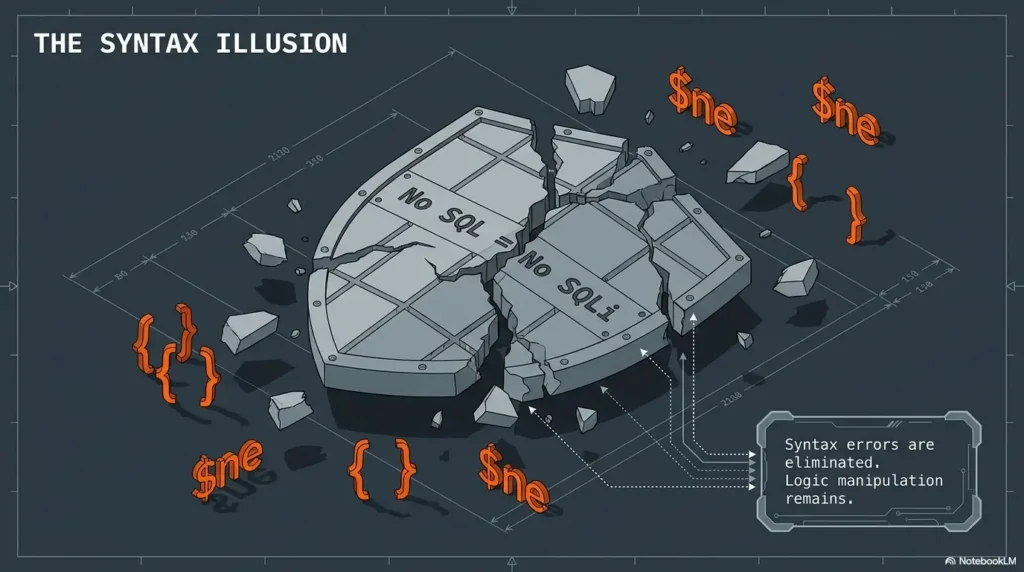
This is why removing a few suspicious characters is rarely a complete defense. A perfectly ordinary-looking JSON object can still be the wrong shape for the business action. The secure contract for a login field is not “anything serializable.” It is usually “a bounded string with a known normalization rule.”
Flexible schema does not mean unvalidated input
Flexible storage can be useful, but it does not excuse loose request handling. Database flexibility and API input rules solve different problems. Your collection may accept varied documents while a particular endpoint still requires a rigid request body.
The key distinction: malicious data versus query structure
A safe value stays a value. A dangerous boundary failure allows the caller to influence field names, operators, logical grouping, expressions, or other parts of the query plan. That difference should guide both testing and remediation.
Show me the nerdy details
Think of a query object as a small abstract syntax tree. Field names, operator keys, arrays, and nested objects are nodes that influence evaluation. When an application accepts an arbitrary object from the request and inserts it into that tree, the caller may gain control over more than a scalar value.
Database behavior is product-specific. MongoDB, for example, documents distinct comparison, logical, element, and evaluation predicates. That is why a sound test begins with the official query predicate documentation for the database used in the lab, not with a payload list copied from a different technology.
Four Lab Patterns That Reveal Most NoSQL Query Failures
Most beginner labs can be understood through four patterns. They are not universal exploit categories, but they make a useful diagnostic map. The map keeps your attention on why the query failed rather than on reproducing one magic string.
1. Operator injection: input becomes query logic
The application expects a scalar value but accepts an object that the database driver interprets as a condition. The root cause is structural trust. A controller or repository passes caller-controlled shape into a filter without forcing the intended type.
In a safe lab, the learning objective is to show that two requests containing the “same field” can arrive at the database as different types. You do not need a reusable bypass string to prove that. Parser output and a sanitized query trace are better evidence.
2. Authentication-filter manipulation: the match becomes broader
A vulnerable login route may build one database filter from both identity and secret fields. If either field can carry unexpected query structure, the final condition may no longer mean “this named user has this verified password.” It may merely locate some record that satisfies a broader condition.
3. Type confusion: strings, arrays, objects, and booleans collide
Type confusion is not always injection, but it is often the doorway. A route may compare an array to a string, coerce a boolean, accept a numeric identifier as an object, or handle an absent value differently from an empty value. The response can change even when the database never evaluates an injected operator.
That is why every test needs a control group. Compare expected input, wrong scalar type, array, object, missing field, and extra field. Then determine which layer produced each behavior.
4. Server-side expression exposure: powerful features reach user input
Some database and application stacks support expressions, scripts, regular-expression features, or dynamic evaluation. When user-controlled text reaches those features without strict constraints, the risk can exceed a simple filter bypass. Training should focus on identifying the feature boundary, documenting why it is reachable, and removing or tightly constraining that path.
Key takeaway
A changed response tells you where to look. It does not tell you which of the four patterns occurred. Confirm the parser type and final query before naming the finding.
The Hidden Boundary: Where Plain Input Becomes a Query Object
The most important moment often occurs before the database driver runs. Frameworks and middleware parse bytes into application values. A developer may see a form field in the browser while the server receives a nested object, an array, or a value transformed by coercion rules.
URL-encoded fields and bracket notation
Some parsers interpret bracketed field names as nested structures. Whether that behavior is enabled, limited, or configurable depends on the framework and parser. A lab should record the raw request and the parsed server-side value side by side. Otherwise, you are debugging a shadow puppet.
JSON bodies without schema enforcement
JSON makes types explicit, which is useful only when the application rejects the wrong ones. If an endpoint accepts any object and forwards selected pieces directly into a filter, the database may receive user-shaped structure. A request schema should reject objects where strings are expected and reject extra keys unless they are intentionally supported.
The parser and database may disagree about meaning
The framework decides what type enters application code. The driver decides how that type becomes a database operation. The database decides how the operation is evaluated. A secure review has to inspect all three contracts. Checking only the HTML form is like guarding the porch while the side door is open.
Trace the request path in five stops
- Raw request: method, content type, field names, and body bytes.
- Parser output: exact server-side types and nesting.
- Validation result: accepted fields, rejected fields, coercion, and defaults.
- Application filter: the query object after trusted code builds it.
- Database trace: operation type, sanitized predicate shape, result count, and error class.
The Request-to-Query Trace
1 · Capture
Save the raw request and content type.
2 · Parse
Record the exact runtime type.
3 · Validate
Confirm the schema rejects wrong shapes.
4 · Build
Inspect the trusted query constructor.
5 · Prove
Re-test and store a regression case.
If you cannot point to the stage where meaning changed, the finding is not finished.
A clear application map makes this easier. The guide to vulnerable web application structure can help you separate routes, middleware, services, repositories, and database calls before you begin testing.
Authentication Labs: Why “User Exists” Is Not “Password Matches”
Authentication labs attract attention because the result is easy to see: one request receives a session and another does not. That visible outcome can hide sloppy reasoning. A valid authentication decision requires an identified account, a correctly verified secret or factor, and the right session policy. Finding a record is only the first step.
How a vulnerable combined filter fails
A weak route may place identity and password-related input into one database filter, then treat any returned document as proof of authentication. If caller-controlled objects are accepted, the filter can change shape. Even without injection, querying on a raw password or mixing lookup and verification creates brittle logic and poor auditability.
// Risky illustration: unvalidated request values enter the filter.
const matchedRecord = await users.findOne({
  username: request.body.username,
  passwordField: request.body.passwordField
});

// Safer illustration, inside an async request handler.
// LoginSchema must require bounded strings and reject unknown keys.
const input = LoginSchema.parse(request.body);
const user = await users.findOne({ username: input.username });
const valid = user !== null &&
  (await verifyPassword(input.password, user.passwordHash));
// verifyPassword is a maintained password-hashing library verifier.
The safer pattern still needs rate limits, secure password hashing, session controls, and generic error messages. The important boundary is that the caller supplies a username value, not a query fragment, and password verification is performed by dedicated application logic.
Errors can reveal behavior without proving exploitation
A parser error, validation error, database type error, and authentication failure should be distinguishable in internal logs even if the public response remains generic. Different response times or body sizes may guide investigation, but they are clues, not final proof.
Illustrative example: the login route that looked fixed
A training team patched its login route by blocking keys that began with a database operator prefix. The original demonstration no longer worked, so the ticket was closed.
During review, a developer sent an array where the username should have been a string. The route still reached the repository, produced a different filter shape, and returned a database error. The famous input was blocked, but the contract remained open.
The durable fix was smaller and less dramatic: parse the body with a strict schema, disable implicit coercion for login fields, reject unknown keys, construct the lookup filter from the validated username, and verify the password separately. The team then saved tests for objects, arrays, booleans, missing fields, and extra fields.
The lesson was not “block more symbols.” It was “make one type legal and every other type impossible at the boundary.”
Read-Only Tests First: Observe Before You Modify
A clean lab starts with the least destructive observation that can answer the question. Read-only routes, fictional accounts, and reversible state reduce noise and risk. They also make your evidence easier to explain to an instructor, developer, or reviewer.
Build a control set, not a single clever request
Start with one valid request and one invalid-but-normal request. Then test a small matrix of unexpected types. Keep the field content harmless and focus on structure. Your goal is to identify whether the application rejects the input before the database layer.
| Test case | Expected secure behavior | Evidence to capture |
|---|---|---|
| Valid string | Normal application result | Status, response, parsed type, query trace |
| Wrong scalar type | Client error before repository call | Validation event and absence of database operation |
| Array instead of string | Rejected by request schema | Schema message in internal logs |
| Object instead of string | Rejected before query construction | No operator-shaped keys in database trace |
| Missing required field | Consistent client error | No lookup and no session creation |
| Unexpected extra field | Rejected or ignored by an explicit policy | Documented schema behavior |
Record more than the status code
- Request method, path, content type, and a redacted body.
- Response status, body length, message class, and timing range.
- Parsed server-side value and runtime type.
- Validation decision and rule name.
- Sanitized query shape or confirmation that no query ran.
- Database result count, error category, and transaction state.
- Lab snapshot or reset identifier.
A dramatic exploit teaches less than a clean request diff
Two requests that differ in one controlled property are easier to reason about than a long chain of transformations. Keep a structured record using a penetration-testing note system so the observation, hypothesis, evidence, and remediation remain connected.
Do Not Trust the Status Code: Confirm the Root Cause
A 200 response can represent a failed test, an application fallback, a cached page, or a broad query. A 500 response can represent parser confusion rather than injection. Naming the vulnerability from the screen alone is how false positives acquire expensive shoes.
Separate parser behavior, validation behavior, and database behavior
Ask three sequential questions. What type did the parser create? Did the validator accept it? What operation did the database receive? If the wrong type was rejected before the repository, the injection path is blocked even if the response text differs. If the wrong type reached the database, the boundary is still weak even if no account was accessed.
Use server logs and query tracing to validate the finding
Useful internal logs show a request correlation ID, validation result, route name, repository method, query duration, result count, and error class. Avoid logging passwords, tokens, complete sensitive records, or unrestricted request bodies. Evidence should illuminate the control flow without creating a new data leak.
Rate the strength of your evidence
| Evidence | What it supports | Confidence |
|---|---|---|
| Response changed | Something handled the input differently | Low |
| Parser shows unexpected object or array | The request crossed the first boundary with the wrong type | Moderate |
| Validation accepted the wrong type | The request contract is incomplete | Moderate to high |
| Sanitized query trace shows caller-shaped logic | Untrusted structure reached query construction | High |
| Control request plus repeatable query/result difference | The behavior is reproducible and attributable | High |
| Regression test fails before patch and passes after patch | The remediation addresses the demonstrated path | Very high |
Key takeaway
The best finding explains the data type, the query change, the observed impact, and the exact control that should have stopped it.
Building a Training Lab That Fails Safely
A vulnerable application is not automatically a good teaching environment. A good lab is isolated, observable, resettable, and narrowly scoped. It lets learners make mistakes without turning those mistakes into network incidents or corrupted shared data.
Isolate the application and seed fictional records
Use a disposable virtual machine or container network, restrict inbound access to the learner host, and keep the vulnerable application and database on an internal-only network without outbound access during the exercise. Bind any learner-facing published container port to localhost rather than all host interfaces. Seed fictional users, products, sessions, and logs. Never use reused passwords, real email addresses, or copied customer data.
For broader setup choices, compare host-only, NAT, and isolated virtual networks before launch. A dedicated guide to VirtualBox NAT, host-only, and bridged networking can help prevent the classic mistake of exposing a deliberately vulnerable machine to the wrong segment.
Define success conditions and reset after every exercise
Write the success condition before testing begins. A good example is: “Demonstrate that an object reaches query construction where the schema requires a string, then patch the schema and prove the repository is no longer called.” This is specific, observable, and stops well before unnecessary data access.
Keep vulnerable and remediated versions side by side
A paired design removes guesswork. Learners can compare parser settings, schema rules, query constructors, logs, and tests. Instructors can demonstrate that the same unexpected input reaches different stopping points without publishing a reusable bypass sequence.
Free versus paid tools: what is actually worth buying?
You can learn the core pattern with free local tools: a browser, an API client or intercepting proxy, application logs, database logs, a schema library, and a test runner. Paid software becomes useful when it saves team time, centralizes evidence, scans many code paths, or supports repeatable reporting. It does not replace understanding the request path.
| Setup tier | What it includes | Best for | Watch for |
|---|---|---|---|
| Good: free local lab | Disposable VM or containers, free request client, local logs, schema validation, unit tests | Students and solo developers | Manual evidence collection and inconsistent resets |
| Better: structured learner stack | Intercepting proxy features, saved collections, log dashboard, automated snapshots, CI tests | Study groups and instructors | Buying features before defining the exercise |
| Best: team-grade review | Centralized testing, code scanning, API schema enforcement, audit logs, issue tracking integration | Development teams with multiple services | Treating scanner output as proof without code or query review |
| Professional help | Scoped application-security review, threat modeling, code review, and verification | Production systems, sensitive data, or unclear architecture | Unclear statement of work, missing retest, or no evidence requirements |
Before paying for a tool or service, ask whether it can show parsed types, trace an issue to source code, export reproducible evidence, protect secrets in logs, integrate with your test runner, and distinguish a parser anomaly from a database injection flaw. The cheapest tool that answers your real question is often the best tool.
Fix the Query Boundary, Not Just the Demonstration Input
Blocking the exact input used in a lab is a patch-shaped bandage. The durable fix defines what the endpoint accepts, rejects everything else, and ensures query structure comes only from trusted application code.
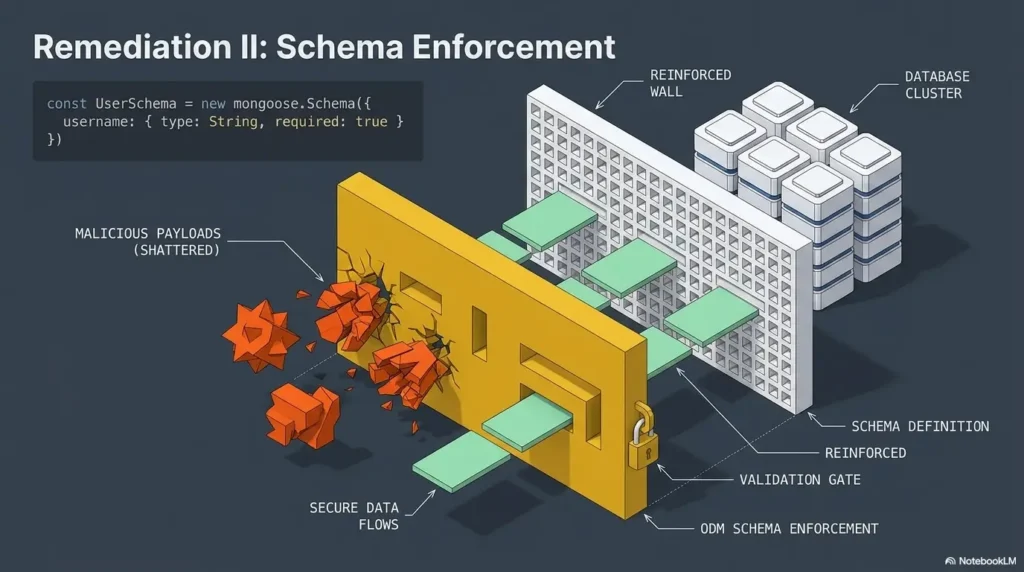
Enforce request schemas before business logic
Define required fields, scalar types, length limits, formats, normalization rules, allowed enum values, array limits, and unknown-key behavior. Prefer rejection over silent coercion for security-sensitive fields. Validation should run server-side even when the client also validates.
The OWASP Input Validation Cheat Sheet is a useful reference for allowlists, syntactic checks, semantic checks, and server-side enforcement.
Reject unexpected objects, arrays, and operator-shaped keys
When a field must be a string, reject objects and arrays before they reach the controller. When an endpoint intentionally accepts a filter object, define every allowed field and operation explicitly. Do not pass a client-provided filter wholesale to the database driver.
Construct queries from trusted application code
Extract validated scalar values, then build the filter using fixed field names and fixed operators chosen by the application. For sortable or searchable endpoints, map public option names to known internal fields. Never let a caller choose an arbitrary database field merely because the UI currently exposes only safe choices.
// SearchSchema rejects unknown keys, requires a string title,
// restricts sort to newest/oldest, and bounds a positive integer limit.
const input = SearchSchema.parse(request.query);
const allowedSorts = {
  newest: { createdAt: -1 },
  oldest: { createdAt: 1 }
};
const filter = { status: "published", title: input.title };
const sort = allowedSorts[input.sort];
const results = await articles.find(filter)
  .sort(sort)
  .limit(input.limit)
  .toArray();
Add least privilege, safe errors, and useful internal logs
The application account should have only the database permissions required by the service. Read-only routes should not quietly inherit write privileges. Public authentication messages should avoid account enumeration, while internal logs retain enough context to distinguish validation failure, lookup failure, password failure, and session failure.
Key takeaway
The secure design rule is not “remove bad characters.” It is “accept one documented shape, build query logic in trusted code, and grant the database account minimal authority.”
Verification After the Patch: Prove the Pattern Is Gone
A patch is not complete when the original demonstration stops working. It is complete when the expected request still works, wrong types fail at the intended boundary, no unsafe query is issued, neighboring routes are checked, and automated tests preserve the behavior.
Re-test the control and the malformed types
- Run the normal valid request and confirm the feature still works.
- Repeat the wrong scalar, array, object, missing-field, and extra-field tests.
- Confirm each rejected request stops before the repository or database layer.
- Check that public errors remain generic and internal logs remain useful.
- Verify no sensitive input appears in logs or traces.
Check neighboring endpoints and shared validators
The same parser, schema helper, filter builder, or repository method may be reused by account lookup, password reset, product search, reporting, and admin routes. A route-level patch can leave the shared weakness intact. Search for code paths that accept the same field or pass request objects into query functions.
Save regression tests that describe the contract
Good regression tests state the rule in plain language: “username must be a bounded string,” “unknown filter keys are rejected,” or “repository is not called when validation fails.” These tests survive framework upgrades better than tests tied only to one demonstration string.
| Patch check | Pass condition |
|---|---|
| Functional control | Valid request succeeds exactly as intended |
| Type enforcement | Objects, arrays, and invalid scalars are rejected |
| Query isolation | Rejected input produces no database operation |
| Shared-code review | Related routes use the same corrected contract |
| Privilege review | Database role permits only required operations |
| Regression coverage | Tests fail on the vulnerable version and pass on the fixed version |
| Logging review | Evidence is useful without exposing secrets |
For teams building a repeatable development process, the NIST Secure Software Development Framework offers a broader structure for preparing, protecting, producing, and responding across the software life cycle.
FAQ: NoSQL Injection Patterns in Training Labs
What is the simplest explanation of NoSQL injection?
NoSQL injection occurs when untrusted input changes the structure or logic of a NoSQL database operation instead of remaining an ordinary value. The exact behavior depends on the database, driver, parser, and application code.
Is NoSQL injection possible in MongoDB-style applications?
Yes. Document filters can contain operators, nested objects, arrays, and expressions. Risk appears when user-controlled structure reaches those query features without strict validation and trusted query construction. MongoDB is one example; other NoSQL products have different models and controls.
How is NoSQL injection different from traditional SQL injection?
Both are injection flaws, but traditional SQL injection usually concerns SQL syntax and parameters. NoSQL injection may involve object structure, operator keys, type confusion, expressions, or database-specific APIs. Tests and fixes must match the actual stack.
Can JSON request bodies cause NoSQL injection?
JSON can carry strings, numbers, booleans, arrays, objects, and null values. A risk exists when an endpoint expects a scalar but accepts an object or array that later influences a query. Strict server-side schemas should enforce the intended type and reject unknown structure.
Why does input type matter in NoSQL security testing?
Because the same field name can carry very different meaning as a string, object, array, or boolean. Type changes may alter parser behavior, validation, application branching, or database query evaluation.
Are authentication forms common NoSQL injection lab targets?
Yes, because login outcomes are visible and combined filters are easy to teach. A responsible lab uses dummy accounts, isolates the network, avoids real credentials, and emphasizes separate account lookup and password verification.
How can developers prevent query operators from entering user input?
Enforce strict schemas, reject objects where scalars are expected, reject unknown keys, map public filter options to fixed internal fields, and build the final database query in trusted application code. Do not forward arbitrary client filters to the driver.
What evidence confirms a real NoSQL injection vulnerability?
Strong evidence includes a repeatable control comparison, the parsed unexpected type, validation acceptance, a sanitized query trace showing caller-influenced logic, and a regression test that fails before remediation and passes afterward.
Is it safe to practice NoSQL injection on a local application?
It can be safe when the application is intentionally vulnerable, isolated from untrusted networks, populated with fictional data, and resettable. Local does not automatically mean isolated, so verify the virtual network mode and bound interfaces.
Should a lab include both vulnerable and patched versions?
Yes. Side-by-side versions make the stopping point visible and let learners prove that validation, query construction, permissions, and tests changed for the right reason.
Your 15-Minute Next Step: Trace One Field End to End
Choose one disposable local endpoint and one ordinary field, such as a username or product title. Send a valid string, record the parsed type, and note the final query shape. Then send the same field as one unexpected harmless type, such as an array or object, without attempting to access another account or record.
Add a schema rule that forces the intended scalar type and rejects unknown keys. Re-run both requests. The valid control should still work, while the unexpected type should stop before the repository. Save that result as a regression test with a plain-English name.
That small exercise closes the loop: you observed the boundary, proved where meaning changed, repaired the contract, and left behind evidence that future code can understand. No fireworks required. Just one field, one trace, and one quieter database.
Last reviewed: 2026-10-13
Technical guidance updated: 2026-10-13. Restored readable code examples, awaited password verification, materialized the MongoDB cursor, specified strict schema constraints, repaired table-of-contents links, and clarified lab isolation and the illustrative story.
A valid filter still needs a tenant boundary
Schema validation and fixed operators prevent important injection paths, but do not decide which records the caller may access. In a multi-tenant application, derive the tenant boundary from authenticated server-side context and enforce it in the data-access path. Do not trust a caller-supplied tenant ID merely because it is a valid string.
The search snippet above is illustrative, not a complete production authorization implementation. Add tests with two synthetic tenants: each permitted query returns only its own authorized records, and a request for another tenant is denied without leaking records or changing state. Preserve positive controls so an empty database is not mistaken for successful isolation. Use the OWASP NoSQL security guidance alongside application-specific access requirements.
Editorial review: 16 October 2026. Examples are illustrative; this review does not represent an audit or live control test.
NoSQL query-boundary review
Use this when: you are an authorized learner tracing one input field through a contained application. Copy these fields into your notes and replace each prompt with a dated response. Keep assumptions and unresolved questions visible.
| Field | What to record | Your evidence / owner / next check |
|---|---|---|
| Input boundary | Record the expected type, parser behavior and accepted structure. | To complete |
| Query construction | Identify the driver operation and where input enters its arguments. | To complete |
| Authorization context | Keep the tenant, ownership and allowed operation with the test. | To complete |
| Result and repair | Record expected and observed behavior, correction and untested variants. | To complete |
Next action: Trace the field into the actual driver call before attributing the behavior to a query flaw. Mark the relevant row confirmed, provisional or unresolved. Keep the supporting record, responsible person and next check beside it so another reader can continue the work without treating an assumption as a result.
This is a blank practice record, not a report of a test performed by Kioptrix. Add the actual versions, approved conditions and observations from your own session.
Worksheet change record — October 20, 2026
Added this nosql query-boundary review with four article-specific fields and an evidence-based next action. Existing source notes retain their own review dates. This addition is not a fresh verification of every statement or a newly executed test.