WordPress Hosting Security Comparison
What Actually Protects Your Site?
Not Just the SSL Badge
A hacked WordPress site rarely announces itself with thunder. More often, it starts quietly: a strange redirect, a spammy pharmacy page in search results, a client email that begins with “Are you aware…?” By then, the cheap hosting plan that looked harmless at checkout may feel like a paper umbrella in a server-room storm.
This guide compares WordPress hosting security by what matters when things go wrong: isolation, firewalls, backups, patching, malware cleanup, DDoS protection, and recovery speed. Not glittery feature lists. Not “military-grade” fog. Just the practical checks that help bloggers, agencies, WooCommerce owners, and small businesses choose a host with fewer blind spots.
You will not find a magic host that makes security effortless. You will find a sharper way to compare providers, ask better sales questions, avoid expensive add-on traps, and build a calmer plan before your site becomes someone else’s playground.
Compare real defenses
WAFs, isolation, backups, updates, and incident response explained in plain English.
Avoid costly mistakes
Spot the security claims that sound strong but collapse under basic questions.
Choose with evidence
Use a 10-minute checklist before switching, upgrading, or signing a client contract.
The useful question is not “Is this host secure?” It is “What happens when one layer fails?” 🛡️
Snapshot
This article is for website owners, bloggers, agencies, and small businesses comparing WordPress hosting security before buying or switching. It helps you separate baseline features from meaningful protection, compare free versus paid security options, ask better provider questions, and run a fast audit before trusting a host with business-critical content.
Table of Contents
Before You Act: Security Advice Without False Promises
WordPress hosting security is a risk-reduction decision, not a guarantee machine. A stronger host can make attacks harder, limit damage, and speed up recovery, but it cannot cancel out weak passwords, abandoned plugins, careless admin access, or a missing response plan.
Use this guide as a comparison framework. Before buying, switching, or upgrading, confirm the details in the host’s documentation, support chat, service terms, and backup policy. If your site handles payments, personal data, regulated information, or client revenue, consider advice from a qualified security professional before making a major change.
Before-you-act note
No hosting provider can promise that your WordPress site will never be hacked. The better question is whether the host helps you prevent common attacks, contain failures, restore clean backups, and document what happened without turning recovery into a scavenger hunt.
Security first, price second?
Price matters. A tiny blog should not buy a fortress it does not need. But if your site earns ad revenue, collects leads, supports clients, or processes orders, the cheapest plan may be expensive in disguise.
A compromised WordPress site can cost you search visibility, affiliate income, customer trust, emergency developer fees, and days of distracted cleanup. That is why this comparison starts with protection and recovery before storage, bandwidth, or coupon pricing.
What this guide can and cannot do
This guide can help you compare hosting security features, understand provider language, prepare buying questions, and spot weak promises. It cannot inspect a provider’s private infrastructure or certify that a host is safe for your specific business.
For a higher-risk site, such as a busy WooCommerce store or agency network, combine hosting due diligence with your own security testing strategy. If you need a framework for that, this related guide on building a security testing strategy can help you think beyond hosting alone.
Know Your Threat Model Before You Compare Hosts
The best WordPress host for a recipe blog may not be the best host for a WooCommerce shop. Security only makes sense when it is matched to what you are protecting. Otherwise, you end up buying smoke alarms for a boat and life jackets for a library.
Start with your threat model: who might attack your site, what they would want, how much damage they could cause, and how quickly you need to recover.
Solo bloggers vs ecommerce stores vs client sites
A solo blogger monetized through display ads mostly needs uptime, clean backups, malware prevention, and quick search reputation recovery. A WooCommerce store needs stronger protection around payments, login abuse, customer data, and order continuity.
An agency has a different headache: one weak client site can become a reputational stain across the whole account. If you manage client sites, account isolation and repeatable restore processes become far more important than a glossy dashboard.
Key takeaway
A “secure host” is not one fixed thing. A hobby blog, lead-generation site, online store, and agency account need different security depth, backup frequency, and support response expectations.
Credential theft, plugin exploits, and brute-force attacks
Many WordPress incidents begin in ordinary places: reused admin passwords, vulnerable plugins, outdated themes, exposed login pages, insecure file permissions, and weak third-party access. The attack does not need to be brilliant. It only needs one unlocked window.
When comparing hosts, look for protections that reduce those common paths: login rate limiting, WAF rules, malware scanning, file integrity monitoring, automatic updates, staging environments, and backup restoration that has been tested rather than merely advertised.
A simple WordPress hosting risk map
| Site type | Primary risk | Security features to prioritize | Paid upgrade may be worth it when… |
|---|---|---|---|
| Personal blog | Defacement, spam injection, search penalties | Daily backups, malware scan, basic WAF, SSL, auto updates | The site earns steady ad or affiliate income |
| Lead-generation site | Lost inquiries, form abuse, brand trust damage | WAF, bot filtering, uptime monitoring, clean restore process | Each missed lead has clear business value |
| WooCommerce store | Checkout disruption, customer data exposure, downtime | Stronger isolation, frequent backups, DDoS mitigation, rapid support | Orders are time-sensitive or traffic spikes often |
| Agency account | Cross-site contamination, client churn, support overload | Account isolation, centralized backups, access control, incident process | Multiple client sites share one provider or team |
The Isolation Test That Separates Good Hosts From Great Ones
Shared hosting is not automatically unsafe. It is common, affordable, and often enough for smaller sites. The question is whether one customer’s disaster can spill into your account.
Account isolation is the quiet security feature that rarely gets a dramatic homepage banner, yet it may matter more than half the features that do.
Shared hosting’s biggest security weakness
On low-cost shared hosting, many accounts may live on the same server. If the provider does not isolate accounts well, a compromised neighboring account can increase risk for others. It is the apartment-building problem: your door can be locked, but the hallway still matters.
Ask whether your account is isolated at the user, process, file system, and resource level. You do not need to become a systems engineer. You do need a support answer that is more specific than “we take security seriously.”
Containerized environments and account isolation explained
Some managed WordPress hosts use containerized or otherwise isolated environments so each site has its own boundaries. This can reduce cross-account risk, contain resource spikes, and make cleanup easier after an incident.
Isolation does not fix a vulnerable plugin inside your site. It helps limit blast radius. That phrase may sound dramatic, but it is exactly the right mental model: when something breaks, how far can the broken glass travel?
Provider question to ask
“If another customer on the same infrastructure is compromised, what prevents their account from accessing my files, database, or resources?” A strong provider should answer with architecture, not adjectives.
What happens when another customer gets hacked?
A good host can explain containment. A weaker host may only explain cleanup after the fact. You want to know whether compromised neighboring accounts are quarantined, whether suspicious file activity is flagged, and whether support can identify affected accounts quickly.
This is especially important for agencies. If ten client sites sit in one poorly separated environment, one weak plugin can turn into a week of grim coffee and apology emails.
Firewall Claims Decoded: WAF, Bots, and Virtual Patching
“Firewall included” sounds comforting, but it can mean several different things. Some firewalls protect the network. Some inspect web traffic. Some block obvious bot noise. Some are little more than a checkbox wearing a velvet cape.
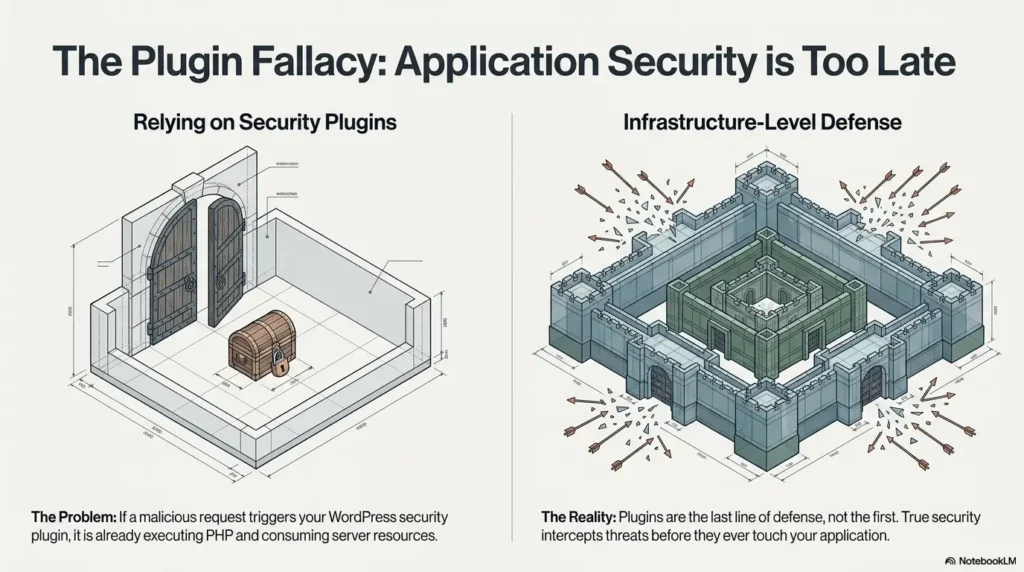
For WordPress, the most relevant firewall layer is usually a web application firewall, often shortened to WAF. It helps filter malicious HTTP requests before they reach your WordPress application.
Network firewalls vs application firewalls
A network firewall can help control traffic at the infrastructure level. A WAF looks closer at web requests, which is where many WordPress attacks arrive: login attempts, exploit strings, suspicious query patterns, and automated probes.
Both layers can be useful, but they solve different problems. If a host only says “firewall” without describing the layer, rules, or managed updates, ask for detail before giving that feature too much weight.
Managed WAF rules and virtual patching
Managed WAF rules matter because WordPress attack patterns change as plugin and theme vulnerabilities are discovered. Virtual patching means the firewall may block exploit attempts before you have fully patched the vulnerable component.
This does not replace updates. It buys time. Think of it as putting a guard at the hallway while you repair the broken lock.
For a deeper comparison of protective layers, see this related guide on WAF vs RASP vs CSP for startups. The vocabulary overlaps with WordPress hosting decisions more than many buyers realize.
Bot filtering and automated attack prevention
Bot filtering can reduce junk traffic, login attempts, scraping, spam submissions, and noisy probes. For smaller sites, this may feel invisible when working well. For high-traffic sites, it can protect performance and reduce support headaches.
Ask whether bot protection is included by default, whether it covers the WordPress login path, whether it can create false positives, and how you can review or adjust blocked traffic if legitimate users complain.
Which firewall features actually matter?
| Firewall claim | What to ask | Why it matters |
|---|---|---|
| “WAF included” | Is it managed, updated, and tuned for WordPress? | Static rules age quickly and may miss common attack patterns. |
| “Bot protection” | Does it cover login, comments, forms, and checkout? | Bot noise can drain resources and create fake leads or orders. |
| “DDoS protection” | What level is included, and when does mitigation begin? | Marketing language may hide plan limits or paid escalation. |
| “Virtual patching” | Do rules target known WordPress plugin and theme exploits? | This can reduce risk while you test and deploy updates. |
Backups Under Stress: The Restore Test Buyers Forget
Backups are easy to promise and painful to test. Many hosting plans advertise daily backups, but the real question is whether you can restore the right clean version quickly, without accidentally bringing the infection back with it.
A backup is not a comfort object. It is a recovery tool. Treat it accordingly.
Backup frequency versus recovery readiness
Daily backups may be enough for a small content site. They may be too slow for an active store receiving orders all day. If your site changes often, ask how frequently backups run and whether files and databases are captured together.
Recovery readiness means you know how to restore, what the restore includes, how long it usually takes, and whether you can preview or stage the restored version before replacing the live site.
Offsite backups and ransomware resilience
If backups sit in the same environment as the compromised site, they may be exposed to the same disaster. Offsite backups reduce that risk. For business-critical sites, also ask whether backups are immutable, separately authenticated, or protected from accidental deletion.
You do not need every advanced feature on a modest blog. But relying on a single backup location is a gamble with a very boring name.
Key takeaway
When comparing WordPress hosting security, treat backups as a restore workflow, not a storage feature. A host that backs up daily but makes restoration slow, unclear, or expensive may not reduce your real risk enough.
Recovery point objective in plain English
Recovery point objective, or RPO, means how much data you can afford to lose. If your backup runs once per day, you may lose up to a day of changes. For a blogger, that may mean one post draft. For a store, it could mean orders, inventory changes, and customer messages.
Ask yourself: “If I had to restore yesterday’s version right now, what would I lose?” That single question often reveals whether your hosting plan matches your site’s real value.
The restore test most buyers ignore
| Backup question | Good answer | Warning sign |
|---|---|---|
| How often are backups made? | Clear schedule by plan, including database and files | Vague “regular backups” language |
| Where are backups stored? | Offsite or separately protected backup storage | Only stored on the same server |
| Can I restore myself? | One-click or support-assisted restore with documentation | Restore requires unclear paid support |
| Can I restore to staging first? | Yes, especially for business sites | Live overwrite is the only easy option |
| How long are backups retained? | Retention period stated plainly | Retention buried or plan-dependent |
Malware Cleanup and Incident Response: Read the Promise Slowly
Many hosts mention malware scanning. Fewer include malware removal. Fewer still define how fast they respond, what counts as cleanup, and whether recurring infections are covered.
This is where fine print grows teeth. Read it before you need it.
Free malware removal versus paid remediation
Some hosts scan for malware but charge extra to remove it. Others include cleanup on managed plans. Some only restore a backup, which may not help if the clean backup window has already passed.
Ask whether malware cleanup includes file removal, database cleanup, vulnerable plugin identification, password reset guidance, blocklist support, and recommendations to prevent reinfection.
What hosts define as a security incident
A host may define an incident narrowly. For example, they may help if server infrastructure is affected but not if your outdated plugin caused the problem. That distinction matters because WordPress incidents often live in the gray area between host responsibility and site-owner responsibility.
If your business relies on the site, ask for the support boundary in writing. “What do you fix, what do I fix, and what costs extra?” is not rude. It is adult supervision for your budget.
Response-time guarantees worth paying for
For hobby sites, standard support may be enough. For revenue sites, response time matters. A hacked homepage during a launch, sale, or client campaign can burn money while everyone waits for a ticket reply.
If you manage multiple sites, you may also need a separate response relationship. This guide on incident response retainers explains when outside help may be more useful than hoping your host handles every detail.
Real-world example: the agency restore that was not really a restore
A small agency moved twelve client sites to a cheaper shared plan. The dashboard looked clean. The plan included SSL, daily backups, malware scanning, and “expert support.” On paper, it seemed efficient.
Then one client’s outdated form plugin was exploited. The host flagged malware and suspended the site. The agency opened a ticket and learned that scanning was included, but cleanup was a paid add-on. The latest backup also contained infected files.
The painful part was not the fee. It was the confusion. No one knew which backup was clean, who owned cleanup, or whether other client sites were affected.
The lesson is plain: before you compare prices, compare the incident workflow. A cheap plan with unclear recovery can turn one vulnerable plugin into a full-week fog machine.
SSL Is the Door Lock, Not the Whole House
HTTPS is important: modern connections use TLS, although hosts often still call certificates “SSL.” HTTPS encrypts traffic and authenticates the connection to your domain when correctly configured. It does not certify that the site or its software is safe.
A site can have a perfect padlock icon and still be vulnerable to plugin exploits, stolen admin credentials, malicious file uploads, or weak backup practices.
Why SSL is now the minimum standard
Any serious WordPress host should provide SSL support. For many sites, free automated SSL is normal. If a host treats SSL as a premium security miracle, keep your eyebrow raised.
SSL belongs in the baseline column. It should be present, easy to renew, and correctly configured, but it should not distract you from deeper controls.
What SSL does not protect against
- Vulnerable WordPress plugins or themes
- Weak administrator passwords
- Compromised hosting accounts
- Malware already inside site files
- Bad file permissions
- Spam form submissions
- Infected backups
SSL protects the tunnel. It does not inspect everything traveling through the tunnel, and it does not decide whether the building at the end is safe.
Security features commonly mistaken for SSL benefits
Buyers often bundle many security ideas into “the site is secure because it has HTTPS.” In reality, HTTPS is only one layer. You still need WAF rules, updates, access control, backups, malware detection, and recovery planning.
For official hardening guidance, WordPress maintains a practical security document that is worth bookmarking before you choose a host or configure a new site.
Update Management: A Common WordPress Security Gap
Many WordPress security problems begin with software that should have been updated. Core, plugins, themes, PHP versions, and server packages all age. Some age gracefully. Some become unlocked doors with version numbers.
Managed WordPress hosting can help, but “managed” does not always mean the host manages every plugin, theme, custom code change, and compatibility test for you.
Automatic core updates and patch deployment
Ask whether WordPress core updates are automatic, whether security releases are handled differently from major feature releases, and whether you can delay updates briefly for testing. The best setup balances speed with caution.
A news site with many plugins may need staging tests before major updates. A simple blog may benefit from faster automatic updates because the compatibility risk is lower.
Plugin vulnerabilities and delayed patching
Plugins are the lively market square of WordPress: useful, crowded, and occasionally chaotic. A host may alert you to vulnerable plugins, but you may still be responsible for replacing, updating, or removing them.
Look for vulnerability alerts, safe update tooling, staging environments, rollback options, and clear guidance when an abandoned plugin becomes risky.
Show me the nerdy details
A practical WordPress update process has four layers: detection, testing, deployment, and rollback. Detection identifies outdated or vulnerable components. Testing checks whether updates break layouts, checkout, forms, or custom code. Deployment applies updates in a controlled way. Rollback lets you recover quickly if the update causes trouble.
For higher-value sites, ask whether the host supports staging, automatic backups before updates, plugin vulnerability alerts, PHP version management, and restore points. Also ask whether the provider updates server-side software, not only WordPress itself.
The strongest setup is boring in the best way: updates happen, failures are reversible, and no one has to perform digital archaeology at midnight.
Safe update testing environments
Staging environments let you test updates before pushing changes live. This is especially useful for WooCommerce, membership sites, learning platforms, or any site where one broken plugin can affect money, logins, or customer trust.
If a provider includes staging only on higher plans, compare the upgrade cost against the real cost of broken checkout pages, lost leads, or emergency developer time.
Good, Better, Best WordPress Hosting Security Setup
Not every site needs premium managed hosting. The smarter move is matching the security setup to the site’s business impact. A tiny personal blog and a six-figure WooCommerce store should not be shopping from the same fear basket.
Use the table below as a realistic comparison, not a universal buying rule.
| Setup | Best for | Security features to expect | Budget logic |
|---|---|---|---|
| Good | Small blogs, simple brochure sites, early projects | SSL, daily backups, basic malware scanning, auto core updates, support documentation | Low cost is reasonable when downtime has limited business impact |
| Better | AdSense blogs, lead-generation sites, freelancers, small business sites | Managed WAF, offsite backups, staging, plugin alerts, stronger login protection, clear restore process | Worth considering when traffic or leads have measurable value |
| Best | WooCommerce, agencies, membership sites, high-traffic publishers | Strong account isolation, frequent backups, DDoS mitigation, malware cleanup, priority support, incident workflow | Premium cost may be justified when downtime, cleanup, or reputation damage is expensive |
Free tools versus paid security services
Free security plugins and basic hosting controls can be enough for low-risk sites. They may help with login limits, basic scans, and simple hardening. The tradeoff is that you are usually responsible for configuration, monitoring, interpretation, and cleanup.
Paid hosting security can make sense when it reduces operational work, adds expert remediation, or shortens recovery. Do not pay for vague “protection.” Pay for specific outcomes: faster restores, managed rules, cleanup support, staging, backup retention, and clearer accountability.
DIY vs professional help
| Situation | DIY may be enough when… | Professional help may be worth considering when… |
|---|---|---|
| New blog | You use few plugins and can rebuild quickly | The site already earns meaningful monthly revenue |
| Small business site | The site is mostly informational and backed up | Forms, bookings, or leads drive sales |
| WooCommerce store | Rarely, only for very small test stores | Orders, customer accounts, or inventory are active |
| Agency portfolio | You manage only one or two low-risk sites | You manage client sites under contract |
A simple framework for comparing providers
WordPress Host Security Flow
1. Risk
What would downtime, malware, or data loss cost?
2. Isolation
Can one account contaminate another?
3. Filtering
Does the WAF block common web attacks?
4. Recovery
Can you restore a clean copy quickly?
5. Updates
Are patches tested, deployed, and reversible?
6. Response
Who cleans up, how fast, and at what cost?
Common Shortcuts That Create Bigger Risks
Security shortcuts often feel sensible in the moment. You disable a feature to improve speed. You delay an update because the site is busy. You share one admin account because it is convenient. Then time passes, and convenience quietly becomes liability.
Using outdated premium plugins indefinitely
Premium plugins can become risky when licenses expire and updates stop. The plugin may still work, which makes the danger easy to ignore. Functionality is not the same as safety.
Before choosing a host, check whether it alerts you to vulnerable or outdated plugins. Before renewing a plugin, ask whether it is still maintained, whether alternatives exist, and whether your site truly needs it.
Sharing admin accounts across team members
Shared admin accounts make investigation harder. If something changes, you cannot easily tell who did it. Every real user should have their own account, appropriate permissions, and multi-factor authentication where possible.
Agencies should treat this as basic hygiene. Client sites deserve individual access records, not a communal password that has wandered through three inboxes and a spreadsheet.
Disabling security features to improve speed
Performance matters for user experience and SEO, but disabling security controls without understanding the tradeoff is risky. If a WAF rule, bot filter, or scan appears to slow the site, ask support for tuning options before turning it off completely.
Speed and security should be tuned together. A fast compromised site is still a compromised site, just wearing running shoes.
Key takeaway
The riskiest WordPress security choices are often ordinary: reused passwords, stale plugins, untested backups, vague support promises, and turning off protection because something felt slightly inconvenient.
Relying on a single backup location
One backup location is better than none, but it is not ideal for important sites. If the backup is deleted, corrupted, infected, or inaccessible during an outage, your recovery plan becomes a shrug in formal clothing.
For business sites, consider keeping a separate backup solution in addition to host backups. It does not need to be fancy. It needs to be restorable.
10-Minute Security Checklist Before You Switch Hosts
Before you buy a WordPress hosting plan, run the same checklist against every provider. This keeps you from comparing one host’s marketing page to another host’s technical documentation, which is how confusion sneaks in wearing polished shoes.
Questions to ask before purchasing
- Is SSL included and automatically renewed?
- Is a managed WAF included, or is it a paid add-on?
- How are WordPress core, plugin, theme, and PHP updates handled?
- Are accounts isolated from other customers on shared infrastructure?
- How often are backups created, where are they stored, and how long are they retained?
- Can I restore to staging before going live?
- Is malware cleanup included or only scanning?
- What DDoS protection is included at my plan level?
- What support response time applies during a security incident?
- What security responsibilities remain mine?
Evidence worth verifying in documentation
Look for documentation pages, support knowledge base articles, plan comparison tables, terms of service, backup retention policies, and support scope language. Sales pages are useful for orientation, but documentation is where the seams show.
If you read security documentation often, this guide on how to read a penetration test report can also sharpen how you evaluate claims, findings, and remediation language.
Security benchmarks to compare side by side
| Benchmark | 0 points | 1 point | 2 points |
|---|---|---|---|
| Backups | No clear policy | Daily backups only | Offsite, retained, easy restore |
| WAF | Not included | Basic or unclear firewall | Managed WAF with WordPress-focused rules |
| Isolation | Not explained | Some account separation | Clear account or container isolation |
| Updates | Mostly manual | Core updates handled | Core, plugin alerts, staging, rollback options |
| Malware response | Scanning only | Paid cleanup available | Cleanup scope and response time defined |
| Support | General tickets only | Priority available | Security escalation path stated |
A provider does not need a perfect score for every site. But if your site earns money, handles customer activity, or supports clients, a low score should change either your plan choice or your risk expectations.
Red flags that deserve immediate caution
- Security language that never explains responsibility boundaries
- Backups advertised without retention or restore details
- Malware scanning included but cleanup hidden behind unclear fees
- No clear staging or rollback path for important sites
- Support unable to explain account isolation
- “Managed WordPress” used without update scope details
- Security add-ons priced separately but not explained clearly
FAQ
Which WordPress hosting provider is considered the most secure?
There is no single most secure WordPress host for every site. The better choice depends on your threat model, budget, traffic, business impact, update needs, backup expectations, and support requirements. Compare providers by isolation, WAF quality, backup restoration, malware cleanup, DDoS protection, and response process.
Is managed WordPress hosting safer than shared hosting?
Managed WordPress hosting is often safer for business sites because it may include updates, WordPress-tuned infrastructure, staging, backups, and better support. But “managed” is not a fixed standard. Some shared plans with good isolation and backups may be suitable for lower-risk sites, while weak managed plans may still leave major gaps.
Do I still need a security plugin if my host provides protection?
Often, yes, but it depends on what your host already covers. A host-level WAF, backups, and malware scanning may reduce the need for heavy plugins, while a lightweight security plugin may still help with login protection, file monitoring, or alerts. Avoid stacking tools blindly, because overlapping features can cause noise or performance issues.
What security features should every WordPress host include?
Every serious WordPress host should include SSL support, secure server configuration, backups, malware detection, update guidance, access controls, and support documentation. For business sites, also compare managed WAF rules, account isolation, offsite backups, staging, DDoS mitigation, and defined malware cleanup.
How important are automatic backups?
Automatic backups are essential, but they are only useful if you can restore the right clean version quickly. Compare frequency, retention, storage location, restore method, and whether you can test a restore before replacing the live site.
Can hosting alone prevent WordPress hacks?
No. Hosting can reduce risk and improve recovery, but site owners still need strong passwords, careful plugin choices, updates, least-privilege user access, and sensible monitoring. Security works best as layers, not as one heroic purchase.
What is account isolation in WordPress hosting?
Account isolation means one hosting account or site is separated from others at the file, process, user, or container level. Good isolation reduces the chance that another customer’s compromised site can affect yours on shared infrastructure.
Are VPS servers always more secure than shared hosting?
No. A VPS can provide more control and separation, but it also requires proper configuration and maintenance. A poorly managed VPS may be less safe than a well-managed WordPress hosting plan. Choose based on skill, support, update management, monitoring, and recovery needs.
How often should WordPress sites be backed up?
Simple sites may be fine with daily backups. Active ecommerce, membership, booking, or publisher sites may need more frequent backups because orders, user activity, or content changes happen throughout the day. Match backup frequency to how much data you can afford to lose.
What should I do immediately after a hosting-related security incident?
Document what you see, contact the host, preserve logs if available, change passwords, review admin users, identify recent plugin or theme changes, scan files, and confirm your clean restore point. Avoid deleting evidence too quickly if you may need professional investigation.
Your 15-Minute Next Step: Score the Host Before You Pay
The calmest way to choose secure WordPress hosting is not to read twenty more reviews. It is to score two or three providers against the same questions while your head is still clear.
Open each provider’s security, backup, and support documentation. Give each one a simple score for WAF, isolation, backups, updates, malware cleanup, and incident support. Then write one sentence: “My biggest remaining risk is…”
That sentence is the tiny lantern. It tells you whether you need a better plan, a separate backup tool, a developer review, a security plugin, a cleaner update process, or simply a more honest expectation of what your budget buys.
15-minute action
- Choose your top three hosting candidates.
- Score each one from 0 to 12 using the scorecard above.
- Find the weakest category for your current site.
- Ask support one specific question about that weakness.
- Do not switch until you know how to restore a clean backup.
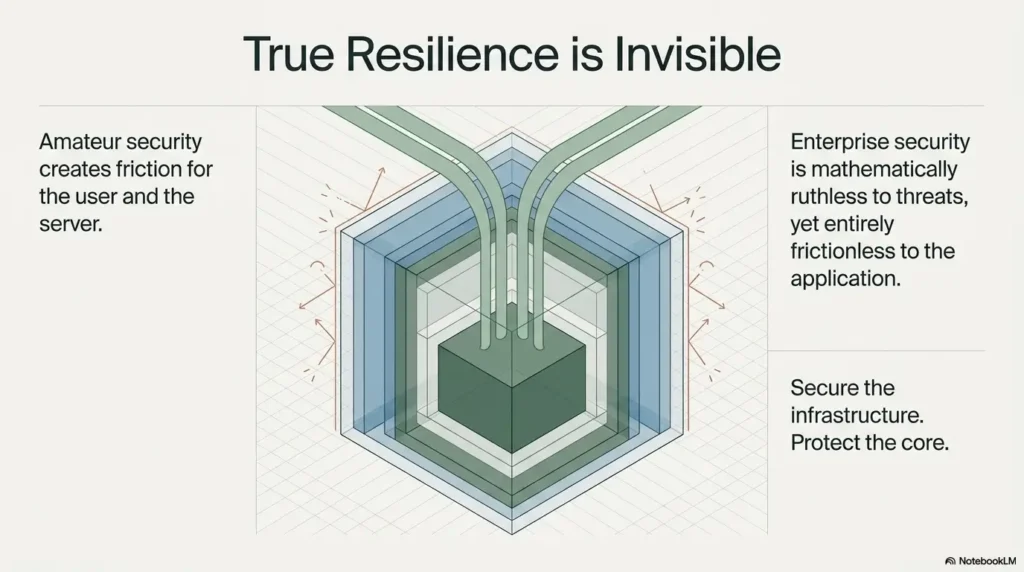
If you remember only one thing, let it be this: WordPress hosting security is not the loudest promise on the pricing page. It is the quiet evidence that prevention, containment, and recovery have been thought through before your site needs rescuing.
Last reviewed: 2026-07
Technical guidance updated: 2026-10-13. Clarified HTTPS/TLS protection, removed an unsupported majority claim, and repaired table-of-contents links.