


Mastering Kioptrix: Moving from Drift to Clarity
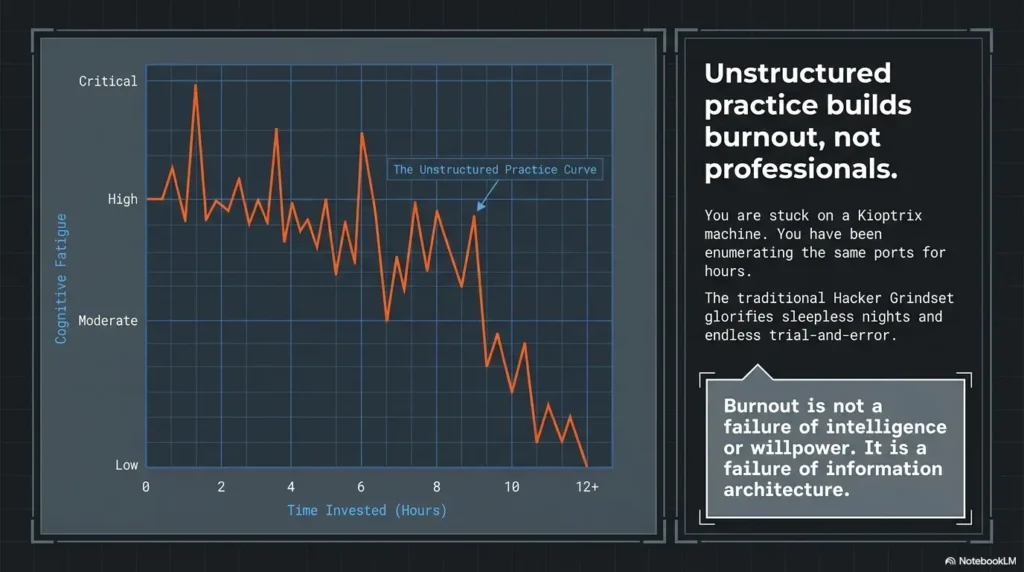
Kioptrix Level has a talent for turning a 60-minute practice session into a three-hour fog bank. Not because the box is massive, but because one clue multiplies into five tabs, two rescans, and a quiet urge to keep going long after your thinking has gone soft.
That is where many learners burn out. Not at the exploit stage, but earlier, when enumeration, note-taking, and tool choices start sprawling wider than attention can comfortably hold. The result is a session that feels busy, technical, and strangely hollow.
Keep practicing that way, and Kioptrix stops feeling like training and starts feeling like interest payments on confusion.
A better Kioptrix practice session is narrower, calmer, and far more repeatable. This guide helps you set a real win condition, manage cognitive load, use time-boxing without killing momentum, and end with notes that make the next session easier instead of heavier.
The method is simple, but not flimsy. It is built around how real progress usually happens in labs: observe carefully, test one branch at a time, document the reasoning, and stop before fatigue starts impersonating grit.
Because burnout rarely begins with failure.
It begins with drift.
And that is fixable.
Here is how to finish Kioptrix Level sessions with more clarity, less sprawl, and enough energy left to come back tomorrow.
Fast Answer: How to finish Kioptrix Level practice sessions without burning out comes down to narrowing the win condition before you begin. Do not treat every session like a full compromise marathon. Set one objective, cap your time, log what you learned, and stop while your thinking is still clean. The goal is not heroic exhaustion. It is building a repeatable workflow you can return to tomorrow.
Table of Contents
Burnout starts early, not late
Why Kioptrix can feel “small” but still drain your brain
Kioptrix is often introduced as a classic beginner box, which is true in one sense and slightly rude in another. Beginner-friendly does not mean low-friction. A compact machine can still ask you to observe carefully, sequence your actions well, and resist the temptation to confuse activity with progress. That combination is mentally expensive.
I have seen learners sit down assuming they will “just poke around for 30 minutes,” then look up 2 hours later with twenty tabs open and a memory full of half-formed clues. The box did not suddenly become enormous. The session did. That difference matters. A good practice routine respects mental load the way a good runner respects pace. Too fast too early, and the last mile turns into a negotiation.
The first drain is not failure. It is friction. You are making dozens of small decisions: what to scan, what to ignore, whether a service matters, whether a result is noise, whether a dead end is actually dead. That cognitive overhead can tire you before anything dramatic happens.
The real trap is cognitive sprawl, not technical difficulty
Most early burnout in labs comes from sprawl. One clue produces three possible actions. One action produces two more tools. Each tool produces more output than you can calmly process. Suddenly the workbench looks like a garage after a storm. Not impossible to fix, just not where clean thinking thrives.
This is why some learners feel strangely exhausted after a session that, on paper, did not include any advanced exploitation at all. They were not defeated by technical depth. They were defeated by decision clutter. That is a much more hopeful problem, because it is fixable with structure.
A small example: you run a basic scan, notice a web service, then immediately open a browser, start a directory brute force, search for historical CVEs, rerun the scan with new flags, and pull up two write-ups “just to compare approaches.” None of those actions is inherently wrong. Together, they can become a glittery swamp. If that pattern sounds familiar, a calmer Kioptrix recon routine can do more for your progress than one more frantic tool switch.
What fatigue looks like before you call it fatigue
Fatigue rarely announces itself with a trumpet. It sneaks in wearing normal clothes. You reread the same output three times. You stop writing notes because “you will remember this.” You rerun a scan without a clear reason. You click faster. You think less. That is usually the turning point.
Here are a few early signs that your session is getting expensive:
- You are opening tools before you can explain why you need them.
- You are collecting output faster than you can interpret it.
- You feel annoyed by your own notes and stop taking them.
- You tell yourself you are close, but cannot state to what.
Once those signs appear, the right move is often not to push harder. It is to narrow the problem again. A session that ends with clear notes and steady attention is healthier than one that ends with a screenshot of root and a fried brain.
- Small boxes can still create heavy cognitive load
- Sprawl is more dangerous than difficulty
- Early fatigue shows up as repeated, low-purpose actions
Apply in 60 seconds: Before your next session, write one sentence: “Today I am trying to learn this, not everything.”
Session goals first, terminal second
Pick one win condition before you touch the keyboard
The cleanest way to avoid burnout is to decide what counts as success before the terminal starts whispering new ideas into your ear. A practice session without a win condition is like grocery shopping while hungry and sentimental. You come home with too much and not enough.
A win condition can be modest. In fact, modest is often ideal. Enumerate the attack surface. Verify one suspected weakness. Document a likely path even if you do not exploit it. Test a single branch of the tree. These are all legitimate victories. They also protect you from the dangerous urge to upgrade every session into a full campaign.
One evening, I set out to “get further than last time.” That sounded reasonable and turned out to mean absolutely nothing. I spent 80 minutes moving briskly in several directions and ended with a notebook full of fog. The next time, I chose one explicit goal: identify all exposed services and write one sentence about why each might matter. The session felt slower. It was actually useful.
Good goals: enumerate, verify, document, or exploit, but not all four
For most beginners, the best session goals fit into one of four buckets:
- Enumerate: map the surface and capture likely leads
- Verify: test whether a suspected clue holds up
- Document: build the reasoning trail and next-step plan
- Exploit: attempt one specific path with evidence behind it
Trying to do all four in one sitting can feel ambitious and disciplined. It is usually just crowded. When you split them, the quality rises. Enumeration becomes sharper. Verification becomes more honest. Documentation stops being a guilty chore you postpone until your memory is already leaking. Exploitation becomes a choice, not a reflex. For learners who want a cleaner sequence from discovery to action, a Kioptrix decision tree can help keep the branches from multiplying into noise.
Bad goals that quietly wreck the session
The goals most likely to cause burnout tend to sound motivating on the surface:
- “I will finish the box tonight.”
- “I will keep going until I get root.”
- “I just want to make real progress.”
- “I will try everything that looks promising.”
These goals are too elastic. They do not help you decide when to stop, what to ignore, or how to know whether the session succeeded. They turn effort into the only scorecard, and effort is a terrible manager after 9 p.m.
Eligibility checklist: Is your session goal narrow enough?
- Yes or No: Can you explain the goal in one sentence?
- Yes or No: Would you know when to stop without guessing?
- Yes or No: Does it require fewer than 2 major task types?
- Yes or No: Could you write the result in 4 lines or less?
Next step: If you answered “No” more than once, trim the session goal before you begin.
Who this is for, and who it is not for
Best for learners building method, note-taking, and attack-path judgment
This approach works especially well for learners who want to become more deliberate. That includes people who suspect their biggest weakness is not knowledge but sequence. They know a handful of tools. They have watched walkthroughs. They may even have had a few satisfying wins. But their process still gets slippery under pressure.
If that sounds familiar, good. You do not need a louder personality. You need a sturdier routine. Kioptrix is excellent for that because it rewards observation and discipline more than theatrical speed. It lets you practice the underrated skills that hiring managers and real teams quietly value: documenting clearly, noticing clues, justifying next actions, and avoiding chaos when the answer is not immediate.
Not ideal for people chasing speed, adrenaline, or “finish at any cost”
If your main joy comes from blitzing through boxes at full tilt, this slower framing may feel like being asked to savor a protein bar. There is nothing morally superior about a more methodical pace. It is simply better for the learner whose current problem is burnout, inconsistency, or self-inflicted confusion.
Some people genuinely enjoy marathon lab sessions. Some can manage them well. But many beginners borrow that style from videos or online culture without noticing the hidden cost. They see the highlight reel and copy the tempo. Then they wonder why practice starts feeling like a second job with worse chairs.
The sweet spot: help desk, SOC-curious, and career-pivot learners
This guide is especially useful for people coming from help desk, IT support, sysadmin, or adjacent roles. Those learners often already have habits that matter: ticket discipline, documentation instinct, triage thinking, and a healthy respect for evidence. What they need is not more chaos. It is a bridge between curiosity and method.
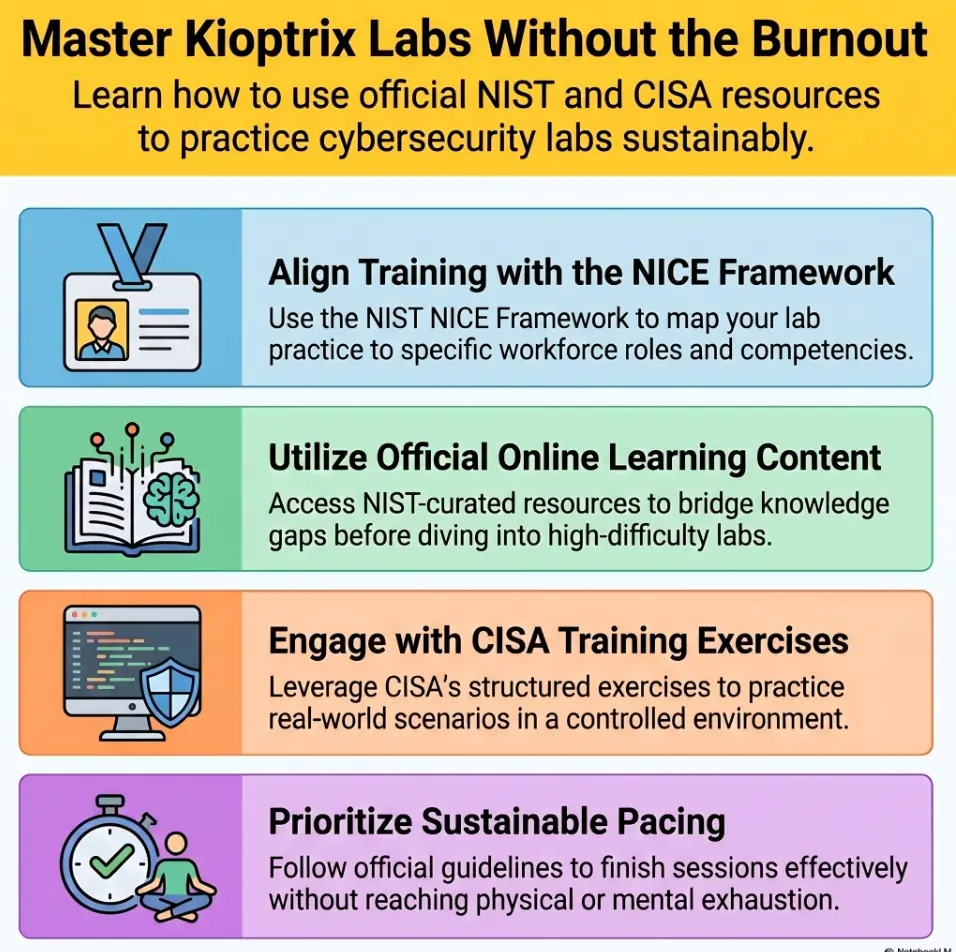
The NICE Workforce Framework from NIST treats cybersecurity work as a family of tasks, knowledge areas, and skills rather than a single dramatic identity. That framing is helpful here. Kioptrix can train reasoning, not just exploitation. It can help you practice how to move from clue to hypothesis to action in a way that sounds like professional judgment, not terminal karaoke. That is one reason Kioptrix works so well for help desk workers exploring security and for career changers building a more credible learning story.
In other words, this article is for learners who want repeatability more than heroics. That is not less serious. It is how serious people often last longer.
Show me the nerdy details
In practical terms, a sustainable Kioptrix workflow trains several transferable habits: scoping, evidence tracking, prioritization, and decision explanation. Those habits map more cleanly to real work than endless tool switching does. This is one reason classic labs still matter. They expose sequence errors quickly.
Time-box the lab before the lab time-boxes you
The 45- to 90-minute window that keeps thinking sharp
For most beginners, a 45- to 90-minute session is the sweet spot. Short enough to protect quality. Long enough to complete one meaningful chunk of work. Beyond that, the odds of sloppy decisions begin to rise, especially if you are practicing after work, after classes, or in the mushy hours when your brain starts negotiating with snacks.
This range is not sacred. It is simply humane. A shorter session can still be excellent if it is well scoped. A longer session can work if you are unusually rested and focused. But as a default, 45 to 90 minutes protects more learners than it disappoints. If you tend to either quit too early or drag too long, this deeper look at Kioptrix session length can help you calibrate the window more realistically.
When to stop even if you are “close”
The most dangerous phrase in a burnout-prone session is “I am probably close.” Close to what, exactly? A clue? A proof? A hunch? Sometimes you are indeed one careful step away. Sometimes you are standing at the mouth of a rabbit hole wearing confidence like a borrowed coat.
Stop when any of these happen:
- You cannot explain why your next action is higher priority than two alternatives.
- You are rereading output without extracting anything new.
- Your notes are getting thinner while your tool usage is getting wider.
- You feel urgency rising faster than clarity.
I once ignored this and pushed “just 20 more minutes.” It became 55. I got no meaningful breakthrough, slept badly, and returned the next day less eager to practice. That is how one extra push can quietly steal two sessions, not one.
Let’s be honest: “one more scan” is often the cliff edge
There are times when another scan is exactly right. There are also times when “one more scan” is just what frustration says when it wants to stay in control. Repeating an action is not wrong. Repeating it without a new question behind it often is.
The clean rule is simple: rerun a scan only if at least one of three things changed. Your question changed. Your scope changed. Your flags changed for a reason you can say out loud. If none of those changed, you may be feeding anxiety, not improving visibility.
Mini calculator: How much practice can you sustainably keep?
Session length × sessions per week = weekly load.
Examples: 60 minutes × 3 sessions = 3 hours. 90 minutes × 4 sessions = 6 hours.
Neutral action: Pick the weekly load you can maintain for 4 weeks, not the one that looks impressive for 4 days.
Don’t turn one machine into five different problems
How tool-hopping creates fake progress
Tool-hopping feels lively because it creates motion. Motion is not the same as progress. If one scan, one browser tab, one enumeration note, and one carefully chosen follow-up can answer the current question, then launching six more tools is not ambition. It is camouflage.
There is a particular kind of fake productivity unique to labs. It looks technical. It sounds industrious. It leaves you with plenty of screenshots and not much understanding. The moment you cannot explain how Tool B is improving the question raised by Tool A, you are probably drifting.
A quieter session often produces better thinking. One terminal. One notebook. One clue under a lamp. That is not glamorous, but neither is redoing yesterday’s confusion in higher resolution.
Why repeating scans can feel productive while telling you nothing new
Scans feel safe because they are concrete. You run them, they return output, and your screen gives you the comforting illusion that work is happening. But repeated scans without new intent can become the cybersecurity version of opening the fridge every seven minutes. The contents do not improve because you are hopeful.
Ask three questions before rerunning anything:
- What exact uncertainty am I trying to reduce?
- What changed since the last run?
- How will I interpret a different result if I get one?
If you cannot answer those, pause. A more useful move may be to read the output you already have and force yourself to summarize it in plain English. Translation is often the missing step. Not more data. The same principle applies when people get stuck choosing between tools like Nmap vs RustScan on Kioptrix Level or waste energy debating Dirb vs Gobuster before they have a crisp question to answer.
The discipline of staying with the evidence you already have
Beginners often leave good clues too early. They see something promising, tug once, feel resistance, and skip to a new branch. Then the session becomes a graveyard of almosts. Staying with the evidence does not mean stubbornly doing the same thing. It means giving one lead a fair, structured examination before abandoning it.
Try this sequence instead:
- State the clue in one line.
- Write one plausible interpretation.
- Choose one action that would confirm or weaken that interpretation.
- Record the result before changing branches.
That tiny structure turns wandering into inquiry. It also gives you something precious when the session ends: a trail you can trust tomorrow.
- Motion can disguise confusion
- Repeated scans need a new question behind them
- Evidence deserves a fair test before you switch branches
Apply in 60 seconds: Put a sticky note near your keyboard: “What question is this tool answering?”
Common mistakes that make Kioptrix feel heavier than it is
Starting with exploits before you understand the surface
This is the classic rush. You see a service. You remember a possible weakness. Your pulse does a small drum solo. You leap toward exploitation before the target has earned that attention. Sometimes it works. More often it creates brittle, shallow progress and teaches the wrong lesson.
Exploitation without understanding is exciting in the way jumping across wet stones is exciting. Memorable, yes. Also a good way to end up in the water. Enumeration is not glamorous, but it is what keeps your later actions connected to reality. That is why disciplined learners usually benefit more from strong Kioptrix enumeration habits than from rushing into a Metasploit-first approach.
Treating confusion as a signal to speed up
When confusion rises, many learners accelerate. They search faster, click faster, switch tools faster. This makes emotional sense and practical nonsense. Confusion is usually a signal to slow the session down until your reasoning becomes visible again.
I still remember one evening where I hit an ambiguous result and immediately started widening the session. A second scan. Then a web search. Then a payload note. Then a different browser. None of it was grounded. It felt like urgency. It was actually avoidance. The real answer was to sit for two minutes and write what I did and did not know.
Reading write-ups too early, then calling it “stuck”
Walkthroughs are not evil. They are tools. But timing matters. If you open one the moment friction appears, you are training your brain to outsource the exact phase where judgment grows. Productive struggle has a boundary, yes. But many learners cross that boundary far earlier than they think.
A better rule is to define your stuck threshold before the session starts. For example: no walkthrough until I have tested 3 grounded hypotheses and documented why each failed. That way, a write-up becomes a learning aid, not a reflex. If you need a fuller framework for that restraint, this piece on Kioptrix Level patience fits naturally with the stop rules in this article.
Mistaking longer sessions for better sessions
There is a folk belief that serious learners grind until the box breaks or they do. It sounds noble. It also explains a lot of abandoned practice plans. Longer is not automatically deeper. Often, it is just blurrier. A crisp 60-minute session with clean notes can outperform a sprawling 3-hour one that ends in self-doubt and noodle-neck posture.
Decision card: When to keep pushing vs when to stop
| If this is true | Choose this | Trade-off |
|---|---|---|
| You still have a clear hypothesis and energy is steady | Keep going 10 to 15 minutes | Slightly more time, possible clean progress |
| You are widening tools and thinning notes | Stop and document | No dramatic finish, but tomorrow stays intact |
| You want a walkthrough because you are annoyed | Pause first, set a stuck threshold | Slower relief, better long-term learning |
Neutral action: Decide your stop rule before emotions get a vote.
Energy management beats motivation every time
Build around attention, not ambition
Motivation is flashy and unreliable. Attention is quieter and far more useful. The question is not “How motivated am I?” The question is “What kind of thinking can I do well right now?” Those are not the same. Some evenings are perfect for enumeration and note cleanup. Others can support a focused exploit attempt. Some are only good for reviewing yesterday’s clues and choosing tomorrow’s first move. That still counts.
When you build around attention, you stop treating every practice block like a performance. You match the task to the quality of mind you actually have. That is not lazy. It is how people with durable routines stay in the game.
How to notice your “sloppy threshold”
Everyone has a sloppy threshold, the moment where effort continues but precision starts falling apart. For some, it hits at minute 50. For others, after work, it arrives before the coffee cools. The trick is to learn your own pattern instead of borrowing someone else’s heroic mythology.
Your sloppy threshold may look like this:
- Reading gets slower and less accurate
- You stop summarizing before acting
- You pick tools by comfort, not relevance
- You become emotionally attached to a hypothesis with thin evidence
Once you notice these signs a few times, you can plan around them. That is a power move. Not glamorous, very effective.
Here’s what no one tells you: stopping on purpose is a skill
Stopping cleanly is harder than starting. Starting feels hopeful. Stopping requires judgment. You have to leave some curiosity unresolved. You have to trust that momentum is preserved by good endings, not just long ones.
Think of musicians rehearsing a difficult passage. They do not always grind until the fingers fall off. They stop when the shape is still intelligible, so the next repetition begins from structure, not collapse. Lab work is similar. The best next session is often born from a disciplined stop, not a dramatic finish.
Short Story: A learner I once helped had a routine that looked serious from the outside and miserable from the inside. Three nights a week, they sat down determined to “make the session count.” That usually meant chasing root until fatigue turned their notes into crumbs. By week three, they were practicing less, not more. We changed one thing first: no session longer than 75 minutes, and every session needed a single written objective before the VM opened.
The first week felt almost too gentle. By the second week, their notes got clearer. By the third, they were seeing attack paths earlier because they were no longer exhausting themselves in the first hour. Nothing magical happened. No secret exploit descended from the clouds. They just stopped paying interest on chaos, and their learning finally had room to breathe.
- Match session type to your real energy level
- Learn your sloppy threshold and plan around it
- Stopping cleanly is part of the craft
Apply in 60 seconds: Label your next session in advance: “enumeration,” “verification,” or “review.”
Notes that reduce tomorrow’s friction
What to capture during the session, not after memory fades
Good notes are not a museum. They are a trail of decisions. The point is not to preserve every byte of output. The point is to preserve enough reasoning that tomorrow-you does not have to rebuild the whole bridge from river stones and vibes.
During the session, capture:
- The clue you noticed
- The action you chose
- The result you got
- The next question that result created
This matters because memory is weirdly flattering. After a session, you think you will remember the important part. By the next day, you remember the emotional texture and lose the technical hinge. You recall that something looked promising on a web service, but not which endpoint, what evidence suggested it, or what failed when you tested it.
The four-line note structure: clue, action, result, next question
This is the note structure I recommend for learners who want something light enough to use in real time:
- Clue: What did I observe?
- Action: What did I do because of it?
- Result: What happened?
- Next question: What is now most worth checking?
Example:
Clue: Web service exposes a login page and a server banner worth noting.
Action: Checked page structure, source, and response behavior for obvious leads.
Result: Found one pattern that may narrow the next test, but not enough to assume a path.
Next question: Is this a real lead or just decorative noise?
That is enough. You do not need a cathedral of documentation for every beginner session. You need a breadcrumb trail that your future self can actually follow without sighing. If you want a slightly more formal structure without drowning in overhead, a Kioptrix technical journal or a reusable recon log template can make this habit easier to keep.
Why incomplete notes are one of the fastest roads to burnout
Incomplete notes make the next session heavier before it starts. You reopen the VM and immediately face an old question with no clean record of what you tried. Then you spend 20 minutes reacquiring context, feel behind, and push too hard to “make up time.” Burnout loves that cycle.
Complete notes shorten reentry. They also improve morale. There is something deeply stabilizing about opening a notebook and seeing that yesterday-you left a lamp on for you.
Quote-prep list: What to gather before you compare next steps
- The strongest clue you saw
- One action already tested
- The result of that action
- The most likely next question
- The stop point if nothing clarifies
Neutral action: Write these five items before you end any session that feels unfinished.
When stuck is useful, and when it is just expensive
Productive stuck: you still have hypotheses to test
Not all stuck is bad. Some stuck is exactly where learning cooks. Productive stuck has structure. You still have hypotheses. You can still explain why the next test matters. The session may feel challenging, but it is not dissolving into guesswork.
Productive stuck often sounds like this: “I have 2 plausible interpretations, and I need one more observation to separate them.” That is a wonderful place to be. It means you are thinking in branches, not flailing in weather.
Wasteful stuck: you are clicking, rescanning, and hoping
Wasteful stuck feels different. It has a more frantic texture. You are no longer testing ideas. You are harvesting possibilities because the silence feels uncomfortable. That is when sessions become expensive. They consume time, confidence, and future enthusiasm all at once.
A reliable test is this: can you explain your next action without using the phrases “just in case,” “might as well,” or “maybe I missed something”? If not, you may have crossed from inquiry into drift.
A clean decision rule for pause, pivot, or quit
Use this simple rule:
- Pause if you still have a grounded hypothesis but your attention is slipping.
- Pivot if the current branch is exhausted and another evidence-backed clue exists.
- Quit for today if you are widening activity without increasing clarity.
This decision rule sounds almost plain enough to ignore. Do not. Plain rules are often the ribs of a sustainable routine.
Infographic: The low-burnout Kioptrix loop
Choose one narrow win condition.
Enumerate and summarize clues in plain English.
Run one action tied to one hypothesis.
Log clue, action, result, next question.
End when clarity drops below activity.
Do not grade yourself by root access alone
Better scorecards for practice sessions
If root access is the only thing that counts, then many excellent sessions will feel like failure. That is too crude. A better scorecard reflects the actual skills being trained. Did you identify the exposed services accurately? Did you form reasonable hypotheses? Did you document what failed and why? Did you leave a strong next step? These are not consolation prizes. They are the work.
Professionals are not paid merely to have outcomes. They are paid to produce defensible reasoning around outcomes. A tidy exploit on a box is satisfying. A tidy thought process is what compounds.
What “good work” looks like when the box stays unfinished
Good work might look like:
- A clean enumeration note with prioritized leads
- One disproven hypothesis that saved time later
- A narrow branch tested carefully, even if it failed
- A next-session plan written before fatigue erased context
One of my best practice sessions ended with no shell at all. I had, however, reduced the machine from a cloudy set of possibilities to a small number of serious branches, and I knew exactly where to resume. The next session was shorter, calmer, and far more effective because the first one had done real work.
Why process wins compound faster than dramatic wins
Dramatic wins are memorable. Process wins are bankable. If you build the habit of scoping, documenting, and stopping cleanly, you can reuse that habit everywhere: other boxes, labs, CTFs, investigations, interviews, even daily technical work. That is a sturdier return than a single adrenaline-soaked night. It is also why thoughtful self-review matters. A simple Kioptrix self-assessment after each session can reveal more growth than obsessing over whether you reached root on schedule.
Coverage tier map: What changes from Tier 1 to Tier 5 in a practice session?
- Tier 1: You noted services and nothing more
- Tier 2: You prioritized leads with reasons
- Tier 3: You tested one hypothesis cleanly
- Tier 4: You documented failures and next steps
- Tier 5: You finished the branch or the box without losing clarity
Neutral action: Aim for Tier 3 or 4 most days. Tier 5 is welcome, not required.
Recovery rituals that keep the next session alive
End with a shutdown checklist, not a vague promise
“I will remember where I left off” is one of the great little lies of technical practice. Recovery starts before the session ends. A shutdown checklist gives the session a clean edge, which makes returning far easier.
Try this 4-step shutdown:
- Write the strongest clue from today
- Write the next question to test
- Write what not to repeat next time
- Set the first action for the next session
This takes about 5 minutes. It can save 20 to 30 minutes of reentry friction later. That is an absurdly good trade.
What to write down before closing the VM
Before you close anything, leave your future self a note that feels like a handoff, not a diary. One sentence for the best clue. One sentence for the next move. One sentence for the trap to avoid. That is enough to preserve the thread.
It is worth being a little embarrassingly clear here. Write as though tomorrow-you has slept poorly and been interrupted twice. That version of you deserves a map, not a riddle.
A five-minute exit routine that protects momentum
Here is a practical five-minute exit routine:
- Minute 1: stop all active branching and close irrelevant tabs
- Minute 2: summarize the session in 3 to 4 lines
- Minute 3: choose the first action for next time
- Minute 4: record one thing you will not repeat
- Minute 5: physically end the session and step away
That last part matters. A session should end like a door closing, not like a hallway fading into darkness. If your lab setup itself keeps adding friction, it may be worth tightening your snapshot strategy or reviewing a more stable Kioptrix network setup so recovery starts before the session even begins.
Next step: run your next Kioptrix session with one narrow objective
Choose one target outcome for today
If you want this article to become something more than encouraging wallpaper, translate it into one real session. Pick one outcome only: enumerate, verify, document, or exploit. You can do that in under a minute. That choice alone will remove a surprising amount of friction.
Set a hard stop time before you begin
Put the end time on paper before the machine boots. Not because you are weak. Because unbounded sessions invite unbounded sprawl. A hard stop gives the work shape. Paradoxically, boundaries often increase seriousness. They force you to choose rather than drift.
End by writing the single most useful clue you found
When the session ends, do not measure it only by whether you reached root. Measure it by whether you discovered the most useful clue and preserved it clearly. That one clue is often the hinge for the next hour, the next box, and the next leap in judgment.
The hook we began with is worth closing now. Kioptrix feels bigger than an evening when the session is shapeless. When you narrow the goal, protect your attention, and leave a clean trail, the box shrinks back to its proper size. Not trivial. Just workable. That is the kind of practice routine people can keep. For readers who are still getting their footing, a gentler primer on Kioptrix for beginners or a broader Kioptrix learning path can make the next step feel less crowded.
- Pick one outcome before you start
- Use a hard stop to protect quality
- Leave one strong clue for tomorrow
Apply in 60 seconds: Open your notes app and create a template with four labels: Goal, Clue, Result, Next Step.
Your honest next move within 15 minutes: schedule one 45- to 75-minute Kioptrix session, define a single win condition, and prepare your note template before the VM opens. That is enough to change the tone of the entire practice week.
FAQ
How long should a Kioptrix practice session be for beginners?
For most beginners, 45 to 90 minutes is a strong default. It is long enough to complete a focused objective and short enough to protect clarity. If you are practicing after work or late at night, staying closer to 45 to 60 minutes is often wiser.
Is it bad to stop a session before getting root?
No. In many cases, it is the smarter choice. If your notes are strong, your reasoning is clean, and you know the next question to test, the session did real work. Root access is one outcome, not the only measure of value.
How do I know whether I am actually learning or just spinning?
You are learning when you can explain your next action, connect it to evidence, and record what changed after you tested it. You are probably spinning when tool usage expands while clarity does not, or when you keep repeating actions without a new question behind them.
Should I use walkthroughs if I keep getting stuck?
Yes, but set a threshold first. For example, decide that you will only check a walkthrough after testing 3 grounded hypotheses and documenting why they failed. That keeps the walkthrough in a teaching role rather than a rescue reflex.
What should I write in my notes during a Kioptrix session?
Keep it simple: clue, action, result, next question. This is enough to preserve the session logic without turning note-taking into a second project.
How often should I practice Kioptrix without burning out?
A sustainable rhythm for many learners is 2 to 4 sessions per week. The better question is not what sounds serious, but what you can actually repeat for 4 weeks without dread or inconsistency.
Is Kioptrix still useful for people coming from help desk roles?
Yes. It can be especially useful because it rewards observation, documentation, and structured reasoning. Those habits translate well from support and operations work into cybersecurity learning.
What is the best session goal if I only have one hour?
Enumeration or verification usually fits best. Both can create meaningful progress in a one-hour window without pressuring you into a full exploitation sprint.
Why do I feel exhausted after a “simple” lab?
Because “simple” boxes can still create heavy decision load. Repeated judgments, branching possibilities, and self-imposed urgency can be tiring even when the technical surface is not especially advanced.
Should I focus on finishing the box or improving my workflow?
Improve the workflow first. A better workflow raises the odds that you will finish boxes more consistently later. Chasing finishes without process often produces streaky results and faster burnout.
Last reviewed: 2026-04.