

Breaking the Fatigue Wall: A Sharper Rhythm for Pentesting Labs
There is a strange moment in Kioptrix Level practice when the terminal is still busy, the tabs are multiplying, and yet the useful part of your brain has already slipped quietly out the side door. The session looks productive. The method, meanwhile, has started to fray.
That is why so many beginners think they are hitting a hard technical wall when they are actually hitting a fatigue wall. Enumeration gets sloppier. Notes get thinner. A clean hypothesis turns into random command drift, copy-paste errors, and one more scan that somehow solves nothing.
This guide helps you build a sharper rhythm for penetration testing labs: shorter sessions, cleaner note-taking, better clue detection, and stronger next-day recall. The goal is not to grind harder. It is to make your learning more repeatable, more accurate, and a lot less foggy.
That perspective comes straight from the body of real homelab experience: missed clues, repeated scans, and the small session-design fixes that make Kioptrix easier to resume and harder to waste.
Here is where the pattern starts. And where it usually breaks.
More importantly, here is how to stop that break before it becomes your default study style.
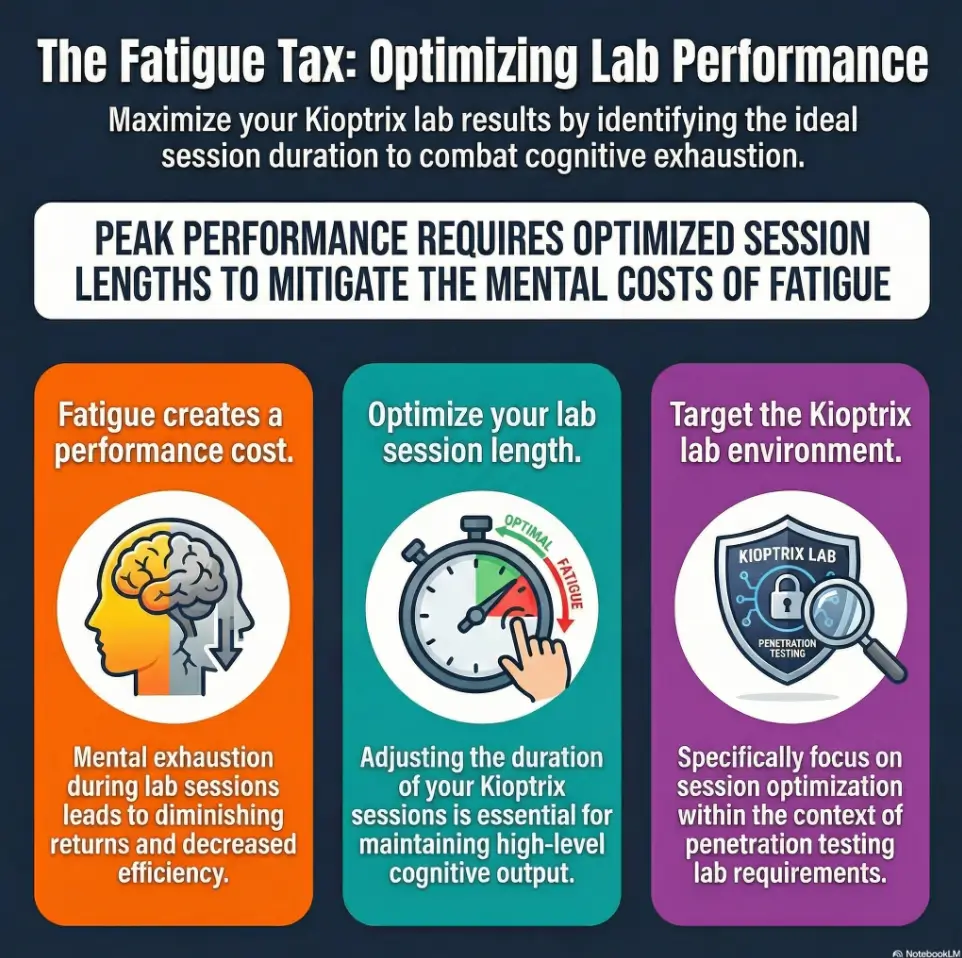
Fast Answer: Kioptrix Level practice usually breaks down in overly long sessions because fatigue damages the exact abilities the lab rewards: noticing small clues, keeping clean notes, testing one hypothesis at a time, and stopping sloppy command drift. What feels like “I should push harder” is often degraded reasoning in disguise. Short, bounded sessions tend to produce better enumeration, fewer repeated dead ends, and stronger next-day recall.
Table of Contents
Why Session Length Becomes the Hidden Failure Point
The first hour teaches
The first hour of a Kioptrix session is often the cleanest. Your eyes still catch weird service banners. Your notes still resemble notes instead of archaeological rubble. You can remember why you ran a command instead of just admiring that it produced output. For beginners, this matters because Kioptrix is not mainly a typing test. It is an observation test. Small clues unlock the box. Fresh brains see them sooner.
I still remember one early lab night when I found the right clue in under 25 minutes, then spent another 90 minutes doubting it because I had drifted into “surely it can’t be that simple” mode. The machine had not gotten harder. I had simply become less trustworthy to myself.
The third hour distorts
By the third hour, especially after work or school, the lab starts wearing carnival mirrors. Easy things look difficult. Difficult things start looking personal. A trivial typo feels like proof you are not cut out for this. A dead end becomes a duel. That is why long sessions are dangerous for learners: they change not only energy, but interpretation.
Official sleep guidance from the National Institute of Neurological Disorders and Stroke explains that sleep is essential for learning and memory formation. The CDC also notes that better sleep supports attention and memory. Those ideas sound abstract until you are staring at a port scan and somehow reading the same line four times like it owes you rent.
Why “more time” can create worse decisions, not better results
More time helps only when your decision quality remains steady. In homelab practice, it rarely does. Enumeration becomes less disciplined. You stop ranking likely paths and start sampling random ones. You search wider and think narrower. That is the expensive irony: the longer session creates the illusion of seriousness while quietly reducing the value of each minute.
- Fresh time tends to produce signal.
- Fatigued time tends to produce noise.
- Very fatigued time produces confidence without accuracy, which is the sneakiest monster in the room.
- Early minutes are usually your cleanest reasoning window.
- Fatigue changes interpretation before it changes motivation.
- More hours can produce worse decisions, not deeper skill.
Apply in 60 seconds: Write one sentence before you start: “My goal for this session is to validate one path, not touch every path.”
Fatigue Has a Signature, and Kioptrix Exposes It Fast
Missed clues during enumeration
Fatigue rarely announces itself with a trumpet. It enters like dust. First you miss a version string. Then you skim past a file share. Then you fail to notice that the output already hinted at the next move. Kioptrix exposes this fast because beginner boxes often reward careful enumeration more than flashy exploitation. When attention slips, the lab feels unfair, but the evidence was usually sitting there the whole time.
One of the most common learner patterns is rerunning nmap with tiny variations because the first result “didn’t look like enough.” Sometimes it really was not enough. More often, the issue was that the first result had not been read with a rested mind. If that pattern sounds familiar, a more deliberate Kioptrix recon routine often helps more than simply adding another scan.
Sloppy command reuse and copy-paste drift
Late in a session, commands start wandering. Flags move around. IP addresses get borrowed from yesterday. You copy a payload from a note, tweak one piece, and accidentally break three others. This is not a moral failure. It is a fatigue signature. The hands are moving faster than the reasoning.
That is why tired practice often feels productive. The keyboard sounds heroic. The terminal scrolls like a slot machine. But the method has already gone off-road and left a little dust devil behind it. This is also why copy-paste commands fail so often in Kioptrix work when the session gets too long.
Tiny mistakes that become 40-minute detours
Beginners often assume long sessions fail because they hit “advanced” technical walls. In truth, many collapses start with tiny mistakes: the wrong target IP, a stale hosts file entry, a misplaced slash, a note that says “try later” without explaining what “this” was. Fatigue does not just create mistakes. It makes them harder to diagnose because it reduces your willingness to step back and ask what changed.
Eligibility checklist: Is your session still usable?
- Can you explain your current hypothesis in one sentence? Yes / No
- Do your last three commands each have a reason? Yes / No
- Could you hand your notes to yourself tomorrow and resume cleanly? Yes / No
- Are you still reading output, not just generating it? Yes / No
Neutral next step: If you answered “No” twice, pause before you create a bigger mess that tomorrow-you will have to mop up.
Show me the nerdy details
In hands-on practice, fatigue often shows up as unstable attention, slower working memory, and weaker error detection. That combination is brutal for enumeration-heavy labs because success depends on noticing small environmental signals, preserving context across commands, and spotting when a result conflicts with your theory.

When Practice Stops Being Practice
You are no longer learning, you are looping
There is a moment when practice stops building skill and starts carving a rut. You rerun scans. You revisit the same write-up fragment. You open five tabs that all say roughly the same thing in slightly different fonts. This is not exploration anymore. It is looping. The brain likes looping because it feels active. The lab likes it because it keeps you busy. Your future progress likes it not at all.
The lab turns into a stubbornness contest
Kioptrix is old-school enough to tempt stubbornness. “I can break this if I just keep pushing” sounds admirable. Sometimes it even works. But for learners, stubbornness often crowds out method. You stop testing hypotheses and start defending your self-image. Now the box is no longer a learning environment. It is a courtroom drama starring your pride.
Let’s be honest… sometimes “I’m still working” really means “I stopped thinking clearly an hour ago”
This is the sentence few learners enjoy hearing because it lands a little too close to home. But it is also freeing. If your session quality has fallen off a cliff, stopping is not quitting. Stopping is choosing not to train bad habits. In real cybersecurity work, clean documentation, repeatable method, and judgment under uncertainty matter more than heroic midnight fog. That same discipline later becomes useful when you turn lab work into better cybersecurity interview stories instead of a blur of terminal commands.
Practical truth: A session can be emotionally intense and educationally weak at the same time.
Decision card: Push longer or stop?
| If this is true | Do this |
|---|---|
| You have one clear lead and your notes are clean | Continue for 15 to 20 more minutes |
| You are rotating tactics without a theory | Stop and write a restart note |
| You feel insulted by the box | Definitely stop. The box has won the theater award. |
Neutral next step: Use the table to decide before emotion starts negotiating for “just one more hour.”
The Real Cost of Overlong Sessions Is Not Just Time
Retention drops even when screen time rises
Long sessions can create a very modern illusion: because you spent 4 hours with the VM open, you assume you learned 4 hours’ worth of material. Not so fast. Retention often drops before the clock does. The National Institute of Neurological Disorders and Stroke explains that sleep is necessary for forming and maintaining the brain pathways used for learning and memory. That makes late-night fatigue a double thief. It steals clarity in the moment and weakens what sticks afterward.
I have had sessions where I “worked” for two extra hours and could not explain the chain the next morning without reconstructing it from screenshots. That is not mastery. That is digital confetti.
Frustration starts overwriting method
Once frustration climbs, it does more than hurt morale. It starts editing your process. You skip note-taking because you just want momentum back. You stop labeling outputs. You lean on write-ups too early. You tell yourself this is temporary, but your brain is already practicing a looser, messier version of the craft.
Why bad sessions can train bad habits into muscle memory
Practice is not neutral. It strengthens what you repeat, whether that pattern is good or not. If your late-session behavior looks like random tab-hopping, weak notes, and command spam, then that is also practice. Not the kind you wanted, but practice all the same.
CISA describes exercises as a way to strengthen security capability through structured practice. Structure is the word worth underlining. When a session loses structure, it stops training the discipline that transfers to other labs and future environments.
- Screen time and learning time are not the same thing.
- Frustration changes process, not just mood.
- Practice reinforces whatever you repeat, even the messy parts.
Apply in 60 seconds: Add one line to your notes template: “What would I want rested-me to know tomorrow?”
Don’t Confuse Endurance With Skill
Long sessions can feel serious without being effective
Cybersecurity culture sometimes treats long hours like a badge polished in terminal light. That is understandable. Labs are hard. Curiosity is real. Ambition is good. But endurance and skill are cousins, not twins. You can sit with a box for 5 hours and still do less useful work than someone who attacks it with a 70-minute plan and excellent notes.
The beginner mistake is assuming that discomfort automatically means growth. Sometimes discomfort means growth. Sometimes it means you have been awake too long and your brain is making soup of your own methodology.
Why cybersecurity learners often reward grind over quality
Part of the problem is social. Grind is visible. Clean reasoning is quieter. “I was up until 2 a.m.” sounds dramatic. “I stopped after 80 minutes because my note quality dipped” sounds less cinematic, even though it is often the smarter move. The internet loves battle stories. Your future self loves repeatability.
The trap of mistaking exhaustion for commitment
Exhaustion can masquerade as dedication. It whispers that leaving the desk means you do not want it enough. Ignore that voice. Commitment is not measured by how completely you fry yourself. It is measured by whether you keep returning with a usable method.
Short Story: A friend once described his Kioptrix routine like this: start after dinner, “just check one thing,” then somehow surface near midnight with 14 tabs open, three half-written notes, and a deep suspicion that Linux itself had become hostile. On the week he changed only one variable, session length, everything shifted.
He capped work at 75 minutes, wrote a hypothesis at the top of each session, and stopped while he still had one good question left. The box did not become easier in any magical sense. But his work became cleaner. He missed fewer clues, repeated fewer scans, and could resume the next day without first excavating his own confusion. The breakthrough was not better talent. It was better session design.
Common Mistakes That Make Long Sessions Collapse Even Faster
Starting without a session goal
If your goal is “make progress,” you have already handed confusion a spare key. Progress is too vague. A better goal sounds like this: identify web attack surface, validate one credential path, or map the service stack and stop. Specific goals create stopping points, and stopping points protect quality.
Pushing past the first clear energy dip
The first dip is not always dramatic. It may be the moment you reread a page because your eyes moved but your mind did not. It may be the point where notes become fragments. Many learners treat that dip as the warm-up for the “real” work. Often it is the first honest signal that the session is reaching diminishing returns.
Skipping notes because “I’ll remember this part”
You will not. Or more precisely, you will remember the vibe and forget the sequence. That is worse. The next day, you will recall that you were onto something but not which output mattered, which path failed, or what assumption you were testing. This turns resumption into reinvention, which is the laboratory version of stepping on the same rake twice. A simple recon log template or a dedicated Kioptrix note-taking workflow can do more for learning continuity than another late-night scan.
Changing tactics too often after fatigue sets in
Tired brains love novelty because novelty feels like momentum. So you jump from web enumeration to SMB to kernel exploits to credential guessing, all in one increasingly decorative swirl. That breadth feels industrious. In reality, it often means fatigue has broken your ability to rank options.
Mini calculator: How overloaded is your session?
Use this quick formula:
Session Load = number of active tabs + number of live hypotheses + hours since your last real break
If your score is above 10, your session is probably wider than your attention can support.
Neutral next step: Close three tabs, keep one hypothesis, and decide whether the remaining work still makes sense.
Show me the nerdy details
Kioptrix-style labs reward depth before breadth. Early-stage learners often gain more from a narrow, documented attack chain than from touching six partial techniques in one sitting. Smaller sessions reduce context-switching costs and preserve the integrity of your evidence trail.
Don’t Do This: The Marathon Mindset That Breaks Clean Method
One machine, five tabs, zero structure
This is the classic collapse pattern. One machine becomes a whole weather system. Browser tabs bloom. Half-read forum posts whisper contradictory advice. Your terminal history starts resembling a frantic diary. The problem is not curiosity. The problem is ungoverned curiosity.
Treating every dead end like a challenge to your identity
Not every dead end means you are missing some elite trick. Sometimes it means that path is simply wrong. Good operators let wrong paths die. Tired operators adopt them like wounded pigeons. They carry them for hours.
Here’s what no one tells you… most lab “difficulty” starts after attention quality drops, not before
This is the secret hinge of the whole article. A lot of what people call hard is really late. The lab did not suddenly transform into a dragon. Your attention slipped, your notes thinned, and your error-checking softened. Once you see this clearly, you stop blaming yourself in useless ways and start designing around the actual problem. Many of the so-called technical walls beginners hit are closer to recon mistakes or enumeration mistakes than to some hidden advanced trick.
Infographic: The Kioptrix Session Curve
0 to 60 min
High signal
Clean notes
60 to 90 min
Still useful
Needs structure
90 to 120 min
Error risk rises
Notes thin out
120+ min
Loop danger
Judgment fog
Reading tip: The bars are not a law of nature. They are a reminder that session quality usually declines before motivation does.
Who This Is For / Not For
This is for learners who keep stalling halfway through a lab
If you often start strong, gather some promising clues, then somehow end the night with a foggy browser and thin notes, this is for you. Your issue may be session design more than technical capacity.
This is for students who finish tired but remember very little
If your post-session feeling is “I worked hard, but I could not teach back what happened,” then you are exactly the reader I have in mind. Effort matters. But effort that does not consolidate into understanding is like carrying water in a sieve.
This is not for people benchmarking speed under exam conditions
Exam prep can justify deliberate endurance training. That is a different game. There, you may choose longer sessions on purpose because you are training stamina under pressure. This article is mostly about everyday lab learning, especially for beginners and lower-intermediate operators.
This is not for advanced users deliberately training long-form endurance
Some advanced practitioners can work long with excellent controls, mature notes, and stable decision habits. Good for them. Truly. But most beginners imitate that style far too early and wind up practicing chaos instead of craft.
What Shorter Sessions Protect That Longer Sessions Damage
Fresh enumeration and cleaner pattern recognition
Shorter sessions protect one precious thing: the ability to notice. That means spotting version numbers, file names, permission oddities, and weird little service behaviors before they blur together. Kioptrix rewards these observations. It is less “be a genius” and more “do not trample the breadcrumbs.”
Better note trails for picking up tomorrow
Shorter sessions also protect your trail. When you stop before collapse, you can usually leave a clear map for tomorrow: what you tried, what failed, what remains plausible, and what you should verify first. That trail turns tomorrow’s start into continuation instead of reconstruction. If you want that trail to become something more polished later, it is easier to build from a clean daily log into a proper Kioptrix lab report than to rescue half-remembered chaos.
More accurate self-review after each attempt
When you end while still coherent, your self-review becomes sharper. You can say, “I missed the clue because I skimmed,” or “I spread too wide after the web path died.” That diagnosis is gold. It tells you what to improve next time. In a marathon session, self-review usually degenerates into “I got tired and everything turned into mashed potatoes.” Not wrong, but not very actionable.
One of my most useful habits is ending with three bullets: biggest clue, biggest mistake, first command for next time. It takes under 2 minutes. It saves far more.
- Fresh eyes catch clues earlier.
- Clear notes reduce restart friction.
- Coherent endings make better self-review possible.
Apply in 60 seconds: Create a three-line end-of-session template: clue, mistake, first move tomorrow.
A Better Rhythm: How to Structure Kioptrix Practice Without Burning the Circuit
Use a single outcome for each session
Pick one outcome. Not ten. Examples: map the web stack, validate one foothold idea, or cleanly document the service landscape. A single outcome keeps the session narrow enough that your attention can actually support it.
Cap effort before judgment gets fuzzy
Try a 45-to-90-minute block as a planning experiment, not a scientifically established optimum for Kioptrix. Choose the length around your task, breaks, and ability to keep clear notes. Longer sessions can also be useful when deliberately structured; stop or take a break when attention and reasoning decline.
End on a note, not on a collapse
Do not let the session end because your mind simply slides off the chair. End it on purpose. Capture the current hypothesis, the strongest clue, and the first next step. This creates continuity. It also reduces the emotional friction of coming back tomorrow.
Build continuity with snapshots, logs, and a restart cue
Snapshots are not just for safety. They are cognitive relief. They let you say, “I can stop here without losing state.” Logs do the same for reasoning. A restart cue helps too. Mine is boring on purpose: open the note file, read the last five lines, run the first command listed there, then decide. Boring systems are underrated. They do not sparkle, but they do keep the floor from disappearing. A clean snapshot strategy for Kioptrix pairs beautifully with a restart note because it turns “I should keep going” into “I can resume without losing the thread.”
Quote-prep list for your next session
- Target IP and current VM state
- One session goal
- One active hypothesis
- One stop time or stop condition
- One note file location
Neutral next step: Gather these five items before you start so the first 10 minutes do not vanish into setup fog.
Show me the nerdy details
Short rest and structured stopping points can improve next-session efficiency because they preserve context. In skill learning, rest is not always “lost time.” It can help the brain consolidate what was just practiced, which is one reason a well-bounded session may outperform an endless one.
The Warning Signs You Should Stop for the Day
You are rerunning the same commands without new reasoning
This is the clearest warning sign. If the command is the same and the theory is not changing, you are not investigating. You are pacing the cage.
You are reading output without really seeing it
Your eyes are moving. Your terminal is scrolling. Your comprehension, meanwhile, has slipped out for coffee. If you cannot summarize the last result in one sentence, stop. That is not laziness. That is signal loss.
You are improvising instead of testing hypotheses
Improvisation has a place. But when every next action is disconnected from the last one, the session has gone from method to mood. That is usually the moment to close the laptop before your notes become an abstract painting.
Irritation is now driving the keyboard
When irritation takes over, tiny obstacles start feeling theatrical. A missing slash becomes an insult. A failed login becomes a feud. I once knew a learner who described this state as “typing with my ego.” Perfect phrase. Whenever ego starts driving, precision rides in the trunk.
- Repeated commands without new logic mean drift.
- Unread output means attention has slipped.
- Irritation is a process risk, not just a mood.
Apply in 60 seconds: Ask: “Can I explain why I am doing the next command?” If not, stop and write the restart note.
Common Mistakes
Studying until you are mentally flat
Flattened attention is not a badge. It is a quality-control failure. When the brain goes flat, even good material starts bouncing off.
Believing confusion always means you should push longer
Sometimes confusion means you need one more pass. Sometimes it means you need sleep, distance, and a cleaner question. Those are not the same thing, and learners lose a lot of time by treating them as interchangeable.
Chasing a breakthrough when what you need is recovery
This one is seductive because breakthroughs do happen late sometimes. The problem is survivorship bias. You remember the one glorious 11:40 p.m. breakthrough and forget the seven nights you just turned your notes into alphabet soup.
Measuring effort by hours instead of usable insight
Hours are easy to count. Insight is harder. But insight is the thing that transfers. If your 40-minute session yields one clean lesson and your 4-hour session yields confusion, only one of those really moved the craft forward.
When in doubt, measure by outputs you can actually reuse:
- One documented clue
- One disproved theory
- One clean next step
- One note set you can resume from tomorrow

FAQ
Why does Kioptrix feel harder the longer I study?
Because the lab depends heavily on attention, small-clue detection, and disciplined troubleshooting. As fatigue rises, those skills usually degrade before motivation does. The box feels harder, but often your reasoning has simply become noisier.
How long should a Kioptrix practice session be for beginners?
A 45-to-90-minute block is a suggested starting experiment, not a universal optimum. Adjust it to your task and attention, include breaks, and preserve a restart note when you stop.
Are short study sessions really better for penetration testing labs?
Often, yes. Shorter sessions protect enumeration quality, make note-taking more consistent, and improve resumption the next day. They also reduce the odds of training sloppy habits through fatigue.
Why do I miss obvious clues late in a lab session?
Late-session clue misses usually come from cognitive drift, not lack of intelligence. You may still be looking at the output, but not processing it deeply. That is why version strings, paths, and service hints suddenly become invisible.
Should I stop when I feel stuck, or keep pushing?
Check the quality of your reasoning. If you still have one clear hypothesis and your notes are clean, 15 to 20 more minutes may be useful. If you are rotating tactics without a theory, stopping is usually smarter.
How do I know whether I need a break or a new tactic?
If you can explain the current path clearly but it is failing on evidence, you may need a new tactic. If you cannot explain what you are doing or why, you probably need a break first.
Can long sessions hurt retention in hands-on cybersecurity practice?
They can. Fatigue makes it harder to consolidate what you practiced, especially when sleep is short or the session ends in frustration. More screen time does not guarantee better memory.
What should I write down before ending a lab session?
Write the strongest clue, the current hypothesis, the last meaningful result, and the first command or question for tomorrow. Those four lines can save you 20 to 30 minutes of restart confusion.
Next Step
Run your next Kioptrix session with one narrow goal, one note file, and one stopping point before fatigue starts bargaining with you
The curiosity loop from the beginning is simple now: the moment when the terminal still looked alive but the real work had quietly left was not a character flaw. It was a session-design flaw. That is good news, because session design can be changed tonight. Not next month. Not after you become “better.” Tonight.
Here is the 15-minute pilot step. Open your VM. Create one note file. Write one session goal. Set one stop condition, such as “I stop when I validate or eliminate this path” or “I stop at 75 minutes.” Then work narrower than your ego prefers. When the stop point arrives, write the next restart cue before you close the lid. That one change often turns Kioptrix from a blur of terminal bravado into a real learning engine. If you are still shaping your overall direction, pairing this habit with a broader Kioptrix learning path or a more specific best practice path for Kioptrix Level can keep your sessions narrow without making them aimless.
Original review: 2026-04.
Technical guidance updated: 2026-10-13. Reframed the suggested session duration as an adjustable experiment rather than a universal learning optimum.