Sources, review date and section shortcuts
Reviewed: October 19, 2026. Plan a repeatable weekly task and a retrieval check without treating attendance as mastery.
Primary documentation · Related practical guide
Go straight to: Decision check · Main workflow · Further detail
Open the Weekly habit feasibility review for this guide’s task-specific fields and next action.
Review the previous artifact before adding a new task
Open last week’s evidence, explain one decision and select the next gap. Keep the session small enough to leave a usable closing note and a recovery state. Adjust the schedule around real constraints. A weekly cadence is a planning example, not a validated learning dose or proof that skill was retained. Reference and scope.
From “One-Night Root” to Sustainable Mastery
Plan a repeatable weekly task and a retrieval check without treating attendance as mastery.
The challenge isn’t lab access, it’s building a routine that survives the “post-work brain fold.” You don’t need more targets; you need a repeatable system for enumeration, testing, and reflection.
This approach transforms Kioptrix from a “solved box” into a reusable training ground for professional judgment. We’re trading terminal theater for real growth through:
- ✓ Shorter, focused sessions
- ✓ Actionable, cleaner notes
- ✓ Logical stopping points
- ✓ Evidence-based self-review
Start Small: Why Kioptrix Works Better as a Weekly Habit Than a Weekend Marathon
A small lab makes repetition easier than sprawling practice ranges
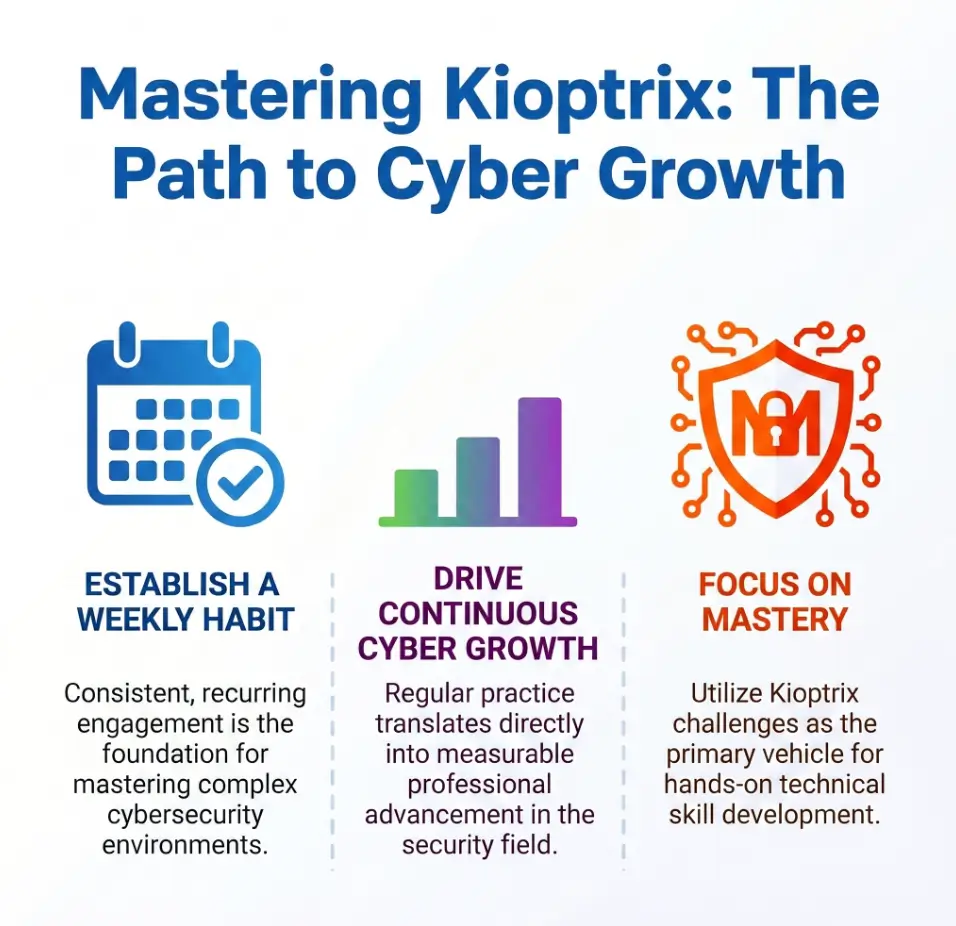
Kioptrix has a useful kind of modesty. It does not sprawl across dozens of targets, dashboards, side quests, and browser tabs that breed false urgency. That smallness matters. A weekly habit needs a lab you can re-enter without a full emotional reboot. When the environment is familiar, your attention stops bleeding into logistics and starts flowing into pattern recognition.
Weekly contact beats occasional intensity for skill retention
Most learners quietly lose momentum in the gap between heroic sessions. A four-hour Saturday binge feels noble right up until the following week disappears. Then the notes look cryptic, the VM settings feel fuzzy, and the whole thing develops the mood of unfinished furniture. A 45-minute weekly session is less glamorous and far more useful. It keeps the mental map warm. That warmth is underrated.
Why consistency reveals weak spots that one big session can hide
- Choose repetition over intensity
- Keep the same target long enough to see your habits
- Let familiarity reduce setup noise
Apply in 60 seconds: Put one recurring 45-minute block on your calendar and label it “Kioptrix: enumeration only.”
Who This Is For and Not For
Best for beginners, career changers, and rusty practitioners rebuilding fundamentals
This approach is ideal for people who need a dependable learning lane. Beginners benefit because the target is narrow enough to make cause and effect visible. Career changers benefit because the routine can survive a full-time job, family obligations, and a brain that is already negotiating with three other responsibilities. Rusty practitioners benefit because Kioptrix lets them sand down old habits without needing a giant lab environment.
Good for learners who need structure more than endless target variety
Some people do not need more boxes. They need a better loop. They need a way to begin, stop, review, and return without turning every practice night into a new expedition. If that is you, Kioptrix is not boring. It is merciful. It lets you practice the craft itself: observation, narrowing, testing, revising, documenting.
Not ideal for people looking only for fast novelty or advanced red team simulation
If you only want surprise and spectacle, this will feel too quiet. If you want modern enterprise simulation, this will feel too small. That is fine. The value here is not novelty. It is disciplined repetition. The same way scales still matter to a pianist long after the first recital, Kioptrix can matter long after the first shell.
Eligibility checklist
- Yes: You have 30 to 60 minutes a week and want structure more than excitement.
- Yes: You want better notes, cleaner enumeration, and stronger interview stories.
- No: You are only chasing new targets and do not want repetition.
- No: You need a modern enterprise simulation right now.
Neutral next step: If you checked more Yes than No, build a four-week Kioptrix loop before buying more variety.
Build the Ritual: What a Good Weekly Kioptrix Practice Loop Actually Looks Like
One lab, one narrow objective, one notebook page
A good weekly loop is almost boring on paper, which is exactly its charm. One target. One narrow objective. One page of notes. Not three machines, seven scanners, and a browser forest with twenty-two tabs blooming like ivy. Weekly systems survive because they are small enough to begin without bargaining. Your objective might be as narrow as “enumerate services and write three hypotheses” or “map the web surface and note one false assumption.” That is enough.
Break the session into setup, enumeration, testing, and reflection
Give each session a sequence. Five minutes for setup. Fifteen to twenty for enumeration. Ten to fifteen for testing. Five for reflection. The numbers are flexible, but the shape matters. Your brain learns faster when it knows the container. The habit also becomes easier to resume after a rough week because the routine is already standing there like a familiar hallway.
The habit becomes real when the stopping point is planned in advance
Try this simple weekly loop:
- Minute 0 to 5: Boot the lab and confirm networking
- Minute 5 to 25: Enumerate slowly and record only observed facts
- Minute 25 to 40: Test one or two hypotheses
- Minute 40 to 45: Write what changed, what failed, and what comes next
Show me the nerdy details
Oracle’s VirtualBox documentation explains the networking modes used to let VMs talk to each other, the host, or outside networks. Broadcom’s VMware Workstation documentation also notes that snapshots preserve a VM at a specific moment in time, which is useful when you want repeatable practice instead of rebuilding from scratch. In a habit system, those boring mechanics matter because stable networking and clean snapshots reduce friction before the thinking begins.
Don’t Start With Exploitation: Begin With the Part Most Learners Rush Past
Enumeration is where weekly skill compounding actually happens
Exploitation is flashy. Enumeration is where the real compounding lives. The reason is simple: exploitation often depends on a path you may or may not find, but enumeration trains the part of you that can improve every single week. You can get better at observing ports, parsing service banners, comparing likely attack surfaces, and noticing what does not fit. That skill carries everywhere.
Repeating discovery steps trains judgment, not just tool familiarity
When you repeat the discovery phase, you stop treating tools like slot machines. You start asking better questions. Why this service first? Why this version string matters? Why that web page is likely more useful than the loud, obvious path. The learner who improves is not the one who memorizes the most commands. It is the one who learns to narrow options with evidence.
Why “I already scanned this before” is often the start of sloppy practice
This sentence has wrecked many decent sessions. “I already scanned this before” sounds efficient. It is often lazy in a tuxedo. In a weekly habit, repeated enumeration is not redundant. It is calibration. Each pass gives you a chance to catch assumptions, improve note quality, and observe the lab without the static of hurry.
What to look for during a slow enumeration pass:
- Anything that narrows the likely attack surface
- Anything that looks default, outdated, or oddly exposed
- Anything that contradicts your first guess
- Anything you cannot yet explain without inventing a story
Set a Theme Each Week: One Lab, Different Skill Focus
Week themes can rotate between networking, web enumeration, service analysis, and note quality
A weekly theme keeps repetition from turning stale. The lab stays the same, but your lens changes. One week might focus on networking and host-only setup. Another on web enumeration. Another on service analysis. Another on note quality alone. That last one sounds almost comically humble until you realize how many learners can explain what they typed but not why they typed it.
The same target becomes a better teacher when your lens changes
Changing the theme changes the lesson. The same box that once looked like a simple exploitation route becomes a case study in decision-making, evidence handling, and restraint. That is the quiet magic of repeated practice. The target does not get bigger. Your seeing gets better.
Curiosity gap: what changes when you measure decisions instead of commands?
A great weekly question is this: what did I decide, and based on what? Once you start measuring decisions, the session becomes far more revealing. You begin to notice whether you chase noise, whether you skip validation, whether you confuse momentum with clarity. It is a little like hearing your own footsteps in an empty hall. Suddenly the rhythm tells on you.
Decision card: When A vs B
| When A | When B |
| Use a theme week when motivation is fragile and you need structure. | Use a free review week when your notes show repeated confusion on the same step. |
| Time trade-off: lower novelty, higher repeatability. | Time trade-off: slower pace, better understanding. |
Neutral next step: Pick a theme before you boot the VM so the session has a lens.
Common Mistakes That Quietly Break the Habit
Treating every session like a race to root
The first habit-killer is urgency cosplay. If every session must end in visible progress, you will soon start forcing the lab to perform for your mood. Some weeks, the win is a cleaner map of the target. Some weeks, it is noticing that your first assumption was wrong. Those are not consolation prizes. They are the actual bricks.
Changing tools constantly before understanding the evidence
Tool-hopping creates a feeling of activity while stealing the very thing you came to build: judgment. A new scanner can be useful. A fifth scanner used to avoid thinking is just a caffeinated smoke machine. The more you bounce between tools before understanding the target, the more your notes turn into a parade of syntax and the less they resemble learning.
Keeping notes that record commands but not reasoning
A command log without reasoning is like keeping a map of footsteps but not the destination. Later, you will know what you typed and still not know what you were thinking. When a habit breaks, this is often why. The notes cannot pull you back in because they never captured the logic that moved you forward.
- Do not demand a shell every session
- Do not switch tools to avoid thinking
- Do not confuse longer with better
Apply in 60 seconds: Add one line to your notes template: “Why this step, now?”
Stop Here Before Burnout: The Session Length Mistake That Makes Good Learners Drift
Longer sessions often lower observation quality instead of improving mastery
There is a point where the room goes a little flat. Your eyes keep scanning, but they stop seeing. Your mind keeps moving, but it starts substituting familiarity for evidence. That is the place where many learners make the habit mistake. They stay. Then next week, because the memory of that slog still has teeth, they avoid the lab altogether.
A shorter weekly block is easier to repeat and easier to review
Shorter sessions do something beautiful: they leave energy in the bank. That leftover clarity matters because a weekly practice system is not only about what happens during the session. It is also about whether you feel willing to return. A 30 to 45 minute block is long enough to learn and short enough to survive ordinary life. That balance is not weakness. It is design. If you are still tempted to overstay, this fuller guide on Kioptrix session length pairs well with the rhythm described here.
Pattern interrupt: Let’s be honest, fatigue loves to dress up as productivity
Mini calculator: weekly load
If you practice 45 minutes each week for 8 weeks, that is 360 minutes, or 6 focused hours on one lab.
That is enough time to improve setup discipline, enumeration quality, note structure, and reflection without requiring a cinematic lifestyle.
Neutral next step: Choose the smallest weekly block you can repeat for 8 weeks without drama.
Make Progress Visible: What to Track So the Habit Feels Real
Track time spent, findings made, false assumptions, and next questions
Habits stick when progress becomes visible. Not glamorous. Visible. Track four things each week: time spent, findings made, false assumptions, and next questions. That last category matters more than it looks. Good questions are evidence that your understanding is growing finer, not just louder.
Use a simple scorecard for patience, clarity, and evidence-based decision making
You do not need a dashboard worthy of a spaceship. You need a small scorecard. Rate yourself from 1 to 5 on patience, clarity, and evidence-based decision making. This is not science in a lab coat. It is self-observation in work boots. Over a month, those tiny numbers show patterns. Maybe you rush when a service looks familiar. Maybe your patience drops late in the evening. Maybe your clarity improves when the notes template is tighter.
Small proof of improvement matters more than dramatic breakthroughs
A simple weekly scorecard can include:
- Patience: Did I slow down enough to observe?
- Clarity: Could I explain why each step happened?
- Evidence: Did I test based on what I saw, not what I hoped?
- Recovery: Did I note what to do next week?
Don’t Copy-Paste Your Way Through It: Why Tool Lists Are Not Skill Growth
A command without context teaches less than learners think
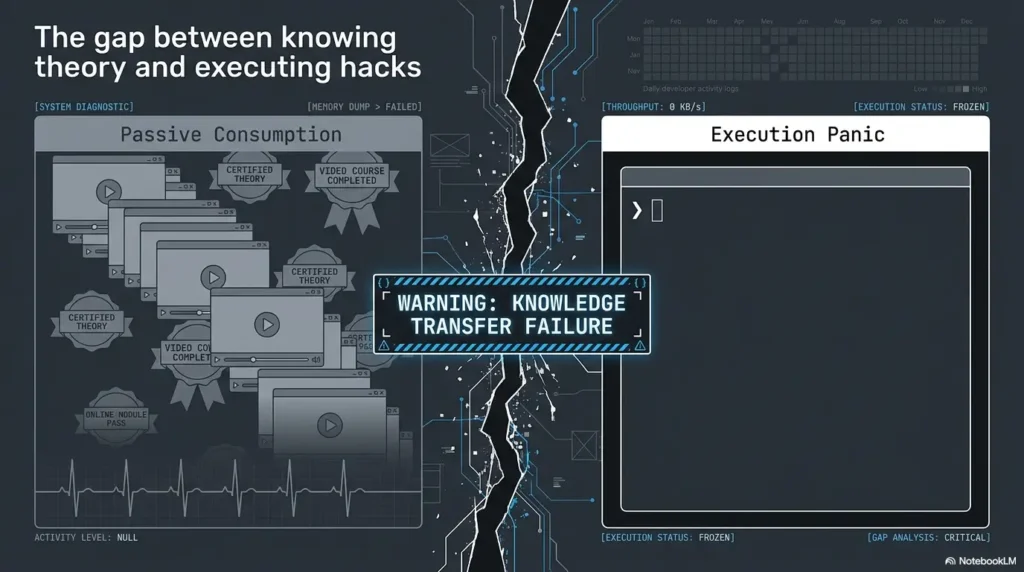
Commands are useful. Command worship is not. A copied line can produce output without producing understanding. That is why some learners can “complete” a lab and still struggle to narrate their reasoning in an interview, a study group, or even their own notes. The action happened. The learning barely clocked in.
Reused walkthrough habits can hollow out your own reasoning
Walkthroughs are not evil. They are tools. But if they enter the room too early, they can flatten your instincts. You begin to look for confirmation instead of evidence. You compare yourself to the path rather than comparing the path to the target. That difference matters. In a weekly habit, walkthroughs are best used as a late-stage review tool, not a steering wheel strapped to your wrists.
Curiosity gap: how much of your current method still works without the internet open?
This is a deliciously uncomfortable test. Close the browser. Keep the notes. What still stands? Which steps remain justified? Which choices suddenly look like borrowed choreography? The answer tells you a lot about whether your system is growing roots or just collecting costume jewelry.
Use Friction on Purpose: Why a Little Repetition Builds Better Instincts
Repeating the same target reduces chaos and sharpens pattern recognition
There is a common learning fantasy that more variety always equals more growth. Sometimes the opposite is true. Repetition removes noise. That reduced chaos lets your attention settle on the quality of your own decisions. You start noticing the tiny places where you jump too early, ignore weak evidence, or cling to the first interesting lead like it owes you rent.
Familiar environments make your thinking easier to inspect
Familiarity is not the enemy of improvement. It is the microscope. When the lab setup, network layout, and target feel known, your thinking becomes easier to inspect. That is especially true when you are using snapshots or stable VM configurations. Broadcom’s documentation on VMware Workstation snapshots emphasizes preserving a VM at a specific moment in time, and that repeatability is gold for practice. You want the environment quiet enough that your reasoning becomes the loud part. If you want a more deliberate approach, a dedicated Kioptrix snapshot strategy can make repeated sessions much easier to sustain.
Here’s what no one tells you: boredom is sometimes the doorway to deeper skill
Boredom gets slandered in learning culture. Yet a little boredom is often the doorway to precision. Once the novelty burns off, you are left with the craft itself. The sequence. The notes. The restraint. The part where your habits stop hiding behind adrenaline and start introducing themselves by name.
- Stable labs expose unstable habits
- Snapshots reduce rebuild fatigue
- Boredom can sharpen attention
Apply in 60 seconds: Decide one thing you will keep unchanged for four weeks: VM setup, notes template, or session length.
Turn Notes Into Evidence: How to Build a Record You Can Reuse Later
Write what you saw, what you assumed, what you tested, and what changed
Good notes are not decorative. They are evidence. Write four categories every session: what you saw, what you assumed, what you tested, and what changed. That simple structure prevents your document from becoming a graveyard of commands. It also gives future-you a way back into the session without needing to reconstruct your thinking from scraps. A lightweight Kioptrix recon log template can help if you want this structure ready before your next session.
Good notes make interview stories and self-review much stronger
This matters beyond the lab. If you are changing careers or preparing for interviews, the notes become raw material for better stories. The NIST NICE Framework describes cybersecurity work in terms of real-world roles, tasks, knowledge, and skills. That means employers care less about theatrical command lists and more about how you gather evidence, narrow options, and reflect on decisions. Strong notes help you speak that language. Later, those reflections can become interview stories built from real lab judgment rather than generic “I did a box” summaries.
Reflection turns a solved lab into a reusable training asset
Quote-prep list for your next self-review
- The first observation that actually mattered
- One assumption that turned out wrong
- One choice you can defend with evidence
- The next question you would test in a fresh session
Neutral next step: End tonight’s notes with three sentences you could say out loud in an interview.
FAQ
How many times should I repeat the same Kioptrix level?
Try a few weekly passes with different objectives, then review whether they still reveal useful gaps. There is no established optimal repeat count. Move to an unfamiliar target when the exercise mainly measures memory rather than transferable reasoning.
Is it bad if I already know the solution path?
No. It just changes the purpose. If you already know the path, use the lab to improve setup discipline, enumeration quality, note structure, timing, and reflection. Known targets are still useful when the goal is process quality.
How long should one weekly session be?
Usually 30 to 45 minutes is enough. The best length is the one you can repeat without drama for at least a month. A smaller session you actually sustain will beat an epic session that leaves you ghosting your own calendar.
Should I use walkthroughs at all?
Yes, but late. Try your own pass first. Use walkthroughs after the session to compare reasoning, spot blind spots, and correct weak notes. Let them review your process, not replace it.
What should I write in my notes each week?
At minimum: what you saw, what you assumed, what you tested, what changed, and what you will try next. That keeps the notes useful for both self-review and interview storytelling.
Can Kioptrix still help if I am switching into cybersecurity from another field?
Absolutely. In fact, this is one of its strongest uses. A small repeatable lab lets you build evidence of patience, logic, and learning behavior without requiring huge blocks of free time or expensive infrastructure.
How do I know whether I am actually improving?
Look for cleaner hypotheses, fewer random pivots, better stopping discipline, and stronger notes. Improvement often shows up as calmer judgment before it shows up as speed.
What if I get stuck on the same step every week?
Narrow the theme and lower the ambition. Spend one full session only on that step. Then write down what evidence you expected to see, what you actually saw, and what assumption may be blocking you. Repeated friction is often a clue, not a failure.
Next Step: The One Weekly Move That Makes This Habit Start
Schedule one 45-minute Kioptrix session this week with a single goal: enumeration only
That is the move. Not a full roadmap. Not a new subscription. Not a six-color dashboard that will look gorgeous for exactly three days. One session. One goal. Enumeration only. When the first week is too ambitious, the habit never gets off the runway.
End the session by writing three lines: what I found, what I assumed, what I will test next
These three lines matter because they create continuity. They also strip away the vague fog that causes so many learners to restart from scratch each week. You are leaving yourself a lit doorway back into the work.
Repeat before expanding scope, difficulty, or toolset
Give the system time to become normal before you decorate it. Once the weekly rhythm feels natural for 3 to 4 sessions, then you can change the theme, add a comparison target, or refine your tooling. Build the floor first. The ceiling can wait.
- Schedule one block
- Keep the goal narrow
- Leave a written trail back in
Apply in 60 seconds: Create a note titled “Kioptrix Week 1” and pre-fill the three closing lines now.
Choose a Feasible Task for the Next Session
Review the previous artifact before adding another activity. A weekly schedule is an organizing choice; the useful question is whether the next task has a clear purpose, available prerequisites and a stopping state you can preserve.
What does the existing record still need?
- If a conclusion lacks a source artifact, reopen or locate the original before extending it.
- If a prerequisite is unresolved, make that prerequisite the task instead of assuming a full investigation can begin.
- If the task is already complete, choose a new question or a justified repeat rather than rerunning it only to maintain a streak.
Keep, narrow or postpone the plan deliberately
| Condition | Planning response |
|---|---|
| Task and prerequisites still fit | Keep the task and identify the evidence to retain. |
| Setup or missing information blocks the task | Narrow the session to one prerequisite check. |
| Available time does not support careful work and closure | Postpone or choose a smaller review task, keeping the current state and next question documented. |
Use the feasibility record below to explain the choice. A missed session is scheduling information; attendance alone does not establish whether a skill was retained. For broader planning, use the learning-path guide.
A Simple Weekly Kioptrix Infographic
Weekly Kioptrix Habit Loop
1. Setup
Boot VM, confirm network, open notes.
Time: 5 min
2. Enumerate
Record observed facts before stories.
Time: 15 to 20 min
3. Test
Try 1 to 2 evidence-based hypotheses.
Time: 10 to 15 min
4. Reflect
Write findings, assumptions, next move.
Time: 5 min
Rule: Stop on time. Return next week before changing the whole system.
Conclusion
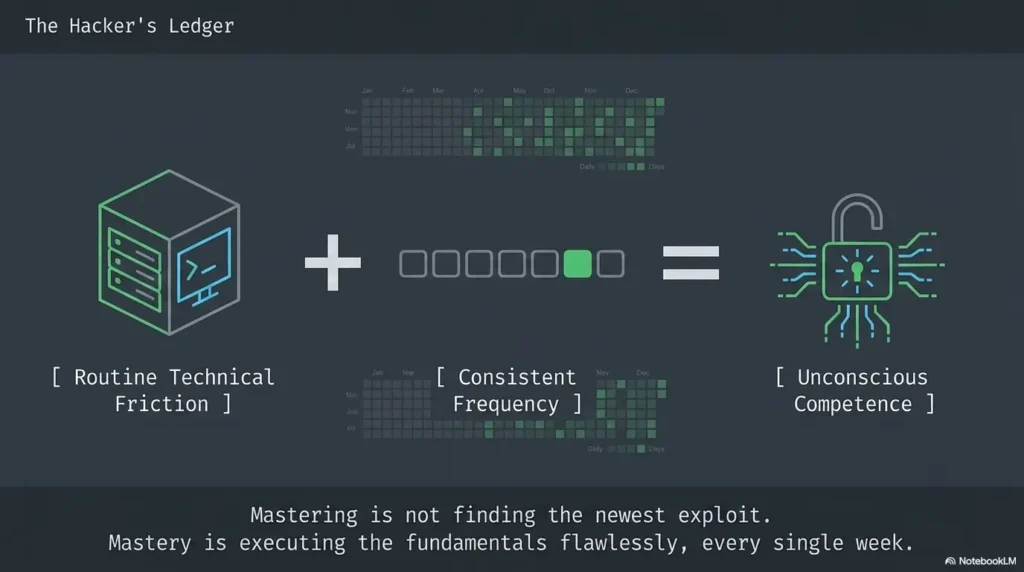
The hook at the beginning was that Kioptrix works better as a candle than fireworks. By now the reason should be clear. Fireworks dazzle and vanish. A candle lets you return, notice, and improve. That is what a weekly skills-building habit needs. Not spectacle. Not strain. Not borrowed choreography. Just a stable lab, a narrow session, honest notes, and the humility to come back.
If you do one thing in the next 15 minutes, make it this: schedule one 45-minute Kioptrix session, choose enumeration only, and pre-write your closing lines. Then let repetition do the quiet work. Oracle’s VirtualBox docs can help you keep networking predictable, Broadcom’s VMware docs can help you preserve clean practice states, and the NIST NICE Framework is a useful reminder that real cybersecurity growth is built around tasks, knowledge, skills, and repeatable judgment. For readers who want the bigger map before they commit, the core Kioptrix level guide is a natural next internal stop.
Original review: 2026-04.
Technical guidance updated: 2026-10-13. Removed an unsupported optimal repetition count and added a clear point for moving to an unfamiliar target.
Weekly habit feasibility review
Use this record for the specific task in this guide. Copy the fields into your notes and complete them with the actual conditions, evidence and assistance used in your own work.
Field guidance for this record
| Field | What to record | Your evidence / next check |
|---|---|---|
| Recurring task | Choose a small repeatable question. | To complete |
| Previous artifact | Retrieve and explain the last relevant output. | To complete |
| Real constraint | Record setup, time or access limits affecting the plan. | To complete |
| Next adjustment | Select a smaller task or different schedule when needed. | To complete |
Edit the template below with your own dated observations. Bracketed prompts are guidance, not evidence. This page does not automatically save or upload your entry; download it before leaving or reloading.
Template ready. Replace the prompts with your record, then download a copy.
Worksheet usability update — October 23, 2026: added an editable record and a download of its current contents. This does not verify the article’s sources or perform the lab exercise.
Next action: Review the last artifact before scheduling more activity. Keep the original record so a later correction does not make an earlier assumption look like an established fact.
Related task: Continue with Kioptrix Lab Consistency: A Small Repeatable Plan when you need that separate part of the workflow.
Worksheet change record — October 20, 2026
Added four task-specific fields, a next action and a related guide. This is an editorial working aid, not a completed lab result or a validated skill assessment. Existing source-review dates retain their own scope; this addition is not a new fact-check of every statement.