

The Durable Path: Strategic Cybersecurity Practice
Career change rarely fails because people lack ambition. It usually fails somewhere between a long workday, a half-finished dinner, and a lab session that asks for more energy than ordinary life can spare. That is exactly why Kioptrix Level for career changers can be so useful. Not as a flashy challenge box, but as a small, repeatable study system that still works when your calendar looks slightly singed.
The real problem is not motivation. It is study design. Most adults trying to move into cybersecurity do not need a bigger lab, a louder plan, or a heroic weekend. They need a practice rhythm that survives tired evenings, interrupted focus, and the slow build of skills like enumeration, note discipline, and troubleshooting.
Keep guessing, and you risk turning every study session into proof that you are “behind,” instead of practice that actually compounds.
This post shows how to use Kioptrix Level as a low-friction cybersecurity routine: short sessions, stable tooling, cleaner notes, and return points that make it easier to begin again tomorrow. The goal is not to feel impressive for one night. The goal is to become steadily more capable over time.
The method here is grounded in the kind of habit-building the body itself keeps returning to: narrow scope, repeatable sessions, snapshot-friendly lab setup, and progress measured by clarity, not theater. Because this is where adults usually get it wrong:
- ✖ Too much intensity.
- ✖ Not enough structure.
- ✖ Too many “fresh starts.”
So let’s build something smaller. And much more durable.
Fast Answer: Kioptrix Level for career changers works best when treated as a small, repeatable study system, not a weekend endurance test. Most adults changing careers do better with short, structured sessions, a narrow lab scope, and a simple note-taking loop they can sustain around work and family life. The goal is not speed. The goal is steady skill accumulation that survives real life.
Table of Contents

Why Kioptrix Level Fits a Career-Change Season Better Than a Big, Chaotic Lab
Why smaller labs often teach better than sprawling practice environments
Big labs can feel productive in the way warehouse stores feel responsible. So much possibility. So many aisles. So many ways to spend two hours and come home with one lemon and a mild identity crisis. Kioptrix Level is smaller, and that is its hidden gift. You can see the edges. You can notice your own habits. You can repeat a scan, compare notes, and actually remember what changed.
Why consistency matters more than intensity for adults with limited time
When adults say they do not have time, they usually mean they do not have clean time. They have interrupted time, tired time, post-dinner time, waiting-for-laundry time. A smaller lab respects that reality. It does not demand a cinematic montage. It asks for 20 to 45 useful minutes and a willingness to come back tomorrow.
How Kioptrix rewards patience, observation, and repeatable habits
That matters because entry-level cybersecurity work is not built only on dramatic wins. NIST’s NICE Framework is used for career discovery, education, training, and describing the knowledge and skills needed for real cybersecurity work. In plain English: the field rewards habits, not just adrenaline.
I have seen learners improve fastest not when they “got root” once, but when their second scan became cleaner than their first, their notes became less chaotic, and their next step stopped sounding like a shrug. Kioptrix is good at exposing that kind of growth.
- Smaller scope makes repetition realistic
- Repetition reveals your thinking patterns
- Clear boundaries reduce wasted effort
Apply in 60 seconds: Decide that this week’s goal is one Kioptrix target, not “all the cyber things.”
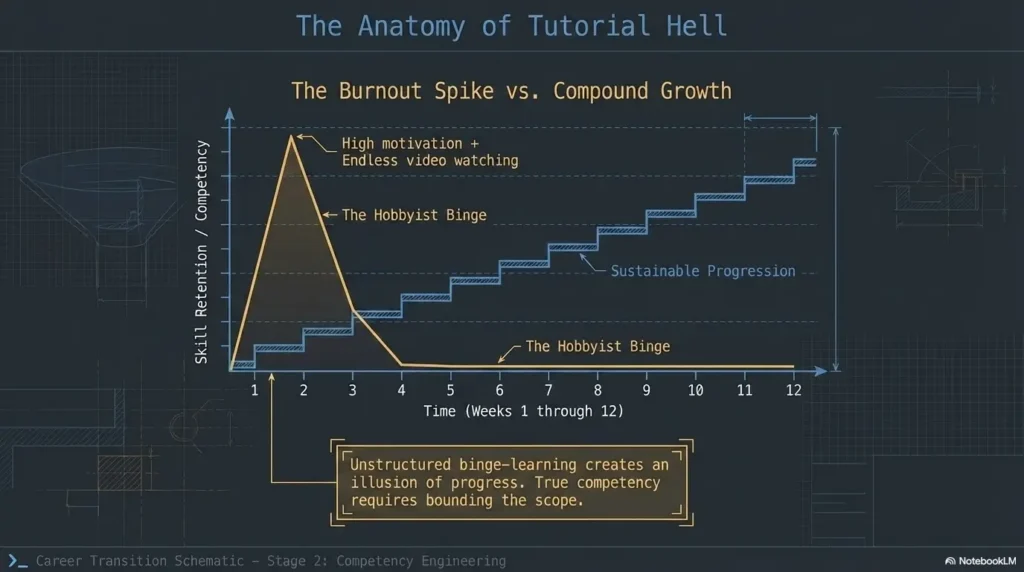
The Real Constraint: Your Schedule Is Not the Problem, Your Study Design Might Be
Why “I only have 30 minutes” can still be enough
Thirty minutes is enough for a focused question. It is enough to boot the VM, run one scan, compare results, jot down two clues, and leave a next command waiting for future-you like a small kindness. It is not enough for an ego trip, which is excellent news.
How fragmented evenings can still produce meaningful progress
The mistake is assuming progress must look smooth. Career-changer progress rarely does. One night you enumerate services. Another night you follow one thread. Another night you realize your earlier assumption was wrong and correct course. That still counts. In fact, it counts more than one giant, blurry session you barely remember.
Let’s be honest… most study plans fail because they are too ambitious for ordinary weekdays
I once watched someone design a “serious” study plan with 90-minute blocks, three tools per session, and a color-coded dashboard that looked ready for a NASA launch. By Thursday, the dashboard was intact and the study habit was dead. The plan had elegance. Their life had children, email, and a headache.
Study design fails when it assumes your best day is your normal day. The better plan is smaller than your ambition, because the smaller plan survives contact with a real calendar.
Eligibility checklist: Is this study style right for you this month?
- Can you protect 20 to 45 minutes, 3 times a week? Yes / No
- Can you keep one VM and one note template stable for 2 weeks? Yes / No
- Can you tolerate slow progress without calling it failure? Yes / No
Neutral next step: If you answered “No” to two or more, shrink the cadence before you add more tools.
Who This Is For, and Who Will Probably Need a Different Practice Setup
Best fit: career changers balancing work, family, and limited daily energy
This setup is ideal for people who need training to coexist with ordinary responsibilities. If you have a full-time job, care work, commuting friction, or a brain that turns into mashed potatoes after 8 p.m., good. You are exactly the person who benefits from a study system with low startup friction.
Strong fit: beginners who want lab discipline before chasing harder boxes
Kioptrix is also a strong fit for beginners who need to build discipline before complexity. Before harder targets, you need the quiet muscles: noticing, documenting, checking assumptions, resuming without panic. If you are still deciding what your first Kioptrix lab should look like, that smaller beginning is often an advantage, not a compromise.
Not a great fit: learners who need constant novelty or advanced exploit variety
If you are already comfortable with enumeration flow, exploit research, privilege escalation patterns, and you mainly need broader exposure, this may feel too contained. That is not a flaw. It just means the lab has given you what it can.
Not a great fit: people trying to brute-force confidence through marathon sessions
If your plan is “I’ll study hard enough in one weekend to stop feeling behind,” Kioptrix will probably become a mirror you dislike. It will show fatigue, impatience, and tool-hopping with almost rude honesty. Useful, yes. Flattering, not especially.
Oracle’s VirtualBox guidance also reminds us why a contained lab is practical: virtualization lets you run multiple operating systems on one machine, and snapshots let you preserve states and return to them later. That is perfect for beginner practice, especially when your life is already crowded enough without rebuilding your lab from scratch after one wrong turn. It is even more useful if you have already thought through the best hypervisor for Kioptrix and settled on something stable.
Show me the nerdy details
Virtual machine snapshots are not just convenience features. They turn experimentation into a reversible activity. For beginners, that lowers the emotional cost of trying something, breaking something, and learning exactly what changed. That emotional safety matters more than most people admit.
Start Smaller Than You Want: The Study System That Actually Survives Busy Weeks
A three-part system: short lab time, short notes, short reset
The simplest durable system has only three parts: do a short lab session, write short notes, leave a short reset point. Not elegant. Very effective.
How to divide one Kioptrix target into multiple low-friction sessions
You do not “do Kioptrix.” You split it. Session one might be environment check plus baseline enumeration. Session two might be one service thread. Session three might be validating an assumption or testing a tiny branch you ignored. Session four might be retrying a failed step with cleaner notes. This is not slow. This is modular.
Why “unfinished on purpose” can be a smart stopping point, not a failure
Adults often stop too late. They stop when they are exhausted, annoyed, or vaguely offended by nmap. Better to stop with one thread partially open and a return point waiting. Unfinished on purpose is not failure. It is a breadcrumb trail.
Here is the subtle shift: your goal is not to maximize tonight’s completion. Your goal is to minimize tomorrow’s restart friction.
Infographic: The 3-Part Kioptrix Study Loop
1. Lab
20 to 45 minutes
One technical thread only
2. Notes
Clues found
Dead ends logged
3. Reset
Next command visible
Easy re-entry tomorrow
Why it works: small loops reduce dread, protect focus, and make progress repeatable.
Decision card: 20 minutes vs 45 minutes
Choose 20 minutes when your energy is low, you need a restart session, or you only want one scan and one note update.
Choose 45 minutes when you already know your question and can stay on one technical thread without opening twelve tabs “for context.”
Neutral next step: Pick tomorrow’s session length before tomorrow arrives.
Session Size First: Build a Practice Rhythm Before You Build Technical Speed
What a 20-minute session can realistically accomplish
A 20-minute session can boot the environment, confirm network connectivity, run a scan, read one output carefully, and update your notes. It can also rescue continuity after a gap. That matters. Restart sessions are not inferior sessions. They are often the ones that keep the habit alive.
What a 45-minute session can do without creating cognitive spillover
Forty-five minutes can be a useful starting block for following one thread: enumerate, test a lead, and leave clean notes. It is a planning example, not a proven attention limit. Adjust it to the task, your energy, and any breaks you need; longer structured sessions can also work.
How to choose a weekly cadence you can still keep during a bad week
My favorite boring rule is this: choose a weekly cadence you can keep even during a bad week. Not a perfect week. A bad one. For many career changers, that means three sessions. Sometimes two. Rarely seven, unless your life currently resembles a monk with fiber internet.
One learner I know finally improved after cutting back from six “aspirational” sessions to three modest ones. Their skills did not accelerate because they worked harder. They accelerated because they stopped disappearing for four days after one exhausting push. Readers who struggle with this exact rhythm problem often benefit from a deeper look at how long a Kioptrix session should really be.
- 20 minutes is enough for continuity
- 45 minutes is often enough for one solid thread
- Your bad-week cadence is your real cadence
Apply in 60 seconds: Set a recurring weekly target of 3 sessions, then protect the smallest one first.
Don’t Chase Momentum, Build Return Points
Why every session needs a clean re-entry path for tomorrow
Momentum is overrated when you are tired. Return points are better. A return point is one visible line in your notes telling you exactly where to begin next time. That might be a command to rerun, a service to investigate, or a clue to verify.
What to log before you stop: scans run, clues found, dead ends, next command
Before you stop, write four things: what scans you ran, what clues stood out, what dead ends you hit, and what command or question comes next. This sounds almost insultingly simple until you experience the opposite, which is reopening the lab two days later and staring at your own tabs like an archaeologist of poor decisions. A simple recon log template for Kioptrix can remove a shocking amount of restart friction.
How return points reduce dread and shorten restart time
Return points reduce two hidden taxes: dread and restart time. Dread is emotional friction. Restart time is operational friction. Both are expensive. Tiny notes cut both at once.
Kali’s documentation also reinforces the value of a stable learning environment. Kali explicitly documents installation and virtualization paths across platforms, which is a polite way of saying: set your environment up once, then spend your brain on the work instead of perpetual setup drama.
Common Mistakes That Quietly Break the System
Mistake: treating one lab like a test of talent instead of a practice field
This is the big one. The moment you turn a practice lab into a referendum on your future, everything gets louder. Every dead end feels personal. Every hint feels like moral failure. Every slow scan becomes evidence that perhaps accounting would have been safer.
Mistake: changing tools, methods, and note formats every few days
Tool churn feels smart because it looks like adaptation. Often it is avoidance dressed in utility belts. Keep your tooling stable long enough to learn what your thinking does under pressure. Nmap, a browser, a notes file, and a VM are enough for a surprisingly long time. If you need a steadier home for observations, a dedicated Kioptrix technical journal or a practical guide to choosing a note-taking tool for Kioptrix can help keep the system boring in the best way.
Mistake: confusing longer sessions with better learning
Longer sessions can produce more output and worse understanding. By hour three, many learners are no longer evaluating evidence. They are bargaining with it.
Mistake: stopping only when exhausted, stuck, or irritated
Stopping late teaches your brain that the lab is where evenings go to die. Stopping cleanly teaches your brain that the lab is a manageable task with edges. That difference matters more than motivation speeches ever will.
Short Story: A career changer I once helped had a ritual. Every Sunday, they would promise themselves a “real session.” Three hours, coffee, two monitors, the works. By Sunday night, they were tangled in notes, hungry, vaguely embarrassed, and already avoiding Wednesday. We rebuilt the system. Tuesday: 25 minutes, one scan.
Thursday: 30 minutes, one service thread. Saturday: 40 minutes, clean recap. After three weeks, they were moving more slowly on paper and much more effectively in practice. The funny part was that their confidence improved before their technical speed did. They stopped needing the lab to prove something cosmic. It only needed to teach them one useful thing at a time. That was the week the habit finally became believable.
Quote-prep list for your next session
- One question you want the session to answer
- One command you know you will run first
- One note file already open before the VM starts
- One stopping rule so the session ends cleanly
Neutral next step: Put these four lines in a pinned note and reuse them every session.
Don’t Do This: The Marathon-Weekend Trap That Makes Monday Feel Like Defeat
Why overloading one day often creates avoidance for the next five
Marathon weekends feel noble. They also create a credit-card model of energy: the purchase is exciting, the bill arrives later. When Sunday absorbs all your willpower, Monday starts with avoidance, not momentum.
How fatigue turns simple enumeration into messy guesswork
Enumeration is where fatigue becomes visible. You miss obvious clues. You stop reading carefully. You open a second path before finishing the first. Then a third. Then twenty tabs bloom like a digital rash. Nothing is technically impossible. Everything is cognitively expensive. This is also why so many Kioptrix enumeration mistakes are really fatigue mistakes wearing technical clothing.
Here’s what no one tells you… inconsistency often begins with one “productive” session that costs too much
The most dangerous session is often the one that feels productive but empties the tank. It gives you the glow of effort and the hangover of overload. That is why disciplined stopping matters.
VirtualBox’s snapshot guidance is part of this story, too. Snapshots let you preserve a state and return later, which supports experimentation without requiring every session to end in total closure. That reduces the temptation to force completion just because you are already deep in it. A thoughtful snapshot strategy for Kioptrix makes this much easier in practice.
What to Track So Progress Feels Real Before Results Look Impressive
Track attempts, not just outcomes
If you only track whether you solved the box, your motivation will become hostage to outcomes. Track attempts instead. Track whether you showed up. Track whether your session had a clear question. Track whether you left a return point.
Track clearer notes, cleaner enumeration, and fewer repeated mistakes
Progress often appears first in quality, not glory. Your scan outputs become easier to compare. Your notes stop looking like they were taken during an earthquake. Your repeated mistakes become less repeated, which is lovely.
Track confidence in the process, not just whether you got root
Confidence in cybersecurity is often misunderstood. It is not the feeling that you always know the answer. It is the feeling that you know how to proceed when you do not. Over time, that usually shows up in cleaner enumeration reports and more coherent lab reports, long before it shows up as dramatic speed.
| What to Track | Good Signal | Why It Matters |
|---|---|---|
| Sessions completed | 2 to 3 per week | Builds identity and continuity |
| Repeated mistakes | Trending downward | Shows sharper observation |
| Restart time | Under 5 minutes | Reduces dread dramatically |
- Measure attendance
- Measure note quality
- Measure faster re-entry
Apply in 60 seconds: Add one line to your notes template: “Restart time today: ___ minutes.”
A Minimal Workflow for Each Kioptrix Session
Open with one question, not ten
Start each session with one question. Not a grand theme. A question. Which service deserves attention? What changed between scans? What does this banner suggest? A single question narrows your attention and keeps curiosity from becoming clutter.
Spend the middle on one technical thread at a time
In the middle, follow one thread. Resist the urge to “just quickly check” five others. Most beginner chaos begins in the middle. The start is usually fine. The end is usually hopeful. The middle is where all the tabs get ideas. A stable Kioptrix recon routine helps keep that middle from turning into a fog machine.
Close with a two-minute recap and a visible next step
At the end, recap in two minutes. What did you learn? What failed? What comes next? Keep it visible. Future-you should not need a séance.
Keep your tooling stable until your thinking gets sharper
Kali Linux remains a common platform for security practice because it centralizes tools and documents a wide range of installation and virtualization options. For a beginner, the lesson is simple: stability first, novelty later. That is also why many learners do better after choosing one dependable Nmap workflow for Kioptrix instead of reinventing their scanning style every week.
Show me the nerdy details
A stable workflow lowers context-switching cost. Context-switching cost is the invisible tax you pay every time you swap tools, rename files, reinvent note templates, or reconfigure your lab instead of using it. The cost feels small in the moment and massive over a month.
When Motivation Drops: Make the System Smaller, Not Dramatic
Why shrinking the task beats waiting to “feel ready”
Motivation is a weather pattern. Systems are architecture. When motivation drops, do not make a speech. Make the task smaller. Open the notes. Boot the VM. Run one command. That counts.
How to study usefully on low-energy days
Low-energy days are perfect for maintenance work: re-reading prior notes, comparing outputs, labeling dead ends, cleaning your return point, or rerunning one known command to confirm an assumption. These are not fake sessions. They are part of the craft.
What counts as a win when life crowds the calendar
A win on a crowded week might be embarrassingly small. Good. Embarrassingly small wins are often the ones that preserve continuity. One command. One clue. One note. One return point. That is how serious people keep going when life stops posing for productivity posters.
NIST’s NICE material is helpful here because it frames cybersecurity as a set of real work roles and workplace skills, not as a mythology of constant intensity. Career changers need that reminder. You are not trying to look impressive in your living room. You are trying to become reliable in a field that values reliability.

FAQ
Is Kioptrix Level good for absolute beginners changing careers into cybersecurity?
Yes, especially if you treat it as a practice environment for observation, enumeration, note discipline, and patient troubleshooting. It is less useful as a vanity project and very useful as a repeatable routine.
How many hours per week should a career changer spend on Kioptrix?
For many adults, 1.5 to 3 hours per week split across 3 sessions is more sustainable than one giant block. The exact number matters less than whether you can repeat it for several weeks without resentment.
Can 20 to 30 minutes a day really help with cyber lab practice?
Yes. Short sessions are enough for scans, note cleanup, one service thread, or a restart session. The gain is cumulative. Think bricks, not fireworks.
Should I finish one Kioptrix box before starting another lab?
Usually yes, at least early on. Finishing or pausing deliberately teaches better closure than scattering your attention across multiple boxes before your workflow is stable. For many beginners, that fits naturally into a more deliberate Kioptrix best-practice path.
What should I write down during a Kioptrix study session?
Write down scans run, clues noticed, dead ends encountered, assumptions made, and the next command or question for the next session. Those five items are enough to cut restart time sharply.
How do I stay consistent when I work full time?
Design for tired weekdays, not ideal weekends. Use short sessions, fixed cadence, stable tools, and a stopping rule. Consistency usually lives inside boring structure.
Is it bad if I need hints while learning Kioptrix?
No. Hints are tools, not confessions. Use them carefully. The goal is to understand what clue you missed and how your process can improve next time.
How do I know whether I am improving if I am still slow?
You are improving if your notes are clearer, your restart time is shorter, your questions are sharper, and you repeat mistakes less often. Speed usually arrives after method, not before.
Do I need Kali Linux to do this well?
Not always, but many learners use Kali because its documentation and tool ecosystem are geared toward security work. The bigger issue is stability. A consistent environment beats fashionable churn.
Next Step: Build One Week You Can Actually Repeat
Pick one Kioptrix target, three short sessions, and one note template
If you want this article to become useful instead of merely agreeable, build one real week now. Pick one Kioptrix target. Choose three short sessions. Use one note template. Keep the environment stable.
Decide in advance what “done for today” looks like
Your stopping rule matters. “Done” might mean one scan reviewed, one clue logged, and one next command written. Pre-deciding your stopping rule prevents the old bargain where tiredness makes decisions and then blames the lab.
End the week by reviewing process improvements, not just technical wins
At week’s end, ask process questions. Was your restart time shorter? Did your notes get cleaner? Did you stop opening side quests like a raccoon in a shiny-object warehouse? Those are real gains.
And this closes the loop from the beginning: the reason Kioptrix is so good for career changers is not that it transforms you overnight. It is that it gives you a structure small enough to survive ordinary life and honest enough to reveal whether your method is improving. That is how confidence becomes sturdy rather than theatrical. If you want a broader map after that first sustainable week, a more complete Kioptrix learning path can help you extend the habit without breaking it.
- One lab target
- Three short sessions
- One stable note template
Apply in 60 seconds: Put three 25-minute sessions on your calendar and label them “Kioptrix: one question only.”
Original review: 2026-04.
Differentiation Map
| What competitors usually do | How this article avoids it |
|---|---|
| Pushes “learn cybersecurity fast” energy | Centers on sustainable study design for adults with real constraints |
| Treats Kioptrix as a pure technical walkthrough topic | Frames it as a repeatable habit system tied to career-change realities |
| Uses vague sections like “Benefits,” “Tips,” and “Conclusion” | Uses distinct, intent-rich headings with practical friction points |
| Assumes learners have long blocks of free time | Builds around short, consistent sessions and re-entry-friendly workflows |
| Focuses only on tools and exploits | Highlights cognitive load, session design, note discipline, and fatigue control |
| Makes slow progress feel like failure | Reframes small wins as the real engine of long-term skill building |
Technical guidance updated: 2026-10-13. Clarified that session lengths are adjustable planning examples rather than universal attention limits.