
Beginner Pentesting Lab Guide
Kioptrix vs VulnHub: Choose the Right First Box
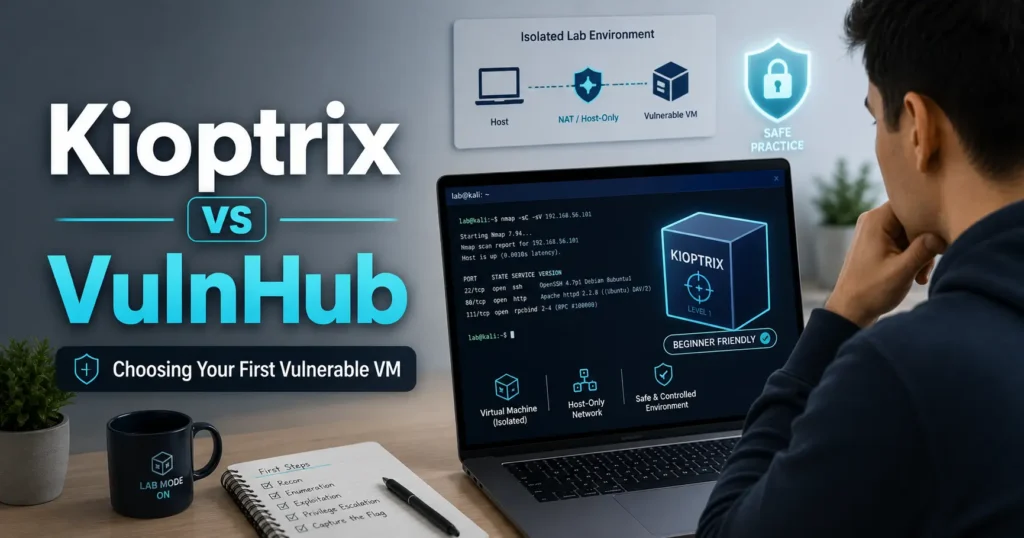
The first surprise is also the most useful: Kioptrix and VulnHub are not rival training platforms. Kioptrix is a series of intentionally vulnerable virtual machines distributed through VulnHub. The real decision is whether Kioptrix Level 1 is the right first target for your current skills, or whether another learning format would teach you faster.
Kioptrix gives new pentesters a compact version of the full testing cycle. You discover a host, map exposed services, form hypotheses, validate a weakness, gain access, inspect the compromised system, and work toward root. There is no cheerful progress bar telling you that you are 63 percent finished. That uncertainty is both the lesson and the occasional headache.
This guide helps you decide where to begin, build a safely isolated lab, avoid spoiler-driven practice, and complete a structured 90-minute attempt. It also explains when free local machines are enough and when guided lessons, better hardware, or paid learning tools may be worth considering.
The aim is not merely to capture root. It is to understand why your next action makes sense. 🧭
Snapshot
This article is for cybersecurity students, IT professionals, and self-taught beginners choosing a first vulnerable VM. You will learn whether Kioptrix fits your current ability, how it differs from browsing the wider VulnHub catalog, how to isolate the lab, and how to complete a useful first session without reading a full walkthrough.
Table of Contents
Lab Safety First: Keep the Vulnerable Machine Contained
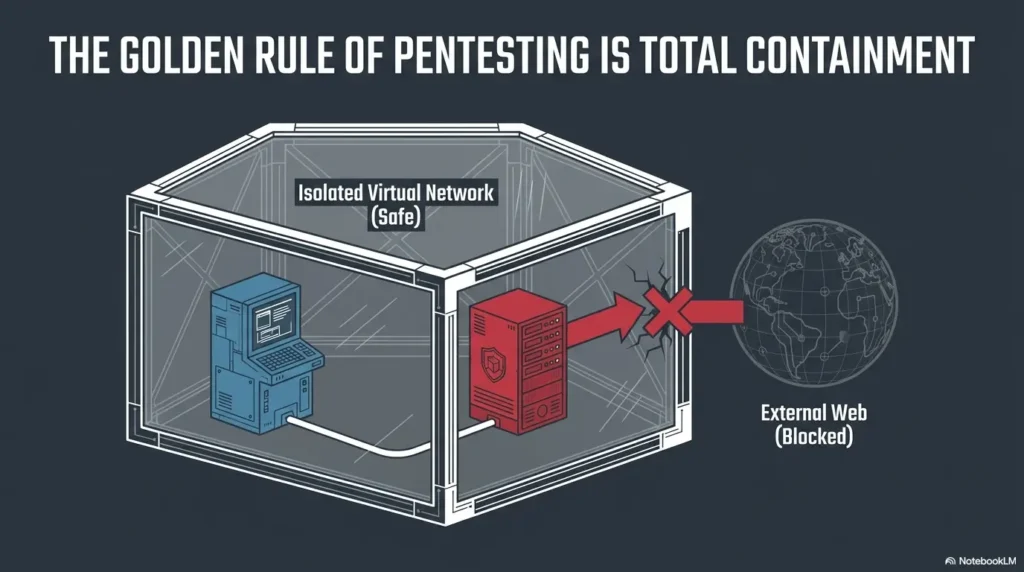
Kioptrix machines are intentionally insecure. That is their purpose, but it also means they should be treated more like a jar of live laboratory specimens than an ordinary desktop VM.
Use these machines only on hardware you own or are authorized to operate. Place the attacker and target on an isolated virtual network, keep sensitive files out of both systems, and confirm that the target cannot reach your household devices, workplace network, or the public internet.
Before You Act
This guide explains safe lab planning and beginner learning methods. It is not permission to test systems belonging to other people or organizations. Network settings vary by hypervisor, operating system, and local environment, so confirm isolation before scanning. When a lab is connected to school, employer, shared-building, or managed infrastructure, ask the responsible administrator before proceeding.
Why bridged networking is a poor beginner default
A bridged adapter can place a VM directly on the same network as real devices. That may allow the vulnerable target to communicate with laptops, phones, printers, storage systems, smart-home equipment, or workplace resources.
Host-only or internal networking is generally easier to contain. The labels differ between virtualization tools, so do not rely on a setting name alone. Test what the VM can actually reach.
Four isolation tests to complete first
- Confirm the attacker VM can communicate with the target VM.
- Confirm the target cannot browse the public internet.
- Confirm the target cannot reach unrelated local IP addresses.
- Confirm both machines are on a subnet you can clearly identify.
Key takeaway
Do not begin by asking, “Can I see the target?” Begin by asking, “What else can the target see?”
Kioptrix Is Inside VulnHub, Not Opposite It
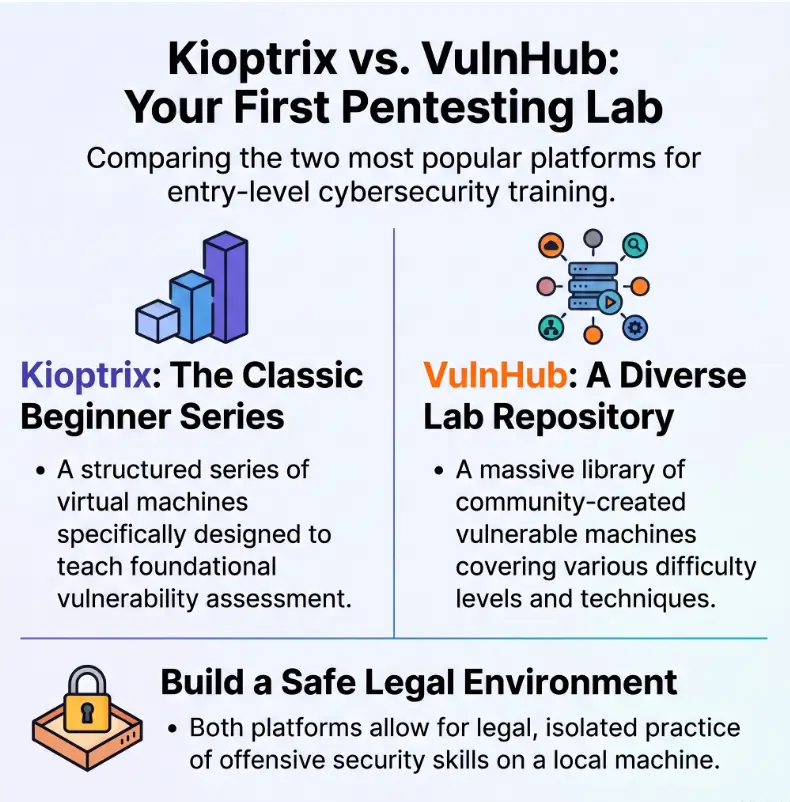
The phrase “Kioptrix vs VulnHub” contains a category error. VulnHub is a catalog and distribution site for deliberately vulnerable training machines. Kioptrix is one series available through that catalog.
A closer comparison would be “Kioptrix Level 1 versus another beginner VulnHub machine” or “the Kioptrix sequence versus browsing VulnHub by technology and difficulty.” Once that distinction clicks into place, the choice becomes much easier.
What VulnHub provides
VulnHub gives learners access to downloadable virtual machines created for lawful security practice. Its catalog spans different operating systems, application stacks, challenge styles, and expected skill levels.
The variety is valuable, but it can also turn the first decision into an evening of tab collecting. One box has a charming theme. Another promises realism. A third has twenty writeups and an ominous skull in the description. None of those details tells you whether it fits your current ability.
What the Kioptrix series provides
Kioptrix offers a recognizable progression through beginner-oriented Linux machines. The early levels encourage service enumeration, exploit research, initial access, local investigation, and privilege escalation.
The machines do not behave like a guided course. They give you a target and let the silence do some teaching. For students who already understand basic networking, that open-ended format can be exactly the right amount of difficulty.
The real beginner question
You are not choosing between a series and a website. You are choosing between a focused first route and a broad catalog.
| Question | Choose Kioptrix first | Browse other VulnHub machines |
|---|---|---|
| Do you want a predictable sequence? | Yes | Not essential |
| Do you want varied technologies immediately? | Limited variety | Better fit |
| Do you need built-in instruction? | No | Usually no |
| Do you want a complete Linux box workflow? | Strong fit | Depends on the machine |
| Are you selecting by a narrow skill? | Less precise | Better fit |
You can review VulnHub’s own description of its training catalog on the official VulnHub About page.
Key takeaway
Kioptrix is not an alternative to VulnHub. It is one carefully bounded route through VulnHub.
Who Should Start With Kioptrix, and Who Should Wait?
Kioptrix Level 1 is beginner-friendly by vulnerable-machine standards. That does not mean it teaches every prerequisite from zero.
A learner who can use a terminal, recognize an IP address, and run a basic port scan has enough foundation to begin. Someone who is still unsure what a port represents may spend the entire session wrestling with vocabulary rather than practicing security analysis.
A good fit for Kioptrix
- You know basic Linux navigation and file commands.
- You have used Nmap at least once and understand that open ports expose services.
- You can distinguish an attacker VM from a target VM.
- You are comfortable reading documentation when a tool behaves unexpectedly.
- You want to practice a complete route from discovery to privileged access.
Start with guided lessons first when…
- You have never configured a virtual machine.
- Terms such as subnet, service banner, shell, and privilege escalation are unfamiliar.
- You need step-by-step explanations before independent practice.
- You become stuck because you do not know which question a tool is answering.
Guided training is not the lesser path. It separates learning a technique from proving that you can recognize when to use it. A few structured lessons can prevent hours of ceremonial command typing.
A five-minute readiness scorecard
| Can you do this without a tutorial? | Score |
|---|---|
| Find your VM’s IP address | 1 point |
| Explain what an open port means | 1 point |
| Run and save a basic Nmap scan | 1 point |
| Research a service name and version | 1 point |
| Explain why the target must be isolated | 1 point |
A score of four or five suggests that Kioptrix Level 1 is a sensible next step. Two or three means you can still begin, but keep a networking reference nearby. Zero or one suggests a short guided foundation course will produce a better first experience.
For a more detailed preparation sequence, use this Kioptrix beginner lab guide before importing the target.
What Kioptrix Teaches Before You Notice It
The obvious lesson is exploitation. The more important lesson is how to move from incomplete evidence to a defensible next action.
Enumeration becomes the main character
Beginners often expect the dramatic moment to be an exploit launching successfully. In practice, most of the intellectual work happens earlier.
- Discover the target without scanning unrelated devices.
- Identify exposed ports and the services behind them.
- Collect versions, banners, page behavior, and protocol responses.
- Separate confirmed facts from guesses.
- Return to earlier results when a promising route collapses.
This creates a habit that transfers well beyond old training VMs: observe first, interpret second, test third.
Exploitation is only the middle
A shell is not the finish line. It is a change in perspective. You now need to determine who you are, what system you entered, what local services exist, which permissions are available, and whether a path to higher privileges can be justified.
Stopping at the first shell teaches the wrong rhythm. A complete practice attempt should include post-exploitation enumeration and a written explanation of how initial access differs from root access.
Manual research versus framework-assisted testing
Frameworks can save time, standardize checks, and help you understand common exploit workflows. They can also hide assumptions behind a polished interface.
Before running a module, identify the vulnerability it targets, the affected software, the required conditions, and the expected result. Afterward, compare the module’s behavior with your original hypothesis.
| Approach | Best use | Main risk | Question to record |
|---|---|---|---|
| Manual verification | Learning protocols and vulnerability conditions | Setup friction can consume time | What evidence confirms the weakness? |
| Framework-assisted test | Validating a known path efficiently | Success without understanding | What did the module check before exploitation? |
| Writeup reproduction | Reviewing a technique after an independent attempt | Copying without recognition | Which clue should have led me here? |
Real-world example: evidence beats a crowded toolbox
A learner scans a Kioptrix machine and finds several open ports. The first instinct is to search each port number beside the word “exploit,” open six tabs, and launch the first matching module.
A stronger approach begins with service detection. The learner records the web server, protocol behavior, visible application clues, and software versions. One finding appears old, but the reported version alone is not enough. The learner checks whether the target configuration matches the vulnerability’s prerequisites.
The first hypothesis fails. Instead of adding more tools, the learner returns to the scan and notices an overlooked service. That second route produces a meaningful result.
The practical lesson is quiet but durable: failed validation is not wasted time when it narrows the possibilities and improves the next decision.
Key takeaway
The best beginner notes do not merely record commands. They record why each command was worth running.
The Hidden Cost of Choice Inside VulnHub
VulnHub’s catalog is a gift to curious learners. It can also become a beautifully organized form of avoidance.
More machines can produce less practice
Community difficulty labels are not perfectly standardized. A machine described as easy may assume familiarity with a technology you have never seen. Another beginner target may contain setup quirks that feel harder than the intended security challenge.
Constant box-hopping prevents repetition. You never complete the same workflow often enough for it to become automatic: discover, enumerate, interpret, validate, document, and review.
Browsing can feel suspiciously like studying
Reading machine descriptions, comparing ratings, and bookmarking writeups creates the soft glow of progress. Yet no evidence log appears, no service gets investigated, and no hypothesis is tested.
Set a selection limit. Spend no more than fifteen minutes choosing a machine, then commit to one uninterrupted attempt. The goal is not to find the perfect box. The goal is to become the learner who can finish one.
When the wider catalog becomes an advantage
- You can repeat a basic enumeration workflow without prompting.
- You know which skill is currently weak.
- You want several comparable targets for pattern recognition.
- You need practice with a particular operating system, protocol, or application type.
- You are building a curriculum for a study group or class.
Key takeaway
Choice becomes useful after you have a selection rule. Before that, it mostly produces more tabs.
Old VMs Can Still Build Modern Testing Habits
The Kioptrix machines were released years ago and contain legacy operating systems, services, and configurations. That age creates limitations, but it does not erase their educational value.
Skills that still transfer
- Asset and host discovery
- Port and service enumeration
- Version and configuration research
- Hypothesis ranking
- Exploit-prerequisite validation
- Local system enumeration
- Evidence-based note-taking
- Clear technical reporting
These activities are durable because they train reasoning rather than attachment to a single tool version.
What not to copy into modern work
Do not assume an old exploit path reflects the most common conditions in maintained systems. Modern environments may have stronger defaults, additional monitoring, segmented networks, patched dependencies, or entirely different architecture.
Likewise, a command copied from a decade-old writeup may use outdated syntax or deprecated software. Check current documentation and understand every option before execution.
Setup friction is separate work
Older virtual appliances may require adapter changes, format conversion, altered boot settings, or careful DHCP troubleshooting. Those tasks can teach persistence, but they should not blur into your exploitation notes.
Maintain two logs:
- Environment log: hypervisor version, adapter mode, VM format, subnet, boot errors, and fixes.
- Assessment log: discovered services, evidence, hypotheses, tests, results, and next actions.
For help separating VM problems from target-analysis problems, consult this Kioptrix troubleshooting guide.
Show me the nerdy details
A virtual network mode is not a security guarantee by itself. The actual communication path depends on the virtual switch, host firewall, routing table, DHCP source, adapter configuration, and whether more than one interface is enabled.
A target attached to an internal network may be isolated from the host, while a host-only network commonly permits communication with the host but not external systems. NAT usually allows outbound access through the host. Bridged mode commonly places the guest beside physical network devices.
Because implementations differ, verify reachability directly. Record the attacker IP, target IP, network prefix, default gateway, active interfaces, and routes before scanning. Disable unnecessary adapters rather than trusting that they will remain unused.
Choose a Training Route by Learning Goal
Popularity is not a learning objective. Choose the route that creates the kind of difficulty you need next.
Choose Kioptrix for a full-box workflow
Kioptrix is a strong option when you want to practice the connective tissue between stages. You must decide how service information affects exploit research, how initial access changes local enumeration, and how local evidence informs privilege escalation.
Choose another machine for one weak skill
Once you can complete a basic Linux target, use the broader catalog to isolate a weakness. You might select a web-heavy target, a machine centered on misconfiguration, or a system that requires more exploit modification.
The important move is to name the skill before choosing the machine. “I want something harder” is vague. “I need more practice recognizing web enumeration clues” is actionable.
Choose guided training when instruction is the missing ingredient
Open-ended machines test whether you can recognize and combine techniques. They are less efficient at teaching an unfamiliar technique from first principles.
A subscription course or guided platform may be worth paying for when you need structured explanations, browser-based labs, saved progress, progressive hints, or a defined curriculum. Free local VMs are often enough when you already know the underlying technique and need independent repetition.
| Setup tier | What it includes | Best for | What to verify before paying |
|---|---|---|---|
| Good: free local practice | Existing computer, free hypervisor, attacker VM, downloaded target | Self-directed learners who can troubleshoot | Hardware capacity, isolation controls, image compatibility |
| Better: organized home lab | More memory or storage, dedicated lab folders, snapshots, structured notes | Regular practice and repeatable workflows | Whether upgrades solve a real bottleneck |
| Best for convenience: guided service | Hosted labs, lessons, hints, progress tracking, curated paths | Beginners who need instruction or limited setup | Curriculum depth, cancellation terms, lab access, skill coverage |
A simple decision rule
Your first-box decision flow
Build the Lab Before Running the First Scan
A clean lab setup saves more learning time than an extra scanning tool. The minimum useful design has one attacker VM, one vulnerable target VM, an isolated network, and a way to revert both systems.
Minimum lab components
- An attacker VM with current tools and security updates
- The downloaded Kioptrix target image
- An internal or host-only virtual network
- A clean snapshot taken before testing
- A dedicated notes folder
- No sensitive documents, credentials, or synced personal folders
Verify the download before importing it
Compare the downloaded file’s checksum with the value published on the machine page when one is available. Preserve the original archive so you can rebuild the VM without downloading an unknown replacement.
Record where the file came from, the archive name, checksum, hypervisor, import settings, and network mode. This takes a few minutes and makes later troubleshooting far less foggy.
The pre-scan lab checklist
- Only the required network adapter is enabled on each VM.
- The attacker and target addresses belong to the intended lab subnet.
- The target has no route to the public internet.
- Unrelated household or workplace devices are unreachable.
- The target boots without unresolved storage or adapter errors.
- A clean snapshot exists.
- Your notes file already contains the date, target name, subnet, and goals.
Use this dedicated Kioptrix network setup guide when you need a deeper check of adapters and subnets. For virtualization tradeoffs, see the hypervisor comparison for Kioptrix.
Common Mistakes That Ruin a First Kioptrix Attempt
Most first attempts do not fail because the learner lacks a secret exploit. They fail because the workflow becomes noisy, unsafe, or impossible to review.
Mistake 1: scanning the wrong network
Identify the lab subnet before using discovery tools. Confirm each target address before running a scan. NAT, bridged, internal, and host-only modes are not interchangeable labels for “the VM has networking.”
Mistake 2: opening a walkthrough after five minutes
Set a minimum independent-enumeration period. When you become stuck, use a progressive hint rather than a complete solution. Ask for the next category of action, not the exact command.
Before seeking help, document what you know, what you tested, why it failed, and what you believe should happen next. This turns help into instruction rather than rescue.
Mistake 3: treating every open port as an exploit
An open port is an invitation to investigate, not proof of vulnerability. Separate discovery, service identification, configuration analysis, vulnerability research, validation, and exploitation.
Mistake 4: stopping after obtaining a shell
Identify the current user, privileges, operating system, local services, network interfaces, running processes, and accessible files. Record how the shell was obtained and what evidence suggests a path to higher privileges.
| Common mistake | Safer alternative | Learning benefit |
|---|---|---|
| Scanning before confirming the subnet | Record IP ranges and routes first | Prevents accidental targeting |
| Launching unrelated modules | Rank hypotheses by evidence | Builds analytical discipline |
| Reading a full walkthrough immediately | Use progressive hints after a documented attempt | Preserves discovery |
| Copying an old command | Check current syntax and understand options | Reduces tool dependence |
| Stopping at initial access | Complete local enumeration | Teaches the full assessment cycle |
| Keeping only terminal history | Save output and interpretation separately | Makes review possible |
A structured Kioptrix note-taking workflow can prevent the session from dissolving into screenshots named “final2-really-final.png.”
A 90-Minute First Run Without Spoiling the Box
Ninety minutes is long enough to produce meaningful evidence and short enough to prevent frustration from swallowing the entire evening.
Minutes 0 to 15: establish the laboratory
- Start the attacker and target VMs.
- Confirm the intended subnet and isolation.
- Discover the target address.
- Create an evidence log with timestamps.
- Write one session goal, such as “map all exposed services.”
Minutes 15 to 35: map the attack surface
- Run an initial port scan.
- Follow with targeted service detection.
- Save raw output to a dedicated file.
- List services that require manual investigation.
- Separate confirmed findings from assumptions.
Minutes 35 to 60: build three hypotheses
For each promising service, write a short hypothesis:
- Observation: What did the target reveal?
- Possible weakness: What condition might be unsafe?
- Required evidence: What must be true for the weakness to apply?
- Validation step: What is the smallest useful test?
Rank the three hypotheses by evidence, not excitement. Choose one to test first.
Minutes 60 to 90: validate and close the loop
- Confirm the selected vulnerability’s prerequisites.
- Run the narrowest reasonable validation step.
- Record the exact result and your interpretation.
- Return to enumeration if the evidence weakens.
- Write the next three actions before stopping.
- Take a snapshot or revert the target as appropriate.
The session is successful even without root if you can explain the exposed services, defend your leading hypothesis, and identify a sensible next action.
Evidence log template
- Command or action: What did you do?
- Reason: Why was it worth doing?
- Result: What happened?
- Interpretation: What does the result suggest?
- Next test: What would confirm or reject the idea?
- Correction: Which assumption changed?
Kioptrix vs VulnHub FAQ
Is Kioptrix separate from VulnHub?
No. Kioptrix is a vulnerable-machine series hosted and indexed through VulnHub. VulnHub is the broader catalog containing Kioptrix and many other downloadable training targets.
Which Kioptrix level should a beginner start with?
Start with Kioptrix Level 1. Do not choose a later machine merely because its writeups look more popular or its numbering seems interesting. The first level gives you a cleaner introduction to the series’ expected workflow.
Can someone who has never used Nmap try Kioptrix?
Yes, but a brief guided introduction to IP addressing, ports, and scan output will reduce unproductive confusion. Kioptrix is better at testing an enumeration process than teaching every networking concept from the beginning.
Should beginners use VirtualBox or VMware?
Either can support an isolated beginner lab. Compare import compatibility, snapshot controls, network configuration clarity, host operating system support, and the behavior of older appliance formats. The best choice is the one you can configure, verify, and restore confidently.
Can Kioptrix be completed without Metasploit?
Some machines may allow more than one route, including manual and framework-assisted approaches. A manual-first attempt can improve protocol understanding and exploit research, while a framework can help validate a known hypothesis efficiently.
How long should the first Kioptrix machine take?
There is no useful universal completion time. Setup experience, networking knowledge, tool familiarity, and research habits create large differences. Measure progress by completed stages: isolation, discovery, enumeration, hypothesis building, validation, initial access, local enumeration, and reporting.
When should a beginner read a walkthrough?
Read one after a documented independent attempt, preferably after using progressive hints. Then revert the machine and complete a clean second run without copying the solution line by line.
What should come after the Kioptrix series?
Choose machines that target your weakest repeatable skill. If web enumeration was weak, select a web-focused target. If local privilege escalation felt mechanical, choose a box requiring stronger local analysis. Difficulty should be a consequence of your learning goal, not the goal itself.
Your Next Step: One Evidence-Driven Attempt
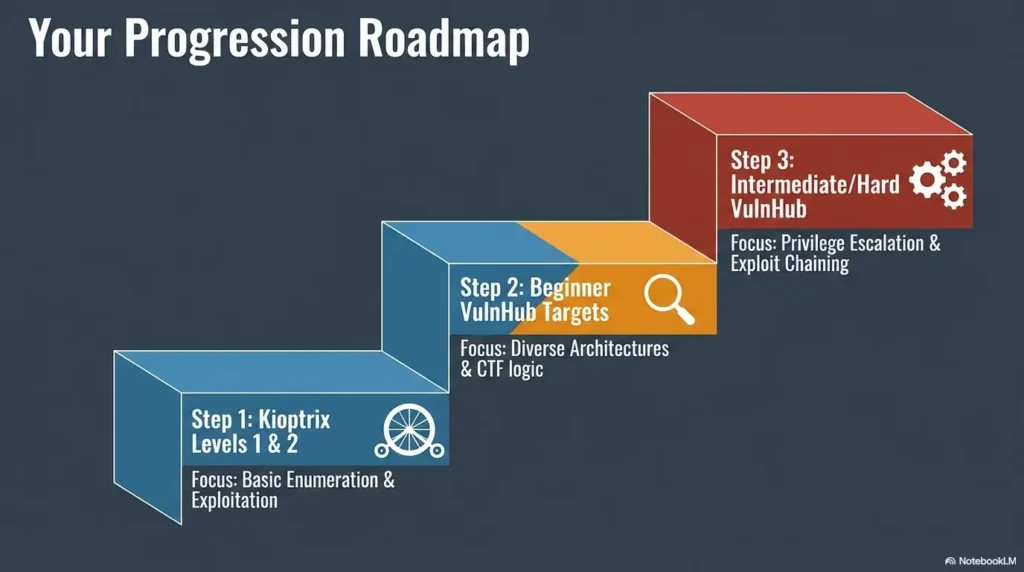
The answer to Kioptrix versus VulnHub is now pleasantly unglamorous. Kioptrix is one path within VulnHub, and it is a strong first choice when you know basic networking, can run an initial scan, and want to practice an entire Linux compromise workflow without built-in guidance.
Your next action does not require a new course, a larger tool collection, or a heroic weekend schedule.
Within the next fifteen minutes, create a folder for Kioptrix Level 1, add a blank evidence log, record your intended lab subnet, and review the Kioptrix Level 1 preparation guide. Do not run a scan until you can state which machines should be reachable and which should not.
Then schedule one uninterrupted 90-minute session. Aim to finish discovery and service enumeration before consulting a walkthrough. Root access would be satisfying, but a clear evidence trail is the more valuable first artifact. It is proof that you are beginning to think like a tester rather than merely borrowing a tester’s commands.
The 15-minute commitment
Create the lab folder. Create the evidence log. Record the subnet. Verify the isolation plan. One small, clean beginning beats another hour spent searching for the perfect first machine.
Last reviewed: 2026-09