
Security due diligence without accidental promises
Security Questionnaire Answers for Encryption:
Say Exactly What You Can Defend
An encryption question may occupy one line in a customer spreadsheet, yet the answer can quietly become a sales representation, an audit artifact, and a contractual expectation. That is why “Yes, AES-256” is rarely the reassuring answer it appears to be. It names an algorithm while leaving the buyer to guess which systems, data types, keys, backups, network hops, and exceptions are actually covered.
A defensible response does not need to expose the wiring behind your vault door. It needs a clear boundary. The strongest answers identify the data and product scope, describe the implemented control, assign key-management responsibility, acknowledge material limitations, and point to evidence that an authorized reviewer can verify.
This guide gives SaaS founders, security teams, sales engineers, and compliance managers a practical system for writing answers that survive procurement follow-ups. You will learn where vague claims crack, how FIPS wording goes wrong, when paid questionnaire tools are useful, and how to build an answer library that remains accurate after the architecture changes.
Define the boundary
Separate databases, files, logs, backups, exports, and network paths.
Control the claim
Replace brittle absolutes with accurate, approved, product-specific language.
Attach real evidence
Connect each answer to an owner, artifact, exception, and review date.
The goal is not the strongest-sounding answer. It is the strongest answer your production system can prove. 🔐
Snapshot
This article is for SaaS vendors and cloud-service teams completing customer security reviews. It solves the problem of vague, stale, or overstated encryption answers. By the end, you will be able to map encryption controls, choose safer wording, compare answer-management options, and create a one-page evidence map before submitting your next questionnaire.
Table of Contents
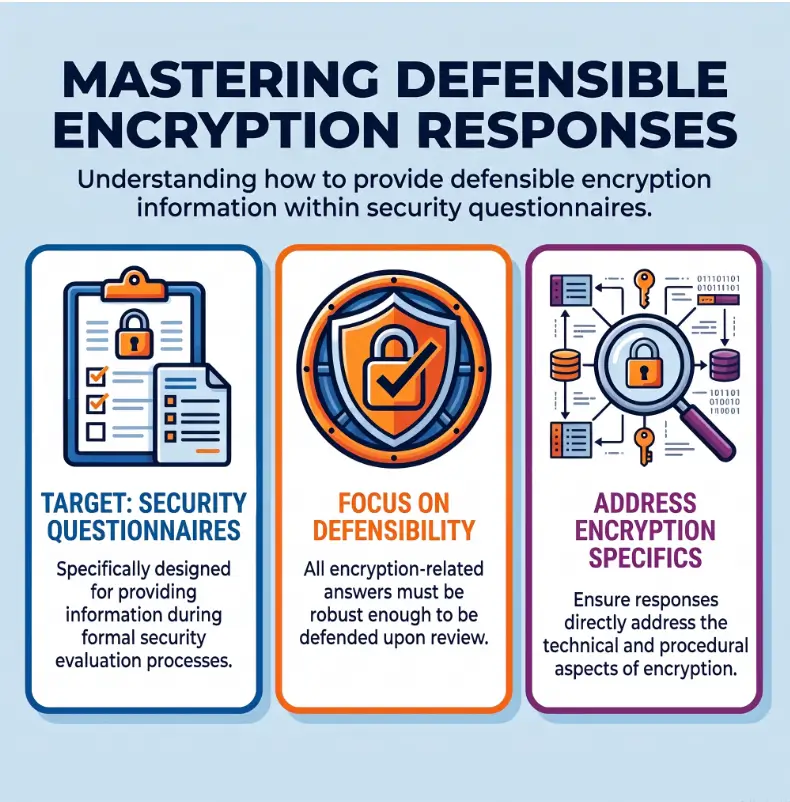
Before You Answer: Treat Every Claim as Reviewable
Before You Act
This guide helps teams prepare and review questionnaire language. It is not legal advice, an audit opinion, or proof that a control is effective. Confirm important answers against the current production architecture, approved policies, cryptographic module records, customer contracts, and known exceptions. Claims involving certifications, universal coverage, customer-exclusive control, or regulatory compliance should receive qualified security and legal review.
Why a one-word “Yes” can create a many-page problem
A buyer may ask, “Is customer data encrypted at rest?” The questionnaire cell appears to invite a binary response. The real question is larger: which customer data, in which product, in which environment, using which service, with whose keys, and subject to which exceptions?
An unsupported “Yes” can be interpreted as universal coverage. That interpretation may later reach a procurement contract, a security addendum, an auditor, or an incident-response investigation. The sentence that helped close a deal on Tuesday may become evidence on a less cheerful Friday.
Use a four-person ownership chain
- Engineering confirms implementation. The data stores, services, network connections, and key-management behavior must match production.
- Security confirms control language. The wording should reflect approved standards, exceptions, and evidence-handling rules.
- Legal or compliance reviews consequential claims. This is especially important for absolute terms, certifications, customer-controlled encryption, deletion, and regulatory language.
- An answer owner records the review date. The owner is responsible for triggering a new review after material product or infrastructure changes.
The minimum pre-submission check
- The answer names the relevant product or service.
- The answer separates production from development and test environments where necessary.
- The covered data types and storage locations are known.
- The responsible party for key management is identified.
- Exceptions, optional features, and plan limitations are not hidden.
- The evidence is current and actually supports the claim.
- The language does not turn future work into a present control.
Key takeaway
A questionnaire answer is not merely sales copy. Treat it as a controlled security statement with an implementation owner, evidence source, approval path, and expiration date.
Teams building a wider due-diligence process may also benefit from a structured vendor security questionnaire workflow and a practical SOC 2 compliance checklist for startups.
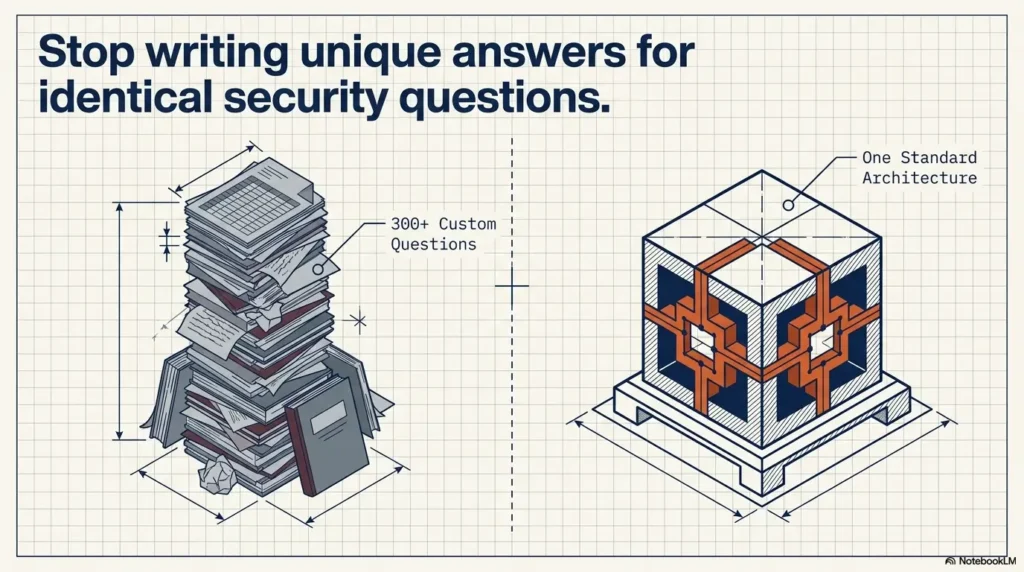
The Five-Part Encryption Answer Framework
A useful encryption answer gives the buyer enough information to evaluate the control without handing over sensitive operational details. The following framework works for long-form responses, questionnaire comments, trust-center copy, and approved answer libraries.
The defensible answer path
1. Scope
Name the product, environment, data, region, and system boundary.
2. State
Separate data at rest, in transit, in use, and in backup copies.
3. Control
Describe the configured service, protocol, or architectural protection.
4. Ownership
State who manages keys, access, configuration, and exceptions.
5. Evidence
Link the statement to a current, approved artifact and owner.
Scope and state prevent accidental universals
Start by defining what the answer covers. A company may operate several products, deployment models, regions, or legacy components. The same encryption statement may not apply to all of them.
Then identify the data state. Data at rest and data in transit are not interchangeable. Backups, temporary processing files, application memory, customer exports, and logs may each have different control boundaries.
Control and ownership reveal how protection really works
“AES-256” describes an algorithm, not an operating model. A buyer also needs to understand whether encryption is implemented through managed disk encryption, a database service, application-level logic, field-level encryption, client-side encryption, or another control.
Ownership clarifies responsibility. Keys may be managed by your company, a cloud provider, a subprocessor, the customer, or a combination of parties. A shared-responsibility answer is not weaker when it is accurate. It is simply easier to evaluate.
Evidence turns a description into a reviewable statement
Evidence may include an approved architecture diagram, encryption standard, cloud configuration record, key-management procedure, audit report, module certificate, access-control record, or exception register. The artifact should be current, product-specific, and owned by someone who can explain it.
| Answer element | Question it should resolve | Example evidence |
|---|---|---|
| Scope | Which product, environment, data, and region? | Data inventory or architecture diagram |
| State | At rest, in transit, backup, temporary, or exported? | Data-flow map |
| Control | What configured protection is operating? | Security standard or configuration record |
| Ownership | Who controls keys, settings, and access? | Responsibility matrix or key procedure |
| Evidence | How was the statement verified? | Audit artifact, certificate, or approved record |
Key takeaway
The most useful answer is usually one direct sentence followed by bounded detail: scope, control, ownership, exceptions, and evidence.
Encryption at Rest: Map the Stores, Not Just the Algorithm
What “AES-256” leaves sitting in the dark
AES-256 may be part of an accurate answer, but it does not identify where the control applies. It says nothing about the encryption service, mode of operation, key owner, storage boundary, legacy exceptions, or whether the statement includes backups and logs.
Imagine telling a homebuyer, “The building uses steel.” That may be true, yet it does not explain which beams, which structure, or whether the balcony is held up by optimism. Encryption answers need the same architectural specificity.
The storage-boundary checklist
- Production relational and non-relational databases
- Object and file storage
- Block volumes, server disks, and container storage
- Search indexes and data warehouses
- Application caches and message queues
- Logs, traces, metrics, and error-reporting systems
- Analytics and business-intelligence platforms
- Snapshots, replicas, archives, and disaster-recovery copies
- Temporary processing directories and troubleshooting exports
- User-generated reports and downloaded files
Provider encryption is not the same as application encryption
| Encryption layer | What it commonly protects | What it may not prove |
|---|---|---|
| Disk or volume encryption | Physical media and attached storage volumes | Protection from an authorized application or database session |
| Database-level encryption | Database files, tablespaces, or managed storage | Identical protection for exports, logs, caches, or replicas |
| Application-level encryption | Selected values before storage | Coverage for every field or operational data store |
| Field-level encryption | Specific sensitive fields | Protection for surrounding metadata and search indexes |
| Client-side encryption | Data encrypted before reaching the service | That every product feature can operate without server-side plaintext |
| End-to-end encryption | Content intended to remain unavailable to intermediaries | Protection from endpoint compromise, metadata exposure, or authorized recipient access |
A safer way to structure an at-rest answer
Open with a direct response, then state the covered systems and data. Identify the implemented encryption service and the party managing the keys. Close with any meaningful exceptions and the evidence source used for verification.
For example, an approved answer might explain that customer content in named production databases and object-storage services is encrypted at rest through configured cloud encryption services, with keys managed under the company’s approved access and lifecycle procedures. It should separately address backups, logs, exports, and any product tier where the control differs.
Key takeaway
Never use “all customer data” until you can account for logs, metadata, backups, analytics copies, caches, temporary files, and exports.
Encryption in Transit: Follow Every Network Hop
Public HTTPS is only the front door
A valid certificate on the public application endpoint demonstrates something important, but it does not prove that every internal, administrative, replication, or vendor connection is encrypted. A buyer may care about the whole production data path, not merely the browser’s padlock.
Map the route one connection at a time. Include traffic from the user to the application edge, the edge to internal services, service-to-service connections, application-to-database traffic, storage APIs, administrative sessions, backup transfers, telemetry, and subprocessor exchanges.
Network hops that deserve separate verification
- User device to public application endpoint
- Content-delivery or edge service to application infrastructure
- Application service to internal service
- Service mesh or workload-to-workload traffic
- Application to database, cache, queue, and storage
- Production system to monitoring and logging platforms
- Primary region to backup or disaster-recovery region
- Application to payment, email, analytics, support, or other subprocessors
- Administrator or support engineer to production systems
State protocol policy without freezing a fragile promise
A durable answer can describe the minimum approved protocol version, certificate-management ownership, cipher-configuration process, mutual authentication where applicable, legacy exceptions, and review frequency. This is more useful than “we use TLS,” while avoiding an exhaustive configuration dump that may become stale or create unnecessary exposure.
For authoritative implementation guidance, review the NIST guidance on TLS implementations. It treats protocol selection and configuration as related but distinct decisions.
Real-world example: the green padlock and the forgotten queue
A SaaS team answered that all customer data was encrypted in transit because its public application enforced HTTPS. During a customer follow-up, an engineer reviewed the architecture and found that an older internal worker sent job data to a message queue through a legacy connection that did not follow the current transport-security baseline.
The control was not entirely absent. Most traffic was protected, the public endpoint was correctly configured, and remediation was already practical. The problem was the word “all.”
The team changed the questionnaire response to define the verified production paths, documented the exception, assigned remediation ownership, and set a review date. The revised answer sounded less glossy, yet it was far more useful to the buyer and safer for the vendor.
Key Management: Explain Who Can Decrypt What
Key custody is a lifecycle, not a rotation number
Buyers asking about key rotation are often evaluating something broader: who creates keys, where they are protected, how access is authorized, how compromise is handled, and whether old keys remain available for backups and recovery.
- Key generation and approved cryptographic source
- Storage and protection in a key-management service or protected module
- Access authorization for people, services, and automation
- Separation of duties and privileged approval
- Scheduled or event-driven rotation and rekeying
- Revocation after compromise, access change, or decommissioning
- Backup, recovery, and disaster-recovery availability
- Audit logging, monitoring, and alert ownership
- Cryptographic destruction and retention dependencies
Data keys and key-encryption keys are different jobs
Many cloud systems use envelope encryption. A data-encryption key protects the data, while a separate key-encryption key protects that data key. This design can limit exposure and simplify management, but the questionnaire answer should still explain who controls each layer and which service performs the cryptographic operations.
You do not need to turn a procurement spreadsheet into a graduate seminar. A plain-English explanation of the responsibility boundary is usually enough.
Describe human access without impossible absolutes
Statements such as “employees cannot access encryption keys” may be inaccurate when administrators can manage permissions, trigger operations, or use emergency workflows. The safer question is not whether a human can ever interact with the system. It is how access is restricted, approved, logged, monitored, and reviewed.
- Role-based restrictions for key-management administration
- Service identities used for routine cryptographic operations
- Privileged-access approval and time limits
- Break-glass procedures for emergencies
- Separation between application access and key administration
- Logging and review of sensitive administrative actions
“Customer-managed keys” must name the actual capability
| Capability | Who controls the key? | Question to verify |
|---|---|---|
| Provider-managed keys | Cloud or service provider | Does the vendor control configuration, access, or key selection? |
| Organization-managed keys | The SaaS vendor | Are keys shared, dedicated, regional, or environment-specific? |
| Dedicated tenant keys | Usually the SaaS vendor | Can the customer rotate, disable, or revoke independently? |
| Bring Your Own Key | Shared control | Where is the key generated and who can authorize its use? |
| Hold Your Own Key | Primarily the customer | Can the service operate without vendor custody of usable key material? |
| Customer-controlled revocation | Customer has a control action | What happens to availability, backups, and recovery after revocation? |
NIST’s Recommendation for Key Management provides a useful reference for understanding cryptographic key lifecycles, protection requirements, and operational responsibilities.
Show me the nerdy details
A key-management answer becomes more precise when it distinguishes cryptographic operations from administrative control. An application may request encryption or decryption without receiving raw key material. A cloud key-management service may retain the master key while policy determines which workload identity can request an operation.
Rotation can also mean different things. It may create a new key version for future writes, rewrap existing data keys, fully re-encrypt stored data, or merely change an alias. These actions have different operational effects.
When a questionnaire asks how often keys rotate, confirm what rotates, which data is affected, whether the service manages the schedule, and which events trigger immediate revocation or rekeying.
FIPS Claims: Verify the Module Before Using the Label
An approved algorithm is not a validated module
A product can use a recognized algorithm without using a validated cryptographic module. It can use a validated module but operate it outside the approved configuration. It can also rely on a validated component without making the entire application or service “FIPS certified.”
The Cryptographic Module Validation Program evaluates defined hardware, software, firmware, or hybrid modules against applicable FIPS requirements. The validation belongs to the identified module and tested operating environments, not automatically to every product that calls the module.
Check the certificate against what is actually deployed
- Module vendor and official module name
- Certificate number and validation standard
- Module version or build
- Hardware, software, or operating environment
- Approved mode and required configuration
- Security level and applicable caveats
- Certificate status
- Relationship between the deployed product and validated module
FIPS 140-2 and FIPS 140-3 are not decorative substitutes
Questionnaires sometimes use “FIPS” as if it were one timeless badge. Your response should identify the actual module, certificate, standard, and deployment relationship. Do not quietly replace a FIPS 140-2 reference with FIPS 140-3 language because the newer number sounds tidier.
The official NIST Cryptographic Module Validation Program explains the validation process and provides access to module records.
Use bounded wording when validation is incomplete
When the service uses a recognized cryptographic library or managed encryption feature but the team has not verified module status across every production deployment, say so. An accurate answer can identify the service and algorithm while declining to represent the whole product as FIPS validated.
Key takeaway
Before using “FIPS validated,” confirm the exact module, version, certificate, operating environment, approved mode, and product-to-module relationship.
Evidence Sharing Without Exposing Sensitive Details
Build an evidence matrix before attaching documents
The evidence should prove the answer, not merely resemble it. A generic cloud-provider page may show that an encryption feature exists, but it does not prove that your product enabled it, configured it correctly, included every relevant store, or committed to it contractually.
| Claim | Strong evidence | Weak substitute |
|---|---|---|
| Production databases are encrypted at rest | Current architecture record plus approved configuration evidence | Generic database-service marketing page |
| Keys are access restricted | Key policy, role mapping, and privileged-access record | General identity policy with no key scope |
| Transport policy is enforced | Approved baseline plus current configuration or test evidence | Screenshot of one public endpoint |
| A FIPS-validated module is used | Module certificate matched to version and operating environment | Vendor statement that a library is “FIPS capable” |
| Backups are encrypted | Backup architecture, storage configuration, and recovery procedure | Production database encryption record alone |
Use evidence tiers for different buyers
- Public evidence: trust-center pages, approved security briefs, certification listings, and public standards statements.
- Controlled evidence: audit reports, policies, test summaries, and architecture documents shared under confidentiality restrictions.
- Review-only evidence: sensitive diagrams, screenshots, or configuration records shown during a supervised review without distributing a copy.
Do not prove security by publishing the map to the treasure room
- Key identifiers or secret locations
- Internal hostnames and administrative endpoints
- Unredacted configuration files
- Detailed recovery or break-glass instructions
- Credentials, tokens, or service-account details
- Security-monitoring thresholds and evasion-relevant rules
- Diagrams containing unnecessary network or tenant details
A useful evidence process resembles good vulnerability documentation: enough detail to support review, with careful handling of sensitive material. The same discipline used in clear vulnerability report writing can improve questionnaire evidence packages.
Free Checklists, GRC Tools, or Professional Review?
Not every SaaS company needs an expensive questionnaire platform. The right setup depends on questionnaire volume, product complexity, buyer requirements, evidence sensitivity, and how often the architecture changes.
Good, Better, Best: choose the smallest system that stays accurate
| Setup | Best fit | What it includes | Main limitation |
|---|---|---|---|
| Good: controlled spreadsheet | Early-stage vendor with occasional reviews | Approved answers, owners, evidence links, scope, and review dates | Manual updates and weak workflow control at higher volume |
| Better: questionnaire or GRC platform | Growing SaaS team handling repeated enterprise requests | Answer library, assignments, approval workflow, evidence controls, and reuse | Subscription cost and implementation effort |
| Best: platform plus scheduled expert review | Complex products, regulated buyers, or several deployment models | Tooling plus engineering, security, compliance, and legal validation | Higher cost and need for disciplined internal ownership |
When a free DIY process is enough
A spreadsheet can work well when the company has one product, a relatively simple architecture, a small review team, and only occasional questionnaires. The crucial word is “controlled.” A folder full of copied answers with no owner or review date is not a system. It is a fossil bed.
- Limit editing permissions.
- Require evidence links for high-risk claims.
- Record product and deployment scope.
- Add answer, evidence, and approval owners.
- Use review dates and change triggers.
- Archive superseded wording rather than silently overwriting it.
When paid questionnaire software may save money
Paid tools become more attractive when sales engineers repeatedly search for the same answers, security reviewers become a bottleneck, evidence must be shared under different access rules, or product variations create frequent exceptions.
Before buying, compare role-based access, approval workflow, answer expiration, evidence permissions, product-specific variants, integrations, export control, artificial-intelligence features, source traceability, and the ability to prevent unapproved language from being sent.
When professional review is worth considering
- The questionnaire includes FIPS, regulated data, sovereign hosting, or customer-controlled keys.
- Sales and engineering disagree about the current architecture.
- The answer may enter a contract or security addendum.
- Several products, regions, or deployment models require different wording.
- A recent incident, migration, acquisition, or platform redesign changed the control boundary.
- The buyer requests unusual evidence or product-specific attestations.
A broader security tool stack cost comparison can help teams evaluate whether workflow software replaces real labor or merely adds another dashboard to feed.
Mistakes and Edge Cases That Break Good Answers
Seven expensive wording mistakes
- Answering “Yes” without scope. The buyer may reasonably read the response as universal.
- Using “all customer data” without a complete inventory. Logs, metadata, caches, analytics copies, and exports often complicate the claim.
- Confusing hashing with encryption. Hashing, tokenization, masking, encoding, and encryption solve different problems.
- Repeating cloud-provider language as your own implementation. Availability of a feature does not prove configuration or coverage.
- Inventing a universal rotation period. Different key types and managed services may follow different lifecycles.
- Presenting planned work as implemented. Label planned, partial, optional, and customer-responsibility controls honestly.
- Reusing stale answers indefinitely. Infrastructure changes faster than questionnaire libraries admit.
The edge-case checklist buyers use to test whether the answer is real
| Edge case | What to verify | Why it changes the answer |
|---|---|---|
| Backups and snapshots | Storage encryption, replication, restoration access, and key availability | Production controls may not automatically cover recovery copies |
| Logs and telemetry | Customer content, identifiers, tokens, request bodies, and destinations | Operational data can carry sensitive information quietly |
| Temporary files | Staging paths, processing directories, dumps, and troubleshooting exports | Short-lived data can still be copied or exposed |
| Subprocessors | Data received, transmission, storage, key owner, and evidence | The responsibility boundary changes outside your platform |
| Multi-region replication | Regional differences, sovereign deployments, and recovery regions | One global answer may conceal different implementations |
| Support access | Authorized application access, privileged tools, approvals, and logging | Encryption does not prevent every authorized plaintext view |
| Customer exports | Export generation, storage, download path, expiration, and customer responsibility | Control may change once data leaves managed storage |
Use status labels instead of polishing uncertainty
- Implemented: operating in the stated production scope.
- Partially implemented: operating in defined systems with documented gaps.
- Planned: approved or proposed work that is not yet a current control.
- Available by configuration: technically supported but dependent on setup.
- Plan-specific: available only to particular service tiers or contracts.
- Customer responsibility: dependent on customer configuration, endpoint security, or key custody.
Key takeaway
Exceptions do not automatically make a control weak. Hidden exceptions make the answer unreliable.
When Security, Engineering, or Legal Must Step In
Ask engineering when the data path is uncertain
Engineering review is necessary when the answer depends on undocumented stores, service-to-service traffic, backup behavior, mobile clients, custom cryptography, legacy components, regional deployments, or recent migrations.
Do not ask engineering merely, “Do we encrypt data?” Bring a specific inventory of systems and network hops. Precision reduces review time and reveals gaps more quickly.
Ask security when implementation needs interpretation
Security should review key custody, privileged access, cryptographic standards, threat assumptions, exception language, evidence sensitivity, and whether a control description discloses too much operational detail.
Ask legal when an answer could become a promise
- Always
- Never
- All data
- No employee access
- Fully compliant
- End-to-end encrypted
- FIPS certified
- Guaranteed deletion
- Customer-exclusive control
These phrases are not automatically forbidden, but they require unusually strong evidence and carefully defined scope. Legal review is especially important when the wording may be copied into an agreement, order form, security schedule, or representation relied upon by the customer.
Pause submission when evidence contradicts the draft
If architecture records, configuration evidence, or engineering statements conflict with the proposed answer, the problem is not cosmetic. Do not smooth the wording until everyone feels comfortable. Resolve the control boundary, document the exception, or narrow the claim.
Encryption Questionnaire FAQ
Is customer data encrypted at rest?
Answer by naming the covered product, data classes, storage systems, encryption service, key owner, and material exceptions. Address backups, logs, analytics copies, and customer exports separately when they do not share the same control.
Is customer data encrypted in transit?
Describe the verified external, internal, administrative, replication, and subprocessor connections. State the approved transport-security baseline and disclose documented legacy exceptions rather than implying that a public HTTPS endpoint proves every network path.
What encryption algorithms does the service use?
Identify both the algorithm and its use case. Explain which system or data type it protects, which service implements it, and who controls the related keys. Avoid presenting the algorithm name as the complete control description.
Who creates, stores, and rotates encryption keys?
State the key-management platform, administrative owner, service-identity model, access restrictions, lifecycle process, logging, and responsibility boundary. Distinguish provider-managed, vendor-managed, and customer-controlled key options.
Can customers manage their own encryption keys?
Confirm whether the feature provides customer-controlled generation, rotation, authorization, revocation, or custody. A dedicated key managed by the SaaS vendor is not automatically a customer-managed key.
Is the product FIPS 140-3 validated?
Verify the exact cryptographic module, certificate, version, operating environment, approved mode, and deployment relationship. Module validation should not be presented as automatic certification of the entire product or service.
Are backups encrypted with the same controls?
Give backups a separate answer. Confirm storage encryption, replication paths, restoration access, retention, key dependencies, disaster-recovery availability, and whether archived copies follow the same key lifecycle as production data.
Can administrators view decrypted customer data?
Separate raw key access from application-authorized access, database access, support tooling, privileged workflows, and emergency access. Encryption can reduce unauthorized exposure without preventing every authorized plaintext view.
How often are encryption keys rotated?
Describe the applicable scheduled, managed-service, or event-driven lifecycle. Clarify what type of key rotates and whether rotation creates a new version, rewraps data keys, or fully re-encrypts stored information. Do not invent one company-wide interval if the systems differ.
Build Your Encryption Evidence Map in 15 Minutes
The fastest useful next step is not rewriting every answer in your library. It is building one page that shows where customer data lives, how each location or transfer is protected, who controls the keys, and which evidence supports the statement.
Start with these eight rows
| Data location or transfer | Data covered | Encryption control | Key owner | Exceptions | Evidence | Answer owner | Last verified |
|---|---|---|---|---|---|---|---|
| Production database | Customer records and content stored in primary databases | Record the configured database or storage encryption control | Identify provider, vendor, customer, or shared control | Note product, region, or legacy differences | Link approved architecture and configuration records | Assign a named role | Record the review month |
| Object storage | Files, attachments, and generated content | Record service-side, application, or client-side encryption | Identify key administrator | Note public assets or alternate storage classes | Link storage standard and configuration evidence | Assign a named role | Record the review month |
| Application traffic | User and API communications | Record approved transport-security policy | Identify certificate and configuration owner | Note legacy clients or special endpoints | Link baseline and test evidence | Assign a named role | Record the review month |
| Internal service traffic | Service-to-service data | Record protocol, service mesh, or private transport control | Identify platform owner | List documented internal exceptions | Link data-flow and configuration records | Assign a named role | Record the review month |
| Backups and snapshots | Recovery copies and archives | Record storage and replication encryption | Identify backup key owner | Note old archives or separate regions | Link backup architecture and recovery procedure | Assign a named role | Record the review month |
| Logs and analytics | Events, identifiers, metrics, and derived data | Record destination and storage protection | Identify platform or subprocessor owner | Note content exclusions and retention differences | Link logging standard and data inventory | Assign a named role | Record the review month |
| Subprocessor transfers | Data sent to external service providers | Record transfer and storage protections | Identify shared-responsibility boundary | Note region, feature, and vendor differences | Link contract, security documentation, and data-flow records | Assign a named role | Record the review month |
| Customer exports | Reports, downloads, and generated files | Record generation, temporary storage, and download protection | Identify when responsibility passes to the customer | Note expiration and retention behavior | Link export workflow and product documentation | Assign a named role | Record the review month |
Turn each verified row into an approved answer module
- Write one direct opening sentence.
- Name the covered product, data, and environment.
- Describe the implemented control in plain English.
- Identify key-management and configuration responsibility.
- State material limitations, options, and exceptions.
- Attach or reference the approved evidence tier.
- Add the owner, approval status, and next review date.
Set a timer for 15 minutes and complete only the production database row first. Do not chase perfect prose. Find the owner, identify the control, locate the evidence, and record what remains uncertain. One honest row is more valuable than twenty polished answers built on assumptions.
When the map is complete, your questionnaire library stops being a pile of confident sentences and becomes something sturdier: a living index of what the product can prove.
Last reviewed: 2026-09