
2026 OSCP+ Cost Guide
OSCP Exam Cost in 2026:
What You Will Actually Pay
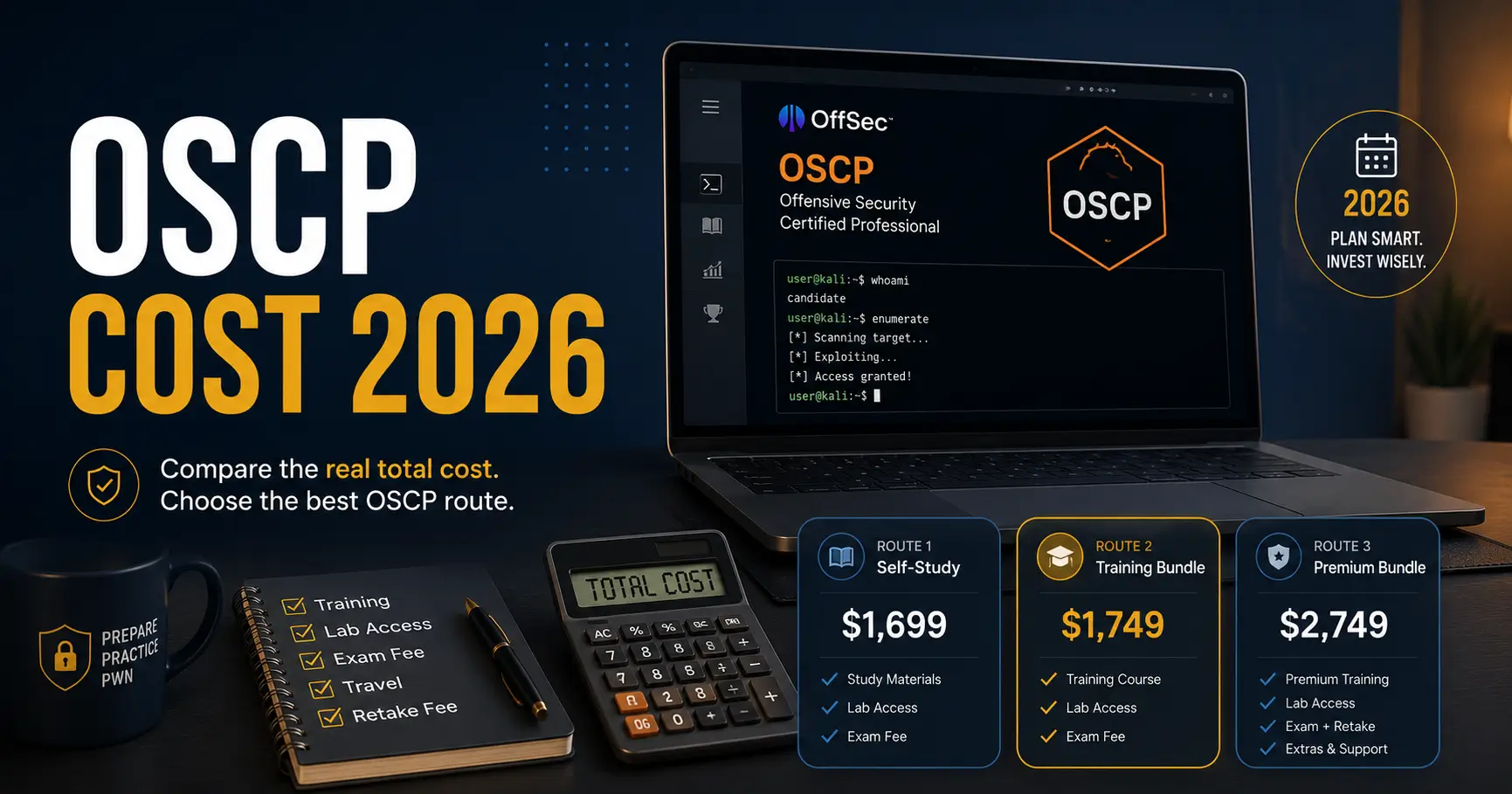
The OSCP price is no longer one neat number sitting politely at checkout. US learners can choose an exam-only route, a 90-day PEN-200 training bundle, or a year-long subscription. The lowest published entry price is not automatically the least expensive path.
The strange wrinkle is a $50 gap. The standalone OSCP+ exam costs $1,699, while the Course + Cert Bundle costs $1,749 and includes PEN-200 training. That tiny difference makes readiness, study time, and attempt scheduling more important than the sticker price.
This guide builds the budget that checkout does not show: retakes, practice platforms, equipment, backup internet, financing, lost work time, and the optional cost of maintaining the OSCP+ designation after you pass.
The goal is not the cheapest cart. It is the least wasteful route to a credible exam attempt. 🧭
Snapshot
This guide is for US individual learners paying in USD. It compares the official 2026 OSCP+ purchase routes, shows how failure and scheduling change the total, and gives you a three-line budget you can complete before paying.
Table of Contents
Before You Act: Treat Every Price as a Live Quote
Before You Pay
This article provides general cost-planning information, not personal career, financing, tax, or technical advice. OffSec can change prices, product inclusions, attempt windows, exam rules, and maintenance requirements. Confirm the terms displayed in your checkout, Learning Library account, order confirmation, and current exam guide before purchasing or scheduling.
What this guide can do
It can help you compare the available routes, identify expenses that are easy to miss, and decide whether a shorter or longer preparation window better fits your life.
It cannot predict whether you will pass, how many study hours you personally need, whether financing will be approved, or whether an employer will value the credential in a particular hiring decision.
What to confirm before purchase
- The final USD price and any applicable state tax.
- The number of included OSCP+ attempts.
- The precise expiration date of each attempt.
- Whether course access begins immediately or on a selected date.
- The current refund and cancellation rules.
- The current tool, reporting, identification, and proctoring requirements.
- The total financed repayment amount, not merely the monthly installment.
2026 Price Snapshot: Three Official OSCP+ Routes
As reviewed on August 5, 2026, OffSec lists a $1,699 standalone OSCP+ exam, a $1,749 Course + Cert Bundle, and Learn One at $2,749 per year. The standalone product includes two attempts without PEN-200 materials, the bundle includes 90 days of course and lab access with one attempt, and Learn One includes a year of access with two attempts for the selected primary certification.
| Official route | Published price | Training access | Included OSCP attempts | Best suited to |
|---|---|---|---|---|
| OSCP+ Standalone Exam | $1,699 once | None | 2 | Experienced candidates who are already exam-ready |
| Course + Cert Bundle | $1,749 once | 90 days of PEN-200 and labs | 1 | Focused learners who can study intensively |
| Learn One | $2,749 per year | One year for one selected 200- or 300-level course | 2 for the selected certification | Working professionals who need a longer runway |
OSCP+ Standalone Exam: $1,699
The standalone route is an exam-only purchase. It includes two OSCP+ attempts but does not include PEN-200 course materials, instructional videos, or training labs.
This option makes sense when you can already enumerate unfamiliar systems, obtain initial access, escalate privileges on Windows and Linux, work through Active Directory attack paths, pivot when necessary, and document every meaningful step without a structured curriculum holding your hand.
There is no discounted conversion from the standalone purchase into a training package. You may buy PEN-200 training later, but it becomes a separate purchase rather than a tidy $50 upgrade. OffSec also states that passing on the first standalone attempt forfeits the second attempt, with no refund or transfer.
Course + Cert Bundle: $1,749
The Course + Cert Bundle includes 90 consecutive days of PEN-200 course and lab access plus one certification attempt. It is currently the lowest-priced official route that includes the training designed for the exam.
The study period cannot simply be paused because work becomes noisy, a family obligation appears, or your laptop begins impersonating a small radiator. Once access starts, the clock continues.
OffSec’s bundle FAQ says the included attempt remains valid for 120 days after the lab-access end date. That creates more scheduling room than the 90-day training period, but only one attempt is included.
Learn One: $2,749 per year
Learn One includes one year of access to one selected 200- or 300-level course, its associated labs, and two attempts for the corresponding certification. It also includes a KLCP attempt and an OSWP attempt, but those should not be mistaken for additional OSCP attempts.
Your selected primary course remains fixed during the subscription year. Learn One is therefore a commitment to PEN-200, not a buffet where you drift between advanced courses whenever a new syllabus catches your eye.
Key takeaway
The official starting price is only the first layer. The real comparison is training access, study runway, included attempts, and your likelihood of using those attempts before they expire.
The $50 Gap: Why the Cheapest Route Is Not Obvious
Compare the entry prices correctly
The standalone exam is $1,699. The training bundle is $1,749. The difference is only $50, but the products solve different problems.
Standalone gives a prepared candidate two attempts. The bundle gives a developing candidate one attempt plus 90 days of official preparation. Attempt count favors standalone, while instructional support favors the bundle.
Neither route is universally better. A second attempt has little value when you are not ready for the first. Ninety days of training has limited value when your calendar allows only three tired hours on Sunday evenings.
Price the missing training before choosing standalone
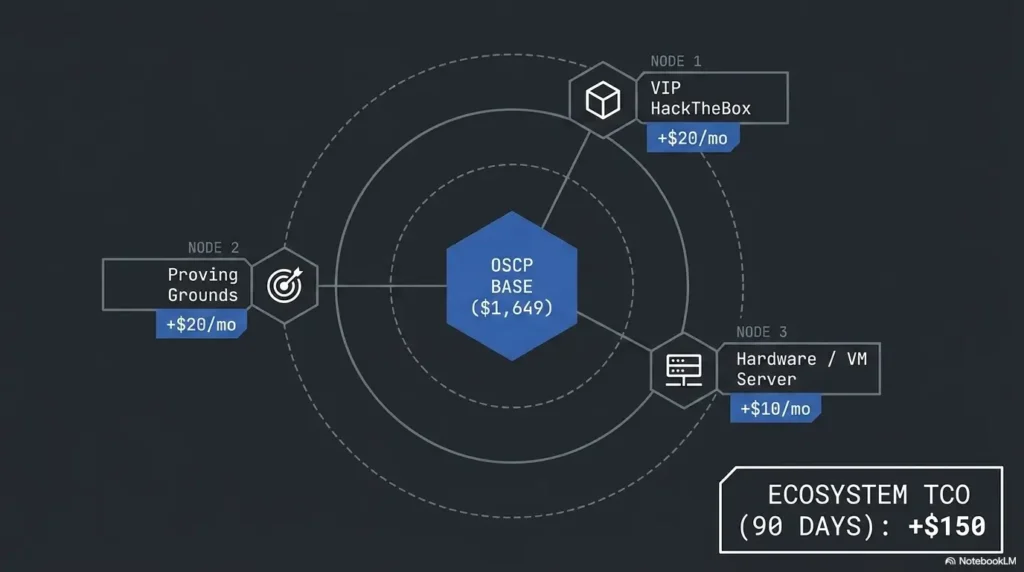
An exam-only buyer may still need third-party labs, an Active Directory practice environment, a report-writing workflow, books, cloud resources, or an upgraded computer. Those additions can quickly turn a $50 saving into several hundred dollars of replacement preparation.
Start by reviewing your existing practice stack. A learner already paying for suitable platforms and maintaining a capable home lab has a different budget from someone beginning with a four-year-old laptop, scattered notes, and heroic confidence.
The site’s existing OSCP preparation budget guide can help separate reusable training expenses from costs created specifically by the exam.
Confidence is not the same as exam readiness
General penetration-testing experience is valuable, but OSCP+ readiness also requires familiarity with OffSec’s exam structure, proof requirements, report expectations, Active Directory environment, restricted tools, and long-form time pressure.
- Can you enumerate a new target without waiting for hints?
- Can you recover when the obvious exploit produces no usable shell?
- Can you escalate privileges manually on both Linux and Windows?
- Can you work through a multi-machine Active Directory set?
- Can you record commands, output, proof files, and screenshots while working?
- Can another technical reader reproduce your path from your report?
- Can you recognize when automation crosses an exam-policy boundary?
Key takeaway
Choose standalone only when your evidence says you are prepared. “I have watched a lot of walkthroughs” is not yet evidence. It is a promising stack of cinema tickets.
Choose Your Route by Readiness, Not Optimism
Best fit for the standalone exam
Choose the $1,699 standalone exam when you already work in penetration testing, previously completed PEN-200, or can independently solve unfamiliar intermediate systems under time limits.
You should also have a tested reporting process. Technical success that cannot be documented correctly may not receive the points you expect.
Best fit for the Course + Cert Bundle
Choose the $1,749 bundle when you want the official PEN-200 curriculum and can protect a demanding 90-day study block. It suits self-directed learners with predictable evenings, weekends, or employer-supported study hours.
The bundle becomes less attractive when the next three months include travel, a major launch, relocation, caregiving pressure, university exams, or another event likely to fracture your routine.
Best fit for Learn One
Choose Learn One when your weekly availability is real but uneven. A parent, consultant, shift worker, or on-call engineer may need a year-long runway because life rarely respects a lab-access countdown.
The higher price buys time, two attempts, and reduced pressure to schedule before you are ready. That can be financially sensible when rushing would otherwise produce a failed attempt, a later retake, and another round of paid practice.
When the cheapest decision is to wait
Postpone the purchase when you are still learning basic networking, Linux permissions, Windows administration, Bash or Python fundamentals, web enumeration, or privilege escalation.
Build foundations first. The guides on privilege escalation for beginners and the SMB enumeration checklist provide useful readiness work without starting an expensive OffSec clock.
| Choice | Good | Better | Best |
|---|---|---|---|
| Study runway | Wait and strengthen foundations | 90-day Course + Cert Bundle | Learn One for unpredictable schedules |
| Exam readiness | Can solve beginner labs | Can solve intermediate labs with notes | Can solve unfamiliar targets and report independently |
| Purchase route | No purchase yet | Training bundle | Standalone only when demonstrably ready |
Build the Full OSCP Budget Checkout Leaves Out
Start with required cash costs
- Your selected OffSec training or exam route.
- Applicable state tax shown at checkout.
- Any additional $249 retake purchased after included attempts are exhausted.
- Financing interest or fees when the purchase is not paid in full.
- Optional annual maintenance after passing, if keeping OSCP+ active matters to you.
Add optional preparation costs
Optional does not mean frivolous. It means the expense depends on your current setup and learning gaps.
- Third-party penetration-testing lab subscriptions.
- Active Directory practice environments.
- Cloud-hosted attack machines or lab infrastructure.
- Books, courses, tutoring, or coaching.
- Note-taking, screenshot, or report-production tools.
- Additional storage for virtual machines and snapshots.
- A RAM, SSD, or computer upgrade when your current system cannot run a stable lab.
Reserve exam-day contingency money
A technically capable setup can still fail in wonderfully ordinary ways: a router reboots, a charging cable develops a personality, or a neighbor begins drilling into the wall during your reporting window.
- A mobile hotspot or second internet connection.
- A tested backup Kali virtual machine.
- Local copies of permitted notes and templates.
- A power bank or uninterruptible power supply.
- Meals, drinks, and easy food for a long session.
- Childcare, pet care, or a quiet hotel room when home is unsuitable.
- Transportation and parking when using another workspace.
Read the financing total, not the monthly number
OffSec advertises Klarna options for eligible US learners, including three or four interest-free payments or longer financing subject to approval. Published APRs range from 0% to 35.99%, so two learners financing the same course may face very different total repayment amounts.
Before accepting financing, record the purchase price, tax, down payment, number of payments, APR, fees, and total amount paid. A comfortable monthly payment can hide a rather uncomfortable total.
| Budget layer | Lean setup | Supported setup | Long-runway setup |
|---|---|---|---|
| Official route | $1,699 standalone | $1,749 bundle | $2,749 Learn One |
| External practice | Use existing access | One focused subscription | Several months of specialized labs |
| Equipment | Existing tested computer | Storage or RAM upgrade | Replacement workstation if necessary |
| Continuity | Phone hotspot | Hotspot plus backup VM | Backup system, power, and quiet workspace |
| Failure reserve | $249 saved separately | $249 saved separately | $249 saved separately |
The Four-Layer OSCP Budget
The Retake Trap: How Failure Changes the Math
Calculate the first additional retake
An independent OSCP retake costs $249 after the attempts included in your product have been exhausted. Purchased retakes are generally valid for 120 days, with timing adjustments when purchased during an active cooling-off period.
| Route | When the $249 retake is needed | Official cost plus one purchased retake |
|---|---|---|
| Course + Cert Bundle | After the single included attempt is failed | $1,998 |
| Standalone Exam | After both included attempts are failed | $1,948 |
| Learn One | After both included attempts are failed | $2,998 |
These totals exclude tax, equipment, financing, practice platforms, travel, workspace expenses, and maintenance after passing.
Cooling-off periods can consume your remaining window
OffSec applies a four-week wait after the first failed exam, an eight-week wait after the second, and a twelve-week wait after the third failure and later failures. The count follows your total failures for that certification, not the number of failures within one particular purchase.
This means buying a fresh product does not erase your history. A candidate who has already failed twice does not return to the four-week waiting period merely because a new subscription appears in the account.
Schedule backward from the final eligible date
- Find the exact expiration date in your account.
- Subtract the cooling-off period that would apply after a failed attempt.
- Reserve several days for scheduling availability and administrative issues.
- Place your first attempt before that safer internal deadline.
- Do not treat the final eligible day as your target exam date.
Real-world example: the attempt that existed only on paper
Imagine a standalone buyer with two attempts and a confirmed 120-day validity period. The learner spends the first three months studying, then schedules the first exam near day 100.
If that attempt is unsuccessful, the required four-week waiting period extends beyond day 120. The account technically included a second attempt, but the calendar made it unusable.
The lesson is not to schedule recklessly early. It is to preserve enough time for the product you already purchased to work as intended. An included attempt has no budget value when poor timing prevents you from using it.
Key takeaway
Your failure reserve needs both money and calendar space. Saving $249 without preserving a usable retake window solves only half the problem.
90 or 120 Days? Resolve the Published Conflict
Official pages currently show different standalone windows
OffSec’s standalone product page describes two attempts in a 90-day period. The standalone FAQ, Certification Exam FAQ, course-start guidance, and exam-management pages state that both standalone attempts are valid for 120 days from purchase.
This is not a trivial typo for a buyer. Thirty days can determine whether a second attempt fits after the required four-week waiting period.
Verify the controlling date in your own account
- Read the product description immediately before payment.
- Check the precise expiration date displayed after purchase.
- Save the order confirmation and relevant account screen.
- Contact OffSec support promptly when the pages and account disagree.
- Plan around the date actually attached to your attempts.
Use the shorter period until your account confirms otherwise
Before purchase, a conservative plan should assume 90 days. After purchase, use the confirmed expiration date shown in your account and documentation.
That approach prevents a planning spreadsheet from borrowing 30 days that your actual purchase may not provide.
Show me the nerdy details
A 120-day window can hold a first attempt, a four-week cooling-off period, and a second attempt only when the first exam occurs early enough. A 90-day window leaves less margin for preparation, scheduling availability, illness, technical problems, or a delayed decision to retake.
Build an internal deadline that is earlier than the official expiration date. Your internal date should preserve the applicable waiting period plus a scheduling buffer.
Hardware, Internet, and the Cost of Two Quiet Days
Test the computer under realistic load
You do not automatically need a new premium laptop. You need a system that remains stable while running your Kali environment, VPN, browser, notes, screenshots, terminals, and reporting tools for an extended session.
- Confirm that virtualization is enabled and reliable.
- Leave sufficient free storage for screenshots, notes, tools, downloads, and snapshots.
- Test memory pressure with the applications you will actually use.
- Install updates well before exam week, not the night before.
- Verify that screenshots, clipboard functions, and time synchronization work.
- Keep a clean backup of the virtual machine.
For home-lab planning, compare your options in the VirtualBox, VMware, and Proxmox guide. The correct choice is the one you have tested, not the one with the most enthusiastic forum supporters.
Back up internet, power, and Kali
A phone hotspot is useful only after you have confirmed that it connects, provides sufficient data, and works in the room where you will sit. The same rule applies to a backup Kali installation or persistent USB environment.
A Kali persistent USB setup can be part of a continuity plan, but it should be tested before the exam and should not replace a stable primary environment.
Reserve nearly two days of controlled time
The OSCP+ practical exam lasts 23 hours and 45 minutes. After it ends, candidates receive another 24 hours to upload their documentation. The exam is proctored, reporting requirements are strict, and prohibited tools include commercial attack services, automatic exploitation tools, mass vulnerability scanners, and AI chatbots.
You may sleep and take breaks, but your budget should protect the entire period. Arrange childcare, pet care, meals, work leave, and a quiet room before the session begins.
Review the vulnerability report writing guide before exam week. Report production should be a practiced workflow, not an archaeological dig through unlabeled screenshots.
Calculate the quiet cost of study time
Opportunity cost is not a bill you pay to OffSec, but it matters when comparing a compressed plan with a year-long one.
Use this simple formula:
For example, 250 study hours valued at $30 per hour represents $7,500 of personal time. Keep that figure separate from cash spending, but use it when deciding whether a frantic 90-day schedule is genuinely cheaper.
The Cost After You Pass: OSCP Versus OSCP+
The base OSCP remains valid indefinitely
Candidates who pass the current exam receive both OSCP and OSCP+. The base OSCP credential does not expire. OSCP+ has a three-year validity period and requires renewal activity if you want to keep the plus designation active.
If OSCP+ later expires, you do not lose the underlying OSCP. This distinction matters because maintenance is not required simply to remain an OSCP holder.
AMF versus AMP: $145 or $299 annually
| Maintenance option | Annual price | What it provides | Best suited to |
|---|---|---|---|
| Annual Maintenance Fee | $145 | Maintenance coverage only | Holders who need no additional learning access |
| Annual Membership Program | $299 | Maintenance coverage plus eligible learning and practice benefits | Holders who want continued platform use |
You do not need both AMF and AMP for the same maintenance period. OffSec describes AMF as a maintenance-only fee and AMP as an annual membership that includes maintenance coverage plus broader practice benefits.
Add the three-year ownership cost
- AMF route: up to $435 across three annual $145 payments.
- AMP route: up to $897 across three annual $299 memberships.
- CPE requirement: 120 credits over the three-year certification cycle when using the CPE renewal path.
Maintenance coverage is required for each year of the cycle when keeping an eligible expiring certification active through the CPE program. It is not simply a payment made at the end of year three.
Key takeaway
Passing ends the exam budget, but it may begin a maintenance budget. Decide whether you need the non-expiring OSCP alone or want to preserve the time-limited OSCP+ designation.
Five Mistakes That Make OSCP More Expensive
1. Choosing standalone because it is $50 cheaper
The standalone exam is cheaper only when you already possess the preparation it excludes. Buying separate training later can duplicate costs because there is no direct upgrade path from the standalone exam to PEN-200 access.
2. Starting 90-day access during a busy month
Do not activate a compressed training window immediately before travel, major work deadlines, relocation, university exams, or predictable family obligations.
The activation date is a financial decision. Every week you cannot study is paid access disappearing into the calendar.
3. Scheduling the first attempt at the deadline
A late first attempt may leave no usable room for the cooling-off period and second attempt. Schedule backward from the final date instead of forward from the day you feel vaguely ready.
4. Comparing monthly payments instead of total repayment
A small installment is not the certification price. Compare the full financed amount with the cash price and ask whether the interest would be better spent on a retake reserve, hardware stability, or additional preparation.
5. Losing an attempt to prohibited tools or weak documentation
AI chatbots, commercial attack tools, automatic exploitation tools, and mass vulnerability scanners are prohibited during the exam. Metasploit use is restricted, and incomplete proof or reporting can reduce or erase points.
Read the current exam guide before every attempt, even when you read it months earlier. Policy compliance protects the money and time already invested.
| Common mistake | Safer alternative |
|---|---|
| Buying before testing readiness | Complete timed practice and a sample report first |
| Activating during a chaotic quarter | Choose a start date with protected weekly study blocks |
| Trusting a remembered expiration window | Save the account date and order confirmation |
| Using one internet connection | Test a hotspot or secondary connection |
| Leaving reporting until the exam | Practice evidence capture during every lab |
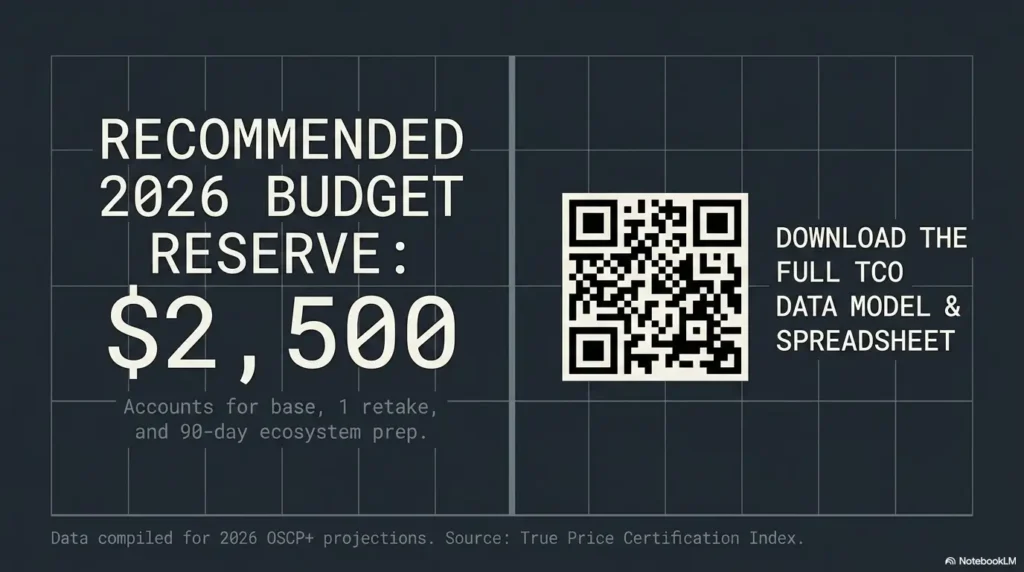
| Spending the full budget at checkout | Keep a separate $249 failure reserve |
Frequently Asked Questions
How much does the OSCP exam cost in 2026?
The current official routes are $1,699 for the standalone OSCP+ exam, $1,749 for the Course + Cert Bundle, and $2,749 per year for Learn One. Your realistic total may also include tax, practice labs, equipment, internet backup, financing, a $249 retake reserve, and post-pass maintenance.
Can I buy the OSCP exam without PEN-200?
Yes. The $1,699 standalone OSCP+ product provides two exam attempts without PEN-200 course materials or labs. It is intended for candidates who believe they already possess the necessary skills.
Is the $1,749 PEN-200 bundle better than standalone?
It is better for learners who need official training and can use 90 days effectively. Standalone may be better for experienced candidates who are already ready and value two included attempts. The correct comparison is preparation value, not a universal winner.
How many OSCP attempts are included?
The Course + Cert Bundle includes one OSCP attempt. The standalone exam and Learn One each include two attempts for OSCP when PEN-200 is the selected Learn One course.
How much is an OSCP retake?
A regular independent retake costs $249 after the relevant included attempts have been exhausted. Cooling-off periods still apply.
Does Learn One include unlimited OSCP attempts?
No. Learn One includes two attempts for the certification associated with the selected primary 200- or 300-level course. Its KLCP and OSWP attempts are separate certifications, not extra OSCP attempts.
Does OSCP expire after three years?
The base OSCP does not expire. OSCP+ has a three-year validity period and requires renewal activity and annual maintenance coverage when you want to keep the plus designation active.
Are there annual OSCP maintenance fees?
No annual fee is required to retain the non-expiring OSCP. Keeping OSCP+ active through the CPE route involves annual maintenance coverage, currently $145 through AMF or $299 through AMP.
Can I pay for OSCP in installments?
Eligible US learners may see Klarna installment or financing options, subject to approval. Review the APR, fees, payment schedule, and total repayment before accepting an offer.
Is OSCP suitable for a complete cybersecurity beginner?
It is usually a poor first purchase for someone still learning networking, Linux, Windows administration, scripting, enumeration, and basic exploitation. Build those foundations first, then test your readiness with independent lab machines and a complete sample report.
Build Your Three-Line OSCP Budget Today
Open a blank note or spreadsheet and spend 15 minutes creating three lines. This small exercise turns a large, foggy purchase into a decision you can inspect.
Line 1: Choose the access path
Write one starting price: $1,699 for standalone, $1,749 for the Course + Cert Bundle, or $2,749 for Learn One.
Line 2: Add a failure reserve
Set aside at least $249 for one purchased retake. Keep it reserved even when your product includes two attempts. The money remains yours when you pass without needing it.
Line 3: Add personal preparation and continuity costs
Total your likely tax, optional labs, hardware upgrades, backup internet, power protection, workspace, childcare, lost work time, financing, and desired OSCP+ maintenance.
Your three-line OSCP budget
Access path: Official route + tax
Failure reserve: $249 + protected calendar space
Personal costs: Practice + equipment + continuity + time + maintenance
When the three lines fit your finances and your calendar, you have a working plan. When they do not, waiting is not failure. It is the cheapest way to prevent an expensive clock from starting too early.
Last reviewed: 2026-09