
SaaS Procurement & Vendor Risk
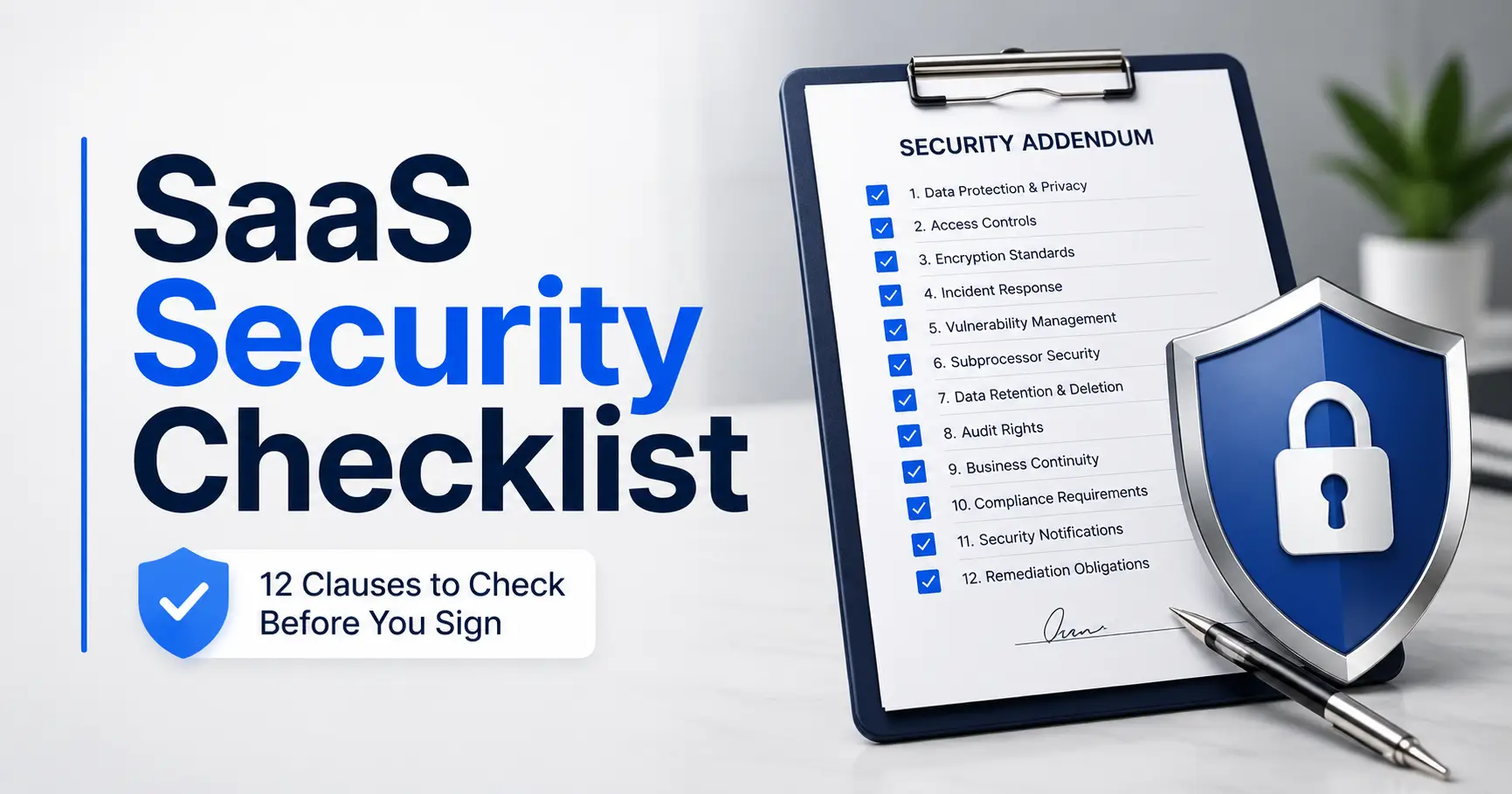
Security Addendum Checklist for SaaS Contracts:12 Clauses to Check Before You Sign
A SaaS agreement can look reassuringly polished while leaving the uncomfortable questions in soft focus. Who can access your data? How quickly must the vendor tell you about an incident? What happens if a subprocessor fails? And after cancellation, does your information actually disappear, or merely move into a backup archive wearing a fake moustache?
The useful security addendum is not necessarily the longest one. It is the one that turns important expectations into language your procurement, security, IT, privacy, and legal teams can test. Words such as reasonable, appropriate, and industry standard may have a place, but they should not be asked to carry the entire building.
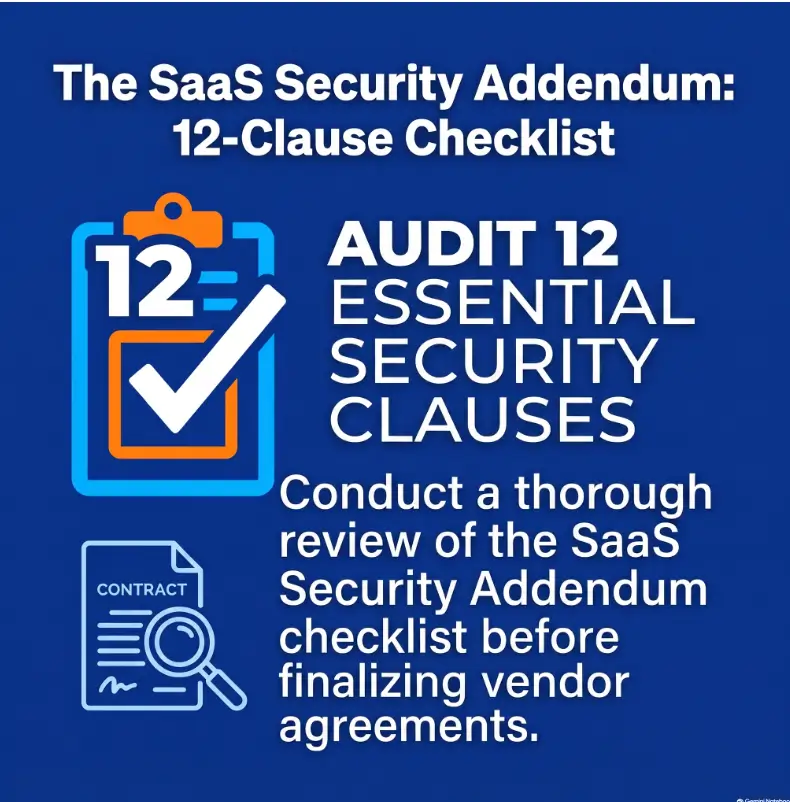
This guide gives you a practical 12-clause review method for SaaS contracts, including what to inspect first, where apparently strong language can hide weak mechanics, how to prioritize redlines, and when a lightweight DIY review should give way to specialist legal or security help.
Keep this principle in view: the best security promise is one you can define, verify, and enforce when the sunny procurement meeting has turned into a rainy incident call. 🔐
Snapshot
Who this is for: founders, SaaS buyers, procurement teams, IT managers, security leaders, and in-house counsel reviewing vendor terms before signature. What it solves: vague security language, hidden downstream risk, and scattered contract documents. Your next move: score 12 clauses Red, Yellow, or Green before sending the agreement into formal negotiation.
Before You Act
This article is educational and is not legal advice, a security assessment, or a substitute for reviewing the laws and contractual requirements that apply to your organization. SaaS obligations can change materially when a service handles financial, health, biometric, authentication, government, or other regulated information. Confirm high-impact decisions with qualified legal, privacy, and security professionals where appropriate.
Table of Contents
Who Needs This Checklist, and Who Needs Something Stronger?
A security addendum sits at an awkward crossroads. It is legal text describing technical behavior, written for a commercial relationship that may last years. That means no single reviewer sees the entire picture automatically.
A founder may care about speed. Procurement wants predictable obligations. Security wants controls it can evaluate. Legal wants enforceable language and manageable liability. The business owner mostly wants the software working by Tuesday.
Ordinary business SaaS still deserves a structured review
If a tool holds ordinary employee records, sales information, project files, customer support conversations, or internal documents, a lightweight review may be enough to identify obvious weaknesses before escalation.
The goal is not to transform a small software purchase into a six-month enterprise procurement opera. It is to identify whether the vendor has made meaningful commitments around the information and systems that matter to you.
Regulated data changes the review
Financial customer information, protected health information, government data, authentication secrets, sensitive consumer information, and similar datasets may carry specific regulatory or contractual requirements. For example, the FTC Safeguards Rule requires covered financial institutions to address service-provider safeguards, including contractual security expectations and monitoring.
Health information can introduce another contract layer. HHS explains that HIPAA business associate arrangements can require written contractual safeguards when a covered entity or business associate entrusts protected health information to another party.
Key takeaway: A checklist can triage a contract. It cannot tell you that a clause satisfies every law applying to a particular dataset, jurisdiction, or regulated business.
Know when not to DIY the review
Escalate sooner when the service will become operationally critical, handle unusually sensitive data, reach a large user population, support regulated activities, or create substantial breach or outage exposure. An acquisition, enterprise-wide platform, healthcare deployment, or major financial-services system deserves more than a hurried checkbox pass between meetings.
Start With the Data: The Clause Most Teams Skip First
Before debating encryption standards or notification deadlines, define what the vendor actually receives. A beautifully negotiated security clause can still protect the wrong thing if the contract’s definition of customer data is narrower than the product’s real data flow.
Map what actually enters the SaaS
Open the application architecture, onboarding questionnaire, privacy documentation, or a simple blank page and write down the information categories that move through the service.
- Customer and prospect records
- Employee and contractor information
- Usernames, tokens, credentials, or authentication data
- Uploaded documents, files, images, or attachments
- Payment-related or billing information
- Application logs and audit records
- Usage data, telemetry, and device information
- API payloads and integration data
- Derived information created by the service
- Backups, replicas, caches, and recovery copies
This small exercise often changes the negotiation. A collaboration tool that appears to store harmless project notes may also ingest employee identifiers through SSO, API data from another platform, administrative audit events, and documents containing customer information.
Separate customer data from derived and diagnostic data
Read the definitions section closely. Vendors commonly distinguish customer content from service-generated telemetry, metadata, analytics, diagnostic information, aggregated data, and de-identified information.
Those distinctions may be commercially reasonable, but you should know which protections, usage rights, deletion promises, and confidentiality duties attach to each category. Do not discover six months later that the information your security team cares about lives under a different defined term.
Five-minute data-scope check
- List every data type the service receives.
- Circle credentials, regulated data, and sensitive business information.
- Compare the list with the contract’s defined terms.
- Mark any data category that appears outside the security obligations.
- Ask who owns and may use derived or diagnostic information.
Real-world example
Imagine a 40-person SaaS company buying a support platform. Procurement thinks the platform contains customer email addresses and ticket text. The security questionnaire therefore receives a quick approval.
During implementation, the platform is connected to the product database, identity provider, billing system, and internal chat workspace. Support agents can now pull account metadata and diagnostic events directly into tickets.
The security addendum protects “Customer Content,” but the vendor’s separate terms classify much of the diagnostic information as “Service Data.” Those terms permit broader use and different retention.
No dramatic breach occurred. The problem was simpler: the contract review described the purchase as imagined, not the service as deployed. A ten-minute data-flow sketch before negotiation would have exposed the mismatch.
Security Controls: Replace Vague Promises With Testable Obligations
“We maintain industry-standard security” is comforting in approximately the same way as a hotel saying it has “good locks.” Perhaps it does. You still want to know what protects the door.
Name the control families that matter
Rather than demanding a giant catalog of technical requirements, anchor the security addendum around the control areas relevant to the service. NIST SP 800-53 organizes security and privacy requirements into defined control families and is designed to support risk-based selection rather than one universal checklist.
- Identity and access management
- Authentication and privileged access
- Encryption and key management
- Logging and monitoring
- Secure configuration and change management
- Vulnerability and patch management
- Incident response
- Backup and resilience controls
- Personnel security and confidentiality
- Supplier and subprocessor risk
If your own SaaS environment still needs stronger authentication, the practical companion is this MFA rollout guide. Contract language works best when your internal configuration does not leave the side door open.
Prevent silent security downgrades
Ask what happens if the provider materially changes its security program during the contract term. A vendor may update systems constantly, and the agreement should not freeze normal engineering work, but neither should an important control quietly disappear after procurement has approved the product.
Useful language often focuses on material reduction rather than demanding that every control remain technologically identical forever.
Treat SOC 2 and certifications as evidence, not the contract itself
SOC 2 reports, ISO certifications, penetration-test summaries, and similar materials can provide valuable assurance evidence. They do not automatically answer whether the vendor has promised your organization a particular notification period, deletion process, audit remedy, or contractual standard.
If you are building the buyer side of that evidence review, see the SOC 2 compliance checklist for startups for a complementary operational perspective.
Show me the nerdy details
A mature addendum usually contains three different species of language that should not be confused.
Control obligation: what the vendor must actually do, such as maintain access controls or encrypt defined information.
Assurance evidence: what the buyer may review to gain confidence, such as an independent assessment, report, certification, or test summary.
Remedy or escalation mechanism: what happens if the control is absent, materially changed, or unsupported by satisfactory evidence.
Access Control and Encryption: Follow the Privileged Paths
Security promises become more concrete when you ask two questions: who can reach the data, and what protects it while stored or moving?
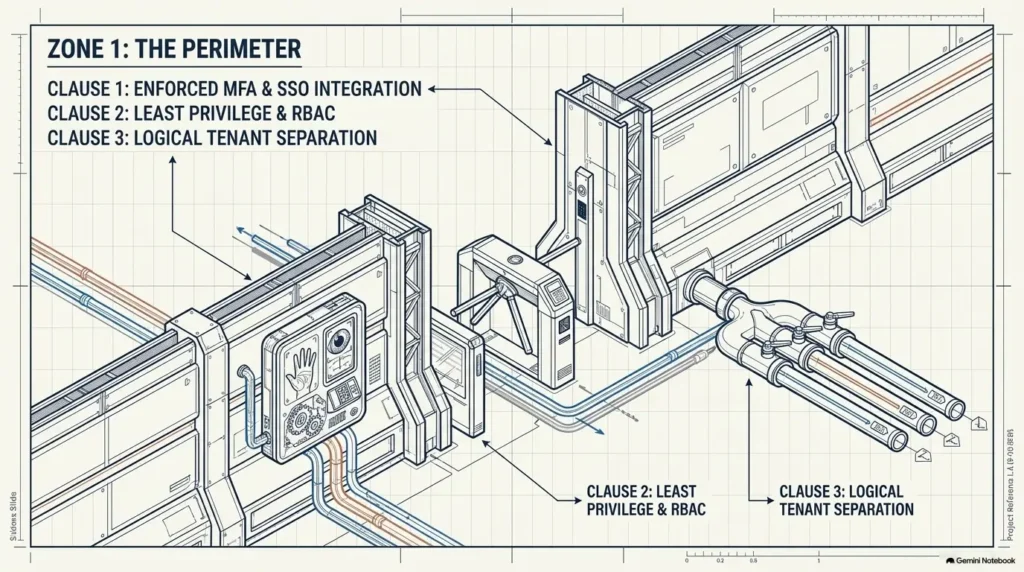
Require sensible least-privilege access
Review how the contract or referenced security documentation handles role-based privileges, administrative accounts, multifactor authentication, access reviews, account termination, and logging of sensitive administrative activity.
Do not stop at “employees are authorized.” Ask whether workforce access to customer environments is limited to a legitimate operational need and whether privileged actions can be reconstructed later.
Write down the customer’s configuration responsibilities
Many SaaS failures occur in the seam between vendor responsibility and customer configuration. If SSO, MFA, API key handling, session controls, administrative roles, or audit logging require customer action, document that boundary.
Your technical team may also want to compare those responsibilities against your SAML SSO configuration approach and API authentication and authorization controls.
Check encryption scope, exclusions, and keys
“Data is encrypted” is the beginning of the review. Ask whether the commitment covers data in transit, data at rest, backups, replicas, exports, temporary storage, and other relevant systems.
For higher-risk services, key-management questions may also matter: who controls keys, who has privileged access, whether duties are separated, and whether customer-managed keys are available or necessary for the use case.
Key takeaway: Access control belongs on both sides of the contract. The vendor may secure its administrators perfectly while your tenant keeps three shared super-admin accounts and a forgotten API key from 2024.
Subprocessors: Inspect the Company Behind the Company
Your SaaS provider may rely on cloud hosting, messaging infrastructure, analytics services, support tools, payment systems, AI services, identity providers, and specialist contractors. The vendor perimeter is often a family tree, not a fence.
Identify material subprocessors and their functions
Review whether the provider maintains a current subprocessor list, identifies what those parties do, and provides enough information for you to understand which vendors may process relevant customer information.
Supply-chain review is a recognized part of cyber risk management. CISA’s supplier-risk materials provide structured questions organizations can use when evaluating ICT suppliers and providers.
Decide what happens when the list changes
The right mechanism depends on bargaining power and risk. Possible approaches include advance notice, a defined objection period, discussion of reasonable alternatives, migration assistance, or termination rights where an unacceptable new subprocessor cannot be resolved.
A small startup buying a low-risk productivity app probably does not need veto power over every infrastructure supplier. A regulated enterprise transferring sensitive records may reasonably need considerably more visibility.
Flow relevant obligations downstream
Ask whether subprocessors that handle protected information receive confidentiality and security obligations appropriate to their function. The exact terms need not be identical in every contract, but your protections should not evaporate simply because processing crossed another corporate boundary.
The 12-Clause Security Addendum Map
What information is covered?
What controls are promised?
Who can reach the data?
How is privileged access protected?
Where and how is data protected?
Who else receives information?
When does notification begin?
How is known risk remediated?
Can the service recover?
How can claims be checked?
What survives termination?
Do remedies match the risk?
Incident Notification and Vulnerabilities: Put the Clock in the Contract
Breach-notification negotiations often begin with a number: 24 hours, 48 hours, 72 hours, “without undue delay.” The number matters. The trigger matters more.
Define the security incident before negotiating the deadline
A contract may distinguish attempted attacks, successful unauthorized access, incidents affecting the provider generally, compromises involving your data, and legally reportable breaches. If the parties use different definitions, a seemingly aggressive notification deadline may start much later than the buyer expects.
For regulated healthcare relationships, incident obligations can be more specific. HHS notes that HIPAA business associates have duties relating to identifying and responding to security incidents, and business associate agreements may include reporting requirements.
Ask exactly when the clock starts
Look for verbs such as discover, determine, confirm, and become aware. They are not interchangeable.
A clause requiring notification within a short period after “confirmation of a reportable breach” may allow substantial investigation before the contractual clock begins. Depending on your risk, you may instead want early notice of a credible incident affecting your systems or information, followed by updated findings as the investigation develops.
Require useful updates, not a single alarming email
- Known or reasonably suspected affected systems
- Known categories of affected information
- Containment measures taken
- Customer actions reasonably required
- Investigation status
- Material findings as they become available
- Remediation or mitigation steps
- Reasonable cooperation on customer response obligations
If your organization lacks its own response structure, compare these contractual duties with an internal incident response retainer and escalation plan. The contract should connect to your operational response rather than disappearing into a legal folder after signature.
Give known vulnerabilities a risk-based treatment path
Patch language should define how severity is determined, what remediation expectations apply, and how exceptions are handled. It can also be useful to distinguish ordinary vulnerabilities from weaknesses known to be actively exploited or otherwise urgent in the customer’s environment.
Avoid turning generic numerical scores into automatic legal deadlines without context. Severity, exploitability, exposure, compensating controls, affected components, and operational consequences can all matter.
Key takeaway: Never negotiate an incident-notification deadline without also negotiating the event that starts it. A fast clock attached to a slow trigger is contract theatre.
Backups, Audit Evidence, and Deletion: Test the Whole Data Life Cycle
Security is not merely preventing unauthorized access. It also means maintaining usable information through disruption and disposing of it appropriately when the relationship ends.
Separate backup promises from recovery commitments
“Daily backups” sounds useful until the first restoration attempt reveals that nobody promised how quickly data could return, how much recent data could be lost, how long backups were retained, or whether restoration was ever tested.
| Term | Question to Ask | Why It Matters |
|---|---|---|
| Backup frequency | How often is recoverable data captured? | Affects potential data loss between copies. |
| Retention | How long are recovery copies kept? | Determines what historical restoration may be possible. |
| RPO | How much recent data loss is the recovery design intended to tolerate? | Helps translate backup frequency into business impact. |
| RTO | How quickly is restoration intended to occur? | Connects technical recovery with operational downtime. |
| Testing | Are restoration procedures periodically exercised? | A backup that cannot restore is decorative storage. |
| Isolation | How are recovery copies protected from production compromise? | Important in destructive or ransomware scenarios. |
Use an evidence-first approach to audit rights
Unlimited inspection rights sound formidable and are often impractical. Many buyers are better served by a layered model: reusable independent evidence first, supplemental information when gaps appear, and stronger audit rights for significant unresolved risk.
The FTC’s service-provider guidance illustrates the underlying principle for organizations within its scope: contractual security expectations should be accompanied by ways to monitor provider performance rather than simply being assumed.
Follow deletion all the way into backups
Termination language should address the customer’s opportunity to retrieve data, available export formats, production deletion, retention exceptions, backup cycles, and any agreed evidence or certification of deletion.
Absolute immediate deletion from every recovery medium may be technically unrealistic. The better question is whether backup copies remain protected, isolated from ordinary use, expire according to a defined schedule, and are not quietly restored into normal processing after the relationship ends.
Key takeaway: Ask the vendor to describe the exit path before you enter. Data portability and deletion are much easier to negotiate when nobody is already trying to leave.
Liability Meets Security: Read the Addendum Beside the MSA
A technically excellent security exhibit can lose much of its practical force if the main agreement sharply limits the consequences of breaking it. Security review therefore has to cross the border into the MSA.
Check the liability cap before celebrating strong language
Determine whether security, confidentiality, data-protection, or incident-related claims sit inside the ordinary contractual liability cap, have a separate cap, receive special treatment, or are affected by exclusions for particular categories of damages.
There is no universal “correct” structure. Contract value, data sensitivity, bargaining power, available insurance, foreseeable exposure, and the parties’ commercial model all matter. That is precisely why the cap should be reviewed rather than discovered after an incident.
Search for conflicts across the document stack
- Master services agreement
- Security addendum or security exhibit
- Data processing agreement
- Service level agreement
- Order form
- Privacy terms
- Acceptable use policy
- Product-specific terms
- Online policies incorporated by reference
Pay particular attention to inconsistent definitions of customer data, incidents, confidential information, service providers, and termination. One document can quietly narrow a promise made enthusiastically in another.
For teams creating their own SaaS contractual stack, this SaaS acceptable use policy guide illustrates why document boundaries and definitions deserve deliberate attention.
Decide which document wins
If the MSA says one thing and the security addendum says another, the order-of-precedence clause may decide which obligation governs. Review that language before assuming the more protective security provision automatically wins.
7 Security Addendum Mistakes That Look Harmless
Mistakes 1 to 4: Big templates, vague standards, certification worship, and broken clocks
- Copying a giant enterprise template. More requirements can produce more negotiation without proportionately reducing risk. Match the controls to the service.
- Accepting undefined security adjectives. “Commercially reasonable” or “industry standard” may be useful supporting language, but important controls deserve greater specificity.
- Treating SOC 2 as a magic shield. Assurance evidence helps evaluate a program. It does not necessarily create the incident, deletion, liability, or cooperation terms you need.
- Negotiating the breach deadline without the trigger. “24 hours” is less impressive when the vendor alone decides when the incident becomes sufficiently confirmed to start counting.
Mistakes 5 to 7: Missing vendors, weak exits, and fighting every sentence
- Forgetting subprocessors. Strict obligations with your direct vendor are less useful if sensitive processing moves downstream without suitable protections.
- Ignoring termination mechanics. Export and deletion terms can become most important at the exact moment negotiating leverage is disappearing.
- Treating every redline as equally important. Spending an hour on low-impact wording while a weak incident trigger survives untouched is a poor use of specialist time.
Use a Red, Yellow, Green negotiation model
| Status | Meaning | Typical Action |
|---|---|---|
| Red | Missing or materially unacceptable protection | Redline, escalate, obtain alternative control, or reconsider the risk. |
| Yellow | Ambiguous, incomplete, or dependent on evidence | Clarify wording, request documentation, or assign an owner. |
| Green | Acceptable language supported by credible evidence | Record the decision and move on. |
This model gives procurement permission to stop polishing clauses that are already adequate. Contract review becomes less like sculpting marble and more like triage: attention goes where the consequences are largest.
DIY Review vs Paid Help: Spend Expertise Where the Risk Lives
Not every $49-per-month SaaS subscription deserves an outside counsel memo. Not every seven-figure platform belongs in a founder’s Friday-afternoon DIY review either. A sensible process scales review effort with exposure.
Good, Better, Best review paths
| Review Level | Best Fit | What You Do | Where Money May Be Worth Spending |
|---|---|---|---|
| Good | Low-risk, replaceable SaaS with ordinary business data | Use the 12-clause checklist, review vendor evidence, document accepted gaps. | Usually little or none beyond normal internal review. |
| Better | Important workflows, personal data, integrations, or moderate outage impact | Add security review, architecture questions, DPA/MSA comparison, and risk-owner approval. | Vendor-risk tooling, specialist security review, or targeted legal review may save time. |
| Best | Regulated data, high contract value, critical operations, unusual liability, or large-scale exposure | Coordinate legal, privacy, security, procurement, technical, and insurance review. | Specialist counsel, security assessment, penetration-test interpretation, or cyber-insurance advice may be appropriate. |
Questions to ask before paying for outside help
- Does the reviewer regularly handle SaaS security and privacy terms?
- Will the work focus on the material clauses or redline the entire contract?
- Can security and legal reviewers coordinate instead of duplicating work?
- What documents should be supplied upfront to avoid repeated discovery?
- Will the output distinguish legal issues from technical recommendations?
- Can unresolved risks be ranked by severity and business impact?
If the liability discussion leads into insurance, your next comparison may be whether existing coverage actually responds to vendor incidents. These guides to cyber insurance for small businesses and cyber insurance for e-commerce operations provide a useful starting framework.
Key takeaway: Buy specialist review for the uncertainty that could materially change the decision. Do not pay premium rates merely to color every comma red.
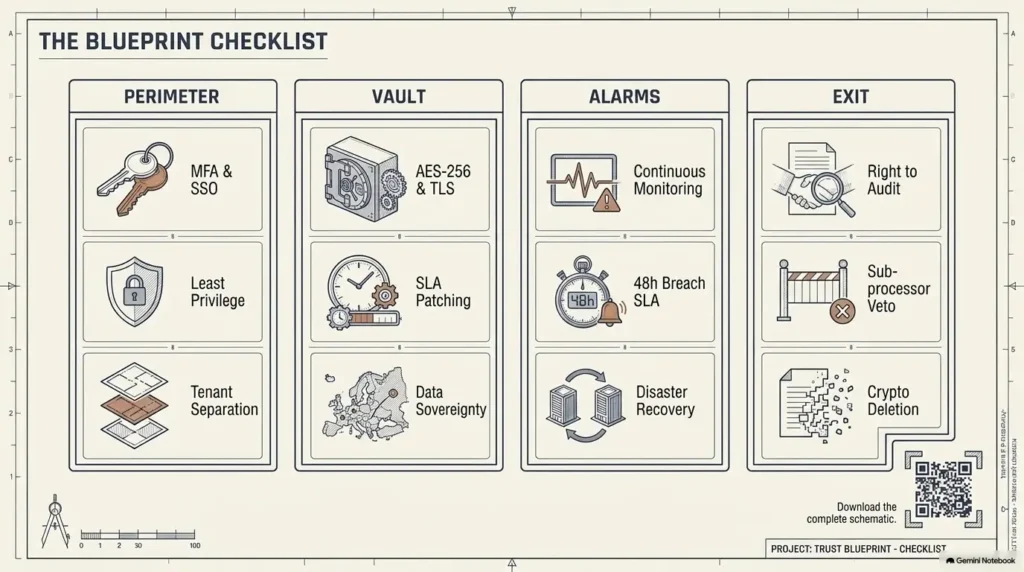
The 12-clause buyer checklist
| # | Clause | Fast Review Question |
|---|---|---|
| 1 | Data scope | Does the protected-data definition match actual product data flows? |
| 2 | Security standard | Are important controls specific enough to evaluate? |
| 3 | Access control | Is privileged and workforce access restricted and reviewed? |
| 4 | MFA | Is strong authentication required where the risk justifies it? |
| 5 | Encryption | Does protection cover relevant storage, transmission, backups, and keys? |
| 6 | Subprocessors | Can you identify downstream providers and material changes? |
| 7 | Incident notice | Are the trigger, clock, content, and updates clearly defined? |
| 8 | Vulnerabilities | Is remediation risk-based, measurable, and communicable? |
| 9 | Backups | Are recovery expectations understandable and tested? |
| 10 | Audit evidence | Can you verify important security claims without impractical demands? |
| 11 | Deletion | Are export, retention, backups, and termination mechanics addressed? |
| 12 | Liability alignment | Do the MSA’s remedies and limits make sense beside the security promises? |
FAQ: SaaS Security Addendums Before Signature
What is a security addendum in a SaaS contract?
A security addendum is a contractual document or exhibit that sets security-related obligations for a SaaS provider. It commonly addresses matters such as safeguards, access, encryption, incident response, subprocessors, audits, vulnerability management, backups, and data handling. Its relationship with the MSA and DPA should be clear.
Is a security addendum the same as a data processing agreement?
No. They can overlap substantially, but a DPA generally concentrates on privacy and processing obligations while a security addendum concentrates on protective controls and operational security duties. Depending on the contract, security requirements may appear inside the DPA instead of a separate exhibit.
Do I need a security addendum if the SaaS vendor has SOC 2?
A SOC 2 report may provide valuable independent assurance, but it does not necessarily create the customer-specific contractual rights you need. Review the report as evidence and separately evaluate the obligations in the contract.
What should a SaaS breach-notification clause cover?
At minimum, examine the definition of the triggering incident, when the notification clock begins, the expected timing, information supplied, follow-up updates, investigation cooperation, remediation information, and the relationship with applicable legal notification duties.
Should SaaS vendors disclose all subprocessors?
The appropriate disclosure model depends on the service and data. Many buyers focus on subprocessors that process relevant customer information and ask for a maintained list, notice of material changes, appropriate downstream obligations, and a workable objection or escalation process.
Can a vendor refuse customer audit rights?
Audit rights are negotiable and often constrained by security, confidentiality, operational, and cost concerns. Practical alternatives can include independent reports, certifications, questionnaires, penetration-test summaries, remediation evidence, and enhanced review rights when a specific material concern arises.
How long should a SaaS provider retain data after termination?
There is no universal retention period for every SaaS service. The appropriate arrangement depends on retrieval needs, backup architecture, business requirements, legal obligations, security concerns, and the contract. What matters is that the export and deletion process is understandable before termination occurs.
Who should review a SaaS security addendum?
For lower-risk purchases, procurement, IT, or a knowledgeable business owner may perform the initial triage. Higher-risk contracts often benefit from coordinated input from information security, privacy, legal counsel, technical owners, procurement, and sometimes insurance specialists.
Run the 15-Minute Red-Flag Review Before Negotiation
You do not need to understand every sentence of a 40-page SaaS contract before identifying its most expensive uncertainties. Give yourself 15 minutes and work in a fixed order.
- Minutes 1 to 3: Identify the data, integrations, and business process the platform will touch.
- Minutes 4 to 6: Find the security standard, access, MFA, and encryption provisions.
- Minutes 7 to 9: Find subprocessors, incident notification, and vulnerability obligations.
- Minutes 10 to 11: Check backups, recovery, audit evidence, export, and deletion.
- Minutes 12 to 13: Open the MSA and locate the liability cap, exclusions, indemnity language, and order of precedence.
- Minutes 14 to 15: Mark each of the 12 clauses Red, Yellow, or Green and assign an owner for every Red item.
The point is not to finish the negotiation in 15 minutes. It is to stop wasting specialist attention on the wrong problems. A two-line deletion ambiguity may matter more than three pages of polished security language. A liability cap may matter more than a shiny certification badge. A notification trigger may matter more than the headline deadline.
When the review is finished, negotiate the Red items first. Clarify the Yellow items second. Leave the Green clauses alone unless another provision changes their meaning. That small discipline can turn a sprawling security addendum into a tractable decision rather than an endless redline spiral.
Your next 15 minutes
Open the vendor’s MSA, DPA, security exhibit, and SLA side by side. Write the 12 clause names on one page. If you cannot locate an answer, mark it Yellow. If the answer creates material risk, mark it Red. You now have a negotiation agenda instead of a contract-shaped fog bank.
Last reviewed: 2026-09