
Kioptrix • Compliance Cost Guide • 2026
PCI DSS Compliance Cost for Ecommerce Stores: What You Actually Need to Budget
PCI DSS compliance can cost an ecommerce store almost nothing in outside fees or tens of thousands of dollars a year. The difference is rarely store revenue alone. It is usually the payment architecture: where card data travels, what your website can influence, which validation path your acquirer accepts, and how much remediation remains unfinished.
A small store using a genuinely outsourced hosted checkout may be able to handle much of the work internally. A custom checkout, payment-page JavaScript, multiple environments, stored cardholder data, or a QSA-led Report on Compliance can turn the same four letters, PCI, into a materially larger security program.
This guide separates the assessment fee from the costs that usually hide behind it: scanning, testing, payment-page controls, staff time, evidence collection, remediation, and recurring monitoring. It also reflects the PCI DSS v4.x requirements that are fully effective in 2026.
PRICE THE RIGHT SCOPE
Separate hosted checkout from custom payment flows before requesting quotes.
FIND THE HIDDEN COSTS
Budget for remediation, testing, monitoring, evidence work, and staff time.
KNOW WHEN TO PAY
See when DIY is sensible and when a QSA, software, or specialist is justified.
💳 The cheapest PCI program usually begins with a smaller payment-data footprint, not a cheaper auditor.
Snapshot
This guide is for ecommerce founders, IT managers, security leads, developers, and compliance owners trying to build a realistic PCI DSS budget. You will be able to identify the cost tier your checkout architecture is likely to create, separate necessary spending from optional tooling, and prepare a cleaner brief before requesting a PCI assessment or compliance-service quote.
Before You Act
PCI DSS is an industry security standard, while your practical validation obligations are often imposed through payment brands, acquiring banks, processors, contracts, and merchant programs. The correct SAQ, assessment method, testing scope, and evidence requirements depend on your actual payment flow. Confirm material decisions with your acquirer, payment provider, QSA, or other appropriately qualified professional before changing architecture or signing an assessment contract.
How much does PCI DSS compliance cost for an ecommerce store?
There is no universal PCI DSS compliance fee. The PCI Security Standards Council does not publish a single price that merchants pay to become compliant.
For budgeting, a small ecommerce store with a properly outsourced payment page and a straightforward self-assessment may spend little beyond internal staff time and any compliance-program fees charged by its processor or provider. A store that needs outside guidance, monitoring, scanning, or remediation can move into the low thousands. Custom payment environments and QSA-led assessments can move into five figures, while complex multi-system environments can go much higher.
The following figures are planning envelopes, not PCI SSC fees or guaranteed market quotes. They are useful for deciding which budget conversation you should be having before you approach a provider.
| Typical ecommerce situation | Likely planning envelope | Internal effort | Main cost risk |
|---|---|---|---|
| Fully outsourced hosted checkout, SAQ A eligibility confirmed | $0–$1,500 per year in external compliance spend | Roughly 8–25 staff hours | Assuming “outsourced” means nothing on the merchant site needs attention |
| SAQ A environment needing outside help or dedicated monitoring | $1,000–$5,000 per year | Roughly 15–50 hours | Third-party scripts, evidence gaps, unclear ownership |
| Custom payment flow or broader SAQ A-EP-style scope | $5,000–$20,000 per year | Roughly 40–120 hours | Scanning, testing, application controls, remediation |
| Complex environment requiring QSA-led ROC or extensive validation | $20,000–$100,000+ per year | 100–400+ hours can be plausible | Assessment depth, multiple systems, segmentation, remediation |
Those bands deliberately exclude payment-processing transaction fees. They also exclude major engineering projects such as replacing a legacy checkout, redesigning a network, or removing stored card data from a large application estate.
For UK businesses, the same cost logic applies, but obtain quotes in pounds and compare scope rather than mechanically converting a US planning range. Local consultancy rates, VAT treatment, travel, and merchant-provider programs can change the cash number without changing the underlying PCI workload.
Key takeaway
If someone gives you a PCI price before asking how your checkout works, where card data travels, and what validation your acquirer expects, you do not yet have a meaningful quote.
What changes the PCI DSS cost?
Six variables do most of the financial heavy lifting.
1. Whether card data ever touches your systems
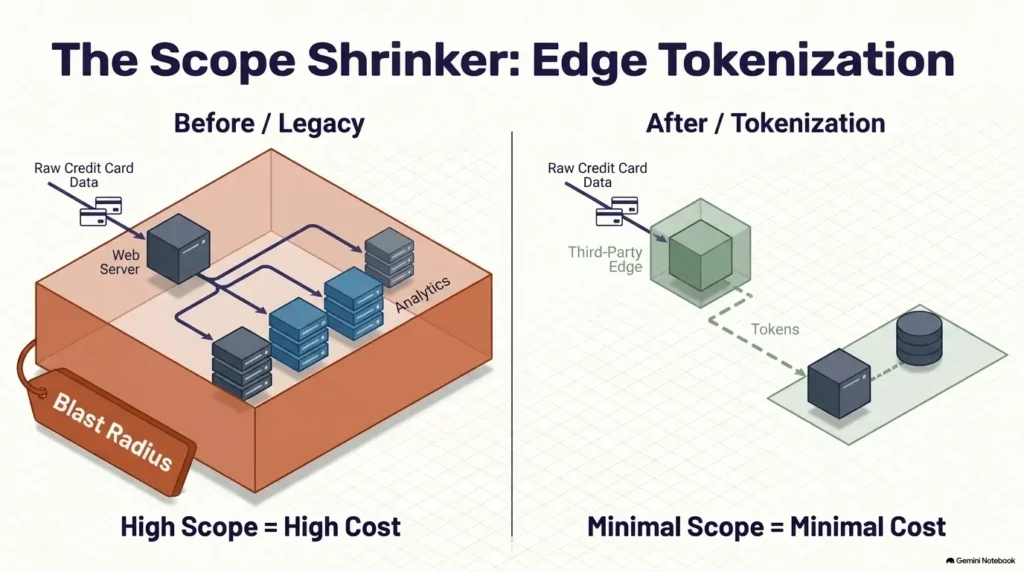
A hosted payment page that keeps payment-account data away from your application can dramatically reduce scope. A checkout that stores, processes, transmits, or can materially affect payment data can pull more infrastructure, code, people, testing, and evidence into the assessment.
2. Whether your own website can affect payment security
Modern ecommerce pages load tag managers, analytics, chat widgets, advertising scripts, A/B testing code, fraud tools, consent platforms, and other third-party JavaScript. Those scripts are not merely a performance issue when they can influence a payment experience.
PCI DSS v4.x gives ecommerce payment-page security much more operational weight. Current requirements and SAQ eligibility criteria mean merchants should understand which scripts execute, whether they are authorized, whether their integrity is protected where applicable, and how unexpected changes or tampering are detected.
3. Your validation method
A self-assessment questionnaire completed internally is a different commercial exercise from a QSA-led Report on Compliance. Payment brands and acquiring banks determine merchant validation programs, so transaction volume can matter, but the exact threshold and requested evidence should be confirmed with the party that accepts your validation.
4. The state of your controls before assessment
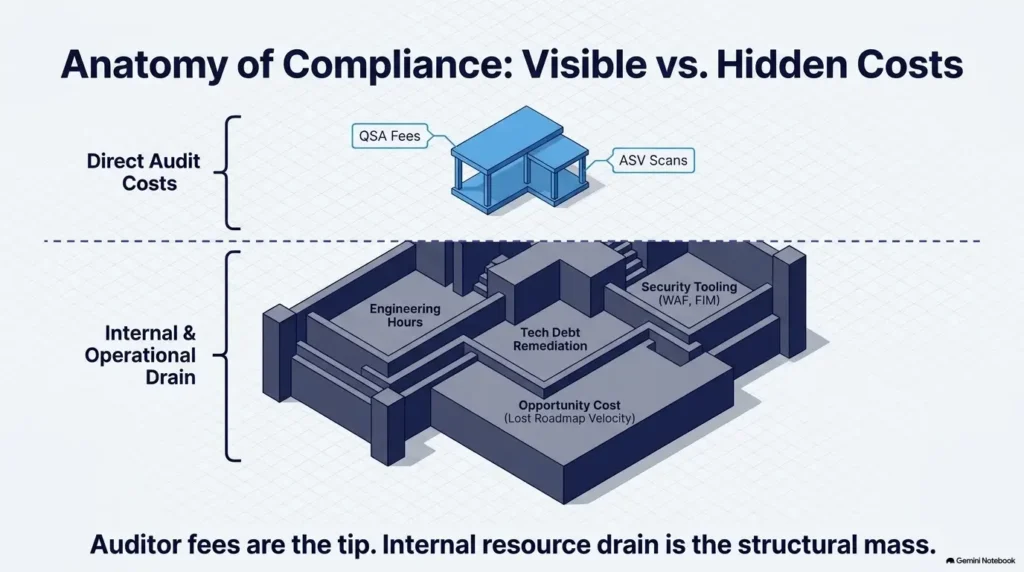
A store with clean asset inventories, current policies, well-managed access, tested logging, documented vendors, and a maintained evidence trail pays mainly for validation. A store discovering its first serious control gaps during the assessment pays for archaeology first and compliance second.
The same principle applies to vulnerabilities. A remediation backlog can consume more money than the assessor. Define who owns fixes and how quickly they are expected to close. A formal vulnerability remediation SLA can help turn recurring findings into an operational process rather than an annual scramble.
The answer changes when…
…your checkout moves from fully hosted to merchant-controlled, card data appears in logs or databases, the number of payment-connected systems grows, an acquirer requires independent validation, or unresolved security gaps need engineering work before you can attest to the controls.
Your checkout architecture decides more than your transaction count
For ecommerce, the first cost-control exercise is not shopping for compliance software. It is drawing the payment flow.
Different integrations can look almost identical to a customer while creating very different PCI scope behind the browser.
| Checkout design | Possible validation direction | Cost consequence |
|---|---|---|
| Customer is redirected to a PCI-compliant payment provider | May qualify for SAQ A if all eligibility criteria are satisfied | Usually the lightest merchant scope |
| Payment fields are fully provided by an eligible third party inside the merchant experience | May qualify for SAQ A depending on implementation and current eligibility criteria | Still requires careful attention to the merchant website and third-party dependencies |
| Merchant-hosted page collects data that is posted directly to a processor or tokenization service | Often creates broader scope such as SAQ A-EP | More application, scanning, security-control, and evidence work |
| Merchant systems store, process, or transmit cardholder data | Broader SAQ D or ROC-related validation may apply | Much larger technical and operational scope |
Do not choose an SAQ from a blog table alone. The table is a scoping map, not a determination. Confirm the appropriate validation method with your acquirer or the organization accepting your PCI evidence.
As of the August 2026 review of this guide, PCI DSS v4.0.1 is the operative PCI DSS revision, and requirements that were originally future-dated through March 31, 2025 are now effective. Ecommerce merchants should therefore avoid old cost estimates based on the lighter pre-v4.x operational model.
The PCI cost chain
1. Checkout
Where does payment data travel?
2. Scope
Which systems and people can affect it?
3. Validation
SAQ, QSA support, or ROC?
4. Testing
What scanning and testing applies?
5. Remediation
What must be fixed before validation?
Budget rule: price the chain from left to right. Starting with an auditor quote skips the variable most likely to change the total.
Where the PCI DSS budget actually goes
The assessment invoice is only one line. A more useful budget separates eight categories.
| Cost component | What you are paying for | What expands it |
|---|---|---|
| Scope discovery | Payment-flow mapping, asset inventory, SAQ or ROC determination | Multiple gateways, stores, clouds, brands, regions, legacy systems |
| Validation | Internal SAQ effort or QSA assessment work | Independent validation, larger CDE, more interviews and evidence |
| Scanning | Approved external scanning when applicable and vulnerability management | More external assets, failures, retesting, changing infrastructure |
| Penetration testing | Applicable internal/external and segmentation testing | More applications, networks, segmentation boundaries, retests |
| Ecommerce page protection | Script inventory, change monitoring, integrity controls, investigation | Tag-heavy sites, frequent deployments, many third-party scripts |
| Security tooling | Logging, access control, vulnerability management, monitoring and evidence | Large estates, retention needs, integrations, premium support |
| Internal labor | Engineering, security, IT, legal/procurement and evidence collection | Fragmented ownership and weak documentation |
| Remediation | Fixing actual gaps | Legacy applications, stored PAN, weak segmentation, outdated controls |
What Changes the Quote
Suppose two online shops both process 500,000 transactions a year. One redirects every card payment to a compliant provider and retains no account data. The other hosts a custom checkout, runs twenty marketing and analytics scripts near payment, operates several cloud accounts, and has a legacy order-management system containing historical payment information.
Transaction count alone does not describe the second store’s technical effort. The systems that can affect payment security are where the assessor’s hours, testing, evidence requests, and remediation tickets begin to multiply.
This is also why buying a broad security stack before completing scope discovery can waste money. If you are budgeting multiple controls at once, a security tool stack cost model can help separate recurring licenses from the PCI-specific work those tools are expected to support.
Hidden-cost rule
Keep remediation as its own budget line. If the quote includes “assessment and remediation” without telling you which engineering work is included, you cannot compare it cleanly with another provider.
Three ecommerce budget scenarios
Scenario 1: Small store with fully outsourced checkout
Imagine a 12-person ecommerce business. The checkout redirects customers to a compliant payment provider. No primary account numbers are intentionally stored in the company’s systems, and the acquirer accepts SAQ A.
The sensible strategy is usually to keep the program lean: confirm eligibility, maintain provider evidence, review relevant website security controls, assign one internal owner, complete the required attestation work, and keep a small evidence folder throughout the year.
Paying for a large compliance automation platform may not be necessary unless it solves a broader security or evidence problem.
Scenario 2: Growing store with a custom front end
Now imagine a 40-person merchant with a headless storefront. Payment data goes directly to a processor through a custom payment integration, while the merchant controls the page, deployment pipeline, tag manager, and several third-party scripts.
The business should expect more work around application security, payment-page scripts, vulnerability management, change monitoring, access, evidence, and potentially scanning or testing requirements applicable to its validation path.
This is where specialist PCI advice or a narrowly chosen monitoring tool can be cheaper than repeated manual investigation, especially when the storefront changes several times a week.
Scenario 3: Multi-brand retailer requiring independent validation
A larger ecommerce business operates several storefronts, multiple payment integrations, cloud workloads, call-centre systems, and segmented payment infrastructure. Its acquiring relationship requires formal independent validation.
The budget now needs to account for QSA time, technical evidence, interviews, applicable penetration and segmentation testing, vulnerability remediation, project management, retesting, and possibly travel or specialist engineering. A five-figure assessment can be perfectly rational here, but only if the proposal defines the scope precisely.
The important lesson is not that bigger merchants should spend more. It is that architectural and validation complexity create work, and work creates the bill.
DIY, software, or professional help?
| Approach | Best fit | What you gain | What can go wrong |
|---|---|---|---|
| DIY | Small, clearly scoped merchant with strong internal technical ownership | Lowest cash cost and direct understanding of controls | Wrong SAQ, incomplete evidence, forgotten recurring tasks |
| Compliance/security software | Repeated evidence work, multiple owners, continuous monitoring needs | Automation, reminders, inventories, evidence workflows | Paying for a platform that does not reduce actual PCI work |
| PCI consultant | Scope uncertainty, first-time preparation, difficult remediation | Targeted expertise without necessarily buying full validation | Advice that does not match the requirements your acquirer will accept |
| QSA-led engagement | Independent validation required or complex merchant environment | Qualified assessment and formal validation support | Expensive discovery if you arrive with poor scope and evidence |
Do it free or mostly DIY when…
- Your validation path is unambiguous.
- The payment flow is simple and well documented.
- You intentionally avoid storing payment-account data.
- Internal staff understand the applicable technical controls.
- Evidence collection is small enough to manage manually.
- Your acquirer does not require independent assessment.
Pay for software when…
- Evidence is scattered across multiple teams and systems.
- Website-script monitoring or other recurring control checks create meaningful manual work.
- You repeatedly lose time recreating inventories or screenshots.
- Several compliance programs share the same controls.
- Integrations and automated reminders materially reduce staff workload.
Pay for professional help when…
- You cannot confidently identify PCI scope.
- A QSA-signed assessment or ROC is required.
- You have stored card data, a complicated CDE, or uncertain segmentation.
- Major remediation must be prioritized before assessment.
- Your internal team cannot interpret applicability questions with confidence.
Good-enough decision rule
Do not buy software merely to make a short SAQ look prettier. Pay when the tool removes recurring work, creates reliable evidence, or operates a control you genuinely need.
How to compare PCI DSS quotes without buying the wrong scope
Two PCI proposals can differ by 300% and both be reasonable if they include different work. Ask providers to expose those differences before you compare totals.
| Question to ask | Why it matters |
|---|---|
| Which SAQ, ROC, or validation assumption is this quote based on? | A price built on the wrong validation path is useless. |
| Which domains, applications, networks, cloud accounts, and locations are included? | “Ecommerce environment” is too vague for a commercial scope. |
| Is initial scoping included? | Some providers price discovery separately. |
| Are ASV scans included when required? | Scanning may be a separate subscription or third-party service. |
| Is penetration or segmentation testing included where applicable? | Testing can become one of the larger separate cost items. |
| Are failed scans or retests included? | Retesting terms can turn a cheap quote into an expensive one. |
| Does the engagement include remediation engineering? | Advice and implementation are different services. |
| How are ecommerce scripts and payment-page change risks handled? | A modern ecommerce assessment should not ignore browser-side payment risk. |
| What deliverable will we receive? | Confirm whether you receive guidance, completed evidence, an AOC, ROC support, or something else. |
| What causes a change order? | New systems, extra locations, failed testing, or revised scope may increase price. |
Red flags in a PCI proposal
- The seller promises that a tool will automatically make you PCI compliant.
- The proposal does not name the assumed validation path.
- You are quoted before anyone asks how payment data flows.
- Remediation is described as “included” without hours, boundaries, or exclusions.
- There is no explanation of retesting or failed-scan charges.
- The provider treats every ecommerce site as having the same scope.
- The proposal guarantees compliance or assessment success.
- The engagement ignores third-party scripts and payment-page security.
Be especially cautious with the phrase “PCI certification.” Merchants commonly validate compliance through SAQs, Attestations of Compliance, or Reports on Compliance depending on the required path. Ask the provider to name the exact deliverable rather than relying on a sales label.
How to reduce PCI DSS cost without creating false economy
The strongest savings usually come from reducing scope and reducing repeated work.
1. Keep payment data out of your environment where practical
If the commercial and technical model allows it, outsourcing payment capture to an appropriate PCI-compliant provider can shrink the number of systems your team must protect, document, test, and validate.
This does not eliminate merchant responsibility. It changes the responsibility you retain.
2. Search for accidental card-data storage
Legacy databases are obvious. Debug logs, support tickets, analytics events, exports, screenshots, backups, and observability systems are less obvious. Accidentally retaining data can undo a carefully designed low-scope architecture.
3. Reduce checkout-page script clutter
Every unnecessary third-party script is another dependency to understand and manage. Removing abandoned marketing tags can improve performance and reduce the amount of browser-side change your security process must track.
4. Collect evidence all year
Evidence has a curious talent for becoming expensive when everyone starts looking for it on the same Friday afternoon.
Create lightweight folders for recurring evidence such as access reviews, scan results, change records, vendor documentation, incident-response tests, training records, and policy approvals. The goal is not paperwork for its own sake. It is avoiding an annual reconstruction project.
5. Fix known gaps before the assessor starts billing
If your team already knows that unsupported systems, weak access controls, failed scans, or missing inventories will create findings, remediate what you reasonably can before the formal assessment window.
Assessment hours are expensive places to discover ordinary operational debt.
6. Avoid buying duplicate compliance tools
If you already operate vulnerability management, identity, logging, ticketing, and cloud-security tools, check whether those systems can produce the PCI evidence you need before adding another platform.
Best place to save money
Spend thirty minutes reducing scope before spending three hours comparing QSA rates. One system removed from the cardholder-data environment can be worth more than shaving a few hundred dollars from an assessment quote.
PCI compliance also does not replace broader risk transfer or incident planning. If payment security is part of a larger ecommerce risk review, compare your technical controls with the separate questions involved in cyber insurance for ecommerce stores.
FAQ
Is PCI DSS only for large ecommerce companies?
No. PCI DSS can apply to organizations that store, process, transmit, or otherwise fall within scope for payment-account data regardless of company size. What changes with size and payment-brand programs is often the required validation method, not the underlying need to protect payment data.
Do I need a QSA if my store qualifies for SAQ A?
Not automatically. Many merchants complete an accepted self-assessment path without hiring a QSA. Professional help becomes useful when scope is unclear, your acquirer requests independent validation, the environment is unusually complicated, or internal staff cannot confidently interpret the applicable requirements.
Does SAQ A mean my ecommerce website is outside PCI security concerns?
No. A reduced validation scope does not mean the merchant website can be ignored. Current PCI ecommerce guidance and SAQ eligibility criteria recognize browser-side attacks and malicious scripts as material payment risks. Your precise obligations depend on the integration and validation path.
Are quarterly ASV scans required for every ecommerce merchant?
No. Scanning requirements depend on the applicable PCI requirements and validation path. Do not buy an ASV subscription simply because another merchant uses one. Confirm whether it is required for your environment and which external assets are actually in scope.
Can a payment provider make my store PCI compliant for me?
A compliant provider can materially reduce your scope, but outsourcing payment processing does not outsource every merchant responsibility. You still need to confirm your integration, maintain applicable controls, manage relevant service providers, and complete whatever validation your merchant program requires.
Does PCI DSS compliance also satisfy GDPR or UK data-protection law?
No. PCI DSS is a payment-card security standard. Data-protection laws and privacy obligations have separate scopes, legal bases, rights, governance duties, and enforcement mechanisms. Some security controls may support both programs, but one does not automatically establish compliance with the other.
Your 15-minute PCI budget check
Do one thing before asking for a PCI DSS quote: create a one-page payment-scope card.
Spend no more than 15 minutes recording these four facts:
- Checkout method: redirect, hosted payment fields, direct post, custom checkout, or another model.
- Card-data touchpoints: whether any backend, database, log, support tool, analytics system, backup, or employee workflow can receive payment-account data.
- Validation request: the SAQ, AOC, ROC, or other evidence your acquirer or processor has actually asked for.
- Known gaps: failed scans, old systems, excessive scripts, weak access controls, missing inventories, or unresolved security findings.
That single page will tell you far more about your likely PCI DSS cost than employee count or annual revenue alone. It also gives a consultant or assessor something concrete to price, which is where vague compliance quotes begin turning into comparable proposals.
Last reviewed: 2026-09