
OSCP Exam Day Mental Checklist: 9 Shocking Lessons I Learned After Failing, Then Passing
If your heart’s doing tiny Nmap scans in your chest right now—yeah, you’re exactly where you’re supposed to be.
The OSCP exam isn’t just a test of your hacking chops. It’s more like a stealth audit of your sleep schedule, ego control, caffeine tolerance, and note-taking discipline. On my first attempt, I flamed out in a spectacular blur of tabs, terminals, and existential dread. Failed hard. Not because I didn’t know enough—but because I let the pressure run the show.
When I finally passed? My technical skills were more or less the same. What changed? My headspace. That was the real pivot.
So, in this guide, I’m handing you the mental survival checklist I wish someone had slapped into my shaking hands before the exam. We’re talking: what to do hour by hour, how to dodge “panic pivoting,” and why refreshing the scoreboard every 3 minutes is a trap.
I know you’re tired. You’re probably working full-time, burning weekends on labs, and paid for this beast out of your own pocket. So let’s keep it tight. In under 15 minutes, you’ll walk away with a battle-tested, repeatable exam-day game plan—one you can lean on when your feelings start gaslighting you at 3 a.m.
Later in this guide, I’ll even walk you through a 60-second cost estimator to see what a failed attempt actually sets you back—and why it’s absolutely worth fixing your mindset before your buffer overflows.
Table of Contents
Why This Checklist Matters More After You’ve Failed Once
On my first OSCP attempt, I treated the exam like a boss fight. On my second, I treated it like a long, slightly boring consulting engagement. Same tools, same brain, very different result.
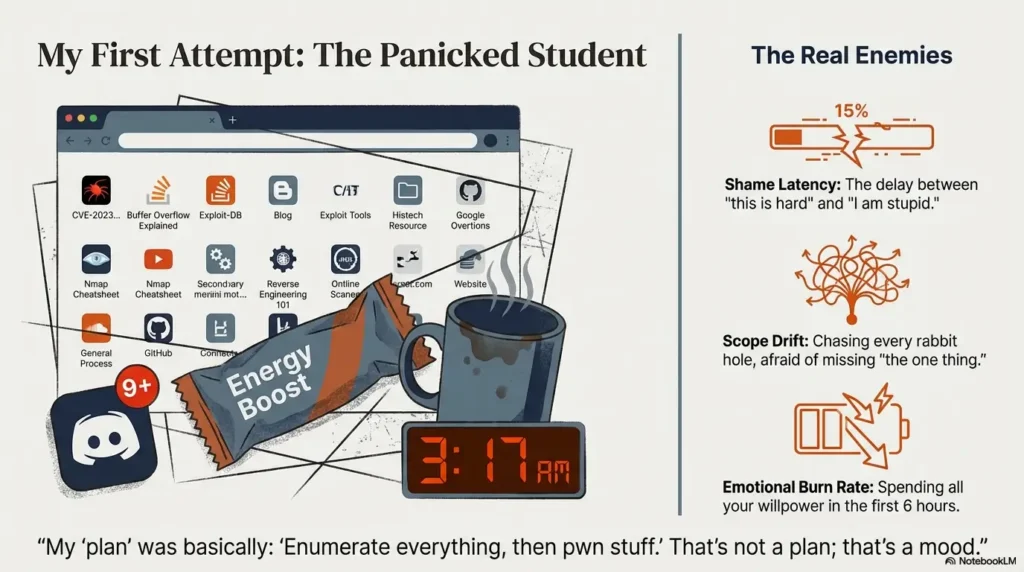
Here’s the uncomfortable truth: after a failure, your technical skill usually isn’t the bottleneck. Your real enemies are:
- Shame latency — the delay between “this is hard” and “I am stupid.”
- Scope drift — chasing every possible rabbit hole because you’re afraid of missing “the one thing.”
- Emotional burn rate — spending all your willpower in the first 6 hours.
On my fail attempt, I spent 4 hours trying to “outsmart” one box instead of admitting I was stuck and pivoting. On my pass attempt, I set a timer, accepted my limits, and moved on at the 90-minute mark. I went from zero rooted boxes in the first 10 hours to three boxes and decent points by hour 16, largely because my rules were written before the emotions kicked in.
“If you don’t decide how you’ll suffer in advance, the exam will decide for you.”
- Assume your skills are “good enough” for a passable score.
- Assume your emotions will lie to you under sleep debt.
- Write rules now that your tired self must obey later.
Apply in 60 seconds: Write one sentence: “If I’m stuck after 90 minutes, I pivot to another target, no debate.” Tape it above your monitor.
Lesson 1: Your Brain Is the Real Exam Environment
On paper, the OSCP exam environment is simple: VPN, targets, proctor, report. In reality, it’s you, alone at 3 a.m., arguing with an error message while your self-worth quietly erodes.
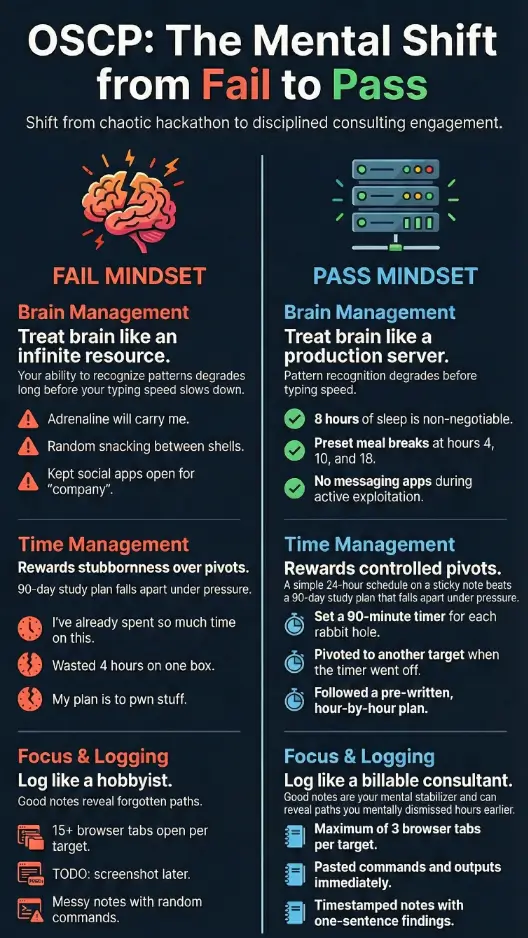
On my failed attempt, I made three classic mistakes:
- Started the exam slightly sleep-deprived, “because adrenaline.”
- Had no fixed meal times—just random snacking between shells.
- Kept Slack/Discord open “for company,” bleeding focus every 5 minutes.
On the pass attempt, I treated my brain like a production server:
- 8 hours of sleep the night before—non-negotiable.
- Preset meal breaks at hours 4, 10, and 18.
- No messaging apps during active exploitation windows.
One small anecdote: during my pass attempt, I literally told the proctor, “I’m taking a 20-minute walk; you’ll see me AFK.” It felt unprofessional. It also came right before I landed a crucial foothold I’d been blind to for hours.
Think of this as your brain’s SLAs: if you violate them, the service degrades, and no amount of Burp magic fixes it.
Show me the nerdy details
Sleep deprivation trashes working memory and pattern recognition long before it slows your typing speed. That means you’ll still “feel productive” while making systematically worse decisions about where to spend your time. A strict sleep + break schedule is less about health and more about preserving high-value decision cycles during the exam’s middle 8–10 hours—exactly when most people run out of mental fuel and start brute-forcing everything in sight.
- Plan sleep and food before you schedule the exam window.
- Block all “just checking” tabs (Slack, email, socials).
- Schedule one 15–20 minute walk at your personal “crash point.”
Apply in 60 seconds: Open your calendar and block 3 exam-day breaks with exact times. Protect them like root access.
Lesson 2: Scope Rules Are Self-Care Rules
Everyone respects scope when it’s about not hacking the wrong host. Almost nobody respects scope when it comes to their own attention.
On my failed attempt, I had 15 browser tabs open per target: three exploit-db pages, random blog posts, an unrelated buffer overflow guide I’d panic-opened “just in case.” I was technically in-scope but mentally all over the internet.
On the pass attempt, my personal scope looked like this:
- Maximum 3 browser tabs per target.
- Only one “wildcard research” tab allowed at a time.
- If I opened StackOverflow or a forum, I had to write a specific question in my notes first.
It sounds ridiculous, but that simple constraint cut my “help rabbit hole” time by at least 30–40 minutes every 4-hour block.
Money Block #1 — OSCP Exam Day Eligibility Checklist (Mindset Edition)
Binary checklist before you even click “Start Exam”:
- Yes / No: I can explain my pivot strategy in 2 sentences.
- Yes / No: I have a hard limit for “stuck time” on each target.
- Yes / No: I have a simple fee schedule written down (exam + possible retake).
- Yes / No: I’ve set an out-of-pocket budget for retakes and lab extensions.
- Yes / No: I’ve told at least one person my exam window so they don’t interrupt.
If you can’t confidently tick “Yes” on at least 4 out of 5, you’re not mentally eligible yet—you’re gambling, not testing.
Save this checklist and confirm the current exam requirements and fees on the official provider page before you book.
- Limit open tabs as aggressively as you limit ports.
- Define “good enough” research before the panic starts.
- Use a binary eligibility checklist, not vibes, to decide exam day.
Apply in 60 seconds: Write down your max tab count and one rule for when you’re allowed to Google things. Stick to it for the next lab session.
Lesson 3: Why 90-Day Study Plans Fail on Exam Day
Most OSCP blogs obsess over the 90-day study plan. Very few talk about the 24-hour exam-day plan, which is where a lot of otherwise prepared candidates crash.
On my failed attempt, my “plan” was basically: “Enumerate everything, then pwn stuff.” That’s not a plan; that’s a mood.
For the second attempt, my exam-day plan fit on a single sticky note:
- Hour 0–2: Broad recon on all targets, quick notes only.
- Hour 2–6: Deep dive on 2 best-looking footholds.
- Hour 6–10: Pivot to remaining easy/medium boxes; decide one “boss box.”
- Hour 10–18: Alternate boss box and easy wins; no single rabbit hole over 90 minutes.
- Hour 18–20: Clean notes, screenshots, stabilize shells.
- Hour 20–24: Sleep + short review; no new attacks unless trivial.
Short Story: On my pass attempt, I hit a horrible wall at around hour 9. My shells were unstable, one exploit kept crashing the service, and I caught myself rewriting the same Nmap command three times because I couldn’t remember if I’d run it already. I looked at my sticky note and realized I was already 40 minutes over my time budget on that box.
The old me would have “just kept going”—because sunk cost. Instead, I forced myself to pivot to another machine. Ninety minutes later, I had a clean low-priv shell, a privesc path mapped, and enough points on the board that the earlier failure stopped feeling like the end of the world. That’s when I understood: the exam doesn’t reward stubbornness; it rewards controlled reallocation of effort.
Exam day is where your 24-hour schedule matters way more than your “90-day roadmap” wallpaper graphic.
- Pre-allocate windows for recon, exploitation, and cleanup.
- Set hard caps on how long you’ll fight a single pivot.
- Include sleep and report time in the same plan.
Apply in 60 seconds: Draft a 6-line exam-day schedule like the one above, then refine it after each lab session.
Lesson 4: Time-Boxing Like a Proctor, Not a Panicked Student
When you’re mid-exam, time doesn’t feel linear. Ten minutes on a promising privesc path feels like 30 seconds. Ten minutes watching an exploit hang feels like a year.
On my failed attempt, I had no external time reference beyond the exam clock. I “felt” like I was spending 30–40 minutes per idea. My notes later showed that some dead ends ate 2–3 hours.
On the pass attempt, I used simple time boxing:
- Set a 30-minute timer for each idea (privesc path, exploit chain, enumeration strategy).
- At the buzzer, write a one-line summary: “Still promising” or “Probably dead.”
- Decide whether to renew the slot or park the idea for later.
Yes, it’s annoying. Yes, it breaks your flow. That’s the point: it forces you to switch from “feeling” to deliberate decision-making.
Money Block #2 — OSCP Time vs Cost Mini Table (Example Only)
| Year | Typical Total Investment (Lab + Exam) | Extra Cost of One Failed Attempt | Notes |
|---|---|---|---|
| 2023 | $1,000–$1,400 | $150–$300 | Depends on bundle, discounts, and region. |
| 2024 | $1,100–$1,500 | $150–$350 | More subscription-style options, some price adjustments. |
| 2025 | $1,100–$1,600 (example) | $200–$400 (example) | Assume gradual increases; confirm official fee schedule. |
These numbers are illustrative, not official. The point isn’t the exact figure; it’s realizing that every 2–3 hours you waste on exam day quietly nudges you toward paying this “extra cost” later.
Save this table concept and confirm the current fee schedule on the official OffSec site before you schedule or reschedule.
Infographic: OSCP Exam Day Mental Stack
7–8 hours in the bank, no exceptions.
24-hour schedule, time-boxes, break windows.
Pivot limits, tab limits, research rules.
Your usual toolkit, nothing fancy or new.
- Use 30-minute slots for each idea or path.
- Write one-line summaries at each buzzer.
- Decide to renew, pivot, or park deliberately.
Apply in 60 seconds: Install a simple Pomodoro or timer app and set a 30-minute preset labeled “OSCP path test.”
Lesson 5: Logging Like a Billable Consultant, Not a Hobbyist
The OSCP report scares a lot of people, but logging is secretly your mental stabilizer.
On my failed attempt, my notes were half-hearted: random commands, partial outputs, and “TODO: screenshot later.” Those “laters” never came.
On the pass attempt, I pretended I was on a client engagement:
- Used timestamps in my notes every 30–45 minutes.
- Pasted key commands and outputs immediately, not “when I have time.”
- Wrote one-sentence findings for each meaningful step, even dead ends.
A small, humbling anecdote: I discovered a privesc path on my second attempt purely because I saw an old note from hour 3 that said, “Weird SUID binary, looks custom.” I’d mentally dismissed it. My notes hadn’t. That one sentence turned into root on a box worth crucial points.
Money Block #3 — 60-Second OSCP Failure Cost Estimator
Curious how much a failed attempt really costs you when you factor in time, not just the exam fee?
OSCP Failure Cost Estimator (Example Only)
This isn’t about scaring you; it’s about seeing that “just one more attempt” might represent $2,000+ in effort. Logging well is one of the cheapest ways to avoid paying that “invisible premium” twice.
Save this idea and verify your actual fee schedule and time investment before you book, so you know exactly what you’re putting on the table.
- Time-stamp notes to see where your hours really go.
- Log dead ends so they can pay off later.
- Capture commands and screenshots immediately, not “after the exam.”
Apply in 60 seconds: Create a simple notes template with sections for recon, foothold, privesc, and “weird things to revisit.” Use it in your next lab session.
Lesson 6: When to Push, When to Sleep, and When to Let Go
One of the most shocking lessons I learned: brute-forcing yourself is slower than sleeping.
On my failed attempt, I pushed through the night, convinced that “real hackers don’t sleep.” The result: I spent nearly 3 hours mis-reading a single config file. When I reviewed it post-exam, the pivot was painfully obvious.
On the pass attempt, I made a deal with myself:
- Minimum 3 hours of sleep in the last third of the exam window.
- No new targets started after a certain hour—only stabilization and cleanup.
- If I caught myself re-running the same command three times, that was a mandatory break trigger.
If you’re in Asia, including Korea, and taking the exam at a time aligned to US or European working hours, this becomes even more critical. Your exam window might straddle your normal sleep schedule. Plan your naps and caffeine like you’d plan your buffer overflows: with intention and boundaries, not vibes.
Money Block #4 — Decision Card: More Lab Time vs Retaking the Exam
| Option | When It Makes Sense | Typical Cost Impact | Notes |
|---|---|---|---|
| Buy More Lab Time | You still struggle with basic footholds and privesc paths. | Extra lab subscription; delays retake fee. | You can consistently root OSCP-style boxes in <6 hours. |
| Retake Soon | You were close to passing; main issues were mental and timing. | Retake fee sooner, but less “skill decay” over time. | You can explain exactly why you failed the first time. |
Save this decision card and confirm the current lab and exam prices on the official site before choosing which path you’ll fund next.
- Plan a minimum sleep window into your exam schedule.
- Use “repeat command syndrome” as your forced-break indicator.
- Choose between more lab time and a fast retake intentionally.
Apply in 60 seconds: Decide now: for your exam, what’s your absolute latest “start new target” time?
Lesson 7: The Money Math of Failing vs Passing
We don’t talk enough about how much this certification actually costs in money and missed opportunities. That silence quietly kills people’s motivation after the first failure.
Here’s a simple way to think about it:
- Your OSCP journey has a premium: the total out-of-pocket amount you’re willing to invest.
- Each exam attempt and lab extension is like a new coverage tier—you pay more to get closer to the “pwned everything” outcome.
- Your time is the hidden deductible: you must “pay” a certain number of deep-focus hours before the exam “pays out.”
On my failed attempt, I pretended the cost was “just the exam fee.” On my pass attempt, I wrote down a simple budget that included:
- Total money I was willing to invest this year.
- Maximum number of attempts I could afford.
- Minimum number of hours I’d dedicate before each attempt.
Seeing those numbers in black and white changed my behavior. I stopped doing “lazy recon.” Every 30 minutes wasted felt like burning a small, visible stack of cash.
- Decide how many attempts you’ll fund before you start.
- Track hours spent so far as part of your “deductible.”
- Protect deep-focus time like you protect your bank account.
Apply in 60 seconds: Write down: “Max attempts I’ll fund this year: __; total budget: $__.” Let that shape your habits.
Lesson 8: Building Your OSCP Exam Day Playbook
By now, you’ve seen that passing OSCP after a failure is less about “new tools” and more about codifying your behavior. That’s what a real playbook is: not a fancy PDF, but a set of actions your tired, scared future self can follow.
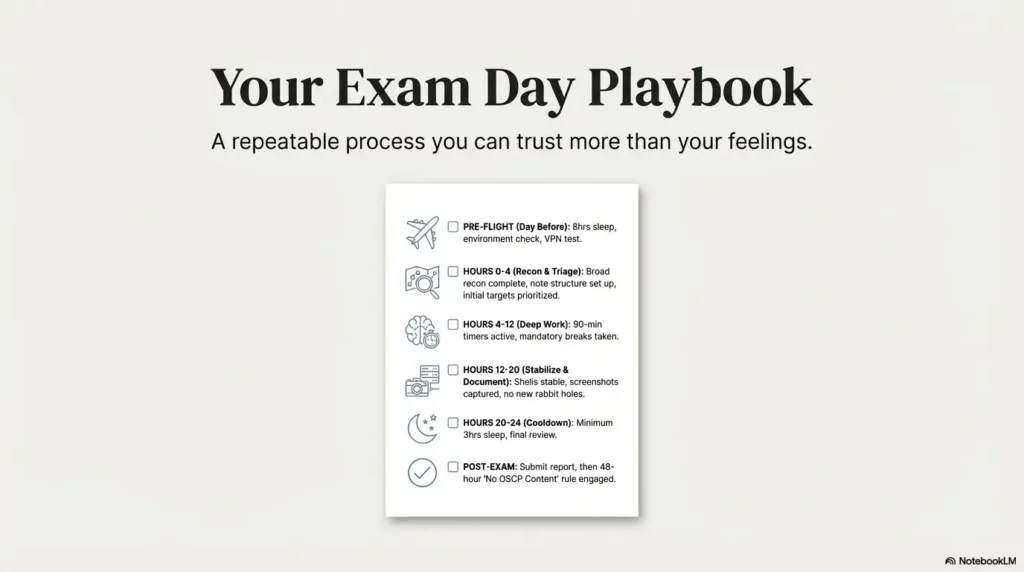
Your OSCP Exam Day Mental Checklist might include sections like:
- Pre-Exam (Day Before) — sleep, food, environment, backups, VPN test.
- Hour 0–4 — recon, note structure, first prioritization.
- Hour 4–12 — deep work windows, fixed breaks, time-boxing.
- Hour 12–20 — stabilizing shells, screenshots, “don’t break what works.”
- Hour 20–24 — sleep, review, light cleanup.
- Post-Exam — emotional decompression, realistic debrief, next steps.
On my pass attempt, I literally had a printed one-pager next to my keyboard with boxes I could tick. Every time I checked one off, my anxiety dropped a little. I didn’t feel “on track” emotionally, but the checklist showed that I was.
If you’re reading this from Korea or elsewhere in Asia, time zone juggling is part of your playbook. Decide in advance:
- Will you align your sleep schedule to the exam’s “daylight hours,” even if that means shifting your usual routine for a week?
- Which hours in your local time will be your “high focus” slots?
- Who can you warn ahead of time so nobody knocks on your door at a critical privesc moment?
- Fit your exam-day plan on a single page.
- Include boxes to tick; your brain needs visible wins.
- Localize it to your time zone and household reality.
Apply in 60 seconds: Start a one-page document titled “OSCP Exam Day Playbook” and create six simple sections like the ones above.
Lesson 9: What Changes the Second Time You Sit
The second time you sit for the OSCP, something subtle changes: you know exactly how it feels to watch the clock run out with not enough points on the scoreboard.
That memory can either poison you or empower you.
Here’s what I noticed on my second attempt:
- I panicked earlier in the exam because I’d already “seen the movie” of failing.
- I also trusted my process more because I had real data from my first attempt.
The mental shift that helped me most was this: I stopped treating the second attempt as a “second chance” and started treating it as a different experiment. My goal was not “redeem the failure,” but “run the exam with a new playbook and see what breaks.”
That posture changed everything:
- Failures mid-exam felt like data, not character judgments.
- Every pivot was “me testing my rules,” not “me admitting defeat.”
- I walked into the report-writing phase calmer, because I’d assumed from the start that not everything would be rooted.
If your first attempt left a scar, you’re not alone. The trick is to turn that scar into a configuration change, not a story about your worth.
- Write down what failed last time in neutral language.
- Define 3 things you’ll do differently this time.
- Measure success by process adherence, not just the final score.
Apply in 60 seconds: In one sentence, complete this: “This attempt will be successful if I consistently follow these three rules: __, __, __.”
FAQ
1. How do I know if I’m actually ready to book my next OSCP attempt?
You’re ready when at least three things are true: you can consistently root OSCP-style boxes in under 6 hours, you’ve done at least one full 24-hour “mock exam” with strict breaks and logging, and you can explain in clear language why you failed the first time and what’s changed. If you’re still guessing on those points, your next 60 seconds are best spent writing an honest self-assessment, not clicking “Book exam.”
60-second action: Write down three bullet points: skills improved, habits changed, and remaining weak spots. If the first two are thin, delay booking.
2. What’s the biggest mental mistake people make on OSCP exam day?
The biggest mistake is equating “stuck” with “doomed.” Stuck is just a normal phase of any complex exam. The danger comes when you respond by thrashing—opening 20 tabs, half-reading forum posts, and refusing to pivot because “I’ve already spent so much time on this.” The exam rewards controlled pivots and good note-taking far more than raw stubbornness.
60-second action: Choose a “stuck phrase” now—something like, “Stuck is data, not destiny”—and write it at the top of your exam-day notes template.
3. How much does failing once really hurt my OSCP chances long-term?
Emotionally, it can feel devastating. Practically, it often makes you more likely to pass next time—if you treat the failure as a source of logs, not a verdict. The real risk is financial and motivational: each failed attempt increases your out-of-pocket cost and your temptation to quit. That’s why having a clear budget and a maximum number of funded attempts is so important.
60-second action: Decide whether your last attempt was a “skill failure,” “process failure,” or “life logistics failure.” Your next study month should focus on whichever of those categories hurts most.
4. How should I manage breaks without losing focus or momentum?
Think of breaks as part of the exam, not a betrayal of it. Short, pre-planned breaks (5–10 minutes) every 90–120 minutes help reset your attention and reduce the urge for random, unscheduled “micro-breaks” later. During breaks, avoid screens; walk, stretch, drink water, breathe. Your goal is to come back with cleaner eyes, not to cram in more content.
60-second action: Set recurring timers for breaks in your calendar right now and label them “Mandatory OSCP reset.”
5. How do I handle the anxiety of waiting for results after the exam?
The waiting period can feel worse than the exam itself. What helped me was deciding in advance how I’d spend those days: no doom-refreshing email, no rehashing every command in my head. Instead, I set a rule: “No OSCP content for 48 hours after submission.” That created a clean emotional boundary. When the result finally arrived, I met it from a more grounded place.
60-second action: Plan a small, non-tech activity for the day after your exam—something physical, social, or creative that reminds you there’s more to your life than one score.
Conclusion: Your Next 15 Minutes
When I look back, the most shocking part of my OSCP story isn’t the failure or the pass. It’s how little my technical skills changed between the two—and how much my exam-day behavior did.
The OSCP Exam Day Mental Checklist you’ve just walked through is not magic. It won’t guess the right exploit for you. But it will keep you from burning your limited time, money, and emotional energy in predictable ways.
In the next 15 minutes, you can:
- Draft a one-page exam-day schedule with time-boxed windows.
- Write a binary eligibility checklist you’ll use before booking.
- Create a simple notes template that treats you like a consultant, not a hobbyist.
Your first attempt may have felt like a verdict. It wasn’t. It was a very expensive, very detailed log file. Now you have the chance to read it, change your configuration, and run the test again with a calmer heart and a sharper plan.
Last reviewed: 2025-12; sources: official certification information, personal exam logs, and community-shared OSCP experiences. OSCP Exam Day Mental Checklist, OSCP exam tips, OSCP failure recovery, penetration testing certification, exam day mindset