Startup compliance without the fog machine
SOC 2 Policies Every Startup Needs
Before the Audit Gets Real
SOC 2 pressure rarely arrives politely. One week your startup is shipping features, patching bugs, and trying to close deals. The next week an enterprise buyer asks for your SOC 2 report, your security questionnaire grows teeth, and every undocumented habit starts making tiny thunderclouds over the sales process.
The good news: SOC 2 policies do not need to turn a lean SaaS team into a marble-floor bank. The useful version is simpler and harder at the same time. Your policies must describe how your company actually protects systems, handles customer data, reviews vendors, responds to incidents, and proves that the work happened.
This guide is built for founders, security leads, operators, and very tired first compliance owners who need a practical policy stack before the audit window becomes a calendar-shaped wolf. We will cover what to write, what evidence to collect, where templates help, and where copy-paste compliance turns into expensive theater.
Know the core policies
Access, risk, vendors, incidents, change, retention, training, assets, continuity, and scope-specific policies.
Connect words to proof
Turn each policy into owners, controls, tickets, logs, reviews, acknowledgments, and audit-ready evidence.
Avoid policy bloat
Write rules your team can follow every week, not heroic promises that collapse under normal startup weather.
Best use of this guide: build your policy map first, then buy tools second. The cart should not lead the horse into the server room. 🔐
Snapshot
This article is for US and UK B2B SaaS teams preparing for SOC 2 sales pressure, auditor readiness, or enterprise procurement. You will learn which SOC 2 policies startups usually need, how each policy connects to control evidence, when templates are enough, when professional help is worth considering, and how to build a one-page readiness matrix before the audit gets serious.
Table of Contents
Before You Turn Templates Into Promises
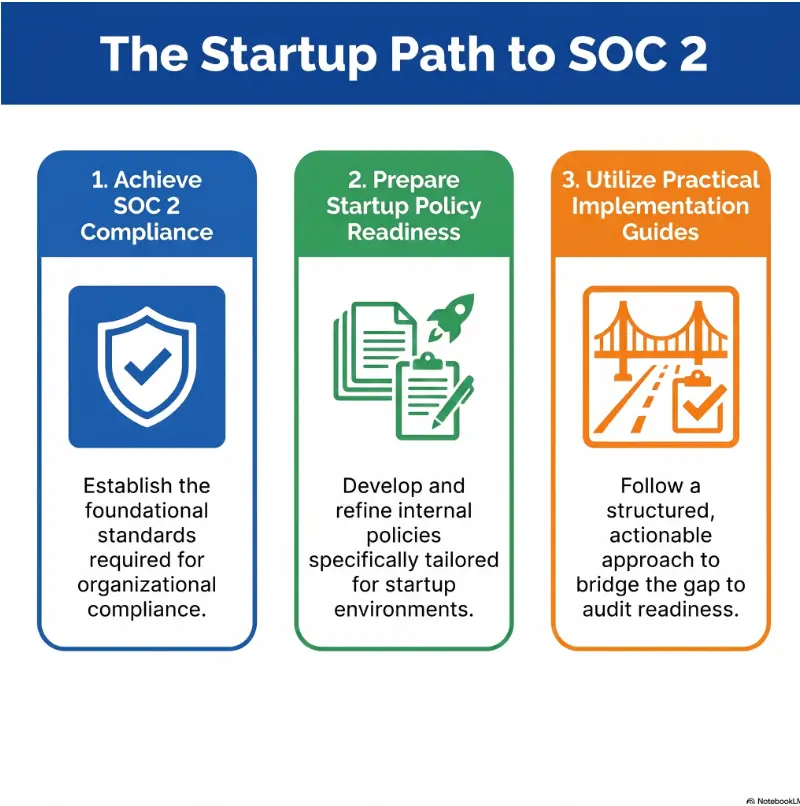
SOC 2 policy work sits in a strange little room between security, accounting, operations, privacy, legal, sales, and customer trust. It is not just paperwork. It is also not a magical badge that proves a company is immune to bad days.
A SOC 2 examination evaluates controls related to the selected Trust Services Criteria. Security is common, while Availability, Processing Integrity, Confidentiality, and Privacy depend on your scope, product, contracts, and customer expectations. A small SaaS company handling ordinary business data may need a different policy depth than a workflow platform processing sensitive client records, financial transactions, or regulated data.
Before you act
This article is educational and practical, not legal, audit, accounting, or cybersecurity advice. Your SOC 2 readiness depends on your systems, data flows, cloud architecture, vendors, contracts, selected criteria, and auditor expectations. Confirm high-impact decisions with a qualified CPA firm, security advisor, privacy counsel, or compliance lead before relying on any policy for an actual examination.
Why Policy Language Can Create Risk
Policies sound harmless until they become promises. If your access control policy says all access is reviewed monthly, but your team reviews access twice a year, the policy is not “aspirational.” It is a mismatch.
That mismatch can create audit friction, customer confusion, contract problems, and internal resentment. No one enjoys being judged against a rule they never had a real chance to follow.
The Startup Safe Word Is Evidence
For SOC 2, a policy is only the beginning. The real question is: can you show that the policy is approved, communicated, followed, reviewed, and connected to working controls?
Evidence might be an access review export, a vendor review record, a training completion report, a ticket showing approval before deployment, a risk register update, or a tabletop incident response exercise. Evidence is the breadcrumb trail that keeps your audit from becoming folklore.
Key takeaway
Write policies your company can actually operate. A plain policy with clean evidence is usually stronger than a grand policy that exists only in a shared drive, wearing a tiny ceremonial hat.
The Policy Stack Buyers Actually Expect
Enterprise buyers rarely ask for policies because they love documents. They ask because they need confidence that your startup can protect customer data after the sales call ends.
For a seed or Series A SaaS company, the policy stack should answer one practical question: if a reasonable buyer asked, “How do you run security here?” could your team explain it clearly and show proof?
Why “We Use AWS” Is Not A Security Program
Cloud providers can supply strong infrastructure features, but they do not decide who gets admin access to your production account. They do not review your support tool vendors. They do not approve your code changes, train your employees, classify your data, or write your customer deletion process.
Your startup still owns many operational decisions. SOC 2 policies make those decisions visible, repeatable, and reviewable.
The Minimum Policy Set For A Seed-Stage SaaS Company
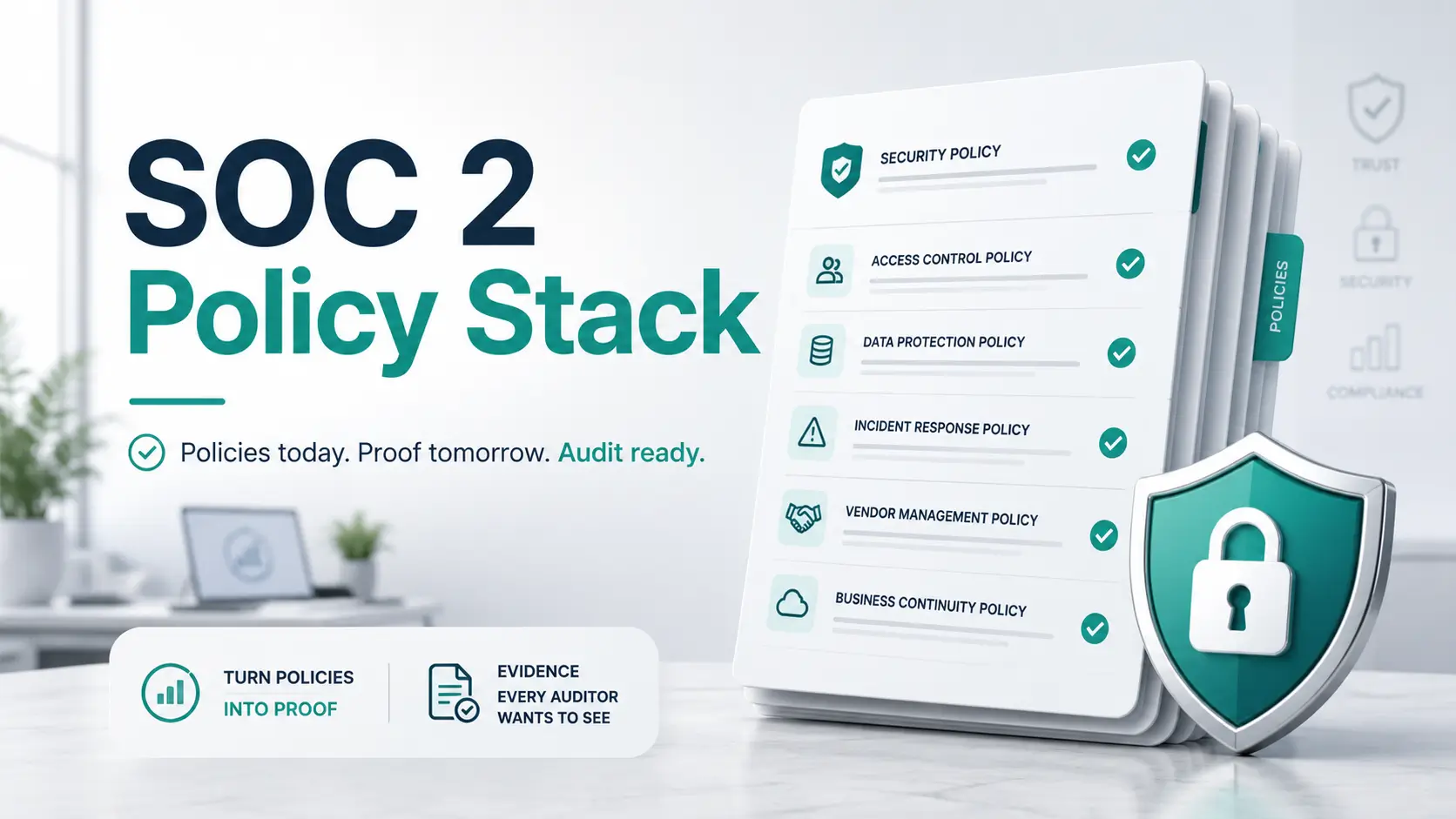
A practical early SOC 2 policy set usually includes these documents:
- Access Control Policy
- Information Security Policy
- Risk Management Policy
- Vendor Management Policy
- Incident Response Policy
- Change Management Policy
- Data Retention and Disposal Policy
- Employee Onboarding, Offboarding, and Security Training Policy
- Asset Management Policy
- Business Continuity and Disaster Recovery Policy
- Privacy Policy and Confidentiality Policy, if scope and contracts require them
This is not a universal legal list. It is a strong working map for B2B SaaS teams that need to prepare for customer security reviews and a future SOC 2 audit.
The Policy-To-Control Bridge Your Auditor Will Look For
A policy says what should happen. A control describes the activity that makes it happen. Evidence proves the control happened during the review period.
| Policy statement | Control activity | Typical evidence |
|---|---|---|
| Privileged access is reviewed regularly. | Admin users are reviewed on a defined schedule. | Export, reviewer notes, ticket, approval record. |
| Critical vendors are assessed before use. | Security review completed before onboarding. | Vendor checklist, SOC report, contract notes, approval. |
| Changes are tested before production release. | Pull requests require review and test evidence. | PR record, deployment log, test results. |
| Incidents are escalated promptly. | Incident severity and response roles are defined. | Incident ticket, timeline, post-incident review. |
A Policy Without Evidence Is Theater
The cleanest policy library in the world will not save you if no one follows it. SOC 2 readiness lives in the gap between “we wrote it down” and “we can prove we did it.”
Before you expand your policy stack, build an evidence habit. If the policy requires review, approval, testing, or acknowledgment, decide where that record will live.
The SOC 2 Policy-To-Proof Flow
1. Scope
Which criteria and systems are included?
2. Policy
What rule does the company commit to?
3. Control
What action makes the rule real?
4. Evidence
Where is the record kept?
5. Review
Who checks it and how often?
Access Control Policy: The Audit’s Front Door
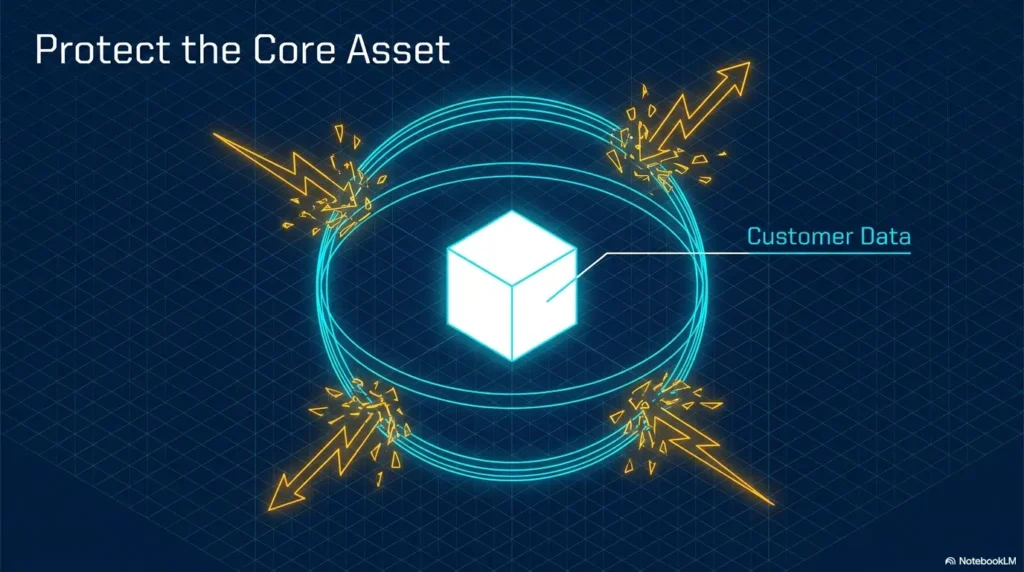
If SOC 2 had a front door, access control would be holding the clipboard. Auditors and buyers care deeply about who can reach production systems, customer data, source code, admin consoles, billing tools, support dashboards, and sensitive documents.
A strong access control policy explains how access is requested, approved, granted, reviewed, changed, and removed. It should also define privileged access, MFA expectations, password manager rules, and offboarding timelines.
Role-Based Access Without Building A Maze
Small teams do not need a 900-row permission matrix on day one. They do need clear roles. For example, engineers may need code repository access, but only selected owners should hold production admin rights. Customer support may need ticket history, but not raw database access.
Start with a short role map: founder admin, engineer, support, finance, contractor, and auditor or read-only reviewer. Then define which systems each role can access and who approves exceptions.
MFA, SSO, Password Managers, And Privileged Access
Your policy should state that MFA is required for business systems where feasible, especially email, cloud infrastructure, code repositories, identity providers, finance tools, and customer-data systems. If you use SSO, explain which apps are covered and how exceptions are handled.
Password managers help reduce shared-password chaos. If your team still has secrets in chat history, old spreadsheets, or browser autofill, fix that before it becomes a fossil bed of bad decisions.
Joiner-Mover-Leaver Rules That Prevent Ghost Accounts
Access control is not only about new hires. It is also about role changes and departures. A developer moving into product should not keep admin access forever. A contractor should not retain source code access three months after the project ends.
Define three workflows: joiner, mover, and leaver. Each should include requester, approver, target systems, deadline, and evidence record.
Evidence To Collect Before The Auditor Asks
- Access request tickets or forms.
- Manager or system owner approvals.
- User lists from key systems.
- Quarterly or monthly access review records.
- Offboarding checklists with timestamps.
- MFA or SSO configuration screenshots or exports.
- Privileged access exception records.
If your security roadmap includes SAML or enterprise identity work, a related guide such as SAML SSO for SaaS can support the access-control side of your compliance cluster.
Security, Risk, And Vendor Policies That Hold The Middle Together
Access control is visible. The middle layer is quieter: information security, risk management, and vendor management. These policies are the beams inside the walls. Buyers may not admire them directly, but they notice when the house creaks.
Information Security Policy: The Umbrella Document
The information security policy explains your company’s overall security responsibilities. It should cover acceptable use, remote work, encryption, device expectations, data handling, employee responsibilities, reporting security concerns, and basic governance.
Keep it readable. A founder, engineer, support lead, and sales hire should all understand what the policy expects from them. If only your compliance consultant can parse it, the policy is wearing a velvet cape indoors.
Risk Management Policy: The Boardroom Version Of “What Could Break?”
A risk management policy defines how your team identifies, scores, owns, reviews, and treats risk. For a startup, this can be a simple risk register with fields for risk description, likelihood, impact, owner, treatment plan, due date, and status.
Risk does not need to sound like a committee trapped in a filing cabinet. A useful risk might be: “A former contractor retains access to a code repository.” Another might be: “Backups exist, but restore testing has not been performed.” Clear beats fancy.
Vendor Management Policy: Your Hidden Supply Chain
Your startup’s control environment includes more than your product. Support desks, analytics tools, payroll systems, email providers, cloud platforms, AI tools, payment processors, and logging platforms can all touch sensitive information or affect operations.
A vendor management policy should define vendor tiers, security review steps, contract review triggers, renewal checks, offboarding steps, and who approves critical vendors.
| Vendor tier | Example vendor type | Review depth | Evidence to keep |
|---|---|---|---|
| Low | General productivity tool with no customer data | Basic business owner approval | Owner, purpose, renewal date |
| Medium | Support, analytics, HR, or marketing tool | Security and privacy review | Checklist, data types, contract notes |
| High | Cloud provider, payment processor, identity provider, production monitoring | Formal review before onboarding and at renewal | SOC report or equivalent, risk notes, approval record |
For a deeper operational companion, a vendor security questionnaire guide can help teams turn vendor review from inbox chaos into a repeatable workflow.
Key takeaway
Your first risk register and vendor inventory will be imperfect. That is fine. What matters is having a defined owner, a review rhythm, and enough evidence to show the process is alive.
Incident, Change, And Evidence Rules That Prove The Team Is Awake
Incident response and change management policies show whether your startup can behave calmly when something breaks or moves quickly. Buyers want to know that speed does not erase accountability.
Incident Response Policy: The Document You Need Before Panic
An incident response policy defines what counts as a security incident, who leads response, how severity is assigned, how evidence is preserved, when legal or privacy review is needed, and how customer communications are handled.
Do not define incidents so narrowly that only a Hollywood breach counts. Suspicious login behavior, exposed secrets, lost devices, unauthorized access, malware alerts, production data exposure, and vendor incidents may all deserve a triage path.
The Tabletop Exercise That Makes The Policy Real
A tabletop exercise is a structured conversation about a pretend incident. It does not need lasers, sirens, or a conference room named after a planet. Pick a realistic scenario and walk through roles, decisions, communications, and records.
- Scenario: a production API key is accidentally committed to a private repository.
- Question 1: who declares an incident?
- Question 2: who rotates the secret and checks logs?
- Question 3: who decides whether customers, counsel, or vendors must be contacted?
- Question 4: where is the timeline documented?
- Question 5: what control changes after the review?
Helpful official resource
CISA provides incident response planning resources that can help teams think through preparation, response, recovery, and communication before a real event compresses the room.
Change Management Policy: Don’t Let Speed Become Evidence Debt
A change management policy explains how code, infrastructure, configuration, and emergency changes are requested, reviewed, tested, approved, deployed, and documented.
Small teams can keep this lightweight. A pull request with reviewer approval, linked ticket, test result, and deployment log may be enough for many routine changes. Emergency changes need their own path, including post-change review.
Don’t Approve Changes After Deployment Just To Satisfy The Audit
Backdating approvals or rubber-stamping changes after the fact creates weak evidence. If your current workflow does not capture approvals before release, change the workflow. Do not polish the mirror and call it a window.
A safer rule: standard changes require documented review before deployment. Emergency changes may happen first when needed, but they require timely post-deployment review and a reason for the exception.
Data Retention, Training, And Asset Management: The Quiet Audit Traps
Some SOC 2 policy areas look boring until they become costly. Data retention, security training, and asset management often reveal whether a startup knows where its information lives and who can touch it.
Data Retention And Disposal Policy: The Expensive Stuff You Forgot You Kept
A data retention and disposal policy explains how long different categories of data are kept, why they are kept, who owns retention decisions, and how data is deleted or disposed of when no longer needed.
Customer records, logs, backups, exports, support tickets, billing data, contracts, analytics data, and employee records may all follow different rules. The goal is not to delete recklessly. The goal is to stop keeping everything forever because no one wanted to choose.
Employee Onboarding And Security Training Policy
Your employee policy should cover background check timing where applicable, new-hire security training, acceptable use acknowledgment, access setup, periodic refreshers, and offboarding requirements.
Training should match real behavior. A startup team needs practical guidance on phishing, password managers, device locks, reporting suspicious events, customer data handling, secure remote work, and approved tools. A generic slideshow about cyber villains in hoodies may not move the needle.
Asset Management Policy: Know What Can Touch Customer Data
Asset management is not just laptop inventory. It includes devices, cloud assets, repositories, SaaS admin accounts, production systems, databases, domains, certificates, and other systems that can affect customer data or service reliability.
Useful inventory fields include owner, asset type, purpose, data sensitivity, location, access level, encryption status, endpoint status, and review date. Decorative inventory fields are where spreadsheets go to wear cufflinks.
| Quiet trap | Why it hurts later | Safer policy move |
|---|---|---|
| Keeping customer exports forever | Old data becomes a privacy, security, and contract risk. | Define export retention and deletion ownership. |
| Training only at hiring | Employees forget, tools change, threats change. | Use annual refreshers and event-based reminders. |
| Tracking laptops but not cloud admins | The riskiest access may live outside the laptop sheet. | Inventory critical systems and privileged accounts. |
| Ignoring contractors | Temporary access becomes permanent access. | Define contractor onboarding and offboarding rules. |
Show me the nerdy details
Retention policies become tricky because deletion is not one event. Data may exist in the production database, search indexes, support tickets, object storage, analytics tools, data warehouse tables, backups, logs, and local exports.
For SOC 2 readiness, avoid vague claims such as “we delete all customer data immediately.” Instead, define practical categories: active production data, support attachments, audit logs, billing records, backups, and legal hold exceptions.
A mature policy states who owns each category, what triggers deletion, what systems are included, what exceptions exist, and what evidence is retained to prove the workflow happened.
Continuity, Privacy, And Scope Decisions: Where SOC 2 Gets More Expensive
Some policies are essential for most startups. Others become deeper depending on your SOC 2 scope, customer promises, and product risk. Business continuity, disaster recovery, privacy, confidentiality, and processing integrity deserve special care because they can create expectations your team must support with working controls.
Business Continuity And Disaster Recovery Policy
A business continuity and disaster recovery policy explains how your company prepares for disruptions, restores services, tests backups, assigns recovery owners, and communicates during outages.
Key terms include RTO and RPO. Recovery Time Objective is how quickly you aim to restore. Recovery Point Objective is how much data loss you can tolerate. Do not pick numbers because they look heroic in a deck. Pick numbers your architecture, staffing, and budget can support.
What Changes If Availability Is In SOC 2 Scope
If Availability is included, uptime commitments, monitoring, capacity planning, backup tests, incident response, and disaster recovery evidence usually matter more. Customer contracts may also create expectations around service levels, outage notice, and support response.
Startups should be careful with public uptime claims. “We care about reliability” is not the same as a contractual uptime promise backed by monitoring, staffing, escalation, and recovery testing.
Privacy, Confidentiality, And Processing Integrity
Privacy may apply when your system collects, uses, retains, discloses, or disposes of personal information in ways that need to be evaluated under the Privacy category. Confidentiality focuses on information designated as confidential by agreement or company commitment. Processing Integrity may matter when your system must process data completely, accurately, timely, and as authorized.
The dangerous move is including criteria because they sound impressive, then discovering your policies and controls do not support them. Scope should follow reality, not vanity.
Match Policy Language To What Your Company Truly Does
If your customer contracts include deletion timelines, confidentiality duties, uptime language, or security-review rights, your policies should not contradict those commitments. If your marketing says data is encrypted, access is restricted, or backups are tested, your internal controls should be able to prove it.
Helpful official resources
Use authoritative frameworks to understand the vocabulary behind SOC 2 scope and cybersecurity governance. Do not treat them as a substitute for your auditor’s expectations.
Review AICPA Trust Services CriteriaExplore NIST Cybersecurity Framework
Tools, Services, And Cost-Smart Choices Before You Spend
SOC 2 spending can get lumpy fast. Startups often consider compliance automation platforms, security consultants, penetration testing, legal review, cloud hardening help, privacy support, and CPA firm fees. Some of that spend may be worthwhile. Some of it may be a shiny shopping cart rolling downhill.
The best way to choose is to separate three needs: policy creation, control operation, and audit examination. A tool may help organize evidence, but it will not decide your scope correctly, fix weak access habits, or negotiate customer security language for you.
Free Vs Paid SOC 2 Policy Help
Free templates can help you see the shape of common policies. Paid tools can help manage evidence, employee acknowledgments, vendor reviews, access reviews, and audit requests. Professional advisors can help with scope, policy tailoring, risk decisions, and control design.
The most expensive mistake is buying a platform before you know your systems, data flows, policy owners, and audit scope. The tool then becomes a tidy warehouse for confusion.
Good / Better / Best Setup For Startups
| Setup | Best for | What you handle | What to watch |
|---|---|---|---|
| Good: structured DIY | Very early teams with simple systems and no urgent audit deadline | Policy drafts, owner map, evidence folders, basic controls | Scope mistakes, weak evidence, template mismatch |
| Better: DIY plus advisor | Teams facing customer pressure but still building process | Internal workflows, evidence collection, tool setup | Advisor quality, unclear ownership, under-scoped vendor review |
| Best: tool plus advisor plus CPA coordination | Teams preparing for a real audit window or enterprise buyers | Control operation, remediation, ongoing ownership | Cost creep, overbuilt controls, policies stricter than reality |
If budget is a major concern, a SOC 2 budget calculator can help frame cost categories before procurement turns into confetti.
Questions To Ask Before Buying A Compliance Tool
- Which SOC 2 criteria and systems are we preparing for?
- Does the tool support our actual cloud, identity, HR, ticketing, and code systems?
- Can it track policy approval and employee acknowledgments?
- Can it manage vendor reviews and access reviews?
- How does it handle exceptions and manual controls?
- Will our auditor accept the evidence format?
- What work remains outside the tool?
- What happens if we switch tools after the audit?
When Professional Help May Be Worth It
Consider qualified help if you handle sensitive or regulated customer data, have enterprise buyers asking for specific scope, operate complex cloud infrastructure, rely on many vendors, or already made contractual promises about security, privacy, deletion, or uptime.
Professional help is also valuable when the team has policies but no working controls. A good advisor will not just hand you documents. They will help connect policy language to behavior, evidence, and audit expectations.
Common Mistakes That Make SOC 2 Policies Fail
Most SOC 2 policy failures are not dramatic. They are small mismatches repeated quietly: a forgotten contractor account, a vendor review skipped during a busy launch, a policy reviewed after the audit period, a change approved only because someone remembered the auditor might ask.
Copying A Template Without Matching The Control Owner
Templates are useful scaffolding. They become risky when they include owners, systems, review frequencies, or control activities your company does not actually use.
Every policy should name a responsible role. “The company reviews access” is fog. “The Head of Engineering reviews production access quarterly” is a control beginning to stand upright.
Writing Stricter Rules Than The Team Can Follow
Do not promise daily reviews if monthly reviews are realistic. Do not require a formal security committee if your startup has five employees and two houseplants. Right-size the policy, then improve the control over time.
Forgetting Evidence Until The Audit Window Opens
Evidence must exist during the review period. You cannot reliably reconstruct months of access reviews, training acknowledgments, vendor decisions, and change approvals after the fact.
Set up the evidence trail before the Type 2 period begins. Future-you deserves that kindness.
Mixing Legal Promises, Security Controls, And Marketing Claims
Security claims in contracts, privacy notices, security pages, and sales materials should align with your controls. If you say customer data is encrypted, access is reviewed, or incidents are handled according to a defined process, make sure those statements are true and supported.
Mistake checklist
- Policies mention tools your company does not use.
- Review frequencies are stricter than actual practice.
- No one owns policy updates.
- Vendor reviews happen only after renewal.
- Access reviews exclude contractors and admins.
- Incident response has no customer communication path.
- Backups are configured but never restore-tested.
- Security training has no completion evidence.
Build A One-Page Policy Readiness Matrix
A one-page policy readiness matrix helps founders and operators see the whole SOC 2 policy stack without drowning in folders. It is part map, part mirror, part smoke alarm.
Use it before buying another tool, sending policies to customers, or entering an audit period. If a policy has no owner, no control, and no evidence source, it is not ready yet.
The Four Statuses That Keep Everyone Honest
- Draft: policy exists but is not approved.
- Approved: policy is formally accepted by leadership.
- Implemented: controls are operating in the business.
- Tested: evidence exists and has been reviewed.
Policy Readiness Matrix Template
| Policy | Owner | Control example | Evidence source | Status |
|---|---|---|---|---|
| Access Control | Engineering or Security | Quarterly access review | Ticket, export, approval notes | Draft / Approved / Implemented / Tested |
| Vendor Management | Operations or Security | Critical vendor review before onboarding | Vendor checklist, contract notes | Draft / Approved / Implemented / Tested |
| Incident Response | Security or CTO | Tabletop exercise and incident log | Exercise notes, response timeline | Draft / Approved / Implemented / Tested |
| Change Management | Engineering | PR approval before deployment | Pull request, test record, deployment log | Draft / Approved / Implemented / Tested |
| Data Retention | Operations, Legal, or Security | Deletion workflow for customer exports | Request ticket, deletion record | Draft / Approved / Implemented / Tested |
Illustrative Example: The Founder With Beautiful Policies And No Proof
A founder preparing for a large procurement review had twelve polished policies in a shared folder. The titles looked excellent. The formatting looked expensive. The access control policy even had a tasteful table.
Then the buyer asked for evidence of recent access reviews, vendor reviews, security training, and incident response testing. The room changed temperature.
The team had been operating responsibly in many ways, but the proof was scattered across Slack messages, memory, Git history, and a few heroic spreadsheets. Nothing connected cleanly to the policies.
The fix was not rewriting every policy. The fix was building owners, review dates, evidence folders, and lightweight workflows. Within weeks, the same policy library became usable because each document finally had legs.
Key takeaway
Do not judge SOC 2 policy readiness by document count. Judge it by whether each policy has an owner, a control, a review rhythm, and evidence your team can find without opening twelve browser tabs and whispering to the ceiling.
Privacy and security reference
For teams making privacy or data-security statements to customers, official business guidance can help you think more carefully about claims, data collection, protection, and disposal.
FAQ
What SOC 2 Policies Does A Startup Need First?
Most B2B SaaS startups should begin with access control, information security, risk management, vendor management, incident response, change management, data retention, employee training, asset management, and business continuity policies. Privacy, confidentiality, and processing integrity policies depend on scope, data types, contracts, and customer commitments.
Can A Startup Pass SOC 2 With Policy Templates?
Templates can help, but they are not enough by themselves. A template must be adapted to your systems, owners, workflows, evidence sources, review timing, and actual controls. Auditors and buyers care whether the policy reflects real practice.
How Many Policies Are Required For SOC 2?
There is no single universal number for every startup. The right policy set depends on your SOC 2 scope, selected Trust Services Criteria, company size, systems, customer data, and auditor expectations. Many early SaaS teams start with roughly ten core policies, then add scope-specific policies as needed.
Who Should Own SOC 2 Policies In A Small Startup?
One person may coordinate the program, but each policy should have an operational owner. Engineering may own change management. Operations may own vendor management. Security or the CTO may own access control and incident response. Leadership should approve the policy set and support enforcement.
Are SOC 2 Policies The Same As SOC 2 Controls?
No. Policies describe expectations and rules. Controls are the specific activities used to meet those expectations. Evidence proves the controls happened. A policy might require periodic access reviews. The control is the review process. The evidence is the completed review record.
Do Startups Need Privacy In Their SOC 2 Scope?
Not always. Privacy scope depends on how your company collects, uses, retains, discloses, and disposes of personal information, along with customer expectations and contractual commitments. Teams should confirm scope with their auditor and privacy counsel where appropriate.
How Often Should SOC 2 Policies Be Reviewed?
Many companies review policies at least annually and whenever major business, product, system, vendor, legal, or risk changes occur. The review schedule should be realistic, documented, and supported by evidence.
What Evidence Proves A SOC 2 Policy Is Followed?
Evidence may include approvals, tickets, logs, screenshots, exports, access review records, vendor review checklists, training reports, incident timelines, tabletop notes, backup test records, and policy acknowledgments. The best evidence is created during normal operations, not assembled in a panic later.
Your Next 15 Minutes: Turn One Policy Into Proof
Do not try to fix the entire SOC 2 policy stack today. That way lies spreadsheet mist and snack-based decision making. Pick one policy and connect it to proof.
Start with access control because it usually matters early and touches real systems. Open a blank page or spreadsheet. Create five columns: policy, owner, control, evidence, status. Add “Access Control Policy.” Assign an owner. Choose one control, such as quarterly review of production and admin access. Decide where evidence will live.
Then schedule the first review. Not someday. Not after the audit portal opens. Put it on the calendar, collect the export, record the reviewer, note exceptions, and save the evidence. That one small loop turns SOC 2 from a document project into an operating habit.
15-minute action checklist
- List your ten core SOC 2 policies.
- Assign one owner to each policy.
- Pick one control for access, vendors, incidents, and changes.
- Choose where evidence will be stored.
- Mark each policy as draft, approved, implemented, or tested.
The audit gets real when promises meet proof. Build the proof while the company is still small enough to change without drama. Future buyers, auditors, employees, and your very human future self will thank you.
Last reviewed: 2026-07
Technical guidance updated: 2026-10-13. Repaired table-of-contents links to the corresponding policy sections.
Change a policy without rewriting its history
When a team cannot follow an approved policy, record the actual exception before deciding whether the rule, implementation, or staffing needs to change. Assign an owner, affected systems, reason, compensating safeguards, approval, and expiry. An exception is not evidence that the original requirement was met.
If the policy changes, preserve the previous version, approval date, effective date, and explanation. Notify affected control owners and update procedures or training. Keep evidence tied to the policy version that applied when the work occurred; do not backdate a relaxed rule to hide a missed control.
Illustrative example: changing access reviews from monthly to quarterly in October does not make missed September reviews disappear. Explain the historical gap and prospective change to the CPA firm as appropriate. The policy inventory here is a practical starting point, not a mandatory document count imposed by the AICPA SOC framework.
Editorial review: 16 October 2026. Examples are illustrative; this review does not represent an audit or live control test.