

KIOPTRIX • CMMC BUYER GUIDE • AUGUST 2026
CMMC Consultant Cost:
Hourly vs Fixed-Fee Pricing
A specialist CMMC consultant may be priced by the hour, by a fixed project fee, through a monthly retainer, or with a hybrid model. For planning purposes, experienced specialist work is often modeled around $250 to $400 per hour, but the more useful question is how many hours your scope, evidence gaps, and remediation work are likely to consume.
Hourly pricing usually makes sense when the problem is narrow or still poorly defined. Fixed-fee pricing becomes more attractive when the environment, deliverables, assumptions, and completion criteria can be written down clearly. For many Level 2 readiness projects, a hybrid structure is the calmer middle ground: fixed-price discovery first, then capped hourly or milestone-based remediation.
There is also an unusually important 2026 wrinkle. The Department’s official CMMC site says the transition to Phase II requirements was suspended on July 13, 2026, while Phase I self-assessment requirements remain in place. That makes stale, deadline-driven consulting proposals especially worth questioning before signing.
Planning rate
$250-$400/hr
Useful as a budgeting assumption, not a universal market tariff.
Best pricing fit
Hybrid often wins
Define scope first, then price the implementation risk you can actually see.
Biggest cost driver
Scope + gap depth
A tidy enclave and a sprawling mixed environment are different projects.
Price the scope, not the consultant’s title. A lower hourly rate attached to twice as many hours is not a bargain. 💡
Snapshot
For: defense contractors, subcontractors, founders, IT leaders, compliance managers, and overseas suppliers evaluating U.S. CMMC consulting help. You will leave with: a working hourly-rate model, realistic project bands, a pricing-model decision rule, a proposal checklist, and a way to separate readiness consulting from formal assessment cost.
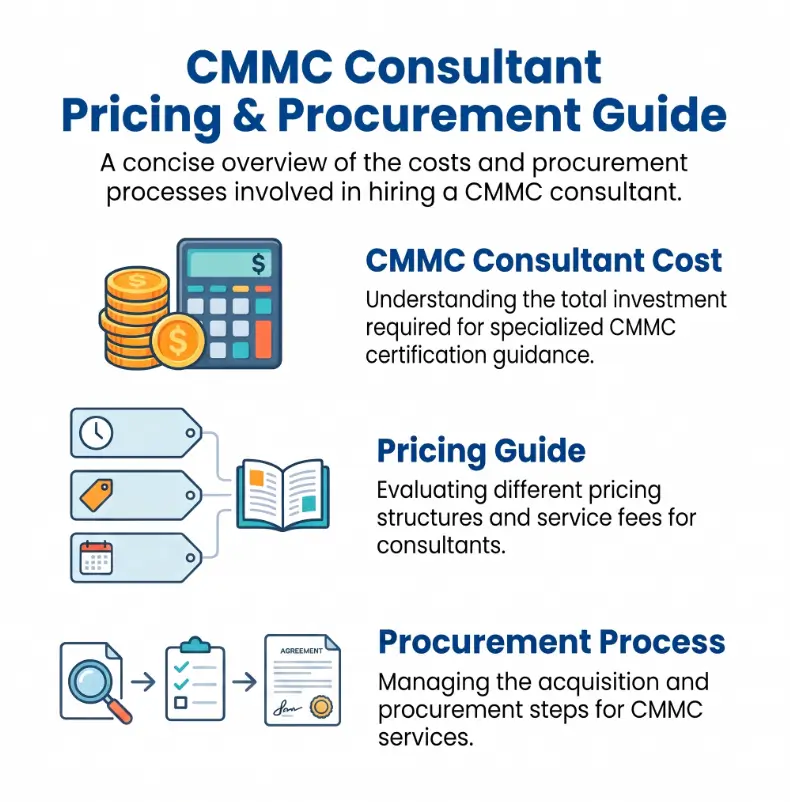
How much should a CMMC consultant cost?
For budgeting, a useful starting assumption for specialist CMMC advisory work is roughly $250 to $400 per billable hour. That does not mean every consultant charges inside that range, or that an expensive consultant automatically produces better work.
The more useful calculation is:
The practical pricing rule
Expected consultant hours × realistic hourly rate + remediation + tooling + internal labor + assessment cost, when applicable = the budget you should actually care about.
A $300-per-hour consultant who needs 35 hours costs $10,500. A $200-per-hour provider who turns the same problem into a 100-hour engagement costs $20,000 before implementation expenses arrive.
| Pricing model | Usually best for | Main buyer risk |
|---|---|---|
| Hourly | Scoping, troubleshooting, expert review, uncertain projects | Hours expand without a meaningful cap |
| Fixed fee | Defined readiness assessments, documentation packages, bounded projects | Important work becomes an exclusion or change order |
| Hybrid | Discovery followed by implementation | Poor handoff between fixed and variable phases |
| Retainer | Ongoing evidence maintenance, advisory support, recurring reviews | Paying monthly for capacity you rarely use |
Before You Act
This article is a budgeting and procurement guide, not legal or regulatory advice. Your contract language, CMMC level, information flow, architecture, current assessment status, customer requirements, and current federal implementation instructions can materially change what you need. Verify the requirement in the solicitation or contract before buying an assessment-readiness package.
What the 2026 CMMC pause changes before you buy
Timing matters unusually much right now. On July 13, 2026, the Department announced an immediate suspension of the transition to CMMC Phase II requirements and pending or future implementation milestones. The official CMMC site states that Phase I self-assessment requirements remain in place.
You can verify the current position on the official CMMC program page. The codified program requirements remain available in 32 CFR Part 170.
What the suspension does not mean
It does not mean that protecting Federal Contract Information or Controlled Unclassified Information suddenly became optional. It also does not make an unsupported SPRS score safer to submit.
The practical procurement consequence is narrower: a consulting proposal written around an obsolete November 2026 third-party deadline may no longer reflect the current implementation path.
Ask for the regulatory assumption in writing
Before approving a large fixed-fee readiness engagement, ask the provider to state which current requirement the project is preparing you for: Level 1 self-assessment, Level 2 self-assessment, an existing contractual assessment requirement, anticipated future verification, or general NIST SP 800-171 readiness.
This distinction can save real money. Paying to improve controls and evidence may still make sense. Paying an urgency premium because somebody’s proposal deck has not been updated since July 2026 is another matter.
Decision rule: Do not stop necessary cybersecurity work because the rollout changed. Do stop and re-check any consulting package whose value depends primarily on a suspended deadline.
For the broader cost picture beyond consulting fees, see Kioptrix’s CMMC compliance cost guide.
Realistic CMMC consulting pricing by project size
There is no official CMMC consultant tariff. Providers differ in seniority, staffing model, specialization, geography, deliverables, and how much implementation work they perform.
One useful public benchmark comes from the Department’s 2024 CMMC regulatory cost model. For several small-entity calculations, the model assumed an external service provider labor rate of approximately $260 per hour. That figure was an economic-model assumption, not an approved consultant rate card, but it provides a useful sanity check when building a budget.
Using a broader $250 to $400 planning range produces the following project bands.
| Example engagement | Illustrative hours | Planning range at $250-$400/hr | Typical output |
|---|---|---|---|
| Narrow advisory review | 8-20 | $2,000-$8,000 | Scope question, evidence review, control interpretation, focused technical advice |
| Readiness diagnostic | 20-40 | $5,000-$16,000 | Scope validation, gap findings, prioritized remediation plan |
| Evidence and remediation sprint | 60-120 | $15,000-$48,000 | Policies, evidence structure, implementation guidance, control-owner support |
| Broad implementation program | 150-300 | $37,500-$120,000 | Multi-workstream remediation, documentation, architecture, evidence and project management |
These are estimation bands, not quotations. A 25-person contractor with a tightly isolated CUI enclave can require less effort than a 12-person company whose CUI flows through laptops, personal email, shared SaaS tools, subcontractors, old file shares, and a lightly documented MSP.
Do not confuse consultant cost with C3PAO cost
A readiness consultant helps you understand scope, close gaps, improve evidence, and prepare. A formal Level 2 certification assessment, when one is actually required under the applicable CMMC implementation rules, is a different service performed by an authorized or accredited CMMC Third-Party Assessment Organization.
The 2024 regulatory cost model estimated a much larger total burden for a small entity supporting a Level 2 certification assessment because it included company labor, preparation, assessment participation, reporting, affirmation, and C3PAO effort. It should not be interpreted as today’s C3PAO price list, especially given the July 2026 program changes.
What changes a CMMC consulting quote?
If two companies both say, “We need Level 2 help,” their proposals can still differ by tens of thousands of dollars without either quote being irrational. Six variables usually explain most of the gap.
| Cost driver | Cheaper end | More expensive end |
|---|---|---|
| Assessment scope | Small, well-defined enclave | Enterprise-wide or uncertain CUI flow |
| Current control maturity | Controls operating and evidenced | Large remediation backlog |
| Documentation | Current SSP, diagrams, inventories, procedures | Consultant must reconstruct reality from interviews |
| Architecture | Simple, standardized systems | Legacy systems, OT, specialized assets, multiple environments |
| External providers | Responsibilities clearly documented | Ambiguous MSP, CSP or ESP responsibilities |
| Consultant responsibility | Advice and review only | Hands-on policy, engineering, project management and evidence production |
1. Scope comes before pricing
CMMC Level 2 scope is not simply “every computer we own.” The rule distinguishes categories including CUI assets, Security Protection Assets, Contractor Risk Managed Assets, and specialized assets.
A provider who prices before understanding where CUI is processed, stored, transmitted, or protected is estimating in fog.
2. Evidence maturity can matter as much as technology
You may already have MFA, logging, backups, endpoint protection, access restrictions, and change controls. If nobody can show how those controls are configured, monitored, approved, and tied to the assessment objectives, the consultant still has a substantial evidence job.
3. Remediation ownership changes everything
A $12,000 gap assessment that tells your IT team what to fix is not economically comparable to a $45,000 engagement in which the provider also writes procedures, coordinates the MSP, redesigns access, updates diagrams, structures evidence, and manages remediation meetings.
The answer changes when…
your CUI boundary expands, your evidence is weak, specialized assets enter scope, outside providers lack clear responsibility matrices, or the consultant moves from advice into hands-on implementation.
Hourly vs fixed-fee CMMC consulting: which should you choose?
Choose hourly when uncertainty is the thing you are buying help to resolve
Hourly pricing works well for scope discovery, second opinions, limited architecture questions, difficult evidence reviews, targeted policy reviews, and remediation advice where nobody yet knows how deep the problem goes.
- You need 10 to 20 hours of senior expertise rather than a full program.
- Your environment may change during the engagement.
- Your internal team will perform most implementation work.
- You want the ability to stop after discovery.
- You can require weekly hour reporting and a not-to-exceed cap.
Choose fixed fee when the output can be defined precisely
Fixed pricing becomes attractive for a bounded readiness assessment, SSP review, defined policy package, tabletop exercise, evidence review, or pre-assessment project with a stable scope.
- The systems and locations are known.
- Deliverables can be listed by name.
- The number of interviews and workshops is defined.
- Both sides agree who performs technical remediation.
- Rework and change-order triggers are explicit.
Choose hybrid when you do not yet know enough to price the whole journey
This is often the strongest structure for a first-time Level 2 readiness project. Buy a fixed-price discovery phase first. Use that phase to define the assessment boundary, asset categories, evidence gaps, remediation backlog, and responsible owners.
Then price the second phase using fixed milestones or capped hourly work. The uncertainty premium becomes smaller because the consultant is no longer guessing what is behind the curtain.
| Your situation | Best starting model | Why |
|---|---|---|
| Known enclave, organized evidence, limited gaps | Fixed fee | Scope is measurable |
| Unknown CUI flow, multiple vendors, legacy systems | Hourly discovery | Pricing a full project now creates a large risk cushion |
| Clear discovery task, uncertain remediation | Hybrid | Locks down phase one while preserving flexibility |
| Ongoing evidence and advisory support | Retainer with usage terms | Recurring work may justify reserved capacity |
Build a realistic CMMC consulting budget
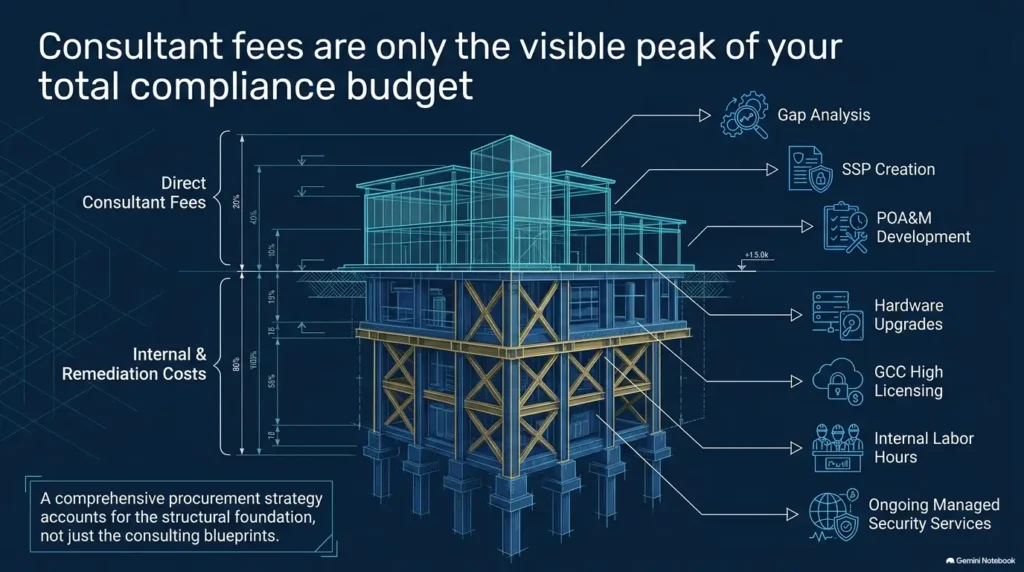
A consultant proposal is only one line in the real CMMC budget. Treating it as the entire compliance cost is how a seemingly tidy $20,000 project becomes a much larger operational commitment.
The five-bucket CMMC budget
1. Consulting
Scope, gap review, policy, evidence and advisory work.
2. Internal labor
IT, leadership, HR, facilities and system-owner time.
3. Remediation
Configuration, migration, engineering and process changes.
4. Tools
Security, logging, identity, backup or evidence tooling.
5. Assessment
Separate formal assessment expense if and when required.
Realistic budget = consulting + internal labor + remediation + tooling + applicable assessment costs + contingency.
Scenario 1: small contractor with a controlled enclave
Imagine an 18-person engineering firm that already keeps CUI inside a defined environment. MFA, managed endpoints, backups, logging, and access controls exist. The biggest weaknesses are documentation, evidence consistency, and a handful of procedures.
A fixed-price readiness review followed by a modest remediation block can work well because the consultant can estimate the environment without padding the proposal for major uncertainty.
Scenario 2: larger contractor with uncertain CUI flow
Now consider a 120-person contractor with two offices, remote staff, an MSP, test equipment, legacy engineering systems, several cloud providers, and no reliable diagram showing where CUI travels.
A large fixed fee quoted before discovery will usually contain one of two things: a generous risk premium for the consultant, or exclusions that eventually return as change orders. Paying for a bounded discovery phase first creates a better pricing baseline.
Scenario 3: overseas supplier receiving U.S. flowdown
A UK or other non-U.S. supplier receiving a CMMC-related subcontract requirement should first establish exactly what information and contractual obligation are flowing down. Buying a broad readiness package before clarifying the contract, scope, data handling, and foreign-provider issues can reverse the sensible order of operations.
Costs commonly excluded from the consultant’s fee
A proposal can be accurate and still leave you with a large bill elsewhere. Before comparing prices, identify what the consultant expects your organization, MSP, software vendors, cloud providers, or another engineering firm to do.
Technical remediation
Some consultants identify gaps but do not implement MFA changes, network segmentation, logging, endpoint hardening, backup changes, identity redesign, or cloud configuration.
Internal staff time
Expect interviews, evidence gathering, procedure review, architecture discussions, change approvals, configuration work, remediation testing, management decisions, and ongoing control ownership. The invoice may say $25,000 while the organization quietly spends hundreds of internal hours supporting the project.
Software and service upgrades
A readiness review may reveal that existing licensing, logging retention, security monitoring, identity controls, backup architecture, or cloud services do not support the required implementation. Those costs belong in a separate remediation budget.
Evidence maintenance after the project
A polished folder of evidence is useful only if the organization continues operating the controls represented by it. Procedures, access reviews, training records, incident processes, inventories, diagrams, configuration records, and security evidence all age.
| Common exclusion | Question to ask |
|---|---|
| Engineering changes | Who actually implements technical remediation? |
| Policy customization | Are documents tailored to our real environment or supplied as templates? |
| Evidence collection | Who gathers and organizes artifacts? |
| MSP coordination | How many vendor meetings are included? |
| Travel | Are travel days and expenses included? |
| Re-testing | How many remediation review cycles are included? |
| Formal assessment | Is C3PAO assessment completely separate? |
How to compare CMMC consultant proposals without buying the wrong thing
Do not compare the number at the bottom of page six until you have normalized what each provider is selling. One proposal may be a diagnostic. Another may include policy development, technical workshops, evidence support, mock assessment work, and six months of project management.
Your proposal should answer these questions
- What CMMC level or current contractual requirement is the project addressing?
- What systems, facilities, people, providers, and asset categories are assumed to be in scope?
- What exact deliverables will be produced?
- How many interviews, workshops, review cycles, and meetings are included?
- Who performs technical remediation?
- Who writes or updates the SSP, diagrams, policies, and procedures?
- Who collects evidence?
- What is explicitly excluded?
- What event triggers a change order?
- What are the hourly rates for out-of-scope work?
- Can you terminate after discovery without buying implementation?
- How will FCI, CUI, credentials, screenshots, logs, and other sensitive evidence be protected?
Ask about CMMC conflict-of-interest rules
This is not merely housekeeping. Under 32 CFR Part 170, CMMC ecosystem conflict-of-interest policies prohibit ecosystem members from participating in a Level 2 certification assessment when they previously served as a consultant preparing that organization for a CMMC assessment within the prior three years.
If the provider also participates in the assessment ecosystem, ask them to explain how consulting now affects your ability to use their personnel or organization later.
Proposal red flags
Be cautious with guaranteed certification language, a fixed fee with no scope assumptions, unexplained “all-inclusive” remediation, a proposal built around a stale deadline, vague evidence deliverables, or a provider that cannot explain whether its consulting creates a future assessment conflict.
What the contract really changes
A fixed fee does not automatically create budget certainty. The certainty lives in the assumptions and change-control language.
If the statement of work says the fee assumes one office, one enclave, 50 endpoints, two external providers, existing inventories, current network diagrams, and client-led remediation, you can evaluate the price intelligently.
If the same proposal says additional effort may be billed whenever “conditions require,” you effectively have a variable-cost engagement wearing a fixed-fee hat.
DIY, software, or a CMMC professional?
Hiring a consultant is not automatically the mature choice. Some organizations already have enough internal security, compliance, and systems knowledge to perform much of the work themselves.
| Approach | Good fit when | What it does not solve |
|---|---|---|
| DIY | Scope is small, internal expertise is strong, official documentation is sufficient | Independent judgment, staffing shortages, unfamiliar edge cases |
| Compliance software | You need evidence organization, ownership, recurring workflows and reporting | Bad architecture, missing controls, incorrect scope or weak implementation |
| Consultant | You need scoping judgment, control interpretation, remediation planning or readiness support | Formal certification authority unless separately qualified and permitted |
| C3PAO | A current contract or applicable requirement calls for a formal Level 2 certification assessment | Serving as your unrestricted implementation consultant before assessing you |
Do it free or mostly DIY when
- Your CUI boundary is already documented.
- Your IT and security staff understand NIST SP 800-171 assessment objectives.
- Your SSP and inventories reflect reality.
- The remaining work is evidence cleanup rather than major control implementation.
Pay for software when workflow is the bottleneck
Software can become worthwhile when dozens of owners must collect recurring evidence, manage remediation tasks, map requirements, document approvals, and maintain control status across time.
It should reduce administrative work. It should not be treated as a box that turns noncompliant systems into compliant ones.
Pay for a professional when judgment is the bottleneck
Professional help is easier to justify when you cannot reliably determine the CUI scope, a large number of requirements are not implemented, specialized assets complicate the environment, your MSP responsibilities are unclear, or leadership needs a defensible readiness plan before committing to a major technical redesign.
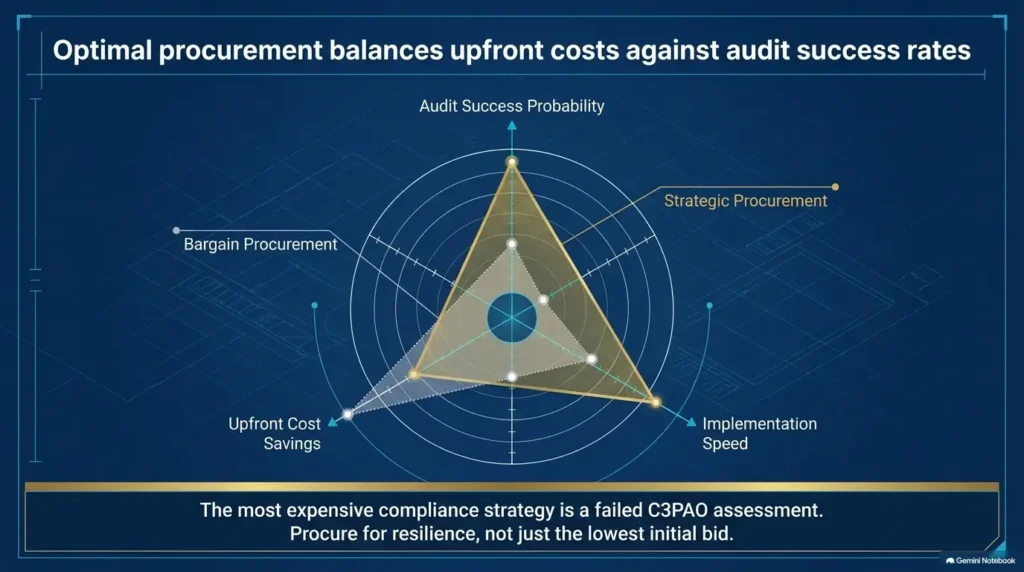
Good-enough rule: buy software for repeatable workflow, buy consulting for difficult judgment, and buy formal assessment services only when the applicable requirement actually calls for them.
FAQ
Is hourly CMMC consulting always cheaper than a fixed fee?
No. Hourly work is cheaper when the task stays small. It becomes expensive when the scope remains uncertain and meetings, evidence review, remediation support, and rework accumulate. Fixed pricing can be cheaper for a well-defined project because both parties know where the finish line is.
Can a fixed-fee CMMC engagement include remediation?
Yes, but the proposal should identify exactly which remediation work is included. Policy edits and evidence organization are much easier to price in advance than replacing infrastructure, redesigning identity, migrating workloads, or changing an MSP architecture.
Should a CMMC consultant be a CCP or work for a registered organization?
Credentials can help demonstrate familiarity with the CMMC ecosystem, but they should not replace evaluation of cybersecurity competence, NIST SP 800-171 knowledge, relevant architecture experience, deliverable quality, conflict-of-interest implications, and the provider’s ability to explain your specific scope.
Can my MSP handle CMMC consulting?
Possibly. An MSP may understand your environment better than an outside consultant and may already operate many relevant controls. The important question is whether it can objectively identify gaps in services it designed, clearly document its responsibilities, and provide the CMMC-specific assessment knowledge your organization needs.
Does the 2026 Phase II suspension mean I should postpone all CMMC spending?
No. The official program site states that Phase I self-assessment requirements remain. Existing contractual cybersecurity obligations and the underlying need to protect relevant federal information also remain important. The suspension is a reason to re-check the purpose and timing of spending, not an automatic reason to abandon security work.
Can the same consultant later perform my Level 2 certification assessment?
Do not assume so. Current 32 CFR Part 170 conflict-of-interest provisions prohibit CMMC ecosystem members from participating in a Level 2 certification assessment if they previously served as a consultant preparing that organization for a CMMC assessment within three years. Ask about this before signing a consulting agreement.
Your 15-minute next step: create a one-page quote brief
Before requesting another CMMC consultant quote, spend 15 minutes writing down five items. You do not need a perfect SSP or a polished compliance workbook.
- Requirement: What does the current solicitation, contract, or flowdown actually require?
- Scope: Where do FCI or CUI currently enter, move, reside, and leave?
- Baseline: What assessment, SPRS score, SSP, network diagram, and asset inventory already exist?
- Known gaps: List the five problems you already know are unresolved.
- Desired output: Decide whether you want a diagnostic, readiness assessment, remediation plan, hands-on implementation, evidence package, or ongoing advisory support.
Send the same brief to each provider and ask for two prices where practical: a fixed-price discovery option and an hourly or capped-hybrid option. Suddenly you are comparing similar work instead of comparing beautifully formatted apples with mysteriously expensive satellites.
Last reviewed: 2026-09