CMMC Readiness Assessment Cost for Small Businesses
What to Budget Before You Buy
A small defense contractor can easily receive three very different quotes for something all three providers call a “CMMC readiness assessment.” One may be a questionnaire and gap report. Another may test evidence, interview staff, inspect the CUI boundary, review the SSP, and rehearse the assessment process. The price difference is often really a scope difference wearing a price tag.
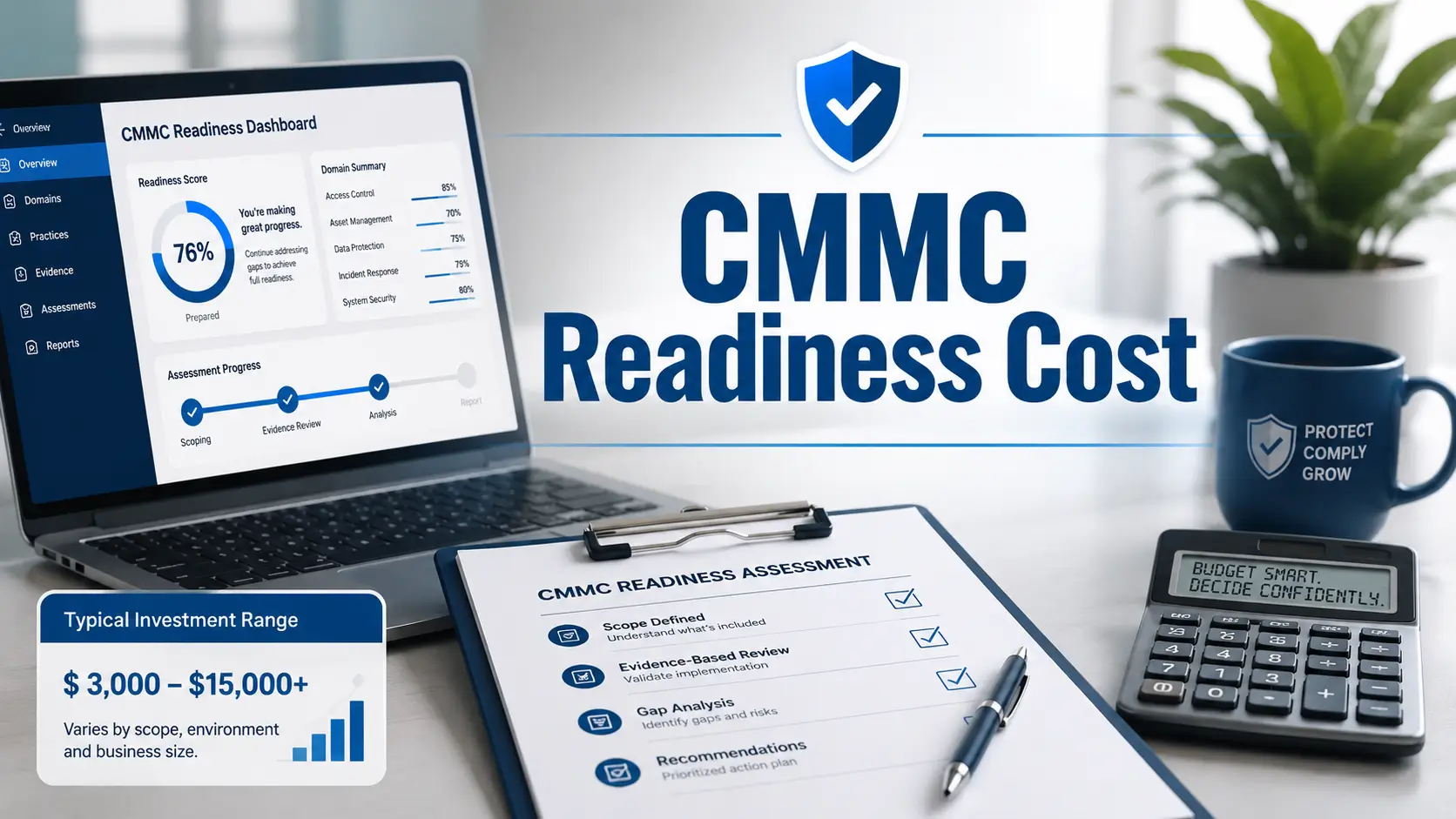
For planning purposes, a small business might reserve roughly $5,000 to $10,000 for a narrow Level 2 gap assessment, around $10,000 to $25,000 for a deeper evidence-based readiness review, and potentially $25,000 to $40,000 or more when multiple sites, service providers, unclear CUI flows, specialised assets, or extensive validation expand the work. These are budgeting bands, not DoD-set prices or guarantees of what a provider will quote.
There is another wrinkle in 2026: the CMMC rollout changed again. Phase II requirements that had been scheduled for November 10, 2026 were suspended in July, while Phase I self-assessment requirements remain in place. That makes scope verification even more important before a small business spends heavily on a mock assessment or future certification preparation.
🧭 The useful question is not “What does CMMC readiness cost?” It is “What level of readiness evidence do we need before spending the next dollar?”
Snapshot: This guide is for small US defense contractors and subcontractors trying to budget a CMMC gap or readiness assessment. It helps you distinguish a basic review from a mock-assessment-style engagement, estimate a sensible budget, understand what is usually excluded, and compare proposals before paying.
Table of Contents
How Much Should a Small Business Budget for CMMC Readiness?
A useful starting budget for a small company pursuing CMMC Level 2 is about $5,000 to $25,000 for the readiness work itself, with more complex organisations potentially moving beyond that range.
The lower end should generally buy a defined gap analysis. The higher end should buy materially more: evidence sampling, interviews, technical verification, CUI scoping, SSP and POA&M review, and a defensible remediation roadmap.
| Readiness approach | Planning budget | What you should expect | Best fit |
|---|---|---|---|
| DIY directional review | $0 to low thousands | Internal mapping, checklists, basic evidence inventory | Early-stage scoping |
| Focused gap assessment | About $5,000–$10,000 | Requirement-by-requirement gap review and prioritised findings | Small, simple CUI enclave |
| Evidence-based readiness assessment | About $10,000–$25,000 | Interviews, evidence testing, SSP review, technical validation, remediation roadmap | Small businesses preparing seriously for Level 2 |
| Complex readiness engagement | $25,000–$40,000+ | Multiple sites, substantial ESP/CSP dependencies, specialised assets, broad evidence testing | Complex or poorly bounded environments |
These figures are planning bands rather than published government fees. The government does not set the commercial price of a pre-assessment readiness engagement.
There is, however, an unusually useful benchmark in the CMMC final rule. DoD estimated that supporting a Level 2 self-assessment and affirmation would cost a small entity $34,277, while supporting a Level 2 C3PAO certification assessment and affirmation was estimated at $101,752. Those regulatory estimates include internal and external labour assumptions and, critically, assume applicable NIST SP 800-171 requirements are already implemented. They are not readiness-consulting price lists.
Cost rule: Do not compare a $6,000 gap analysis with a $20,000 mock assessment as though they are interchangeable. Compare deliverables, testing depth and scope first. Price comes second.
Before You Act
CMMC applicability can turn on contract clauses, the type of information you handle, your system boundary, subcontract flow-downs and current program implementation rules. This article is a budgeting and decision guide, not personalised legal or regulatory advice. Confirm material contract decisions with the contracting party and qualified compliance or legal professionals where appropriate.
What the 2026 CMMC Pause Changes Before You Spend
Timing matters because the CMMC implementation schedule is no longer the schedule many 2025 planning documents assumed.
On July 13, 2026, the Department announced the immediate suspension of CMMC Phase II requirements that had been scheduled to begin November 10, 2026. The current official CMMC page says implementation remains paused in Phase I and that Phase I self-assessment requirements remain in force.
Do not confuse “paused” with “ignore cybersecurity”
The same official guidance states that the pause does not eliminate the obligation to protect covered information under applicable DFARS requirements. During the current Phase I posture, the program describes Level 1 self-assessments and Level 2 self-assessments, with Level 2 continuing to reference the 110 requirements in NIST SP 800-171 Revision 2.
For a small contractor, that changes the purchasing decision. You should not rush into an expensive third-party readiness engagement merely because an old project plan says “Phase II: November 2026.” First confirm what your current solicitation, contract, prime contractor or customer actually requires.
Readiness work can still be useful
The pause may reduce immediate certification pressure, but it can make a lower-cost readiness exercise more attractive. A company can use the breathing room to fix scope, evidence quality and implementation gaps without buying every service at once.
What a CMMC Readiness Assessment Should Actually Include
“Readiness assessment” is commercial terminology, not a separate official CMMC status. The official Level 2 assessment guidance distinguishes between a Level 2 self-assessment performed by the organisation and a Level 2 certification assessment performed by a C3PAO.
A readiness assessment sits before those formal activities. Its purpose is diagnostic: find where your evidence and implementation would fail scrutiny while you still have time to fix them.
A cheap gap analysis
A basic engagement may map each applicable requirement to a status such as implemented, partially implemented or missing. It may also estimate an SPRS score and produce a remediation list.
That can be perfectly adequate when the company is early in its program and mainly needs to know where to start.
A stronger readiness assessment
A more valuable engagement tests whether claims are supported by evidence. The official Level 2 guide uses assessment methods built around examining evidence, interviewing personnel and testing implementations. A serious readiness assessment should imitate enough of that discipline to expose weak assumptions before they become expensive surprises.
- Confirm the CUI boundary and asset categories.
- Review the System Security Plan against the real environment.
- Map requirements to owners and evidence.
- Sample policies, configurations, logs and records.
- Interview people who actually perform the processes.
- Test selected technical controls where appropriate.
- Identify missing or weak evidence.
- Produce prioritised remediation actions rather than a giant undifferentiated spreadsheet.
The deliverable that matters most
The most useful output is not a colourful readiness score. It is a traceable finding set: requirement, evidence reviewed, reason for the finding, remediation action, owner, dependency and priority.
The Readiness Cost Chain
What is actually in?
Can claims be proved?
What is truly missing?
What must change?
Did the fix hold?
The wider the boundary and the deeper the evidence testing, the more professional hours the assessment consumes.
The Answer Changes When These Five Cost Drivers Change
1. Your CUI boundary gets wider
Employee count matters less than many buyers assume. A 20-person manufacturer with a tangled production network, engineering workstation fleet and several external providers may take more effort to assess than a 70-person company with a tightly isolated CUI enclave.
The official Level 2 guide allows assessment scope to cover an enterprise network or specific enclave depending on how the scope is defined. That makes boundary design one of the largest economic levers available to a small contractor.
2. Your documentation does not match reality
An elegant SSP that describes controls nobody can demonstrate is not an advantage. It creates reconciliation work.
A mature company with imperfect formatting may be cheaper to assess than a company with polished policies but unclear ownership and little operational evidence.
3. External providers sit inside the CUI workflow
Managed service providers, cloud services, security providers, outsourced help desks and other external services can increase the evidence trail. The consultant may need contracts, responsibility matrices, architecture details and proof of how provider controls support your requirements.
4. You need testing, not merely document review
Interviews and configuration validation take time. A readiness provider who must inspect MFA enforcement, audit logging, privileged access, encryption configuration, backups and endpoint controls is performing substantially more work than a provider reviewing policy files.
5. Your first assessment discovers the boundary is wrong
This is the budget trap. If CUI flows through systems that were assumed to be out of scope, the engagement may turn from “verify 25 assets” into “re-map the business.”
High-value action: Ask a readiness provider to price the engagement only after the proposed CUI boundary, sites, endpoints, cloud services and external providers are listed in writing. Otherwise you are comparing fog.
A Practical CMMC Readiness Cost Model for Small Businesses
Rather than relying on one industry average, build the budget as a stack:
Where the Cost Comes From
Readiness budget
Base assessment
+ scope complexity
+ evidence validation
+ documentation reconciliation
+ technical testing
+ remediation planning
+ optional reassessment
= realistic readiness spend
Scenario A: 12-person engineering subcontractor
Imagine a 12-person firm using one controlled cloud environment, company-managed laptops and a small number of SaaS services. CUI is already constrained to a clear enclave, MFA is deployed, the SSP exists and the company mainly needs confirmation that its evidence is defensible.
A $5,000 to $10,000 planning budget for a focused readiness engagement may be reasonable. Paying $25,000 before asking what extra work is included would deserve scrutiny.
Scenario B: 35-person manufacturer
Now picture CUI touching engineering workstations, a file server, production support systems, remote users and an outsourced IT provider. Documentation exists, but asset categorisation and responsibility boundaries are fuzzy.
This company may reasonably plan around $10,000 to $25,000 for an evidence-based review because scoping and technical validation consume more time.
Scenario C: 70-person multi-site contractor
A third company has two offices, a shop floor, specialised devices, several cloud providers, remote administrators and an MSP. CUI flows have never been fully documented.
A $25,000 to $40,000-plus readiness engagement becomes easier to justify if it includes boundary reconstruction, provider responsibility review, extensive evidence testing and a detailed remediation plan.
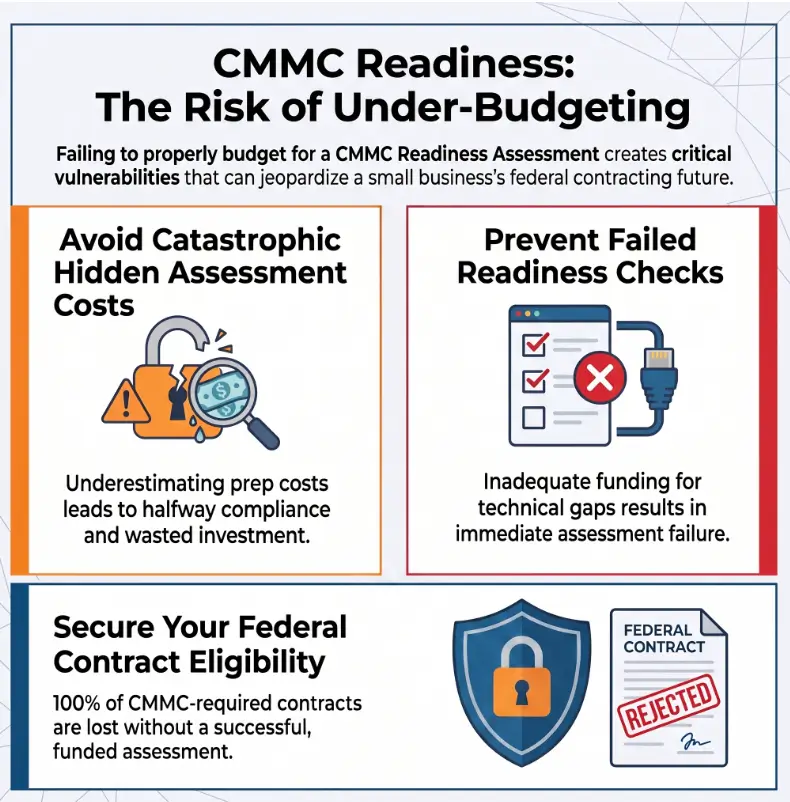
The important distinction is that these figures address readiness assessment work, not the entire compliance program. Hardware, software, managed services, implementation labour and future formal assessment costs can dwarf the diagnostic fee.
For the broader budget, including remediation and assessment-related expenses, see the Kioptrix guide to CMMC compliance cost.
The Expensive Part May Be What the Readiness Quote Excludes
A $7,500 readiness assessment can expose $60,000 of remediation work. That does not mean the assessment was overpriced. It means the assessment and the repair bill are separate economic events.
| Cost component | Often included? | Why it matters |
|---|---|---|
| Initial interviews and evidence review | Usually | Core diagnostic work |
| CUI scope validation | Sometimes | A weak boundary can invalidate the entire estimate |
| SSP review | Often | Finds differences between documentation and reality |
| Policy rewriting | Often excluded | May become a separate consulting project |
| Technical remediation | Usually excluded | Can require new architecture, configuration or tooling |
| Security software licences | Excluded | Creates recurring operating expense |
| Managed IT or security services | Excluded | May become a monthly recurring cost |
| Follow-up reassessment | Varies | Can add cost after remediation |
| Official C3PAO assessment | Separate | Readiness work does not itself create CMMC certification status |
DoD’s own estimate contains the same warning
The 2024 CMMC final rule’s Level 2 cost analysis explicitly assumed that contractors had already implemented the applicable NIST SP 800-171 Revision 2 requirements. It therefore did not treat the quoted Level 2 assessment-support figures as the cost of fixing an unready environment.
That distinction is crucial. If your company has ten major control gaps, your real budget is not:
Readiness assessment = CMMC cost.
It is closer to:
Readiness assessment + internal labour + remediation + technology + provider changes + evidence maintenance + future assessment activity.
If new security tooling becomes part of that plan, the security tool stack cost calculator can help separate recurring software expense from one-time consulting work.
Do It Yourself, Buy Software, or Pay a Professional?
| Approach | Good choice when | Main limitation |
|---|---|---|
| DIY | You are early in the process, scope is simple, and internal staff understand NIST SP 800-171 | Teams can overrate controls they designed themselves |
| Compliance software | Evidence mapping, task ownership and recurring collection are becoming operationally heavy | Software organises work but does not automatically make weak controls effective |
| Professional readiness assessment | You need independent challenge, technical validation or assessment-style evidence review | Costs more and quality varies substantially by scope |
DIY first when you are still discovering the basics
If you cannot yet answer which systems process, store or transmit CUI, paying senior consultants to discover every laptop name for you is a poor use of budget.
Start with the official CMMC documentation, asset inventory, data-flow notes, current SSP, contracts and your existing NIST SP 800-171 work. The official Level 2 Assessment Guide is especially useful because it shows how requirements are evaluated and the kinds of evidence assessors may examine.
Software becomes useful when evidence becomes a workflow
Once controls have owners, artefacts recur, evidence expires and multiple people must update status, a compliance platform can save administrative time. Its value is repeatability, not magical compliance.
Professional help becomes valuable when your confidence matters
If the organisation is preparing to make an executive affirmation, respond to a meaningful customer requirement or eventually undergo independent validation, paying someone to challenge assumptions can be worth more than another dashboard.
The best professional engagement identifies uncomfortable gaps while they are still cheap to fix.
How to Compare CMMC Readiness Assessment Quotes
Ask every provider to answer the same questions in writing. Otherwise, a lower quote may simply contain less assessment.
| Provider question | Why it matters |
|---|---|
| Which CMMC level and assessment criteria are you evaluating? | Prevents a generic cybersecurity review being sold as CMMC readiness |
| How do you define the systems and assets included in the fixed fee? | Exposes scope assumptions |
| Do you validate the CUI boundary? | Boundary errors can multiply cost later |
| Will you examine evidence, conduct interviews and test selected controls? | Shows whether the engagement is assessment-like or checklist-only |
| How much SSP and POA&M review is included? | Clarifies documentation depth |
| Will you estimate or validate our SPRS score? | Useful if self-assessment obligations are relevant |
| What exact deliverables do we receive? | Turns vague consulting into measurable output |
| Is remediation included? | Prevents a surprise second project |
| Is a post-remediation reassessment included? | Clarifies the final cost |
| What causes a change order? | Identifies hidden pricing risk |
Better buying rule: A readiness proposal should describe the assessment boundary, methods, evidence depth, deliverables, assumptions, exclusions and change-order triggers. “Review CMMC compliance” is not a scope of work.
Check independence before mixing consulting and future assessment work
The CMMC ecosystem includes formal conflict-of-interest requirements intended to preserve impartiality, and the final rule addresses restrictions affecting ecosystem members who previously served as consultants. If you may later want an organisation or particular assessor involved in formal assessment activity, ask how its readiness services interact with those independence rules before signing.
For eventual assessor verification, The Cyber AB maintains the CMMC ecosystem directory. A readiness consultant does not need to be your future assessor, and in many cases keeping preparation and independent assessment clearly separated is operationally cleaner.
Five Readiness Mistakes That Waste Small-Business Budgets
Buying a mock assessment before defining scope
This is the compliance equivalent of hiring a building inspector before deciding which building you own.
Document the proposed CUI environment first.
Paying for documentation without testing operations
A provider can improve prose while the underlying control remains weak. Ask whether the engagement validates what users, administrators and systems actually do.
Treating the readiness score as the product
A score tells you where you landed. A good finding tells you what to fix Monday morning.
Letting remediation scope quietly enter the assessment quote
Readiness and remediation can legitimately come from the same consulting provider, but price them separately. Otherwise it becomes difficult to see whether you are paying for diagnosis, implementation or both.
Planning around an obsolete CMMC date
The July 2026 Phase II suspension is a sharp reminder that volatile program milestones should be checked against official sources immediately before committing substantial money. The durable work is different: understand your data, protect it, know your boundary and maintain evidence.
Frequently Asked Questions
Does a readiness assessment give my company CMMC certification?
No. A commercial readiness or gap assessment is preparation work. It does not itself create an official CMMC certification status.
Can a small business perform its own CMMC readiness review?
Yes. A company with suitable internal expertise can review its environment against current CMMC criteria and official assessment guidance before hiring outside help. The harder issue is objectivity: teams sometimes accept evidence or implementations they would challenge more aggressively in someone else’s environment.
Should I pay for a readiness assessment during the Phase II suspension?
Possibly, but urgency should come from your actual contractual situation and security obligations rather than an outdated Phase II deadline. A smaller gap assessment may be appropriate now if your main objective is to identify and prioritise weaknesses while the program is under review.
Why can two readiness quotes differ by $15,000 or more?
The providers may be selling different work. Check whether each quote includes boundary analysis, interviews, technical testing, evidence sampling, SSP review, SPRS scoring, remediation planning and follow-up validation.
Does employee count determine the readiness assessment price?
It contributes, but scope complexity is often more important. Systems handling CUI, sites, cloud services, external providers, specialised assets and the quality of existing evidence can have a larger effect than headcount alone.
Is remediation normally included in a readiness assessment fee?
Do not assume so. Many readiness engagements diagnose gaps and produce a roadmap, while implementation, policy development, architecture changes and new software are priced separately. Ask for exclusions in writing.
Your 15-Minute Next Step: Build the One-Page Quote Brief
Before contacting another CMMC consultant, spend 15 minutes creating one page with three things:
- Your target: Level 1 or Level 2, plus the contract or customer reason you believe it applies.
- Your proposed scope: approximate users, endpoints, sites, cloud services, external providers and where CUI is believed to flow.
- Your current evidence: whether you already have an SSP, asset inventory, network/data-flow documentation, SPRS score and mapped evidence.
Send the same brief to every provider you are considering and ask for separate pricing for gap assessment, evidence-based readiness assessment, remediation and reassessment.
That single step turns a vague “How much is CMMC?” conversation into a comparable purchasing decision. For a small business, that clarity can be worth more than negotiating a few hundred dollars off the hourly rate.
Bottom line: Buy enough readiness work to reveal the expensive surprises before you begin remediation. Do not pay for assessment theatre, and do not let a temporarily changing implementation schedule distract from the durable work of scoping CUI, implementing required controls and maintaining evidence.
Last reviewed: 2026-09