There is no official government fee for writing a CMMC System Security Plan. For a CMMC Level 2 environment, external SSP spending can range from almost nothing when a capable internal team already understands its CUI boundary and control implementations, to roughly $1,500 for software-assisted documentation, to about $5,000 to $20,000 in currently advertised human-assisted or standalone authoring services. Those figures are public pricing examples, not a government rate or a statistically valid market average.
The biggest cost variable is not company size by itself. It is whether you are documenting an environment you already understand or paying someone to discover the boundary, reconstruct the architecture, identify control gaps, create missing evidence, and then write the SSP. A $5,000 documentation quote and a $25,000 readiness project may therefore describe very different work.
There is also a major 2026 timing issue. As of August 2026, DoD says it has suspended the planned CMMC Phase II requirements while Phase I self-assessment requirements remain in place. The underlying obligation to protect CUI under applicable DFARS requirements has not disappeared. Before paying for expedited certification-oriented work, verify what your current solicitation, contract, subcontract, and CMMC assessment type actually require.
Table of Contents
How Much Should You Budget for a CMMC SSP?
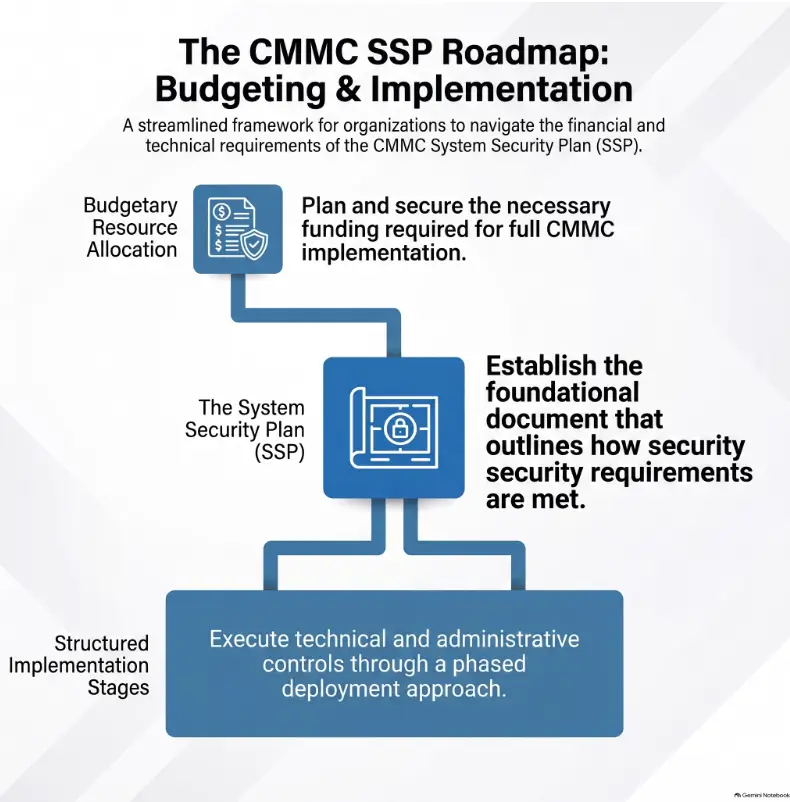
A practical budget starts by separating SSP authoring from the other work frequently bundled into a CMMC proposal. The SSP is documentation. Scoping, gap assessment, remediation, policy creation, evidence collection, tooling, and an independent assessment are separate activities even when one consultant sells them as a package.
| Approach | Current Cost Signal | Best Fit | Main Risk |
|---|---|---|---|
| Internal DIY | $0 external authoring fee, plus staff time | Clear CUI boundary, mature IT documentation, knowledgeable internal security staff | Writing what should be true instead of what is actually implemented |
| Software-assisted SSP | Low four figures in some public offerings | Small, relatively simple environment with staff able to validate every implementation statement | Generated language may not match technical reality |
| Human-assisted or standalone SSP authoring | Public fixed-price examples currently extend from about $5,000 into the high teens | Defined environment but limited internal compliance-writing capacity | Scope discovery, diagrams, policies, or remediation may be excluded |
| Full CMMC readiness engagement | Usually priced separately from SSP-only work | Uncertain scope, significant gaps, missing policies, weak evidence, or limited internal expertise | Paying readiness-project pricing when documentation alone was needed |
For context, one current software-assisted offering publicly lists a one-time SSP, POA&M, and gap-report package at about $1,500, while a current standalone human SSP authoring service publicly lists a fixed price of $19,500. The enormous spread is the point: the phrase “CMMC SSP” does not define a standardized unit of work.
If you are trying to estimate the entire compliance project rather than the document alone, use a broader CMMC compliance cost model. Mixing the two budgets is one of the easiest ways to make an SSP quote look either suspiciously cheap or unnecessarily expensive.
What You Are Actually Paying Someone to Produce
A useful SSP is not a decorative binder containing 110 paragraphs of compliance prose. It has to describe the real system that handles or protects CUI and explain how the applicable security requirements are implemented.
DoD’s CMMC Level 2 Assessment Guide says the SSP should address the assessment scope, operating environment, applicable security requirements, implementation methods, relationships and connections to other systems, and a defined update frequency. The guide states that the update frequency should be at least annual.
- CMMC assessment scope: what environment the SSP covers.
- System boundary: where the CUI environment begins and ends.
- Environment of operation: the infrastructure and operational context in which the system functions.
- Security requirement implementation: how requirements are actually satisfied, not merely which products have been purchased.
- External relationships and connections: cloud services, identity platforms, managed services, networks, and other connected systems that affect the environment.
- Update process: how the organization keeps the SSP aligned with changes in the system.
DoD guidance also makes an important cost-saving point: the security plan does not have to be one monolithic document. Existing policies, procedures, design specifications, inventories, and supporting documentation can be referenced rather than rewritten into the SSP. Good documentation architecture can therefore reduce authoring cost substantially.
The Cost Hinge Is Scope Before Prose
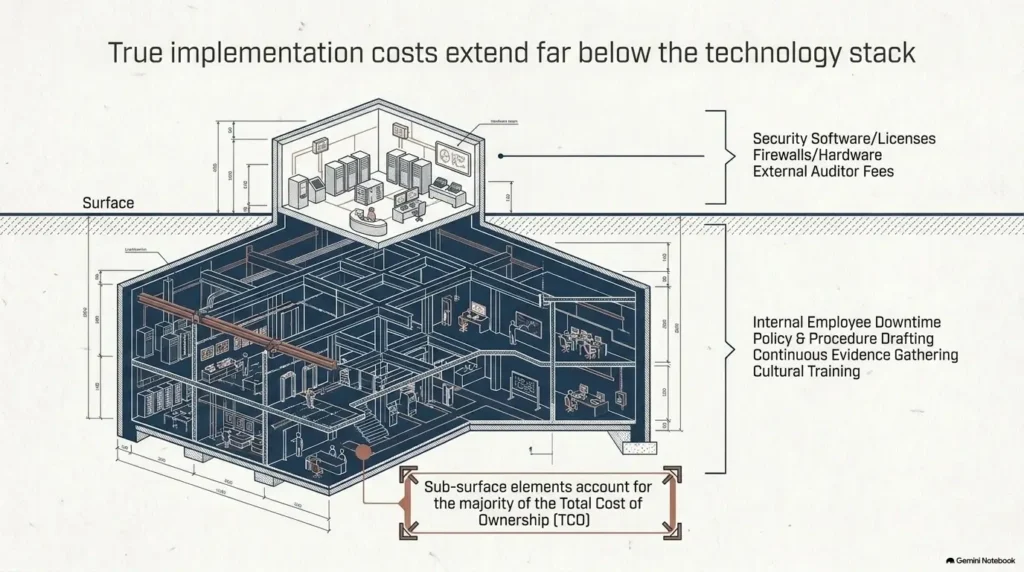
If a consultant begins writing control narratives before your CUI boundary is understood, the project is starting at the expensive end of the telescope. Scope determines which systems, assets, connections, service providers, and responsibilities must be represented in the SSP.
A small manufacturer with a tightly isolated CUI enclave may require less documentation work than a similarly sized company whose CUI moves through corporate email, endpoints, engineering applications, cloud storage, remote-access systems, multiple locations, and external IT providers. Employee count alone misses most of that complexity.
| Cost Driver | Why It Raises SSP Effort | Cost-Control Move |
|---|---|---|
| Unclear CUI boundary | Consultant must perform discovery before documenting the system | Map where CUI enters, moves, is stored, and exits before authoring begins |
| Multiple locations or enclaves | More architecture, connections, responsibilities, and exceptions must be described | Determine whether all locations genuinely need to handle CUI |
| Many external service providers | Shared responsibilities and system dependencies require investigation | Build a provider and responsibility inventory first |
| Missing diagrams and inventories | The author must reconstruct technical context from interviews | Prepare current asset, network, identity, and data-flow information |
| Control gaps | The project shifts from documentation into remediation planning | Separate “write the SSP” from “fix the environment” in the quote |
| Generic or outdated policies | Implementation statements cannot safely rely on existing documentation | Identify which policies are current before commissioning replacements |
| Weak evidence | Additional interviews and artifact collection are needed to support implementation claims | Create an evidence index before the writing sprint |
This is why scope reduction can save far more than negotiating a lower writing rate. If CUI can legitimately be confined to a smaller enclave, the benefit may continue into assessment, tooling, administration, evidence collection, and recurring maintenance. Scope must reflect reality, however. Declaring inconvenient systems “out of scope” does not make them so.
Do Not Confuse SSP Cost With CMMC Assessment Cost
The SSP, the self-assessment, and a third-party certification assessment are different things. Paying for one does not automatically buy the others.
- SSP authoring documents the system and how requirements are implemented.
- Gap assessment identifies where implementation or evidence is deficient.
- Remediation changes technology, processes, configuration, or documentation to close gaps.
- CMMC self-assessment evaluates the applicable requirements using the required methodology.
- C3PAO assessment is an independent assessment when the applicable CMMC requirement calls for that assessment type.
The distinction matters when reading government cost figures. In the CMMC Program final rule, DoD estimated $34,277 to support a Level 2 self-assessment and initial affirmation for a small entity under its regulatory cost assumptions. That figure is not an official SSP price. The model assumes the organization has already implemented the NIST SP 800-171 Revision 2 requirements and includes assessment preparation, assessment work, reporting, and affirmation activities.
Using that $34,277 figure as a quote for “what an SSP costs” would therefore compare a whole assessment-support basket with one document inside the basket.
Why NIST Revision Numbers Can Cause Expensive Confusion
NIST has superseded SP 800-171 Revision 2 with Revision 3. CMMC’s current Level 2 implementation, however, continues to reference the 110 requirements in NIST SP 800-171 Revision 2. A consultant should therefore be able to explain which baseline applies to your present contractual and CMMC obligations rather than silently substituting the newest NIST publication because it has a higher revision number.
The current DFARS CMMC clause also ties the required CMMC status to contractor information systems used to process, store, or transmit FCI or CUI when the clause applies. Always read the actual solicitation and contract rather than assuming every defense-related company needs the same SSP package.
When a DIY SSP Is a Reasonable Choice
DIY can be economical when the expensive thinking has already been done. An internal security or IT lead who knows the CUI boundary, understands the 110 requirements, can identify implementation owners, and has access to current technical evidence may be able to build and maintain the SSP without outsourcing the document.
DIY becomes false economy when the team is trying to reverse-engineer its own environment while writing. The resulting document often contains confident language but uncertain ownership, fuzzy boundaries, inherited cloud assumptions, or statements copied from templates that nobody has verified.
DIY is more defensible when you already have
- a documented CUI boundary;
- an accurate asset inventory;
- a current network or architecture diagram;
- documented cloud and external-service responsibilities;
- named owners for relevant security functions;
- existing policies and procedures that describe what personnel really do;
- evidence supporting implementation statements; and
- someone capable of reviewing the document against the current CMMC assessment guidance.
If several of those are missing, the problem is no longer merely “write an SSP.” Budget for discovery or readiness work instead.
When Software-Assisted SSP Creation Makes Sense
Software can reduce repetitive drafting and control mapping, particularly in a small, well-understood environment. Its value is automation, not authority. A generated implementation statement is useful only if a knowledgeable person confirms that the described control exists, operates as stated, and applies to the documented scope.
This creates a simple buying rule: pay for software when it reduces documentation labor. Do not pay for software because it appears to convert questionnaire answers into compliance.
Also examine where the platform stores your answers and uploaded artifacts. An SSP can reveal architecture, security products, identity design, remote-access methods, connections, and weaknesses. Do not place CUI or sensitive security artifacts into a generic SaaS or AI service merely because the service creates CMMC documents. Verify the provider’s data-handling model and determine whether the information you intend to upload is permitted there.
When Paying a CMMC Consultant Is Worth It
Professional help earns its fee when judgment is the scarce resource. That usually means your team cannot confidently define scope, interpret shared responsibilities, connect implementation evidence to requirements, or reconcile what policies say with how the environment actually operates.
Paying more can also make sense when the engagement includes meaningful technical discovery, architecture analysis, evidence mapping, revision support, and handoff to the people who must maintain the SSP. Paying more merely for a longer Word document does not.
The Quote Comparison Checklist
Before comparing prices, make every vendor quote answer the same questions. Otherwise one proposal may contain forty hours of discovery while another assumes your team will hand over a perfect boundary diagram on day one.
- Is CUI boundary scoping included?
- Is an asset inventory included, reviewed, or assumed to exist?
- Are network and data-flow diagrams included?
- Does the price cover implementation statements for the applicable Level 2 requirements?
- Will the consultant validate statements against technical evidence or rely mainly on interviews?
- Are policies and procedures included or separately priced?
- Is POA&M development included?
- Is technical remediation included?
- How many revision rounds are included?
- Will you receive the SSP in an editable format?
- Who owns updates after delivery?
- Is annual SSP maintenance included or separately billed?
- Is assessment preparation included, and if so, what exactly does that mean?
- Will subcontractors perform any part of the engagement?
- How will your security documentation and uploaded artifacts be protected?
A useful quote should also identify assumptions. “One enclave, one location, customer provides current inventory and architecture diagrams” is a real scope statement. “Complete CMMC documentation” is fog with a dollar sign attached.
Hidden Costs That Are Not Really SSP Costs
The most painful budget surprises usually appear after the writing starts. An implementation statement cannot truthfully say MFA, centralized logging, secure configuration, access review, encryption, or another requirement is implemented when the underlying capability is absent or incomplete.
That can trigger spending on licenses, identity changes, endpoint controls, cloud architecture, network segmentation, logging, managed services, training, configuration work, or internal labor. If tooling gaps emerge, estimate them separately with a security tool stack cost model instead of burying them inside the SSP budget.
Keep four numbers separate on the project spreadsheet:
- documentation and SSP authoring;
- security remediation and implementation;
- assessment and assessment-preparation costs; and
- recurring maintenance, evidence, tooling, and annual-update costs.
That separation tells leadership whether the expensive item is paperwork, technical debt, assessment assurance, or ongoing security operations. Without it, “CMMC cost” becomes one large number nobody can manage.
A Simple SSP Budget Model
Instead of beginning with a market-average number, build the budget from the work your environment requires:
Scope discovery + architecture documentation + control implementation mapping + evidence validation + SSP drafting + revisions + recurring maintenance = realistic SSP budget
If the first four terms are already complete, SSP authoring can be relatively inexpensive. If none are complete, an apparently expensive proposal may actually be a readiness engagement wearing an SSP label.
Ask vendors to price those components separately whenever possible. That gives you the option to perform asset inventory, diagrams, policy cleanup, or evidence collection internally while purchasing only the specialist work your team cannot perform reliably.
Frequently Asked Questions
Does every CMMC contractor need an expensive SSP?
No. The Level 2 SSP requirement is tied to protecting CUI and documenting the applicable environment. An organization dealing only with Level 1 FCI requirements should not automatically purchase a Level 2 SSP package. Determine the information handled and the contractual requirement first.
Can I use a free SSP template?
Yes, a template can provide structure. The difficult part is not obtaining headings. It is accurately describing your boundary, operating environment, connections, implementation methods, and responsibilities. A free template is excellent value when your team can supply those facts correctly.
Does an expensive SSP make a company CMMC compliant?
No. Documentation cannot substitute for implementation. If the SSP states that a security requirement is implemented, the relevant process or technology must actually support that statement and be capable of assessment.
Should I delay all CMMC work because Phase II was suspended?
Not automatically. The 2026 suspension affects the CMMC rollout, but DoD states that Phase I self-assessment requirements remain and that existing obligations to protect CUI continue. Use the pause to verify contract requirements and avoid deadline-driven overspending, not as evidence that CUI security requirements disappeared.
How often should the SSP be updated?
The current DoD Level 2 Assessment Guide specifies a defined update frequency of at least annually. Significant architecture, scope, provider, or control changes may justify updating it sooner rather than waiting for the calendar.
What to Do Before Requesting an SSP Quote
Spend ten minutes creating a one-page scope brief before contacting a consultant. List where CUI is received, where it is stored, which users access it, which endpoints and servers touch it, which cloud and managed-service providers support the environment, and whether you already have an asset inventory and network diagram.
Then send the same brief to every provider and ask each one to separate scope discovery, SSP authoring, policy work, evidence mapping, remediation, assessment preparation, and recurring maintenance. You will learn more from those seven line items than from a polished proposal promising “complete CMMC readiness.”
If your boundary is already clear, buy documentation help only if documentation is the unresolved problem. If the boundary is unclear, solve scope first. That is usually the point where the SSP budget either becomes manageable or reveals that the SSP was never the expensive part.
Last reviewed: 2026-08