Microsoft GCC High can cost substantially more than ordinary Microsoft 365, but the license price is only one part of the CMMC budget. As of July 2026, publicly disclosed reseller list pricing puts Microsoft 365 Business Premium for GCC High at about $35.80 per user per month, G3 at $65.20, and G5 at $97.50, before migration, configuration, compliance work, or outside support.
Open the practical working record to document this decision with evidence and an accountable owner.
The more important question is whether your CMMC scope actually requires GCC High. CMMC does not mandate a Microsoft product or require every defense contractor to move its entire company into GCC High. The expensive mistake is buying government-cloud licenses for everyone before identifying which systems, users, vendors, and workflows actually process Controlled Unclassified Information (CUI).
One more timing issue matters in 2026: the Department announced on July 13, 2026 that CMMC Phase II requirements were suspended while the program undergoes review. Phase I self-assessment requirements remain in place. That pause changes assessment timing, but it does not remove existing obligations to safeguard federal data or make a poorly scoped CUI environment safe to ignore.
Table of Contents
How Much Does Microsoft GCC High Cost in 2026?
Microsoft does not publish a conventional public GCC High shopping-cart price. GCC High customers must pass eligibility validation and purchase through approved government licensing channels. Your actual price therefore depends on the license, agreement, reseller, commitment term, and number of seats.
For planning purposes, the following figures come from current reseller-published GCC High list pricing effective July 1, 2026. These are per-user monthly equivalents on an annual billing plan, checked against the reseller page on October 13, 2026; they are not month-to-month cancellation prices or guaranteed quotes.
| GCC High option | Published planning price | Typical role | Main budget question |
|---|---|---|---|
| Microsoft 365 F3 | $13.20/user/month | Frontline or limited-access users | Does this user need full desktop productivity and CUI tooling? |
| Microsoft 365 Business Premium for GCC High | $35.80/user/month | Smaller defense-industry organizations | Can its capabilities cover your actual technical design? |
| Microsoft 365 G3 | $65.20/user/month | General enterprise knowledge workers | Which security capabilities must come from add-ons or existing tools? |
| Defender + Purview suites add-on | $24.40/user/month | Organizations needing additional security and data controls | Are equivalent capabilities already present elsewhere? |
| Microsoft 365 G5 | $97.50/user/month | Security- and compliance-intensive environments | Does consolidation justify the higher license cost? |
Microsoft also implemented government-suite pricing changes beginning July 1, 2026. Organizations budgeting from a 2025 quote should therefore request fresh pricing rather than multiplying an old per-seat rate. Microsoft explains the current changes in its Microsoft 365 government pricing update.
GCC High Is Not the Same Thing as CMMC Compliance
This distinction can save more money than negotiating a few dollars off a license.
GCC High is a Microsoft cloud environment. CMMC is an assessment framework applied to contractor information systems handling federal information under applicable contracts. Buying GCC High does not certify your organization, complete your System Security Plan, configure your identities, document procedures, train employees, restrict CUI, or prove that controls operate correctly.
Microsoft states that Microsoft 365 GCC High can support organizations working toward CMMC Levels 2 and 3 when configured appropriately. The last four words do a great deal of work.
Your organization remains responsible for the controls that depend on its people, endpoints, configurations, processes, facilities, third parties, and operating practices. A government-cloud tenant is an ingredient in the architecture, not a certificate in a box.
When GCC High Is Worth Paying For
GCC High becomes easier to justify when your organization needs a Microsoft collaboration environment designed for sensitive U.S. government workloads, particularly where DoD CUI, export-controlled information, contractual requirements, or government-cloud commitments affect the architecture.
Microsoft recommends GCC High and Azure Government for CUI in its shared-responsibility guidance. Check the specific service commitments and eligibility before purchase. Microsoft distinguishes SRG equivalency from a DoD impact-level authorization for a contractor-owned system; do not describe a GCC High subscription as certifying the customer’s environment.
A useful decision rule is:
If your contract and data flows create a government-cloud requirement, evaluate GCC High. If the argument is simply “we need CMMC, therefore everyone needs GCC High,” stop and scope the CUI environment first.
Microsoft’s GCC High eligibility and purchasing guidance is the right place to confirm the purchasing route before accepting a reseller proposal.
What Actually Changes Your GCC High CMMC Budget
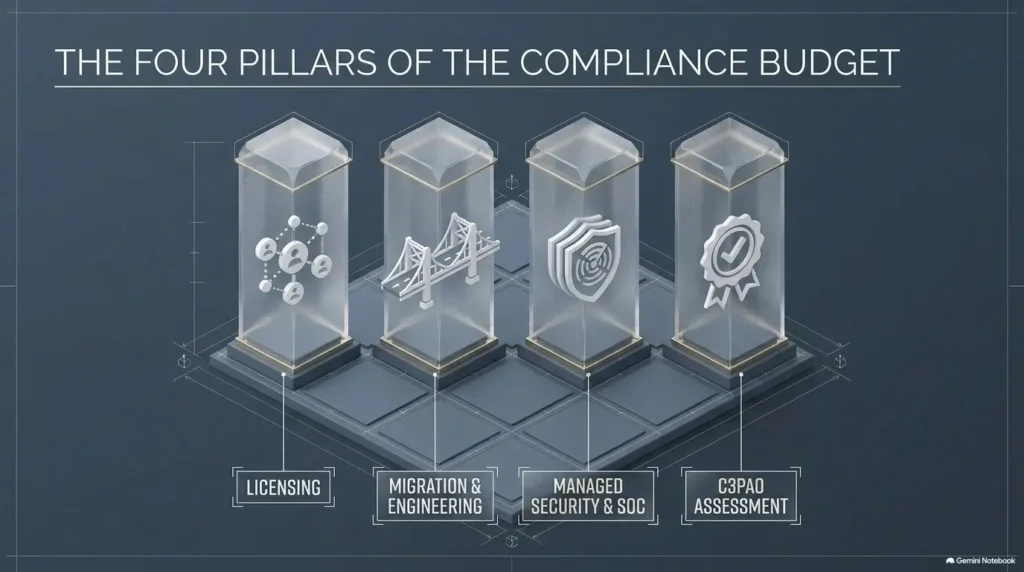
Seat count matters, but five other variables usually matter just as much.
| Cost driver | Why it changes the budget | Best question to ask |
|---|---|---|
| CUI user count | Determines how many people may require licenses and controlled access | Who genuinely needs to create, receive, modify, or access CUI? |
| CUI boundary | A broad boundary pulls more devices, applications, users, and evidence into scope | Can CUI be isolated without breaking normal operations? |
| Existing Microsoft tenant | Moving between cloud environments can require migration rather than a simple license change | What data and services actually need to move? |
| Current security stack | Existing EDR, identity, SIEM, DLP, or management tools may reduce or duplicate Microsoft add-ons | Which control capability are we actually missing? |
| Compliance maturity | Weak documentation and inconsistent procedures create consulting and remediation work | Which requirements fail today because of process rather than software? |
| Assessment scope | More assets and service providers mean more evidence and validation effort | What exactly will appear inside the assessed system boundary? |
The license spreadsheet therefore should not be your first budgeting artifact. Your CUI data-flow diagram should.
A Better GCC High Cost Model
A realistic budget separates recurring licensing from the work required to make the environment defensible.
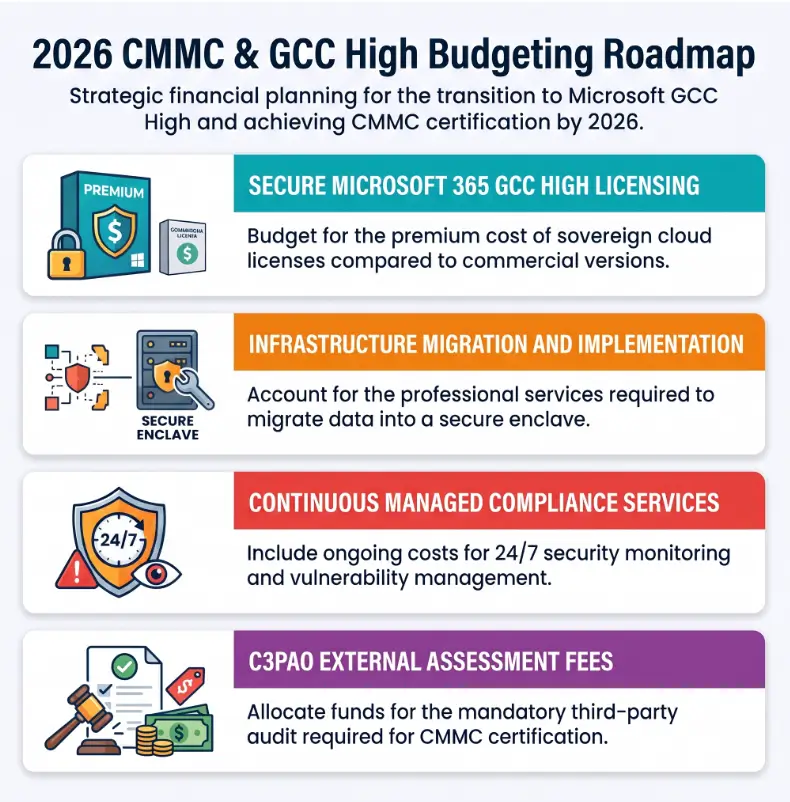
Realistic GCC High budget = licenses + migration + security configuration + CUI scoping + documentation + remediation + assessment preparation + recurring administration
This prevents a common procurement illusion: a $65-per-user license does not imply that $65 per user is your CMMC cost.
Licensing
This is the predictable recurring component. Multiply the quoted monthly or annual price by the number of users who genuinely require that license, then account for add-ons and renewal increases.
Migration
If you are leaving a commercial Microsoft 365 environment, budget for tenant planning, account provisioning, mail, SharePoint, OneDrive, Teams data, application dependencies, authentication changes, endpoint enrollment, testing, and cutover work. Migration complexity can matter more than the first year of license savings between two plans.
Configuration and Control Implementation
Licenses expose capabilities. Someone still has to configure conditional access, MFA, device management, logging, information protection, retention, administrative roles, monitoring, account lifecycle controls, and the other safeguards supported by your design.
Documentation and Evidence
CMMC work extends beyond settings in an admin portal. The organization needs documentation that matches reality, including its System Security Plan, boundaries, responsibilities, procedures, evidence, and any permitted plans of action and milestones.
Remediation
The surprise bill often lives here. Unsupported endpoints, shared administrator accounts, weak asset inventories, unmanaged vendors, incomplete logging, undocumented physical controls, or old line-of-business systems can generate spending that no Microsoft license fixes.
For the wider budget beyond Microsoft licensing, see KIOPTRIX’s CMMC compliance cost breakdown. Keeping platform cost and total compliance cost separate makes quotes much easier to compare.
What 25 or 50 GCC High Users Could Cost
The examples below use the July 2026 reseller-published list prices above. They are illustrative license calculations only. They exclude migration, consulting, assessments, remediation, third-party software, taxes, and negotiated discounts.
| Example | Calculation | Monthly licenses | Annual licenses |
|---|---|---|---|
| 25 Business Premium users | 25 × $35.80 | $895 | $10,740 |
| 25 Business Premium users + $24.40 add-on | 25 × $60.20 | $1,505 | $18,060 |
| 50 G3 users | 50 × $65.20 | $3,260 | $39,120 |
| 50 G3 users + $24.40 add-on | 50 × $89.60 | $4,480 | $53,760 |
| 50 G5 users | 50 × $97.50 | $4,875 | $58,500 |
That comparison exposes a useful procurement question. At current planning prices, G3 plus the Defender and Purview bundle approaches G5 pricing. If you were already going to license the add-on broadly, compare the complete capability set and operational burden rather than assuming G3 is automatically the cheaper architecture.
The reverse is equally important. Do not buy G5 merely because it contains more security features. A feature you do not need, operate, document, or monitor is still a recurring invoice.
Annual commitment and migration overlap change the cash budget
The reseller’s monthly equivalent is a comparison unit, not proof of monthly cancellation or payment rights. Ask for the invoice schedule, seat-reduction rules, renewal notice date and treatment of unused seats in the actual agreement. Microsoft’s July 2026 pricing notice says existing customers remain on current pricing until renewal.
Illustrative calculation using the $35.80 reseller rate above: assume 25 seats for a full year, a $6,000 migration quote and two months of overlapping old licenses at an assumed $22 per seat per month. This models the transition cost; it is not a new reseller quote.
| Check | How to use it |
|---|---|
| New annual licenses | 25 × $35.80 × 12 = $10,740. If payable annually in advance, this is the license cash commitment rather than a $895 cancellable monthly purchase. |
| Migration and overlap | $6,000 + (25 × $22 × 2) = $7,100. |
| First-year subtotal | $10,740 + $7,100 = $17,840, before add-ons, support, remediation, assessment, tax and internal staff time. |
| Renewal comparison | Keep the one-time migration and old-license overlap separate from recurring renewal cost. Request revised quantities and rates rather than carrying the first-year total forward. |
The CUI Enclave Can Change the Economics
One of the strongest cost levers is reducing the number of people and assets that need access to the controlled environment.
Imagine a 60-person company where eight employees work on contracts involving CUI. Moving all 60 people into the same controlled environment may be operationally simple, but it can also multiply licenses, managed endpoints, evidence collection, administrative overhead, and assessment scope.
A properly designed enclave may instead restrict CUI processing to defined users and systems while leaving unrelated corporate activity outside that boundary. That does not mean casually splitting licenses. The boundary must be technically enforceable and consistent with actual data flows.
Before choosing an enclave, verify:
- where CUI enters the organization;
- who receives or creates it;
- where it is stored;
- which endpoints can access it;
- which applications process it;
- whether backups, ticketing, email, monitoring, or support systems can expose it;
- which external service providers can access the environment.
An enclave saves money only when the boundary is real. A diagram with arrows that users routinely bypass is a paperwork sculpture, not scope reduction.
Business Premium vs G3 vs G5 for CMMC
For smaller organizations, Microsoft’s newer Business Premium for GCC High offering deserves attention because it creates a lower-cost entry point than the traditional enterprise plans. Microsoft states that Business Premium for GCC High supports up to 500 users. Confirm the exact SKU and agreement rather than applying the commercial Business Premium seat limit.
| Option | Consider it when | Watch for |
|---|---|---|
| Business Premium | You are a smaller organization and its included controls fit your architecture | Confirm required security and compliance capabilities rather than assuming “Premium” covers every design |
| Business Premium + security/compliance add-ons | You need additional Defender and Purview capabilities | Compare total price with G3 and G5 before stacking licenses |
| G3 | You need enterprise licensing but already operate some separate security tools | Identify gaps and duplicated tools before adding Microsoft bundles |
| G5 | Consolidated advanced security and compliance capabilities reduce operational complexity | Higher cost is wasted if the features are not actually implemented and operated |
The cheapest SKU and the cheapest operating model are not always the same. G5 can reduce third-party tooling in some environments. In another company, existing endpoint security, SIEM, DLP, and identity investments may make a lower Microsoft tier more economical.
What the 2026 CMMC Phase II Suspension Changes
On July 13, 2026, the Department suspended advancement to CMMC Phase II, which had been scheduled to begin November 10, 2026. Phase I self-assessment requirements remain in effect while a reform task force reviews the program.
The Department’s current CMMC program page should therefore be checked before making a purchase whose sole justification is an assumed Phase II assessment deadline.
The suspension does not mean:
- CMMC has disappeared;
- contracts no longer contain cybersecurity requirements;
- organizations can stop protecting CUI;
- existing DFARS obligations have vanished;
- a contractor should deliberately delay correcting known NIST SP 800-171 gaps.
What it does mean is that a company should distinguish security work required by its current contracts from purchases driven only by an anticipated third-party assessment schedule. That distinction is especially valuable for small contractors facing a large GCC High migration proposal.
How to Reduce GCC High Cost Without Weakening the CUI Boundary
Cost reduction should come from reducing unnecessary scope and duplication, not from quietly deleting controls.
- Count CUI users before buying seats. Separate people who genuinely handle CUI from employees who never need access.
- Map existing tools. Inventory endpoint security, identity, email protection, DLP, logging, device management, vulnerability management, and retention tools before buying overlapping Microsoft add-ons.
- Compare complete bundles. A lower base license plus several add-ons can approach the price of a higher tier.
- Keep ordinary corporate workflows outside the CUI boundary when defensible. Accounting, marketing, recruiting, and other unrelated systems should not drift into scope merely because the architecture was never designed.
- Get more than one licensing proposal. GCC High is purchased through approved channels, so compare the SKU mix, commitment term, implementation work, exclusions, and renewal assumptions rather than only the headline total.
- Price internal labor. A “cheap” tenant that requires continuous manual evidence gathering and administration may cost more than a slightly richer license with useful automation.
If you are comparing Microsoft spending with other security tools, KIOPTRIX’s security tool stack cost calculator can help expose duplicate categories before renewal.
Your 15-Minute GCC High Scope Check
Do this before requesting a final license quote.
- Write down the exact contract clause or customer requirement driving the CMMC work.
- Identify whether your organization handles FCI, CUI, export-controlled data, or a combination.
- Count the people who actually require access to CUI.
- List every Microsoft workload those people use: Exchange, Teams, SharePoint, OneDrive, Windows, Intune, Defender, Purview, and identity services.
- List existing non-Microsoft security tools that could satisfy the same operational need.
- Mark every system that receives CUI indirectly through email, backup, logging, support, synchronization, or file sharing.
- Ask the licensing partner for separate pricing for the minimum viable configuration and the recommended configuration.
- Require migration, implementation, and recurring managed-service fees to appear as separate line items.
If a provider cannot explain why each paid component exists, the quote is not ready for approval.
Questions to Ask a GCC High Provider Before Signing
| Question | Why it matters | Warning sign |
|---|---|---|
| Which exact licenses and add-ons are included? | Prevents vague “CMMC package” pricing | No SKU-level breakdown |
| Which users actually require GCC High? | Tests whether scope drove the quote | Provider automatically licenses every employee |
| What security capabilities are assumed to come from third-party tools? | Reveals hidden dependencies | Architecture assumes products you do not own |
| What migration work is excluded? | Exposes later project charges | Quote says “migration included” without workloads or volumes |
| Who configures the tenant against our documented control design? | Licensing alone does not implement controls | No named implementation responsibility |
| Who owns ongoing evidence and configuration maintenance? | CMMC is not a one-day configuration event | No post-migration operating model |
| What happens at renewal? | Government licensing and partner terms can change | No renewal assumptions or term details |
Frequently Asked Questions
Is GCC High mandatory for CMMC Level 2?
No Microsoft product is mandated merely because an organization is pursuing CMMC. The required outcome is protecting the applicable information within an appropriately scoped contractor information system. GCC High is one platform organizations use to support those requirements, particularly for DoD CUI and environments with additional government or export-control constraints.
Does buying GCC High make a company CMMC compliant?
No. The environment can provide or support technical capabilities, but the organization still must correctly configure systems, operate controls, manage people and devices, document the environment, produce evidence, and meet the requirements applicable to its contract and assessment scope.
Can only CUI users receive GCC High licenses?
Potentially, if the organization can build and enforce a defensible boundary that prevents out-of-scope users and systems from processing, storing, or transmitting CUI. The decision must follow the actual architecture and data flows rather than a licensing shortcut.
Should we delay GCC High because CMMC Phase II was suspended?
Do not base the decision on the Phase II deadline alone. If an existing contract, CUI handling requirement, DFARS obligation, export-control requirement, or current customer requirement already makes the environment necessary, that work may still be justified. If the only trigger was an assumed November 2026 third-party assessment deadline, re-check current government guidance before committing funds.
What to Do Before You Request a GCC High Quote
Start with one page, not a purchase order. Draw where CUI enters, which users touch it, which systems store or transmit it, and which external services can reach it. Then count the identities and endpoints inside that boundary.
Give that scope to the licensing provider and request at least two architectures: the least expensive configuration that satisfies the documented requirements, and the provider’s recommended configuration with a line-by-line explanation of what the additional spending solves.
That turns the GCC High discussion from “Which expensive Microsoft package should we buy?” into the question that matters: “What is the smallest defensible environment that protects our CUI and supports the controls we actually have to operate?”
Last reviewed: 2026-10
Technical guidance updated: 2026-10-13. Clarified the annual-billing basis of monthly price figures and linked the official GCC High seat limit. Do not add Defender or Purview components again when they are already included in G5 or a managed-service bundle.
Editorial review: October 16, 2026. This update clarifies the cost assumptions and purchasing checks above. Illustrative calculations use stated assumptions and are not provider quotes or evidence of product testing.
GCC High cost and commitment record
Use this when: you are a contractor normalizing reseller offers for a defined migration and operating scope. Copy the table into your working notes and replace the prompts with a dated response. Keep unresolved items visible rather than filling them with a default assumption.
| Decision field | What to record | Your evidence / owner / next check |
|---|---|---|
| License baseline | Record exact SKUs, users, term, minimums and eligibility. | To complete |
| Migration scope | Separate mail, files, identities, devices and integration changes. | To complete |
| Operations | List monitoring, administration, support and evidence responsibilities. | To complete |
| Renewal and exit | Record billing basis, renewal changes and data export or transition work. | To complete |
How to use the result: Compare the full commitment and customer workload, not only a monthly equivalent. Mark each row confirmed, provisional or unresolved, and link the source that supports the status. Keep a reviewer and review date beside decisions that affect spending, deployment or external claims.
This is an editorial working aid. Complete it with your own scope, source documents and responsible reviewers; the completed table alone does not establish compliance or acceptance.
Worksheet change record — October 20, 2026
Added this gcc high cost and commitment record with four article-specific working fields, evidence ownership and a next action. The article’s existing source notes retain their own review dates. This addition does not represent a new verification of every statement or a newly executed lab test.