


Small Business Cyber Coverage Guide
Cyber Insurance for Small Businesses:
What It Covers Before a Claim
Cyber insurance sounds simple until the bad day arrives. A fake invoice lands in accounting. A cloud app leaks customer records. A ransomware note appears where yesterday’s booking calendar used to be. Suddenly the question is not “Do we have insurance?” It is “Which costs are covered, who must approve the response, and did we accidentally promise the insurer something we cannot prove?”
This guide is built for owners, freelancers, agencies, ecommerce sellers, healthcare-adjacent vendors, and local service companies that depend on email, cloud tools, payments, customer records, or bookings. It explains cyber insurance in the language of real business interruption, not brochure mist.
You will learn how first-party coverage differs from third-party liability, why ransomware and invoice fraud need special attention, what exclusions can shrink a policy, and how to prepare before a claim so your policy is more than expensive desk confetti.
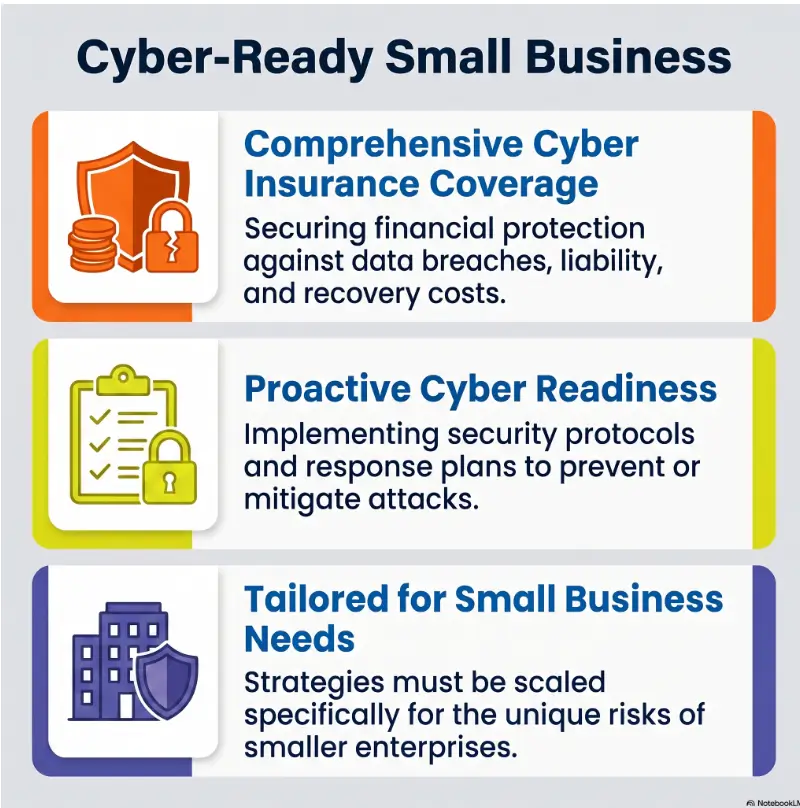
Know the coverage split
Separate your own losses from claims others may bring against you.
Spot weak policy areas
Check sublimits, exclusions, conditions, and approval rules before panic.
Prepare for claims
Build a proof folder for MFA, backups, training, vendors, and contacts.
The goal: buy smarter, document better, and avoid learning policy language while the server room is metaphorically smoking. 🛡️
Snapshot
This article is for small businesses comparing cyber insurance options before buying or renewing. It explains what cyber policies may cover, where claims can stumble, what to ask a broker, and how to create a simple pre-claim readiness file before anything breaks.
Table of Contents
Coverage Split: The First Door Most Owners Miss
Cyber insurance for small businesses becomes easier to understand once you split it into two doors: first-party coverage and third-party coverage. First-party coverage is about your own losses. Third-party coverage is about claims made against your business by customers, clients, partners, regulators, or other affected parties.
That split matters because a cyber incident can hit both sides at once. A hacked ecommerce store may need forensic help, downtime support, customer notification, legal review, and also defense if customers claim the company failed to protect their information. One event, several bills, different policy sections.
First-party coverage pays for your own cyber mess
First-party cyber coverage may help with costs your business directly suffers after a cyberattack or data incident. Think system restoration, forensic investigation, breach coaching, data recovery, lost income from downtime, crisis communications, customer notices, call centers, and certain extortion expenses.
A small dental billing vendor, for example, may not be sued on day one after a breach. But it may still need emergency IT help, legal guidance, notification planning, and lost revenue support if systems are offline. That is the first-party side of the house.
Third-party coverage pays when others blame you
Third-party coverage may respond when someone outside your business claims they were harmed by your cyber incident. This can include legal defense, settlements, judgments, regulatory response costs, and certain contractual claims, depending on the policy wording.
If your marketing agency stores client login credentials and an attacker uses them to access a client account, the expensive question may become: “Did your security failure create their loss?” That is where third-party liability can matter.
The expensive gray zone between the two
Some costs are not neatly polite. A vendor breach might trigger your customer notification duties. A fraudulent wire may sit between cyber coverage, crime coverage, and social engineering coverage. A ransomware event may include extortion, recovery, business interruption, legal review, and regulatory worries.
When comparing cyber insurance policies, do not ask only “Does it cover cyberattacks?” Ask which bucket pays for which bill, what approval is required, and whether any sublimit applies.
Key takeaway
A policy that covers data breach costs may still be weak for invoice fraud, vendor incidents, downtime, or regulatory response. The coverage category matters as much as the headline limit.
Before You Act: Cyber Insurance Is Not Cybersecurity
Cyber insurance is a financial backstop, not a security program. It can help pay certain covered costs after an incident, but it does not replace multi-factor authentication, employee training, patching, backups, vendor review, written procedures, or legal compliance.
This article is educational. It cannot interpret your specific policy, state insurance rules, customer contracts, breach notification duties, or regulatory exposure. For buying or renewing coverage, compare policy wording with a licensed insurance professional. For breach notification, regulated data, customer contracts, or potential lawsuits, involve legal counsel early.
The Federal Trade Commission tells businesses to discuss first-party, third-party, or combined coverage needs with an insurance agent. That is sensible advice because the wrong policy can look comfortable until the claim arrives with muddy boots.
Before you rely on coverage, confirm these four items:
- Whether your policy includes first-party, third-party, or both.
- Whether ransomware, social engineering, wire fraud, and downtime have sublimits.
- Whether your application answers match your real security controls.
- Who must approve emergency vendors before costs are covered.
First-Party Costs: What Happens After the Alarm Bell Rings
First-party coverage is the part many owners picture first: your systems are down, your data is locked, or your customer records may be exposed. The business needs help immediately. Not next quarter. Not after a committee has finished brewing lukewarm coffee. Now.
Coverage varies, but these are the cost categories small businesses should ask about before buying cyber insurance.
Forensics before feelings
Forensic investigation may help determine what happened, when it happened, what systems were affected, what data may have been accessed, and whether the attacker is still present. This is not just technical curiosity. It can shape legal notices, customer communication, recovery work, and claim documentation.
Ask whether the insurer requires you to use a pre-approved forensic firm. Hiring your own favorite IT person before calling the breach hotline can create friction if the policy requires carrier consent.
Lost income during system downtime
Cyber business interruption coverage may help replace lost income when systems are down because of a covered cyber event. This can matter for ecommerce shops, appointment-based clinics, SaaS companies, agencies, restaurants using online ordering, and any business where the cash register now lives partly in the cloud.
Read the waiting period and calculation method. Some policies only respond after a set number of hours. Others may limit coverage to specific systems, specific causes, or a defined restoration window.
Data recovery, restoration, and replacement
Data recovery coverage may help pay to restore, replace, or recreate data damaged by malware, ransomware, unauthorized access, or system corruption. But it may not pay for long-neglected upgrades, ordinary maintenance, or pre-existing system problems.
This is where backups become the quiet hero. If your policy application says you maintain tested backups, save proof. A backup that has never been restored is a locked door with a painted-on handle.
Customer notification and crisis communications
Cyber policies may cover customer notification letters, credit monitoring in certain cases, call center services, breach counsel, and crisis public relations. These costs can feel invisible during shopping because nobody daydreams about call center scripts. Yet they can become very real after a breach involving personal data.
For small businesses, the practical move is simple: ask the broker whether these services are included, optional, subject to sublimits, or available only through insurer-approved vendors.
| First-party cost | Why it matters | Question to ask before buying |
|---|---|---|
| Forensic investigation | Shows what happened and what data may be affected | Must we use insurer-approved firms? |
| Business interruption | Helps with lost income during covered downtime | What waiting period and calculation method apply? |
| Data recovery | Pays for covered restoration or recreation work | Are backups, testing, or patching required? |
| Notification support | Helps manage legal notices and customer contact | Are call centers and credit monitoring sublimited? |
| Crisis PR | Helps protect trust when customers are worried | Is PR included or only available by endorsement? |
Third-Party Liability: When the Breach Leaves Your Building
Third-party cyber liability matters when other people say your business caused or contributed to their loss. A breach does not need to physically leave your office to leave your responsibility zone. It can travel through email, shared folders, API connections, client portals, payment systems, and vendor platforms.
This is especially important for agencies, IT consultants, bookkeepers, healthcare-adjacent vendors, managed service providers, ecommerce operators, and any business that holds data on behalf of someone else.
Customer claims after exposed data
If customer, employee, patient-adjacent, or payment information is exposed, affected people may bring claims. Whether those claims succeed is a legal question. The insurance question is whether your policy may provide defense and settlement support for covered allegations.
Do not assume general liability insurance will handle this. Many traditional policies were not designed for modern data incidents. A general liability policy may cover bodily injury or property damage, while cyber liability focuses on digital events, data, network security, privacy, and related response costs.
Lawsuits, settlements, and defense costs
Defense costs can be the part that surprises owners. Even a weak claim can be expensive to answer. Look for whether the policy has a “duty to defend” structure, how defense costs affect the limit, and whether consent is required before settling a claim.
Some policies pay defense costs inside the limit, which means legal fees reduce the amount available for settlements or judgments. Others may structure defense differently. This is a broker conversation, not a skim-and-hope moment.
Regulatory inquiries and response expenses
Cyber incidents can trigger regulatory questions, especially where personal information, financial data, health-related data, children’s data, or consumer promises are involved. Policies may offer coverage for certain regulatory response costs, fines, penalties, or defense expenses, but this area is highly wording-dependent.
Ask directly: “What regulatory costs are covered, what is excluded by law, and which sublimits apply?” Then ask the same question again, but slower, because this is where expensive nouns gather in a trench coat.
Key takeaway
Third-party coverage is not only for large companies. If clients, customers, employees, or partners could blame your business after a cyber incident, review this section carefully.
Ransomware and Business Email Compromise: Two Clauses to Read Slowly
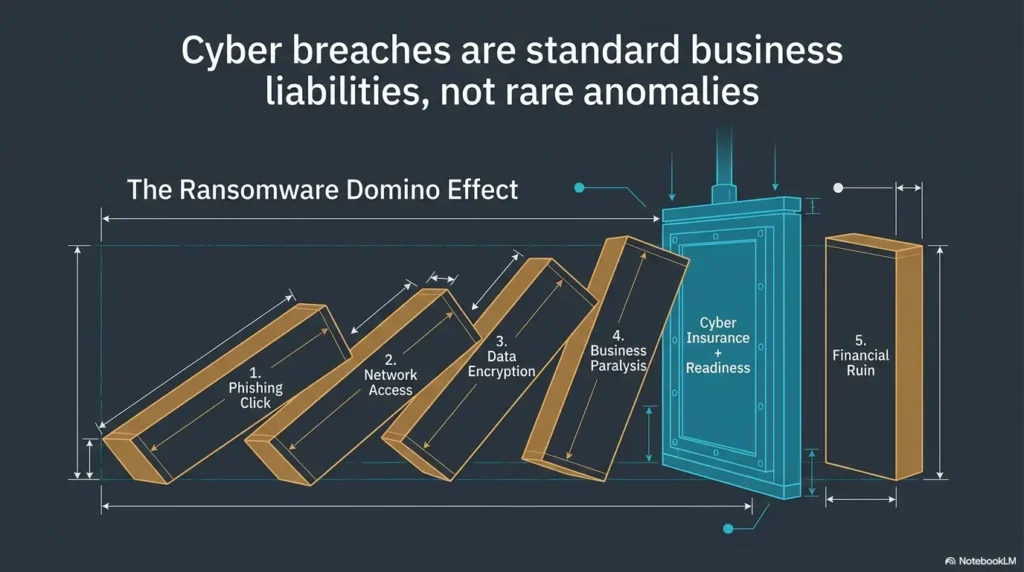
Ransomware and business email compromise are often discussed together, but insurance may treat them differently. Ransomware can lock systems or threaten data exposure. Business email compromise often tricks a person into sending money, changing payroll, or approving a fake invoice.
Both can be devastating. Both can be covered differently from what a busy owner expects. This is where sublimits, exclusions, insurer approval, and claim timing become crucial.
What cyber extortion may include
Cyber extortion coverage may address ransom demands, negotiation support, threat analysis, and recovery expenses connected to a covered event. Some policies may also involve legal review around sanctions, payment restrictions, and insurer consent before any payment is made.
Ransom payment is rarely the only cost. The larger bill may include forensic investigation, system rebuilding, lost income, overtime, legal review, customer communication, and weeks of strained operations.
Business email compromise: the invoice trap in a nice shirt
Business email compromise can look embarrassingly ordinary. A fake vendor message. A changed payment instruction. A “CEO” who needs a wire transfer before lunch. The fraud succeeds because it looks less like a movie hacker and more like Tuesday.
Coverage may sit under cyber, crime, funds transfer fraud, social engineering, or a specific endorsement. Do not assume a cyber policy automatically covers wire fraud. Ask whether employee deception, voluntary transfer, invoice manipulation, and payment redirection are covered.
Real-world example: The clean invoice that emptied the account
A small design agency receives what appears to be a routine invoice from a long-time print vendor. The email thread looks familiar. The amount is plausible. The payment instructions changed, but only by one sentence.
Accounting pays it. Two days later, the real vendor asks about the overdue balance. Now the agency has one real bill, one fraudulent transfer, a nervous client file, and an owner searching the policy for “social engineering.”
The lesson is not “never trust email,” because business would freeze into a sad little ice sculpture. The lesson is to require out-of-band verification for payment changes, keep approval logs, and confirm whether fraud coverage matches the way money actually leaves your business.
Timing can control coverage
Many cyber policies have notice duties. Some require you to contact a breach hotline before hiring vendors, negotiating with attackers, or making certain payments. In a crisis, this can feel slow. In a claim file, it can matter.
Before renewal, write down the breach hotline, broker contact, legal contact, IT contact, and who inside the company can authorize emergency spending. Keep that page offline and printed. Yes, paper. The old goat still has a few tricks.
Vendor Breaches: Your Data in Someone Else’s Kitchen
Small businesses rarely operate alone. Payroll systems, booking apps, cloud storage, CRMs, web hosts, payment processors, email platforms, marketing tools, managed IT providers, and analytics tools all hold pieces of the business. Your data may be scattered across a polite little village of vendors.
That creates a hard insurance question: if a vendor gets breached, whose policy responds, whose customers must be notified, and who pays for the response?
Why “they got hacked” may still become your problem
If your business collected the data, promised to protect it, or has contractual duties to customers, a vendor incident can still land on your desk. The vendor may have its own duties, but that does not automatically erase yours.
Ask your broker whether contingent business interruption, dependent business interruption, outsourced provider incidents, or vendor-caused privacy events are covered. The terminology varies, so bring plain-English scenarios instead of trying to guess the perfect magic phrase.
Contract language should match insurance language
Vendor contracts and insurance policies should not live in separate kingdoms. If your customer contract says you will maintain certain controls, carry specific limits, or notify within a short time window, your insurance and incident response process should support those promises.
A simple way to start is to compare your top five vendor contracts with your cyber policy. Look for indemnity language, breach notice deadlines, security requirements, insurance requirements, data ownership, subcontractor rules, and limitation of liability language.
The vendor questionnaire is not paperwork confetti
Security questionnaires can feel like office origami, but they matter. If you tell a customer or insurer that your business uses MFA, encrypted backups, access reviews, employee training, and vendor monitoring, keep proof.
For a practical next step, use a consistent vendor security questionnaire before giving vendors access to sensitive data. It does not need to be fancy. It needs to be repeatable, honest, and saved where someone can find it during renewal or a claim.
| Vendor risk | What to check | Insurance question |
|---|---|---|
| Payroll provider | Employee data, tax IDs, bank details | Are vendor privacy incidents covered? |
| Cloud storage | Access controls, sharing settings, audit logs | Does coverage include cloud misconfiguration? |
| Booking platform | Customer names, appointment notes, payment links | Does downtime from provider failure count? |
| Managed IT provider | Admin access, remote tools, backup control | What happens if their account is compromised? |
| Email platform | Mailbox compromise, phishing, account takeover | Is BEC or social engineering sublimited? |
Exclusions and Conditions: Where Good Claims Get Smaller
Cyber insurance policies do not just say what they cover. They also say what they exclude, limit, condition, or require. This is where a policy that looked broad at purchase can become much narrower under claim pressure.
The most dangerous exclusions are not always written in villain font. They can appear in endorsements, definitions, security conditions, application warranties, waiting periods, exclusions, or sublimits.
Outdated systems and missing patches
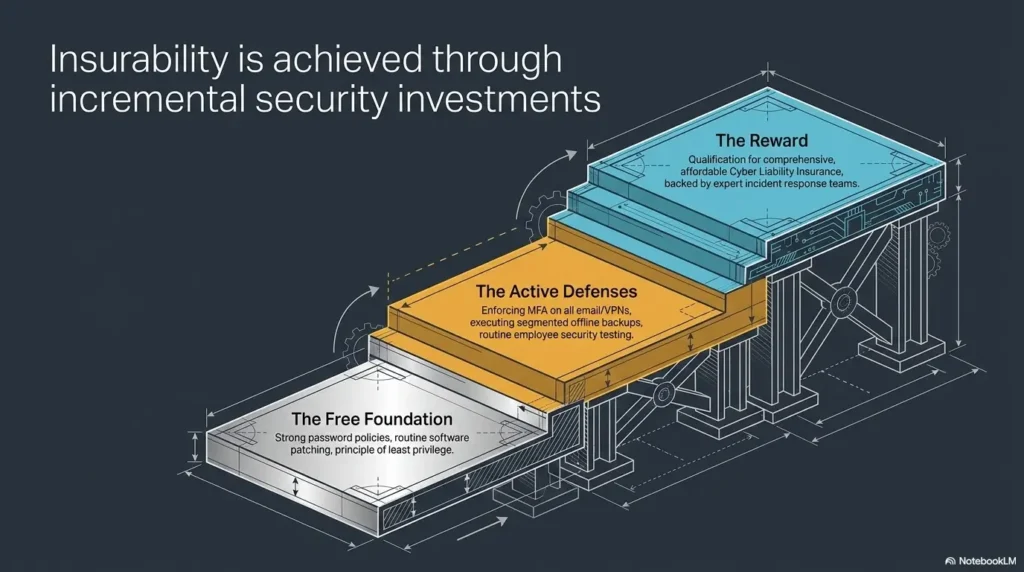
Insurers increasingly care about basic controls. If a claim involves unsupported software, missing patches, exposed remote access, weak passwords, or no MFA, expect harder questions.
Small businesses do not need enterprise theater. They do need a patching routine, an asset list, secure remote access, MFA for key accounts, backup testing, and a way to show those controls were actually in place.
False answers on the insurance application
The cyber insurance application is not harmless paperwork. It can become part of the coverage story. If you answer “yes” to MFA, encrypted backups, employee training, or endpoint protection, make sure the answer is true for the systems the insurer cares about.
For founders and operators, this is similar to tracking security metrics for founders: the value is not the pretty dashboard. It is the ability to show what is working, what is incomplete, and what changed over time.
Missing MFA, backups, or endpoint controls
MFA, backups, endpoint protection, phishing training, access controls, and vulnerability remediation are common underwriting topics. If your policy has security conditions, treat them as operational requirements.
One wise habit: after every renewal, create a one-page “what we promised” sheet. List the controls you confirmed on the application, who owns each one, where proof lives, and when it was last checked.
Show me the nerdy details
Cyber coverage disputes often turn on definitions, exclusions, sublimits, notice duties, consent rules, and whether the claimed loss fits the exact coverage grant. A ransomware event may trigger cyber extortion, data recovery, business interruption, privacy response, and legal expense sections. A fraudulent wire may involve social engineering, funds transfer fraud, computer fraud, crime coverage, or a cyber endorsement. When reviewing a quote, map each likely incident to the policy section that would respond, then check the limit, sublimit, retention, waiting period, exclusions, and approval rules for that section.
Key takeaway
Do not treat the application as a sales form. Treat it as a coverage document that must match reality, logs, screenshots, invoices, training records, and written procedures.
Who This Is For, and Who Should Not Rely on It
Cyber insurance is not only for tech companies. A bakery with online orders, a solo consultant with client files, a real estate office using wire instructions, a therapist-adjacent billing vendor, or a local contractor storing employee records can all carry cyber risk.
The question is not whether your business feels “technical.” The question is whether a digital failure could cost money, expose data, interrupt revenue, damage trust, or trigger legal duties.
Best fit: businesses with customer, employee, payment, or health-adjacent data
Cyber coverage is especially worth reviewing if your business stores personal information, employee files, payment details, appointment notes, contracts, tax documents, logins, or sensitive client materials. That includes ecommerce sellers, agencies, bookkeepers, consultants, recruiters, wellness practices, local service companies, and B2B vendors.
Healthcare-adjacent vendors should be extra careful. Even if your company is not a hospital or clinic, contracts may impose privacy, security, breach notice, or indemnity duties.
Best fit: businesses that depend on email, cloud apps, or ecommerce
If email or cloud systems stop working, can you still operate? If the answer is “not really,” business interruption and system recovery deserve serious attention. That includes online stores, booking-based companies, agencies, SaaS startups, and professional service firms.
If your risk is mainly from cloud configuration, it may also help to review common cloud misconfigurations so you understand where insurance ends and prevention begins.
Not enough: businesses wanting insurance instead of basic security
Cyber insurance gets weaker when used as a substitute for basic controls. If a business refuses MFA, has no backups, ignores updates, shares admin passwords, and cannot document training, insurance may still be available, but claim friction and higher premiums become more likely.
A simple one-hour-a-month security training habit can often do more practical good than a thick policy nobody understands.
Cost, Limits, and Buying Options Without Wasting Money
The cost of cyber insurance for small businesses depends on industry, revenue, data type, claims history, security controls, coverage limit, deductible or retention, and selected endorsements. A tiny consultant with no sensitive records is not priced like a healthcare vendor holding thousands of customer files.
Instead of chasing the cheapest quote, compare the loss scenarios your business actually faces. The best way to choose cyber insurance is to match coverage to your most likely and most damaging events.
Good, better, best coverage comparison
| Option | Best for | What to compare | Watch out for |
|---|---|---|---|
| Good: basic cyber endorsement | Very small firms with limited data and low digital dependency | Privacy response, legal support, notification costs, basic cyber event coverage | Low limits, narrow wording, weak fraud or downtime coverage |
| Better: standalone cyber policy | Businesses using cloud apps, email, ecommerce, client portals, or vendor systems | First-party, third-party, ransomware, downtime, vendor incidents, breach hotline | Sublimits, waiting periods, approval rules, security conditions |
| Best: standalone cyber plus coordinated crime and tech coverage | Agencies, IT providers, SaaS firms, professional service firms, and higher-risk vendors | Cyber, crime, E&O, contractual liability, social engineering, incident response | Gaps between policies, duplicate costs, inconsistent definitions |
Limits, sublimits, and retentions
The headline policy limit can be misleading. A policy may advertise a large overall limit but apply smaller sublimits to ransomware, fraud, business interruption, regulatory costs, or dependent provider incidents.
Also check the retention, which is the amount your business pays before coverage responds. A lower premium with a painful retention may be fine for a cash-rich company, but risky for a lean freelancer or microbusiness.
Free checklist vs paid professional help
A free checklist can help you organize risks before talking to a broker. Paid professional help may be worth considering when you handle sensitive data, have complex contracts, operate in regulated sectors, depend heavily on uptime, or cannot clearly answer security application questions.
For companies buying security services, it can also help to understand penetration testing vs vulnerability scanning and typical penetration testing cost factors. Security testing will not guarantee coverage, but it can improve your understanding of risk and remediation priorities.
Cyber Insurance Coverage Flow
1. Name the risk
Ransomware, breach, downtime, fraud, vendor failure.
2. Pick the bucket
First-party, third-party, crime, E&O, or vendor-related.
3. Check limits
Overall limit, sublimit, retention, waiting period.
4. Prove controls
MFA, backups, training, patching, vendor review.
5. Ask the broker
Confirm wording before renewal, not during chaos.
Claim Readiness: The Quiet Work Before Panic
A cyber policy is only as useful as your ability to act quickly and document clearly. Claim readiness is the calm work done before anyone is locked out, phished, breached, or staring at a ransom note with the emotional range of a damp sock.
You do not need a fifty-page incident response manual to start. You need names, numbers, proof, and a habit of keeping promises visible.
Create an incident contact list
Your incident contact list should include the insurer breach hotline, broker, business owner, legal counsel, IT provider, cloud admin, payment processor contact, and communications lead. Store it somewhere accessible even if email is down.
If your company is large enough to need outside response help, compare whether an incident response retainer is useful. For some small businesses, the insurer panel may be enough. For higher-risk firms, a retainer can reduce confusion when time matters.
Save proof of MFA, backups, training, and patching
Create a cyber insurance proof folder. Save screenshots or reports showing MFA settings, backup schedules, backup restore tests, employee training dates, endpoint protection status, patch records, vendor reviews, and admin access reviews.
Do not overcomplicate it. A shared folder with dates and plain labels can beat a beautiful compliance system nobody updates.
Know who can authorize emergency vendors
In a cyber incident, someone may need to approve forensic help, legal review, restoration work, communications support, or emergency hardware. Decide in advance who can approve spending, who must notify the insurer, and what costs require consent.
This is also where a simple security testing and remediation calendar helps. If your business is working toward SOC 2, a SOC 2 budget calculator can help organize expected costs, but insurance readiness still needs practical proof, not just future intentions.
Claim readiness checklist
- Print the insurer breach hotline and broker contact.
- Save the current policy, endorsements, and application answers.
- Document MFA on email, admin accounts, cloud apps, and remote access.
- Save backup test evidence, not just backup settings.
- List approved emergency vendors and approval authority.
- Keep a breach-notification decision path with legal counsel involved.
- Review the file before renewal and after major system changes.
Key takeaway
The best pre-claim habit is boring in the most profitable way: keep a folder proving your controls, contacts, approvals, and policy promises.
FAQ
Does cyber insurance cover ransomware for small businesses?
Many cyber policies may include ransomware or cyber extortion coverage, but coverage depends on wording, sublimits, exclusions, security conditions, and insurer approval requirements. Ask whether the policy covers ransom negotiation, recovery work, legal review, business interruption, data restoration, and any required vendors.
Does cyber insurance cover lost income during downtime?
Cyber business interruption coverage may help with lost income after a covered cyber event causes system downtime. Check the waiting period, how lost income is calculated, which systems count, whether cloud provider outages are included, and whether a sublimit applies.
Does cyber insurance cover employee mistakes?
Some policies may cover certain employee errors, such as clicking a phishing link or accidentally exposing data. But intentional acts, repeated control failures, false application answers, or excluded conduct may create problems. Ask about phishing, social engineering, privacy errors, and training requirements.
Does cyber insurance cover vendor or cloud provider breaches?
Some policies may cover certain vendor incidents, dependent provider outages, or outsourced data breaches. Others may limit or exclude them. Ask about SaaS platforms, cloud storage, payroll vendors, payment processors, managed IT providers, and what proof you need from each vendor.
Is cyber insurance different from general liability insurance?
Yes. General liability insurance is usually designed for bodily injury, property damage, and certain advertising injury claims. Cyber insurance focuses on digital incidents, data exposure, network security, privacy response, cyber extortion, system recovery, and related liability, depending on the policy.
What is the difference between first-party and third-party cyber coverage?
First-party cyber coverage may pay for your own losses, such as forensic costs, data recovery, notification, downtime, or extortion response. Third-party cyber coverage may respond when customers, clients, partners, or regulators make claims against your business after a covered incident.
Can a cyber insurance claim be denied?
Yes. Claims can be denied or reduced because of exclusions, late notice, uncovered events, missing approvals, false application answers, lack of required security controls, sublimits, or facts that do not fit the coverage grant. This is why policy review and documentation matter before a claim.
How much cyber insurance does a small business need?
There is no universal amount. Consider revenue, data volume, contracts, industry, downtime exposure, regulatory risk, vendor dependence, fraud risk, and cash reserves. Ask a broker to model several scenarios: breach response, ransomware recovery, business interruption, wire fraud, and customer claims.
Next Step: Do the 15-Minute Coverage Snapshot
You do not need to become an insurance scholar by sunset. You need one clean page that turns vague cyber worry into broker-ready questions. Set a timer for 15 minutes and build your coverage snapshot.
Start with your top five digital risks: ransomware, customer data breach, fake invoice payment, cloud app outage, vendor breach, lost laptop, compromised email account, or website takeover. Then mark each as first-party, third-party, fraud, vendor-related, or “not sure.”
Next, open your policy or quote. Circle every sublimit, exclusion, waiting period, retention, security condition, breach hotline rule, and vendor approval requirement. Do not solve everything today. Just turn the fog into labeled jars.
Send these three questions to your broker
- Which sections of this policy respond to ransomware, business email compromise, vendor breach, and business interruption?
- What sublimits, waiting periods, retentions, exclusions, and approval rules apply to each scenario?
- Which security controls did we promise in the application, and what proof should we keep before renewal?
That small exercise can save hours later. Cyber insurance is not magic. It is a contract, a response process, and a documentation habit stitched together. When those three pieces line up, a small business has a better chance of meeting the bad day with a steady hand instead of a drawer full of mystery paper.
Last reviewed: 2026-07