Open the practical working record to connect this guide to your scope, evidence and next decision.
Enterprise Vendor Risk Guide
SOC 2 Type 1 vs Type 2:
Which Report Do Buyers Need?
A vendor says, “We have SOC 2.” The sales team exhales. Procurement checks a box. Everyone inches toward signature day. Then someone opens the report and discovers that the controls were examined on one date, the relevant product is missing from scope, or the audit period ended before a major platform migration.
That is why the real comparison is not simply whether Type 2 is “better” than Type 1. Buyers need to know what evidence each report provides, how current that evidence remains, which systems were actually examined, and whether the report matches the risk created by the contract.
This guide turns a dense assurance report into a practical buying decision. It is written for SaaS founders trying to unblock enterprise sales, security teams reviewing third parties, and procurement professionals who would rather prevent a surprise than explain one later.
Compare the evidence
Understand the point-in-time test and the period-of-time test.
Match proof to risk
Choose a requirement based on access, data, dependency, and impact.
Write a defensible rule
Create acceptance language that sales and security can apply consistently.
The useful question is not “Does the vendor have SOC 2?” It is “What does this report prove about the service we are buying today?” 🔍
Snapshot
Who it is for: SaaS vendors, enterprise buyers, procurement, GRC, legal, sales, and security teams. What it solves: confusion about when Type 1 is acceptable and when Type 2 should be required. What you can do next: classify vendor risk, review the right report sections, and write a one-sentence acceptance rule.
Table of Contents
Before You Act: Treat the Report as Evidence, Not a Guarantee
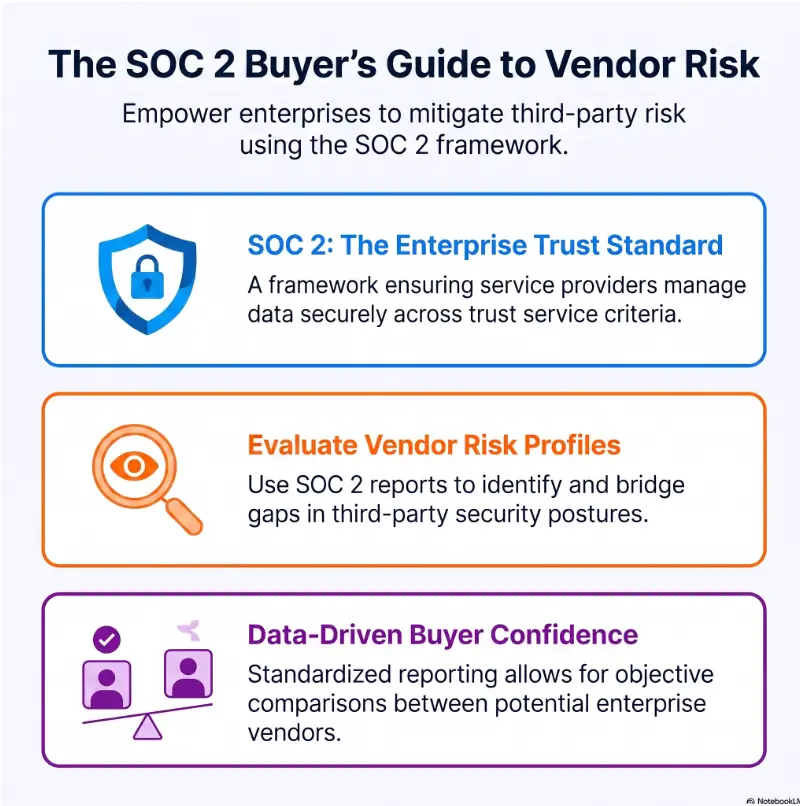
A SOC 2 report can provide useful independent evidence about a service organization’s controls. It does not promise that the vendor will never suffer an incident, outage, privacy failure, or control breakdown.
This article offers general educational guidance, not legal, accounting, audit, insurance, or cybersecurity advice. Contract requirements should be reviewed against your organization’s risk policy, regulatory obligations, customer commitments, and the specific service being purchased.
For material decisions, consider involving qualified security, privacy, legal, procurement, and assurance professionals. A two-person review is often sensible when the vendor will process regulated data, connect to production systems, handle privileged credentials, or support a critical business operation.
Before approving the vendor
Confirm the report type, audit period, legal entity, relevant product, infrastructure scope, exceptions, subprocessors, customer responsibilities, and material changes since the examination. The cover page is the front door, not the whole house.
Two Reports, One Expensive Question: Did the Controls Work?
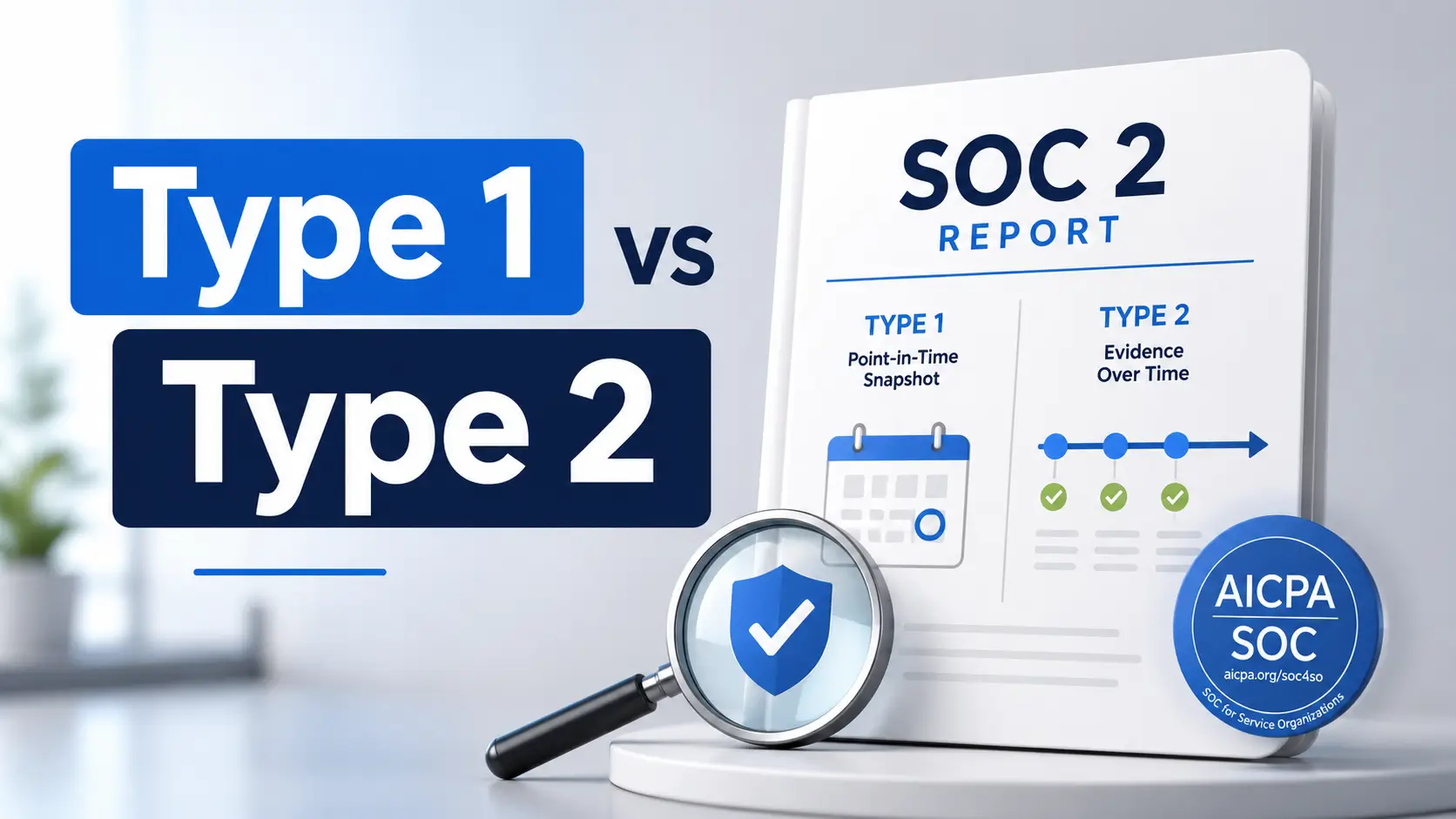
The simplest distinction is temporal. A Type 1 examination evaluates the design and implementation of controls as of a specified date. A Type 2 examination also addresses whether those controls operated effectively throughout a stated period.
AICPA materials describe Type 1 testing around a specific “as of” date and distinguish Type 2 reporting by its attention to operating effectiveness. That additional time dimension is why buyers generally obtain stronger evidence from Type 2 when recurring processes matter.
Type 1 asks whether the controls were ready on one date
Imagine photographing a restaurant kitchen at 9:00 a.m. The surfaces are clean, the refrigerator log is posted, and the food-safety checklist is clipped neatly to the wall. The photograph can show that the system was designed and present at that moment.
It cannot show whether employees completed the checklist every day, whether temperatures were reviewed during busy weekends, or whether problems were escalated when the manager was away.
Type 2 asks whether the controls kept working
Type 2 adds the equivalent of observing the kitchen across a defined period. It can provide evidence about recurring controls such as user-access reviews, employee onboarding and termination, vulnerability remediation, backup monitoring, incident management, change approval, vendor oversight, and security training.
This does not mean every control must operate perfectly. The report may disclose exceptions, explain the testing performed, and describe management’s response. Those awkward frames are often more informative than a spotless marketing summary.
| Buyer question | SOC 2 Type 1 | SOC 2 Type 2 |
|---|---|---|
| Were the controls suitably designed? | Opinion addresses design as of a specified date | Opinion addresses design for the period covered |
| Were the controls implemented? | Evaluated as of the report date | Evaluated within the examination |
| Did recurring controls operate effectively? | Not demonstrated over a period | Tested throughout a defined period |
| Can buyers see test results and exceptions? | More limited operating evidence | Detailed tests and results are commonly central to review |
| Typical buyer use | Interim or lower-risk evidence | Stronger evidence for mature or higher-risk relationships |
Key takeaway
Type 1 evaluates a control environment at a point in time. Type 2 gives buyers evidence about repeat performance. When the risk depends on what happens every week, month, quarter, or employee lifecycle event, the period matters.
Type 1 Is a Snapshot, but It Is Not Worthless
Type 1 is sometimes dismissed as a decorative stepping stone. That is too blunt. A well-scoped Type 1 report can be useful when a company has recently established formal controls, launched a new service, reorganized its infrastructure, or is entering enterprise procurement for the first time.
Why early-stage vendors often begin with Type 1
A young SaaS company may have built a credible control environment but lack a sufficiently long operating history for the evidence a buyer expects from Type 2. Type 1 can document the current design while the company accumulates evidence for a later period examination.
It may also help sales teams answer a more precise question. Instead of saying, “We are working on compliance,” the vendor can provide an independent report showing what was actually in place on a stated date.
When Type 1 may be proportionate
- The vendor receives little or no sensitive customer data.
- The service is isolated from production and has no privileged access.
- The engagement is a limited pilot with a small, reversible impact.
- The buyer can apply technical restrictions, data minimization, or manual review.
- The vendor has a dated Type 2 plan and will provide interim evidence.
- The buyer’s policy permits a documented, time-limited exception.
What Type 1 cannot prove
A Type 1 report does not demonstrate that quarterly access reviews occurred on schedule, that terminated users were consistently removed, that backups were repeatedly tested, or that vulnerabilities were remediated within stated targets over several months.
That boundary should be written plainly in the review record. “Accepted because the vendor has SOC 2” is weak documentation. “Accepted for a 90-day pilot because data is de-identified, production access is blocked, and Type 2 is due by October 31” is much easier to defend.
Vendor-side reality check
Avoid saying only, “We are SOC 2 compliant.” State the report type, period or date, in-scope service, Trust Services Categories, and expected date of the next report. Precision sounds more mature than a badge-shaped fog bank.
Vendors estimating the effort behind the next stage can use a structured SOC 2 budget calculator to organize likely readiness, audit, tooling, and staffing costs before promising an unrealistic completion date.
Type 2 Shows the Movie, Including the Awkward Frames
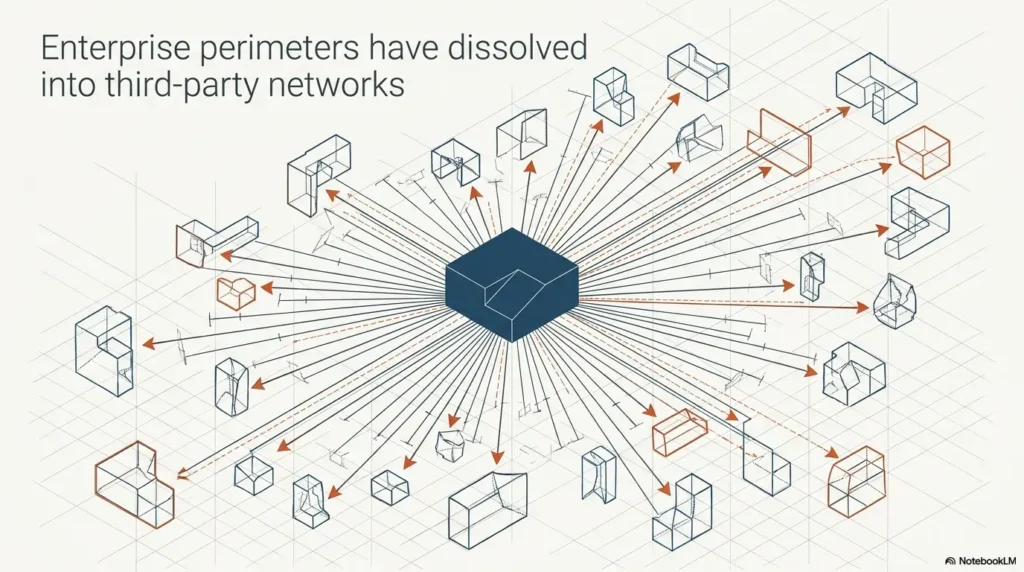
Enterprise buyers usually prefer Type 2 because a service relationship is not a one-day event. Access changes. Code ships. Employees leave. Backups fail. Vendors add subprocessors. Security controls earn their keep through repetition.
What operating effectiveness means in practice
An auditor may inspect samples or other evidence related to controls performed during the period. Depending on the control and test approach, this could include tickets, approvals, system configurations, review records, logs, reports, training records, incident documentation, or evidence that exceptions were investigated.
The AICPA’s illustrative Type 2 report reflects a service auditor’s examination under the applicable attestation reporting framework and gives readers a useful model for understanding how the opinion, system description, control testing, and results fit together.
An exception is a clue, not an automatic rejection
A buyer may find that one access review was completed late, one terminated account remained active beyond the target window, or a sample lacked retained approval evidence. The next step is not to slam the report shut with courtroom drama.
Ask how often the issue occurred, what systems were affected, whether unauthorized activity resulted, why the control failed, how quickly the vendor detected it, what remediation occurred, and whether the weakness appears elsewhere.
| Exception pattern | Buyer interpretation | Useful follow-up |
|---|---|---|
| One isolated documentation gap | May be administrative rather than a control failure | Confirm the activity occurred and evidence retention was corrected |
| Repeated late reviews | May indicate weak ownership or staffing | Request remediation dates, overdue metrics, and recent samples |
| Failure involving privileged access | Potentially higher security impact | Confirm affected accounts, monitoring, investigation, and restrictions |
| Exception paired with a security incident | Requires deeper review | Coordinate legal, privacy, incident-response, and contract analysis |
| Multiple related control failures | May show a broader process weakness | Ask whether the auditor’s opinion was modified and review management’s plan |
A clean opinion does not mean perfect security
SOC 2 is an examination against defined criteria and the service organization’s system description. It is not a universal search for every vulnerability, an adversarial penetration test, or proof that every architectural choice is sound.
Buyers can pair report review with a risk-based questionnaire, architecture discussion, incident-history review, vulnerability-management evidence, privacy documentation, and testing appropriate to the service. A practical vendor security questionnaire can help organize those questions without asking the same generic 300 items of every vendor.
The Buyer’s Decision Tree: When Each Report Is Enough
The report requirement should follow vendor risk, not prestige, company size, or the volume of enthusiasm in the sales presentation. A tiny integration can create severe exposure if it receives privileged production access. A large contract may be comparatively limited if it involves public data and no operational dependency.
Start with four risk signals
- Data: What information will the vendor store, process, transmit, or view?
- Access: Can the vendor reach production, source code, cloud consoles, customer accounts, or administrative functions?
- Dependency: What stops working if the vendor fails?
- Impact: Could failure create legal, financial, privacy, safety, customer, or reputational consequences?
A practical Type 1 vs Type 2 requirement table
| Vendor tier | Typical situation | Reasonable evidence position | Possible conditions |
|---|---|---|---|
| Good: Low risk | Public data, no production access, easily replaced service | Type 1 may be acceptable; alternative evidence may sometimes suffice under policy | Data minimization, no privileged access, annual review |
| Better: Moderate risk | Internal business data, workflow dependency, limited integrations | Prefer Type 2; Type 1 may be a temporary exception | Dated Type 2 commitment, bridge evidence, contract safeguards |
| Best: High risk | Regulated data, critical operations, production or privileged access | Require a current Type 2 covering the relevant service | Incident notice, audit rights, resilience evidence, recurring review |
Illustrative example: The small vendor with the large blast radius
Hypothetical buyer-review scenario: a 25-person SaaS provider offers a support integration. The example illustrates a decision process, not a recorded customer approval or a recommended acceptance outcome.
During technical review, the buyer learns that the integration can read customer tickets, retrieve order details, and trigger account actions through a privileged API token. An outage would slow customer service, while misuse could expose personal data or alter account records.
The vendor has a recent Type 1 report and expects Type 2 in six months. Rather than judging the company by headcount or contract value, the buyer focuses on access and impact. The pilot proceeds only with restricted permissions, token monitoring, a limited customer cohort, incident-notification terms, and a written Type 2 deadline.
The lesson is simple: vendor size was small; the blast radius was not.
The SOC 2 Buyer Decision Flow
1. Classify risk
Score data, access, dependency, and impact.
2. Match the report
Use Type 1 temporarily or require Type 2.
3. Test relevance
Check dates, scope, categories, and system changes.
4. Record conditions
Set safeguards, evidence needs, owner, and expiry date.
Decision shortcut
An organization may choose Type 1 for a limited exposure and request Type 2 where evidence of recurring operation is important. That is a risk-policy decision, not a universal acceptance rule created by the report label. Record your rationale, safeguards, owner and review date.
Report Freshness: The Date Problem Behind the Label
A Type 2 report is not automatically current merely because it says “Type 2” on the cover. Buyers need to separate at least three dates: the beginning of the examination period, the end of that period, and the report issue date.
Coverage period and issue date answer different questions
The coverage period tells you when controls were tested for operating effectiveness. The issue date tells you when the auditor released the report. Neither confirms that nothing important changed afterward.
A report might cover January through September and be issued in November. If the buyer reviews it the following June, a meaningful gap may exist between tested operations and the current service.
What a bridge letter can and cannot do
A bridge letter, sometimes called a gap letter, is generally a management communication intended to address the period after a SOC report’s coverage ends. It may state whether management is aware of material changes that would affect the report’s conclusions or describe relevant developments.
It is not a new Type 2 examination and does not extend the auditor’s tested period. K Financial’s sample is on service-organization letterhead and signed by management; it expressly does not replace reading the current SOC 2 report. Treat it as that kind of management update, not a new auditor opinion.
Changes that can age a report quickly
- A major cloud migration or infrastructure redesign
- An acquisition, merger, or divestiture
- A newly launched product or materially changed architecture
- A change in identity, logging, encryption, or incident-response systems
- Rapid employee growth, layoffs, or security-team turnover
- A significant incident, prolonged outage, or control failure
- A new critical subprocessor or outsourced operational function
An older Type 2 report can still be useful, but buyers should request current evidence when the system has changed materially. In some cases, a recent Type 1 report covering a redesigned system may be more relevant than an older Type 2 report covering the retired one. It still provides less evidence about operating effectiveness, so the gap should be managed rather than ignored.
Freshness takeaway
Ask two separate questions: “How old is the tested period?” and “How much has the service changed since then?” A current logo cannot freshen old evidence.
What Buyers Should Inspect Beyond Type 1 or Type 2
Once the report type and dates are clear, the deeper review begins. A Type 2 report covering the wrong legal entity or an irrelevant product may provide less assurance than a narrower report that precisely matches the service being purchased.
Confirm scope before reading control results
- Legal entity: Is the contracting vendor the organization named in the report?
- Products and services: Is the purchased application or platform included?
- Infrastructure: Are the relevant cloud environments, data stores, networks, and operational tools described?
- Locations and teams: Are important support, engineering, or processing locations within scope?
- Period: Does the report cover a useful and sufficiently recent timeframe?
- Boundaries: What is explicitly excluded?
Match the Trust Services Categories to the risk
SOC 2 uses criteria related to Security, Availability, Processing Integrity, Confidentiality, and Privacy. Security is commonly included, while the relevance of the other categories depends on the service, commitments, and system requirements. The AICPA’s published criteria explain the categories used to evaluate controls over information and systems.
A buyer relying on a payment-calculation service may care deeply about processing integrity. A health-data platform may raise confidentiality and privacy concerns. A mission-critical communications service may require close attention to availability.
Read the opinion, exceptions, and customer responsibilities
Start with the auditor’s opinion. Determine whether it is unmodified or modified and understand the reason for any qualification or limitation.
Next, examine the testing results and exceptions. Then find the complementary user entity controls, often shortened to CUECs. These are controls the service organization assumes customers will operate, such as managing authorized users, configuring security settings, reviewing reports, or promptly notifying the vendor of relevant changes.
A buyer that ignores CUECs may approve a vendor while silently accepting duties no internal team owns. The vendor’s controls and the customer’s controls are two hands on the same steering wheel.
Check subprocessors and subservice organizations
Many SaaS companies depend on hosting providers, support platforms, identity services, payment processors, data vendors, and managed service providers. The report should describe how relevant subservice organizations are treated.
Under an inclusive approach, certain subservice-organization controls may be included in the report. Under a carve-out approach, those controls are excluded, although the vendor may describe the services and complementary controls expected from the subservice organization.
A carve-out is not automatically unacceptable. It means the buyer must determine whether additional assurance is needed, particularly when the excluded provider performs a critical function.
Show me the nerdy details
A useful SOC 2 review distinguishes four layers of evidence: the auditor’s opinion, management’s system description and assertion, the controls and tests, and the responsibilities or dependencies that sit outside the vendor’s direct control.
The opinion tells you the auditor’s conclusion within the engagement scope. The system description tells you what environment and commitments management says the report covers. The testing section shows how selected controls were examined and whether exceptions appeared. CUECs and subservice-organization disclosures reveal where assurance depends on customers or other providers.
Reviewers get into trouble when they read only one layer. A clean opinion cannot repair an irrelevant scope. A large control table cannot cover an excluded product. A strong vendor control cannot compensate for a customer responsibility nobody performs.
| Review item | Question to answer | Evidence to record |
|---|---|---|
| Entity | Does the report name the contracting organization? | Exact legal entity and relationship to affiliates |
| Service scope | Is the purchased product included? | Product, modules, environments, and exclusions |
| Criteria | Do the categories match the risk? | Security plus any relevant additional categories |
| Opinion | Was the opinion modified? | Opinion type and reason |
| Exceptions | What failed, how often, and with what impact? | Frequency, cause, remediation, residual risk |
| CUECs | What must the buyer operate? | Named owner and implementation status |
| Subservice organizations | Which important providers are excluded? | Carve-out or inclusive treatment and added evidence |
| Changes | Has the current system materially changed? | Bridge letter, change summary, or updated report |
SOC 2 should also sit beside, not on top of, other security evidence. A buyer comparing assurance with technical testing may find this guide to reading a penetration test report useful for separating exploit findings, scope limitations, severity, and remediation status.
Mistakes That Turn SOC 2 Into Security Theater
Mistake 1: Accepting the badge instead of the report
A logo reveals almost nothing about scope, dates, report type, categories, exceptions, or system changes. Ask for the report through an appropriate confidential review process and confirm who is authorized to access it.
Mistake 2: Treating Type 1 as proof of months of operation
Type 1 can demonstrate that controls were designed and implemented as of a specified date. It should not be described as evidence that recurring controls consistently operated over an earlier or later period.
Mistake 3: Rejecting every Type 1 vendor automatically
A universal Type 2 requirement may slow low-risk purchases without improving security proportionately. It can also encourage reviewers to ignore meaningful safeguards merely because a preferred document is unavailable.
Use risk tiers. A restricted pilot involving synthetic data should not necessarily face the same evidence threshold as a production processor holding customer financial records.
Mistake 4: Reading the cover and skipping the uncomfortable pages
The pages describing scope, exclusions, exceptions, subprocessors, CUECs, and material changes often contain the decision-grade information. A reviewer who stops at “unmodified opinion” may miss that the purchased module was launched after the examination period.
- Do not assume every product sold by the vendor is covered.
- Do not assume every subprocessor was examined.
- Do not assume every control passed without an exception.
- Do not assume the buyer has implemented all required CUECs.
- Do not assume SOC 2 replaces technical testing or contract review.
Do not do this
Approve a high-risk vendor because a sales slide says “SOC 2 certified.” Request the actual report, use precise examination language, and document why the evidence is sufficient for the service and risk tier.
Procurement Language That Prevents Last-Minute Confusion
Many SOC 2 disputes appear late because the requirement was never defined early. Sales hears “SOC 2,” the vendor provides Type 1, and the buyer’s security team expected a recent Type 2 covering a full operational period.
Clear intake forms, request-for-proposal language, security addenda, and vendor policies can prevent this expensive little opera.
Define the evidence before the questionnaire begins
- State whether Type 2 is mandatory for the vendor tier.
- Define the maximum acceptable age or uncovered period.
- Require the report to cover the contracted service and relevant systems.
- State which Trust Services Categories are expected, when applicable.
- Require disclosure of material exceptions and relevant security incidents.
- Identify acceptable interim evidence when Type 1 is temporarily approved.
- Assign an expiration date and owner to every exception.
Contract terms to consider
The exact wording should be reviewed by qualified counsel. Depending on risk, buyers may consider provisions addressing report delivery, incident notification, material control changes, subprocessor changes, remediation, audit cooperation, business continuity, data return or deletion, and termination rights.
| Requirement | Weak wording | Clearer operational wording |
|---|---|---|
| Report type | Vendor must be SOC 2 compliant | Vendor must provide a current SOC 2 Type 2 report covering the contracted service |
| Freshness | Vendor will provide its latest report | Report and bridge evidence must address the buyer’s permitted uncovered period |
| Interim Type 1 | Type 1 is acceptable | Type 1 is accepted through a stated date subject to named safeguards and Type 2 delivery |
| Exceptions | Vendor will disclose audit issues | Vendor will identify material exceptions relevant to the service and provide remediation status |
| Scope changes | Vendor will maintain security | Vendor will notify the buyer of material changes affecting report scope or control operation |
Free review, paid tools, or professional help?
A small company reviewing a low-risk vendor may be able to use a focused checklist and document its decision internally. A growing SaaS business may benefit from workflow software that tracks questionnaires, evidence, report dates, exceptions, and renewals.
Professional help may be worth considering when the service touches regulated data, customer contractual commitments, financial reporting, critical infrastructure, complex subprocessors, or high-impact operations. The value is not merely reading the PDF. It is connecting the report to architecture, law, contracts, and operational reality.
| Approach | Best fit | What it can cover | Main limitation |
|---|---|---|---|
| Free internal checklist | Low volume, low-risk vendors | Basic scope, dates, opinion, exceptions, and CUECs | Depends heavily on reviewer skill and follow-through |
| Vendor-risk software | Growing vendor inventory | Workflow, evidence collection, reminders, scoring, and reporting | Automation cannot decide whether evidence is truly relevant |
| Specialist review | Complex or high-risk engagements | Assurance interpretation, technical context, contract alignment | Higher cost and still requires internal ownership |
A broader security testing strategy can help teams decide how SOC reports, penetration tests, vulnerability scans, architecture reviews, and ongoing monitoring should complement rather than duplicate one another.
Contract takeaway
When Type 1 is accepted temporarily, document the compensating controls, Type 2 delivery date, review owner, and expiration date. Temporary exceptions without clocks have a habit of becoming permanent furniture.
FAQ: SOC 2 Type 1 vs Type 2
Is SOC 2 Type 2 always better than Type 1?
Type 2 generally provides stronger evidence about recurring control operation because it covers a defined period. “Better” still depends on relevance. An old Type 2 report covering a retired product may be less useful than a recent report covering the system actually being purchased.
Can an enterprise buyer accept a Type 1 report?
Yes, when the buyer’s policy allows it and the decision is proportionate to risk. Acceptance is easier to defend when access is limited, data sensitivity is low, consequences are reversible, compensating safeguards exist, and a dated Type 2 commitment is documented.
How long must controls operate before a company obtains Type 2?
There is no single buyer rule that fits every engagement. The examination covers a stated period selected for the engagement, while buyers may set their own minimum coverage expectations. Vendors should discuss timing, evidence availability, control frequency, and customer expectations with their CPA firm rather than promising a date based on a generic internet timeline.
Does Type 2 mean every control passed without exceptions?
No. A Type 2 report may contain exceptions. Buyers should assess their frequency, severity, cause, affected systems, remediation, and relationship to other findings. The auditor’s opinion and management’s response provide important context.
Can a bridge letter extend a Type 2 audit period?
No. A bridge letter may provide management’s update about a subsequent gap, but it does not extend the auditor’s testing or transform the uncovered months into an examined period.
Should buyers reject reports that carve out subprocessors?
Not automatically. Buyers should identify what the carved-out organization does, how critical it is, what controls the vendor uses to oversee it, and whether separate assurance or contract evidence is needed.
Is the Security category alone sufficient for most SaaS vendors?
Security may address the central risk for many services, but additional categories can matter. Availability may be important for operationally critical systems, processing integrity for transaction or calculation services, and confidentiality or privacy for sensitive information. Match the categories to the service rather than collecting labels.
Can SOC 2 replace a penetration test or security questionnaire?
No. These tools answer different questions. SOC 2 examines controls within a defined scope and criteria. A penetration test searches for exploitable weaknesses within its technical scope. A questionnaire can address architecture, policies, current practices, and risks not fully covered by the report.
Is a company “SOC 2 certified”?
SOC 2 is more accurately described as an examination resulting in a report, rather than a general certification that covers everything the company does. Precise language helps buyers understand what evidence exists and prevents marketing shorthand from becoming a procurement requirement.
The AICPA describes SOC as a suite of CPA service offerings connected to controls at service organizations and distinguishes SOC 2 from SOC 1, which is intended for controls relevant to user entities’ internal control over financial reporting.
Your 15-Minute Next Step: Write an Acceptance Rule
Open your vendor-risk policy, intake form, or procurement checklist. Choose one common vendor category and answer four questions: What data does it receive? What access does it obtain? What breaks if it fails? What consequence would matter most?
Then write a one-sentence evidence rule. Do not attempt to perfect the entire third-party risk program before lunch. One clear sentence is enough to turn a vague preference into an operational decision.
Copy-ready acceptance rule
“High-risk vendors must provide a current SOC 2 Type 2 report covering the contracted service and relevant systems; Type 1 may be accepted only as a time-limited exception with documented safeguards, an accountable owner, and a dated Type 2 commitment.”
For moderate-risk vendors, adapt the same sentence rather than inventing a new process. Define the allowed report age, acceptable bridge evidence, required scope, and exception expiry. For low-risk vendors, document when lighter evidence is proportionate.
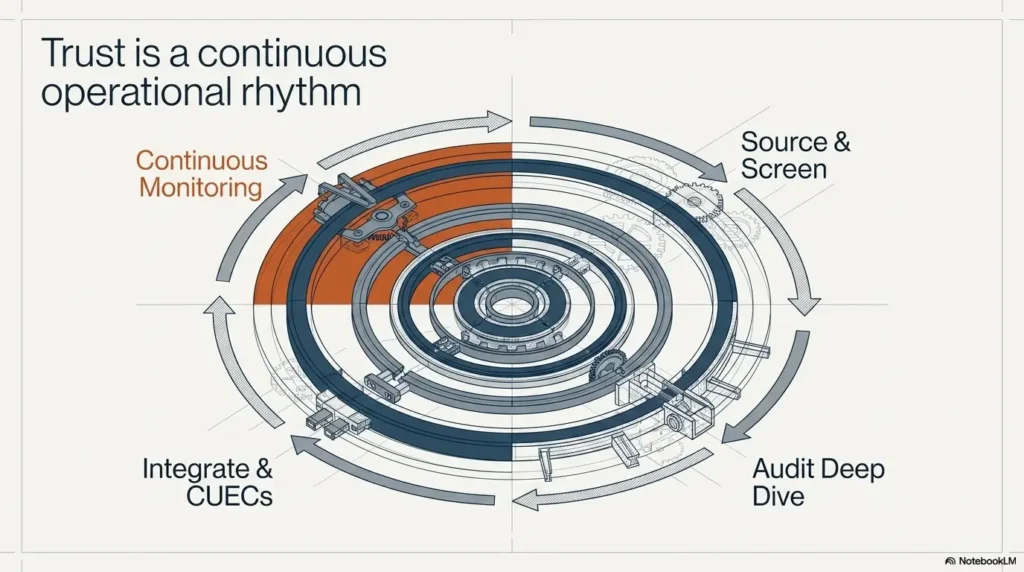
The final decision is not Type 1 versus Type 2 in the abstract. It is whether the available evidence is recent, relevant, and strong enough for the risk you are about to accept. Once that question becomes standard, SOC 2 stops being a ceremonial PDF and starts doing useful work.
Last reviewed: 2026-10-16
Technical guidance updated: 2026-10-13. Repaired table-of-contents navigation for report types, buyer risk tiers, freshness, scope, and acceptance conditions.
Read the conclusion before treating the comparison as a pass
The comparison table describes what each examination addresses. It does not mean the auditor reached a favorable conclusion. Read the actual opinion and its basis; a qualification, adverse opinion, or disclaimer requires interpretation rather than a “Type 2 = approved” shortcut.
Complete an acceptance record with the report period, relevant system, opinion, unresolved exceptions, CUEC owners, and next review date. If a pilot depends on restricted permissions or synthetic data, identify who will verify those safeguards before access is granted and what event ends the exception. The AICPA SOC resources provide the official reporting context; the acceptance workflow here is an editorial aid, not an auditor opinion.
Editorial review: 16 October 2026. Examples are illustrative; this review does not represent an audit or live control test.
SOC 2 report acceptance record
Use this when: you are a buyer deciding whether a particular report addresses its evidence requirement. Copy these fields into your notes and replace each prompt with a dated response. Keep assumptions and unresolved questions visible.
| Field | What to record | Your evidence / owner / next check |
|---|---|---|
| Required service | Match the report entity, system and criteria to the purchased service. | To complete |
| Report timing | Record the report type, relevant date or period and coverage gaps. | To complete |
| Conclusion and detail | Review the opinion, exceptions and relevant control testing. | To complete |
| Buyer obligations | Identify complementary user controls, subservice treatment and follow-up needs. | To complete |
Next action: Decide whether the actual report meets the scoped acceptance rule before relying on its label. Mark the relevant row confirmed, provisional or unresolved. Keep the supporting record, responsible person and next check beside it so another reader can continue the work without treating an assumption as a result.
This is an editorial working aid. Complete it with your own scope, source records and accountable reviewers. Filling the table does not by itself establish coverage, compliance or acceptance.
Worksheet change record — October 20, 2026
Added this soc 2 report acceptance record with four article-specific fields and an evidence-based next action. Existing source notes retain their own review dates. This addition is not a fresh verification of every statement or a newly executed test.